109 |
P a g e
SELF-SERVICE KIOSK FOR TESTING SUNGLASSES
Waffa Chaudhary
1, Upasana Sharma
2, Anjana Bhardwaj
3123
Electronics & Communication Department, A.B.E.S. Engineering College, Ghaziabad (India)
ABSTRACT
Sunglasses users may only be assured on their ultraviolet protection by purchasing certified products, however
they are not able to check if sunglasses are still ultraviolet (UV) protected as they age, unless they resort
themselves to a professional who is qualified for using a spectrophotometer and is acknowledged on the
standards for providing a report for the user. Current literature establishes safe limits on the exposure of the eyes
relatively to the ultraviolet radiation exposure for the UVA and UVB ranges (280 nm – 400 nm). The UV
protection is category dependent. Sunglasses are categorized from 0 to 4 and the categories are determined by
the lenses transmission’s percentage on the visible range (380 nm – 780 nm).
Methods: In order to overcome inaccessibility of such measurements on sunglasses, a prototype for testing
ultraviolet protection on sunglasses, according to Brazilian Standards, has been developed for amateur use. The
system consists of assembling UVA and UVB light sources and two UV responsive photodiode sensors, with
Erythema action response for measuring UV protection; for categories measurements, combination of white light
and LEDs were used for the visible range, as well as a light sensor having spectral response similar to the
human eye. Electronics has been developed for controlling the measurements and software has been
implemented for providing the report as well as for the user’s interface.
Results: All the system was embedded as a self-service touch screen kiosk and provides transmittance
measurements that are within the deviation limit required by NBR15111, i.e., 0.25%. Measurements were
performed in over 45 sunglasses and compared to CARY 5000 – VARIAN spectrophotometer and present a good
correlation for the measurements of transmittance in the visible spectral range (r2 = 0.9999) and in the
ultraviolet range (r2 = 0.9997).
Conclusions: The prototype identifies the UV protection, for non-corrective sunglasses, according to category of
the lens and is available for the public. In addition to educating the population about the importance of wearing
protected sunglasses, the prototype has also allowed the public to have access to information about the quality
of protection of their own sunglasses in an easy and free testing method.
I. LITERATURE REVIEW
Sunglasses are world widely used, whether for glamour, visual comfort and particularly for ocular protection, for
those who are aware that excessive ultraviolet radiation may harm the eye if lenses are not properly protected [6,7].
Global standards specify mechanical and optical for sunglasses and sun glare filters of nonprescription lenses,
110 |
P a g e
measurements that are within the deviation limit of 0.25%.Transmittance measures include ultraviolet radiation (UVR) for an effective protection test of spectacles against
eye diseases [6,7] infrared radiation, and traffic signal light radiation, so that minimum thresholds required for
traffic signs visibility and visible radiation can be established. These measures ensure the minimum safety
requirements to the population, indicating excessively dark lenses, which can limit the ability to identify objects in
shadows while driving, extremely colored lenses, which can affect the detection and recognition of colors, and
filter protection against harmful UV radiation.
The American Standard [8] and British and European Standard [9] require UV protection on the 280 nm – 380 nm
range. Brazilian Standard [10] and The Australian/New Zealand Standard [11] have an extended UVA protection,
thus the wavelength range for safety is from 280 nm – 400 nm.
It is still controversial in literature the harms of UV radiation for each component of the ocular media. The corneal
epithelium absorbs UV-A and UV-B radiation, avoiding inner eye components from extreme radiation, but severe
exposure to UV radiation may induce corneal changes [1,2]. Yet, a number of ocular diseases in the internal
structures of the eye are related to UV radiation exposure, such as cataract [3]. Sunglasses can attenuate ocular
exposure, but unprotected sunglasses and its incorrect use, may interfere on this attenuation [4]. Sunglasses can
increase UV exposure of the crystalline lens and corneal limbus by disabling the eyes’ natural mechanisms of lid
closure and pupil constriction [5].
II.INTRODUCTION
Measurements of the UVA and UVB protection for sunglasses are categories of sun-glasses reliant. Categories of
sunglasses are labelled based on the percentage of visible light transmitted through the spectacles. Visible light
transmittance is proportionally to the response of the human eye for the different wavelengths within this range.
Fashion spectacles are categorized by the amount of visible light – 380 nm 780 nm - allowed to pass through the
lens. Category rating, ranging from 0 - 4, is given to deter-mine how light or dark sunglasses lenses are, the higher
the number, the darker the lens colour. The labelling requirements for sunglasses are based on the transmittance
111 |
P a g e
Table 1 Transmittance for sun glare filters for general use of NBR15111(2013) [10]Requirements
Ultraviolet spectral range Visible spectral range
Filter
Maximum value of
spectral
Maximum value of
solar
Range of luminous
transmittance
categor
y transmittance τF(λ)
UVA transmittance
τSUVA(λ) (380-780 nm) τV
280-315 nm > 315-400 nm From over % To %
0 80.0 100
1 τV 43.0 80.0
2 0.1 - τV 18.0 43.0
3
0.5 - τV
8.0 18.0
4 3.0 8.0
III. PROPOSED METHOD
As an interface software routine, the user places the sunglasses in an appropriate compartment of the kiosk and the
category of the sunglasses is measured in one of the lenses as well as the UV protection on the other lens, as shown
on the chart in Figure 2. The data is stored and the user is asked to replace the sunglasses in such a way that the
category and UV protection measurements are performed for a second time, but now on the opposite lenses than
previously done, and finally the report provided to the user is based on both measurements data for each pair of
lenses.
For the category measurements, we have used as illuminating sources a combination of LEDs, with
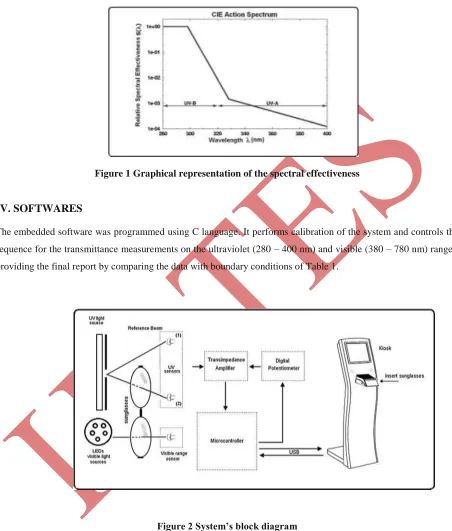
band peaks at the 405 nm; 450 nm; 550 nm; 565 nm; 610 nm and 680 nm and sensors. For the UV
measurements we have used two sensors and lamp as the illuminating source; One acts as the
112 |
P a g e
Figure 1 Graphical representation of the spectral effectiveness
IV. SOFTWARES
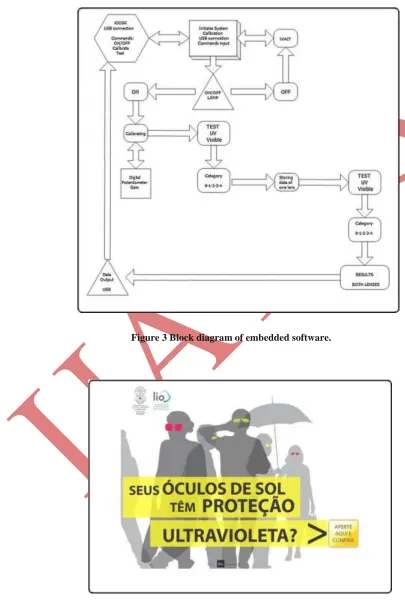
The embedded software was programmed using C language. It performs calibration of the system and controls the
sequence for the transmittance measurements on the ultraviolet (280 – 400 nm) and visible (380 – 780 nm) ranges,
providing the final report by comparing the data with boundary conditions of Table 1.
Figure 2 System’s block diagram
The software also establishes a communication with the microcontroller, sending commands to turn ON and turn
OFF the lamp; calibrating the system; and performing the measurements. The block diagram of the embedded
113 |
P a g e
114 |
P a g e
self-testing
The sequenced interface screens guide the user for testing the sunglasses, as well as provide them information about
each item to be tested. It also states previously to the tests that the machine is for sunglasses testing purposes only.
V. RESULTS
The outcome of this system is a self-service sunglasses testing kiosk, which is presented in Figure 5. It shows the
prototype - kiosk - and in detail, the slot to place the sunglasses for testing.
To test the system, its repeatability and accuracy, measurements were performed as described below.
Figure 5 Picture of the available system for the public. (a) The self-service sunglasses testing kiosk; (b); inserting sunglasses for testing.
Repeatability
The test consisted of performing repeated measurements of transmittance at different positions and angles within
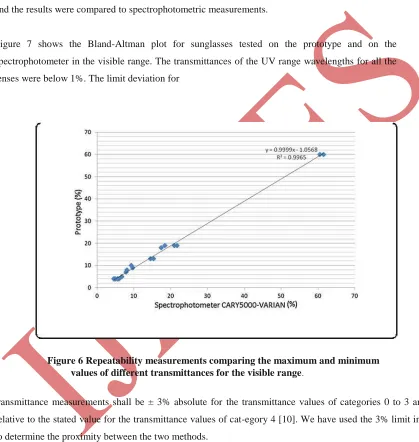
the device, for 10 different sunglasses (05 from ABIÓP-TICA and 05 from the signature companies). Figure 6
shows the results obtained for visible light transmittance, emphasizing the values of maxima and minima obtained
115 |
P a g e
was 3%. For UV transmittance, the sunglasses measures showed practically all 0% UV transmittance, and themaximum difference was 1% from the mean value.
Benchmarking tests
Two tests were performed on each of the 20 lenses from 10 sunglasses in the developed equipment
and the results were compared to spectrophotometric measurements.
Figure 7 shows the Bland-Altman plot for sunglasses tested on the prototype and on the
spectrophotometer in the visible range. The transmittances of the UV range wavelengths for all the
lenses were below 1%. The limit deviation for
Figure 6 Repeatability measurements comparing the maximum and minimum values of different transmittances for the visible range.
transmittance measurements shall be ± 3% absolute for the transmittance values of categories 0 to 3 and ± 30%
relative to the stated value for the transmittance values of cat-egory 4 [10]. We have used the 3% limit in Figure 7
to determine the proximity between the two methods.
Furthermore, 45 additional sunglasses (35 from ABIÓPTICA and 10 from signature companies) - 90 lenses - have
been tested and results show that there is a good correlation for the measurements of transmittance in the visible
116 |
P a g e
Figure 7 Bland-Altman plot measurements of sunglasses tested on the prototype and on the spectrophotometer (visible range).
VI. CONCLUSIONS
A prototype has been built and it identifies the UV protection, for non-corrective sunglasses according to the
category of the lens, performing measurements of average light transmittance in the visible spectral region - 380
nm – 780 nm - and ultraviolet range - 280 – 400 nm.
REFERENCES
[1] Doughty MJ, Cullen AP: Long-term effects of a single dose of ultraviolet-b on albino rabbit cornea.1. Invivo
analyses. Photochem Photobiol 1989, 49(2):185–196.
[2] Ringvold A: Corneal epithelium and UV-protection of the eye. Acta Ophthalmol Scand 1998, 76(2):149–153.
[3] Norval M, Cullen AP, de Gruijl FR, Longstreth J, Takizawa Y, Lucas RM, Noonan FP, van der Leun JC: The
117 |
P a g e
Photochem Photobiol Sci 2007, 6(3):232–251.[4] Rosenthal FS, Bakalian AE, Lou C, Taylor HR: The effect of sunglasses on ocular exposure to
ultraviolet-radiation. Am J Public Health 1988, 78(1):72–74.
[5] Sliney DH: Intraocular and Crystalline Lens Protection From Ultraviolet Damage. Eye & Contact
Lens-Science and Clinical Practice 2011, 37(4):250–258.
[6] ICNIRP: Guidelines on limits of exposure to ultraviolet radiation of wavelengths between 180 nm and 400 nm
(incoherent optical radiation). Health Phys 2004, 87(2):171–186.
[7] Sliney DH: Ultraviolet radiation exposure criteria. Radiat Prot Dosim 2000, 91(1–3):213–222.
[8] (ANSI): ANSI Z80.3 American National Standard Requirements for Non-Prescription Sunglasses and Fashion
Eyewear. New York: ANSI; 2010:33.
[9] (BSI): BS EN 1836:2005 Personal eye protection. Sunglasses and sunglare filters for general use and filters for
direct observation of the sun. Chiswick, UK: BSI; 2005:46.
[10]ABNT: NBR15111 Proteção pessoal dos olhos - Óculos de sol e filtros de proteção contra raios solares para
uso geral. São Paulo: ABNT; 2013.
[11]AS/NZS: Sunglasses and fashion spectacle. In Volume 1067. Sydney, Australia e Wellington, New Zealand:
Standards Australia e Standards New Zealand; 2003:50.
[12]Joint ISO/CIE Standard ISO 11664-2:2007 (E)/CIE S 014-2/E:2006, CIE Colorimetry - Part 2: Standard
![Table 1 Transmittance for sun glare filters for general use of NBR15111(2013) [10]](https://thumb-us.123doks.com/thumbv2/123dok_us/9164723.1454951/3.612.76.521.124.608/table-transmittance-sun-glare-filters-general-use-nbr.webp)