The Effect of Ventilation Tubes on Language Development in Infants
With Otitis Media With Effusion: A Randomized Trial
Maroeska M. Rovers, MSc*; Huub Straatman, MSc‡; Koen Ingels, PhD, MD*; Gert-Jan van der Wilt, PhD§; Paul van den Broek, PhD, MD*; and Gerhard A. Zielhuis, PhD‡
ABSTRACT. Objective. To study the effectiveness of ventilation tubes on the language development in infants with persistent otitis media with effusion (OME). All existing studies addressed children 3 years of age or older. Currently, OME is detected and treated with ven-tilation tubes at a younger age. Because of the critical relationship between age, hearing, and language devel-opment, we conducted a study of the effects of ventila-tion tubes on language development in infants 1 to 2 years old with persistent OME.
Design. A multicenter, randomized, controlled trial (embedded in a cohort) with 2 treatment arms: 1) treat-ment with ventilation tubes (VT group;nⴝ93); or 2) with a period of watchful waiting (WW group;nⴝ94). Hear-ing loss and expressive and comprehensive language were assessed every 6 months, while tympanometry and otoscopy were performed every 3 months. Other factors with potential influence on language development were also included: adenoidectomy, hospital, attending day care, sex, age at randomization, educational level of the mother, upper respiratory infections, and the native country of the parents and older siblings. The trial was designed to allow for the detection of a mean difference in language development of 3 months or more between children allocated to the VT and WW groups.
Results. No relevant differences were found in ex-pressive or comprehensive language between the 2 groups after adjustment for educational level of the mother, IQ of the child, and differences at baseline.
A principal component analysis showed that in the VT group, the children with frequent complaints improved 1.6 months more in comprehensive language than those with no or some complaints. The children with favorable language stimulation, however, did not improve more than the children with less favorable stimulation. No differences were found for expressive language among the various clusters.
The probability to improve>3 months in comprehen-sive language was .48 (95% confidence interval [CI]: .29 – .68) for children with highly educated mothers versus .09 (95% CI: .02–.30) for children whose mothers had a low educational level. In the WW group, these changes were .30 (95% CI: .14 –.53) and .14 (95% CI: .04 –.35), respec-tively. The probability to improve>4 months in expres-sive language was .52 (95% CI: .32– .71) for children with
highly educated mothers versus .06 (95% CI: .01–.31) for children whose mothers had a low educational level. In the WW group these changes were .42 (95% CI: .23–.64) and .11 (95% CI: .03–.35), respectively. In addition, there were delays in expressive language in both groups com-pared with their age expected values.
The comprehensive language of the children who were effusion-free during the follow-up (nⴝ54) improved 1.5 months (95% CI:ⴚ.2–3.2) more than that of the children who had persistent effusion during the entire follow-up (nⴝ28). No differences were found for expressive lan-guage development.
Disregarding the intervention contrast, improvements in hearing seemed to be related to improvements in language development, especially in verbal comprehen-sion.
Discussion. In this study, we used the Reynell, Schli-chting, and Lexi tests to study the relation between early persistent OME and language development. These tests are directly related to normal language, widely accepted, and validated. It cannot be ruled out that more specific measures such as auditory perception tests would have produced more differences between groups, but the fo-cus was on general language development.
A total of 10 children in the WW group received treat-ment with ventilation tubes during follow-up. A further 11 children dropped out during the trial. A sensitivity analysis with the 10 children who received ventilation tubes did not change the results, and baseline differences were not found between the 11 children who dropped out and those who completed the trial.
Conclusions. In the total group of infants with persis-tent OME, ventilation tubes did not have any incremen-tal effect on language development. Beneficial effect of treatment in individual patients or subgroups of patients can, however, not be excluded. Pediatrics 2000;106(3). URL: http://www.pediatrics.org/cgi/content/full/106/3/
e42;randomized, controlled trial, otitis media with effu-sion, ventilation tubes, language development infants.
ABBREVIATIONS. OME, otits media with effusion; ENT, ear, nose, and throat; VT group, ventilation tube group; WW group, watchful waiting group; SE, standard error; CI, confidence inter-val.
O
titis media with effusion (OME), one of the most common diseases in early childhood, is associated with mild to moderate conductive hearing loss.1,2This hearing loss is presumed to havean adverse effect on language development.2,3 The
aim of the insertion of ventilation tubes is to restore hearing to normal levels and to prevent potential developmental problems.
From the *Departments of Otorhinolaryngology and ‡Epidemiology, Uni-versity Medical Center Saint Radboud, Nijmegen, The Netherlands; and the §Department of Medical Technology Assessment, University Medical Cen-ter Saint Radboud, Nijmegen, The Netherlands.
Received for publication Feb 14, 2000; accepted Apr 27, 2000.
Address correspondence to Maroeska M. Rovers, MSc, University Medical Center St Radboud, Ear, Nose, and Throat Department, Box 9101, 6500 HB Nijmegen, The Netherlands. E-mail: [email protected]
Evidence of an association between OME during very early childhood and (later) language develop-mental problems, however, remains elusive, because of conflicting results from previous studies.2– 4Some
authors found an association between otitis media and language development,4 –17 whereas others did
not.3,18 –30The conflicting findings may be caused by
methodological limitations.3,31–33Some studies failed
to confirm the duration and the severity of OME or did not measure hearing levels. Other studies used a retrospective design, included only a few cases, and/or included only a specific group of children. None of the studies accounted for other factors that might contribute to a child’s language performance, such as the educational level of the mother or other demographic characteristics.3,34
A focus on young children is necessary because the essence and rates of language development in infants are different for infants and preschool children. First, speech and language develop more rapidly during the first 2 years of life than in subsequent years. Second, it has been argued that (intermittent) hear-ing loss because of OME has different effects on early and later language development33 because
one-to-one interaction typically for early childhood con-trasted with communication in noise at later ages.
Adequately designed prospective studies on the effects of OME on development are few in number.33
Currently, OME is detected and treated with venti-lation tubes at a younger age,35so there is need for
well-designed studies among young children. Nonrandomized studies on children younger than 3 years old found mixed or contradictory results. Wright et al20 did not find an association between
OME and speech and language scores in children 2 years old. Friel-Patti and Finitzo9 found effects on
receptive language in 1-year-old children and effects on expressive language in 11⁄2-year-old children;
however, there were no effects during the other pe-riods, ie, between 1 and 2 years old. Vernon-Feagans et al36 and Roberts et al16 found an association
be-tween OME and language development, but their analyses suggested that this association was proba-bly confounded by the environment of the child (eg, educational level of the mother).
The accepted way to deal with such (unknown) confounding is to perform a randomized, controlled trial. Maw et al37recently performed such a trial on
186 children 3 to 4 years old. At 9 months of follow-up, marginally significant differences were found in comprehensive and expressive language between children in the surgery group and children in the watchful waiting group (WW group). However, 18 months after randomization, 85% of the children in the WW group had undergone surgery and the groups no longer differed. So far, no trials have been performed on children younger than 3 years of age. We performed a randomized, controlled trial on the effect of treatment for OME on language devel-opment in infants 16 to 24 months old. Treatment with ventilation tubes was compared with watchful waiting in infants with persistent OME. Language development was tested at 6 and 12 months of fol-low-up.
METHODS Patients
The trial is embedded in a cohort, which includes 30 099 chil-dren born in the Eastern part of The Netherlands between January 1, 1996 and April 1, 1997. These children were invited for routine hearing screening at 9 months old. For the purpose of the trial, those who failed 3 successive tests were referred to 1 of the 13 participating ear, nose, and throat (ENT) outpatient clinics for diagnosis and follow-up (n⫽1081). The parents of infants found to be suffering from persistent (4 – 6 months) bilateral OME (con-firmed by tympanometry and otoscopy) by the ENT surgeon in subsequent observations were invited to enter their child into our randomized, controlled trial (n⫽ 386). Exclusion criteria were Down syndrome, schisis, asthma, cystic fibrosis, and sensorineu-ral hearing loss. The children for whom informed consent was obtained were randomly allocated to 1 of 2 groups: the ventilation tube group (VT group;n⫽93), treatment with ventilation tubes (Bevel Bobbins, Entermed BV, The Netherlands); or the WW group (n⫽94), a period of watchful waiting. The 2 groups were followed for 1 year with language tests within 2 weeks after randomization (before treatment) and at 6 and 12 months after randomization.
Information on prognostic factors, such as educational level of the mother, attending day care, and the number of siblings, was obtained using a questionnaire completed by the parents during the first visit to the ENT clinic.38Information on other clinical symptoms, such as adenoidectomy before randomization, was obtained by means of a questionnaire completed by the ENT surgeon.
We obtained approval from the ethical committees of all 13 participating hospitals.
Methods
A balanced allocation procedure was used to increase the com-parability at baseline. In this trial, 187 children were balanced over 5 prognostic factors: sex, age, season at randomization, educa-tional level of the mother, and hospital.
The Reynell test39 was used to measure comprehensive lan-guage development, while the Schlichting test40was used for the expressive language development. These tests were administered by a speech therapist. Scores were obtained as age-standardized and equivalent age. We also used the Lexi test40for the expressive language development. This test consists of words that appear in normal language; the parents are asked to mark the words that their child speaks spontaneously.
Hearing was assessed with a portable visual reinforcement audiometry set, which was developed especially for this study and has been described in detail elsewhere.41Otoscopy was per-formed by the ENT surgeon. Tympanometry was classified ac-cording to Jerger,42while OME was classified according to the Maastrichts’ Otitis Media With Effusion Study protocol.43
A test for IQ, Bayley developmental scales,44 was included because IQ interacts with language development.
Other factors with potential influence on language develop-ment were also included: adenoidectomy before randomization, hospital, attending day care, sex, age at randomization, educa-tional level of the mother, upper respiratory infections, native country of the parents, and older siblings.
The trial was designed to allow for the detection of a mean difference in language development of 3 months or more between children allocated to the VT and WW groups as measured by the Reynell-test at 12 months of follow-up.
Statistical Analysis
All analyses were performed based on intention to treat. Lan-guage development was expressed as the difference between equivalent age in months and real age in months. Differences in language development at 0, 6, and 12 months, as well as the difference between 12 and 0 months of follow-up between groups, were tested with the Student’sttest for independent groups.
To adjust for potential confounders and to study possible effect modifiers, we performed regression analysis with the following basis model:
M(‚language after 12 months of follow-up) ⫽ 
Potential confounders and/or effect modifiers were: adenoid-ectomy before randomization (yes/no), hearing loss at baseline (dB), IQ of the child at baseline (low/middle/high), day care (yes/no), hospital (1–13), sex (male/female), age at randomization (ⱖ20/⬎20), educational level mother (low/middle/high), season at randomization (winter/spring/summer/autumn), common colds since birth (ⱕ4/⬎4), older siblings (yes/no), and native country of the parents (The Netherlands/other).
The models were built in 2 directions: 1) starting with univar-iate analysis followed by a multivarunivar-iate model with the relevant factors; and 2) starting with a model with all potential confound-ers, plus all possible effect modificonfound-ers, and then deletion of the irrelevant factors.
We also made logistic models to analyze the probability that a child would improve⬎3 months, 4 months, and 170 words on the Reynell, Schlichting, and Lexi tests, respectively. The dichotomi-zation of improvements was based on the P75. The models can be described by:
logit(P)⫽␣⫹1⫻treatment⫹2⫻confounders⫹3⫻treatment
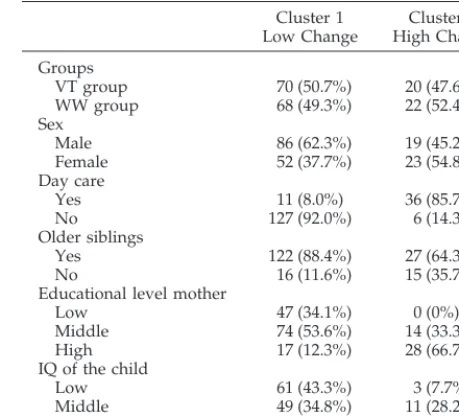
⫻effect modifiers. To reduce the number of variables in subgroup analyses, we performed principal component analysis: a model with 2 compo-nents summarizing several clinical factors (adenoidectomy before randomization, frequent common colds, OME before randomiza-tion, and fever and/or earache as indications of acute otitis me-dia); a model indicating the degree of auditive stimulation (edu-cational level of the mother, older siblings, attending day care, and the IQ of the child). Two clinical components occur (Table 1): 1) children with no or some complaints, and 2) children with fre-quent complaints. Two clusters were also apparent for the predis-posing factors (Table 2): 1) the low-chance children (children with a lower IQ and with a mother with a low educational level, and 2) the high-chance children (children with higher IQ and with a mother with a high educational level).
RESULTS
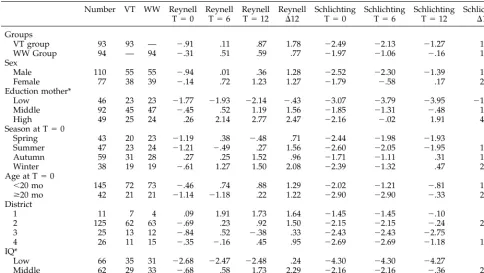
A total of 187 children were randomized: 93 chil-dren to the VT group and 94 to the WW group. Mean language development and patient characteristics are shown in Table 3. The parents of 19 infants with-drew immediately after randomization. During the trial, an additional 11 children dropped out: 8 from the WW group and 3 from the VT group. Further-more, 10 children in the WW group were treated with ventilation tubes.
The number of alternative/additional treatments
were either equally distributed (adenoidectomy) over both groups, or the children in the VT group received slightly more (antibiotics and nose drops), compared with the WW group.
The mean age of the children at randomization was 19.5 months (standard error [SE]: 1.7) in the VT group and 19.4 months (SE: 1.9) in the WW group.
The mean hearing levels (measured over 500, 1000, 2000, and 4000 Hz) in the best ear at randomization were 46.4 dB A (SE: 1.1) in the VT group and 43.4 dB A (SE: 1.2) in the WW group.
At 6 months of follow-up the improvement in hearing levels in the VT group was 10.2 dB versus 4.6 dB in the WW group; at 12 months of follow-up, these values were 13.1 dB and 8.5 dB, respectively.45
At 3, 6, 9, and 12 months of follow-up, 14.6%, 29.3%, 26.9%, and 26.6% of the children in the VT group were diagnosed with bilateral OME, respec-tively. In the WW group, these percentages were 77.2%, 65.9%, 57.3%, and 53.2%, respectively. In the WW group, 25 children (26.6%) were diagnosed as having bilateral OME at all visits, while 10 children (10.7%) only had 1 episode of bilateral OME. In the VT group, 3 children (3%) were diagnosed as having bilateral OME at all visits, while 44 (47.3%) were only diagnosed as having bilateral OME before insertion of the tubes.
Verbal Comprehension
Figure 1 shows the children’s comprehensive lan-guage development. Lanlan-guage development in the VT group increased more than that in the WW group, but there was also a baseline difference. At baseline, the WW group had a language develop-ment that was .3 month (95% confidence interval [CI]: ⫺.3–.95) behind their age score, while the VT group score was .9 month (95% CI: .35–1.5) behind their age score. At 6 and 12 months of follow-up, both group scores were better than the age scores. At 12 months of follow-up, the children in the WW
TABLE 1. Two Clusters Formed by Means of a Principal Component Analysis With Two Components (Explained Variation⫽5%)
Cluster 1 No/Some Complaints
Cluster 2 Frequent Complaints
Groups
VT group 62 (50.0%) 49 (49.1%)
WW group 62 (50.0%) 28 (50.9%)
Sex
Male 69 (55.7%) 35 (63.6%)
Female 55 (44.4%) 20 (36.4%)
Adenoidectomy
Yes 5 (4.0%) 11 (20.0%)
No 119 (96.0%) 44 (80.0%)
Fever
Yes 8 (6.5%) 49 (89.1%)
No 116 (93.6%) 6 (10.9%)
Earache
Yes 31 (25.0%) 55 (100%)
No 93 (75.0%) 0 (0%)
Common colds 3.8 4.7
Hearing level at T⫽0 (dB)
44.6 45.4
TABLE 2. Two Clusters Formed by Means of a Principal Component Analysis With Two Components*
Cluster 1 Low Change
Cluster 2 High Change
Groups
VT group 70 (50.7%) 20 (47.6%)
WW group 68 (49.3%) 22 (52.4%)
Sex
Male 86 (62.3%) 19 (45.2%)
Female 52 (37.7%) 23 (54.8%)
Day care
Yes 11 (8.0%) 36 (85.7%)
No 127 (92.0%) 6 (14.3%)
Older siblings
Yes 122 (88.4%) 27 (64.3%)
No 16 (11.6%) 15 (35.7%)
Educational level mother
Low 47 (34.1%) 0 (0%)
Middle 74 (53.6%) 14 (33.3%)
High 17 (12.3%) 28 (66.7%)
IQ of the child
Low 61 (43.3%) 3 (7.7%)
Middle 49 (34.8%) 11 (28.2%)
High 31 (22.0%) 25 (64.1%)
group had improved .8 month (95% CI: ⫺.1–1.6), while the children in the VT group had improved 1.8 months (95% CI: 1.0 –2.6).
Multivariate analysis showed that the educational level of the mother, IQ of the child, and language development at baseline were confounders. In Table 4, the estimates of this model are shown. After ad-justment for these factors, the children in the VT group improved .7 month (95% CI: ⫺.3–1.7) more than the children in the WW group (P⫽ .18).
In Table 5, the estimates of the logistic model are shown. In this model, the probability to improve⬎3 months in the VT group was .48 (95% CI: .29 –.68) for children with highly educated mothers versus .09 (95% CI: .02–.30) for children whose mothers had a low educational level. In the WW group, these chances were .30 (95% CI: .14 –.53) and .14 (95% CI: .04 –.35), respectively.
Fig 1. Comprehensive language de-velopment (equivalent age⫺real age in months).
TABLE 3. Mean Language Development in Months (Equivalent Age⫺Real Age) and Patient Characteristics Number VT WW Reynell
T⫽0
Reynell T⫽6
Reynell T⫽12
Reynell
⌬12
Schlichting T⫽0
Schlichting T⫽6
Schlichting T⫽12
Schlichting
⌬12 Groups
VT group 93 93 — ⫺.91 .11 .87 1.78 ⫺2.49 ⫺2.13 ⫺1.27 1.35 WW Group 94 — 94 ⫺.31 .51 .59 .77 ⫺1.97 ⫺1.06 ⫺.16 1.88 Sex
Male 110 55 55 ⫺.94 .01 .36 1.28 ⫺2.52 ⫺2.30 ⫺1.39 1.24 Female 77 38 39 ⫺.14 .72 1.23 1.27 ⫺1.79 ⫺.58 .17 2.12 Eduction mother*
Low 46 23 23 ⫺1.77 ⫺1.93 ⫺2.14 ⫺.43 ⫺3.07 ⫺3.79 ⫺3.95 ⫺1.06 Middle 92 45 47 ⫺.45 .52 1.19 1.56 ⫺1.85 ⫺1.31 ⫺.48 1.55 High 49 25 24 .26 2.14 2.77 2.47 ⫺2.16 ⫺.02 1.91 4.02 Season at T⫽0
Spring 43 20 23 ⫺1.19 .38 ⫺.48 .71 ⫺2.44 ⫺1.98 ⫺1.93 .51 Summer 47 23 24 ⫺1.21 ⫺.49 .27 1.56 ⫺2.60 ⫺2.05 ⫺1.95 1.34 Autumn 59 31 28 .27 .25 1.52 .96 ⫺1.71 ⫺1.11 .31 1.85 Winter 38 19 19 ⫺.61 1.27 1.50 2.08 ⫺2.39 ⫺1.32 .47 2.76 Age at T⫽0
⬍20 mo 145 72 73 ⫺.46 .74 .88 1.29 ⫺2.02 ⫺1.21 ⫺.81 1.34
ⱖ20 mo 42 21 21 ⫺1.14 ⫺1.18 .22 1.22 ⫺2.90 ⫺2.90 ⫺.33 2.69 District
1 11 7 4 .09 1.91 1.73 1.64 ⫺1.45 ⫺1.45 ⫺.10 .80 2 125 62 63 ⫺.69 .23 .92 1.50 ⫺2.15 ⫺2.15 ⫺.24 2.14 3 25 13 12 ⫺.84 .52 ⫺.38 .33 ⫺2.43 ⫺2.43 ⫺2.75 .23 4 26 11 15 ⫺.35 ⫺.16 .45 .95 ⫺2.69 ⫺2.69 ⫺1.18 1.32 IQ*
Low 66 35 31 ⫺2.68 ⫺2.47 ⫺2.48 .24 ⫺4.30 ⫺4.30 ⫺4.27 .21 Middle 62 29 33 ⫺.68 .58 1.73 2.29 ⫺2.16 ⫺2.16 ⫺.36 2.18 High 58 28 30 1.81 3.21 3.35 1.42 ⫺.03 ⫺.03 2.53 2.45
* The language scores over the subgroups of the educational level of the mother as well as over the subgroups of the IQ of the child were significant (P⬍.05) for all measurements.
TABLE 4. Final Linear Model With Development of Verbal Comprehension (Reynell) as Dependent Variable at 12 Months’ Follow-Up*
Covariable Estimate SE PValue
Intercept ⫺.19 .67 Treatment effect
Watchful waiting ⫺.71 .53 .18 Ventilation tubes (reference) — — — Language at T⫽0 ⫺.53 .11 .0001 Educational level mother
High .86 .65 .19
Middle (reference) — — — Low ⫺2.10 .65 .002 IQ of the child
High 2.92 .83 .0006 Middle 2.86 .68 .0001 Low (reference) — — —
The principal component analyses with 2 compo-nents showed that in the VT group, the children with frequent complaints (cluster 2; Table 1) improved 1.6 months more than those with no or some complaints (P ⫽ .20). However, the VT group children with favorable language stimulation (cluster 2; Table 2) did not improve more than the children with less favorable stimulation (P ⫽.4).
Expressive Language
Figure 2 shows expressive language development. During the whole follow-up, the 2 groups had scores that were behind their age scores. The overall in-creases in expressive language were 1.9 (95% CI: .65–3.1) and 1.4 (95% CI: .2–2.5) months in the WW and VT groups, respectively.
Again, language development at baseline, educa-tional level of the mother, and IQ were confounders in the multivariate analysis. The estimates of this model are shown in Table 6. After adjustment for the confounding factors, the children in the WW group improved 1 month more than those in the VT group (P⫽ .17).
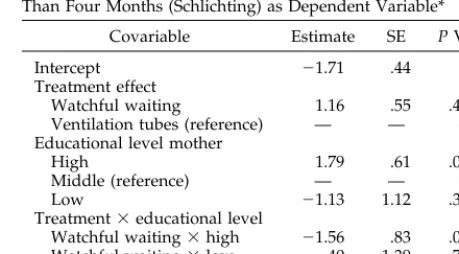
In Table 7, the estimates of the logistic model are shown. In this model, the probability of an improve-ment of 4 months or more in the VT group was .52 (95% CI: .32–.71) for children with highly educated mothers versus .06 (95% CI: .01–.31) for children whose mothers had a lower level of education. In the WW group, these chances were .42 (95% CI: .23–.64) and .11 (95% CI: .03–.35), respectively.
No differences were found between the various clusters (Tables 1 and 2). The children in the WW group improved from 60 to 267 words on the Lexi test, versus an improvement from 55 to 253 words in the VT group (P ⫽ .66). After adjustment for the educational level of the mother, IQ of the child, and language development at baseline, the children in the WW group improved 8 words more than the children in the VT group (P⫽.32). The probability of achieving considerable improvement on the Lexi test (ie,⬎170 words) was equal within the 2 groups and within the various subgroups.
Fig 2. Expressive language develop-ment (equivalent age ⫺ real age in months).
TABLE 5. Logistic Model With an Improvement of More Than Three Months (Reynell) as Dependent Variable*
Covariable Estimate SE PValue
Intercept ⫺.59 .32 Treatment effect
Watchful waiting ⫺.51 .47 .28 Ventilation tubes (reference) — —
Educational level mother
High .50 .53 .34
Middle (reference) — — — Low ⫺1.72 .81 .03 Treatment⫻educational level
Watchful waiting⫻high ⫺.25 .80 .75 Watchful waiting⫻low .97 1.08 .37 Others (reference) — — —
*n⫽173; 86 children in the WW group and 87 in the VT group.
TABLE 6. Final Model With Development of Verbal Expres-sion (Schlichting) as Dependent Variable at 12 Months’ Follow-Up*
Covariable Estimate SE PValue
Intercept ⫺3.55 .98 .0004 Treatment effect
Watchful waiting .96 .71 .18 Ventilation tubes (reference) — — — Language at T⫽0 ⫺.88 .13 .0001 Educational level mother
High 1.80 .86 .04 Middle (reference) — — — Low ⫺2.26 .91 .01 IQ of the child
High 5.21 1.06 .0001 Middle 3.47 .94 .0003 Low (reference) — — —
*n⫽158; 78 children in the WW group and 80 in the VT group.
TABLE 7. Logistic Model With an Improvement of More Than Four Months (Schlichting) as Dependent Variable*
Covariable Estimate SE PValue
Intercept ⫺1.71 .44 Treatment effect
Watchful waiting 1.16 .55 .4 Ventilation tubes (reference) — — — Educational level mother
High 1.79 .61 .0003 Middle (reference) — — — Low ⫺1.13 1.12 .31 Treatment⫻educational level
Watchful waiting⫻high ⫺1.56 .83 .06 Watchful waiting⫻low ⫺.40 1.39 .77 Others (reference) — — —
Maximum Contrast
Spontaneous resolution and recurrence of OME obscured the contrast between the 2 groups to some extent. To test our causal model (hearing loss attrib-utable to OME influences language development), we compared the children with effusion during the entire follow-up (n⫽28) with the children who were effusion-free during follow-up (n⫽54). The compre-hensive language of children who were effusion-free during follow-up improved 1.5 months (95% CI: ⫺.2–3.2) more than that of the children who had persistent effusion. No differences were found for expressive language development.
Hearing Level
As mentioned above, the causal model of this study was that effusion results in hearing loss, which was expected to influence language development. By comparing the language development of the children in the VT group with that of the children in the WW group, we only studied the effect of OME on lan-guage development. To study the effect of hearing levels on language development, we made another linear model with the improvement in hearing at 12 months of follow-up as the independent variable. After correction for the language difference at base-line, the educational level of the mother and the IQ of the child, the children with the greatest improvement in hearing had the best comprehensive language de-velopment:⫽ ⫺.05 (SE: .02;P⫽.01), which means that with every dB improvement in hearing, compre-hensive language development improved .05 month. For expressive language, the -estimate was also ⫺.05 (SE: .03), but this estimate could not be distin-guished from chance (P⫽ .10).
It should be noted that the original intervention contrast was disregarded in this analysis and in the maximum contrast analysis.
DISCUSSION
In this trial, there was no difference in language development between young children who received ventilation tubes and those who underwent watchful waiting. This is dissimilar to the study by Maw et al37
who reported a marginal effect of otitis media trement on language developtrement. This might be at-tributable to some differences between the trials. First, the children in the Bristol trial were older (3 years old vs 19 months old in our study). Second, the children in our trial were selected based on failing the Ewing screening and had no obvious complaints, whereas the children in the trial by Maw et al37were
included because of disruptions in speech, language, learning, or behavior. Third, Maw et al37 did not
adjust for important covariables, such as the educa-tional level of the mother and IQ of the child. In their articles, as Roberts et al and Vernon-Feagans et al16,30,34,36,46suggested that it is important to account
for any factors that might contribute to a child’s language performance and, therefore, might interact with the treatment effect.
Verbal comprehension improved from below stan-dard to about the stanstan-dard level during the trial. The
children in the VT group did not improve substan-tially more than those in the WW group. Verbal expression, however, remained below standard, which is in agreement with the findings of Maw et al.37 It should be noted that it takes a child ⬃5
months to produce the words once he/she compre-hended them.47 The follow-up in our study might
have been too short to demonstrate an effect on verbal expression in the core analyses as well as in analyzing the maximal contrast.
In this study, we used the Reynell, Schlichting, and Lexi tests to study the relation between early persis-tent OME and language development. These tests are directly related to normal language, widely accepted, and validated. It cannot be ruled out that more spe-cific measures (such as auditory perception tests) would have produced more differences between groups, but the focus was on general language de-velopment.
Surprisingly, despite balanced randomization, there was a difference in language development be-tween the VT group and the WW group at baseline. This difference can be explained partly by 19 parents who had given informed consent but withdrew their child immediately after hearing the result of the bal-anced randomization procedure. These children were excluded from the analyses; 15 had originally been randomized to the VT group and 4 to the WW group. Audiometry data on these 19 children showed that the 4 children randomized to the WW waiting group had poorer mean hearing levels than did the remaining children in the WW group. To adjust for this baseline difference, language develop-ment at randomization was taken into account in the analysis.
The educational level of the mother seemed to be an important covariable in our model, despite the balanced allocation procedure over this factor. This can be explained based on the children who were withdrawn immediately after randomization. Al-though the resulting imbalance was small, we had to adjust for this factor in our multivariate model.
Ten children in the WW group received treatment with ventilation tubes during follow-up. An addi-tional 11 children dropped out during the trial pe-riod. If these children differed from the other chil-dren, the intention-to-treat analysis would have led to an underestimation of the effect. However, no differences in language development were found at baseline between the 10 children who received ven-tilation tubes during follow-up and those who re-mained in the WW group, or between the 11 children who dropped out and those who completed the trial. In sensitivity analyses, the 10 children who received ventilation tubes were not analyzed at all or they were analyzed as treated; the results did not change.
CONCLUSION
Ventilation tubes did not have a substantial incre-mental effect on language development in the total group of infants with persistent OME. In agreement with the language model of Roberts and Vernon-Feagans,33hearing improvement seemed to have an
model, hearing loss was the causal variable, but there were also moderating variables, such as the educa-tional level of the mother, parental sensitivity, child IQ, and child temperament. It is possible that the parents of children with persistent OME and hearing loss compensate for negative effects of impaired hearing on language development. In our study, we tried to find such subgroups, but no relevant differ-ences were found. Because this might be attributable to a power problem, a meta-analysis is advocated on datasets of trials that adequately documented the potential modifiers.
ACKNOWLEDGMENTS
This project was funded by the Dutch Investigative Medicine Fund of the National Health Insurance Board.
We thank the parents and the children who took part in this study, the speech therapists, the psychology assistant who tested the children, Joost Engel for his valuable suggestions concerning this article, and Sonja van Oosterhout for trial management and data entry.
We also thank the 22 ENT surgeons1who provided medical management: J. van Leeuwen, Rijnstate Hospital, Arnhem; G. Pluimers, H. Vencker, J. Mol and A. Frima-van Aarem, Eemland Hospital, Amersfoort; J. Engel and S. J. de Vries, Canisius Wil-helmina Hospital, Nijmegen; K. Ingels, University Hospital St Radboud, Nijmegen; M. Nijs, P. Gerritsma, P. van den Ven, Sling-eland Hospital, Doetinchem; S. J. Rietema, Hospital Gelderse Va-lei, Ede; E. Teunissen, G. van de Meerakker, Carolus Liduina Hospital, Hertogenbosch; E. Kwadijk, A. de Visscher, GZG, Her-togenbosch; H. Cats, Willem-Alexander Hospital, HerHer-togenbosch; T. Bruggink, S. Hofstad, Hospital Rivierenland, Tiel; G. Peeters, D. Elprana, St Maartensgasthuis, Venlo; J. Alvarado-van Os, Beatrix Hospital, Winterswijk; and F. Mud, Ch. Sepmeijer, Hospital Het Nieuwe Spittaal, Zutphen.
REFERENCES
1. Bluestone CD. Definitions, terminology, and classification. In: Rosen-feld RM, Bluestone CD, eds. Evidence-Based Otitis Media. Hamilton, Canada: Decker Inc; 1999:85–103
2. Silva P, Chalmers D, Stewart I. Some audiological, psychological, edu-cational and behavioral characteristics of children with bilateral otitis media with effusion: a longitudinal study. J Learn Disabil. 1986;19: 165–169
3. Roberts JE, Burchinal MR, Davis BP, Collier AM, Henderson FW. Otitis media in early childhood and later language.J Speech Hear Res. 1991;34: 1158 –1168
4. Teele DW, Klein JO, Chase C, Menyuk P, Rosner BA, the Greater Boston Otitis Media Study Group. Otitis media in infancy and intellectual ability, school achievement, speech, and language at age 7 years.J Infect Dis. 1990;162:685– 694
5. Friel-Patti S, Finitzo-Hieber T, Conti G, Clinton-Brown K. Language delay in infants associated with middle ear disease and mild, fluctuat-ing hearfluctuat-ing impairment.Pediatr Infect Dis J. 1982;1:104 –109
6. Silva PA, Kirkland C, Simpson A, Stewart I, Williams S. Some devel-opmental and behavioral problems associated with bilateral otitis me-dia with effusion.J Learn Disabil. 1982;15:417– 421
7. Pearce PS, Saunders MA, Creighton DE, Sauve RS. Hearing and verbal-cognitive abilities in high risk preterm infants prone to otitis media with effusion.J Dev Behav Pediatr. 1988;9:346 –352
8. Rach GH, Zielhuis GA, Baarle van PW, Broek van den P. The effect of treatment with ventilating tubes on language development in preschool children with otitis media with effusion. Clin Otolaryngol. 1991;16: 128 –132
9. Friel-Patti S, Finitzo T. Language learning in a prospective study of otitis media with effusion in the first two years of life.J Speech Hear Res. 1990;33:188 –194
10. Abraham SS, Wallace IF, Gravel JS. Early otitis media and phonological development at age 2 years.Laryngoscope. 1996;106:727–732
11. Teele DW, Klein JO, Rosner BA. Otitis media with effusion during the first three years of life and development of speech and language. Pediatrics. 1984;74:282–288
12. Hubbard TW, Paradise JL, McWilliams BJ, Elster BA, Taylor FH.
Con-sequences of unremitting middle-ear disease in early life.N Engl J Med. 1985;312:1529 –1534
13. Feagans L, Sanyal M, Henderson F, Collier A, Appelbaum M. Relation-ship of middle ear disease in early childhood to later narrative and attention skills.J Pediatr Psychol. 1987;12:581–593
14. Wallace IF, McCarton CM, Bernstein RS, Gravel JS, Stapells DR, Ruben RJ. Otitis media, auditory sensitivity, and language outcomes at one year.Laryngoscope. 1988;98:64 –70
15. Knishkowy B, Palti H, Adler B, Tepper D. Effect of otitis media on development: a community-based study.Early Hum Dev. 1991;26:101–111 16. Roberts JE, Burchinal MR, Medley LP, et al. Otitis media, hearing sensitivity, and maternal responsiveness in relation to language during infancy.J Pediatr. 1995;126:481– 489
17. Wallace IF, Gravel JS, Schwartz RG, Ruben RJ. Otitis media, communi-cation style of primary care givers and language skills of 2-year-olds: a preliminary report.J Dev Behav Pediatr. 1996;17:27–35
18. Bishop DVM, Edmudson A. Is otitis media a major cause of specific developmental language disorders?Br J Disord Commun. 1986;21:321–338 19. Roberts JE, Sanyal MA, Burchinal MR, Collier AM, Ramey CT,
Hender-son FW. Otitis media in early childhood and its relationship to later verbal and academic performance.Pediatrics. 1986;78:423– 430 20. Wright PF, Sell SH, McConnell KB, et al. Impact of recurrent otitis
media on middle ear function, hearing, and language.J Pediatr. 1988; 113:581–587
21. Roberts JE, Burchinal MR, Collier AM, Ramey CT, Koch MA, Henderson FW. Otitis media in early childhood and cognitive academic and classroom performance of the school-aged child.Pediatrics. 1989;83:477–485 22. Gravel JS, Wallace IF. Listening and language at 4 years of age: effects
of early otitis media.J Speech Hear Res. 1992;35:588 –595
23. Black MM, Sonnenschein S. Early exposure to otitis media: a prelimi-nary investigation of behavioral outcome.Dev Behav Pediatr. 1993;14: 150 –155
24. Grievink EH, Peters SAF, Bon van WHJ, Schilder AGM. The effect of early bilateral otitis media with effusion on language ability: a prospec-tive cohort study.J Speech Hear Res. 1993;36:1004 –1012
25. Paul R, Lynn TF, Lohr-Flanders M. History of middle ear involvement and speech/language development in late talkers.J Speech Hear Res. 1993;36:1055–1062
26. Schilder AGM, Manen van JG, Zielhuis GA, Grievink EH, Peters SAF, Broek van den P. Long-term effects of otitis media with effusion on language, reading and spelling.Clin Otolaryngol. 1993;18:234 –241 27. Feagans LV, Kipp E, Blood I. The effects of otitis media on the attention
skills of day-care attending toddlers.Dev Psychol. 1994;30:701–708 28. Peters SAF, Grievink EH, Bon van WHJ, Schilder AGM. The effects of
early bilateral otitis media with effusion on educational attainment: a prospective cohort study.J Learn Disabil. 1994;27:111–121
29. Roberts JE, Burchinal MR, Clarke-Klein SM. Otitis media in early child-hood and cognitive, academic and behavior outcomes at 12 years of age. J Pediatr Psychol. 1995;20:645– 660
30. Roberts JE, Burchinal MR, Zeisel S, et al. Otitis media, the care giver environment and language and cognitive outcomes at 2 years.Pediatrics. 1998;102:346 –353
31. Paradise JL. Does early-life otitis media result in lasting developmental impairment? Why the question persists, and a proposed plan for ad-dressing it.Adv Pediatr. 1992;39:157–163
32. Ruben RJ. Effectiveness and efficacy of early detection of hearing im-pairment in children.Acta Otolaryngol. 1991;482:127–131
33. Vernon-Feagans L. Impact of otitis media on speech, language, cogni-tion, and behavior. In: Rosenfeld RM, Bluestone CD, eds.Evidence-Based Otitis Media. Hamilton, Canada: Deckers Inc; 1999:353–373
34. Roberts JE, Schuele CM. Otitis media and later academic performance: the linkage and implications for intervention.Top Lang Disord. 1990;11:43–62 35. Engel JAM, Anteunis LJC, Hendriks JJT. Treatment with grommets in the Netherlands: incidence in children from birth to 12 years. In: Tos M, Thomsen J, Balle V, eds. Otitis Media Today. The Hague/The Netherlands: Kugler Publications; 1999:451– 455
36. Vernon-Feagans L, Emanuel DC, Blood I. The effect of otitis media and quality of daycare on children’s language development.J Appl Dev Psychol. 1997;18:395– 409
37. Maw R, Wilks J, Harvey I, Peters TJ, Golding J. Early surgery compared with watchful waiting for glue ear and effect on language development in preschool children: a randomised trial.Lancet. 1999;353:960 –963 38. Rovers MM, Zielhuis GA, Straatman H, Ingels K, Wilt van der GJ, Broek
van den P. Prognostic factors for persistent otitis media with effusion in infants.Arch Otolaryngol Head Neck Surg. 1999;125:1203–1207 39. Eldrik van MCM, Schlichting JEPT, Lutje Spelberg HC, Meulen van der
40. Schlichting JEPT, Eldrik van MCM, Lutje Spelberg HC, Meulen van der Sj, Meulen van der BF.Schlichting Test for Expressive Language. Nijmegen, The Netherlands: Berkout BV; 1987
41. Rovers MM, Snik AFM, Ingels K, Wilt van der GJ, Zielhuis GA. Feasi-bility of ambulant visual reinforcement audiometry in epidemiological studies on otitis media with effusion (OME) in infants. In press 42. Jerger J. Clinical experience with impedance audiometry.Arch
Otolar-yngol. 1970;92:311–324
43. Engel J, Anteunis L, Volovics A, Hendriks J, Marres E. Prevalence rates of otitis media with effusion from 0 to 2 years of age: healthy born versus high-risk-born infants.Int J Pediatr Otorhinolaryngol. 1999;47:243–251
44. Bayley N.Manual for the Bayley Scales of Infant Development. Lisse, The Netherlands: Swets and Zeitlinger BV; 1982
45. Rovers MM, Straatman H, Ingels K, Wilt van der GJ, Broek van den P, Zielhuis GA. The effect of ventilation tubes versus watchful waiting on hearing in infants with persistent otitis media with effusion: a random-ized trial. In press
46. Feagans LV. Otitis media: a model for long-term effects with implica-tions for intervention. In: Kavanagh JF, ed.Otitis Media and Child De-velopment. Parkton, MD: York Press; 1986:192–208
DOI: 10.1542/peds.106.3.e42
2000;106;e42
Pediatrics
den Broek and Gerhard A. Zielhuis
Maroeska M. Rovers, Huub Straatman, Koen Ingels, Gert-Jan van der Wilt, Paul van
Media With Effusion: A Randomized Trial
The Effect of Ventilation Tubes on Language Development in Infants With Otitis
Services
Updated Information &
http://pediatrics.aappublications.org/content/106/3/e42
including high resolution figures, can be found at:
References
http://pediatrics.aappublications.org/content/106/3/e42#BIBL
This article cites 38 articles, 4 of which you can access for free at:
Subspecialty Collections
http://www.aappublications.org/cgi/collection/otitis_media_sub
Otitis Media
orders_sub
http://www.aappublications.org/cgi/collection/ear_nose_-_throat_dis
Ear, Nose & Throat Disorders following collection(s):
This article, along with others on similar topics, appears in the
Permissions & Licensing
http://www.aappublications.org/site/misc/Permissions.xhtml
in its entirety can be found online at:
Information about reproducing this article in parts (figures, tables) or
Reprints
http://www.aappublications.org/site/misc/reprints.xhtml
DOI: 10.1542/peds.106.3.e42
2000;106;e42
Pediatrics
den Broek and Gerhard A. Zielhuis
Maroeska M. Rovers, Huub Straatman, Koen Ingels, Gert-Jan van der Wilt, Paul van
Media With Effusion: A Randomized Trial
The Effect of Ventilation Tubes on Language Development in Infants With Otitis
http://pediatrics.aappublications.org/content/106/3/e42
located on the World Wide Web at:
The online version of this article, along with updated information and services, is
by the American Academy of Pediatrics. All rights reserved. Print ISSN: 1073-0397.