University of New Hampshire
University of New Hampshire Scholars' Repository
Crimes Against Children Research Center
Research Institutes, Centers and Programs
10-2013
Children's Exposure to Violence and the
Intersection Between Delinquency and
Victimization.
Carlos A. Cuevas
Northeastern University
David Finkelhor
University of New Hampshire - Main Campus
, [email protected]
Anne M. Shattuck
University of New Hampshire
, [email protected]
Heather Turner
University of New Hampshire - Main Campus
, [email protected]
Sherry L. Hamby
The University of the South - Sewanee
Follow this and additional works at:
https://scholars.unh.edu/ccrc
Part of the
Sociology Commons
This Article is brought to you for free and open access by the Research Institutes, Centers and Programs at University of New Hampshire Scholars' Repository. It has been accepted for inclusion in Crimes Against Children Research Center by an authorized administrator of University of New
Hampshire Scholars' Repository. For more information, please [email protected].
Recommended Citation
U.S. Department of Justice Office of Justice Programs
Office of Juvenile Justice and Delinquency Prevention
N A T I O N A L S U R V E Y O F
C
C
hildr
hildr
en’
en’
s Exposur
s Exposur
e to
e to
Violence
Violence
Robert L. Listenbee, Administrator
October 2013
Office of Justice Programs
Innovation • Partnerships • Safer Neighborhoods
www.ojp.usdoj.gov
A Message From OJJDP
Children are exposed to violence every day in their homes, schools, and com-munities. Such exposure can cause them significant physical, mental, and emotional harm with long-term effects that can last well into adulthood. The Attorney General launched Defend-ing Childhood in September 2010 to unify the Department of Justice’s efforts to address children’s exposure to vio-lence under one initiative. Through Defending Childhood, the Department is raising public awareness about the issue and supporting practitioners, researchers, and policymakers as they seek solutions to address it. A compo-nent of Defending Childhood, OJJDP’s Safe Start initiative continues efforts begun in 1999 to enhance practice, research, training and technical assis-tance, and public education about chil-dren and violence.
Under Safe Start, OJJDP conducted the National Survey of Children’s Exposure to Violence, the most comprehensive effort to date to measure the extent and nature of the violence that children endure and its consequences on their lives. This is the first study to ask chil-dren and caregivers about exposure to a range of violence, crime, and abuse in children’s lives.
As amply evidenced in this bulletin series, children’s exposure to violence is pervasive and affects all ages. The research findings reported here and in the other bulletins in this series are critical to informing our efforts to protect children from its damaging effects. Access OJJDP publications online at ojjdp.gov.
Learn more about the Attorney General’s Defending Childhood Initiative at justice.gov/ag/defendingchildhood.
Find out more about OJJDP’s Safe Start Initiative at
safestartcenter.org.
Children’s Exposure to
Violence and the Intersection
Between Delinquency and
Victimization
Carlos A. Cuevas, David Finkelhor, Anne Shattuck,
Heather Turner, and Sherry Hamby
The association between delinquency and victimization is a common focus in juvenile justice research. Some observ ers have found that victimization and delinquency largely overlap, with most victims engaging in delinquency and most delinquents being victimized at some point in their lives (Lauritsen, Laub, and Sampson, 1992; Lauritsen, Sampson, and Laub, 1991; Singer, 1986). The literature in the bullying and peer victimization field paints a different picture. It points to three distinct groups of children: in addition to the children who are both victims and offenders (often referred to as bully-victims or, as in this bulletin, delinquent-victims), a second group are primarily victims and a third group are primarily offenders (Dodge et al., 1990; Olweus, 1978, 2000). One may explain the contrast in this way: many studies have relied simply on measures of association between delinquency and victimization (e.g., correlation or regression analyses) (see, e.g., Chang, Chen, and Brownson,
2003; Jensen and Brownfield, 1986; Sul livan, Farrell, and Kliewer, 2006). When researchers look beyond the association between delinquency and victimization (even when that association is strong), they are likely to find groups of children who are primarily victims or primarily offenders. Research has not fully explored how large these groups are and how their characteristics and experiences differ.
Defining Delinquents,
Victims, and
Delinquent-Victims in the NatSCEV
Study Group
History of the National Survey of Children’s
Exposure to Violence
Under the leadership of then-Deputy Attorney General Eric Holder in June 1999, the Office of Juvenile Justice and Delinquency Prevention (OJJDP) created the Safe Start initiative to prevent and reduce the impact of children’s exposure to violence. As a part of this initiative and with a growing need to document the full extent of children’s exposure to violence, OJJDP launched the National Survey of Children’s Exposure to Violence (NatSCEV) with the support of the Centers for Disease Control and Prevention.
NatSCEV is the first national incidence and prevalence study to comprehen sively examine the extent and nature of children’s exposure to violence across all ages, settings, and timeframes. Conducted between January and May 2008, it measured the past-year and lifetime exposure to violence for children age 17 and younger across several major categories: conventional crime, child mal treatment, victimization by peers and siblings, sexual victimization, witnessing and indirect victimization (including exposure to community violence and family violence), school violence and threats, and Internet victimization. This survey marks the first attempt to measure children’s exposure to violence in the home, school, and community across all age groups from 1 month to age 17, and the first attempt to measure the cumulative exposure to violence over the child’s lifetime. The survey asked children and their adult caregivers about not only the incidents of violence that children suffered and witnessed themselves but also other related crime and threat exposures, such as theft or burglary from a child’s household, being in a school that was the target of a credible bomb threat, and being in a war zone or an area where ethnic violence occurred.
OJJDP directed the development of the study, and the Crimes against Children Research Center at the University of New Hampshire designed and conducted the research. It provides data on the full extent of violence in the daily lives of children. NatSCEV documents the incidence and prevalence of children’s exposure to a broad array of violent experiences across a wide developmental spectrum. The research team asked followup questions about specific events, including where the exposure to violence occurred, whether injury resulted, how often the child was ex posed to a specific type of violence, and the child’s relationship to the perpetrator and (when the child witnessed violence) the victim. In addition, the survey docu ments differences in exposure to violence across gender, race, socioeconomic status, family structure, region, urban/rural residence, and developmental stage of the child; specifies how different forms of violent victimization “cluster” or co-occur; identifies individual-, family-, and community-level predictors of violence expo sure among children; examines associations between levels/types of exposure to violence and children’s mental and emotional health; and assesses the extent to which children disclose incidents of violence to various individuals and the nature and source of assistance or treatment provided (if any).
victimization and delinquency converge or diverge among youth of different ages. Using the interview data from NatSCEV (see “Methodology” on page 7) (Finkelhor, Turner, Ormrod, and Hamby, 2009), the re search team categorized adolescents ages 10 to 17 into one of four groups: those youth who were primarily delinquents and not victims (primarily delinquents), those who were primarily victims and not delinquents (primarily victims), those who were both delinquents and victims (delinquent-victims), and those who were neither victims nor delinquents. The crite ria for defining these groups are based on work done in an earlier study (Cuevas et al., 2007) and take into account that many
children have minor victimizations and that they engage in different kinds of de linquency, including violent delinquency, property delinquency, and forms of mild delinquency, such as skipping school or getting drunk.
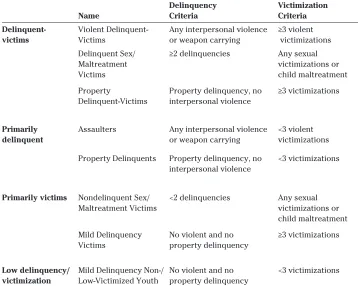
In the interest of clarity, the research ers defined the subgroups in terms of key characteristics that the literature on victimization and delinquency suggests (Dodge et al., 1990; Jennings, Piquero, and Reingle, 2012; Malinosky-Rummell and Hansen, 1993; McGrath, Nilsen, and Kerley, 2011; Olweus, 1978, 2000; Windle and Ma son, 2004). Table 1 illustrates the typology groups and defining criteria.
Definition of Victimized
Versus Nonvictimized Youth
From previous analyses (Finkelhor, Hamby et al., 2005; Finkelhor, Ormrod et al., 2005a; Hamby et al., 2004), the researchers determined that one of the best measures of victimization intensity is the number of types of victimization per respondent based on the screening categories that the Juvenile Victimization Questionnaire (JVQ) uses (see “Methodology” on page 7). Although simply adding up the number of different types of victimization (including parental abuse, sex offenses, property of fenses, and peer victimizations) does not take into account repeated victimizations of the same type, analyses have suggested that factoring in repeated victimizations and other measures of victimization sever ity does not produce substantively differ ent results in identifying highly victimized youth (Finkelhor, Hamby et al., 2005; Finkelhor, Ormrod, and Turner, 2007). For the purposes of this study, the re searchers defined victimized youth as those who suffered three or more vic timizations in the past year. They chose this number because the mean number of types of victimization in the past year per respondent in the NatSCEV study was 2.68 and because the JVQ and NatSCEV include many common kinds of victimiza tions, such as being hit by a sibling or having property stolen. Consequently, the researchers categorized non-/low victimized youth as those who suffered two victimizations or fewer in the past year.As with victimized youth, some categories of delinquent youth are defined as those who committed more delinquent acts than the past-year mean (i.e., two or more types of delinquent acts within the past year). Given the inclusion of relatively minor and perhaps normative delinquent acts in the Frequency of Delinquency Behavior (Loeber and Dishion, 1983) (see “Methodo logy” on page 7), the researchers decided that defining those who committed fewer than the mean number of delinquent acts in the past year as nondelinquent would adequately identify youth with no or only minor delinquency.
Categories of
Delinquent-Victims
The researchers first defined three groups of youth who fell into the delinquent-victim overlap category (see table 1). They defined “Violent Delinquent-Victims,” consistent with descriptions from other studies of victimization and delinquency (Haynie et al., 2001; Olweus, 1978, 2000; Schwartz, Proctor, and Chien, 2001), as youth who in the past year engaged in violent, interpersonal acts or carried weapons and who experienced three or more violent victimizations in the past year. As suggested in the trauma response literature (Briere et al., 1997; Finkelhor, 1990; Kilpatrick et al., 2003; Wilsnack et al., 2004; Windle and Mason, 2004), the research team termed the second defined group as “Delinquent Sex/Maltreatment Victims,” who had experienced sexual vic timization or a form of child maltreatment and had engaged in two or more delin quent acts in the past year. They defined the third group, “Property Delinquent- Victims,” as delinquent and highly victim ized youth whose delinquencies were related solely to property crime and who had three or more victimizations of any type in the past year.
Categories of Primarily
Delinquent Youth
In contrast to these three groups of delinquent-victims, the study also catego rized some youth as primarily delinquent. These were youth who had rates of vic timization below the mean of three in the past year, but who had engaged in violent (youth categorized as “Assaulters”) or property delinquency (youth categorized as “Property Delinquents”), which were the most serious and least frequent delinquencies (see table 1).
Categories of Youth Who
Are Primarily Victims
The researchers defined two groups who were primarily victims but not delinquents. These were the “Mild Delinquency Vic tims,” who had greater than mean levels of victimization (three or more victimizations within the past year) but no property or violent delinquency, and “Nondelinquent Sex/Maltreatment Victims,” who had ex perienced a sexual victimization or a form of child maltreatment but had committed fewer than two delinquent acts in the past year (see table 1). This last group was dis tinguished as a separate category because the victimization literature suggests special seriousness for youth who experience even one incident of sexual victimization or child maltreatment, which are also acts that lead to the involvement of child protective ser vices or police referrals (Briere et al., 1997; Egeland et al., 2002; Finkelhor, 1990; Kilpat rick et al., 2003; Wilsnack et al., 2004; Windle and Mason, 2004; Wood et al., 2002).
Table 1: Delinquency and Victimization Criteria for Typology Groups
Delinquency Victimization Name Criteria Criteria Delinquent- Violent Delinquent- Any interpersonal violence ≥3 violent
victims Victims or weapon carrying victimizations Delinquent Sex/ ≥2 delinquencies Any sexual
Maltreatment victimizations or
Victims child maltreatment
Property Property delinquency, no ≥3 victimizations Delinquent-Victims interpersonal violence
Primarily Assaulters Any interpersonal violence <3 violent
delinquent or weapon carrying victimizations
Property Delinquents Property delinquency, no interpersonal violence
<3 victimizations
Primarily victims Nondelinquent Sex/ <2 delinquencies Any sexual Maltreatment Victims victimizations or
child maltreatment
Mild Delinquency No violent and no ≥3 victimizations Victims property delinquency
Low delinquency/ Mild Delinquency Non-/ No violent and no <3 victimizations
victimization Low-Victimized Youth property delinquency
Source: Cuevas et al., 2007.
of delinquency and victimization: violent delinquent-victims, delinquent sex/ maltreatment victims, assaulters, non-delinquent sex/maltreatment victims, property delinquent-victims, property delinquents, mild delinquency victims, and mild delinquency non-/low-victimized youth (note that assaulters and nondelin-quent sex/maltreatment victims, although they are categorized as primarily delin quent and primarily victims, respectively, are regarded as higher in the hierarchy than property delinquent-victims). This or dering was presented in the original typol ogy using the Developmental Victimization Survey (DVS) data (Cuevas et al., 2007), which established this order according to which group of individuals was most similar based on their demographic char acteristics. For consistency, the ordering remained the same for the purposes of this analysis based on the NatSCEV data.
Findings by Gender
and Typology Group
for Delinquents,
Victims, and
Delinquent-Victims
Victimization and Delinquency
Patterns Among Boys
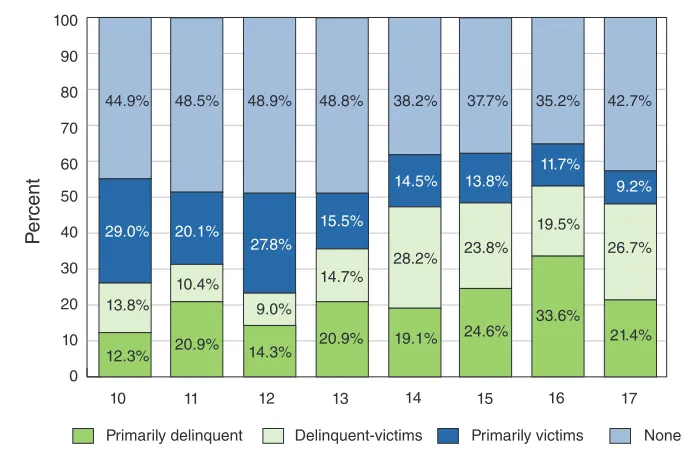
Among boys overall, the primarily delin quent group comprised 20.8 percent of the total sample (see “Methodology” on page 7 for sample size). Boys who were primarily victims with little or no delinquency com prised 17.9 percent of the total sample, and the group who were both victimized and delinquent comprised 18.1 percent (figure 1). Substantial percentages of all three groups were evident throughout the developmental course for boys ages 10 to 17 (figure 2). However, the propor-tion of boys in the primarily victim group differed between ages 12 and 13 (declin ing from 27.8 percent to 15.5 percent). At ages 13 and 14, the proportion of boys in the delinquent-victim group increased from 14.7 percent to 28.2 percent and was elevated through age 17.
Figure 1: Victimization-Delinquency Co-occurrence by Gender,
Ages 10 to 17
100 90 80
43.1% 52.5%
17.9% 21.2% 18.1% 20.8% 13.3% 13.0% 70 Pe rcent 60 50 40 30 20 10 0
Male Female
Primarily delinquent Delinquent-victims Primarily victims None
Percentages may not add up to 100% because of rounding.
Figure 2: Victimization-Delinquency Co-occurrence by Males
Ages 10 to 17
100 90 12.3% 13.8% 29.0% 44.9% 20.9% 10.4% 20.1% 48.5% 14.3% 9.0% 27.8% 48.9% 20.9% 14.7% 15.5% 48.8% 19.1% 28.2% 14.5% 38.2% 24.6% 23.8% 13.8% 37.7% 33.6% 19.5% 11.7% 35.2% 21.4% 26.7% 9.2% 42.7% 80 70 60 Pe
rcent 50
40 30 20 10 0
10 11 12 13 14 15 16 17 Primarily delinquent Delinquent-victims Primarily victims None
Percentages may not add up to 100% because of rounding.
Table 2: Characteristics by Delinquent/Victim Group and Gender
NatSCEV 10- to 17-year-olds N = 2,090 (unweighted)
Delinquent/Victim Group
Males (n = 1,039) Females (n = 1,051) Primarily
Delinquent (a)
Delinquent-Victims (b)
Primarily Victims (c)
Primarily Delinquent (d)
Delinquent- Victims (e)
Primarily Victims (f) Total n (unweighted) 222 198 167 140 155 214
Age 13.9c 14.2c 12.7a.b 13.9 14.4f 13.3e
Total number of victimization screeners
Victimization type (% yes)
2.0b,c 6.3a,c 4.5a,c 2.7e,f 6.4d,f 4.2d,e
Witness family violence 15b 26a,c 12b 18e 36d,f 19e
Exposure to community violence 49b.c 70a 63a 54e 71d 63
Assault 57b,c 91a,c 80a,b 62e 90d,f 68e
Sexual victimization 0b,c 40a,c 13a,b 7e,f 58d,f 27d,e
Property victimization 24b,c 56a,c 43a,b 38e 63d,f 45e
Maltreatment 1b,c 45a,c 25a,b 4e,f 59d,f 33d,e
Bullying 16b,c 40a,c 58a,b 34e,f 51d 53d
Internet victimization 5b 14a,c 1b 12e 33d,f 7e
Past-year adversity score (mean) 1.1b 1.9a,c 1.1b 1.6e 2.2d,f 1.6e
Total delinquency score (mean) 2.7b.c 3.9a,c 0.3a,b 2.0e,f 3.3d,f 0.3d,e Violent delinquency (mean) 1.3b,c 1.5a,c 0.0a,b 1.0e,f 0.8d,f 0.0d,e Property delinquency (mean) 0.6b,c 0.9a,c 0.0a,b 0.4e,f 0.8d,f 0.0d,e Drugs/minor delinquency score (mean)
Mental health symptoms (mean)
0.8b,c 1.4a,c 0.3a,b 0.6e,f 1.7d,f 0.2d,e
Anger 9.8b 11.3a,c 9.3b 10.8e,f 12.4d,f 9.7d,e
Depression 11.5b 12.3a 11.7 13.2e 15.3d,f 12.6e
Anxiety
Parenting characteristics (mean scale scores)
6.4b 7.2a 6.9 7.5e,f 8.3d,f 6.6d,e
Warmth 38.0 37.9 38.5 38.5 37.9 38.1
Inconsistency/harshness 11.2 11.3 10.6 10.4e 11.8d,f 10.8e
Supervision/monitoring 4.9 5.0 4.8 4.7 5.0 4.8
Social support score 27.1b 25.7a,c 27.5b 27.6e 24.7d.f 27.1e
Notes: Estimates are weighted. Sample sizes are unweighted. Superscript letters indicate that a value is significantly different from the value in the column labeled with the same letter in parentheses. Comparisons were made using one-way analysis of variance and post-hoc Bonferroni tests.
Past-year adversity score: total number of adverse events, out of 15 possible, that the youth experienced in the past year. Examples of items: natural disaster, a parent going to prison, and homelessness.
Total delinquency score: total number of delinquency types, out of 15 possible, that the youth committed in the past year. Violent, property, and drugs/minor delinquency scores are subsets of total delinquency. Violent delinquency items: destruction or damage of property, physical assault against a peer or adult, carrying a weapon, and injuring someone enough to require medical care. Property delinquency items: theft at school, theft at home, theft from a store, graffiti, and avoiding paying for things such as movies or bus rides. Drugs/minor delinquency items: cheating on tests at school, skipping school, tobacco use, marijuana use, and other drug use.
Scores for mental health symptoms, parenting characteristics, and social support are adjusted for age.
greater percentages of sexual victimization
(which includes sexual harassment) (40 percent for delinquent-victim boys versus 13 percent for primarily victim boys), witnessing family violence (26 percent for delinquent-victim boys versus 12 percent for primarily victim boys), and Internet victimization (14 percent for delinquent-victim boys versus 1 percent for primarily victim boys). The primarily victim group of boys had a greater percentage of vic tims than the delinquent-victim group in only one victimization category— bullying victimization (58 percent versus 40 percent).
The boys in the delinquent-victim group were also more delinquent than the primarily delinquent group (3.9 and 2.7 delinquent activities in the past year, respectively) (see table 2), which may be in part a function of the definitional criteria that set a higher threshold of delinquent activities for delinquent-victim boys than for primarily delinquent boys. The elevation of their drugs/minor delin quency score was particularly large (1.4 for delinquent-victims versus 0.8 for the primarily delinquent group).
Victimization and
Delinquency Patterns
Among Girls
Girls had different patterns in both typol ogy groups and age of changes in victim ization and delinquency. Except for the group of girls who were neither victims nor delinquents (52.5 percent), the largest group of girls was the primarily victim group (21.2 percent). The primarily delin quent group (13 percent) and delinquent-victim group (13.3 percent) were smaller than the comparable groups among boys, reflecting that girls tend to engage in less delinquency than boys. A rise in both delinquency and victimization for girls ap peared particularly notable between ages 11 and 12 (figure 3); as girls got older, the victimization component remained stable and then rose, while the delinquency com ponent rose and then fell.
The patterns of victimization and de linquency for girls are generally similar to those for boys in terms of both the number and types of victimizations and delinquent acts. The delinquent-victim girls were more victimized than the primarily victim girls, disclosing 6.4 and 4.2 different victimizations in the past year, respectively (table 2). (This is not a function of the definitional criteria that set a higher threshold of victimizations for
delinquent-victim girls than for primarily victim girls.) The delinquent-victim girls had greater percentages of victimization in every category of victimization except bullying victimization. Their victimization rates were particularly higher for sexual victimization, for which the rate among delinquent-victim girls (58 percent) was more than twice that among the primar ily victim girls (27 percent); and Internet victimization, for which the rate among delinquent-victim girls was more than four times higher than among the primarily victim girls (33 percent versus 7 percent) and much higher than the equivalent rate among delinquent-victim boys (14 percent).
Delinquent-victim girls were also more delinquent than the primarily delinquent girls (3.3 and 2.0 delinquent activities in the past year, respectively). As with the boys, their drugs/minor delinquency scores were particularly elevated (1.7 for delinquent-victim girls versus 0.6 for primarily delinquent girls).
Figure 3: Victimization-Delinquency Co-occurrence by Females
Ages 10 to 17
100 90 80 70 10 None Primarily victims Delinquent-victims Primarily delinquent
11 12 13 14 15 16 17 5.4% 4.7% 24.8% 65.1% 11.2% 6.4% 17.6% 64.8% 17.5% 10.3% 23.8% 48.4% 12.1% 11.3% 25.0% 51.6% 14.5% 15.3% 21.0% 49.2% 8.0% 23.2% 17.6% 51.2% 18.2% 15.7% 23.1% 43.0% 18.0% 20.5% 16.4% 45.1% Pe rcent 60 50 40 30 20 10 0
Findings Regarding Other
Dimensions of Adversity
As table 2 shows, the groups differ on some additional dimensions as well. Among both boys and girls, delinquent-victims tended to experience more lifeadversities and mental health symptoms than other groups. They also received less social support. Delinquent-victim girls experienced higher rates of inconsistent/harsh parenting. There were few significant differences among the primarily delinquent, primarily victim, and delinquent-victim groups on features such as socioeconomic status, ethnicity, family structure, disability status, school performance, or physical features.
Implications for
Adolescent
Development and
for Intervention by
Practitioners
Age Onset of Increasing
Risk for Victimization and
Delinquency
Methodology
The National Survey of Children’s Exposure to Violence (NatSCEV) was designed to obtain past-year and lifetime prevalence estimates of a wide range of childhood victimizations and was conducted between January and May 2008. NatSCEV docu mented the experiences of a nationally representative sample of 4,549 children ages 1 month to 17 years living in the contigu ous United States. This study focuses on the 2,090 children (1,039 male and 1,051 female) who were 10 to 17 years old at the time of the survey. These children were surveyed on both their victimization experiences and their participation in 15 different kinds of delinquent behavior.
Sampling Techniques
The interviews with parents and youth were conducted over the phone. Sample households were drawn from a nationwide sampling frame of residential telephone numbers through random-digit dialing. To ensure that the study included an adequate number of minority and low-income respondents for more accurate subgroup analyses, the researchers oversampled telephone exchanges that had high concentrations of African American, Hispanic, or low-income households. Sample weights were ap plied to adjust for differential probability of selection due to (1) study design, (2) demographic variations in nonresponse, and (3) variations in eligibility within households. Additional information on sampling methods and procedures has been provided elsewhere (Finkelhor, Turner, Ormrod, and Hamby, 2009; Finkelhor, Turner, Ormrod, Hamby, and Kracke, 2009).
Interviewers first spoke with an adult caregiver in each household to obtain family demographic information. They then randomly selected the child with the most recent birthday to be interviewed. Interviewers spoke directly with children ages 10 to 17. For children younger than age 10, they interviewed the caregiver who “is most familiar with the child’s daily routine and experiences.”
Sources and Analysis of Information Regarding Victimization
Researchers obtained reports of victimization using the Juvenile Victimization Questionnaire (JVQ), an inventory of childhood victimization (Finkelhor, Hamby et al., 2005; Finkelhor, Ormrod et al., 2005a; Hamby et al., 2004). The JVQ obtains reports on 48 forms of youth victimization covering 5 general areas of interest: conventional crime, maltreatment, victimization by peers and siblings, sexual victimization, and witnessing and exposure to violence (Finkelhor, Ormrod et al., 2005b).
Followup questions for each victimization item gathered additional information about each event, including perpetrator charac teristics, weapon use (use of a knife, gun, or other object that could cause physical harm), injury, whether the event occurred in the past year, and whether it was known to school officials or police.
The analysis for this bulletin examined victimizations that occurred in the past year. The researchers constructed 8 aggregate types of victimization from 32 of the JVQ’s 48 victimization screeners: physical assault, sexual victimization, maltreatment, property victimization, witnessing family violence, exposure to community violence, bullying, and Internet victimization.
Sources and Analysis of Information Regarding Delinquency
Researchers used the Frequency of Delinquency Behavior (FDB) that Loeber and Dishion (1983) originally developed to measure self-reported delinquency. For this study, the researchers adapted the FDB scale from its most recently published format (Dahlberg, Toal, and Behrens, 1998; Loeber and Stouthamer-Loeber, 1987).* The adapted form asked participants only whether they had committed the listed delinquency in the past year rather than how often they had committed each delinquent behavior. Researchers asked all NatSCEV participants between the ages of 5 and 17 about a total of 15 delinquency items. This study focuses on the 2,090 respondents aged 10 to 17.
*For a sample of the Frequency of Delinquent Behavior survey and scoring instrument, see www.djj.state.fl.us/docs/jjdp-performance-measurement/ frequency_of_delinquent_behavior.pdf?sfvrsn=0.
The relative sizes of these various groups appear to change as children age; they also differ by gender. The delinquent-victim group among boys is larger overall and increases substantially between ages 13 and 14. This may reflect an increase in delinquent activities around the time they enter high school among those who had previously been primarily victims. The high school environment may expose them to older delinquent role models and present them with conditions of more independence and less supervision than middle school.
For girls, the pattern change appears to occur earlier (between ages 11 and 12) and is associated with an increase in both victimization and delinquency, but partic ularly victimization. This is likely related to the onset of pubertal changes in girls and shows up in the data as a particularly marked increase in sexual harassment.
Increased Risk of Both
Delinquency and
Victimization for
Delinquent-Victims
For both genders, the data reveal worrying facts about the group who areTiming of Interventions To
Reduce Victimization and
Delinquency
The current study is not longitudinal, and so it is limited in the inferences that can be made about how to identify children who are on track to become distressed delinquent-victims. This group does not appear to be discernible on the basis of demographic, family, or school variables collected in this study. The age compar isons suggest that victims who have additional adversities and higher levels of victimization and mental health symptoms may also be those at greatest risk of mov ing into delinquent activities. Targeting prevention at highly victimized youth with mental health symptoms may be important. The study points clearly to the importance of early intervention. For girls, a large jump in victimization and delinquency occurs between ages 11 and 12; for boys, the delinquent-victim group increases between ages 13 and 14. This strongly sug gests that delinquency and victimization prevention efforts need to be marshaled around or before the fifth grade, and they need to include components that minimize sexual aggression and harassment. The transition to high school may also be a crucial juncture, especially for boys. Further study may better determine how children at this juncture both are targeted as victims and initiate multiple delinquent activities. Better early-warning systems may identify students who need special guidance and education from early in their high school careers.
References
Briere, J. 1996. Trauma Symptoms Checklist for Children (TSCC): Professional Manual.
Odessa, FL: Psychological Assessment Resources.
Briere, J., Woo, R., McRae, B., Foltz, J., and Sitzman, R. 1997. Lifetime victimization his tory, demographics, and clinical status in female psychiatric emergency room pa tients. Journal of Nervous and Mental Disease
185:95–101.
Chang, J.J., Chen, J.J., and Brownson, R.C. 2003. The role of repeat victimization in ado lescent delinquent behaviors and recidivism.
Journal of Adolescent Health 32(4):272–280.
Cuevas, C., Finkelhor, D., Turner, H.A., and Ormrod, R.K. 2007. Juvenile delinquency and victimization: A theoretical typology. Journal of Interpersonal Violence 22:1581–1602.
Dahlberg, L.L., Toal, S.B., and Behrens, C.B. 1998. Measuring Violence-Related Attitudes, Beliefs, and Behaviors Among Youth: A Com pendium of Assessment Tools. Atlanta, GA: Centers for Disease Control and Prevention, National Center for Injury Prevention and Control.
Dodge, K.A., Coie, J.D., Pettit, G.S., and Price, J.M. 1990. Peer status and aggression in boys’ groups: Developmental and contextual analy ses. Child Development 61(5):1289–1309.
Egeland, B., Yates, T., Appleyard, K., and van Dulmen, M. 2002. The long-term conse quences of maltreatment in the early years: A developmental pathway model to antisocial behavior. Children’s Services: Social Policy, Research, and Practice 5:249–260.
Finkelhor, D. 1990. Early and long-term effects of child sexual abuse: An update.
Professional Psychology Research and Practice
21:325–330.
Finkelhor, D., Hamby, S.L., Ormrod, R.K., and Turner, H.A. 2005. The JVQ: Reliability, validity, and national norms. Child Abuse & Neglect 29(4):383–412.
Finkelhor, D., Ormrod, R.K., and Turner, H.A. 2007. Poly-victimization: A neglected com ponent in child victimization trauma. Child Abuse & Neglect 31:7–26.
Finkelhor, D., Ormrod, R.K., Turner, H.A., and Hamby, S.L. 2005a. Measuring poly-victimization using the JVQ. Child Abuse & Neglect 29(11):1297–1312.
Finkelhor, D., Ormrod, R.K., Turner, H.A., and Hamby, S.L. 2005b. The victimization of chil dren and youth: A comprehensive, national survey. Child Maltreatment 10(1):5–25.
Finkelhor, D., Turner, H., Ormrod, R., and Hamby, S.L. 2009. Violence, abuse, and crime exposure in a national sample of children and youth. Pediatrics 124(5):1–13.
Finkelhor, D., Turner, H., Ormrod, R., Hamby, S., and Kracke, K. 2009. Children’s Exposure to Violence: A Comprehensive National Survey.
Bulletin. Washington, DC: U.S. Department of Justice, Office of Justice Programs, Office of Juvenile Justice and Delinquency Prevention.
Hamby, S.L., Finkelhor, D., Ormrod, R.K., and Turner, H.A. 2004. The Juvenile Victimiza tion Questionnaire (JVQ): Administration and Scoring Manual. Durham, NH: Crimes against Children Research Center.
Haynie, D.L., Nansel, T., Eitel, P., Crump, A.D., Saylor, K., Yu, K., and Simons-Morton, B. 2001. Bullies, victims, and bully/victims: Distinct groups of at-risk youth. The Journal of Early Adolescence 21:29–49.
Jennings, W.G., Piquero, A.R., and Reingle, J.M. 2012. On the overlap between victimiza tion and offending: A review of the literature.
Aggression and Violent Behavior 17:16–26. Jensen, G.F., and Brownfield, D. 1986. Gender, lifestyles, and victimization: Beyond routine activity, Violence and Victims 1(2):85–99.
Kilpatrick, D.G., Ruggiero, K.J., Acierno, R., Saunders, B.E., Resnick, H.S., and Best, C.L. 2003. Violence and risk of PTSD, major depression, substance abuse/dependence, and comorbidity: Results from the national survey of adolescents. Journal of Consulting and Clinical Psychology 71:692–700.
Lauritsen, J.L., Sampson, R.J., and Laub, J.H. 1991. The link between offending and victimization among adolescents. Criminol ogy 29:265–292.
Loeber, R., and Dishion, T.J. 1983. Early predictors of male delinquency: A review.
Psychological Bulletin 94:68–94.
Loeber, R., and Stouthamer-Loeber, M. 1987. The prediction of delinquency. In Handbook of Juvenile Delinquency, edited by H.C. Quay. New York, NY: Wiley, pp. 325–382.
Malinosky-Rummell, R., and Hansen, D.J. 1993. Long-term consequences of child hood physical abuse. Psychological Bulletin
114:68–79.
McGrath, S.A., Nilsen, A.A., and Kerley, K.R. 2011. Sexual victimization in childhood and the propensity for juvenile delinquency and adult criminal behavior: A systematic review.
Aggression and Violent Behavior 16:485–492.
Olweus, D. 1978. Aggression in the Schools: Bullies and Whipping Boys. Oxford, England: Hemisphere.
Olweus, D. 2000. Bullying. In Encyclopedia of Psychology, vol. 1, edited by A.E. Kazdin. Washington, DC: American Psychological As sociation, pp. 487–489.
Schwartz, D., Proctor, L.J., and Chien, D.H. 2001. The aggressive victim of bullying: Emotional and behavioral dysregulation as a pathway to victimization by peers. In Peer Harassment in School: The Plight of the Vulner able and Victimized, edited by J. Juvonen and S. Graham. New York, NY: Guilford Press, pp. 147–174.
Singer, S.I. 1986. Victims of serious violence and their criminal behavior: Subcultural theory and beyond. Victims and Violence
1:61–70.
Snyder, H.N., and Sickmund, M. 2006. Juvenile Offenders and Victims: 2006 National Report.
Washington, DC: U.S. Department of Justice, Office of Justice Programs, Office of Juvenile Justice and Delinquency Prevention.
Sullivan, T.N., Farrell, A.D., and Kliewer, W. 2006. Peer victimization in early adolescence: Association between physical and relational
victimization and drug use, aggression, and delinquent behaviors among urban middle school students. Development and Psychopa thology 18(1):119–137.
Wilsnack, S.C., Wilsnack, R.W., Kristjanson, A.F., Vogeltanz-Holm, N.D., and Harris, T.R. 2004. Child sexual abuse and alcohol use among women: Setting the stage for risky sexual behavior. In From Child Sexual Abuse to Adult Sexual Risk: Trauma, Revictimization, and Intervention, edited by L.J. Koenig, L.S. Doll, A. O’Leary, and W. Pequegnat. Washing ton, DC: American Psychological Association, pp. 181–200.
Windle, M., and Mason, W.A. 2004. General and specific predictors of behavioral and emotional problems among adolescents.
Journal of Emotional and Behavioral Disorders
12:49–61.
Wood, J., Foy, D.W., Goguen, C.A., Pynoos, R., and James, C.B. 2002. Violence exposure and PTSD among delinquent girls. Journal of Aggression, Maltreatment, and Trauma
6:109–126.
Acknowledgments
This bulletin was written by Carlos A. Cuevas, Ph.D., Associate Professor, School of Criminology and Criminal Justice, Northeastern University; David Finkelhor, Ph.D., Director, Crimes against Children Research Center, University of New Hampshire; Anne Shattuck, Data Analyst, Crimes against Children Research Center, Univer sity of New Hampshire; Heather Turner, Ph.D., Professor, Department of Sociol ogy, University of New Hampshire; and Sherry Hamby, Ph.D., Research Associate Professor, Department of Psychology, Sewanee: The University of the South. OJJDP wishes to acknowledge the contributions to this bulletin of Melissa T. Merrick, Ph.D., Epidemiologist, Division of Violence Prevention, National Center for Injury Prevention and Control, Centers for Disease Control and Prevention (CDC). OJJDP also wishes to acknowledge the support of CDC for the National Survey of Children’s Exposure to Violence and its partnership in the Safe Start initiative to create safe, stable, and nurturing environments for children and their families.
This bulletin was prepared under grant number 2005–JL–FX–0048 from the Office of Juvenile Justice and Delinquency Prevention (OJJDP), U.S. Department of Justice.
Points of view or opinions expressed in this document are those of the authors and do not necessarily represent the official position or policies of OJJDP or the U.S. Department of Justice.
The Office of Juvenile Justice and Delinquency Prevention is a component of the Office of Justice Programs, which also includes the Bureau of Justice Assistance; the Bureau of Justice Statistics; the National Institute of Justice; the Office for Victims of Crime; and the Office of Sex Offender Sentencing, Monitoring, Apprehending, Registering, and Tracking.
Share With Your Colleagues
Unless otherwise noted, OJJDP publications are not copyright protected. We encour age you to reproduce this document, share it with your colleagues, and reprint it in your newsletter or journal. However, if you reprint, please cite OJJDP and the authors of this bulletin. We are also interested in your feedback, such as how you received a copy, how you intend to use the information, and how OJJDP materials meet your individual or agency needs. Please direct your comments and questions to:
Juvenile Justice Clearinghouse
Publication Reprint/Feedback P.O. Box 6000
Rockville, MD 20849–6000 800–851–3420
301–519–5600 (fax)
U.S. Department of Justice Office of Justice Programs
Office of Juvenile Justice and Delinquency Prevention
Washington, DC 20531
Official Business
Penalty for Private Use $300
*NCJ~240555*
PRESORTED STANDARD POSTAGE & FEES PAID
DOJ/OJJDP PERMIT NO. G–91