RADIATION EFFECTS ON MHD FLOW
PAST AN IMPULSIVELY STARTED
EXPONENTIALLY ACCELERATED
VERTICAL PLATE WITH VARIABLE
TEMPERATURE IN THE PRESENCE OF
HEAT GENERATION
A.G Vijaya Kumar
Department of Mathematics, Stanley Stephen College of Engineering And Technology, Panchalingala Kurnool, Andhra Pradesh 518005,India
S.Vijaya Kumar Varma
Professor, Department of Mathematics, S.V University, Tirupati, Andhra Pradesh, 517502, India
Abstract:
The objective of the present study is to investigate Radiation effects on unsteady MHD flow of an electrically conducting radiating, viscous, incompressible fluid past an impulsively started moving exponentially accelerated vertical plate with variable temperature in the presence of heat generation and applied transverse magnetic field. The fluid is considered is gray, absorbing/emitting radiation but a non-scattering medium. At time t > 0, the temperature of the plate raised linearly with time t. The dimensionless governing equations involved in the present analysis are solved using the Laplace transform technique. The velocity, temperature, skin friction and the rate of heat transfer are shown graphically and with some numerical computations in terms of the parameters M(the magnetic field parameter), R(the radiation parameter), H(the heat source parameter), Pr(the prendtl number), a(exponential index) and t(time).
Keywords: MHD flow, exponential, accelerated vertical plate, variable temperature, radiation, heat generation.
1. Introduction:
Takhar et al.[6] investigated the effects of radiation on the MHD free convection flow past a semi-infinite vertical plate. Later, Hossain and Takhar [7] studied the effect of radiation using the Rossel and diffusion approximation. Further, Hossain et al .[8] studied the effect of radiation on the free convection flow on a vertical porous plates. Muthucumaraswamy and kumar [9] analyzed the thermal diffusion effects on moving infinite vertical plate in the presence of variable temperature and mass diffusion. Recently, Rajesh, et al [10] investigated radiation effects on MHD flow past moving infinite vertical plate in the presence of heat generation. The present paper is aimed at analyzing the effects of radiation on MHD flow of an electrically conducting radiating, viscous, incompressible fluid past an impulsively started exponentially accelerated vertical plate with variable temperature in the presence of heat generation under the action of a constant magnetic field of constant pressure gradient is subjected to an external magnetic field of constant strength in the direction to the plate and to the direction to the flow.
2. Mathematical analysis:
In this problem we consider the radiation effects on unsteady MHD flow of an electrically conducting radiating, viscous, incompressible fluid past an impulsively started exponentially accelerated vertical plate with variable temperature in the presence of heat generation. The plate is taken along ′-axis in vertically upward direction and ′-axis is taken normal to the platein the direction of the applied magnetic field. Initially, it is assumed that the plate and the surrounding gas are at the same temperature ∞′ at stationary condition for all the points. At time ′> 0, the plate is exponentially accelerated with velocity ′ ′ in its own plane. And at the same time the plate temperature raised linearly with time t. Then the fully developed flow of a radiating gas is governed by the following set of equations.
′
′ ′ ∞′
′
′
′
1
′
′ к ′
′ ′ ′ ∞′ 2 With the following initial and boundary conditions
′ 0 ′ 0, ′
∞′, ′
′ 0 ′ ′ ′ , ′
∞′ ′ ∞′ ′ ′ 0, ′ 0, ′ ∞′, ′ ∞ (3)
. In the optically thick limit, the fluid does not absorb its own emitted radiation that is there is no self radiation, but it does absorb radiation emitted by the boundaries. It has been derived by cogly et al [1],that in the optically thick limit for a non-gray gas near equilibrium, that
′ ′ ∞′ ′
∞
′ ∞
′
On introducing the following non-dimensional quantities (5) in equations (1), (2) and (3) reduces to
′
,
′
, √
′
,
′
,
′ ∞ ′ ′
∞
′ , , к ,
G
′ ∞ ′
We get the following equations which are dimensionless
(6)
, (7) The initial and boundary conditions in dimensionless form are as follows
, , , 0 , , , And
, ∞. (8)
All the appeared physical parameters are defined in the nomenclature. The dimensionless governing equations (6) and (7), with respect to the boundary conditions (8) are solved by usual Laplace transform technique and the solutions for hydro magnetic flow with variable temperature in the presence of heat generation are obtained as follows.
,
√
√ √
√ √ √ √
√ (9)
, √
√
√
√
+
√ √ √ √ √ √ √ √
- √
√ √
√
√ √
+ √
√
√
√
-√ √
√
√ √ √
√ √
+ √ √
√
√ √
√
-√ √
√
√ √
√
(10)
Where
3. Skin friction:
From velocity field, now we study skin friction (rate of change of velocity in flow with respect to y) it is given in non-dimensional form as
(11)
From equations (10) and (11) we get skin-friction as follows
1
√ √
+ √
√ √
-√ √ √
+
√ √
- √
√
+ √
- √
4. Nusselt number:
From temperature field, now we study Nusselt number (rate of change of heat transfer) it is given in non-dimensional form as
(12)
From equations (9) and (12) we get Nusselt number as follows
√ 2√
5: Discussions and Results:
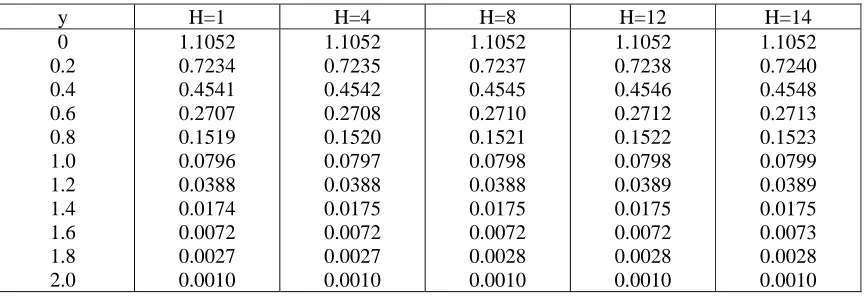
In order to get the physical insight into the problem the velocity, temperature, skin-friction and the rate of heat transfer are shown graphically and some numerical computations are also performed for different values of the physical parameters like Radiation parameter (R), Magnetic parameter (M), Heat source parameter (H). Time (t), exponential index (a) and Prandtl number (Pr). Figure (1) and (2) describe the behavior of the temperature field with the variation in the parameter(R). It is observed that the temperature decreases as the radiation parameter R increases at time t=0.2 and t=0.4 respectively. From fig 3&4 it is clear that at time t=0.2 & 0.4 the temperature increases with increasing heat source parameter (H). Fig.5 represents temperature profiles for various values of the time (t=0.2, 0.4, 0.6, 0.8, 1.0). The trend shows that the temperature increases with increasing time t.
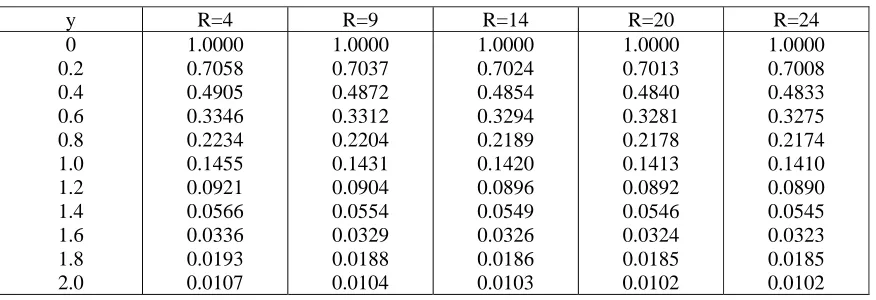
meets the logic that the magnetic field exerts a retarding force on the free convection flow. Fig.8 represents the velocity profiles for various values of time (t=0.2, 0.4, 0.6, 0.8, 1.0). It is observed that the velocity increases as time t increases. The variation in velocity for different values of radiation parameter (R=4, 9, 14, 20, 24) when Pr=0.71, H=2, M=3 with an exponential index a=0.5 at time t=0.2&0.4are numerically computed in table 1&2 respectively. These computations are explaining that the velocity gradually decreases with increasing of radiation parameter R. This is shows that there is a fall in velocity in the presence of high radiation. The variation in velocity for different values of heat source parameter (H=1, 4, 8, 12, 14) when Pr=0.71, M=3, R=15, with an exponential index a=0.5 at time t=0.2&0.4 are computed in table 3&4 respectively. It is clear that the velocity increases with increase of heat source parameter H.
An investigation is also performed with numerical computations the effects of radiation and heat source parameters at no acceleration of the plate (i.e.at uniform velocity of the plate) at time t=0.2&0.4 respectively. It is found that from tables 5, 6, 7, &8 the velocity decreases as radiation parameter R increases while it increases with increase of Heat source parameter H.
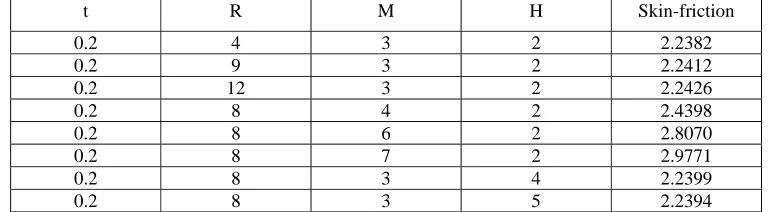
The computed numerical values of skin- friction are presented in table.9 for different values of Radiation parameter(R), Magnetic field parameter (M) and Heat source parameter (H). It is interesting to note that the skin-friction increases with increasing of Radiation parameter (R) or Magnetic field parameter (M) but decreases with increase of Heat source parameter (H).
Finally, from fig.9 it is observed that the Nusselt number increases with increasing values of radiation parameter(R) but decreases as heat source parameter (H) increases.
6. Graphs and Tables:
Figure 2: Temperature profiles when Pr=0.71, H=2, t=0.4
Figure 4: Temperature profiles when Pr=0.71, R=10, t=0.4
Figure 6: Velocity profiles when Pr=0.71, R=10, H=4, a=0.5, t=0.2
Figure 8: Velocity profiles when Pr=0.71, R=10, M=3, H=4, a=0.5
Table 1:Velocity for different values of R when Pr=0.71, M=3, H=2, a=0.5, t=0.2
y R=4 R=9 R=14 R=20 R=24
0 0.2 0.4 0.6 0.8 1.0 1.2 1.4 1.6 1.8 2.0 1.1052 0.7244 0.4554 0.2718 0.1527 0.0801 0.0390 0.0176 0.0073 0.0028 0.0010 1.1052 0.7239 0.4547 0.2712 0.1522 0.0798 0.0389 0.0175 0.0072 0.0028 0.0010 1.1052 0.7235 0.4542 0.2708 0.1520 0.0797 0.0388 0.0175 0.0072 0.0027 0.0010 1.1052 0.7232 0.4538 0.2705 0.1518 0.0796 0.0387 0.0174 0.0072 0.0027 0.0010 1.1052 0.7230 0.4536 0.2703 0.1517 0.0795 0.0387 0.0174 0.0072 0.0027 0.0010
Table 2: Velocity for different values of R when Pr=0.71, M=3, H=2, a=0.5, t=0.4
y R=4 R=9 R=14 R=20 R=24
0 0.2 0.4 0.6 0.8 1.0 1.2 1.4 1.6 1.8 2.0 1.2214 0.8397 0.5702 0.3812 0.2500 0.1604 0.1003 0.0609 0.0359 0.0204 0.0112 1.2214 0.8376 0.5670 0.3778 0.2470 0.1580 0.0985 0.0597 0.0351 0.0199 0.0109 1.2214 0.8363 0.5651 0.3759 0.2455 0.1569 0.0978 0.0592 0.0348 0.0197 0.0108 1.2214 0.8353 0.5637 0.3746 0.2445 0.1562 0.0973 0.0589 0.0346 0.0197 0.0108 1.2214 0.8348 0.5630 0.3740 0.2441 0.1559 0.0971 0.0588 0.0346 0.0196 0.0108
Table 3: Velocity for different values of H when Pr=0.71, M=3, R=15, a=0.5, t=0.2
y H=1 H=4 H=8 H=12 H=14
Table 4: Velocity for different values of H when Pr=0.71, M=3, R=15, a=0.5, t=0.4
y H=1 H=4 H=8 H=12 H=14
0 0.2 0.4 0.6 0.8 1.0 1.2 1.4 1.6 1.8 2.0 1.2214 0.8360 0.5646 0.3755 0.2451 0.1566 0.0976 0.0591 0.0347 0.0197 0.0108 1.2214 0.8364 0.5652 0.3761 0.2456 0.1569 0.0978 0.0593 0.0348 0.0198 0.0108 1.2214 0.8371 0.5662 0.3770 0.2464 0.1575 0.0982 0.0595 0.0349 0.0198 0.0109 1.2214 0.8380 0.5675 0.3783 0.2475 0.1584 0.0988 0.0599 0.0352 0.0200 0.0110 1.2214 0.8385 0.5683 0.3792 0.2482 0.1589 0.0992 0.0602 0.0354 0.0201 0.0110
Table 5: Velocity for different values of R at no acceleration of the plate when Pr=0.71, M=3, H=2, t=0.2
y R=4 R=9 R=14 R=20 R=24
0 0.2 0.4 0.6 0.8 1.0 1.2 1.4 1.6 1.8 2.0 1.0000 0.6683 0.4267 0.2579 0.1463 0.0774 0.0379 0.0172 0.0071 0.0027 0.0010 1.0000 0.6677 0.4260 0.2573 0.1459 0.0771 0.0378 0.0171 0.0071 0.0027 0.0009 1.0000 0.6674 0.4256 0.2569 0.1456 0.0769 0.0377 0.0170 0.0071 0.0027 0.0009 1.0000 0.6671 0.4252 0.2566 0.1454 0.0768 0.0376 0.0170 0.0071 0.0027 0.0009 1.0000 0.6669 0.4250 0.2564 0.1453 0.0768 0.0376 0.0170 0.0071 0.0027 0.0009
Table 6: Velocity for different values of R at no acceleration of the plate when Pr=0.71, M=3, H=2, t=0.4
y R=4 R=9 R=14 R=20 R=24
Table 7: Velocity for different values of H at no acceleration of the plate when Pr=0.71, M=3, R=15, t=0.2
y H=1 H=4 H=8 H=12 H=14
0 0.2 0.4 0.6 0.8 1.0 1.2 1.4 1.6 1.8 2.0 1.0000 0.6673 0.4254 0.2568 0.1455 0.0769 0.0377 0.0170 0.0071 0.0027 0.0009 1.0000 0.6674 0.4256 0.2569 0.1456 0.0770 0.0377 0.0170 0.0071 0.0027 0.0009 1.0000 0.6676 0.4259 0.2572 0.1458 0.0770 0.0377 0.0171 0.0071 0.0027 0.0009 1.0000 0.6678 0.4262 0.2574 0.1460 0.0772 0.0378 0.0171 0.0071 0.0027 0.0009 1.0000 0.6680 0.4264 0.2576 0.1461 0.0772 0.0378 0.0171 0.0071 0.0027 0.0009
Table 8: Velocity for different values of H at no acceleration of the plate when Pr=0.71, M=3, R=15, t=0.4
y H=1 H=4 H=8 H=12 H=14
0 0.2 0.4 0.6 0.8 1.0 1.2 1.4 1.6 1.8 2.0 1.0000 0.7020 0.4849 0.3289 0.2185 0.1417 0.0895 0.0548 0.0325 0.0186 0.0103 1.0000 0.7025 0.4855 0.3295 0.2190 0.1420 0.0897 0.0549 0.0326 0.0186 0.0103 1.0000 0.7031 0.4865 0.3304 0.2197 0.1426 0.0901 0.0552 0.0327 0.0187 0.0103 1.0000 0.7040 0.4878 0.3318 0.2209 0.1435 0.0907 0.0556 0.0330 0.0189 0.0104 1.0000 0.7046 0.4886 0.3326 0.2216 0.1441 0.0911 0.0559 0.0332 0.0190 0.0105
Table 9: Skin-friction
t R M H Skin-friction
0.2 4 3 2 2.2382
0.2 9 3 2 2.2412
0.2 12 3 2 2.2426
0.2 8 4 2 2.4398
0.2 8 6 2 2.8070
0.2 8 7 2 2.9771
0.2 8 3 4 2.2399
0.2 8 3 5 2.2394
7. Conclusions:
decreases with the increasing values of magnetic parameter M or radiation parameter R whereas it increases with the increase of heat source parameter H or time t. The same phenomenon is noted in velocity affected by the parameters M, R, H, t at no acceleration of the plate. It is found that the skin-friction increases with increasing of Radiation parameter (R) or Magnetic field parameter (M) but decreases with increase of Heat source parameter (H). It is also found that the Nusselt number increases with increasing values of radiation parameter(R) but decreases with increases heat source parameter (H).
Nomenclature:
Exponential index
External magnetic field
Specific heat at constant pressure. Acceleration due to gravity. G Thermal Grashof number
к Thermal conductivity Heat generation constant H Heat source parameter
M Magnetic field parameter Nusselt number
Prandtl number
Radiative heat flux in the y - direction Radiative parameter
′ Temperature of the fluid near the plate ′ Temperature of the plate
∞′ Temperature of the fluid far away from the plate ′ Time
Dimensionless time
′ Velocity of the fluid in the x′- direction
Dimensionless velocity
′ Co-ordinate axis normal to the plate
Dimensionless co-ordinate axis normal to the plate
Absorption coefficient Planck function
Volumetric Coefficient of thermal expansion
µ Coefficient of viscosity
Kinematic viscosity
Density of the fluid Electric conductivity Dimensionless temperature
erf error function
erfc Complementary error function
References:
[1] Grief. R, Habib, I.S. and Lin, J.C., Journal of Fluid Dynamics, Vol. 46, pp. 513-520(1971).
[2] Viskanta, R., ZAMP, vol. 14, pp. 353-361(1963).
[3] Gupta, P.S. and Gupta, A.S., Int. J. Heat Mass Transfer, vol.17, pp. 1437- 1442(1974).
[4] Soundalgekar, V.M. and Takhar, H.S., Modeling measure and cont, Vol. 51, pp.31-40(1992).
[5] Cogly, A.C., Vincentine, W.C. and Gilles, S.E., AIAA Journal, Vol. 6, pp.551-555(1968).
[6] Takhar, H.S., Gorla, R.S.R. and Soundalgekar, V.M., Int. J. Numerical methods Heat Fluid Flow, Vol. 6, pp. 77-83 (1996).
[7] Hossain, M.A., and Takhar, H.S., Int. J. Heat Mass Transfer, Vol. 31, pp.243-248(1996).
[8] Hossain, M.A., Alim, M.A. and Rees, D.A.S., Int.J. Heat Mass Transfer, Vol. 42, pp.181-191(1999).