Council of Pediatric Subspecialties (CoPS): The First
Five Years
abstract
The Council of Pediatric Subspecialties (CoPS) was founded in Septem-ber 2006 largely due to concerns about the nonuniformity of the fellow-ship application process. Working with the pediatric subspecialty community, CoPS has been successful in promoting a uniform pro-cess with many more pediatric fellowship programs now using a matching program and the Electronic Residency Application Service. More important, the organization has created a bidirectional network of communication among the pediatric subspecialties and has used this to accomplish a great deal more than improving the entry of residents into subspecialty training. CoPS has provided a united voice for the subspecialties in response to the Institute of Medicine’s Duty Hours report, participated in the development of educational confer-ences geared toward the subspecialist, promoted careers in the subspecialties, and worked with other pediatric organizations to ad-vocate for improved health care for children. This article highlights CoPS’ many achievements and describes the methods it used to accomplish them, illustrating how pediatric subspecialists can de-velop a communication network and use this to work together to achieve common goals.Pediatrics2012;130:335–341
AUTHORS:Richard Mink, MD, MACM,a,bVictoria Norwood, MD,c Laura Degnon, CAE,dChristopher E. Harris, MD, FAAP,a,e Chris Kennedy, MD,f,gRobert Spicer, MD,hDaniel Coury, MD,i and James F. Bale, Jr, MDj
aDavid Geffen School of Medicine, University of California, Los
Angeles, Los Angeles, California;bDivision of Pediatric Critical
Care Medicine, Department of Pediatrics, Harbor-University of California, Los Angeles Medical Center, Torrance, California;
cDepartment of Pediatric Nephrology, University of Virginia
Children’s Hospital, Charlottesville, Virginia;dDegnon Associates,
Inc, McLean, Virginia;eDivision of Pediatric Pulmonary Medicine,
Cedars-Sinai Medical Center, Los Angeles, California;fCenter for
Excellence in Pediatric Resuscitation andgPediatric Emergency
Medicine Fellowship, Children’s Mercy Hospital, Kansas City, Missouri;hDivision of Pediatric Cardiology, Children’s Hospital
and Medical Center, Omaha, Nebraska;iDepartments of
Pediatrics and Psychiatry, The Ohio State University, Columbus, Ohio; andjDepartments of Pediatrics and Neurology, University
of Utah School of Medicine, Salt Lake City, Utah
KEY WORDS
CoPS, Council of Pediatric Subspecialties, pediatrics, pediatric subspecialties
ABBREVIATIONS
AAP—American Academy of Pediatrics ABP—American Board of Pediatrics
ACGME—Accreditation Council of Graduate Medical Education AMSPDC—Association of Medical School Pediatric Department Chairs APPD—Association of Pediatric Program Directors
CoPS—Council of Pediatric Subspecialties ERAS—Electronic Residency Application Service IOM—Institute of Medicine
www.pediatrics.org/cgi/doi/10.1542/peds.2011-2979
doi:10.1542/peds.2011-2979
Accepted for publication Apr 10, 2012
Address correspondence to Richard Mink, MD, MACM, Harbor-UCLA Medical Center, 1000 West Carson St, Box 491, Torrance, CA 90509. E-mail: [email protected]
PEDIATRICS (ISSN Numbers: Print, 0031-4005; Online, 1098-4275).
Copyright © 2012 by the American Academy of Pediatrics
FINANCIAL DISCLOSURE:The authors have indicated they have nofinancial relationships relevant to this article to disclose.
FUNDING:No external funding.
ated. Although the initial issue chosen for improvement was the fellowship appli-cation process, the organization also generated a list of issues of common concern at the time of its founding. In itsfirst 5 years of existence, CoPS has accomplished a great deal more than enhancing the fellowship application process. This article highlights CoPS’ many achievements and describes the methods it used to accomplish them, demonstrating how pediatric subspecial-ists can develop a mechanism to collab-orate to achieve common goals. A plan for the future direction of CoPS is also presented.
THE BEGINNING
CoPS was officially created on September 19, 2006, in Arlington, Virginia. The group was formed after discussions emerging from the Association of Pediatric Pro-gram Directors (APPD), the Pediatric Academic Societies, the American Board of Pediatrics (ABP), the Association of Medical School Pediatric Department Chairs (AMSPDC), and the Federation of Pediatric Organizations made it appar-ent that there was a critical need to create a subspecialty organization that would address issues across the pedi-atric subspecialties.
At the inaugural meeting, CoPS devel-oped its mission statement:
The Council of Pediatric Subspecialties integrates approaches to subspecialty education, research and patient care by providing a forum for considering issues raised by our members or by other or-ganizations; by serving as a voice repre-senting the pediatric subspecialties; and by addressing issues and opportunities of importance to pediatric subspecialty medicine.
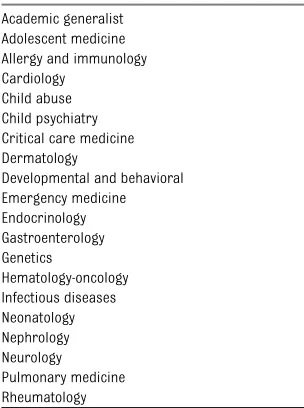
In this session, vision and values were also established, and the organizational structure and governance of CoPS were delineated. CoPS was initially to com-prise representatives from 20 pediatric subspecialties (Table 1) and 6 liaison
organizations. Although not meant to be exclusionary, the subspecialties initially chosen were thought to com-prise the disciplines primarily involved in the care of infants, children, and adolescents.
Initial financial support was provided by both AMSPDC and APPD. To formalize these relationships, Memoranda of Understanding were created that de-tailed the responsibilities of CoPS to the supporting organizations. As a part of the agreement, the management com-pany used by the APPD was selected to administer CoPS. Individual subspecial-ties were expected to support the travel and work expenses of their representa-tives, and APPD and AMSPDC provided funds to sustain the activities of the or-ganization. For additional details about CoPS’creation, please see the excellent summary by Sectish et al.1
Soon thereafter, CoPS created bylaws and an organizational infrastructure to support its activities. A logo was cre-ated and a web site was designed (www. pedsubs.org) that included a discus-sion board, a listing of proposed ac-tivities for CoPS generated from the initial meeting, and a detailed descrip-tion of the responsibilities of subspe-cialty representatives.
CoPS primary challenge was to bring together individual subspecialties to present a unified voice for the pediatric subspecialties. Through continued dis-cussion, particularly at its annual meet-ing, CoPS has made progress in meeting this goal. Subspecialty attendance and participation in the CoPS annual and strategic planning meetings has shown steady growth and improvement, from an initial representation of 84% in 2006 to a full 100% representation in 2009. Only 1 subspecialty, genetics, has elected to cease participation in CoPS.
In the CoPS model, representatives are acting on behalf of their subspecialty, rather than conveying the specific in-terests of the individual societies or organizations from which they were appointed. Nonetheless, the represen-tatives are expected to serve as a communication vehicle between CoPS and the subspecialty societies. Irre-spective of the number of societies or organizations associated with a sub-specialty, each subspecialty is entitled to a maximum of 2 votes. CoPS did not impose a process through which rep-resentatives were appointed but allowed each subspecialty to determine its own procedure. Nevertheless, CoPS request-ed that each subspecialty develop a formal method through which their representatives are chosen, and the majority have done so. Requiring that each subspecialty develop a formal process is 1 of CoPS objectives for the next 5 years.
STREAMLINING THE FELLOWSHIP APPLICATION PROCESS
One of CoPS’sfirst activities related to the fellowship application process. Both the Section on Medical Students, Residents, and Fellowship Trainees of the American Academy of Pediatrics (AAP) and Federation of Pediatric Or-ganizations expressed concerns that
Adolescent medicine Allergy and immunology Cardiology
Child abuse Child psychiatry Critical care medicine Dermatology
pediatric residents felt pressured to choose a subspecialty too early in their training and that there was no consis-tent application and selection process for fellowship positions. To examine these issues, a 5-member task force was created by CoPS. In mid-2007, the task force surveyed fellows in 13 sub-specialties in which the ABP offered subspecialty certification. More than 1200 trainees responded. Seventy-six percent supported the use of the Elec-tronic Residency Application Service (ERAS), and 62% thought that fellowship programs should use a match, with most preferring a match date in the fall of theirfinal year of residency.2In
No-vember 2007 and after much discussion with representatives from each sub-specialty, the task force recommended that (1) all pediatric subspecialties use ERAS and select the release date (12 or 18 months before the start of fellowship) most appropriate for the subspecialty and (2) all pediatric subspecialties use a match and choose of 1 of 2 match dates, one late in the spring (13 months before start of training) and the other in late fall (7 months before start).3
Subspecialties not wishing to incor-porate these recommendations were asked to delay offering positions to a date coinciding with one of the proposed match dates. These recommendations were distributed to the subspecialty and program director organizations, and CoPS worked with both the Na-tional Residency Matching Program and ERAS to encourage subspecialties to adopt them.
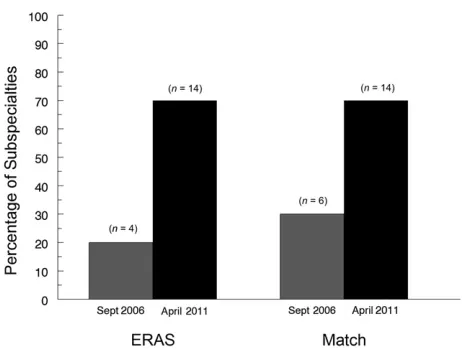
Four years later, substantial progress has been made in implementing these recommendations. At the time of CoPS formation in 2006, only 6 of 20 pediatric subspecialties used a match or had committed to do so (Fig 1). No match dates coincided. Only 4 subspecialties used ERAS, and only 2 used both ERAS and a match. As of April 2011, 14 sub-specialties were using ERAS. Eight
more have joined a match so that 70% of the pediatric subspecialties cur-rently use this process for selecting applicants. Spring and fall match dates have been created with 4 subspecial-ties using each date.
Although all pediatric subspecialties are not yet employing ERAS and a match, CoPS continues to promote dialogue between those subspecialties that have committed to these changes and those that have not. Reasons cited by sub-specialties for not using these processes or suggested offer dates include (1) a small pool of applicants making these systems unnecessary for their sub-specialty, (2) requiring more time for trainees to obtain a visa and/or medical license before starting fellowship, and (3) the need to apply for funds well in advance of the position being made available. One subspecialty, neonatology, was reluctant to change their October match date to one of the recommended dates, having just obtained the agree-ment of their program directors to join the match. Importantly, the CoPS network has allowed the“early adopt-ers” to share their experiences with other subspecialties, often providing critical information andfirsthand knowl-edge of experience with these pro-cesses. CoPS remains committed to these
recommendations and with contin-ued dialogue, it is anticipated that the remaining subspecialties will eventually implement them.
CREATING A COMMUNICATION NETWORK
Recognizing the vital importance of a network to communicate with its members, CoPS appointed a communi-cation task force at its first annual meeting in 2007. The task force
identi-fied 3 groups with which CoPS needed to communicate: fellowship program di-rectors, leaders of subspecialty socie-ties and associations, and individual subspecialists. Because the fellowship application process was thefirst issue that CoPS addressed, the task force devoted its initial efforts to develop a communication network with the fel-lowship program directors.
Several mechanisms were used to generate an e-mail listing of fellowship program directors, because no single organization would provide contact information for all of the fellowship program directors. Through the APPD, a survey was sent to the pediatric cat-egorical program directors to obtain information about their subspecialty training programs. In addition, the ABP
FIGURE 1
Percentage of the number of pediatric subspecialties using ERAS or a match in September 2006 (hatched bars) and April 2011 (filled bars). The denominator is the 20 pediatric subspecialties represented in CoPS.
subspecialty societies provided addi-tional data. This was supplemented by information obtained directly from the ACGME Web site. The names and e-mails were compiled and verified across the various sources, yielding a list of ∼1000 subspecialty program directors. Every 6 months, the list is updated by using data on the ACGME web site.
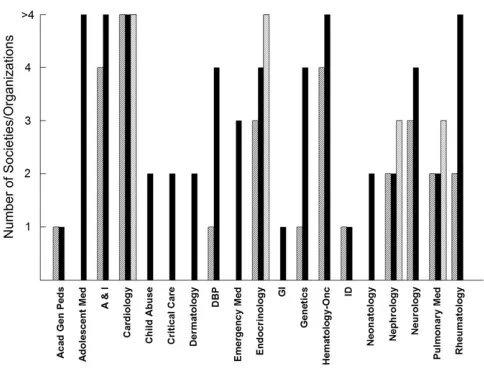
As afirst step in creating a commu-nication network among the various subspecialty societies and organiza-tions and to better understand and identify potential gaps in communica-tion, CoPS surveyed the subspecialty representatives asking them how many societies, sections, or organizations represented their subspecialty. Across the subspecialties, there was consid-erable variation in the number of so-cieties identified for each subspecialty (Fig 2).4 For some (eg, infectious
dis-eases), only 1 organization was
identi-fied, whereas for others (eg, cardiology), each representative named.4. Of note, representatives of the same subspe-cialty often disagreed as to the number
endocrinology representatives cited 3, 4, and .4 organizations as rep-resenting pediatric endocrinology. These data highlighted the challenges to develop a communication network with the various subspecialties and the need to examine the communi-cation system within each individual subspecialty. Nonetheless, these data provided CoPS with vital information as it developed a communication network with the leaders of all pedi-atric subspecialty organizations, al-lowing it to correspond with the vast majority of pediatric subspecialty societies.
CoPS has continued to work to expand its network with external groups. Re-lationships with liaison organizations have been strengthened and the Section on Medical Students, Resi-dents, and Fellowship Trainees was invited to join as a liaison group. To enhance its collaborative efforts with nonpediatric groups, in November 2008, CoPS became a member of the Organization of Program Directors Associations.
Beginning with the recommendations of the Fellowship Application Task Force, CoPS has used its network to promote cross-subspecialty communication. The CoPS newsletter was first issued in the winter of 20095and is distributed
biannually. In addition to describing CoPS’s activities and current subspe-cialty topics, the newsletters also have included information from other organi-zations that may be of particular in-terest to subspecialists. For example, one included an article describing how the APPD and CoPS were working to-gether to promote pediatric subspe-cialty education, and another outlined the ABP Maintenance of Certification requirements specifically for pediatric subspecialists.
Newsletters have not been the sole method used by CoPS to communicate with subspecialists. The CoPS web site has been modified several times to better meet the needs of the specialties, and there has been sub-stantial activity on the site. Compared with CoPS’s second year, the number of page views has doubled with.55 000 views from July 2010 through June 2011. Open forums have been held at several Pediatric Academic Societies meetings to promote dialogue between constituents and the leaders of CoPS. In addition, a PowerPoint presentation was distributed to CoPS representa-tives and placed on the web site to provide a brief summary of CoPS’s structure and activities.
PROMOTING A CAREER IN A PEDIATRIC SUBSPECIALTY
As the pediatric subspecialty repre-sentatives shared their challenges at CoPS’s annual meetings, one common theme was concern about the size of the future pediatric subspecialty work-force. In response to this, CoPS joined the Pediatric Workforce Work Group, which
FIGURE 2
included the American Academy of Child and Adolescent Psychiatry, American Academy of Ophthalmology, American Academy of Pediatrics, American As-sociation of Neurologic Surgeons/ Congress of Neurologic Surgeons, American College of Rheumatology, American Society for Gastrointestinal Endoscopy, American Society of Pediat-ric Nephrology, Child Neurology Society, and National Association of Children’s Hospitals and Related Institutions. CoPS aided in this group’s creation of a posi-tion statement regarding the insuffi -cient number of pediatric subspecialists. This document advocated for a federal study of pediatric subspecialty work-force issues and suggested a number of steps that could help alleviate a poten-tial workforce shortage.
CoPS recognized that one avenue to ex-pand the pediatric subspecialty work-force was to better inform medical students and pediatric residents about the life of a pediatric subspecialist. On the basis of an idea originally proposed by a member of an AAP Section, CoPS created detailed descriptions of each subspecialty on its web site.6 Using
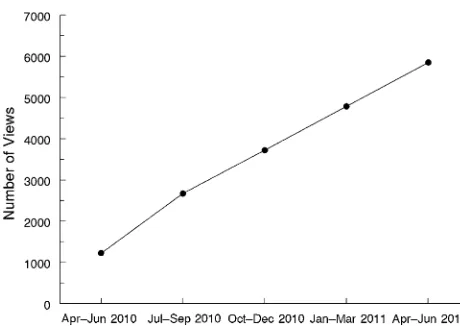
a template, each section was written by a representative of the subspecialty and included information about the clinical services provided by the subspecialist, career opportunities, lifestyle, and av-erage financial compensation, as well as how to identify and apply to training programs. CoPS coordinated this en-deavor, providing continual encourage-ment for representatives to complete their section as well as editorial over-sight to ensure consistency among the descriptions. This project has been highly successful. Since April 2010, when the vast majority of the descrip-tions were posted, the number of page views has consistently increased (Fig 3), now averaging.2000 views per month.
In addition to providing an important resource for medical students and residents, the process illustrated that
communication between CoPS and the subspecialty organizations was bidirec-tional. As noted earlier, an idea presented at an individual subspecialty meeting that would benefit one subspecialty was brought to CoPS and subsequently im-plemented for all.
RESPONDING TO FELLOWSHIP TRAINING ISSUES
The publication of the Institute of Med-icine (IOM) Report on Duty Hours in December 2008 reaffirmed the need for an organization, such as CoPS, capable of addressing issues across the sub-specialties. As one step in responding to this matter, CoPS joined with the Or-ganization of Neonatal Training Pro-gram Directors to publish a position paper,“Resident Duty Hour Restrictions: Is Less Really More?”7 CoPS
subse-quently solicited the opinions of the pediatric subspecialties regarding the IOM recommendations and submitted a formal position statement to the Ac-creditation Council of Graduate Medical Education (ACGME) to delineate these views. CoPS was then invited to present a full report at the ACGME Congress on the IOM Report on Resident Duty Hours held in June 2009. In collabo-ration with the APPD and the AAP, the ACGME was informed of the potential effects of the recommendations on all
pediatric trainees, including residents and fellows.8Although it is difficult to
gauge the ultimate impact of CoPS’s efforts on the final regulations, CoPS effectively communicated the collective
opinions of the pediatric
sub-specialties to the ACGME.
Since thefinal standards were released, CoPS has continued to collaborate with other pediatric organizations to assist subspecialty program directors in un-derstanding and implementing the new guidelines. In particular, CoPS has worked jointly with the APPD to hold scheduled conference calls so that subspecialty programs could share program-specific information.
Recently, the ACGME proposed changes to the Common Program Requirements in which fellows who are entering an ACGME-accredited fellowship mustfirst complete an ACGME or Royal College of Physicians and Surgeons of Canada accredited residency program. Because of the potential impact of this change on the pediatric subspecialty workforce and the available pool of subspecialty fellows, CoPS conducted an e-mail sur-vey of Pediatric Subspecialty Program Directors to elicit their feedback. Be-cause of the limited time available to provide comments to the ACGME, re-sponses were collected over only 10 days. Two hundred andfifty-six of the 952
FIGURE 3
Number of page views of the subspecialty descriptions on the CoPS web site since the second quarter of 2010 when the section was developed.
written comments. Of note, only 7 (0.7%) of the e-mails were returned as un-deliverable. In a short period of time, CoPS was able to solicit the opinions of a substantial number of subspecialty program directors and provide an or-ganizational response to the ACGME about a proposed modification to pro-gram requirements.9
COLLABORATING WITH OTHER PEDIATRIC ORGANIZATIONS
Consistent with its mission, CoPS has been and remains significantly involved in legislative efforts to improve child health. CoPS has collaborated with several other pediatric organizations to accomplish this goal as noted in Table 2.
SUPPORTING EDUCATION OF TRAINEES AND SUBSPECIALISTS
CoPS was involved with the first con-ference on Pediatric Education Excel-lence Across the Continuum held in 2009. In collaboration with other organi-zations, CoPS was a full sponsor for the second version of this unique confer-ence that took place in September 2011. Members of CoPS served on the planning committee and these individuals, as well as other members of CoPS, par-ticipated in the meeting as facilitators and speakers.
Because of its role in representing the pediatric subspecialties, CoPS is work-ing with the ABP to review and revise the written guide provided to fellowship
examinations. CoPS members are re-sponsible for editing its content, com-municating information pertaining to the scholarly activities of subspecialty trainees, and ensuring that the subject matter meets the needs of subspecialty trainees and fellowship program direc-tors. The guide is expected to be com-pleted shortly.
In 2010, the ABP invited members of CoPS to participate in an Invitational Conference on Subspecialty Clinical Training and Certification. Attendees discussed the expectations for clinical training across the various pediatric subspecialties and reviewed the cur-rent model of subspecialty fellowship training. Because of CoPS’s unique po-sition in the pediatric community, the ABP has requested that CoPS serve as a communication network through which opinions regarding proposed modifications in clinical training can be solicited from the many sections and societies that comprise and serve the subspecialty community.13
FROM THE PAST TO THE FUTURE
Among the greatest challenges faced by CoPS has been defining its domain. Although early on there was a recog-nized need to standardize the fellow-ship application process, there were reservations that a new organization to address this would be necessary. Even after the task force dissemi-nated its fellowship application process
issues because it was believed that these were already being addressed by existing pediatric associations. There were also challenges within CoPS. Be-cause there had been limited formal interaction among members of the subspecialties, there was no simple mechanism to identify those individuals who would provide good leadership for the organization. Nevertheless, be-ginning with the implementation of the match process for trainees, CoPS demonstrated a remarkable ability to encourage subspecialties to collabo-rate by serving as the facilitator of discussions among subspecialties in a fashion that had not been previously accomplished. Rather than representing only individual subspecialty organiza-tions, the council members of CoPS also represent the subspecialties, including their goals, needs, commonalities, and future aspirations.
Where does CoPS go from here? To chart its future, CoPS conducted a 2-day strategic planning retreat in January 2011. This retreat identified 4 common themes that will comprise the imme-diate goals of CoPS and will drive the long-range aspirations of the organi-zation: (1) consolidating the network of subspecialty organizations, (2) enhanc-ing CoPS as the source of expertise re-garding the pediatric subspecialties, (3) identifying the role for CoPS in the pro-motion of pediatric subspecialties as rewarding career opportunities, and (4) creating a sustainable business plan that will enable CoPS to achieve its overarching goal of serving as the net-work of pediatric subspecialties.
Enhancing the network of pediatric subspecialties is an immediate focus for CoPS. This network will serve im-portant purposes for several pediatric organizations. CoPS has the ability to identify the common issues and con-cerns of the pediatric subspecialties TABLE 2 CoPS Legislative Activities
1. Formal meeting with Representative Henry Waxman regarding pediatric subspecialty loan repayment10
2. Joined Pediatric Workforce Group
3. Supported Federal Study of Pediatric Workforce Issues
4. Cosigned letter to Senate and House Appropriations Subcommittee on Labor, Health and Human Services, and Education regarding pediatric subspecialty loan repayment11
5. Cosigned letter to Senate Committee on Appropriations for Children’s Hospitals Graduate Medical Education12
6. Cosigned letter to House Committee on Appropriations for Children’s Hospitals Graduate Medical Education12
and to speak with a common voice re-garding these concerns to other rele-vant organizations.
CoPS is uniquely positioned to unify strategies for workforce development across pediatric subspecialties that may differ substantially in their clinical focuses but share the common goal of attracting the best and brightest trainees to become the subspecialists of the future.
The educational challenges that will arise because of the revised trainee duty hour regulations provide unique op-portunities for continued collaboration between CoPS and other organizations
in areas of education, particularly with the APPD. CoPS can use its network of subspecialties to identify common needs and create new curricula to satisfy these educational needs.
Creating a sustainable business plan will be a great challenge for CoPS, especially given the financial pres-sures that confront US health care. By providing unique services relevant to the goals of all pediatric subspe-cialties, CoPS has considerable value to the pediatric community. The part-nerships created through CoPS’s collaboration with existing pediatric organizations will ensure that it can
meet the current and future goals of the pediatric subspecialties. Much work lies ahead, but its accomplish-ments to date confirm that CoPS is prepared for these challenges with the ultimate goal of ensuring optimal child health.
ACKNOWLEDGMENTS
We thank Susan Levy, Director, Special-ties Matching Service, National Resident Matching Program, and Angelique John-son, Manager, ERAS Training Programs and Business Partner Relations, for their assistance in obtaining fellowship pro-gram information.
REFERENCES
1. Sectish TC, Stapleton FB, Schnaper HW, et al. The creation of the Council of Pedi-atric Subspecialties: addressing the needs of the subspecialties and subspecialists.
J Pediatr. 2007;151(2):105–106.e2
2. Council of Pediatric Subspecialties. Fellows’ ERAS and match online questionnaire re-sults, by specialty. Available at: www. pedsubs.org/issues/pdfs/MatchERASTbl. pdf. Accessed September 30, 2011
3. Council of Pediatric Subspecialties. Report and final recommendations. Available at: www.pedsubs.org/issues/pdfs/Fellow_App_ Process_Final.pdf. Accessed September 30, 2011
4. Council of Pediatric Subspecialties. Commu-nication survey. Available at: www.pedsubs. org/meetings/pdfs/CoPS_May2008.ppt. Accessed September 30, 2011
5. Council of Pediatric Subspecialties. News-letter (winter 2009). Available at: www.
pedsubs.org/newsletters/articles/CoPSNL. htm. Accessed September 30, 2011
6. Council of Pediatric Subspecialties. Sub-specialty descriptions. Available at: www. pedsubs.org/SubDes/index.cfm. Accessed September 30, 2011
7. Brion LP, Neu J, Adamkin D, et al. Resident duty hour restrictions: is less really more?
J Pediatr. 2009;154(5):631–632.e1
8. Guralnick S, Rushton J, Bale JF Jr, Norwood V, Trimm F, Schumacher D. The response of the APPD, CoPS and AAP to the Institute of Medicine report on resident duty hours.
Pediatrics. 2010;125(4):786–790
9. Council of Pediatric Subspecialties. CoPS responds to proposed change in ACGME common program requirements. Available at: www.pedsubs.org/about/pdfs/CoPSresponse ACGMEcommon_reqsNov2011.pdf. Accessed on December 1, 2011
10. Council of Pediatric Subspecialties. Pediat-ric Loan Repayment. Available at: www. pedsubs.org/issues/PedSubLoanPayment. cfm. Accessed on January 10, 2012
11. Council of Pediatric Subspecialties. CoPS signs on to Pediatric Loan Repayment Letter. www. pedsubs.org/issues/pdfs/7-26-11Pediatric LoanRepayment LetterHouseandSenateLHHS AppropriationsSubcommittees.pdf. Accessed September 30, 2011
12. Council of Pediatric Subspecialties. Chil-dren’s Hospital Graduate Medical Education (CHGME). Available at: www.pedsubs.org/ issues/CHGME.cfm. Accessed on September 30, 2011
13. Council of Pediatric Subspecialties. Initia-tive on subspecialty clinical training and certification. Available at: www.pedsubs.org/ issues/pdfs/ABPlettertoCoPS7-1-11.pdf. Accessed September 30, 2011
DOI: 10.1542/peds.2011-2979 originally published online July 16, 2012;
2012;130;335
Pediatrics
Services
Updated Information &
http://pediatrics.aappublications.org/content/130/2/335
including high resolution figures, can be found at:
References
http://pediatrics.aappublications.org/content/130/2/335#BIBL
This article cites 1 articles, 1 of which you can access for free at:
Subspecialty Collections
b
http://www.aappublications.org/cgi/collection/medical_education_su Medical Education
following collection(s):
This article, along with others on similar topics, appears in the
Permissions & Licensing
http://www.aappublications.org/site/misc/Permissions.xhtml
in its entirety can be found online at:
Information about reproducing this article in parts (figures, tables) or
Reprints
http://www.aappublications.org/site/misc/reprints.xhtml
DOI: 10.1542/peds.2011-2979 originally published online July 16, 2012;
2012;130;335
Pediatrics
Kennedy, Robert Spicer, Daniel Coury and James F. Bale Jr
Richard Mink, Victoria Norwood, Laura Degnon, Christopher E. Harris, Chris
Council of Pediatric Subspecialties (CoPS): The First Five Years
http://pediatrics.aappublications.org/content/130/2/335
located on the World Wide Web at:
The online version of this article, along with updated information and services, is
by the American Academy of Pediatrics. All rights reserved. Print ISSN: 1073-0397.