HYBRID INFORMATION SECURITY MODEL for
CLOUD STORAGE SYSTEMS
Harpreet Kaur*, Sheenam Katna
**
1Department of Computer Science and Technology, Doaba, Kharar, Chandigarh (India)
2
Department of Computer Science and Technology (India)
ABSTRACT
In todays on demand, data driven word, the most important assets of an organization are their information. The
information that the computer systems create, process, transfer and store have become absolutely necessary to the modern enterprise. Before storing user’s data, the cloud verifies their authenticity. With the developments in society,
the main focus has been on the value of knowledge and information. However the incidents of personal and
corporate information being leaked frequently happen and also the damage is getting increased day by day. The
secret information of individuals is leaked by personal mistakes or outside attacks, thus misused, and thereby
considerable damage is occurring. Therefore there is a need to effectively manage personal and corporate
information. This study tends to suggest a method that can protect the media information which requires security.
Keywords:
Attribute
Based Access Control (ABAC), Infrastructure as a Service (IaaS), Platform as a
Service (PaaS), Software as a Service (SaaS), Data Owner (DO), Cloud service provider (CSP)
I. INTRODUCTION
In recent years the trend of cloud storage systems has increased drastically. Cloud computing is an internet based
technology that enables on demand access to computing and data storage resources at a very low cost. The
applications that require transfer of data over the network require secure data storage on cloud environments. As the
data belongs to the users its security is quite important. This technique of cloud computing provides storage and
computation at a minimal cost. To reduce the risk of unauthorized access to their data, resources and systems
organizations use various access control mechanisms. There are various access control models. Their corresponding
access control mechanisms make use of different techniques and components. One of the access control models is
the Attribute Based Access Control (ABAC). Here the access control decisions are made on the basis of a set of
characteristics, attributes, environment and the resource itself. Each attribute is a distinct field that determines
whether to allow access or to deny access. It is not necessary that the attributes need to be related to each other.
The five characteristics of cloud computing are: on-demand service, location independent, elasticity, self service and
measured scale service. Industries are shifting their businesses towards cloud computing in order to increase their
people believe that cloud is an unsafe place to store data and once the data is sent to the cloud, you do not have
control over it. They are somewhat right, as data confidentiality gets violated by collusion attacks from malicious
users and heavy computation.
In order to ensure these security requirements, many schemes have been proposed but they are suffering from
collusion attack of malicious users and heavy computation. In this scheme, there are three entities: Data Owner
(DO), Cloud Service Provider (CSP), and Users. Users are divided in group on the basis of location, project, and
department. We have proposed a hybrid security model which is implemented by combining various techniques
together to achieve the goal of data security. The various techniques included in this model are Encryption,
Compression, Key exchange and divining the user groups.
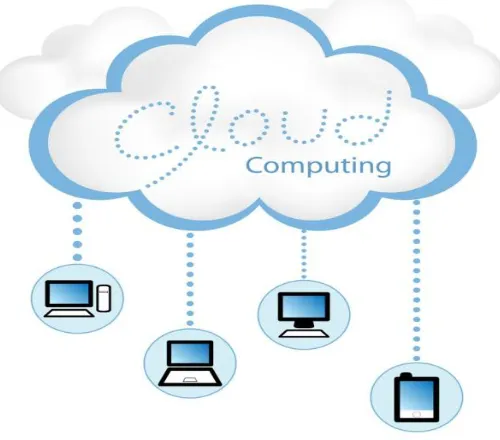
Fig. 1 Cloud Computing
1.1
Deployment models of cloud computing
In cloud computing, the available deployment models are: Public cloud, Hybrid cloud and Private cloud.
Public Cloud: A public cloud can be accessed by any subscriber who is having internet connection and has access
to the cloud space. Since there is an additional burden of ensuring that the data available on public cloud is not
subject to malicious attacks, it seems to be less secure than other cloud models.
Hybrid Cloud: A hybrid cloud is linked to one or more external cloud services. It is a mix of both public and
private clouds. Hybrid clouds allow more secure control of data and applications, allowing various parties to access
the internet.
Private cloud: A private cloud is the one that is set up within an enterprises data centre. It is established for a
specific group or organization and can be accessed by only the particular group or organization. Utilization on
1.2
Service models
Cloud computing provides services according to three fundamental service models:
1) Infrastructure as a service(IaaS)
2) Platform as a service(PaaS)
3) Software as a service (SaaS)
Infrastructure as a Service (IaaS): This model involves outsourcing the equipment required to support operations,
including storage, hardware, servers and networking components.
Platform as a Service (PaaS): It is a platform which allows cloud consumers to develop cloud services and
application directly on the cloud. It hosts both completed and in-progress cloud applications.
Software as a Service (SaaS): It is a software distribution model in which applications are provided by a service
provider and made available to customers over a network. It hosts only the completed Cloud applications
II LITERATURE REVIEW
2016 Nikeetaa P. Choudharri, Ms. Kanchan M. Varpe, [1]
The authors have proposed a technique that makes use of threshold cryptography. Here the data owner partitions
clients into groups and provides a single key to each group for decoding oaf information. Every client in the
gathering shares parts of the key. This plan provides data confidentiality and also lessens the quantity of keys.
Additionally it provides user revocation and manages access control. The proposed system has utilized ability list to
guarantee fine grained access control of outsourced information.
2016 Nancy Garg, Kamalinder Kaur [2]
Here the authors have used hybrid approach for secure data storage on cloud. It is necessary to secure the data stored
by users on cloud and maintain their confidentiality. Here the loaded image is encrypted and is hidden by the cover
image. Thus the original content is not visible. Spatial domain technique least significant Bit (LSB) substitution is
commonly used. Here the secret message bits replace the least significant bit of each pixel.
2016 Keerthana G, Dr. Prabu S, Dr. Swarnalatha P [3]
Cloud computing is a technology where virtual shared servers provide various facilities to clients on a
pay-as-you-use basis. Here the important points of interest include unlimited storage, backup and recovery. In this paper, firstly
the record is taken from client and then partitioned. After partitioning, all recorded parts are encrypted and sent to
various cloud servers. At the point when client needs that information, it is taken back from cloud servers and
decrypted. After decryption the information is merged and offered to the client.
2015 Prachi Shah [4]
Today is the need of low-maintenance system which automates administration daily. There is a need of access
control over network so that data security is ensured. In an organization Role-based access control (RBAC) method
controls access to network resources based on the role given to an individual. Here the roles are defined according to
job skill, authority, and responsibility within an organization. In RBAC, roles can be easily created, changed, or
2015 Sushil Kr Saroj, Sanjeev Kr Chauhan, Aravendra Kr Sharma and Sundaram Vats [5]
In this paper the authors have presented an approach which provides security for data outsourced at CSP. By
employing the threshold cryptography at the user side, the outsourced data is protected from collusion attack. Since,
DO stores its data at CSP in encrypted form and keys are known only to DO and respected users group, data
confidentiality is ensured. To ensure fine-grained access control of outsourced data, capability list has been used.
Public key cryptography and MD5 ensure the entity authentication and data integrity respectively. Public key
cryptography and D-H exchange protected the data from outsiders in this approach. Number of keys has reduced in
the proposed scheme.
2014 Ruj, Sushmita [6]
The authors have proposed a decentralized access control scheme for secure data storage. This technique supports
anonymous authentication. Here the cloud verifies the authenticity of the user without knowing the user’s identity
before storing data. The feature of access control in this scheme allows only valid users to decrypt the stored
information. The scheme prevents replay attacks and supports creation, modification, and reading of data stored in
the cloud.
III . PROBLEM FORMULATION
Cloud computing is a technique that provides storage and computing at a very low cost. However the most important
task here is to ensure the confidentiality, integrity and access control of data. Various approaches are given to ensure
these security requirements but they lacked in some ways such as collusion attacks and heavy computation. In the
existing base paper, authors have proposed a scheme that uses threshold cryptography. Here the data owner divides
users in groups and provides single key to each user group for decryption of data. Each user in the group shares a
part of the key. The authors have used capability access to control data access. The capability list specifies the
authorized data and operations for a user. In threshold cryptography no member of any group knows about the whole
key. Data can be decrypted when at least threshold number of users will be present. Although this scheme improves
the performance by reducing the number of keys, it is not too efficient. After getting the encrypted message the
user’s main concern is to decrypt the data. The process of decryption requires a certain number of users need to be
present. Each user in the group needs to update the PKS vector and decrypts a part of the message with their key
component. Although this technique provides security, the process of decryption of data seems to be time
consuming. Hence it can affect the performance of the system.
IV. PROPOSED MODEL
In this research, we have proposed a cloud data security model for the cloud storage using third party auditors. This
technique will be implemented by combining various techniques together to achieve the data security and data
privacy goal. The techniques included in the combination would be Encryption of data, Compression, key exchange
and divining the user groups. Encryption will store the data in cipher form, compression scheme reduces the size of
group has access to relevant data. This means, if a hacker will attack and download the data, he will have to work
hard a lot to access the data caused by the mathematical computations to generate the key and decrypt the data. Then
the data encryption will be used to create a completely unreadable and hashed data. The combined scheme will be
called as PCP-MABE (Pipeline Cipher Policy- Multiple Attribute Based Encryption).
V. RESULT ANALYSIS
Security Analysis
This section analyzes various attacks on cloud and our defense mechanisms.
System Bootstrap: During the system bootstrap in cloud nodes, the hackers can attempt to inject the malicious
content or malware on the cloud nodes. The proposed solution is self adaptive. Hence, every node is made capable
so that they can take care of their own security. The node authenticates the nodes only after they share a key table of
certain measurement. The randomized key from secure key table is used for verifying the received data, which
defends system from penetration attacks for malware injection.
Key Life-cycle Operations: Hackers can try to change the key tables saved on the nodes or to change the key
generation policy by tweaking into the node software. The nodes will not change the table on any of the hacking
attempt by sending the data to the cloud nodes. Data of only those nodes will be accepted which are replying with
the reply keys. The key table is generated using high randomization based secure code generation technique. This
technique does not hold any computational dependency on the base key. So the hackers can’t gain access and can’t
change key information table.
Key Generation and Usage Control:The key generation policy used in the proposed model is based on the high
randomization and mathematical array value shuffling operation, which creates highly randomized and
undependable numeric keys. Any key in the key table can’t be calculated mathematically in order to find the next
key in the table. Unauthorized applications and hackers cannot bypass the cloud scheme running on the sensor nodes
because, to gain the authority to send the data to the sensor nodes, one has to obtain the authorization by sending a
reply or response key in return to the request or question key However, this administrative operation can be recorded
in the sensor node audit log and held accountable.
Graphical Analysis of Implementation
Entropy of the Key Generation Scheme in Cloud: Entropy is the quantitative measure of disorder or randomness
in a system. High entropy means higher security.
The following figure shows the entropy comparison of implemented scheme with ECG/EEG scheme. The
implemented scheme has higher entropy as compared to ECG/EEG scheme which means it has more randomness on
Figure 2: Entropy comparison of keys generated for 10 subjects.
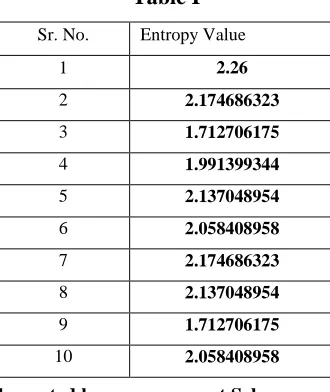
Table I
Sr. No. Entropy Value
1 2.26
2 2.174686323
3 1.712706175
4 1.991399344
5 2.137048954
6 2.058408958
7 2.174686323
8 2.137048954
9 1.712706175
10 2.058408958
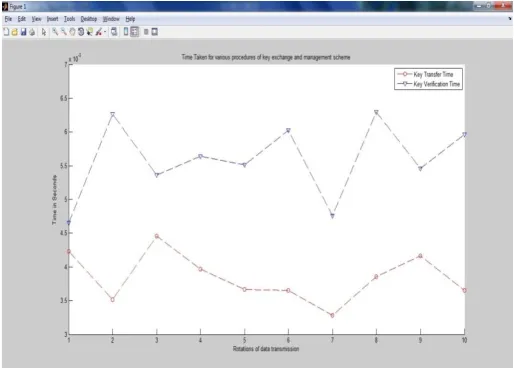
Time comparisons for Implemented key management SchemeThe time taken by various processes in the key management has recorded in the form of graphs and figures. The
MATLAB simulator is used for plotting these procedures. Various procedures for which time is recorded are Key
Figure 3: Time Comparison between variables of key management scheme.
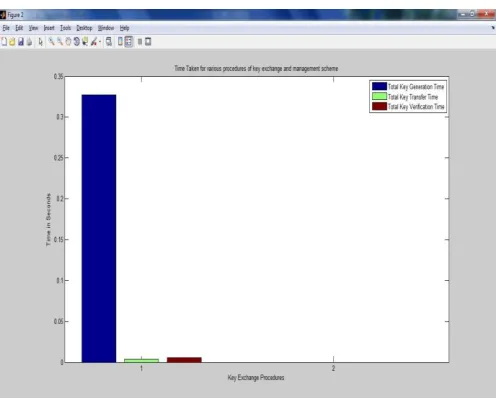
The figure shows that only at first time the key generation time is high as compared to others. As key generation is
done at starting so further there is no time devoted to key generation.
As there is a large difference between key generation and other variable so the following figure compare only key
transfer and key verification. As it is shown in figure the key transfer and key verification time is very less ranges
from 3 to 7 milliseconds.
Figure 5: Total time comparison between variables of key management scheme.
The following figure shows Bar Graph presentation of key generation, key transfer and verification schemes. Others
were compared for each key this is for total times taken.
V. CONCLUSION
In this research, we have proposed a cloud data security model for the cloud storage using third party auditors.
Various approaches have been given to secure the outsourced data, but they have been suffering from having
collusion attacks and large number of keys. By implementing the technique of encryption and data compression, we
protect outsourced data from collusion attack. Moreover there is an improvement in the performance of system as
the data transmission time is low and the space required for data storage is also quite low. The scheme has used
capability list to ensure fine-grained access control of outsourced data. User can access data from cloud based upon
authorization and access permission policies.
REFERENCES
[1] Dr. L. Arockiam and S. Monikandan, Data Security and Privacy in Cloud Storage using Hybrid Symmetric
Encryption Algorithm, International Journal of Advanced Research in Computer and Communication
Engineering Voume. 2, Issue 8, 2013.
[2] Nancy Garg and Kamalinder Kaur, Hybrid information security model for cloud storage systems using hybrid
data security scheme, in International Research Journal of Engineering and Technology (IRJET), Volume 03
Issue 04 , 2016.
[3] Nikeetaa P. Choudharri, and Ms. Kanchan M. Varpe, A stable Data Security in Cloud Computing Using
Threshold Cryptography and User Revocation, International Journal on Recent and Innovation Trends in
[4] Priya jaiswal, Randeep kaur, Ashok Verma, Privacy and Security on Cloud Data Storage Using Hybrid
Encryption Technique, in International Journal of Emerging Technology and Advanced Engineering (IJETAE),
Volume 4, Issue 1, 2014.
[5] Prachi Shah, Data Security for Cloud Storage System Using Role Based Access Control, in International
Journal of Science and Research (IJSR),Volume 4 Issue 1,2015.
[6] Sushil Kr Saroj, Sanjeev Kr Chauhan, Aravendra Kr Sharma and Sundaram Vats, Threshold Cryptography
Based Data Security in Cloud Computing, in IEEE International Conference on Computational Intelligence &