National Conference on Recent Trends and Developments in Environmental and Basic Sciences (RTDEBS-2018) Organized by, Faculty of Science In collaboration with
Internal Quality Assurance Cell (IQAC), Dr. S. D. D. Arts College & Commerce & Science College, Maharashtra, India. Association with International Journal of Scientific Research in Science and Technology © 2018 IJSRST | Volume 4 | Issue 3 | Print ISSN: 2395-6011 | Online ISSN: 2395-602X
Thermal Studies of Thiazole Schiff Base Metal Complexes of
Co(II), Ni(II), Cu(II), Cr(III), Mn(III), Fe(III), VO(IV), Zr(IV) and
UO2(IV)
S. R. Kelode
Department of Chemistry, Arts, Commerce and Science College, Maregaon, Maharashtra, India
ABSTRACT
A newly synthesize thiazole Schiff base has been prepared by the condensation of 2-hydroxy-5-chloro-3-nitro acetophenone and thiazole. The ligand was characterized by elemental analysis and spectral methods. The newly synthesize thiazole Schiff base and metal complexes with Co(II), Ni(II), Cu(II), Cr(III), Mn(III), Fe(III), VO(IV), Zr(IV) and UO2(VI) have been prepared and characterized by elemental analysis, molecular weight
determinations, conductance measurements, spectral and thermal studies. The isolated products are coloured solids, soluble in DMF, DMSO and THF.
Keywords: Schiff base, Magnetic susceptibility, Thermal,
I.
INTRODUCTION
Schiff’s bases, widely used as analytical reactants and have been studied for chemistry.1 Antimicrobial
evaluation of 2-amino pyridine-derived Ligand Schiff base and its complexes with Cu (II), Hg (II), Ni (II), Mn (II) and Co (II)2. Schiff bases metal complexes
have many applications in different fields. TheSchiff bases derived from thiazole and substituted acetophenone have been widely used as ligand for the synthesis of transition metal complexes. Thiazole Schiff base ligands and their metal complexes are biologically active3 and are known for their biological
application4 i.e. one of the drug in cytotoxicity of
anticancer5. The aim of present investigation is to
synthesize various transition metal complexes of
Schiff base derived from 2-hydroxy-5-chloro
acetophenone and 4-(p-hydroxyphenyl)-2 amino thiazole
II.
EXPERIMENTAL
All the chemicals were of A.R. grade and used as received. 2-hydroxy-5-chloro-3-nitro acetophenone (HCNA) and 4-(p-hydroxyphenyl)-2 amino thiazole was prepared by known methods6-9. The solvents were
purified by standard methods10.
Synthesis of 4-(phydroxyphenyl)-2aminothiazole;
Synthesis of 2-hydroxy-5-chloro-3-nitro
was refluxed on a water bath for 4h. After cooling a pale yellow coloured crystalline solid was separated out. It was filtered and washed with ethanol, crystallized from DMF and dried under reduced pressure at ambient temperature. The purity of ligand was checked by elemental analysis and m.p. It was
also characterized by IR and 1H NMR spectral studies.
Yield:70%; m.p. 3100C
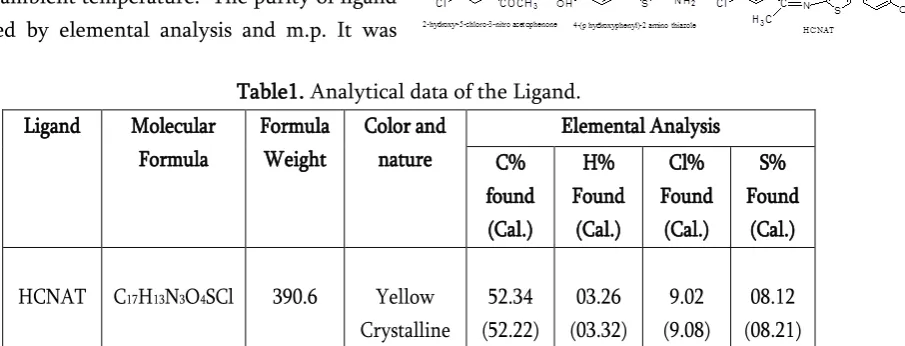
Table1. Analytical data of the Ligand.
Ligand Molecular
Formula
Formula Weight
Color and nature
Elemental Analysis C%
found (Cal.)
H% Found
(Cal.)
Cl% Found
(Cal.)
S% Found
(Cal.)
HCNAT C17H13N3O4SCl 390.6 Yellow
Crystalline
52.34 (52.22)
03.26 (03.32)
9.02 (9.08)
08.12 (08.21)
Preparation of complexes: All the metal complexes were prepared in a similar way by following method. To a hot solution of ligand HCNAT (0.02M) in 25ml of ethanol a suspension of respective metal salts was added drop wise with constant stirring.
Table 2. Analytical data and molar conductance of the compounds.
Ligand Formula
weight g mole-1
Colour Elemental Analysis
Found (Calcd.)
µeff
B.M
M
(Ω-1
cm2
mol-1)
M% C% H% Cl%
[CoL2(H2O)2] H2O 892.1 Brown 6.25 44.86 3.25 7.70 4.6 6.8
(6.60) (45.73) (3.36) (7.95)
[NiL2(H2O)2] H2O 891.9 Green 6.30 45.58 3.16 7.72 3.1 7.6
(6.58) (45.74) (3.36) (7.96)
[CuL2(H2O)2] H2O 896.7 Brown 6.90 45.26 3.12 7.72 1.6 8.2
(7.08) (45.50) (3.34) (7.91)
[CrL2(H2O)Cl] H2O 902.7 Green 5.32 44.90 2.36 11.08 3.8 18.6
(5.76) (45.19) (2.88) (11.79)
[MnL2(OAc)] H2O 929.1 Brown 5.40 46.15 3.16 7.32 4.6 18.4
(5.90) (46.49) (3.33) (7.64)
[FeL2(H2O)Cl] H2O 906.6 Black 6.02 44.81 3.02 11.41 5.2 22.2
(6.16) (45.00) (3.08) (11.74)
[VOL2] 846.2 Green 5.63 48.01 2.15 8.32 1.4 12.4
(6.02) (48.21) (2.83) (8.39)
[ZrL2 (OH)2] 2H2O 940.4 Yellow 9.48 43.13 3.06 7.26 Dia 16.2
(9.69) (43.38) (3.19) (7.54)
The reaction mixture was refluxed on a water bath for 4-5 h. The precipitated complexes were filtered, washed with ethanol followed by ether and dried over fused calcium chloride. Yield : 50-55%. The complexes are soluble in DMSO and DMF but insoluble in water and common organic solvents. The metal chloride content of complexes were analyzed by standard methods11-12 The 1H NMR spectra of ligand
was recorded and obtained from RSIC Chandigarh. IR spectra of the compounds were recorded on Perkin Elmer 842 spectrophotometer in the region 400-4000cm-1, Carbon, Hydrogen and Nitrogen analysis
were carried out at RSIC, Punjab University, Chandigarh. The molar conductance of the complexes at 10-3 M dilution in DMF were determined using
equiptronic digital conductivity meter EQ-660 with a cell constant 1.00 cm-1 at room temperature. The
magnetic moment measurement were made on a Gouy balance at room temperature using [HgCo(SCN)4]
as the calibrant. The thermogravimetric analysis were performed on laboratory set up apparatus in air atmosphere at 100 C min-1 heating rate. The molecular
weights of the complexes were determined by Rast method.
III.
RESULT AND DISCUSSION
The Schiff base HCNAT and its complexes have been characterized on the basis of 1H NMR, IR spectral data,
elemental analysis, molar conductance, magnetic susceptibility measurements and thermo gravimetric analysis data. All these values and analytical data is consistent with proposed molecular formula of legend. All the compounds are coloured solid and stable in air. They are insoluble in water but soluble in coordinating solvents like DMF and DMSO. The molar conductance values in DMF (10-3 M) solution at
room temperature (Table2) shows all the complexes are non electrolytes. The 1H NMR spectra of ligand
HCNAT shows signals at δ 12.11, (1H, s phenolic OH), δ 9.52 (1H, s, phenolic OH ), δ 7.56, 7.54, 7.53 and 7.52 (4H, m, phenyl) δ 6.81, 6.80, and 6.78(3H, s Phenyl), 6.68 (1H s thiophene), and 2.56(3H, s, methyl) 11,13-15. IR spectra of ligand and metal
complexes shows (C=N) peaks at 1620 cm-1 and
absence of C=O peak at around 1700 – 1750 cm-1
indicates the Schiff base formation16-19.
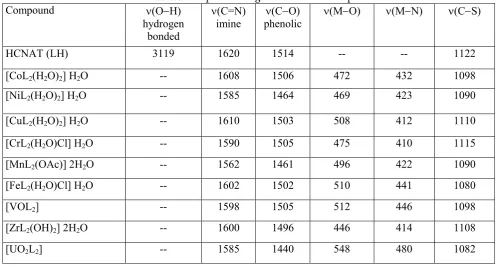
Table 3. IR spectra of ligand and metal complexes
Compound (OH)
hydrogen bonded
(C=N) imine
(CO)
phenolic
(MO) (MN) (CS)
HCNAT (LH) 3119 1620 1514 -- -- 1122
[CoL2(H2O)2] H2O -- 1608 1506 472 432 1098
[NiL2(H2O)2] H2O -- 1585 1464 469 423 1090
[CuL2(H2O)2] H2O -- 1610 1503 508 412 1110
[CrL2(H2O)Cl] H2O -- 1590 1505 475 410 1115
[MnL2(OAc)] 2H2O -- 1562 1461 496 422 1090
[FeL2(H2O)Cl] H2O -- 1602 1502 510 441 1080
[VOL2] -- 1598 1505 512 446 1098
[ZrL2(OH)2] 2H2O -- 1600 1496 446 414 1108
Thermogravimetric studies:
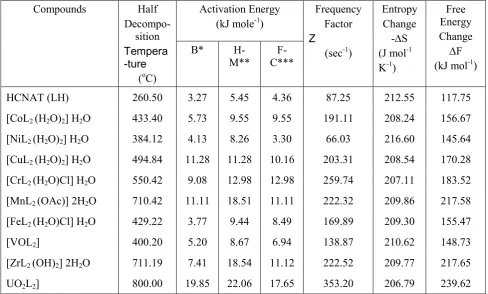
Thermogravimetric study indicates all the complexes are stable up to 60-700C. All the complexes shows half
decomposition temperature(Table 4). The Thermal activation energy was calculated by Freeman-Carroll20,
Horowitz-metzger21 and Broido22 method.
Table 4. Thermal decomposition data of HCNAT and its complexes.
Compounds Half
Decompo-sition
Tempera -ture
(oC)
Activation Energy (kJ mole-1)
Frequency Factor
Z
(sec-1)
Entropy Change
-∆S (J mol-1
K-1)
Free Energy Change
∆F (kJ mol-1)
B*
H-M**
F-C***
HCNAT (LH) 260.50 3.27 5.45 4.36 87.25 212.55 117.75
[CoL2 (H2O)2] H2O 433.40 5.73 9.55 9.55 191.11 208.24 156.67
[NiL2 (H2O)2] H2O 384.12 4.13 8.26 3.30 66.03 216.60 145.64
[CuL2 (H2O)2] H2O 494.84 11.28 11.28 10.16 203.31 208.54 170.28
[CrL2 (H2O)Cl] H2O 550.42 9.08 12.98 12.98 259.74 207.11 183.52
[MnL2 (OAc)] 2H2O 710.42 11.11 18.51 11.11 222.32 209.86 217.58
[FeL2 (H2O)Cl] H2O 429.22 3.77 9.44 8.49 169.89 209.30 155.47
[VOL2] 400.20 5.20 8.67 6.94 138.87 210.62 148.73
[ZrL2 (OH)2] 2H2O 711.19 7.41 18.54 11.12 222.52 209.77 217.65
UO2L2] 800.00 19.85 22.06 17.65 353.20 206.79 239.62
IV.
CONCLUSIONS
In conclusion, we have synthesized new ligand
2-hydroxy-5-chloro-3-nitro acetophenone
4-(p-hydroxyphenyl)-2 imino thiazole and their metal complexes. Ligand was found to bind the metal ion
monobasic (ON) bidentate manner.
Thermogravimetric analysis concluded water loss in metal complexes from the nature of thermograms and half decomposition temperature.
V.
REFERENCES
[1]. Aghera V.K. and Parsania P. H., J. Sci. and Ind. Res.,2008, 67, 1083.
[2]. Rehab K A.S., Wurood A J., and Ali N N., J. Pharma, Bio and Chem Sci., 2017, 8(3), 174.
[3]. Raziya S., Mohan S. and Rao S.,Indian J. Chem., 2007, 46B, 884.
[4]. Kumar S.,Dhar D.and Saxena P.,J. Sci.and Indu.Research, 2009, 68, 181.
[5]. Reji T., Devi S,Thomas K., Sreejalekshmi K., Manju S., Francis M.,.Philip S , Bharathan A., and Rajasekharan K.,Indian j. Chem., 2008, 47B, 1145.
[6]. Aswar A., Bahad P.,.Pardhi A. and Bhave N.,J. Poym. Mater. 5, 232 (1988).
[7]. Pattan S.,.Ali M,Pattan J., Purohit S., Reddy V. and Nataraj B., Indian J. Chem., 45B, 2006, 1929.
[8]. Khrustalev D., Suleimenova A. and Fazylov S., Russian J. App. chem., 81(5), 2008, 900 [9]. Maradiya H.,and Patel V.,J. Fibers and poly.,
[10]. Furniss B.,Hannaford A., Smith P. and Tatchell A., Vogel’s practical organic chemistry 5 thEd. (Logman Scientific Technical, John Wiley and Sons), (1989).
[11]. Sadigova S., Magerramov A.and Allakhverdiev M., Russian J. Org. chem., 81(5), 2008, 900. [12]. Vogel AI, “A Text book of quantitative inorganic
chemistry”3thEd., (ELBS,London,1961). [13]. Campbell E. and Nguyen S.,J. Tetrahedron, 42,
2001, 1221.
[14]. Pietikainen P. and Haikarainen A. J. Mole. Catalysis., 180, 2002, 59.
[15]. Kidwai M., Poddar P. and Singhal K., Indian J. Chem., 48B, 2009, 59.
[16]. Sonwane S., Srivastava S. and Srivastava S.,Indian J. Chem., 47B, 2008 633.
[17]. Patel K. and Mehata A.,E. J. Chem., 3(13), 2006, 267.
[18]. Maurya R.,Antony D., Gopinathan S., Puranic V., Tavale S.and Gopinathan C., Bull. Chem. Soc. Jpn., 68, 1995, 2847.
[19]. Boghaei D.and Mohebi S.J. Tetrahedron, 58, 2002, 5357.
[20]. Mallikarjun K., E. J. Chem., 1(2), 2004, 105. [21]. Horowitz H. and Metzger G.,Anal. Chem., 35,
1963, 1464.