ISSN (e): 2250-3021, ISSN (p): 2278-8719
Vol. 08, Issue 10 (October. 2018), ||V (IV) || PP 38-47
Comparative Analysis of CCTV Video Image Processing
Techniques and Application: A Survey
Varshali Jaiswal , Varsha Sharma2, Sunita Varma3
1 Research scholor, Information Technology,RGPV, Bhopal,India 2 Assistant Professor, Information Technology,SOIT, RGPV, Bhopal,India
3 Professor, Information Technology,SGSITS, RGPV, Bhopal,India Corresponding Author: Varshali Jaiswal
Abstract:
Now a day’s security weak points are increases, for the prevention of attacks need to improve the CCTV (Close-Circuit Television) surveillance system. CCTV video image processing is one of the most applicable techniques uses of improving the CCTV surveillance system and information security. CCTV traffic video image processing is challenging task and required in many areas of where the image segmentation has to perform like background subtraction and foreground segmentation and moving object detection, real-time road Congestion detection, road sign, road surface state recognition and also for the traffic counting, speed measurement, queue length and vehicle classification. The goal of this paper gives a new direction of innovation in the CCTV video image processing in computer vision.
Key Words
—
Image Segmentation, Artificial Neural Network, Classification, Clustering, Evolutionary Approach, Computer Vision.--- --- Date of Submission: 16-10-2018 Date of acceptance: 31-10-2018 --- ---
I.
INTRODUCTION
Currently, there are many areas of application where CCTV video image processing required for example background subtraction and foreground segmentation and moving object detection, real-time road Congestion detection, road sign, road surface state recognition and also for the traffic counting, speed measurement, queue length and vehicle classification. Video image processing improves the efficiency of searching and retrieving the object in video. There are many techniques used for solving CCTV video image processing problem. The paper described firstly introduction then related work and problem description, comparative study and proposed method and their expected result, application and the last conclusion and future work.
II.
CLASSIFICATION
OF
VIDEO
IMAGE
PROCESSING
TECHNIQUES
FOR
CCTV
VIDEO
IMAGE
SEGMENTATION
A. Pre-Processing
The pre-processing is the first step to prepare the video for the next stage. The pre-processing is the first step to prepare the video for the next stage. The preprocessing remove image errors, noise introduced during the scanning and reading image, improving the quality of an image. The pre-processing steps involve color normalization, statistical method, and convolution method. The output of pre-processing would be ready for the next stage to perform complicated video sequences processing tasks on the video data..
B. Conversion to Grayscale
After the frame extracted from a video is to modify into grayscale for image processing purpose. The image is a collection of the pixel and every pixel defined by three different colors, Red, Green, and Blue. The method that will converts a color image into a gray-scaled image using equation 1. And figure 1 show the result of a color image into the gray image.
Figure 1: Conversion to Grayscale
C. Background Subtraction
The background subtraction, is the method of removing the background image from the real image for the purpose of video sequences processing become simple.it is also known as foreground extraction (car, text, human) and used for detecting the moving object, the region of interest etc. After the background subtraction output image pixel is represented by O(x,y) and the input image represented by I(x,y) and B(x,y) is used to represent for the background image. The equation that used for background subtraction is given by equation 2, and result after background subtraction showing figure 2.
O(x , y) = I(x , y) – B(x , y) (2) Figure 2: Background Subtraction
D. Image Segmentation
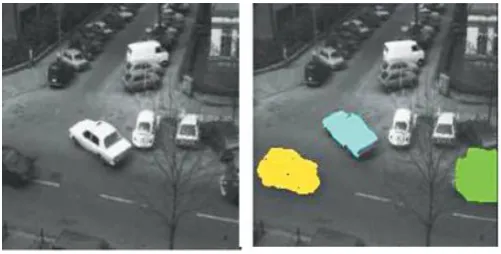
Image segmentation is computer vision techniques in which groups sharing the similar properties, for example, a group having same color pixels or border and a common shape such as a line, circle or ellipse or polygon. Image segmentation further classified as edge detection, region-based classification, thresholding, or any combination of these techniques. After the segmentation result shown in figure 3 is the set of classified pixel elements.
Figure 3: Image Segmentation
E. Image Enhancement
Figure 4: Image Enhancement
F. Object Detection
In video sequences, Object detection determines the presence of an object, and locations in the image. Object detection can be classified into soft detection, which only detects the presence of an object, and hard detection, which detects both the presence and location of the object. Object detection is computer vision applications include recognition, automotive safety, and surveillance. Object detection is the process of finding an object of real-world in video sequences.
Figure 5: Object Detection
G. Region of Interest
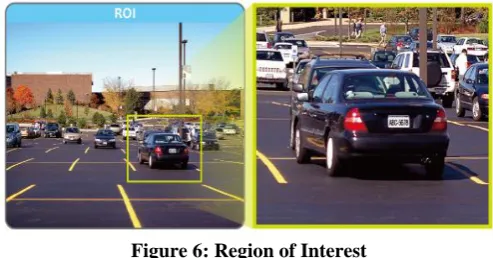
The ROI shows a selected area from video sequences to split frame. It gives more details information about an image without changing the view angle. It is sometimes of interest to process single parts of an image, leaving other portion unchanged. This is known as region-of-interest (ROI).
Figure 6: Region of Interest
III.
LITERATURE
SURVEY
In this section discuss the different type of CCTV Video Image processing techniques. In the last decade, there are different methods introduced which are based on Artificial neural network and evolutionary algorithm for CCTV Video Image processing. Our proposed survey work is focused on CCTV Video Image processing. There are different CCTV Video Image processing techniques which are used in last decade.
on CCTV traffic video can be extended to detect the object in bad weather situation such as fog and rain and also extend for the detection of moving object detection [3].
Jiandong Zhao, Hongqiang Wu, and Liangliang Chen, ―Road Surface State Recognition Based on SVM Optimization and Image Segmentation processing‖ The proposed method based on SVM algorithm and image segmentation processing technology, the author suggested video image processing techniques for road surface state recognition. The method extends for recognize road surface conditions and image recognition. The extended method has accuracy for recognition of hybrid road conditions and different lighting conditions [4].
Kh Tohidul Islam and Ram Gopal Raj, ―Real-Time (Vision-Based) Road Sign Recognition Using an Artifical neural network.‖ The author proposed method for detection and recognition target object and road sign. The system has limitation that signs obscured by other vehicles or trees may not be recognized [5].
Vandta Tiwari, Deepak Choudhary and Varun Tiwari,―Foreground segmentation using GMM combined temporal differencing‖ The proposed method used for detecting the moving object in a CCTV video. The proposed work used for Gaussian mixture model for Background subtraction and temporal differencing for foreground segmentation. The method can extended for relegating difference object class to detect concrete target [6].
Li Wei, Dai Hong-ying, ―Real-time Road Congestion Detection Based on Image Texture Analysis‖, the author proposed method used for real-time road Congestion detection Based on Image Texture analysis. The proposed method based on image texture feature extraction and texture analysis and used to human-computer interaction for set vehicle area. This method faster than the background training method and more suitable to the select area of interesting. Author also estimated vehicle density by texture features. The authors suggested this method merged with road video surveillance system to provide fast and reliable road information to the traffic management system [7].
Ye Li , Fei-Yue Wang ―Vehicle detection based on And–Or Graph and Hybrid Image Templates for complex urban traffic conditions‖ the author proposed method for vehicle detection using AOG and HITs approach to solving the vehicle obstacle problem in an urban traffic situation. In this method construct an AOG to represent the vehicle object in an urban traffic situation, and then fill the parameters in the AOG, and distinguish the vehicles by using a bottom-up approach. The proposed method does not give attention to the night traffic situation and detection of side-view vehicles [8].
Riza Atiq bin O.K. Rahmat ―Vehicle detection using image processing for traffic control and survellance system‖ The proposed method based on the computer vision algorithms for traffic counting, speed measurement, vehicle queue length and vehicle grouping. The algorithm has some limitation that the first main reason for the error during the daytime is for walker passing through the detectors causing the locator pixels to interchange and to detect vehicles of the same color with that of the road surface. .The proposed method can extend by using a high-performance computer system, and multimedia video blaster as the image grabber and color CCTV camera [9].
Giuseppe Guido, Alessandro Vitale, Frank F. Saccomanno, Vittorio Astarita, Vincenzo Giofrè ―Vehicle tracking system based on videotaping data‖ The author explored the effect of the number of GCP(ground control points), camera viewing angle and the deflection angle on the accuracy of the detected vehicle and they were examined, two different geo-referencing models and the results suggest that the projective transformation model have better accuracy than the linear affine model. The method results suggest that the camera viewing angle did not have a significant effect on tracking error and the deflection angle was found to have a significant effect on this error for the angles chosen. The proposed method can extend for Error detection in the video image processing algorithm is caused by camera placement (height and offset distance) and by the deflection of the line of sight with respect to the roadway. The accuracy of proposed video image processing algorithm can be improved by using new modules or subroutines bypassing some limitations, such as the impossibility of tracking vehicles along a curvilinear segment [10].
Y. Dupuisl, P. Subirats1 and P. Vasseur, ―Robust Image Segmentation for Overhead Real Time Motorbike CountingThe proposed a method to segment and classify vehicles from CCTV video traffic images. The proposed method is a combination of the MoG algorithm and processed Laplacian images. This combination setup to handle cast shadows that usually combined different vehicles into a single spot. Then, they also show that simple features can be used to distribute these spots. The performance of proposed algorithm is highlighted on various traffic lighting conditions and video. The proposed algorithm was not able to deal with evening and night time and not be efficient to deal with densely congested situations. The method can extend focused on adding more vehicle classes to the classifier. They wish to improve the algorithm to be able to deal with evening and night time and also for tracking strategy in order to deal with densely congested situations [11].
analyze three traffic states like congestion and slow speed, and smooth speed, which are the main issue in traffic management system. The efficiency of a proposed method should be improved for traffic speed and road space occupancy estimation and also for calculating adaptive traffic parameter thresholds value [12].
Thanh Bui-Minh, Ovidiu Ghita, Paul F. Whelan, and Trang Hoang ―A Robust Algorithm for Detection and Classification of Traffic Signs in Video Data‖ The author proposed algorithm for traffic sign recognition. In this method, color image segmentation is used for traffic sign reorganization with respect to color and shape information and Support Vector Machine for traffic sign classification. The author does not give address description and recognition of route confirmation traffic signs. Because the traffic signs are not standardized and they are not used to regulate the traffic. The proposed method will be extended for the implementation of traffic sign tracking algorithms that can be used to enhance the confidence of the traffic sign recognition and also for recognition of a larger set of traffic signs and on the automatic identification of the traffic lights [13].
Yen-Lin Chen, Bing-Fei Wu, Hao-Yu Huang, and Chung-Jui Fan ―A Real-Time Vision System for Nighttime Vehicle Detection and Traffic Surveillance‖ The proposed algorithm is an efficient method for nighttime vehicle detection and tracking system for determining and classifying moving vehicles for traffic surveillance.
The technique is applicable when dealing with different illumination conditions, traffic flows, and road environments for nighttime traffic surveillance.
The experiment result shows that proposed algorithm does not perform well on detecting vehicles under traffic congestion conditions, and many occlusions and misdetections occur when they are closely moved by a large amount.
The proposed algorithm can be extended for vehicle type classification function and integrate machine learning techniques for classification on multiple features. It can also be extended for classification capability for vehicle types (buses, trucks, lorries, motorbikes.) [14].
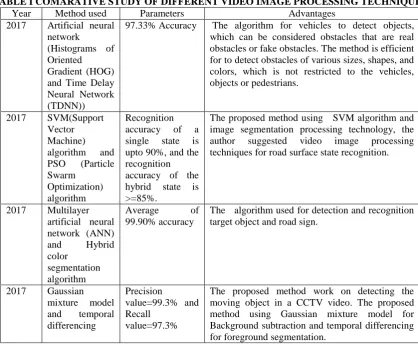
Now discuss the comparative study of different video image processing techniques which is based on Artificial intelligence and evolutionary approach. In this comparison discuss different method and its advantages use.
TABLE I COMARATIVE STUDY OF DIFFERENT VIDEO IMAGE PROCESSING TECHNIQUES
Year Method used Parameters Advantages
2017 Artificial neural network
(Histograms of Oriented Gradient (HOG) and Time Delay Neural Network (TDNN))
97.33% Accuracy The algorithm for vehicles to detect objects, which can be considered obstacles that are real obstacles or fake obstacles. The method is efficient for to detect obstacles of various sizes, shapes, and colors, which is not restricted to the vehicles, objects or pedestrians.
2017 SVM(Support Vector Machine) algorithm and PSO (Particle Swarm
Optimization) algorithm
Recognition accuracy of a single state is upto 90%, and the recognition accuracy of the hybrid state is >=85%.
The proposed method using SVM algorithm and image segmentation processing technology, the author suggested video image processing techniques for road surface state recognition.
2017 Multilayer artificial neural network (ANN) and Hybrid color
segmentation algorithm
Average of 99.90% accuracy
The algorithm used for detection and recognition target object and road sign.
2017 Gaussian mixture model and temporal differencing
Precision
value=99.3% and Recall
value=97.3%
2016 Image processing technology
Accuracy 99% Method for real-time road Congestion detection Based on Image Texture analysis. Image grayscale relegation, and gray level co-occurrence matrix calculation and feature extraction, vehicle density is reflected by energy and entropy is obtained from vehicle area.
2015 And–Or Graph and Hybrid Image
Templates
Precision
value=99.3% and Recall
value=97.3%
An algorithm used for a vehicle detection which based on an And–Or Graph (AOG) and Hybrid Image Templates (HITs). In this method AOG, the vehicle object is partition into different parts of the vehicle by up–down and left–right division to reduce the impacts of vehicle occlusion.
2015 Image Processing algorithms
Coefficient of determination (R^2) two data sets are 0.99 during day time and 0.89 during night time.
The algorithm based on the image processing techniques for traffic counting, speed measurement, queue length and vehicle partition.
2014 Video extraction algorithm
The method explored the effect of the number of GCP (ground control points), camera viewing angle and the deflection angle on the accuracy of the detected vehicle and they were examined, two different geo-referencing models and the results suggest that the projective transformation model have better accuracy than the linear affine model. 2014 MoG algorithm
and Laplacian images
Motorcycle detection Rate 97.7%
The proposed method is used to segment vehicles from CCTV video traffic images. This is a combination of the MoG algorithm and processed Laplacian images. The robustness of proposed algorithm is recommended for various traffic video and lighting conditions.
2013 The proposed method an efficient traffic control
system by detecting and counting the vehicle numbers at various times and locations.
2013 Motion analysis method
Accuracy ratio during daytime is more than 85%,
and state
detection result is 30 seconds.
Method used for a detection of traffic state and used for detection of traffic state in a surveillance video. The system can automatically detect three typical traffic states like congestion and slow speed, and smooth speed, which are the main issue in traffic management system.
2012 Support Vector Machines
Accuracy 87.6% of sign detection, 99.2% of traffic sign classification and 86.7% overall traffic sign recognition
New approach for traffic sign recognition. In which involve color image segmentation for validation of the traffic sign candidate regions with respect to color and shape information and Support Vector Machine for traffic sign classification.
2011 Automatic multilevel histogram thresholding and clustering
Accuracy 96.% of detection rate
The proposed method for vehicle detection and tracking system for identifying and classifying moving vehicles in traffic surveillance. Method used for different illumination conditions, traffic flows, and road environments for nighttime traffic surveillance.
PROPOSEDMETHOD
in the field of video sequences segmentation. The following proposals can be taken forward during the tenure of the research work.
The proposed a method which will work in all types of situation night time, evening time and heavily congested area.
Extended to detect the object in bad weather condition such as fog and rain and also extend for the detection of moving object detection.
The method should be work for side-view vehicles, and the system gives very accurate results.
The proposed method using the artificial neural network and different image processing techniques for CCTV video image processing according to the situation. The proposed method will be able to detect and classify all the vehicles on the road and should help in solving problems like traffic rules violations and different lighting conditions.
A. Proposed Algorithm Steps
Step 1: Get the data i.e. CCTV video from the surveillance camera
Step 2: Apply moving object detection algorithm based on artificial neural network method Step 3: Extract the moving object and store it in database
Step 4: Identify types of situation like night, evening time and heavily congested area and also bad weather condition such as fog and rain
Step 5: Based on situation apply different image processing techniques
Step 6: compare the results with the already available algorithm and save the best one in a database. B. Expected Output
Using the proposed algorithm following outcomes is expected in due course of literature survey and the processed video sequences are posted as follows:
. Video frames are blurred can be segmented with nice quality and frames with clear boundary would be extracted.
. Only clear foreground video sequences would be left and information of the pixels which reside in the extracted boundaries.
. The proposed method gives better result in the night time, evening time and heavily congested area. . The accuracy of proposed system should be 99.9% expected.
C. Proposed System Flowchart
IV.
APPLICATIONS
Following are some application area where the proposed system will work System design, video image processing, edge detection, traffic queue detection, background subtraction, database management, Face recognition.
To monitors human activities and analysis to detect unnatural behaviors.
To traffic control and transportation, traffic sign detection and recognition, motion detection, fingerprint detection.
For People tracking, and driver-assistance system and moving object detection. Security system and military applications
Automatic people counting, access control, flow control, and attention control.
V.
CONCLUSIONS
This paper has investigated the recent development of CCTV video sequences processing, which is based on image processing techniques and Artificial intelligence. The proposed novelty is as follows. First, proposing artificial neural network based approach which will work on CCTV video sequences. Second, we proposed digital image processing techniques for features extraction of moving object and the last using concepts of artificial neural network and digital image processing techniques to detect moving object in bad weather condition like fog, rainy, and evening time, night time and also for light luminosity.
The expected experimental results will show using proposed method to detect moving object into video sequences, the accuracy could be as high as 99%, and the computation speed is very fast, which could be a demand of real-time video processing. The proposed approach would be integrated into road video surveillance system and banking video surveillance in the future and provide better results and fast computation.
REFERENCES
[1]. Zhou, J., Bao, X., Li, D. and Yin, Y., 2017, October. Traffic Video Image Segmentation Model Based on Bayesian and Spatio-Temporal Markov Random Field. In Journal of Physics: Conference Series (Vol. 910, No. 1, p. 012041). IOP Publishing.
[2]. Gadde, R., Jampani, V. and Gehler, P.V., 2017. Semantic video cnns through representation warping. CoRR, abs/1708.03088.
[3]. Varagula, J. and ITOb, T., 2017. Object Detection Method in Traffic by On-Board Computer Vision with Time Delay Neural Network. Procedia Computer Science, 112, pp.127-136.
[4]. Zhao, J., Wu, H. and Chen, L., 2017. Road Surface State Recognition Based on SVM Optimization and Image Segmentation Processing. Journal of Advanced Transportation, 2017.
[5]. Islam, K.T. and Raj, R.G., 2017. Real-time (vision-based) road sign recognition using an artificial neural network. Sensors, 17(4), p.853.
[6]. Tiwari, V., Chaudhary, D. and Tiwari, V., 2017, July. Foreground segmentation using GMM combined temporal differencing. In Computer, Communications and Electronics (Comptelix), 2017 International Conference on (pp. 426-430). IEEE.
[7]. Wei, L. and Hong-ying, D., 2016. Real-time road congestion detection based on image texture analysis. Procedia engineering, 137, pp.196-201.
[8]. Li, Y. and Wang, F.Y., 2015. Vehicle detection based on and–or graph and hybrid image templates for complex urban traffic conditions. Transportation Research Part C: Emerging Technologies, 51, pp.19-28. [9]. bin OK Rahmat, R.A. and bin Jumari, K., 2001, September. Vehicle Detection Using Image Processing
For Traffic Control And Surveillance System. In Universiti Kebangsaan Malaysia, 8th World Congress on ITS, Sydney.
[10]. Guido, G., Vitale, A., Saccomanno, F.F., Astarita, V. and Giofrè, V., 2014. Vehicle tracking system based on videotaping data. Procedia-Social and Behavioral Sciences, 111, pp.1123-1132.
[11]. Dupuis, Y., Subirats, P. and Vasseur, P., 2014, October. Robust image segmentation for overhead real time motorbike counting. In Intelligent Transportation Systems (ITSC), 2014 IEEE 17th International Conference on (pp. 3070-3075). IEEE.
[12]. Li, X., She, Y., Luo, D. and Yu, Z., 2013. A traffic state detection tool for freeway video surveillance system. Procedia-Social and Behavioral Sciences, 96, pp.2453-2461.
[13]. Bui-Minh, T., Ghita, O., Whelan, P.F. and Hoang, T., 2012, November. A robust algorithm for detection and classification of traffic signs in video data. In Control, Automation and Information Sciences (ICCAIS), 2012 International Conference on (pp. 108-113). IEEE.
[14]. Chen, Y.L., Wu, B.F., Huang, H.Y. and Fan, C.J., 2011. A real-time vision system for nighttime vehicle detection and traffic surveillance. IEEE Transactions on Industrial Electronics, 58(5), pp.2030-2044. [15]. Sajid, H. and Cheung, S.C.S., 2017. Universal multimode background subtraction. IEEE Transactions on
[16]. Janrao, A., Gupta, M., Chandwani, D. and Joglekar, U.A., 2017. Real Time Traffic Density Count using Image Processing. International Journal of Computer Applications, 162(10).
[17]. Maharjan, P.S. and Shrestha, A.K., 2015. Automatic Vehicle Detection and Road Traffic Congestion Mapping with Image Processing Technique. International Journal of Computer Applications, 114(16). [18]. Yuan, Z., Xie, X., Hu, J. and Yao, D., 2014. An Efficient Method for Traffic Image Denoising.
Procedia-Social and Behavioral Sciences, 138, pp.439-445.
[19]. Nagaraj, U., Rathod, J., Patil, P., Thakur, S. and Sharma, U., 2013. Traffic jam detection using image processing. International Journal of Engineering Research and Applications, 3(2), pp.1087-1091.
[20]. Zhu, Q., Heng, P.A., Shao, L. and Li, X., 2013, December. What's the Role of Image Matting in Image Segmentation?. In Robotics and Biomimetics (ROBIO), 2013 IEEE International Conference on (pp. 1695-1698). IEEE.
[21]. Janrao, A., Gupta, M., Chandwani, D. and Joglekar, U.A., 2017. Real Time Traffic Density Count using Image Processing. International Journal of Computer Applications, 162(10).
[22]. Abbas, N., Tayyab, M. and Qadri, M.T., 2013. Real Time traffic density count using image processing. International Journal of Computer Applications, 83(9).
[23]. Celiński, I. and Sierpiński, G., 2013. Traffic signal control system with extended logic in the context of the modal split. IERI Procedia, 4, pp.148-154.
[24]. Loce, R.P., Bernal, E.A., Wu, W. and Bala, R., 2013. Computer vision in roadway transportation systems: a survey. Journal of Electronic Imaging, 22(4), p.041121.
[25]. Gupta, P., 2013. A Survey Of Techniques And Applications For Real Time Image Processing. International Journal of Global Research in Computer Science (UGC Approved Journal), 4(8), pp.30-39. [26]. Daigavane, M. and Bajaj, P.R., 2010. Real-Time Vehicle Detection and Counting Method for Real Time
Vehicle Detection and Counting Method for Unsupervised Traffic Video on Highways Unsupervised Traffic Video on Highways. IJCSNS, 10(8), p.112.
[27]. Chan, A.B. and Vasconcelos, N., 2008. Modeling, clustering, and segmenting video with mixtures of dynamic textures. IEEE transactions on pattern analysis and machine intelligence, 30(5), pp.909-926. [28]. Semertzidis, T., Dimitropoulos, K., Koutsia, A. and Grammalidis, N., 2010. Video sensor network for
real-time traffic monitoring and surveillance. IET intelligent transport systems, 4(2), pp.103-112.
[29]. Vikram, N.R., Sivaraman, S. and Balamurugan, R., 2013. Controlling Traffic Jam using Feature Detection and Object Detection Technique. IOSR Journal of Mechanical and Civil Engineering (IOSR-JMCE).
[30]. Cruz Ortiz, J.E., 2012. Visual Servoing for an Omidirectional Mobile Robot Using the Neural network Multilayer Perceptron. IEEE: Engineering Applications (WEA).
[31]. Dalal, N. and Triggs, B., 2005, June. Histograms of oriented gradients for human detection. In Computer Vision and Pattern Recognition, 2005. CVPR 2005. IEEE Computer Society Conference on (Vol. 1, pp. 886-893). IEEE.
[32]. Maddalena, L. and Petrosino, A., 2008. A self-organizing approach to background subtraction for visual surveillance applications. IEEE Transactions on Image Processing, 17(7), pp.1168-1177.
[33]. Candamo, J., Shreve, M., Goldgof, D.B., Sapper, D.B. and Kasturi, R., 2010. Understanding transit scenes: A survey on human behavior-recognition algorithms. IEEE transactions on intelligent transportation systems, 11(1), pp.206-224.
[34]. Gandhi, T. and Trivedi, M.M., 2006. Vehicle surround capture: Survey of techniques and a novel omni-video-based approach for dynamic panoramic surround maps. IEEE Transactions on Intelligent Transportation Systems, 7(3), pp.293-308.
[35]. Aslani, S. and Mahdavi-Nasab, H., 2013. Optical flow based moving object detection and tracking for traffic surveillance. International Journal of Electrical, Computer, Energetic, Electronic and Communication Engineering, 7(9), pp.1252-1256.
[36]. Chamasemani, F.F. and Affendey, L.S., 2013. Systematic review and classification on video surveillance systems. Int. Journal Information Technology and Computer Science, (7), pp.87-102.
[37]. Prati, A., Mikic, I., Trivedi, M.M. and Cucchiara, R., 2003. Detecting moving shadows: algorithms and evaluation. IEEE transactions on pattern analysis and machine intelligence, 25(7), pp.918-923.
[38]. Sen-Ching, S.C. and Kamath, C., 2004, January. Robust techniques for background subtraction in urban traffic video. In Visual Communications and Image Processing 2004 (Vol. 5308, pp. 881-893). International Society for Optics and Photonics.
[39]. Cucchiara, R., Grana, C., Piccardi, M., Prati, A. and Sirotti, S., 2001. Improving shadow suppression in moving object detection with HSV color information. In Intelligent Transportation Systems, 2001. Proceedings. 2001 IEEE (pp. 334-339). IEEE
[41]. Kumar, P., Ranganath, S., Weimin, H. and Sengupta, K., 2005. Framework for real-time behavior interpretation from traffic video. IEEE Transactions on Intelligent Transportation Systems, 6(1), pp.43-53.
[42]. Cucchiara, R., Grana, C., Piccardi, M. and Prati, A., 2003. Detecting moving objects, ghosts, and shadows in video streams. IEEE transactions on pattern analysis and machine intelligence, 25(10), pp.1337-1342.
[43]. Kilger, M., 1992, November. A shadow handler in a video-based real-time traffic monitoring system. In Applications of Computer Vision, Proceedings, 1992., IEEE Workshop on (pp. 11-18). IEEE.
[44]. Ali, M.H., Kurokawa, S. and Shafie, A.A., 2013. Autonomous road surveillance system: A proposed model for vehicle detection and traffic signal control. Procedia Computer Science, 19, pp.963-970. [45]. Kastrinaki, V., Zervakis, M. and Kalaitzakis, K., 2003. A survey of video processing techniques for
traffic applications. Image and vision computing, 21(4), pp.359-381.
[46]. Bahlmann, C., Zhu, Y., Ramesh, V., Pellkofer, M. and Koehler, T., 2005, June. A system for traffic sign detection, tracking, and recognition using color, shape, and motion information. In Intelligent Vehicles Symposium, 2005. Proceedings. IEEE (pp. 255-260). IEEE.
[47]. Nadimi, S. and Bhanu, B., 2004. Physical models for moving shadow and object detection in video. IEEE transactions on pattern analysis and machine intelligence, 26(8), pp.1079-1087.
[48]. Morris, B. and Trivedi, M., 2006, September. Robust classification and tracking of vehicles in traffic video streams. In Intelligent Transportation Systems Conference, 2006. ITSC'06. IEEE (pp. 1078-1083). IEEE.
[49]. Chan, A.B. and Vasconcelos, N., 2005, June. Classification and retrieval of traffic video using auto-regressive stochastic processes. In Intelligent Vehicles Symposium, 2005. Proceedings. IEEE (pp. 771-776). IEEE.
[50]. Morris, B. and Trivedi, M., 2006, November. Improved vehicle classification in long traffic video by cooperating tracker and classifier modules. In Video and Signal Based Surveillance, 2006. AVSS'06. IEEE International Conference on (pp. 9-9). IEEE.
[51]. Busch, C., Domer, R., Freytag, C. and Ziegler, H., 1998, May. Feature based recognition of traffic video streams for online route tracing. In Vehicular Technology Conference, 1998. VTC 98. 48th IEEE (Vol. 3, pp. 1790-1794). IEEE.
[52]. Tan, R., Huo, H., Qian, J. and Fang, T., 2006. Traffic video segmentation using adaptive-k gaussian mixture model. In Advances in Machine Vision, Image Processing, and Pattern Analysis (pp. 125-134). Springer, Berlin, Heidelberg.
[53]. Friedman, N. and Russell, S., 1997, August. Image segmentation in video sequences: A probabilistic approach. In Proceedings of the Thirteenth conference on Uncertainty in artificial intelligence (pp. 175-181). Morgan Kaufmann Publishers Inc.
[54]. Heikkila, M. and Pietikainen, M., 2006. A texture-based method for modeling the background and detecting moving objects. IEEE transactions on pattern analysis and machine intelligence, 28(4), pp.657-662.
[55]. Stauffer, C. and Grimson, W.E.L., 2000. Learning patterns of activity using real-time tracking. IEEE Transactions on pattern analysis and machine intelligence, 22(8), pp.747-757.
[56]. Robert, K., 2009, September. Night-time traffic surveillance: A robust framework for multi-vehicle detection, classification and tracking. In Advanced Video and Signal Based Surveillance, 2009. AVSS'09. Sixth IEEE International Conference on (pp. 1-6). IEEE.
[57]. Bramberger, M., Brunner, J., Rinner, B. and Schwabach, H., 2004, May. Real-time video analysis on an embedded smart camera for traffic surveillance. In Real-Time and Embedded Technology and Applications Symposium, 2004. Proceedings. RTAS 2004. 10th IEEE (pp. 174-181). IEEE.
[58]. Robert, K., 2009, October. Video-based traffic monitoring at day and night vehicle features detection tracking. In Intelligent Transportation Systems, 2009. ITSC'09. 12th International IEEE Conference on (pp. 1-6). IEEE.
[59]. Buch, N., Velastin, S.A. and Orwell, J., 2011. A review of computer vision techniques for the analysis of urban traffic. IEEE Transactions on Intelligent Transportation Systems, 12(3), pp.920-939.