An Interval Overlapping Degree Extension
Method in Upper Limbs Motion Recognition
Based on Acceleration Median
Yonghua Wang
Guangdong University of Technology/ Faculty of Automation, Guangzhou, China Email: [email protected]
Fei Yuan*
Sun Yat-sen University / School of Information Science and Technology, Guangzhou, China Email: [email protected]
Lei Qi
Guangdong University of Technology/ Center of Campus Network & Modem Educational Technology, Guangzhou, China
Email: [email protected]
Jian Yang
Guangdong University of Technology/ Department of Electronic Information Science and Technology, Guangzhou, China
Email: [email protected]
Abstract—Human body action recognition technology is a challenging problem in Human-computer interaction. The computer vision and motion measurements are two primary recognition methods. And the action recognition includes dynamic action recognition and gesture recognition. Acceleration sensor-based human action recognition technology belongs to the dynamic action recognition. This paper proposed an interval overlapping degree extension method in upper limbs motion recognition based on acceleration median (IODE-AM). Stretch arm has the feature that the arm’s acceleration increases firstly, and then decreases. Therefore, the proposed method chooses the acceleration median of the arm outstretching process and the direction of acceleration at the initial moment of arm outstretching as its recognition characteristic. It can reduce the affection of outstretching speed to the characteristic value of limb action, and can achieve the goal that the different outstretching speed actions having same direction could be described by the same characters. Then combining the extension pattern recognition method based on the interval overlapping degree, the IODE-AM recognized the limb action. The experiment results show that the recognition accuracy rate of the IODE-AM is 93.2 %.
Index Terms—upper limb action recognition, extension recognition, acceleration median, interval overlapping degree
I. INTRODUCTION
Human-computer Interaction (HCI) is the
communication and session between the human user and the computer. The flow of information between the users and computer is defined as the loop of interaction [1].
Therefore, there is an interactive interface between man and computer, which is the Human-computer Interfaces [1]. Human body action recognition technology is a challenging problem in Human-computer interaction [2]. Human body action recognition can be described as the process that the computer automatically capture, analyze and understand the various types of gestures and human behaviors, such as fingers, wrists, arms, head, face and body posture or gesture patterns, to determine people’s intentions and provide the corresponding services[3]. Human dynamic action recognition has important value in human behavior understanding, rehabilitation medicine, context awareness, pervasive computing and applications such as navigation and positioning research [2].
The main task of dynamic gesture recognition is the selection of appropriate characteristics to describes the movement, and through learning and training to realize the automatic recognition of action [4]. At present mainly uses video image information and acceleration information to describe the characteristics of the action. Therefore the Computer vision [5-6] and motion measurements [7-8] are two primary recognition methods.
used to identify a rough action, or to identify the object posture.
According the recognition purposes, the action recognition includes dynamic action recognition and gesture recognition. The dynamic action recognition is to identify the dynamic process of one action. Gesture recognition is to recognize the state gesture at a moment. For these two types of actions to recognize, research methods are also different. Dynamic action recognition uses statistical identification methods. Gesture recognition often uses multiple parameters identification method.
Acceleration sensor-based human action recognition technology belongs to the dynamic action recognition. Acceleration sensors are widely used in the interactive games. However, most interactive games do not use the acceleration sensor data to identify the action. So there is no real sense of interaction, and severely reducing the user's fun [9].
This paper proposed interval overlapping degree extension method in upper limbs motion recognition based on acceleration median (IODE-AM). Since the stretch arm has the feature that the arm’s acceleration increases in the first, and then decreases. Therefore, the IODE-AM selects the acceleration median of the arm outstretching process and the direction of acceleration at the initial moment of arm outstretching as its recognition characteristic. Then it combines the extension recognition method [10-12] to recognize the upper limb action. Experiments show that IODE-AM has the high recognition rate to the upper limb movement recognition, which means it could solve the interactive game action recognition question effectively.
This paper has been organized into the following sections. Section II introduces the extension recognition. In section III the acceleration characteristic of stretch arm is analyzed. Section IV provides the analysis on acceleration medians of stretch arm. The Extension Recognition of Outrigger Action is in section V. And section VI concludes this paper.
II.EXTENSION RECOGNITION
The extension theory concept originally called Matter-element Analysis was first proposed by Professor Cai Wen, to solve contradictions and incompatibility problems in 1983 [13].
As a transverse science, Extenics runs through natural sciences and social sciences. It studies the extensibility of things, the rules and methods for opening up things and then uses them for solving problems [10-12]. The research objective of Extenics is the solving of contradictory problems of the reality world [14]. It studies how to transform incompatible problems into compatible ones, to transform antithetical problems into coexist ones, to transform no into yes [14].
Extension theory consists of matter-element model, extended set theory and extension logic [10]. Its basic theory is the extension theory containing matter-element theory and extension mathematics as its two pillars. The matter-element theory includes extension theory of
element and the transformation theory of matter-element. Extension mathematics, based on the extension set, is the quantitative tool of solving problems [14].
Extenics has a special method of its own called the extension method [10-11]. It contains the opening up method of matter-element (divergent tree, chain of resolving and combining, conjugate pair, correlative net and implied system); the transformation methods of matter-element (basic transformations and transformation operations, conductive transformation and compound transformation) and extension thinking methods (rhombus thinking method, transforming bridge method and key strategy method) [11,14]. The applied technology in all areas using extension theory and extension methods is called extension engineering [10].The applications of Extenics involve many areas such as economic engineering, management engineering, decision processes, process control, pattern recognition and artificial intelligence.
Extension recognition is an intelligent recognition method. Extension recognition focuses on the problems that cannot be recognized and make them recognized and it’s a recognition method that studies the turning from “unrecognized” to “recognized” [15].The basic steps of extension recognition are as follows:
Step 1: Establish classical field matter elements and segment field matter elements;
Step 2: Establish the correlation function;
Step 3: Determine the physical element model of the objects to be recognized;
Step 4: Calculate the correlation matrix;
Step 5: Calculate the weight coefficient and the comprehensive correlation;
Step 6: Obtain the Recognition results.
III.ANALYSIS ON THE ACCELERATION CHARACTERISTIC OF STRETCH ARM
A. The Three-axis Accelerometer ADXL330
In this paper, the three-axis accelerometer ADXL330 is used to measure the acceleration of outrigger action. The ADXL330 is a single monolithic IC accelerometer produced by Analog Devices .It is a small, thin, low power, complete 3-axis accelerometer with signal conditioned voltage outputs [16].
The ADXL330 can measure acceleration with a minimum full-scale range of ±3 g and its accuracy is ± 10 %. It can measure the static acceleration of gravity in tilt-sensing applications, as well as dynamic acceleration resulting from motion, shock, or vibration. Because it requires a low operating voltage of only 1.8 V and 180 μA, the ADXL330 is particularly useful for a long-term wearable sensor application.ADXL330 adopts small, 16-lead, plastic lead frame chip scale package(LFCSP_LQ) of 4×4×1.45mm3 [16].
X and Y axes, and a range of 0.5 Hz to 550 Hz for the Z axis [16].
B.The Data Acquisition ModulecPCI-9112
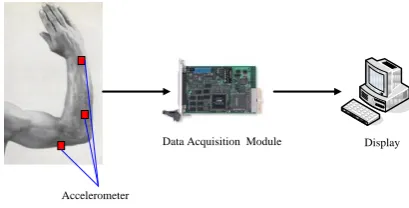
We install three three-axis accelerometers in different parts of the arm, so 9 acceleration median values and their direction characteristics can be measured.
The acceleration signals collected by the accelerometer are analog. In order to facilitate the following processing, the analog acceleration signals are digitized. We use the cPCI-9112 data acquisition module for signal conversion, which is produced by ADLINK Technology Inc. The cPCI-9112 Data Acquisition Module specifications are [17]: 12-bit A/D resolution, 8 μs conversion time, 110 kS/s maximum sampling rate. This device supports automatic analog input scanning, and offers a differential mode for 8-CH analog inputs and maximum noise elimination, as well as single-ended modes for 16-CH analog inputs. It provides analog inputs with 4 programmable input ranges for both bipolar and unipolar inputs. The cPCI-9112 also feature 2-CH 12-bit analog outputs, 1-CH bit general-purpose timer/counter, 16-CH TTL digital inputs, and 16-16-CH TTL digital outputs.
The date collected by the data acquisition card directly to the display terminal. And through the software implement the 9-channel data’s real-time waveform display.
C.Analysis on the Accerleration Characteristic
When measuring a stretched forward arm, X-axis acceleration of the wrist position versus time waveform is shown in Figure 2.
The position 2 represents the static acceleration while the arm has not stretched out. The position 2 indicates that due to the sudden movement at the action start, the initial acceleration along the direction of movement is very large. When the arm continues the forward movement, the acceleration reduces slowly, while the speed increases continuously. At the last part of the forward arm movement, acceleration starts to increase reversely and the speed decreases. When arm reaching the farthest position, the outrigger will action stops suddenly. At this time acceleration is large, the peak acceleration waveform (position 3) formed. While the arm in the furthest position, the acceleration is static (position 4), and only has a relationship with the accelerometer gesture. When the arm backs, the process is the inverse of the above. At the beginning and ending of back arm, the waveform of acceleration will produces
the same peak (position 5) and trough (position 6.) respectively. Reaching the end of a stretched arm cycle (position 7), the acceleration is the static acceleration value of back arm. It is similar to position 1.When the arm move to the opposite direction, the acceleration waveforms in position 2 will be upward peaks. It can be used as a feature to identify actions. However, this characteristic only can differentiate two kinds of movements in the opposite direction.
Figure 2 shows that: The acceleration median (the mean of maximum and minimum acceleration) of the arm outstretch is approximately equal to the acceleration median of the process of arm take back. Choosing the acceleration median to recognize the arm outstretch can avoid the case that same arm outstretch movements can’t be distinguished because have different speeds.
For N kinds of stretch arm in different directions, the x-axis, y-axis, z-axis acceleration values measured by the accelerometer are different from each other and with certain of differentiability. Therefore, the acceleration median of arm outstretching can be used as recognition characteristic. Meanwhile, combined with the initial acceleration direction, it can very well distinguish two in opposite direction arm outstretch movements.
IV.THE SELECTION OF CHARACTERISTICS OF STRETCH ARM IN EXTENSION RECOGNITION THEORY
Through experiments, we obtained the acceleration waveforms of 4 kinds of stretch arm movements, as shown in Figure 3. The stretch arm movements are slow movement processes and the arm pause a moment when reached the farthest point.
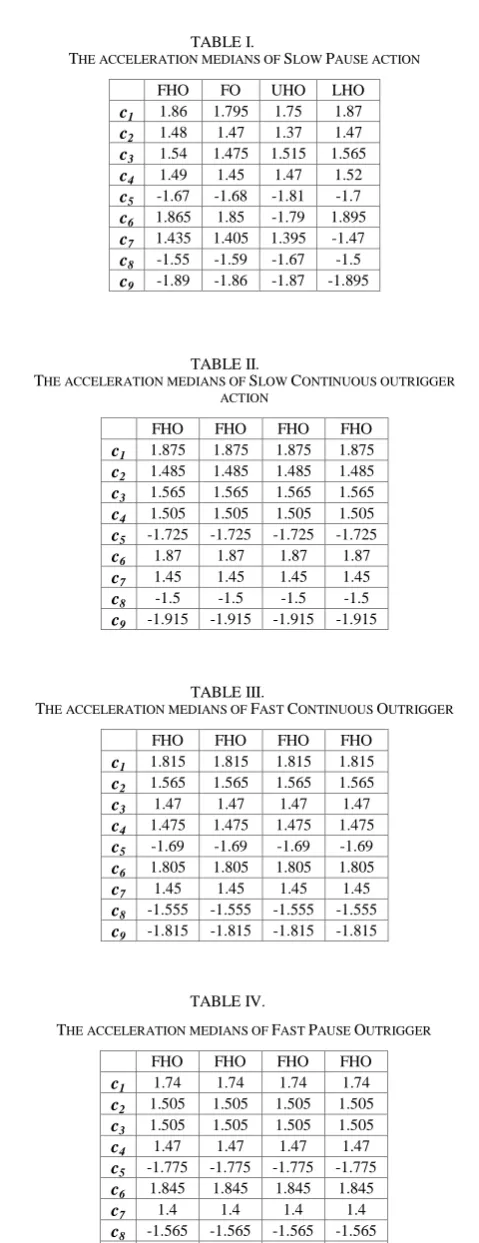
Use "+ "and"- "indicate the direction of the initial moment of outrigger action."+"indicates the acceleration is less than the static acceleration and "-" is reverse. In order to the better description the outrigger process, we also measured the acceleration of the following outrigger movements. They are: Slow Continuous Outrigger (The outrigger speed is slow and don’t stop at the farthest point), Fast Continuous outrigger (The outrigger speed is fast and don’t stop at the farthest point), Fast Pause outrigger (The outrigger speed is fast and then pauses in a moment at the farthest point.). The acceleration medians of above outrigger movements can be gotten from Figure 3, as showed in Table 1,2,3,4.
Where C1, C2, C3 is the x-axis, y-axis, z-axis acceleration median of the accelerometer 1 respectively. C4, C5, C6 is the x-axis, y-axis, z-axis acceleration median of the accelerometer 2 respectively. C7, C8, C9 is Figure 2. Waveforms of x-axis acceleration when the arm stretched
forward.
Data Acquisition Module Display
Accelerometer
the x- axis, y-axis, z-axis acceleration median of the accelerometer 3 respectively. FHO is the forward half outrigger. FO is the forward outrigger. UHO is the upward half outrigger. LHO is the left half outrigger.
Compared values in Table 1, 2, 3, 4, we can see that: for the same kind outrigger action, even if the movement form has the difference, the acceleration medians are basically consistent. For different Outrigger actions, acceleration median values have certain differentiability.
TABLE IV.
THE ACCELERATION MEDIANS OF FAST PAUSE OUTRIGGER
FHO FHO FHO FHO c1 1.74 1.74 1.74 1.74
c2 1.505 1.505 1.505 1.505
c3 1.505 1.505 1.505 1.505
c4 1.47 1.47 1.47 1.47
c5 -1.775 -1.775 -1.775 -1.775
c6 1.845 1.845 1.845 1.845
c7 1.4 1.4 1.4 1.4
c8 -1.565 -1.565 -1.565 -1.565
c9 -1.905 -1.905 -1.905 -1.905
TABLE III.
THE ACCELERATION MEDIANS OF FAST CONTINUOUS OUTRIGGER
FHO FHO FHO FHO c1 1.815 1.815 1.815 1.815
c2 1.565 1.565 1.565 1.565
c3 1.47 1.47 1.47 1.47
c4 1.475 1.475 1.475 1.475
c5 -1.69 -1.69 -1.69 -1.69
c6 1.805 1.805 1.805 1.805
c7 1.45 1.45 1.45 1.45
c8 -1.555 -1.555 -1.555 -1.555
c9 -1.815 -1.815 -1.815 -1.815
TABLE II.
THE ACCELERATION MEDIANS OF SLOW CONTINUOUS OUTRIGGER ACTION
FHO FHO FHO FHO c1 1.875 1.875 1.875 1.875
c2 1.485 1.485 1.485 1.485
c3 1.565 1.565 1.565 1.565
c4 1.505 1.505 1.505 1.505
c5 -1.725 -1.725 -1.725 -1.725
c6 1.87 1.87 1.87 1.87
c7 1.45 1.45 1.45 1.45
c8 -1.5 -1.5 -1.5 -1.5
c9 -1.915 -1.915 -1.915 -1.915
TABLE I.
THE ACCELERATION MEDIANS OF SLOW PAUSE ACTION
FHO FO UHO LHO c1 1.86 1.795 1.75 1.87
c2 1.48 1.47 1.37 1.47
c3 1.54 1.475 1.515 1.565
c4 1.49 1.45 1.47 1.52
c5 -1.67 -1.68 -1.81 -1.7
c6 1.865 1.85 -1.79 1.895
c7 1.435 1.405 1.395 -1.47
c8 -1.55 -1.59 -1.67 -1.5
c9 -1.89 -1.86 -1.87 -1.895
(c) Acceleration waveform of upward half outrigger
(d) Acceleration waveform of left half outrigger
Figure 3. Waveforms of x-axis acceleration when the arm stretched forward.
(a) Acceleration waveform of forward half outrigger
Combining the extension identification methods[10-12] for action recognition, and according to the size 0.1 extension rule, expand the values in table 5, the range of values used in the extension recognition are obtained ,as showed in Table 6.
V.THE EXTENSION RECOGNITION OF OUTRIGGER ACTION
A. Establish Classical Field Matter Elements and Segment Field Matter Elements
The classical field matter elements of outrigger action are the matter element model of all kinds of outrigger actions. Its basic form is:
N N v c v c v c N V C N R , , , ) , ,
( 2 2
1 1 n n
n a b
c b a c b a c N , , , , , , 2 2 2 1 1 1
(1)
Where R is the outrigger action, N is the name, Cis the feature names vector, V is the characteristic value range vector. (ai,bi) is the characteristic value range. According Table 6, the classical field matter elements of the forward half outrigger actions is:
981 . 1 , 781 . 1 , 643 . 1 , 443 . 1 , 543 . 1 , 343 . 1 , 946 . 1 , 746 . 1 , 815 . 1 , 615 . 1 , 585 . 1 , 385 . 1 , 620 . 1 , 420 . 1 , 609 . 1 , 409 . 1 , 923 . 1 , 723 . 1 , outrigger, half forward The , , , , , , , , , outrigger, half forward The 9 8 7 6 5 4 3 2 1 19 9 18 8 17 7 16 6 15 5 14 4 13 3 12 2 11 1 1 c c c c c c c c c v c v c v c v c v c v c v c v c v c R (2)
And classical field matter elements of the forward outrigger, the upward half outrigger, the left half outrigger are similarly the
R
1 .Segment field matter elements are the characteristic value range of the Outrigger actions. 9 9 8 8 7 7 6 6 5 5 4 4 3 3 2 2 1 1 , , , , , , , , , Outrigger, P P P P P P P P P P v c v c v c v c v c v c v c v c v c R TABLEVI.THE RANGE OF ACCELERATION MEDIANS OF FOUR OUTRIGGER ACTIONS
The range of acceleration medians
FHO FHO FHO FHO
c1 <1.723, 1.923> <1.723, 1.923> <1.723, 1.923> <1.723, 1.923> c2 <1.409, 1.609> <1.409, 1.609> <1.409, 1.609> <1.409, 1.609> c3 <1.42, 1.62> <1.42, 1.62> <1.42, 1.62> <1.42, 1.62> c4 <1.385, 1.585> <1.385, 1.585> <1.385, 1.585> <1.385, 1.585> c5 <-1.815, -1.615> <-1.815, -1.615> <-1.815, -1.615> <-1.815, -1.615> c6 <1.746, 1.946> <1.746, 1.946> <1.746, 1.946> <1.746, 1.946> c7 <1.334, 1.534> <1.334, 1.534> <1.334, 1.534> <1.334, 1.534> c8 <-1.642, -1.442> <-1.642, -1.442> <-1.642, -1.442> <-1.642, -1.442> c9 <-1.981, -1.781> <-1.981, -1.781> <-1.981, -1.781> <-1.981, -1.781> TABLEV.
THE AVERAGE VALUE OF THE ACCELERATION MEDIANS OF FOUR OUTRIGGER ACTIONS
FHO FO UHO LHO
c1 1.823 1.744 1.721 1.878
c2 1.509 1.518 1.385 1.485
c3 1.52 1.47 1.5 1.539
c4 1.485 1.45 1.451 1.495
c5 -1.715 -1.711 -1.839 -1.705
c6 1.846 1.818 -1.79 1.88
c7 1.434 1.423 1.398 -1.464
c8 -1.542 -1.571 -1.659 -1.519
759 . 1 , 003 . 2 , 443 . 1 , 759 . 1 , 543 . 1 , 664 . 1 , 98 . 1 , 89 . 1 , 601 . 1 , 939 . 1 , 595 . 1 , 351 . 1 , 639 . 1 , 379 . 1 , 625 . 1 , 285 . 1 , 978 . 1 , 621 . 1 , Outrigger, 9 8 7 6 5 4 3 2 1 c c c c c c c c c (3)
, where vpivli
v2i v3i v4i,(i1,2,,9)。 B. Determine the Correlation Function
( ) 2 1 ) ( 2 1,X0 x a b b a
x
(4)
is the distance of point
x
0
(
,
)
to intervalb a
X0 , .The correlation function is:
) , ( ) , ( ) , ( ) , ( ji i pi i ji i ji i ij v v v v v v v v K
(5)
Therein,
v
iis the value ofi
characteristic of the objectto be recognition
(
i
1
,
2
,
3
9
;
j
1
,
2
,
3
,
4
)
.When the denominator is zero, then1 ) , ( ) ,
( i ji i ji
ij v v v v
K (6)
C. Determine the Weight Coefficient
The overlapping of value ranges will decrease recognition rate in the extension recognition.
The value interval overlapping degree reflects the importance of the characteristic. That is, when the interval overlapping degree is large, the importance of the characteristic is small. While the interval overlapping degree is little, the importance of the characteristic is big. Reducing the weight of the characteristic whose interval overlapping degree is large, can achieve the purpose of improving the extension recognition rate [18]. In order to accurately reflect the relationship between interval overlapping degree and the weight of characteristic, using the mapping function
f
(
x
)
1
/
x
to map the intervals overlap degree and weight. Then get the characteristic weight vectorw
'
[18].
w w wn
w' '1, '2,, ' (7)
) , , 2 , 1 ( , / 1
' ov i n
w i (8)
In order to facilitate calculation of extension pattern recognition, then normalized
w
'
.) , 2 , 1 ( ,' /
' w i n
w
wi
i (9)Finally, get the characteristic weight vector
w
.The weight vector
w
obtained by the above method reflects the importance of each characteristic. It can automatically and objectively determine the weight based on the actual range of the characteristic, and can improve the recognition rate.According to the above weight calculation method, and combined with the data in table 6, the weight coefficient vector can be calculated.
0963 . 0 , 0973 . 0 , 1552 . 0 , 1629 . 0 , 1034 . 0 , 0764 . 0 , 0825 . 0 , 1057 . 0 , 1203 . 1 w (10)D. The Extension Recognition of Action to be Recognized We measured the FHO, FO, UHO, LHO action 10 times and get 10 sets of acceleration information respectively. Each set of information includes 9 acceleration medians and acceleration direction values in the initial movement time. Randomly selected one group data from the 10 groups of each type of action as the objects to be recognized, and carry on the recognition by the extension recognition methods. The random selected information of the actions to be recognized as shown in table 7.
Constructed the element model of the objects to be recognized based on its acceleration information firstly. It is:
19 9 8 8 7 7 6 6 5 5 4 4 3 3 2 2 1 1,
,
,
,
,
,
,
,
,
,
recognized
be
object to
The
v
c
v
c
v
c
v
c
v
c
v
c
v
c
v
c
v
c
R
O TABLEVII.CHARACTERISTIC VALUES OF THE ACTIONS TO BE RECOGNIZED
FHO FO UHO LHO
c1 1.9 1.78 1.875 1.725
c2 1.535 1.47 1.47 1.3675
c3 1.515 1.4725 1.5725 1.515
c4 1.5 1.4575 1.525 1.485
c5 -1.7 -1.648 -1.7 -1.78
c6 1.8725 1.85 1.9 -1.783
c7 1.4425 1.4075 -1.48 1.41
c8 -1.565 -1.588 -1.51 -1.675
9 . 1 , 565 . 1 , 4425 . 1 , 8725 . 1 , 7 . 1 , 5 . 1 , 515 . 1 , 535 . 1 , 9 . 1 , , recognized be object to The 9 8 7 6 5 4 3 2 1 c c c c c c c c c (11)
Then combined with the equation (4~6), calculate the correlation degree Kjivi,vjiof the characteristic value
i
v
of R0. And constitute the association degree matrixK.0795 . 0 0283 . 0 0567 . 0 0795 . 0 0055 . 0 0436 . 0 0827 . 0 0763 . 0 0531 . 0 9666 . 0 0747 . 0 0995 . 0 9707 . 0 0918 . 0 0613 . 0 0716 . 0 2826 . 0 0945 . 0 0989 . 0 0837 . 0 0486 . 0 0945 . 0 0659 . 0 0837 . 0 0837 . 0 0234 . 0 0618 . 0 0945 . 0 3571 . 0 0476 . 0 0891 . 0 0721 . 0 5032 . 0 0763 . 0 1613 . 0 0214 . 0 K (12)
Used the association degree matrix K and Weight Vector
w
, we can calculate the association degree vector'
K ofR0in relation to each outrigger type.
0.0752,0.0455, 0.1001, 0.2586
'wK
K (13)
According to Biggest Association Degree Criterion, we can judge that the Ro belongs to the left half outrigger action from VectorK'. This is consistent with the fact. Using the same method, we can recognize the other three sets of data in Table 7. The recognition results are all correct. Many experimental results show that the average recognition rate of this method is 93.2%. It is quite high.
VI. CONCLUSION
This paper proposed an interval overlapping degree extension method in upper limbs motion recognition based on acceleration median (IODE-AM). IODE-AM chooses the acceleration median of the arm outstretching process and the direction of acceleration at the initial moment of arm outstretching as the recognition characteristic. It can reduce the affection of outstretching speed to the characteristic value of upper limb action. According to the request of extension recognition method, IODE-AM expands the selected characteristics to interval form. The experimental results show that the IODE-AM having the very good recognition rate.
ACKNOWLEDGMENT
The authors wish to thank Dr. Taobo Cheng and Songbin Zhou for their insightful discussions. And we are
grateful to the anonymous referees for their valuable comments on the presentation of this paper.
This work is supported in part by a grant from the National Natural Science Foundation of China (Grant No. 61172156, 61102034), the 211 Project of Guangdong Province (Grant No. YueFaGai [2009] 432), and the Ph.D. Programs Foundation of Guangdong University of Technology (Grant No. 103042).
REFERENCES
[1] H R. Hartson, D. Hix, “Human computer interface
development: concepts and systems for its management,” Computing Surveys, vol.2l, No.1, pp.5-92, March 1989. [2] S. Mitra, T. Acharya, “Gesture Recognition: A Survey,”
IEEE Transactions on systems, man, and cybernetics-part c: applications and reviews, vol. 37, No. 3, pp.311-324, May 2007.
[3] Xu Zhang, “Body Gesture Recognition and interaction based on surface electromyogram,” A dissertation for doctor’s degree. The University of Science and Technology of China .May 2010.
[4] Yuan Fei, “The Research of Extension Pattern Recognition Method Based on Interval Overlapping Degree,” A Dissertation for the Degree of Master. Guangdong University of Technology .May 2010.
[5] Rashid, O, Al-Hamadi, A, Michaelis, B, “A framework for
the integration of gesture and posture recognition using HMM and SVM,” ICIS 2009. IEEE International Conference on Intelligent Computing and Intelligent Systems, pp.572-577. November 2009.
[6] S. Mukherjee, S. K. Biswas, D. P. Mukherjee,
“Recognizing Human Action at a Distance in Video by Key Poses,” IEEE Transactions on Circuits and Systems for Video Technology, Vol. 21, No. 9, pp.1228-1241,September 2011.
[7] Akl, A., Valaee, S., “Accelerometer-based gesture
recognition via dynamic-time warping, affinity propagation, & compressive sensing,” 2010 IEEE International Conference on Acoustics Speech and Signal Processing (ICASSP), pp.2270-2273, March 2010.
[8] K .Junqi, W. Hui, Zh. Guangquan, “Gesture recognition model based on 3D accelerations,” ICCSE '09. 4th International Conference on Computer Science & Education, pp.66-70, July 2009
[9] W. Changxi, Y. Xianjun, X. Qiang, “Motion Recognition system for Upper Limbs Based on 3D Acceleration
Sensors,” Chinese Journal of Sensors and
Actuators.Vol.23,No.6, pp.816-819,June,2010.
[10]Yang Chunyan,Cai Wen, “Extension Engineering. Science
Press,” Beijing: Science Press, August,2007.
[11]Yang Chunyan, Cai Wen, “Extension Engineering
Methods,” Beijing: Science Press, November 2003. [12]Cai Wen, Yang Chunyan, He bin, “Preliminary Extension
Logic,” Beijing: Science Press, November 2003.
[13] W. Cai, “The extension set and incompatibility problem,” J. Sci. Explor., vol. 1, pp. 81–93, 1983.
[14]“Brief Introduction of Extenics,” Available:
http://web.gdut.edu.cn/~extenics/i.htm,2011.
[15] Wang Chungang, Zeng Tao, Yu Yongquan, “A Method of
[16] Analog Devices Inc., “ADXL330 Datasheet,” Available: http://www.analog.com/static/imported-files/data_sheets/ADXL330.pdf,2011.
[17] Adlink Tech Inc., “cPCI-9112 Datasheet,”
Available:http://www.adlinktech.com/PD/cn/PD_detail.ph p?cKind=&pid=8&seq=&id=&sid=,2011.
[18] Yuan Fei, Cheng Taobo, Zhou Songbin, “Extension
pattern recognition method based on interval overlapping
degree. Modem Manufacturing Engineering,” No. 9,
pp.139-142, September 2010.
Yonghua Wanghas received his B.S. degree in electrical Engineering and Automation from Hebei University of Technology in 2001, the M.S. degree in control engineering from Guangdong University of Technology in 2006, and Ph. D degree in communication and information system from Sun Yat-sen University in 2009. Currently he is a lecturer in school of automation in Guangdong University of Technology since 2009. His research interests include cognitive networks, RFID, etc.
Fei Yuan has received his M.S. degree in control engineering from Guangdong University of Technology in
2010. He is now working towards his Ph.D. degree in communication and information system at Sun Yat-sen University. His research interests include computer science, etc.
Lei Qi has received her B.S. degree in computer science from Changchun University of Science and Technology in 1999,and the M.S. degree in computer science from Guangdong University of Technology in 2007. Currently she is a senior engineer in Center of Campus Network& Mod- em Educational Technology in Guangdong University of Technology. Her research interests include computer network etc.