Data Hiding by Image Steganography Appling
DNA Sequence Arithmetic & LSB Insertion
Souvik Kumar Kole Kuntal Ghosh
Department of Computer Science & Engineering Department of Computer Science & Engineering University of Calcutta,West Bengal, India University of Calcutta,West Bengal, India
Prof. Samir Kumar Bandyopadhyay Department of Computer Science & Engineering
University of Calcutta,West Bengal, India
Abstract
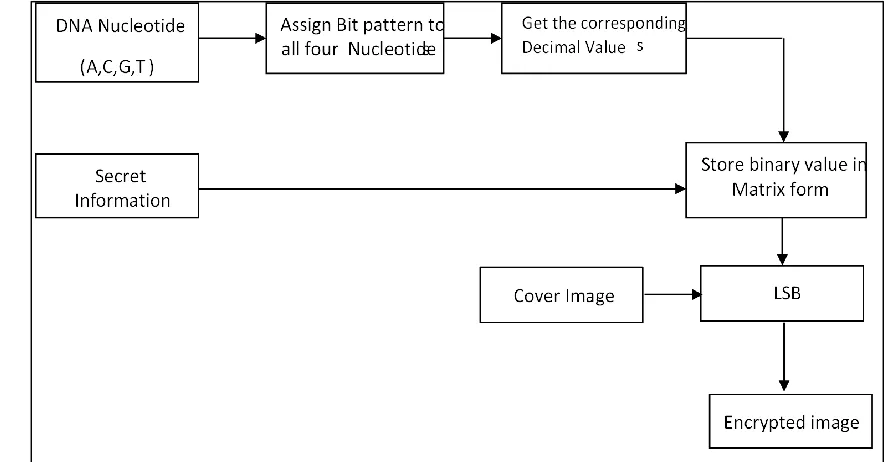
By Image Steganography we can hide the secret data in cover manner. Where present of secret information can’t realize or visible by malicious users. In this approach Steganography procedure divided into two steps. In first step, DNA sequence (combination of four nucleotides A, C, G & T) used to convert secret information into a key matrix by generating key. In seco nd step, values of key matrix will steganography by Least Significant Bit (LSB) Insertion procedure. Advantage of this procedure is that secret information secured by secret key of DNA sequence and Steganography procedure.
Keywords: Image Steganography, DNA, LSB
_______________________________________________________________________________________________________ I. INTRODUCTION
Steganography is the process of hiding a secret message within a larger one in such a way that someone cannot know the presence or contents of the hidden message. Although related, Steganography is not to be confused with Encryption, which is the process of making a message unintelligible—Steganography attempts to hide the existence of communication.
The basic structure of Steganography is made up of three components: the “carrier”, the message, and the key1. The carrier can be a painting, a digital image, an mp3, even a TCP/IP packet among other things. It is the object that will ‘carry’ the hidden message. A key is used to decode/decipher/discover the hidden message. This can be anything from a password, a pattern, a black-light.
Encryption is the most important component part of the infrastructure of communication security and computer security. The relation between encryption and molecular biology was originally irrelevant, but with the in-depth study of modern biotechnology and DNA computing, these two disciplines begin to work together more closely. DNA encryption and information science was born after research in the field of DNA computing field by Adleman. DNA Encryption is based on biological problems: in theory, a DNA computer will not only has the same computing power as a modern computer but will also have a potency and function which traditional computers cannot match. First, DNA chains have a very large scale of parallelism, and its computing speed could reach 1 billion times per second; second, the DNA molecule - as a carrier of data - has a large capacity. It seems that one trillion bits of binary data can be stored in one cubic decimetre of a DNA solution; third, a DNA molecular computer has low power consumption, only equal to one-billionth of a traditional computer [1].
II. RELATED WORK
Least Significant Bit Insertion
LSB insertion is one of the common and popular method for Steganography. In this method Cover-image LSB bits will alter by Secret information.
Pixels: (00100111 11101001 11001000 11100011) (00100111 11001000 11101001 10101100)
B: 01000010
Result: (00100110 11101001 11001000 11100010) (00100110 11001000 11101001 10101100)
Above example shows that how to embed latter B in first eight bytes of three pixels in a 32-bits image.
DNA Encryption:
Logic for DNA encoding and decoding:
Information can store in four DNA nucleotides (chemical bases): adenine (A), guanine (G), cytosine (C), and thymine (T). These bases can makes pairs, A with T and C with G, to form base pairs and pairs are complement to each other. Like in binary 1 and 0 are component, so 10 and 01 are component. We use 00=A, 01=C, 10=G and 11=T. In the 8 bit grey images each pixel is converted in DNA sequence of length 4. For example: 5th pixel value is 137, then its binary form is [10001001], then corresponding DNA sequence is [GAGC].
Logic for addition and subtraction of DNA sequences:
Like other computing procedure DNA computing has a great impact on field of research. Addition and subtraction operation in DNA sequences is same as binary addition and subtraction respectively, but discard carry. For example: 11+11=00, 00-11=11.Binary representation of A, C, G, T is 00, 01, 10, 11 respectively. That is G+T=C, A-C=T ……
Addition and subtraction operation rules are shown in Table-1 and Table 2 respectively. Table – 1
Addition Operation
Table – 2 Subtraction Operation
+ A C G T -- A C G T
A A C G T A A T G C
C C G T A C C A T G
G G T A C G G C A T
T T A C G T T G C A
Image Steganography:
Image steganography has been widely studied by researchers. There are a variety of methods used in which information can be hidden in images. In the following section, we present the most common methods. There are three common methods of steganography: Replacing Moderate Significant Bit, Transformation Domain Techniques, and Replacing Least Significant Bit. Replacing Moderate Significant Bit, Chan et al. showed how to use the moderate significant bits of each pixel in the cover image to embed the secret message. This method improves sensitivity to modification, but it degrades the quality of stego-image [3-4]. Other familiar data hiding techniques use the transformation domain of digital media to hide information discussed by Chang et al. and Hsu et al. Functions such as the discrete cosine transform (DCT) and the discrete wavelet transform (DWT) are widely applied by Chang et al., and Hsu et al. These methods hide the messages in the significant areas of the cover image, which makes them robust against compression, cropping and other image processing attacks. The last method is Replacing Least Significant Bit the concept of LSB Embedding is simple. It exploits the fact that the level of precision in many image formats is far greater than that perceivable by average human vision. Therefore, an altered image with slight variations in its colours will be indistinguishable from the original by a human being, just by looking at it. By using the least significant bits of the pixels’ colour data to store the hidden message, the image itself will seem unaltered.
Procedure of This Project:
Algorithm:
1) for Transformation from secret information to encrypted matrix(M) 2) Scan the secret information string from left to right.
3) Starting from 1st character.
4) Find out which one is closest among A, C, G &T in difference chart.
5) Get the corresponding decimal value of character from modified difference chart. 6) Convert decimal value in binary.
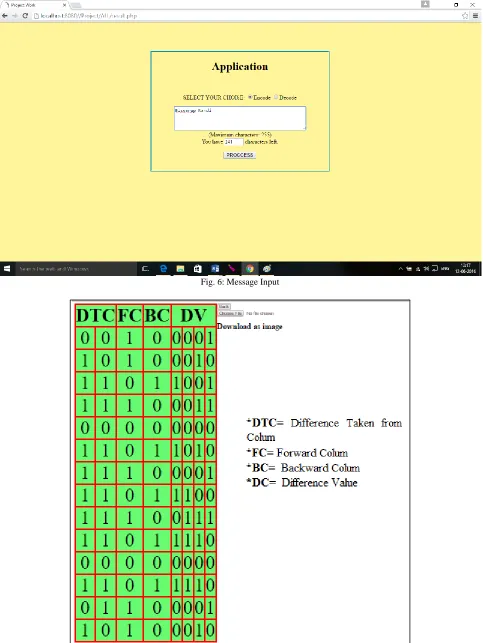
7) Store binary value into a matrix (M) in which each binary digit value will insert row wise. Matrix will contain difference taken from which nucleotide, difference value and forward or backward difference.
8) Go to next character.
9) Repeat step-3 to 5 upto end of secret string. 10) End.
Key generation
Decimal Value of nucleotides (A, C, G and T) is the Key. Values will assign either from addition table (Table-1) or subtraction table (Table-2) .For example if it’s coming from addition table then A= ACGT, C=CGTA, G=GTAC and T=TACG. So, corresponding binary value A=00011011, C=01101100, G=10110001 and T=11000110.
Equivalent decimal value A=27, C=108, G=177, T=198. Difference Chart
If key generated from addition table then difference chart as follows: Difference Chart
A=27 B=28 C=108 D=109 E=110 F=111 G=177 H=178 I=179 J=180 K=181 L=182 M=183 N=184 O=185 P=186 Q=187 R=188 S=189 T=198 U=199 V=200 W=201 X=202 Y=203 Z=204 Space=205
Difference calculation rule
1) Rule-1: Difference from a character to next character is 1(Forward difference). 2) Rule-2: Difference from a character to previous character is 1(Backward difference).
3) Rule-3: Forward difference can be calculates from an upto B, from C upto F, from G up to M, from T up to Z. 4) Rule-4: Backward difference only calculates from T upto N. Rule-5: Difference only calculates from nucleotide. Modified Difference Chart
A=0 B=1 C=0 D=1 E=2 F=3 G=0 H=1 I=2 J=3 K=4 L=5 M=6 N=14 O=13 P=12 Q=11 R=10 S=9 T=0 U=1
V=2 W=3 X=4 Y=5 Z=6 Space=7
Algorithm –II for Modified Least Significant Bit Replacement
This is the simplest of the steganography methods based in the use of LSB, and therefore the most vulnerable. The embedding process consists of the sequential substitution of Least Significant Bit of a single channel of the image pixel for the bit message. For its simplicity, this method can camouflage a great volume of information. The following steps illustrate how this method is used to hide the secret data "A" in cover image “Mansoura.bmp ".
1) Convert the data from decimal to binary.
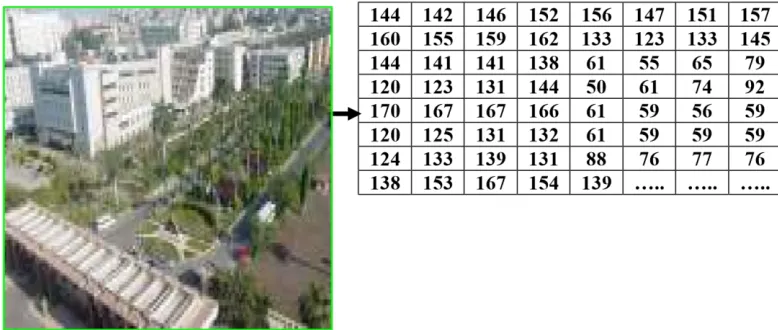
Fig. 2: The cover image “Mansoura.bmp"
Convert the Cover Image from decimal to binary.
10010000 10011010 10011100 10010010 10010110 10011101 10101111 10100101 10100000 10011011 10011111 10100010 10000101 01111011 10000101 10010001 10010000 10001101 10001101 10001010 00111101 00110111 01000001 01001111 01111000 01111011 10000011 10010000 00110010 00111101 01001010 01011100 10101010 10100111 10100111 10100110 00111101 00111011 00111000 00111011 01111000 01111101 10000011 10000100 00111101 00111011 00111011 00111011 01111100 10000101 10000111 10000011 01011000 01001100 01001101 01001100 10001010 10011001 10100111 10011010 10001011 ……….... ……….... ………....
Break the byte to be hidden into bits.
Thus [10000001] [1 0 0 0 0 0 0 1]. Is divided into 8 bits Take each 4th byte of original data from the Cover Image.
10010000 10011010 10011100 10010010 10010110 10011101 10101111 10100101
Replace the least significant bit by one bit of the data to be hidden. First byte of original data from the Cover Image :
1
0
0
1
0
0
0
0
First bit of the data to be hidden :
1 Replace the least significant bit :
1 0 0 1 0 0 1 1
0
0
1
0
0
1
1
0
Fig. 3: The cover image before and after steganography
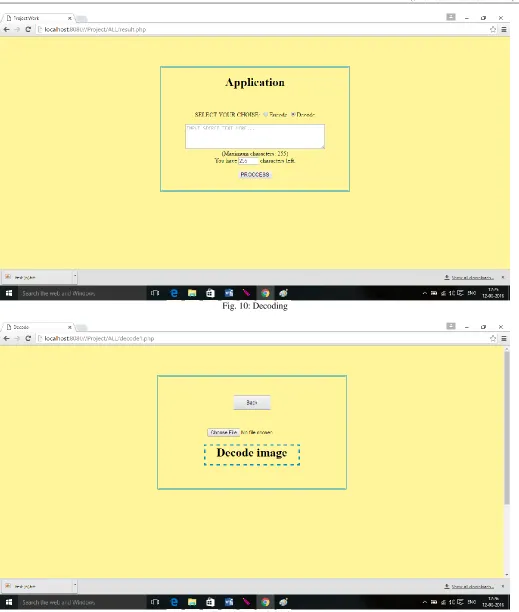
Message Decoding Method
Fig. 4: Steps for Decoding
Result:
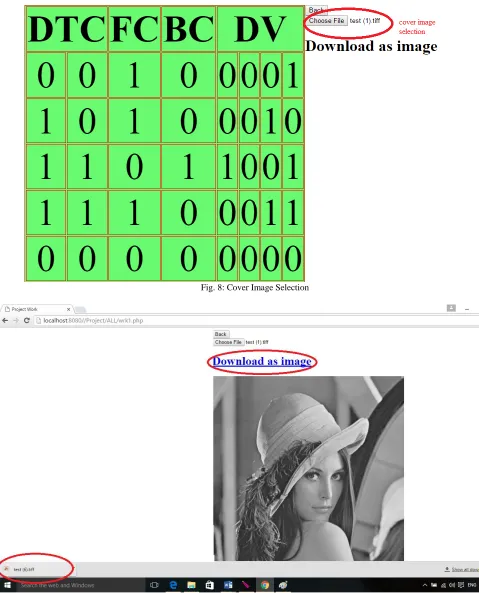
Fig. 8: Cover Image Selection
Fig. 12: Decoded Text
III. CONCLUSION
The steganography is defined as to hide information from unauthorized user. Degree of success of a steganography procedure depends on two factors –First, amount of information hiding, second, rate of distortion of cover image. A unique method of steganography which hidings two secret images with in a cover image. This method hides two secret images without distortion of cover image. DNA microarray and its hybridization procedure use as a tool for implementation.
This algorithm is more efficient than most of other algorithms. The reason behind this is occurrence of change is lesser (each 4th byte’s LSB get changed).
REFERENCES
[1] Moerland, T., “Steganography and Steganoanalysis”, Leiden Institute of Advanced Computing Science, www.liacs.nl/home/tmoerl/privtech.pdf. [2] https://en.wikipedia.org/wiki/DNA_sequencing
[3] Mamta Juneja, Parvinder S. Sandhu, and Ekta Walia, "Application of LSB Based Steganographic Technique for 8-bit Color Images", World Academy of Science, Engineering and Technology 50 2009.