To Propose an Improvement in Zhang-Suen
Algorithm for Image Thinning in Image
Processing
Sonam Soni Sukhmeet Kaur
Research Scholar Associate Professor CGCTC, Jhanjeri, Mohali CGCTC, Jhanjeri, Mohali
Abstract
Thinning is the preprocessing stage to make easy higher level analysis and recognition for such applications like OCR, Fingerprint classification, Pattern recognition. In this paper we described thinning and its various algorithm. It is concluded that there are some loopholes in thinning algorithm. So there is a need to improve thinning rate. The thinning algorithm’s performance has been analysed in terms of PSNR value, MSE value and thinning rate. To improve performance of the algorithm, enhancement has been proposed which is based on back propagation algorithm. The simulation results shows that proposed algorithm performs batter in terms of PSNR, MSE and thinning rate.
Keywords: Thinning rate, Image- Processing, Zhang-Suen, Skeletonization, Neural Network
________________________________________________________________________________________________________
I. INTRODUCTION
Image processing is a method to convert an image into digital form and perform some operations on it, in order to get an enhanced image or to extract some useful information from it. It is a type of signal dispensation in which input is image, like video frame or photograph and output may be image or characteristics associated with that image[3].Usually Image Processing system includes treating images as two dimensional signals while applying already set signal processing methods to them. It is among rapidly growing technologies today, with its applications in various aspects of a business. Image Processing forms core research area within engineering and computer science discipline. Image processing are computer graphics and computer vision. In computer graphics, images are manually made from physical models of objects, environments, and lighting, instead of being acquired from natural scenes, as in most animated movies [5]. Computer vision, on the other hand, is often considered high-level image processing out of which a machine/computer/software intends to decipher the physical contents of an image or a sequence of images.
II. THINNING
Thinning is an image processing process in which binary valued image regions are condensed to lines that approximate the center skeletons of the regions. For each single image region it is usually required that the lines of the thinned result are associated, so that these can be used to infer shape and topology in the original image. A main idea behind thinning is in the preprocessing stage to make easy higher level analysis and recognition for such applications as Optical Character Recognition, fingerprint analysis, diagram understanding, and feature detection for computer vision [5].The skeleton of a binary image is an integral demonstration for the shape analysis and is useful for many pattern recognitions application. The skeleton of an object is a line connecting point’s midway between the boundaries [3]. Thinning techniques have been applied in many fields such as automated industrial inspection, pattern recognition, biological shape description and image coding etc. The main objective of thinning is to improve efficiency, to reduce transmission time. The skeleton refer to the bone of an image [5]. Skeletonization is usually applied on binary images which consist of black (foreground) and white (background) pixels. It takes input a binary image, and produces another binary image as output. Skeletonization has been used in a wide variety of other applications like: Optical character recognition (OCR) [2,5] ,Pattern recognition[3], Fingerprint classification[4],Biometric authentication[5], Signature verification[5], Medical imaging[4].
Thinning Algorithms:
All the Thinning algorithms are classified into two broad categories: 1) Iterative thinning algorithm [3]
Iterative (Pixel Based)
This thinning algorithm produces a skeleton by examining and deleting contour pixels through an iterative process in either sequential or parallel way [3]. Sequential thinning algorithms which examine contour pixels of an object in a predetermined order, and this can be accomplished by either raster scanning or following the image by contour pixels. In parallel thinning algorithms, pixels are deleted on the basis of results obtained only from the previous iteration. Hence parallel thinning algorithms are suitable for implementation in parallel processors [3].
a) Sequential thinning:
This algorithm is that which inspect contour points in a predetermined order of an object and this .can be accomplished by either raster scanning or following the images by contour pixels.
b) Parallel Thinning:
In this type of algorithms pixels are inspect for deletions on the basis of some previous available iteration results.
Non-iterative (non-pixel based)
Thinning is not based on examining individual pixels. Without examining all the individual pixels, these algorithms produce a certain median or center line of the pattern to be thinned directly in one pass. Some popular non pixel based methods include medial axis transforms, distance transforms, and determination of centerlines by line following. Medial axis transforms often use gray-level images where pixel intensity represents distance to the boundary of the object [3]. Distance transform based methods compute the distance to the image background for each object pixel and use this information to determine which pixels are part of the skeleton.
III. LITERATURE REVIEW
In [2] the author proposes a new skeletonization algorithm which combines sequential and parallel approaches which comes under iterative approach. The algorithm is conducted in three stages. First two stages used to extract the skeleton and the third is used for optimizing the skeleton into one-pixel width. An experimental result shows that the proposed algorithm produces better results than the previous Skeletonization algorithms.
In [3] the author proposes two new iterative algorithms for thinning binary images. In the first algorithm, thinning of binary images is done by using two operations: edge detection and subtraction. Second algorithm is based on repeatedly deleting the pixels until a one pixel thick pattern in a binary image is obtained. Erosion conditions are devised to assure preserving connectivity. Experimental results show that edge based iterative thinning algorithm is time consuming as compared to optimized Skeletonization algorithm.
In [4] the author discusses wide range of skeletonization algorithms on binary images including pixel based deletion and non-pixel based deletion methods. Algorithms are discussed in details in this paper and relationships between the different skeletonization algorithms have also been explored. Various comparisons have been made between skeletons obtained from various skeletonization algorithms on the basis of subjective and objective criteria.
In [5] the author introduced a framework for making thinning algorithms robust against noise in sketch images. The framework estimates the optimal filtering scale automatically and adaptively to the input image. Experimental results showed that this framework is robust against typical types of noise which exists in sketch images, mainly contour noise and scratch.
In [10] the author performs thinning of binary images by repeating two sub-iterations: one deletes the south-east boundary points and the north-west corner points while the other one deletes the north-west boundary points and south-east corner points. Point deleting is done according to a specific set of rules. The two sub-iterations are repeated until no more points validate the deleting rules.
In [6] the author proposes a new sequential algorithm which uses flag map and bitmap simultaneously to decide whether a boundary pixel should be deleted or not. Three performance criteria are proposed in this paper for the comparison of proposed algorithm with other algorithms. Experimental results shows that the skeleton produced by the proposed sequential algorithm is not only one pixel thick, perfectly connected, well defined but are also immune to noise.
IV. ZHANG-SUEN THINNING ALGORITHM
This algorithm is very fast and simple to be implemented. It has two sub-iterations. This method has a parallel method which shows that it has previous value on which it depended [7] .In the first one a pixel I (I, J) is deleted if the following conditions are satisfied:
1) Its connectivity number is one.
2) It has at least two black neighbours and not more than six. 3) At least one of I (I, j+1), I (i-1, j) and I (i, j-1) are white. 4) At least one of I(I-1,j), I(i+1, J) and I(I,j-1) are white. In the second Iterations step 3 and 4 are changed.
1) Its connectivity number is one.
2) It has at least two black neighbours and not more than six. 3) At least one of I(i-1, j), I(I,j+1), and I(i,+1 j) are white. 4) At least one of I(I, j+1), I(i+1, J) and I(I,j-1) are white.
A 3*3 window is move down throughout the image and calculations are carried out at each pixels to decide whether it will stay on pixel or not.
At the end pixels which satisfied these conditions are deleted. If the end of the sub-iteration there is no pixel to analysis then algorithm stops.
V. PROPOSED METHODOLOGY
Most of the skeletonization algorithms suffer from traditional problems such as reducing to one pixel width of the skeleton, preserving geometrical and topological properties. Many of the algorithms have the problem of discontinuity in the images. Whereas, several techniques are failed to preserve the shape topology and not re-construct able. Spurious tails and rotating the text shape is other serious problem and due to this most of the thinning methods are failed.
Improved Zhang- Suen Algorithm
It is very popular and well proved algorithm for thinning of an image. This algorithm was proposed by Zhang and Suen in 1984. In base paper Zhang and Suen technique is used to thin some black and white pixels because this algorithm work on binary images. A new thinning algorithm with neural network is proposed using Zhang and Suen algorithm to produce a new thinning algorithm for better results.
Neural Network Approach
Thinning problem requires two tasks to be implemented: (a) peeling the thick pixels off (b) stopping the peeling process when the pixel size reduces to exactly one. The first can be achieved with relative ease. The main difficulty arises in the second part, because the stopping decision must be done automatically. This can be achieved using a real time cellular neural network by training the neural network. Most of the conventional thinning approaches suffer from noise sensitivity and rotation dependency. With the use of neural networks we can perform thinning invariant under arbitrary rotations.
The back propagation algorithm prepares a given feed-forward multilayer neural network for a given arrangement of input patterns with known classifications.
The algorithm can be deteriorated in the accompanying four stages: 1) Feed-forward computation
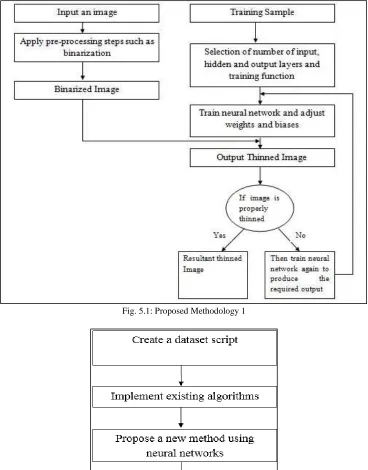
Fig. 5.1: Proposed Methodology 1
Fig. 5.2: Proposed Methodology 2
The Main Steps are Described Below
1) Create a dataset script.
2) Implementing existing algorithms: To implement the existing skeletonization algorithms using neural networks. 3) Proposing a new Method for skeletonization using neural networks.
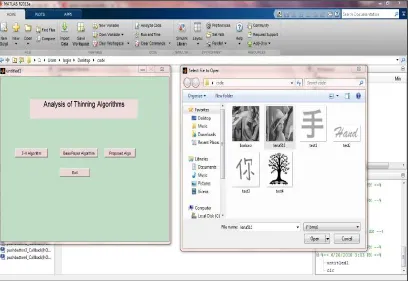
Fig. 6.1: Image Loaded
First Step is to load the image for thinning.
Fig. 6.2: Image Consist of Black & White Pixels (Binarized Image)
Fig. 6.3: Thinned Image using Zhang-Suen Algorithm
The image is loaded for the thinning. The thinning is technique of removing the unwanted data from image. To remove the unwanted data from the image thinning elements is used which will remove unwanted data. The Zhang and Suen algorithm is used for thinning which gave output in terms of MSE, PSNR and thinning rate.
Fig. 6.4: The Thinning rate of Zhang-Suen algorithm is 0.50
As shown in figure 6.6, to improve output of Zhang and Suen algorithm in terms of PNSR, MSE and TR enhancement is proposed which will be based on back propagation algorithm. In this figure, back propagation algorithm is executed with Zhang and Suen algorithm.
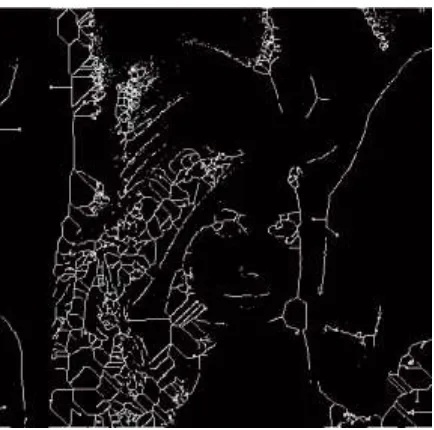
Fig. 6.7: New Thinned Image
As shown in figure 6.7, to improve output of Zhang and Suen algorithm in terms of PNSR, MSE and TR enhancement is proposed which will be based on back propagation algorithm. In this figure back propagation algorithm is executed with Zhang and Suen algorithm. After applying the back propagation algorithm the output of the thinning is image is shown in figure 6.7.
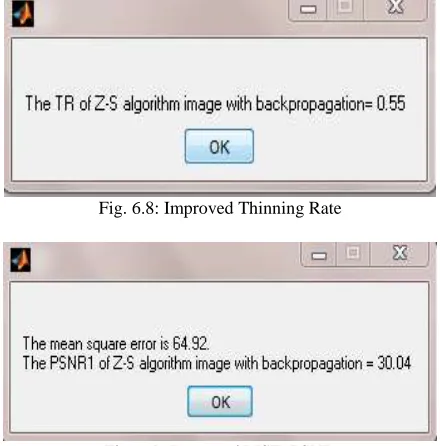
Fig. 6.8: Improved Thinning Rate
Fig. 6.9: Improved MSE, PSNR
As shown in figure 6.8 and 6.9, to improve output of Zhang and Suen algorithm in terms of PNSR, MSE and TR enhancement is proposed which will be based on back propagation algorithm. In this figure back propagation algorithm is executed with Zhang and Suen algorithm. After applying the back propagation algorithm the output of the thinning is image is shown which has better results than existing one. The results after applying MSE, PNSR and TR values are 64.92, 30.04 and 0.55 respectively.
VII. CONCLUSION
propagation algorithm. The simulation results shows that proposed algorithm performs batter in terms of PSNR, MSE and thinning rate. In future work, further improvement will be proposed in the enhancement and this enhancement will be based on Boltzman learning. The technique of Boltzman learning will improve thinning rate, PSNR and MSE value.
REFERENCES
[1] Gonzalez R.C. and Woods R.E. (2002) Digital Image Processing 2nd Ed. Tom Robbins.
[2] Abu-Ain W, et al. “Skeletonization Algorithm for Binary Images” The 4th International Conference on Electrical Engineering and Informatics (ICEEI 2013) pp.704-709.
[3] Padole G.V, Pokle S. B. “New Iterative Algorithms For Thinning Binary Images” Third International Conference on Emerging Trends in Engineering and Technology IEEE 2010 pp. 166-171
[4] Lam L, et al. “ Thinning methodologies-A comprehensive survey” IEEE transactions on pattern analysis and machine intelligence Vol. 14 No. 9 September 1992 pp. 869-885
[5] Chatbri et al. “ Using scale space filtering to make thinning algorithms robust against noise in sketch images” Pattern Recognition letters 42( 2014) pp. 1-10 [6] Zhou R.W., et al. “A novel single-pass thinning algorithm and an effective set of performance criteria” 1995 Elsevier Science pp. 1267-1275.
[7] Ahmed et al. “A Rotation Invariant Rule-Based Thinning Algorithm for Character Recognition” IEEE transactions on pattern analysis and machine intelligence, vol. 24, no. 12, December 2002 pp. 1672-1678
[8] Rockett “An Improved Rotation-Invariant Thinning Algorithm” IEEE transactions on pattern analysis and machine intelligence, vol. 27, no. 10, October 2005 pp.1671-1674
[9] Saeed K, et al. “K3M: A universal algorithm for image skeletonization and a review of thinning techniques” International Journal of Applied Mathematics & Computer Science, 2010, Vol. 20, No. 2, pp. 317–335
[10] Jagna A. and Kamakshiprasad V. “New parallel binary image thinning algorithm” ARPN Journal of Engineering and Applied sciences vol. 5, no. 4, April 2010 pp. 64-67