e-ISSN: 2278-067X, p-ISSN: 2278-800X, www.ijerd.com
Volume 10, Issue 3 (March 2014), PP.48-53
Efficient CAM based Low Power Analysis from Parity
Check Method
K.Sarojini
1, F.V.Jayasudha
2, J.Shobana
31
Department of ECE, M.Tech VLSI Design, Sathyabama University, Tamilnadu, India. 2
Department of ECE, Assistant proffessor, Sathyabama University, Tamilnadu, India.
3Department of ECE, M.Tech VLSI Design, sathyabama university, Tamilnadu, India.
Abstract:- A Content Addressable Memory (CAM) is a Static RAM-based memory that can be accessed in parallel to search for a given search word, providing as a result the address of the matching data. This paper presents a new technique to reduce static and dynamic power consumption, increases speed in Content Addressable Memory (CAM).Our approach is to check most significant bits of CAM for search operation by breaking the match lines into several segments based on most significant bits. Since most stored words fail to match in their respective segments, the search operation is discontinued for corresponding segments. The technique proposed memory partition scheme by validating operating segments of CAM where the ideal portion should be short of to cut-off region using clock gating.
Keywords:- Content addressable memory (CAM), most significant bit, multiple input signature register, memory partition, clock gating.
I.
INTRODUCTION
Content-addressable memory (CAM) is a special type of computer memory used in certain very high speed searching applications. It is also known as associative memory, associative storage or associative array, although the last term is more often used for a programming data structure. Several custom computers, like the Goodyear STARAN, were built to implement CAM, and were designated associative computers. CAM is a type of solid state memory in which data are accessed by their contents rather than physical locations. Content addressable memory (CAM) is an extension of RAM , we have to known the RAM features to understand CAM. IN General RAM has two operations read and write i.e. the data stored in RAM can be read or written. CAM has three operation modes: READ, WRITE, and COMPARE [1]. CAM are faster than other hardware and software based search systems.
Most memory devices store and retrieve data by addressing specific memory locations. The time required to find the data stored in memory can be reduced, if the data can be identified for access by its content rather than by its address. A memory that is accessed in this way is called content addressable memory(CAM). To achieve an effective function of data searching, the data comparisons architecture of CAM is usually implemented in parallel operation structure. The CAM has a parallel active circuitry which consumes more power and the main challenge in designing the CAM is to reduce the power consumption without reducing the speed and memory density.
CAM consisting of 4 words ,with each word containing 3 bits arranged horizontally.CAM search operation begins with loading the search data word into the search data registers followed by precharging all match lines high, putting them all temporarily match state. Next, the search lines drivers broadcast the search word onto the differential search lines, and each CAM core cell compares its stored bit against the bit on its corresponding search lines. Match lines on which all bits match remain in the precharged high state. Match lines that have atleast one bit that misses, discharge to ground. The MLSA then detects whether its match line has a matching condition or miss condition. Finally, the encoder maps the match line of the matching location to its encoded address [1].
Fig.1: simple schematic of CAM
II.
PROPOSED
CAM
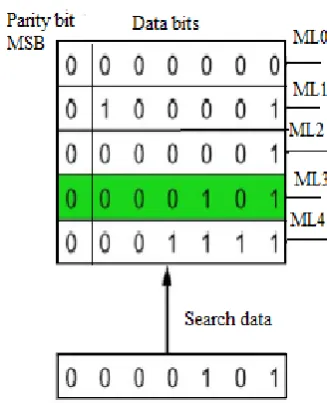
Parity bit is introduced to boost the search speed of the parallel CAM with less 1% power and area overhead and power consumption. In this proposed CAM is partitioned into two ways using parity bit.
The main objective of proposed CAM is to reduce power and increase speed of the CAM by using memory partition and clock gating. First we briefly discuss the conventional parity based CAM before presenting our proposed CAM.
Fig.2: Block diagram of proposed CAM
A. Conventional Parity Bit Based CAM:
The parity bit based CAM design is shown in Fig.2 consisting of the original data segment and an extra one-bit segment, derived from the actual data bits. These parity bit obtain i.e., odd or even number of “1”s. The obtained parity bit is placed directly to the corresponding word and ML [2]. The CAM using parity bit search the data using 0 or 1.we have to add the parity bit for every data bit, power consumes more. The effective gated power .The main drawback of the conventional CAM is transistor level power gating increases leakage current leads to chip violation. For highly recurrent input, CAM insists of searching address in whole memory based parity leads to latency reduction and throughput.
A. Proposed Parity bit CAM USING Memory Partition :
Fig .4: parity bit CAM using Memory partition
The proposed CAM design used to increase speed, reduce static and dynamic power consumption in content addressable memory (CAM) using memory partition and clock gating. Multiple input signature register is proposed to increase the searching speed of CAM by isolate recurrent data into signature memory, it reduces searching time. Our approach is to check most significant bits of CAM for search operation by breaking the match lines into several segments based on most significant bit. It increases speed and reduces power. Memory partition scheme by validating operating segments of CAM where the ideal portion should be using clock gating.
III.
CLOCK
GATING
Clock gating is a popular technique used in many synchronous circuits for reducing dynamic power dissipation. Clock gating saves power by adding more logic to a circuit to the clock tree. Switching states consumes more power .This clock gating process can also save significant area as well as power. Clock gating uses to Register transfer level reduces power consumption. The main advantage of the clock gating sets the ideal mode when CAM is not in use in any other applications.
IV.
PERFORMANCE
COMPARISONS
Performance comparisons mainly discuss about flow summary and power play power analyzer using Quartus II and simulation using model sim 9.a.
A. Flow Summary of Proposed CAM:
This flow summary shows the area, total logic elements is less than 1% area using cyclone II family. This figure discuss about area and speed of CAM.
B. Power Play Power Analyzer Tool:
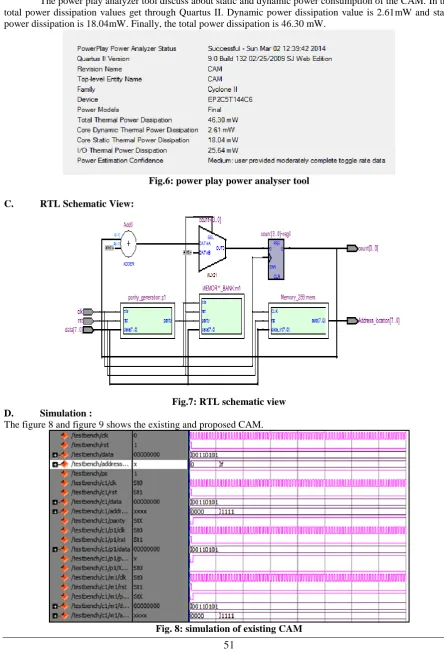
The power play analyzer tool discuss about static and dynamic power consumption of the CAM. In this total power dissipation values get through Quartus II. Dynamic power dissipation value is 2.61mW and static power dissipation is 18.04mW. Finally, the total power dissipation is 46.30 mW.
Fig.6: power play power analyser tool
C. RTL Schematic View:
Fig.7: RTL schematic view
D. Simulation :
The figure 8 and figure 9 shows the existing and proposed CAM.
In this fig 8 shows the existing system of CAM having more parity generation, it consumes more power.
Fig. 9: simulation of proposed CAM
In this fig 9 shows the simulation of proposed CAM having less number of parity generation using memory partition ,it reduces area and increases speed.
E. Comparison Table:
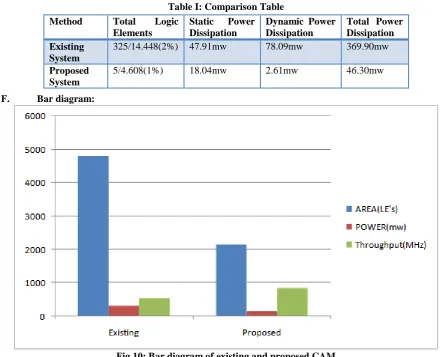
The table 1 shows the existing system and proposed system of CAM
Table I: Comparison Table
F. Bar diagram:
Fig.10: Bar diagram of existing and proposed CAM
V.
CONCLUSIONS
We proposed an effective clock gating technique and a memory partition that offers several major advantages, namely average power consumption, boosted search speed and improved process variation. It is much more stable than recently published designs while maintain their low power consumption. The proposed CAM is well suitable for sub-65-nm CMOS technology.
In future CAM can be used to accelerate any application ranging from Local area network, data base management and file storage management.
Method Total Logic
Elements
Static Power
Dissipation
Dynamic Power Dissipation
Total Power Dissipation Existing
System
325/14.448(2%) 47.91mw 78.09mw 369.90mw
Proposed System
REFERENCES
[1]. Scott Beamer, Mehmet Akgul “Design of low power content addressable Memory (CAM)” Department of Electrical Engineering & Computer Science University of California, Berkeleyfsbeamer,
[email protected] May 7, 2009.
[2]. Anh-Tuan Do, Shoushun Chen, Zhi-Hui Kong, and Kiat Seng Yeo “A High Speed Low Power CAM With a Parity Bit and Power-Gated ML Sensing” ”, IEEE Transactions on Very Large Scale Integration (VLSI) Systems, Vol. 21, No. 1, January 2013.
[3]. Shyue-Kung Lu, Guan-Quan Lin, and Sy-Yen Kuo “Yield Enhancement Techniques for Content-Addressable Memories” Dep. of Electronic Engineering, Fu Jen Catholic University, Taipei, [email protected] *Dep. of Electrical Engineering, National Taiwan University, Taipei, Taiwan
[4]. Oleksiy Tyshchenko and Ali Sheikholeslami, Senior Member, IEEE “Match Sensing Using
Match-Line Stability in Content-Addressable Memories (CAM) IEEE JOURNAL OF SOLID-STATE CIRCUITS, VOL. 43, NO. 9, SEPTEMBER 2008.
[5]. S.Baeg "Low-power ternary content-addressable memory design using a segmented match line", IEEETrans. Circuits Syst. I, Reg. Papers, vol. 55, no. 6, pp.1485 -1494 2008
[6]. D. Patterson and J. Hennessy, Computer Architecture: A Quantitative Approach, 3rd ed. Norwell, MA: Morgan Kaufmann, 2003.
[7]. J. Koomey, S. Berard, M. Sanchez, and H. Wong, “Assessing trends in the electrical efficiency of computation over time,” IEEE Annals History Comput., to be published.