ISSN (Online): 2320-9364, ISSN (Print): 2320-9356
www.ijres.org Volume 7 Issue 2 Ser. I ǁ 2019 ǁ PP. 12-18
Corrosion Behaviour of Heat Treated Mild Steel in Citrus Juice:
Lime
Olakolegan O. D.
1, Stephen J. T.
2,AdeyemiG. J.
2and Adebayo A.
2 1Department of Mechanical Engineering, Federal Polytechnic, Ado-Ekiti, Nigeria. 2Department of Mechanical Engineering, Ekiti State University, Ado-Ekiti, Nigeria. Corresponding Author: Olakolegan O. D
ABSTRACT; This study investigates corrosion behavior of heat treated mild steel when exposed to citrus Juice (Lime) environment. Annealing, normalising, hardening and tempering heat treatment were performed on the mild steel, and their effects on microstructure of the mild steel were examined. Potentiodynamic polarization electrochemical technique was employed to study corrosion of heat treated mild steel in lime solution. The results revealed that the heat treated mild steel samples had better corrosion resistance in lime solution than untreated sample with a corrosion rate of 1.88080 mmpy. The results also showed that microstructures obtained by different heat treatment processes are sensitive to the lime environment, and corrosion of the samples is due to ferrite precipitation and carbide phases. Heat treated tempered and annealed samples exhibited superior corrosion resistance that other heat treated samples in lime solution with corrosion rate of 0.00002 mmpy and 0.0004 mmpy, respectively. Although, some of the heated samples also exhibit low corrosion rate in lime environment but normalize sample was found to have the highest rate of corrosion of 0.19680 mmpy. Hardened sample displayed good corrosion resistance with corrosion rate of 0.13340 mmpy in lime solution.
KEYWORDS: Mild steel, heat treatment, citrus fruit, corrosion, microstructure
--- --- Date of Submission: 22-06-2019 Date of acceptance:08-07-2019 --- ---
I.
INTRODUCTION
Low carbon steel is the least expensive type of steel and commonly used for construction purposes due to its availability, low cost and good mechanical properties, but it is highly susceptible to corrosion, especially when exposed to atmospheric oxygen in a wet environment[1].Due to the high corrosion of carbon steel, different investigations have be conducted to reveal the corrosion characteristics of selected steels in different environments such as HCl, H2SO4, NaOH, processed water, rain water, municipal tap water, cassava extract, cocoa extract etc. [2-4].
Furthermore, heat treatment of low carbon steel has been used to enhance its ductility, toughness and strength which are very good for structural applications and ultimately required properties in material design and selection. Heat treatment is also used to relieve internal stress developed in the material due to machining effect [5-10]. A material which possesses toughness will withstand tearing or shearing and may be stretched or deformed without breaking. Some of the heat treatment processes carried out on metals or alloys are annealing, normalizing, hardening, austempering, martempering, tempering and surface hardening.
II.
LITERATURE REVIEW
Many research works had been carried out on the effects of heat treatments on the mechanical properties of carbon steel. Adebayo and Stephen [11] studied the effects of heat treatments on the mechanical properties of mild steel subjected to tensile, impact and torsional tests after annealed and quenched in SAE 40 oil. It was revealed that stress and ultimate strength decreases as both annealing and tempering temperature increases, whereas the impact energy and breaking torque increases as annealing and tempering temperature increases. The research carried out by Joseph et al.[12] to investigate the effects of heat treatment on microstructure and mechanical properties of SAE 1025 steel revealed significant differences in the microstructure and mechanical properties of the different heat treated samples. The results showed decrease in hardness compared to non-heat treated sample while a higher tensile strength was observed for annealing heat treated samples and a microstructure of enhanced quality was obtained with normalized heat treated sample.
steel (0.36C) under two different quenching media (water and palm oil). Results indicated that water quenched steel produced its best properties in strength and hardness, while palm oil quenched steel has its best property in impact strength. Motagi and Ramesh [16] reported the effects of heat treatment on microstructure and mechanical properties of medium carbon steel. They claimed that the ultimate tensile strength of the normalized samples was greater than annealed samples but less than the tempering and quenched samples while hardness decreases. The experimental results from the evaluation the effect of tempering on mechanical properties and corrosion rate of medium and high carbon steel revealed that mechanical properties of the selected alloy were significantly changed by tempering heat treatment. By increasing the tempering temperature, hardness and ultimate tensile strength were gradually decreased and ductility was improved Gebril et al.[10].
Furthermore, the research carried out by Daramola et al.[5]to study critically the effects of heat treatment on the properties of rolled medium carbon steel showed that the steel developed has excellent combination of tensile strength, hardness and impact strength which is very good for structural applications. Ade-Ajayi and Oyeleke [17] observed that the microstructures of original NS 34 LC mild steel as-rolled products were distorted during strain hardening and the ratio of yield strength to ultimate tensile strength increased as the level of strain hardening increased. Stress-relief annealing was found to remove the effects of previous strain hardening on NS 34 LC. Investigations were also carried out by Offor and Ezekoye[18] to determine the diverse effect of intercritical treatments on the mechanical properties of some low carbon steels revealed the intercritical quenching, with or without low temperature tempering, increased the tensile strength and hardness of the samples but decreased their ductility and toughness. Normalizing increased ductility and toughness, but reduced strength and hardness; while annealing reduced all the properties studied. Therefore, the results from various researches showed that there is always need to carry out heat treatment on steels for further enhancement of desired mechanical properties in the materials which in turn increases the durability and performance of components made from them[19].
Effects of heat treatment on corrosion of mild steel have alsogained attention of some authors. Stephen et al. [20] investigated the effects of heat treatment on corrosion rates of mild steel pipe weldments and pipe-whip restraint devices in saltwater. The results showed that corrosion rate decreases with increase in pipe preheat temperatures but increases with increase in welding pass. Corrosion rate of mild steel was also found to depend on immersion time and tempering temperature. They concluded that appropriate heat treatment could be used to minimize the corrosion rates of metallic structures in a corrosive medium.Babata et al., [21]studied corrosion behaviour of commercial mild steel in municipal tap water. The mild steel was subjected to various heat treatments (annealing, hardening, normalizing and tempering) and the result revealed the heat treated samples had better corrosion resistivity than untreated sample, most especially the annealed and normalized samples. Igwemezie and Ovri [22] studied the effects of microstructural change and corrosion susceptibility of heat treated medium carbon steel in different corrosive media. The study showed that microstructures obtained by different heat treatment processes are sensitive to the environment and corrosion as a result of ferrite precipitation and carbide phases.
Corrosion studies have been done on some of the agro-allied fluids. These are some of the most common agro-allied fluids (coconut oil, groundnut oil, palm kernel oil, cassava, cocoa, orange juice, and pineapple juice). The corrosion of mild steel (uncoated), galvanized steel and stainless steel (304L) have been studied in ground melon (locally called egusi), cassava pulp, mashed palm fruit, tomato pulp, and black-eyed bean pulp respectively. Normalizing the corrosion rates results of these steel with respect to that of stainless steel in each environment showed that in ground melon galvanized steel and mild steel had corrosion rates 91.41 and 13.38 times that of stainless steel; in cassava pulp 183.68 and 148.11 times; in mashed palm-fruit 50.08 and 58.58 times; in bean pulp 301.3 and 377.85 times; and in tomato pulp 128.2 and 14.34 times respectively. Corrosion in orange medium for instance, is very substantial because of varying amounts of citrus acid present in the fluid as indicated to be greater than 70% [23]. These include folic acid, pectin, flavonoids, malic, tartanic benzoic, succinic, oxalic and formic acids. Nitrogenous compounds are also present to some extent of about 0.05-1.0%, mostly as free amino acids: asparagines, histidine, betine, cystein, praline, serine and stachydrine [24].
Low carbon steel is readily available and cheaper compared to stainless steel. Through heat treatment,it can easily be modified for structural applications, and also improve in term of corrosion resistance for production agro-allied equipment. This research therefore focuses on investigating effect of heat treatment on thecorrosion resistance of mild steel in citric environment using potentiodynamic polarization electrochemical method.
III.
MATERIALS AND METHODOLOGY
Materials
juice of the lime fruit was obtained by manual squeezing and filtered with a sieve, thereafter, stored in a covered and labeled jars at room temperature prior to use. The mild steel of 5 mm thickness was mechanically cut into square shape coupon of dimension 10 mm × 10 mm.The elemental composition of the obtained mild steel was determined using Arc Spark Spectrometer prior to heat treatment procedures.
Table 1: Chemical Composition of the Low Carbon Steel.
Elements C Al S P Mn Ni Cr As
Composition 0.1700 0.0018 0.0500 0.0400 1.0300 0.200 0.500 0.0007
Elements Mo V Cu Si Zn Sn Ca Fe
Composition 0.060 0.045 0.2 0.280 0.0045 0.020 0.003 97.4
Heat Treatment
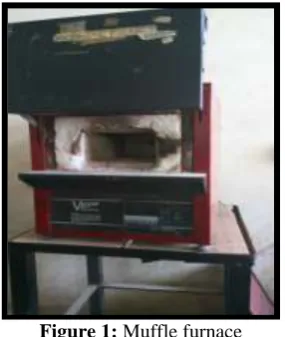
The heat treatment procedures were performed in an electric muffle furnace (Figure 1), capable of attaining temperature exceeding 1200oC.
Annealing:The selected samplewasfirst heated to a temperature of 900oC to obtain austenite phase and later held for 1 hour at that upper critical temperature to enable the samples at that temperature have sufficient time for proper homogenization. The furnace was then switched off so that the sample temperature decreasesat the same rate as that of the furnace (furnace cooling). The sample was taken out of the furnace after a day when the furnace temperature had already reached the room temperature.
Normalising:The sample for normalizingwas first heated to austenitic phase at a temperature of 900oC and kept at this temperature for an hour for proper homogenization. The furnace was then switched off and the sample wasthen taken out and aircool to room temperature.
Hardening: The sample selected for hardeningwas heated to temperature of 900℃in the muffle furnace, allowed to homogenize for an hour, before the heated samples were quenchedin water bath to ambient temperature. It wasthen taken out of the bath, cleaned and dried properly.
Tempering: The specimen for the tempering was heated to 900℃ for an hour and then quenched in water bath maintained at room temperature. The quenched samples were then reheated to a tempering temperature of 230℃.
Figure 1: Muffle furnace
Microstructural Examination (Optical Micrograph)
Cut samples for the microstructural test were grinded using 80, 120, 360, 600 and 800 grits emery paper, and polished metallographically using polishing cloth and paste with alumina particles until a mirror-like surface was obtained. The mirror-like polished surface samples were then etched in 2% Nitric acid and 98% Ethyl alcohol to reveal the microstructure of the surface layer. The phases of the specimens were then photographically recorded at 200 magnification using Zeiss metallurgical microscope with accessories for image analysis.
Corrosion Test
insulated copper wire to one face of the sample using aluminum conducting tape, and cold mounting it in resin after which the sample surfaces were polished progressivelywith emery papers starting from 120grit to 640grit size. The samples were de-greased with acetone and then rinsed in distilled water before immersion in the prepared solutions of Lime orange, exposed to atmospheric air. The working electrodes were immersed in test solutions, as depicted in the experimental set up shown in Figure 2(b), until a stable open circuit potential was obtained. Open circuit potential measurements were carried out in separate cell for 120 minutes.Potentiodynamic polarization measurements were carried out using a scan rate of 0.16 mV/ s at a potential initiated at -200 mV to +250 mV. After each experiment, the electrolyte and the test samples were replaced. Three repeated tests were carried out for all samples to ensure the reproducibility and repeatability of results from the triplicates.The results of the corrosion tests were evaluated byTafel plot extrapolations to determine the corrosion current densities (Icorr), corrosion potentials (Ecorr) andcorrosion rate.
Figure 2: (a)Working electrodes and (b) Experimental set up for electrochemical process
IV.
RESULTS AND DISCUSSION
Microstructural Evaluation
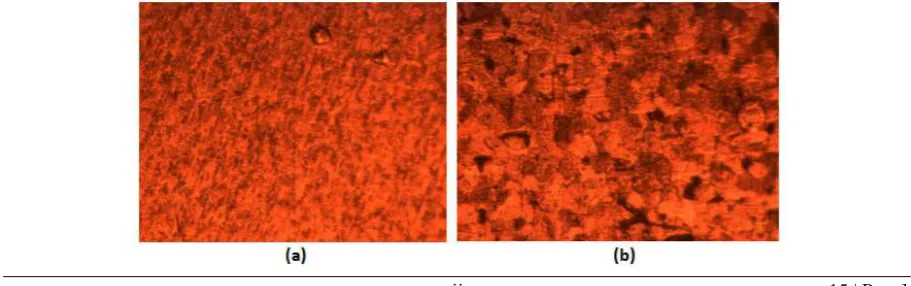
Figure 3: Micrograph showing (a) as-received (b) tempered (c) annealed (d) normalized (e) hardened mild steel microstructures( 200 magnification).
Corrosion behaviour
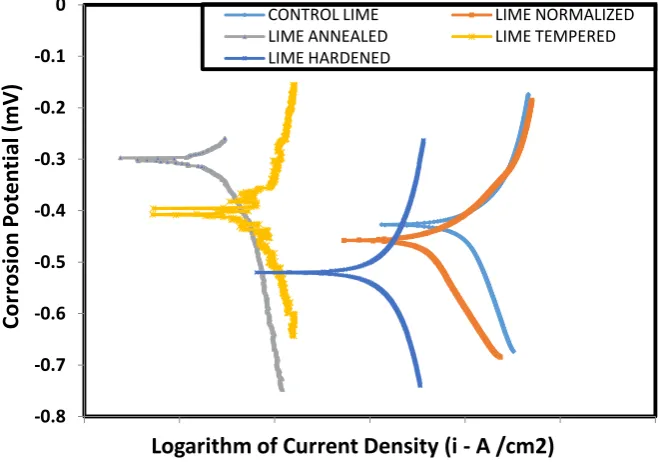
The corrosion results of the as-received and heat treated samples obtained from the Tafel plots electrochemical studies in lime environment is presented in Figure 4 while the Tafel extrapolations of the corrosion current densities (Icorr) and corrosion potentials (Ecorr) are presented in Table 2. It can be observed from the results that all the heat treated samples displayed better corrosion resistance when compared with the non-heat treated sample with a corrosion rate of 1.88080 mmpy. However, the tempered and annealed samples displayed the best corrosion resistance of 0.00044 mmpy and 0.00002 mmpy respectively. The observed behaviourin the tempered sample could be attributed to the low stress levels in the steel sample which makes the localized breakdown of the passivity more difficult than other structure as stated by Atandaet al.,[26]. Furthermore, corrosion behaviour in annealed sample could be due to observed thicker corrosion products covering the surface of the sample, forming a protective film on the surface which inhibited the corrosion rate.
Figure 4:Polarization curves of as-received and heat treated samples in lime -0.8
-0.7 -0.6 -0.5 -0.4 -0.3 -0.2 -0.1 0
Co
rr
os
ion
P
ot
e
n
ti
al
(m
V)
Logarithm of Current Density (i - A /cm2)
CONTROL LIME LIME NORMALIZED
LIME ANNEALED LIME TEMPERED
Table 2: Electrochemical data of samples from the tafel extrapolations in lime solution
S/N Heat-treated samples Potential
Ecorr(mV)
Corrosion Current Icorr (μA) Corrosion
(mmpy)
1. Control -430.2290 162.0830 1.88080
2. Tempered -407.6290 38.4630 0.00044
3. Annealed -300.9130 1.8350 0.00002
4. Normalized -461.8100 16.9620 0.19680
5. Hardened -520.2330 11.4900 0.13340
Although, the heated samples exhibit low corrosion rate in lime environment but normalize sample was found to have the highest rate of corrosion of 0.19680 mmpy. Corrosion rate of 0.13340 mmpy was recorded for hardened sample in lime solution. The observed differences in corrosion rates could be as a result of ferrite and cementite (carbide) phases which might led to setting up of galvanic cells within the microstructure with the cementite phase becoming cathodic and the ferrite anodic thereby accelerating corrosion reaction as reported by Igwemezie and Ovri [22]. However, all the heat treated could be adjudged to perform well in the lime medium as their corrosion rates are well below 0.2 mmpy.
V.
CONCLUSION
Experimental investigation has been carried out on the corrosion behaviour of heat treated mild steel in lime environment. The study employed potentiodynamic polarization electrochemical method to investigate corrosion of heat treated mild steel in lime solution, and the following conclusions were drawn within the limit of work:
After heat treatment, as-received showed a ferrite grain in boundary within acicular pearlite while tempered exhibited low carbon tempered martensite. Annealed heat treatment process affect spatial distribution of ferrite in a pearlite matrix. Hardened sample showed a ferrite grain in martensite matrix whereas the normalised sample results into fine distribution of ferrite-pearlite matrix.
The corrosion results showed that microstructures obtained by different heat treatment processes are sensitive to the lime environment, and corrosion of the samples is due to ferrite precipitation and carbide phases.
It was also revealed that the heat treated mild steel samples have better corrosion resistance in lime solution than untreated sample.
Heat treated tempered and annealed samples exhibited superior corrosion resistance that other heat treated samples in lime solution.
Although, heated samples exhibit low corrosion rate in lime environment but normalize sample was found to have the highest rate of corrosion.
Heat treatment process can be used to control corrosion of mild steel in citrus fruit (lime) environment.
REFERENCES
[1]. Smith, W.F. and J. Hashemi, Foundations of materials science and engineering. 4th ed. 2006, Ney York, NY, USA: McGraw-Hill.
[2]. Mï, H., The corrosion behaviour of a low carbon steel in natural and synthetic seawaters. Journal of the Southern African Institute
of Mining and Metallurgy, 2006. 106(8): p. 585-592.
[3]. Osarolube, E., I. Owate, and N. Oforka, Corrosion behaviour of mild and high carbon steels in various acidic media. Scientific
Research and Essay, 2008. 3(6): p. 224-228.
[4]. Oluwole, O. and O. Olawale, Corrosion Behaviour of Nickel Plated Low Carbon Steel in Tomato Fluid. Leonardo Electronic
Journal of Practices and Technologies, 2010(16): p. 33-42.
[5]. Daramola, O., B. Adewuyi, and I. Oladele, Effects of heat treatment on the mechanical properties of rolled medium carbon steel.
Journal of Minerals and Materials Characterization and Engineering, 2010. 9(08): p. 693.
[6]. Fadare, D., T. Fadara, and O. Akanbi, Effect of heat treatment on mechanical properties and microstructure of NST 37-2 steel.
Journal of Minerals and Materials Characterization and Engineering, 2011. 10(03): p. 299.
[7]. Offor, P., C. Daniel-Mkpume, and D. Obikwelu, Effects of Various Quenching Media on the Mechanical Properties of
Intercritically Annealed 0.15 wt% C–0.43 wt% Mn Steel. Nigerian Journal of Technology, 2010. 29(2): p. 76-81.
[8]. Ndaliman, M., An assessment of mechanical properties of medium carbon steel under different quenching media. AU JT, 2006.
10(2): p. 100-104.
[9]. Odusote, J.K., T.K. Ajiboye, and A.B. Rabiu, Evaluation of mechanical properties of medium carbon steel quenched in water and
oil. AU Journal of Technology, 2012. 15(4).
[10]. Gebril, M.A., M. Aldlemey, and A.F. Kablan. Effect of Tempering on Mechanical Properties and Corrosion Rate of Medium and
High Carbon Steel. in Advanced Materials Research. 2013: Trans Tech Publ.
[11]. Adebayo, A. and J. Stephen, Effects of Heat Treatment on the Mechanical Properties of Mild Steel. Energy (Joules), 2008.
30(100.0): p. 300.0.
[12]. Joseph, O., R. Leramo, and O. Ojudun, Effect of Heat Treatment on Microstructure and Mechanical Properties of SAE 1025 Steel:
Analysis by one-way ANOVA. J. Mater. Environ. Sci., 2015. 6(1): p. 101-106.
[13]. Adebayo, A., J.T. Stephen, and G.J. Adeyemi, Effects of Local Cooling Media on the Mechanical Properties of Heat Treated Mild
Steel. European Journal of Engineering Research and Science, 2018. 3(4): p. 27-31.
[14]. Ndaliman, M.B., An assessment of mechanical properties of medium carbon steel under different quenching media. AU JT, 2006.
www.ijres.org 18 | Page]
[15]. Kanwal, T., R. Nazir, S. Zulqernain, A. Salam, and J. Ahmad, Quench Hardening and Tempering Behaviour of A Low Carbon
Steel. Journal of the Pakistan Institute of Chemical Engineers, 2009. 37: p. 51-53.
[16]. Motagi, B. and R. Bhosle, Effect of heat treatment on microstructure and mechanical properties of medium carbon Steel.
International Journal of Engineering Research and Development, 2012. 2(1): p. 7-13.
[17]. Ade-Ajayi, J. and S. Oyeleke, Effects of Sub-Critical Annealing on the Mechanical Properties of Strain-hardened NST 37-2 Steel.
Nigerian Society of Engineers Technical Transactions, 1996. 31(2): p. 1-13.
[18]. Offor, P., M. Eng, and B. Ezekoye, Intercritical Heat Treatments and the Mechanical Properties of Hot-Rolled Low Carbon Steels.
The Pacific Journal of Science and Technology, 2009. 10(2): p. 142-148.
[19]. Verma, A. and P.K. Singh, Influence of Heat Treatment on Mechanical Properties of AISI 1040 Steel. IOSR Journal of Mechanical
and civil Engineering, 2013. 10(2).
[20]. Stephen, J.T., A.J. Alawode, and O.I. Oluwole, Effects of Heat Treatment on Stress Corrosion Cracking of Pipe Weldments and
Pipe-Whip Restraint Devicesin Seawater Medium. Journal of Engineering and Applied Sciences, Medwell Publications, 2008. 3(4):
p. 350-356.
[21]. Shuaib-Babata, Y.L., A.G.F. Alabi, and N.O. Dirisu, Investigation into Corrosion Behaviours Of Commercial Mild Steel in Ilorin
(Nigeria) Tap Water From Asa and Agba Dams. Journal of engineering and earth science, 2009. 3(1): p. 62-69.
[22]. Igwemezie, V. and J. Ovri, Investigation into the effects of microstructure on the corrosion susceptibility of medium carbon steel.
IJES, 2013. 2(6): p. 11-26.
[23]. Violeta, N., I. Trandafir, and M.E. Ionica, HPLC organic acid analysis in different citrus juices under reversed phase conditions.
Notulae Botanicae Horti Agrobotanici Cluj-Napoca, 2010. 38(1): p. 44-48.
[24]. Abiola, O.K., N.C. Oforka, and E.E. Ebenso, The inhibition of mild steel corrosion in acidic medium by fruit juice of citrus
paradisi. Journal of Corrosion Science and Technology, 2004. 1(1): p. 75-78.
[25]. Clover, D., B. Kinsella, B. Pejcic, and R. De Marco, The influence of microstructure on the corrosion rate of various carbon steels.
Journal of applied electrochemistry, 2005. 35(2): p. 139-149.
[26]. Atanda, P., O. Olorunniwo, O. Alabi, and O. Oluwole, Effect of iso-thermal treatment on the corrosion behaviour of low carbon
steel (Nigerian C2R grade) in a buffered solution containing chloride and carbonate ions. 2012.