https://doi.org/10.5194/tc-12-3137-2018
© Author(s) 2018. This work is distributed under the Creative Commons Attribution 4.0 License.
Spatial variability in snow precipitation and accumulation in
COSMO–WRF simulations and radar estimations
over complex terrain
Franziska Gerber1,2, Nikola Besic3,4, Varun Sharma1, Rebecca Mott2,5, Megan Daniels6, Marco Gabella4, Alexis Berne3, Urs Germann4, and Michael Lehning1,2
1Laboratory of Cryospheric Sciences, School of Architecture, Civil and Environmental Engineering, École Polytechnique
Fédérale de Lausanne, Lausanne, Switzerland
2WSL Institute for Snow and Avalanche Research SLF, Davos, Switzerland
3Environmental Remote Sensing Laboratory, School of Architecture, Civil and Environmental Engineering,
École Polytechnique Fédérale de Lausanne, Lausanne, Switzerland
4Radar, Satellite, Nowcasting Department, MeteoSwiss, Locarno, Switzerland
5Institute of Meteorology and Climate Research, Atmospheric Environmental Research (KIT/IMK-IFU),
KIT-Campus Alpin, Garmisch-Partenkirchen, Germany
6independent researcher: Sydney, Australia
Correspondence:Franziska Gerber ([email protected]) Received: 6 March 2018 – Discussion started: 22 March 2018
Revised: 23 August 2018 – Accepted: 28 August 2018 – Published: 4 October 2018
Abstract. Snow distribution in complex alpine terrain and its evolution in the future climate is important in a variety of applications including hydropower, avalanche forecast-ing and freshwater resources. However, it is still challengforecast-ing to quantitatively forecast precipitation, especially over com-plex terrain where the interaction between local wind and precipitation fields strongly affects snow distribution at the mountain ridge scale. Therefore, it is essential to retrieve high-resolution information about precipitation processes over complex terrain. Here, we present very-high-resolution Weather Research and Forecasting model (WRF) simulations (COSMO–WRF), which are initialized by 2.2 km resolution Consortium for Small-scale Modeling (COSMO) analysis. To assess the ability of COSMO–WRF to represent spatial snow precipitation patterns, they are validated against op-erational weather radar measurements. Estimated COSMO– WRF precipitation is generally higher than estimated radar precipitation, most likely due to an overestimation of oro-graphic precipitation enhancement in the model. The high precipitation amounts also lead to a higher spatial variabil-ity in the model compared to radar estimates. Overall, an autocorrelation and scale analysis of radar and COSMO– WRF precipitation patterns at a horizontal grid spacing of
450 m show that COSMO–WRF captures the spatial variabil-ity normalized by the domain-wide variabilvariabil-ity in precipita-tion patterns down to the scale of a few kilometers. However, simulated precipitation patterns systematically show a lower variability on the smallest scales of a few hundred meters compared to radar estimates. A comparison of spatial vari-ability for different model resolutions gives evidence for an improved representation of local precipitation processes at a horizontal resolution of 50 m compared to 450 m. Addition-ally, differences of precipitation between 2830 m above sea level and the ground indicate that near-surface processes are active in the model.
1 Introduction
of weather forecast models to represent the spatial variabil-ity in snowfall is further crucial to efficiently manage fresh water and hydropower. Moreover, as snow is a potential dan-ger in terms of avalanches, improved knowledge about the distribution of snow is crucial for avalanche forecasting and prevention.
Snow accumulation patterns at a mountain-range scale are known to be strongly dependent on blocking and lift-ing processes includlift-ing large-scale orographic precipitation enhancement (e.g., Houze Jr., 2012; Stoelinga et al., 2013), which is related to large-scale atmospheric circulation. How-ever, for a long time little knowledge was available about the spatial distribution of snow on a mountain-slope or river-catchment scale. Only in recent years have improvements in technology allowed the investigation of mountain-slope scale snow distribution (e.g., Deems et al., 2006; Prokop, 2008; Grünewald et al., 2010). Terrestrial and airborne laser scan-ning reveal annually persistent patterns of peak-of-winter snow accumulation distribution on river-catchment scales (Schirmer et al., 2011; Scipión et al., 2013), which is found to be consistent with few dominant snowfall events of the sea-son. Reported scale breaks in fractal analysis of snow accu-mulation patterns are mainly at scales of <100 m and repre-sent the occurrence of a change in dominant processes (e.g., Deems et al., 2008). On very small scales snow accumulation patterns are assigned to wind redistribution of snow (e.g., Mott et al., 2011; Vionnet et al., 2017). Vegetation effects were found to be dominant at small scales and terrain effects dominate on scales of up to 1 km (Deems et al., 2006; Trujillo et al., 2012; Tedesche et al., 2017). Different dominant scales are reported for different slope expositions relative to the wind direction (Schirmer and Lehning, 2011). Furthermore, Schirmer et al. (2011) could show that snow accumulation smooths the underlying terrain, reducing the small-scale spa-tial variability in topography. While most studies addressed variability in snow accumulation, the combined scale anal-ysis of snow accumulation and snow precipitation patterns by Scipión et al. (2013) reveals much smoother patterns in snow precipitation at about 300–600 m above ground com-pared to final snow accumulation at the ground on scales of up to 2 km. This stresses the importance of pre-depositional near-surface and post-depositional processes for snow accu-mulation patterns.
Driving processes of snow accumulation on the mountain-ridge scale were addressed in numerous studies, which re-veal two main pre-depositional processes. On the one hand, mountaridge-scale precipitation and accumulation are in-fluenced by local cloud dynamical processes (Choularton and Perry, 1986; Dore et al., 1992; Zängl, 2008; Zängl et al., 2008; Mott et al., 2014). On the other hand, particle–flow interactions (i.e., the influence of the local flow field on the pathways of snow particles and particle distribution in the air) determine snow accumulation patterns in mountain-ous terrain (Colle, 2004; Zängl, 2008; Lehning et al., 2008; Dadic et al., 2010; Mott et al., 2010, 2014). On the
mountain-ridge scale, Mott et al. (2014) documented the occurrence of a local event of orographic snowfall enhancement. In their case study, the presence of a low-level cloud gives evidence for precipitation enhancement favored by the seeder–feeder mechanism (e.g., Bergeron, 1965; Purdy et al., 2005). On similar scales, preferential deposition (Lehning et al., 2008) was found to cause enhanced snow accumulation on leeward slopes (e.g., Mott et al., 2010; Mott and Lehning, 2010). However, snow depth measurements in very steep terrain and corresponding local flow field measurements reveal even more complex particle–flow interactions (Gerber et al., 2017) than previously suggested by model studies. On even smaller scales the main driver of snow accumulation patterns is post-depositional snow transport by drifting and blowing snow, which is dependent on local topographic features and wind gusts (Lehning and Fierz, 2008; Mott et al., 2010).
Complex terrain–flow–precipitation interactions (i.e., the effect of terrain-induced flow field variations on precipitation formation and distribution), especially on the mountain-ridge scale, still leave the relative importance of the different pre-depositional processes for snow accumulation and the fre-quency of occurrence barely known (Mott et al., 2014; Vion-net et al., 2017). Running a coupled simulation of the snow-pack model Crocus and the atmospheric model Meso-NH in large-eddy simulation (LES) mode, Vionnet et al. (2017) ad-dressed the question of the relative importance of these dif-ferent processes including snow redistribution by wind. Their results show that post-depositional snow transport dominates snow accumulation variability but leaves the question of the relative importance of pre-depositional processes open.
Given the small scale of these processes, their rela-tive importance may be addressed either based on very-high-resolution numerical simulations or based on spatially highly resolved precipitation measurements. Therefore, ac-curate model results and radar measurements at high resolu-tion are essential. Both, however, are challenging to achieve and very-high-resolution simulations are still rare, especially over complex terrain. Remote-sensing techniques are the most important methods to obtain high-resolution spatial measurements of atmospheric properties at different atmo-spheric levels. They permit us to gain information about both the small- and the large-scale properties of the atmo-spheric processes. Of particular importance is weather radar due to its wide coverage, fine spatial resolution and interac-tion of microwaves with the precipitainterac-tion. These properties have been used to infer orographic precipitation enhance-ment, particularly in the case of liquid precipitation (Panziera et al., 2015).
environment. Combining the COSMO–WRF simulations with operational radar measurements, we perform a variabil-ity analysis for snow precipitation at a regional to mountain-ridge scale to address the following question: to what degree is snow precipitation variability represented by very-high-resolution WRF simulations?
Model simulations, radar measurements and analysis tech-niques are presented in Sect. 2. In a first part of the results and discussion (Sect. 3), we validate COSMO–WRF simulations against point measurements of temperature, relative humid-ity, wind speed and direction (Sect. 3.1). Spatial precipitation patterns in both radar estimates and COSMO–WRF simula-tions are presented in Sect. 3.2. Subsequently, we address the question of to what degree the overall precipitation vari-ability is represented in the model by analyzing the domain-wide statistics (Sect. 3.3). To address the spatial variability in precipitation patterns we present a discussion of domi-nant processes based on variograms and 2-D autocorrelation maps (Sect. 3.4). Variograms and autocorrelation analysis are widely used to address the spatial variability in snow accu-mulation and precipitation (e.g., Deems et al., 2008; Mott et al., 2011; Schirmer and Lehning, 2011; Scipión et al., 2013; Vionnet et al., 2017). While scale analysis has been performed multiple times for snow accumulation patterns on a local scale, we address measured and modeled snow pre-cipitation patterns at the approximate elevation of the op-erational weather radar on the Weissfluh summit at 2830 m above sea level (m a.s.l.) on a mountain-ridge to regional scale. Additionally, we analyze modeled ground precipitation without taking into account any post-depositional processes. Given the different scales of analysis compared to previous studies, here we address scales at which local cloud dynam-ics and particle–flow interactions are expected to occur but leave out scales at which snow accumulation is expected to be dominated by post-depositional snow redistribution. Fol-lowing this analysis of spatial precipitation variability, which includes a discussion of dominant processes driving the spa-tial variability in precipitation patterns, Sect. 3.5 addresses the question of whether increased model resolution may im-prove the representation of spatial variability in the model. Finally, our findings about the model performance, our anal-ysis of the spatial variability in precipitation and future per-spectives are wrapped up in the conclusion (Sect. 4).
2 Data and methods 2.1 WRF model setup
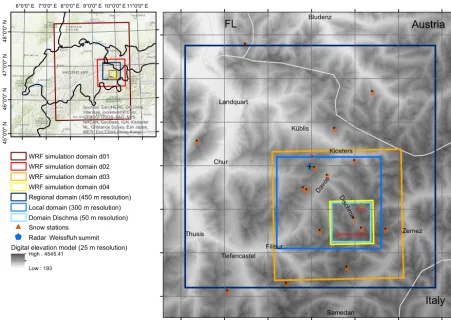
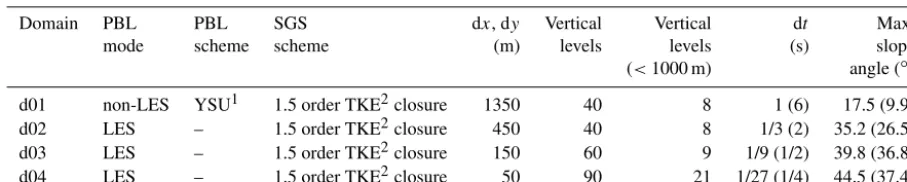
Atmospheric simulations are performed with the non-hydrostatic and fully compressible Weather Research and Forecasting (WRF) model (Skamarock et al., 2008) version 3.7.1 for the region of eastern Switzerland (Fig. 1). Simu-lations are set up with four one-way nested domains (d01– d04, Fig. 1). Domain d01 has a horizontal resolution of
1350 m with 40 vertical levels and covers a region of about 250 km×320 km including eastern Switzerland and a por-tion of the neighboring countries (Fig. 1, Table 1, Supple-ment S1). The three nests have horizontal resolutions of 450, 150 and 50 m using a nesting ratio (dxparent/dxnest) of 3.
Do-mains d02–d04 have 40, 60 and 90 vertical levels, respec-tively, with the model top at 150 hPa using a preliminary ver-sion of vertical nesting (Daniels et al., 2016). A total of 20 and 40 vertical levels refine the whole atmosphere in domains d03 and d04, respectively. A total of 10 vertical levels in d04 are introduced to additionally refine the boundary layer. To make sure that there is plenty of domain for the model to adapt to the refined topography, domain d02 is shifted toward the eastern boundary of domain d01 as dominant wind di-rections are from the northwesterly and southerly didi-rections. Domain d02 covers the central northern part of the Grisons, while domains d03 and d04 cover the surroundings of Davos and the upper Dischma valley, respectively (Fig. 1). Simu-lations are performed for three snow precipitation events on 31 January, 4 February and 5 March 2016 (Sect. 2.5).
Sources: Esri, HERE, DeLorme, Intermap, increment P Corp., GEBCO, USGS, FAO, NPS, NRCAN, GeoBase, IGN, Kadaster NL, Ordnance Survey, Esri Japan, METI, Esri China (Hong Kong),
11°0'0" E 10°0'0" E 9°0'0" E 8°0'0" E 7°0'0" E 6°0'0" E 4 8 °0 '0 " N 4 7 °0 '0 " N 4 6 °0 '0 " N 4 5 °0 '0 " N # * # * # * # * # * #* $ +#* # * # * # * # * # * # * # * # * # * # * # *
750000 760000 770000 780000 790000 800000 810000
16 0 0 0 0 17 0 0 0 0 18 0 0 0 0 19 0 0 0 0 20 0 0 0 0 21 0 0 0 0 22 0 0 0 0 Italy Austria FL Dav os D isc hm a Chur Landquart Zernez Thusis Tiefencastel Filisur Samedan Bludenz Klosters Küblis Snow stations Radar Weissfluh summit Digital elevation model (25 m resolution)
High : 4545.41 Low : 193
WRF simulation domain d01 WRF simulation domain d02 WRF simulation domain d03 WRF simulation domain d04 Regional domain (450 m resolution) Local domain (300 m resolution) Domain Dischma (50 m resolution)
Dischma Moraine FLU2
Figure 1.Overview over the study area in the eastern part of Switzerland surrounding Davos. WRF simulation domains (d01–d04, dark red to yellow) and evaluation domains (blue) give information on the simulation and evaluation setup. The 18 meteorological stations (red triangles) are within or very close to the regional domain. The two stations Dischma Moraine and FLU2, which are used to validate the model, are within the domain Dischma. The operational weather radar is located on the Weissfluh summit at approximately 2830 m above sea level (m a.s.l., blue pentagon). Coordinates in the right panel are in Swiss coordinates CH1903LV03 (unit: m). Shaded topography: dhm25 ©2018 swisstopo (5 740 000 000).
and translated to the U.S. Geological Survey conventions (Pineda et al., 2004; Arnold et al., 2010). Soil type is set to silty clay loam for the whole domain. The link between the soil, which is modeled by the Noah land-surface model with multi-parameterization options (Noah-MP, Niu et al., 2011; Yang et al., 2011), and the atmosphere is given by the MM5 Monin–Obukhov surface layer model (Paulson, 1970; Dyer and Hicks, 1970; Webb, 1970; Zhang and Anthes, 1982; Bel-jaars, 1994), which is based on the Monin–Obukhov simi-larity theory (Obukhov, 1971). For microphysics the Morri-son two-moment precipitation scheme (MorriMorri-son et al., 2005, 2009), which was found to be one of the schemes that most adequately simulates snow precipitation over complex terrain (Liu et al., 2011), is used. Details about processes in the Mor-rison parameterization are given in Appendix A. An inves-tigation of different microphysical parameterizations would be interesting but is beyond the scope of this study. Given the high horizontal resolution, no sub-grid parameterizations for cumulus clouds are used.
The 2.2 km horizontally resolved Consortium for Small-scale Modeling (COSMO-2) analysis by MeteoSwiss is used as initial and boundary conditions for the parent domain. For COSMO-2 analysis data to be readable by the WRF preprocessing system a regridding of the rotated COSMO coordinates to latitude–longitude coordinates is required. COSMO preprocessing, model adaptations and details about the model simulations are given in Gerber and Sharma (2018).
topog-Table 1.Setup for the four nested domains (d01–d04) used in the WRF simulations. For the planetary boundary layer (PBL) the simulation mode is given, distinguishing between non-large eddy simulation (LES) and LES settings. For non-LES settings the PBL scheme is given. Additionally, the sub-grid-scale (SGS) turbulence parameterization is given for all four domains. dxand dygive the horizontal resolution. Vertical levels gives the number of vertical levels in the different domains. Vertical levels (<1000 m) gives the number of vertical levels in the lowest 1000 m of the atmosphere. The lowest 21 model levels for all four domains are given in Table S1. The time step (dt) and the maximum slope angle are given for simulations with four (14) smoothing cycles.
Domain PBL PBL SGS dx, dy Vertical Vertical dt Max.
mode scheme scheme (m) levels levels (s) slope
(<1000 m) angle (◦)
d01 non-LES YSU1 1.5 order TKE2closure 1350 40 8 1 (6) 17.5 (9.9)
d02 LES – 1.5 order TKE2closure 450 40 8 1/3 (2) 35.2 (26.5)
d03 LES – 1.5 order TKE2closure 150 60 9 1/9 (1/2) 39.8 (36.8)
d04 LES – 1.5 order TKE2closure 50 90 21 1/27 (1/4) 44.5 (37.4)
1YSU: Yonsei University PBL scheme.2TKE: turbulent kinetic energy.
raphy (Gerber and Sharma, 2018). Test simulations are run with 14 cycles of WRF 1–2–1 smoothing, which allows for a longer computational time step and therefore saves computa-tional time (Table 1). Maximum slope angles for all domains and different smoothing are given in Table 1. Simulations with different precision of topography further allow us to address the importance of the representation of topography in the model. To allow the simulations to adapt to higher-resolution topography, domains d01–d04 are run with a spin-up of 43, 19, 7 and 1 h, respectively.
As the snow cover in complex alpine terrain is likely rougher than for a flat field and to account for non-resolved topography and additional smoothing, snow surface ness length has been changed to 0.2 m. The chosen rough-ness length is much larger than roughrough-ness lengths assumed by Mott et al. (2015), for example. However, grid spacing in our simulations is larger and the roughness length is chosen such that it accounts for roughness elements in complex ter-rain (e.g., large rocks) and non-resolved topography, which are assumed to have an average size of about 2 m. This esti-mate is based on a comparison of a 2 m digital terrain model (DTM-AV © 2018 swisstopo (5 704 000 000)) to a 25 m res-olution digital elevation model (dhm25 © 2018 swisstopo (5 740 000 000)), which reveals an average difference on the order of 2.5 m for bare ground conditions in domain d04 be-tween 2200 and 2700 m a.s.l. Hence, the estimate of 2 m is rather conservative but takes into account smoothing of the terrain by the snow cover.
For the model validation (Sect. 3.1), WRF variables, using model output of the four grid points surrounding the station, are linearly interpolated to the coordinates of the meteoro-logical station (see Sect. 2.2). Alternatively, the eight neigh-bors of the grid point closest to the station could be used (Goger et al., 2018). Temperature is corrected for elevation due to terrain smoothing using a moist-adiabatic temperature gradient of−0.0065 km−1. Modeled wind speeds are extrap-olated to the measurement height by applying a logarithmic
wind profile, as wind measurements at the automatic weather stations are not taken at 10 m but 4 or 5 m above ground (Sect. 2.2). This is a rough approximation given the assump-tion of a neutral atmosphere. For simulaassump-tion domains d01– d03 10 m wind speeds are extrapolated to the elevation of the sensor above the snow cover, while for domain d04 wind speeds at the lowest model level (approximately 3 m above ground) are used for the extrapolation. The dynamic refer-ence roughness length is chosen to be 0.2 m (corresponding to the surface roughness length in the model simulations). For wind direction comparisons wind directions at 10 and 3 m above ground are chosen for the simulation domains d01–d03 and d04, respectively. As a reference COSMO-2 variables of the closest grid point to the station are included in the model validation and hence in Figs. 2 and 3. The 2 m temperature and 10 m wind speed of COSMO-2 are corrected for elevation using the same procedure as for the WRF sim-ulations.
2.2 Automatic weather stations
WRF domain d04 with a horizontal grid spacing of 50 m, are used for the model validation. The variables evaluated are 2 m temperature, 2 m relative humidity, wind speed and wind direction. Wind measurements at IMIS stations are taken about 5 m above ground, while the wind sensor at station Dis-chma Moraine is located at about 4 m above ground. 2.3 Operational weather radar data
Weather radar datasets employed in the presented analyses are acquired by the MeteoSwiss operational radar located at the Weissfluh summit (2850 m a.s.l.), in the proximity of Davos. It is a dual-polarization Doppler weather radar, pro-viding complementary information about the detected hy-drometeors by considering their interaction with the incident electromagnetic radiation in both horizontal and vertical po-larization planes. This complementary information leads to an enhanced clutter detection, which makes the radar mea-surements in such a complex mountainous terrain signifi-cantly more reliable. The polarimetry also makes it possi-ble to identify the type of hydrometeors (Besic et al., 2016), which allows us to be confident that in the zone of interest for the presented study we deal with solid precipitation, con-sisting mostly of aggregates and crystals and partly of rimed ice particles.
The radar operates in 5 min cycles during which it scans the surrounding atmosphere by performing complete rota-tions at 20 different elevarota-tions, from−0.2 to 40◦(Germann et al., 2015). Operationally, the size of a radar sampling vol-ume is 500 m in range, whereas the size observed in the per-pendicular plane depends on the half-power beamwidth and increases with range. The acquired data undergo an elabo-rated procedure of corrections (Gabella et al., 2017). Before the quantity of precipitation at the ground level is estimated by averaging over 1 km2, the observations are corrected for the vertical profile of reflectivity (VPR) with the weight as-signed to volumes being inversely proportional to their height above the ground (Germann et al., 2006).
In the framework of our study, rather than relying on the operational radar product, we use data with the highest avail-able resolution of 83 m in range. We also adopted a more conservative, nonoperational method of clutter identification, which relies exclusively on the polarimetry and leaves very little residual clutter, however, sometimes at the expense of removing some precipitation. Given that we consider only radar measurements at low elevation angles in the vicinity of the radar and that the bright band is not present in our case studies (all radar measurements are from above 2800 m a.s.l. during the winter season), the observations are not corrected for the VPR. Furthermore, given the strong influence of wind on the snow precipitation, we restrict our precipitation esti-mate to only four elevations, from the second to fifth (0.4, 1, 1.6, 2.5◦), avoiding the first one, judged to contain too lit-tle information due to the abundant rejected ground clutter areas.
Polarimetry helps to identify non-meteorological scatter-ers, to distinguish between different types of hydrometeors, to correct for signal attenuation and to make quantitative es-timates of intense to heavy rainfall. For snowfall measure-ments it is common to use reflectivityZat horizontal polar-ization and convert it into snow water equivalentS using a so-calledZ−Srelationship (Saltikoff et al., 2015):
Z=100S2. (1)
The coefficients used in this formula account for the di-electric properties and fall velocities of snow and convert re-flectivityZ in snow water equivalentS. The radar provides an indirect estimate of snowfall rather than a direct measure-ment. Applied to each radar sampling volume scanned by the four selected elevations in the zone of interest (up to 40 km around the radar), the formula gives an estimate of liquid precipitation equivalent in the three-dimensional volume. By vertically averaging estimates from the four elevation sweeps using equal weights, we obtain the estimate of precipitation in polar (range, azimuth) coordinates at a flat plane at the height level of the radar. These estimates are summed up over 24 h to obtain the accumulation maps used in the study.
Further on, the polar accumulation maps are resampled by means of the bilinear interpolation to the Cartesian grid of the regional domain (450 m resolution) and the local domain (300 m resolution). The obtained Cartesian maps are finally processed to remove the residual clutter using a 3×3 me-dian filter, partly or entirely. The former means that only the isolated high values in the original map are replaced with the corresponding value of the filtered map, at the positions where the difference between the original and the filtered map appears to be larger than 5 mm (hereafter “partly fil-tered”). The latter means that the entire map is influenced by the median filtering (hereafter denoted as “entirely filtered”). 2.4 Autocorrelation and variogram analysis
resolution of variability. Domain Dischma covers the upper Dischma valley with an extent of 9 km×9 km.
To produce variograms the semivariance (γˆ) is calculated at 50 logarithmic lag distance bins (h, i.e., a set of distance ranges) by
γ(h)ˆ = 1 2|N (h)|
X
(i,j )∈S(h)
(aj−ai)2, (2)
whereS(h)are the point pairs(i, j )andN (h)gives the num-ber of point pairs of the evaluated variablea. WRF and radar snow precipitation and topography are evaluated at 450 and 300 m resolutions with maximum lag distances of 25 and 10 km, respectively. Variograms for domain Dischma are cal-culated with a maximum lag distance of 5 km. Minimum numbers of point pairs in one lag distance bin for the lo-cal and regional domain are 18 317 and 8035, respectively. For domain Dischma the minimum number of point pairs is between 677 and 55 419, depending on the resolution.
To determine scaling properties, an empirical log-linear model is fit to the variogram by least-square optimization (Schirmer et al., 2011). The model used is not a valid var-iogram model but used to describe the experimental vari-ograms and chosen to be consistent with Schirmer et al. (e.g., 2011). For all variograms three empirical log-linear models are fit:
y(x)=
α1×log(h)+β1, for log(h) < l1;
α2×log(h)+β2, forl1≥log(h) < l2;
α3×log(h)+β3, for log(h)≥l2;
(3)
using the constraint that each log-linear model needs to tain a minimum of four data points and the continuity con-straint(s)
α1log(l1)+β1=α2log(l1)+β2,
α2log(l2)+β2=α3log(l2)+β3 , (4)
whereα1,2,3andβ1,2,3are the slopes and intercepts of the
three log-linear models, respectively. Scale breaks (l1,l2) are
the lag distances of the intersections of the first and second and second and third log-linear models, respectively. Scale breaks were previously found to determine the scale of a change of dominant processes (e.g., Deems et al., 2006). To address the variability with respect to the overall variability in the respective domain, all variograms are normalized by the total domain-wide variance.
Two-dimensional autocorrelation is calculated based on Pearson’s correlation coefficientrof all grid point pairs for a maximum lag distance of±40 grid points in thexandy di-rections. This results in maximum lag distances of 18 km for the regional domain.
2.5 Snowfall events
This study is based on three precipitation events in win-ter 2016. On 31 January 2016 the Azores high and a
low-pressure area over Scandinavia induced westerly flow over central Europe and relatively mild temperatures with about −3◦C at 2500 m a.s.l. A shift of the Azores high toward northern Spain and a trough over eastern Europe led to a change in wind direction toward northerly advection and a decrease in temperature (about−12◦C at 2500 m a.s.l.) on 4 February 2016. On 5 March 2016 a low-pressure area over France, which is part of a large depression area over central Europe, causes southerly advection over Switzerland. Tem-peratures were about−7◦C at 2500 m a.s.l. Given the rela-tively high temperatures on 31 January 2016, which resulted in quite substantial liquid precipitation at the lowest eleva-tions, total (solid and liquid) ground precipitation is evalu-ated. This does not make a big difference for the precipitation events on 4 February and 5 March 2016 but is essential for the precipitation event on 31 January 2016. For precipitation patterns at the elevation of the radar (2830 m a.s.l.) we only analyze solid precipitation from WRF.
3 Results and discussion
3.1 Point validation of WRF simulations
2 m air temperature and relative humidity, and 4 or 5 m wind speed and direction at two stations (Sect. 2.2) are compared to WRF to validate the model (Figs. 2 and 3).
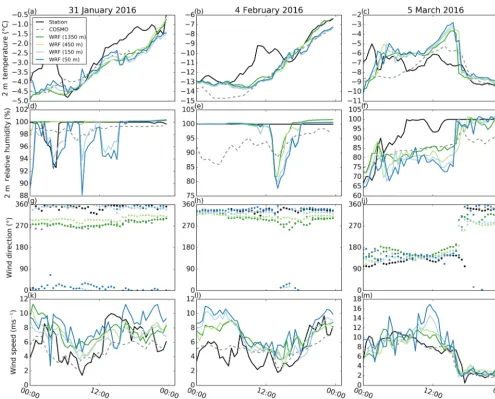
For both stations 2 m temperature matches reasonably with observations, although especially for the precipitation event on 4 February 2016 substantial temperature deviations oc-cur around midday (Figs. 2a–c and 3a–c). Deviations of the WRF model from station measurements during midday are likely caused by errors in station measurements due to radia-tive heating of the multiplate shielded temperature sensors (Huwald et al., 2009, Sect. 2.2).
Relative humidity shows partially good agreement but shows a strong temporal variability (Figs. 2d–f and 3d–f). WRF is generally able to capture the main drops in relative humidity at the two investigated stations but it introduces ad-ditional drops compared to measurements. The microphysics parameterization is originally developed for simulations with a coarser resolution, which produce fewer vertical motions. Thus, the introduction of a higher variability in relative hu-midity in our WRF simulations may be due to strong subsi-dence and lifting, which lead to an overestimation of adia-batic cooling or warming and hence to an overestimation of humidity generation or decay. Additionally, differences be-tween modeled and measured relative humidity may be due to measurement uncertainties.
Figure 2.Comparison of(a–c)2 m temperature (◦C),(d–f)2 m relative humidity (%), 4 m(g–j)wind direction (◦) and(k–m)wind speed (m s−1) at the station Dischma Moraine (black) to WRF simulations interpolated to the coordinates of the station Dischma Moraine for the three precipitation events on 31 January, 4 February and 5 March 2016 for all four simulation domains (d01: dark green, d02: light green, d03: light blue, d04: dark blue). For comparison COSMO-2 is added for the closest grid point (dashed gray). The 2 m temperature in WRF and COSMO is corrected for elevation based on a moist-adiabatic temperature gradient.
cannot accurately capture changes in wind direction close to the surface where weather stations are located. Good agree-ment in wind direction modeling in our COSMO–WRF sim-ulations in complex terrain is likely due to the high resolution of topography. For some cases wind directions in the WRF simulations additionally improve for higher resolutions, al-though for others terrain smoothing is likely to have adverse effects on modeled wind direction.
Compared to the good agreement of wind direction, wind speeds show only partially good agreement with station mea-surements (Figs. 2k–m and 3k–m). Wind speeds were found to strongly depend on the sub-grid-scale turbulence param-eterization and a strong overestimation of wind speeds was observed for different simulation setups (not shown).
Figure 3.As in Fig. 2 but for the station FLU2 on the Flüela Pass with 5 m wind speed and direction.
improve surface wind speeds. However, with this approach, the effect of the sub-grid-scale topography is only included for simulations using a PBL parameterization. As in our model setup a PBL parameterization is only applied for do-main d01; we address the non-resolved topography by in-creasing the surface roughness, which allows us to include the effect of non-resolved topography for all four simula-tion domains. In addisimula-tion, our simulasimula-tions are run over snow-covered terrain, which implies that the standard roughness length for snow used in WRF (on the order of 10−3m) is 2 orders of magnitude lower than roughness lengths represen-tative of the scale of complex terrain in our simulations (on the order of 10−1m). Applying the PBL version of Jiménez and Dudhia (2012) might be a possibility to reduce excess wind speeds in domain d01, which might also impact wind speeds in the domains d02–d04. However, such a sensitivity study is out of scope of the present investigation.
potential cause of disagreement is that station measurements are prone to measurement uncertainties, and riming of the un-heated instruments may lead to an underestimation of wind speeds (Grünewald et al., 2012).
Generally, reasons for an overestimation of wind speeds may be manifold. An exact estimation of wind speeds at sta-tions in the model is not expected due to unresolved topo-graphical features in the complex terrain of our study site. An additional source of uncertainty – though unlikely to be on the order of the strong excess wind speeds – is the extrap-olation of wind speeds based on the assumption of a neutral atmosphere. While different potential causes of wind speed overestimation are discussed above, actual reasons for devi-ations in wind speed remain unknown.
While the model is designed such that it develops in-dependently (given its fetch distances and spin-up times, Sect. 2.1), a poor representation of the large-scale gradients in the COSMO-2 input might not be corrected by COSMO– WRF. The investigated variables do not show a consistent signal of improvement nor a consistent signal of worsening with higher resolutions and with respect to the COSMO-2 input. Similarly but not consistently in phase with COSMO– WRF, COSMO-2 shows a good agreement with station mea-surements for certain cases, while it shows worse perfor-mance for other cases. Given these inconsistencies between cases and for COSMO-2 input, a poor representation of the large-scale gradient in COSMO-2 is an unlikely reason for bad model performance.
Overall, we show that the presented simulation setup cap-tures temperature, relative humidity and wind conditions in complex terrain at two stations by a certain degree. Temper-ature deviations around midday are likely due to measure-ment uncertainties. Wind speeds tend to be overestimated, especially on the windward side of the mountain ridges. This shows that even for very high model resolutions the point performance of the model with respect to wind speeds re-mains challenging. However, the model shows a good per-formance in the representation of the local wind directions, which is likely a consequence of the improved representation of topography.
3.2 Spatial snow precipitation and accumulation patterns
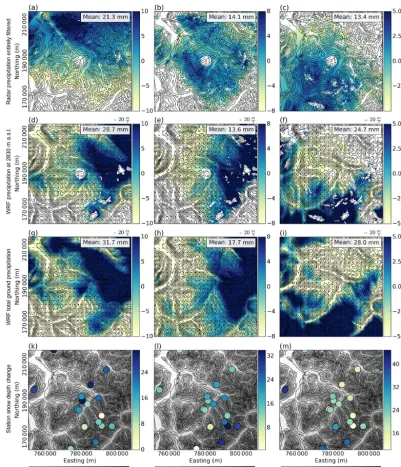
Radar precipitation maps of the regional domain covering an area of about 58 km×56 km centered over the radar on the Weissfluh summit (Fig. 1) tend to show precipita-tion patterns dependent on wind direcprecipita-tion (Figs. 2g–i, 3g– i and 4d–f) (Fig. 4). The precipitation field on 31 January 2016 shows a strong south–north gradient (Fig. 4a), while the precipitation field on 4 February 2016 shows a more homogeneous distribution (Fig. 4b). For the precipitation event on 5 March 2016 radar precipitation maxima are ob-served over the mountain ridges in the southern part of the domain (Fig. 4c). Although our regional domain does not
represent a cross section across the whole alpine moun-tain range, a north–south (south–north) precipitation gradi-ent for southerly (northerly) advection is appargradi-ent. This is in good agreement with large-scale orographic precipitation enhancement (Houze Jr., 2012; Stoelinga et al., 2013), which favors precipitation on the upwind side of a mountain range due to topographically induced lifting and a drying due to sinking air masses downwind of the mountain range.
These large-scale patterns of orographic precipitation en-hancement are partially captured in the WRF simulations (Fig. 4d–f). In particular, for southerly advection (precipi-tation event on 5 March 2016) this large-scale effect is well represented in COSMO–WRF, in which precipitation max-ima occur over mountain ridges in the southern part of the do-main and a north–south precipitation gradient is present. For northerly to northwesterly advection (precipitation events on 31 January and 4 February 2016), however, snow precipita-tion maxima in the WRF simulaprecipita-tions are shifted eastward compared to radar precipitation estimates, i.e., toward the outflow boundary.
Microphysics and precipitation dynamics in the model are likely to be a limiting factor in terms of small-scale precipita-tion patterns. Disagreement between radar and WRF precipi-tation patterns may further be connected to the strong terrain smoothing in the model. Despite the high resolution of our simulations, slope angles are relatively low, with maximum slope angles of 35.2◦ in the regional domain due to the ap-plication of terrain smoothing (Table 1). Given even lower slope angles in domain d01, precipitation fed to domain d02 may already be too weak and thus needs to develop within domain d02. As mountains in the northwestern part of the do-main are shallower than mountains in the southeastern area (Fig. 1), lifting condensation may not be strong enough in the northwestern area of the domain, leading to precipitation generation further downstream in the domain, where steeper and higher mountains may even lead to too strong precipita-tion enhancement. Addiprecipita-tionally, if the tendency of overesti-mated wind speeds sustains up to higher atmospheric levels in the model, this may lead to an overestimation of the ad-vection of hydrometeors in the microphysics scheme (Morri-son et al., 2005). This would result in a downstream shift of the precipitation maximum. However, we do not expect this to have a strong impact on the regional-scale precipitation distribution. Thus, there are likely additional reasons for the observed downstream shift of WRF precipitation compared to radar precipitation, which remains difficult to explain.
Figure 4. The 24 h snow precipitation (mm) from(a–c)MeteoSwiss entirely filtered radar measurements, (d–f)Weather Research and Forecasting (WRF) snow precipitation at 2830 m above sea level (m a.s.l.),(g–i)WRF total ground precipitation and(k–m)24 h snow depth changes (cm) at meteorological stations on 31 January 2016 (left), 4 February 2016 (middle) and 5 March 2016 (right) with a resolution of 450 m in the regional domain (Fig. 1). Radar precipitation is estimated from different radar elevations (Sect. 2.3). White areas in(a– f)mark areas where clutter is removed and small values in the radar data are masked. The same mask is applied for WRF solid precipitation at 2830 m a.s.l. (approximate elevation of the radar),(d–f), for which additional areas where WRF topography is higher than 2830 m a.s.l. are masked. Arrows in(d–f)indicate wind direction and speed at an elevation of 2830 m a.s.l. Northing and easting are given in the swiss coordinate system (CH1903LV03). Note the different color bars. Contour lines in(a–c)and(k–m): dhm25 ©2018 swisstopo (5 740 000 000). Gray shading in(k–m)represents topography.
are visible on the partly filtered radar maps (Sect. 2.3, not shown), while in entirely filtered radar estimates (Fig. 4a– c) the smallest-scale patterns are eliminated but patterns of about 1 km in size emerge. Patterns in the entirely filtered data could be small-scale precipitation cells, while the
very-small-scale patterns are most likely noise in the radar data (see Sect. 3.4).
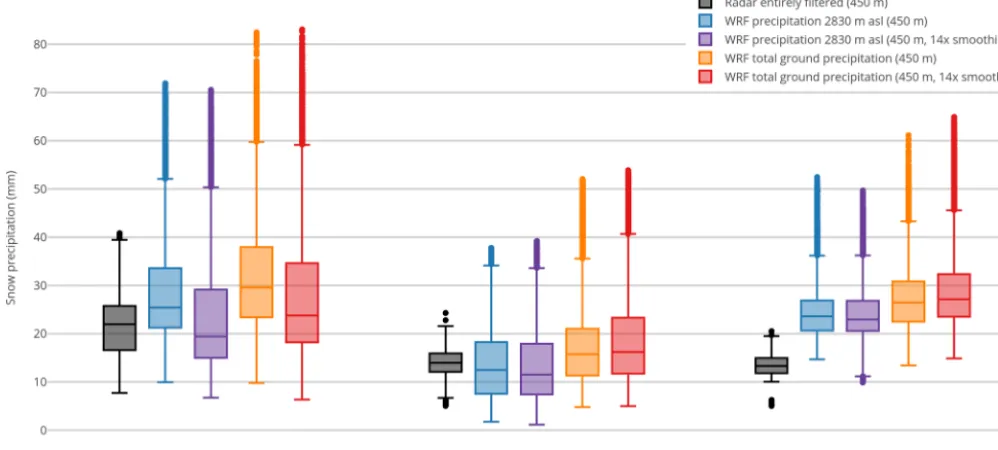
Figure 5.Domain-wide 24 h precipitation statistics for the regional domain (450 m resolution, Fig. 1) for the three precipitation events on 31 January, 4 February and 5 March 2016. Gray colors show entirely filtered radar precipitation. WRF precipitation at 2830 m above sea level (m a.s.l.) for simulations with weak terrain smoothing (Sect. 2.1) and strong terrain smoothing are given in blue and violet, respec-tively. Orange (red) shows box plots of WRF total ground precipitation for weak (strong) terrain smoothing. Radar precipitation and WRF precipitation at 2830 m a.s.l. are masked (as shown in Fig. 4).
by WRF total ground precipitation (Fig. 4g–i). For 31 Jan-uary and 5 March 2016 the large-scale precipitation trend observed in the radar data is generally represented in station measurements. On 4 February 2016 station measurements suggest a precipitation peak in the upper Dischma valley (lower left quadrant in Fig. 4l), which agrees with WRF sim-ulations. Radar estimates, however, show a more homoge-neous distribution of precipitation on 4 February 2016. Snow depth changes at the stations are very local and strongly af-fected by wind redistribution of snow, which may disturb the large-scale gradient. Additionally, the distribution of stations is not homogeneous over the regional domain and fewer sta-tions are available in the western part of the domain.
The visual comparison of radar and WRF precipitation patterns for all three events (Fig. 4) reveals that precipita-tion patterns are influenced by wind direcprecipita-tion and topogra-phy. Large-scale precipitation patterns are in agreement with station measurements, although the latter are strongly influ-enced by the local wind field and snow redistribution pro-cesses.
3.3 Mean variability
Radar precipitation distributions at 2830 m a.s.l. in the re-gional domain (450 m resolution, Fig. 5) show a larger in-terquartile range (IQR) than radar precipitation in the local domain (300 m resolution, Supplement S2), confirming that local precipitation is more uniform than regional
precipita-tion. Radar median precipitation over 24 h is on the order of 10 to 20 mm water equivalent for all three precipitation events in the regional domain. The median of radar precipi-tation in the local domain can be both higher or lower than in the regional domain.
Although radar estimates are based on a referenceS−Z relationship, the employed formula (Eq. 1) is not immune to potential estimation errors. Therefore, despite reasonably as-suming that the potential estimation errors should not signif-icantly influence the variability in and the relative intensity of the precipitation fields, we consider potential inaccuracies in our interpretations.
5 March 2016, for which the deviations increase. This sup-ports the hypothesis that the model tends to overestimate pre-cipitation for higher resolutions with steeper and more com-plex topography.
The domain-wide median and IQR of precipitation at 2830 m a.s.l. in WRF simulations with weaker and stronger terrain smoothing (Sect. 2.1) are similar with a slight ten-dency of higher median values for weaker smoothing, in-dicating that the accuracy of topography does not have a strong influence on the domain-wide statistics of precipita-tion on the regional scale. Enhanced precipitaprecipita-tion for weaker terrain smoothing compared to stronger terrain smoothing could be explained by enhanced precipitation production due to steeper topography.
An overestimation of precipitation in WRF simulations was previously reported (e.g., Mass et al., 2002; Leung and Qian, 2003; Silverman et al., 2013) and could be due to var-ious reasons. Mass et al. (2002) and Leung and Qian (2003) among others report that WRF tends to show a stronger over-estimation of precipitation for higher model resolutions com-pared to coarser model resolutions. Additionally, they doc-ument a dependency on the intensity of precipitation. An overestimation of orographic precipitation enhancement in more complex terrain or an overestimation of moisture in the model were further reported by Silverman et al. (2013). An overestimation of orographic precipitation enhancement would be in agreement with a stronger overestimation of precipitation for the local domain compared to the regional domain and for weaker smoothing compared to stronger smoothing. Furthermore, it is likely to occur for simulations with high horizontal resolution as higher peaks and steeper slopes are preserved (Silverman et al., 2013). Compared to a shallow topography, higher peaks and steeper slopes may cause stronger lifting and subsidence, which is also a likely cause for additional drops in relative humidity in WRF com-pared to measured relative humidity (Sect. 3.1, Figs. 2 and 3). This tendency seems to only apply for the highest eleva-tions. For lower elevations strong smoothing may result in elevation differences, which are too small for precipitation to evolve by lifting condensation (Sect. 3.2). As additional reasons for precipitation overestimation in WRF, an over-estimation of precipitation in the driving model (Caldwell et al., 2009) and underlying land use characteristics (Silver-man et al., 2013) were mentioned. The latter was, however, previously found to only have a weak influence on the pre-cipitation amount (Pohl, 2011). Humidity in COSMO-2 is an unlikely reason as COSMO-2 shows a tendency of underesti-mating relative humidity compared to station measurements (Figs. 2 and 3). Even though there are many possible reasons for an overestimation of precipitation in WRF, the estima-tion of solid precipitaestima-tion from radar measurements is also subject to uncertainties (e.g., Cooper et al., 2017). Given un-certainties in radar precipitation estimates, the comparison of median domain-wide precipitation should be taken with
care. An in-depth analysis of spatial variabilities is given in Sect. 3.4.
At the ground level WRF precipitation tends to show higher median values of precipitation compared to WRF pre-cipitation at 2830 m a.s.l. for both domains. The IQR is simi-lar. From this we hypothesize that there are precipitation for-mation or enhancement processes taking place between the elevation of the radar and the ground. This is in good agree-ment with the fact that near-surface processes can strongly enhance snow precipitation (e.g., riming). Overall, this anal-ysis shows that WRF tends to overestimate domain-wide pre-cipitation and prepre-cipitation variability at 2830 m a.s.l. com-pared to radar estimates.
3.4 Spatial variability
To address spatial patterns and variability in precipitation, a scale analysis is performed augmented with a 2-D autocorre-lation analysis (Sect. 2.4). Given the overestimation of pre-cipitation in the model and the large differences in domain-wide variability between the model and radar precipitation estimates (Sect. 3.3), all variograms are normalized by the domain-wide variability, which allows analysis of spatial pat-terns with respect to the overall range of precipitation values. From the analysis of precipitation patterns (Sect. 3.2), we further know that there are strong large-scale precipitation gradients in the regional domain. In the variogram analysis small- and intermediate-scale structures may be hidden by the large-scale gradient. To avoid this and non-stationarity of patterns, we first present variograms of detrended precip-itation fields (Sect. 3.4.2). However, to assess processes act-ing at different scales, variograms of non-detrended precipi-tation patterns are subsequently analyzed in a scale analysis (Sect. 3.4.3). Finally, a 2-D autocorrelation analysis is used to comment on directional dependencies of precipitation pat-terns (Sect. 3.4.4).
3.4.1 Large-scale precipitation trends
Table 2.Large-scale linear trends of entirely filtered radar and WRF precipitation patterns on the regional domain (450 m horizontal grid spacing, Fig. 1). WRF precip. at 2830 m a.s.l. refers to solid precipitation in WRF simulations at 2830 m above sea level and WRF total ground precip. refers to the total (solid and liquid) precipitation at the ground level. Orientation gives the direction of the slope and intensity the strength of inclination. A value of 0◦would indicate a slope pointing toward the east. WRF snow precipitation is from simulations with weak terrain smoothing (Sect. 2.1).
31 January 2016 4 February 2016 5 March 2016
Orientation Intensity Orientation Intensity Orientation Intensity
Radar entirely filtered 86.9◦ 0.17 −125.9◦ 0.01 −114.8◦ 0.04 WRF precip. at 2830 m a.s.l. 16.7◦ 0.22 −5.1◦ 0.21 −98.2◦ 0.12
WRF total ground precip. 25.0◦ 0.18 5.4◦ 0.26 −103.3 0.19
and therefore the orientation of the slope is arbitrary. For this day, we hypothesize that either dynamics were more vari-able, preventing the evolution of a strong gradient, or lift-ing condensation due to the orography was not as efficient as for the other two events. For two events (31 January and 4 February 2016) the model has trouble reproducing the trend (i.e., orientation and intensity of the linearly fitted plane). For 31 January 2016 the deviation of orientation between the trends of radar precipitation and WRF precipitation at 2830 m a.s.l. is about 70◦but with a similar intensity of the trend. For 4 February 2016 the model shows a strong trend in precipitation, while the intensity of the trend is weak in the entirely filtered radar data. However, for the precipitation event on 5 March 2016 the trend is reasonably captured by the model with a deviation of the orientation of 16.6◦and a slightly stronger intensity of the trend in the model compared to the radar estimation.
Disagreement in precipitation patterns, trend orientation and intensity on 4 February 2016 (quite homogeneous pre-cipitation distribution in the radar estimate (Fig. 4) compared to the strong downstream shift of precipitation in WRF) and the overestimation of precipitation in the model give evi-dence for a too simplistic representation of precipitation in the model (i.e., simplified microphysics and cloud dynam-ics), which tends to overestimate the effect of the highest topographic features but misses precipitation over shallower areas. Good agreement in the intensity of the trend on 31 Jan-uary 2016 and good agreement of the orientation of the trend on 5 March 2016, however, show that the model is able to capture large-scale precipitation trends, which may be con-nected to a large-scale orographic enhancement.
3.4.2 Spatial variability in detrended precipitation fields
On the smallest scales a strong difference is visible in var-iograms of detrended entirely filtered and detrended partly filtered radar precipitation, with weaker variability for en-tirely filtered data (Fig. 6). The smallest-scale structures in the radar data are likely an indicator of residual noise in the partly filtered radar data (Sect. 2.3). However, it could
also imply microscale precipitation features. This stresses the challenge of processing high-resolution radar data (Sect. 2.3) to obtain a reasonable radar precipitation field. In any case the entirely filtered radar precipitation estimates may be re-garded as clean concerning residual clutter and will therefore be used for all subsequent analysis.
Variograms of entirely filtered and detrended radar precip-itation show a steep increase in variability on the smallest scales, while the increase in variability becomes weaker for larger scales (less steep slope in the variograms). Small-scale patterns are likely driven by small-scale precipitation cells induced by local cloud dynamics and microphysics. Such small-scale structures are repeated on intermediate scales and lead to a weaker increase in variability, as fewer new spatial features are added. At larger scales variability reaches the to-tal variability in the detrended data.
Compared to radar precipitation WRF precipitation at 2830 m a.s.l. shows a lower variability and a flatter increase in variability at small scales, giving evidence for a smoother precipitation distribution at the smallest scales. The lack of small-scale patterns shows that the radar sees more vari-ability at the smallest scales, while WRF likely misses the smallest-scale processes. Variability in radar and WRF pre-cipitation at 2830 m a.s.l. at large scales (>5 km), especially on 4 February 2016, shows less systematic differences than at small scales. This indicates that, with respect to total variabil-ity, patterns at these scales are well represented. Total ground precipitation shows a higher variability compared to precip-itation at 2830 m a.s.l. (except for 4 February 2016), which is an indication that near-surface processes are active in the model.
do-Figure 6.Variograms of detrended snow precipitation normalized by the domain-wide variance of precipitation for the precipitation events on (a)31 January 2016,(b)4 February 2016 and(c)5 March 2016 for the regional domain (450 m horizontal grid spacing, Fig. 1). Variograms are given for partly filtered (red) and entirely filtered (orange) radar snow precipitation, WRF snow precipitation at 2830 m above sea level (m a.s.l., blue) and WRF total ground precipitation (violet). WRF precipitation is from simulations with weak terrain smoothing (Sect. 2.1). All precipitation fields are masked.
main) compared to the precipitation variability in radar es-timates indicate that mountain-ridge-scale precipitation pro-cesses are underrepresented in the model.
3.4.3 Scale breaks and dominating processes
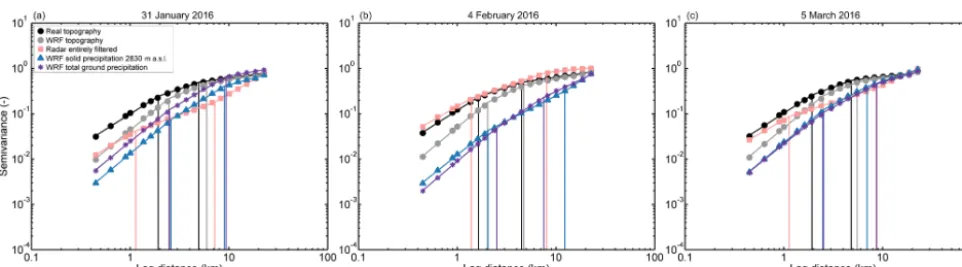
Scale breaks were previously found to be connected to changes in dominant processes (e.g., Deems et al., 2006). Here, we present a scale analysis including variability due to large-scale precipitation processes. Therefore, we present variograms of non-detrended precipitation fields, being aware that a certain portion of the small- and intermediate-scale precipitation variability may become hidden. As pre-cipitation patterns are known to be driven by topography and wind, we present variograms of topography together with the variograms of precipitation.
Variograms of topography clearly reveal two scale breaks (Fig. 7). The first scale break is between 1 and 2.5 km de-pending on the resolution; the second scale break is at 5 and 6 km for real topography and weakly smoothed WRF topog-raphy, respectively. For topography the two scale breaks sep-arate the mountain-slope scale (<1–2 km), mountain-ridge-to-valley scale (between ∼1–2 km and ∼5 km), and the scale of repeated mountain ridges and valleys (>5 km).
For consistency reasons, all variograms in Fig. 7 are pre-sented with two scale breaks. Scale breaks for all events and both resolutions are basically grouped in two areas (∼1– 2.5 and 5–10 km for 450 m resolution, Fig. 7; and∼800 m– 1.2 km and 2.5–5 km for 300 m resolution, Supplement S2), even though for precipitation some scale breaks are arbitrary. Albeit scale breaks of precipitation do not exactly match scale breaks of topography, breaks at similar scales as well as similar slopes of topography and precipitation at small scales support the interpretation of topography-dependent
Figure 7.Normalized variograms of the snow precipitation events on(a)31 January 2016,(b)4 February 2016 and(c)5 March 2016 for the regional domain (450 m horizontal grid spacing, Fig. 1). Variograms are given for entirely filtered radar snow precipitation (orange), WRF snow precipitation at 2830 m above sea level (m a.s.l., blue) and WRF total ground precipitation (violet). Additionally, variograms are given for real topography (based on dhm25 © 2018 swisstopo (5 740 000 000), black) and WRF topography (gray). WRF topography and precipitation are from simulations with weak terrain smoothing (Sect. 2.1). All precipitation fields are masked.
3.4.4 Two-dimensional variability patterns
Finally, the combined influence of topography and the gen-eral wind direction on snow precipitation patterns in the regional domain is assessed by spatial 2-D autocorrelation maps (Fig. 8). Like variograms, autocorrelation is dependent on large-scale trends. The general direction of 2-D autocor-relation patterns is the same for detrended (Fig. 8) and non-detrended (not shown) precipitation patterns. However, au-tocorrelation patterns of detrended precipitation fields show much shorter decorrelation lengths. This is due to the spatial coherence introduced by large-scale trends in precipitation. To avoid biased autocorrelation data, only 2-D autocorrela-tion maps of detrended precipitaautocorrela-tion fields are shown. How-ever, we keep in mind that large-scale trends are present.
Autocorrelation maps of topography (Fig. 8a and e) repre-sent a northwest-to-southeast-oriented pattern, which is, al-though weaker, repeated in the southwest-to-northeast and west-to-east directions. For snow precipitation events with dominating northwesterly to northerly advection, the main axis of the snow precipitation 2-D autocorrelation pattern is oriented in a northwest-to-southeast direction and therefore in alignment with both topography and the main wind di-rection (Fig. 8b–c and f–g). Patterns of WRF precipitation at 2830 m a.s.l. are rotated toward a north–south direction on 4 February 2016. For dominating southerly advection the 2-D autocorrelation map of radar precipitation shows a more ho-mogeneous pattern compared to autocorrelation patterns for northern to northwestern advection but a weak southwest-to-northeast orientation of larger-scale patterns (Fig. 8d). For the WRF simulations a strong southwest-to-northeast orien-tation is present in the autocorrelation map for the precipita-tion event on 5 March 2016 (Fig. 8h). Even though isotropic variograms reveal good agreement in domain-wide variabil-ity, 2-D autocorrelation maps show that this may not nec-essarily go along with good agreement of the orientation of patterns. The best agreement in the orientation of
pat-terns is found for 31 January 2016. For the three events, 2-D autocorrelation maps of detrended precipitation reveal a smoother distribution of precipitation on the smallest scales in the model compared to radar data due to fewer small-scale structures in the model. Conversely, a strong decrease in autocorrelation in the east–west direction is visible for 5 March 2016. This shows that WRF simulations have a stronger dependency on both wind direction and topography and tend to generate strong precipitation bands in the main wind direction, confirming the overly simplistic behavior of the model.
For ground precipitation, 2-D autocorrelation patterns tend to be repeated in the southwest-to-northeast and west-to-east directions as seen for topography (Fig. 8j–g). This stresses the hypothesis that the influence of topographic features on WRF ground precipitation is stronger than at radar eleva-tion and gives evidence that these results are likely produced by near-surface topographically driven pre-depositional pro-cesses such as preferential deposition or the seeder–feeder mechanism in the model, for example. While a topography dependency was already found in isotropic variograms, this 2-D autocorrelation analysis reveals that the wind direction additionally strongly impacts the snow precipitation distri-bution.
3.5 Dependence of spatial variability on model resolution and smoothing
en-Figure 8.Spatial 2-D autocorrelation maps for the regional domain (450 m resolution) of detrended(a)real topography (based on dhm25 © 2018 swisstopo (5740 000 000)),(b–d)entirely filtered radar snow precipitation,(e)WRF topography,(f–h)WRF snow precipitation at 2830 m above sea level (m a.s.l.) and(j–l)WRF total ground precipitation. Autocorrelation maps of snow precipitation are for the three snow precipitation events on 31 January, 4 February and 5 March 2016. WRF topography and precipitation are from simulations with weak terrain smoothing (Sect. 2.1). Radar precipitation and WRF precipitation at 2830 m a.s.l. are masked (as shown in Fig. 4).
tirely filtered radar precipitation. Depending on the event an increase in variability is present for 150 and 50 m resolution. This indicates that the smallest-scale precipitation dynamics are still not fully resolved at 50 m resolution. A comparison of variograms for simulations with strongly smoothed ter-rain compared to simulations with weaker terter-rain smoothing (Sect. 2.1) reveal that a stronger terrain smoothing may re-sult in less explained variability in normalized variograms (not shown). Even though this signal is not consistent for all events, we can show that a better representation of topog-raphy due to higher resolution and less smoothing has the potential to increase the explained variability in precipitation patterns. An increase in variability at small scales (<5 km) indicates that more small-scale patterns are resolved at higher resolutions (50 m horizontal grid spacing) in the model. Our simulations are currently limited to the presented resolutions
and strong terrain smoothing due to model instabilities. How-ever, based on the presented results, once available, the im-mersed boundary method version of WRF (e.g., Lundquist et al., 2010, 2012; Arthur et al., 2016; Ma and Liu, 2017) will likely be a good tool to allow for steeper slopes in the simulation and moving toward higher-resolution LES simu-lations to resolve further small-scale wind fields, which drive the precipitation structures.
4 Conclusions and outlook
Figure 9.Variograms of detrended snow precipitation normalized by the domain-wide variance of precipitation for the precipitation events on(a)31 January 2016,(b)4 February 2016 and(c)5 March 2016 for domain Dischma (Fig. 1). Variograms are given for entirely filtered radar snow precipitation (red) and WRF snow precipitation at 2830 m above sea level (m a.s.l.) with 450 m (violet), 150 m (blue) and 50 m (light blue) resolution. WRF snow precipitation is from simulations with weak terrain smoothing (Sect. 2.1). Radar precipitation is masked.
show that COSMO–WRF is able to reasonably simulate tem-perature, relative humidity and wind direction but tends to (strongly) overestimate near-surface wind speeds. This may be due to many reasons from an overestimation of speedup effects on the windward side of mountain ridges to an under-representation of small terrain features. Additional reasons are likely but remain unknown and future work is needed to address these issues. Relative humidity patterns are highly variable and may be a sign that subsidence and lifting pro-duce too strong effects in the (partially parameterized) cloud dynamics, given the good representation of topography at larger scales.
Regional- and local-scale precipitation patterns in the COSMO–WRF simulations are in partially good agreement with MeteoSwiss operational radar measurements and auto-matic weather stations. For the three events analyzed here, precipitation estimates from WRF simulations are higher compared to precipitation estimates from radar measure-ments. A general overestimation of precipitation produced by WRF is consistent with an overestimation of subsidence and lifting. Overestimation of precipitation in WRF simulations has been documented previously for snow precipitation over complex terrain (e.g., Silverman et al., 2013); among other reasons it may be due to the high model resolution and there-fore more complex topography and higher mountain peaks compared to common high-resolution simulations.
An autocorrelation and scale analysis of radar and WRF snow precipitation reveals a good agreement of precipita-tion patterns on regional scales (>5 km), which are topogra-phy and wind driven. These large-scale patterns are in good agreement with the theory of large-scale orographic precip-itation enhancement (e.g., Stoelinga et al., 2013). Disagree-ment in precipitation patterns, i.e., a downwind shift of snow precipitation in the WRF simulations compared to radar pre-cipitation estimates, is likely due to lifting condensation
bet-ter representation of the complex bet-terrain is essential to re-produce precipitation variability. Although the model cannot represent the full variability measured by the radar at small scales, an increase in precipitation between 2830 m a.s.l. and the ground is an indication that the model captures a certain portion of near-surface processes.
To specifically address processes such as the seeder– feeder mechanism or preferential deposition, an analysis of hydrometeors and precipitation distributions in verti-cal profiles across mountain ridges is needed. To con-nect pre-depositional processes with post-depositional pro-cesses, even higher-resolution WRF simulations would be re-quired. This might be achieved by employing the immersed-boundary method version setup of WRF. A parameterization of post-depositional processes in WRF or using WRF sim-ulations as a boundary condition for simsim-ulations with the Alpine surface processes model Alpine3D (Lehning et al., 2008) would then allow validation of modeled snow accu-mulation patterns compared to measured snow accuaccu-mulation patterns. Furthermore, simulations of precipitation patterns in complex terrain need to be analyzed with higher tempo-ral resolution (e.g., on the order of minutes), as contributing processes show high temporal variability. Future work will include addressing the temporal variability in precipitation patterns using radar observations, along with an analysis of precipitation growth with respect to topography and wind di-rection.
Appendix A: Morrison microphysics in WRF
The Morrison microphysics scheme includes prognostic equations of number concentration and mass mixing ratio of five precipitation species (rain, snow, ice, graupel and cloud droplets). The parametrization of rain, snow, ice and cloud droplets is based on Morrison et al. (2005). The implementa-tion of graupel follows Reisner et al. (1998), except for min-imum mixing ratios, which are required to produce graupel from the collision of rain and snow, snow and cloud water, and rain and cloud ice, which are based on Rutledge and Hobbs (1984).
The kinetic equations include advection, sedimentation and turbulent diffusion as well as source and sink terms of ice nucleation and droplet activation, condensation and deposi-tion, coalescence and diffusional growth, collecdeposi-tion, melting and freezing, and ice multiplication (Morrison et al., 2005). For graupel deposition, collection, collision, accretion, freez-ing and meltfreez-ing processes are parameterized (Reisner et al., 1998).
Size distribution functions are gamma functions:
N (D)=N0Dµe−λD, (A1)
whereDis the particle diameter andµis the shape parameter of the distribution function, which isµ=0 for rain, snow, ice and graupel, resulting in an exponential function forN (D). λandN0are the slope and intercept, respectively, of the size
distribution, evaluated by the predicted number concentra-tionN and mass mixing ratioq:
λ=
cN 0(µ+d+1)
q0(µ+1)
1/d
(A2) and
N0=
N λµ+1
0(µ+1), (A3)
where 0 is the gamma function. c and d are the parame-ters of the power-law functionm=cDdindicating the mass– diameter relationship. Terminal fall speeds are also assumed to have a power-law form ofv(D)=ρsur
ρ aD
b, with individ-ual parametersa andbfor the different species.ρis the air density andρsur the air density at sea level. For
Author contributions. FG and NB performed the analysis, which was supported by fruitful discussions with ML, RM, AB and UG. FG, VS, MD, RM and ML developed the COSMO–WRF coupling and simulation setups, which were run by FG. NB and MG pro-cessed the radar data. FG, ML, RM, NB and AB contributed to the design of the concept. FG and NB, with contributions from all au-thors, prepared the paper.
Competing interests. The authors declare that they have no conflict of interest.
Acknowledgements. The work is funded by the Swiss National Science Foundation (project “Snow-atmosphere interactions driving snow accumulation and ablation in an alpine catchment”, the Dischma Experiment, SNF grant 200021_150146 and project “The sensitivity of very small glaciers to micrometeorology”, SNF grant P300P2_164644). Topographic data are reproduced with permission of swisstopo (JA100118). For advice to setup WRF simulations we thank the WRF help. For supporting our project (“Study on snow precipitation and accumulation over complex alpine terrain”) with computational time many thanks go to the Swiss National Supercomputing Center (CSCS) and their support for technical advice. Additionally, we thank the Swiss Federal Of-fice of Meteorology and Climatology (MeteoSwiss) for providing access to radar data, COSMO-2 analysis and the regridding tool fieldextra. For advice related to COSMO-2 thanks go to Guy de Morsier from MeteoSwiss. Further thanks go to Amalia Iriza and Rodica Dumitrache from MeteoRomania for advice concerning the COSMO–WRF coupling. Additional thanks go to Louis Quéno and Benoit Gherardi for their work on pre-preprocessing steps and data processing to set up WRF simulations. Additionally, we thank Heini Wernli and the two anonymous reviewers for their questions, comments and recommendations, which helped to improve the paper.
Edited by: Ross Brown
Reviewed by: Heini Wernli and two anonymous referees
References
Arnold, D., Schicker, I., and Seibert, P.: High-Resolution Atmo-spheric Modelling in Complex Terrain for Future Climate Sim-ulations(HiRmod), Report 2010, Tech. rep., Institute of Meteo-rology (BOKU-Met), University of Natural Resources and Life Sciences, Vienna, Austria, 2010.
Arthur, R., Lundquist, K. A., Mirocha, J. D., Hoch, S. W., and Chow, F. K.: High-resolution simulations of downslope flows over complex terrain using WRF-IBM, 17th Conference on Mountain Meteorology, American Meteorological Society, Paper 7.6, 18 pp., 2016.
Beljaars, A. C. M.: The parameterization of surface fluxes in large-scale models under free convection, Q. J. Roy. Meteor. Soc., 121, 255–270, https://doi.org/10.1002/qj.49712152203, 1994. Bergeron, T.: On the low-level redistribution of atmospheric water
caused by orography, Suppl. Proc. Int. Conf. Cloud Phys., Tokyo, 96–100, 1965.
Besic, N., Figueras i Ventura, J., Grazioli, J., Gabella, M., Ger-mann, U., and Berne, A.: Hydrometeor classification through statistical clustering of polarimetric radar measurements: a semi-supervised approach, Atmos. Meas. Tech., 9, 4425–4445, https://doi.org/10.5194/amt-9-4425-2016, 2016.
Caldwell, P., Chin, H., Bader, D., and Bala, G.: Evaluation of a WRF dynamical downscaling simulation over California, Clim. Change, 95, 499–521, https://doi.org/10.1007/s10584-009-9583-5, 2009.
Choularton, T. W. and Perry, S. J.: A model of the oro-graphic enhancement of snowfall by the seeder-feeder mechanism, Q. J. Roy. Meteor. Soc., 112, 335–345, https://doi.org/10.1002/qj.49711247204, 1986.
Colle, B.: Sensitivity of orographic precipitation to changing ambient conditions and terrain geome-tries: An idealized modelling perspective, J. At-mos. Sci., 61, 588–606, https://doi.org/10.1175/1520-0469(2004)061<0588:SOOPTC>2.0CO;2, 2004.
Cooper, S. J., Wood, N. B., and L’Ecuyer, T. S.: A variational tech-nique to estimate snowfall rate from coincident radar, snowflake, and fall-speed observations, Atmos. Meas. Tech., 10, 2557–2571, https://doi.org/10.5194/amt-10-2557-2017, 2017.
Dadic, R., Mott, R., Lehning, M., and Burlando, P.: Wind influence on snow depth distribution and accumula-tion over glaciers, J. Geophys. Res., 115, F01012, https://doi.org/10.1029/2009JF001261, 2010.
Daniels, M. H., Lundquist, K. A., Mirocha, J. D., Wiersema, D. J., and Chow, F. K.: A New Vertical Grid Nesting Capability in the Weather Research and Forecasting (WRF) Model, Mon. Weather Rev., 144, 3725–3747, https://doi.org/10.1175/MWR-D-16-0049.1, 2016.
Deems, J. S., Fassnacht, S. R., and Elder, K. J.: Fractal Distribution of Snow Depth from Lidar Data, J. Hydrometeor., 7, 285–297, https://doi.org/10.1175/JHM487.1, 2006.
Deems, J. S., Fassnacht, S. R., and Elder, K. J.: Interan-nual Consistency in Fractal Snow Depth Patterns at Two Colorado Mountain Sites, J. Hydrometeor., 9, 977–988, https://doi.org/10.1175/2008JHM901.1, 2008.
Dore, A. J., Choularton, T. W., Fowler, D., and Crossely, A.: Oro-graphic enhancement of snowfall, Environ. Pollut., 75, 175–179, https://doi.org/10.1016/0269-7491(92)90037-B, 1992.
Dyer, A. J. and Hicks, B. B.: Flux-gradient relationships in the constant flux layer, Q. J. Roy. Meteor. Soc., 96, 715–721, https://doi.org/10.1002/qj.49709641012, 1970.
European Environmental Agency: CORINE Land Cover (CLC) 2006 raster data, Version 13, 2006.
Gabella, M., Speirs, P., Hamann, U., Germann, U., and Berne, A.: Measurement of Precipitation in the Alps Using Dual-Polarization C-Band Ground-Based Radars, the GPM Space-borne Ku-Band Radar, and Rain Gauges, Remote Sens., 9, 1147, https://doi.org/10.3390/rs9111147, 2017.
Gerber, F. and Sharma, V.: Running COMO-WRF on very high resolution over complex terrain, Laboratory of Cryospheric Sci-ences, École Polytechnique Fédérale de Lausanne, Lausanne, Switzerland, https://doi.org/10.16904/envidat.35, 2018. Gerber, F., Lehning, M., Hoch, S. W., and Mott, R.: A