GROWING THE MARINE ENERGY SUPPLY CHAIN IN WALES Gareth Potter, Tracy Tunstall, Ian Masters, John Chapman
Marine Energy Research Group, Civil and Computational Research Centre, Swansea University Swansea, United Kingdom
Abstract
To mitigate Climate Change and reduce greenhouse gas emissions, Europe is currently the World leader for exploiting one of the most significant sources of global untapped renewable energy; energy from our oceans.
Within Europe, the UK is foremost to establish a sustainable marine energy industry, through research, development and supply chain growth.
This article will examine the Skills and Training Needs Analysis work undertaken by Swansea University, to provide training courses designed to grow the marine energy supply chain within Wales and thus support and sustain Europe’s leading status.
Key words: marine energy, Wales, skills, training, supply chain, tidal, wave, Welsh Government
1. INTRODUCTION 1.1 Wales in Context
Wales once fed the world’s demand for energy by exporting its abundant high carbon natural resource; coal. The international price of coal was once set in the Coal Exchange, Cardiff, a building which also saw the world’s first recorded million pound business deal for coal struck in 1909. In 1913 the port of Barry in south Wales was the largest coal exporting port in the world, handling over 4000 ships and 11 million tons of coal (Davies, 2008). Exactly 100 years later the coal industry only supports 6000 direct jobs throughout the UK. Over 40% of the UK’s electricity generation capacity is still derived from coal, however the vast majority is now sourced from cheaper overseas imports (Poyner, 2014). Today, Wales is making the transition to a low carbon economy by exploiting its alternative natural resources; wind, solar, hydro, biomass and marine energy. Part of the ambition behind this shift is to ensure that the country remains in the best possible position to not only create new jobs and supply chain opportunities, but to take advantage of the potential to export the expertise, goods and services to other nations seeking to make the change to a low carbon economy (Welsh Government, 2012). Wales’ marine energy natural resources are impressive. It possesses a coastline of over 1200km, shares the second highest tidal range in the world, has powerful tidal streams in the seas around west and north Wales and a high energy wave resource in the south‐west which emanates from the Atlantic (Fairley, 2012). There is an enormous potential for extracting renewable energy from this resource, which has been estimated as economically achievable at between 1.5 and 6.4GW of installed capacity (RPS, March 2011).
Despite this opportunity, the country currently has no marine energy devices operating in its waters. After 13 years of planning, the DeltaStream demonstrator tidal energy converter is set to become the first grid connected device to be installed in Welsh waters when it is deployed during the latter half of 2014 (Ramsey Sound Project, 2014). Following on from this milestone, the country can look forward to the construction of a 10MW tidal array off North Wales in 2015 and the world’s first purpose built tidal lagoon in Swansea Bay, currently subject to the UK planning process. In addition to these three projects there exists a strong interest / commitment from other tidal, tidal range and wave energy developers to harness the best Welsh sites.
1.2 The UK Perspective
On a national level, the UK leads the world in both deployment and ambition for offshore renewable energy (wind and marine). It has installed more offshore wind generating capacity than any other nation (The Crown Estate, 2013) and has more grid-connected marine energy converters deployed at the European Marine Energy Centre (EMEC), Scotland, than any other single site in the world (European Marine Energy Centre (EMEC), n.d.).
To understand the direction that the emerging marine energy industry is headed, comparison can be drawn with the relatively mature offshore wind industry. The UK has been a driving force in European offshore wind deployment with installed offshore wind capacity reaching 3.6GW in 2013, contributing circa £1bn to the UK economy through 20,000 associated jobs. The marine energy sector, primarily through tidal stream demonstration projects, is forecast to be worth £110m in 2020 by supporting just 2,500 jobs through 100MW of installed capacity (ORE Catapult, Fraser of Allander Institute, BVG Associates, 2014) .
This comparison between marine energy and offshore wind appears unmatched in terms of scale and economic delivery, with the potential impact that it can send the wrong message to those companies considering investing in the marine energy supply chain. A more pragmatic approach could consider the real and proposed projects identified to date.
The MeyGen tidal stream project in the Pentland Firth, Scotland, is Europe’s largest consented tidal array project with a proposed installed capacity of 86MW. Beyond this first stage, the project has ambitions to expand to 398MW by 2020 (MeyGen Tidal Stream Project, 2014). The Tidal Lagoon Swansea Bay project in south Wales is currently seeking a Development Consent Order from the UK Government for a 320MW installed capacity lagoon. The project is seeking a construction start date in 2015 with a projected capital cost of £756m, of which the developer has committed that at least 65% would be procured from UK markets (Munday, 2013). In parallel, the developer is also progressing plans for a second lagoon in Colwyn Bay, north Wales with an installed capacity of 1.5GW and a construction timescale between 2016-2020. The projected capital cost of this project currently stands at £3.55bn (Pöyry Management Consulting (UK) Ltd, 2014).
These two examples clearly prove to demonstrate the greater opportunity that marine energy presents itself to Wales and the UK, than is currently being promoted.
1.3 The Challenge
The UK marine energy supply chain starts from a more advanced position than offshore wind, by inheriting its learning curve and established infrastructure. With the UK at the forefront of technology development, most of the marine energy demonstration devices installed in its waters have been designed and built in the UK.
The supply chain challenge is therefore to ensure that today’s suppliers of prototype and demonstration devices remain as part of the much larger indigenous industrialised supply chain up to and beyond 2020. As the true marine energy opportunity presents itself, the supply chain will be faced with growing competition from overseas companies who may possess an economic advantage of lower labour costs and greater production capability, to fabricate large structures in volume and supply bespoke wave and tidal device installation vessels.
To avoid the same fate of Wales’ former coal industry, the upcoming marine energy industry will need to innovate in order to survive. The UK’s supply chain capabilities need to be fully understood in order to reinforce strengths and address weaknesses.
1.4 The Supply Chain Structure
The size and scale of the marine energy supply chain is proportional to the business demand for marine energy. This factor is determined by the route to commercialisation through the Technology Readiness Levels (TRL). Business demand can be acknowledged by the fact that prototype testing of a marine energy device will require a smaller supply chain (and smaller investment), than the size, scale
and diversity of the supply chain required to produce a full scale commercial multi-megawatt array of marine energy devices.
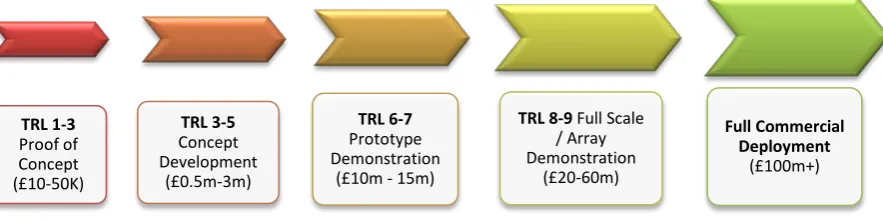
As marine energy technology projects progress through the TRL levels shown in Figure 1, greater investment is provided into the supply chain with different supply chain activities and disciplines required. This process has the effect of creating volume and economic growth, which ultimately increases the demand for more skilled jobs.
Figure 1: The Marine Energy Industry Technology Readiness Levels (TRL) flowchart with indicative development costs (ESB Ocean Energy, 2013)
The UK offshore wind technology supply chain is truly established, having achieved full commercial deployment beyond TRL level 9. The supply chain structure consists of six major segments: turbines; foundations; cables; electrical systems; installation, and operations and maintenance. The UK’s strengths are mainly in the latter four segments of the supply chain, with European and other international suppliers leading in the first two (BVG Associates, 2014).
The overall UK marine energy technology supply chain has achieved TRL levels 7-8, whilst in Wales the level is currently at 6. The supply chain structure draws parallels with offshore wind, with segments defined as; structure and prime mover; foundations and moorings; power take off; connection; installation, and operations and maintenance (Low Carbon Innovation Coordination Group, 2012). Government and industry both recognise that the cost of marine energy technologies will need to reduce by 50-75% over the next 10 years if it is to compete with offshore wind technologies.
It is apparent today that wind technologies have superficially reached a level of convergence, where the three bladed upwind horizontal axis turbine has become the industry standard. Part of the challenge faced by marine energy technologies is that it has not yet reached such a level of convergence, therefore the supply chain cannot achieve the level of standardisation needed to achieve cost reductions.
Designs for wave energy devices are highly innovative with concepts including oscillating water and air columns, overtopping devices, hydrofoils, point absorbers, terminators, attenuators and flexible structures. Tidal devices have converged to a greater extent than wave, with most demonstrator designs now based on a similar three rotor horizontal axis turbines to wind technologies. There are however concepts which include vertical axis turbines, venturi-effect devices and tidal kites (European Marine Energy Centre (EMEC), 2014) .
The UK Government recognises that to unlock the marine energy opportunity, there is a strong case for targeted public sector intervention to accelerate the private sector investment that will create the volume of projects needed (at least 200MW by 2025) to implement supply chain standardisation. There are significant market failures to innovation and the UK cannot rely on other countries to develop these technologies within the timescales needed. Through the work of the UK Government’s innovation agency; The Technology Strategy Board (TSB), many public sector investment tools have been implemented which range from initial £25k grants to the £50m Offshore Renewable Energy Catapult that includes access to some of the world’s leading R&D testing facilities.
TRL 1-3 Proof of Concept (£10-50K)
TRL 3-5 Concept Development
(£0.5m-3m)
TRL 6-7 Prototype Demonstration
(£10m - 15m)
TRL 8-9 Full Scale / Array Demonstration
(£20-60m)
Full Commercial Deployment
(£100m+)
The innovation and investment challenges alone will not unlock the marine energy opportunity. The political will that is needed to implement marine energy and the risk reward profiles that investors require, are two overarching potential failures that have been identified which could become the overarching market failures (Low Carbon Innovation Coordination Group, 2012).
1.5 The Low Carbon Political Will?
The communications front is therefore essential to ensure that the opportunity is properly translated. Energy policy that is implemented in the UK today will determine how the industry develops over the next 30-40 years. Government support on the contrary can often be changeable, where politicians are influenced by the short-lived public opinions that inform the UK general elections every 5 years. The European Council and the European Union (EU) supports the International Panel on Climate Change (IPCC) findings that developed countries as a group should reduce their greenhouse gas emissions by 80-95% by 2050, compared to 1990 levels (European Council, 2009). To fully align itself with the EU support, the UK became the first country in the world to implement the 2008 Climate Change Act which legally binds itself to the EU objective target.
The question is not will the UK and the EU achieve these targets, but how will it achieve these targets? If the early stages of a marine energy industry can be proven as successful, then the political will and investor confidence could follow. A skilled workforce and informed supply chain are one of the crucial underpinning platforms that can help unlock the opportunity from this perspective.
1.6 Welsh Energy Sector Training (WEST) and the Low Carbon Research Institute (LCRI)
The WEST (Welsh Energy Sector Training) project is supported by the Low Carbon Research Institute’s (LCRI) Convergence Energy Programme; a £35m four year project led by Welsh universities to unite and promote energy research in Wales, to help deliver a low carbon future. The aim for WEST is to develop skills and infer knowledge exchange which has been developed through the LCRI project.
LCRI Marine, the marine energy component of the LCRI project, is a collaboration of five leading academic marine institutions in Wales with the aim of helping to enable, support and build a sustainable marine energy sector in Wales.
In 2010 on a visit to Wales, the European Commission President; J M Barroso said that the LCRI was one of "The best examples in Europe of research, innovation and sustainable development" (Low Carbon Research Institute, 2014). In March 2011, the programme was subsequently selected for a European Parliament presentation, as one of two key examples for the development of EU public goods.
1.7 The LCRI Marine Expertise to Deliver Training
The LCRI Marine theme has the capability to deliver training from the research activities of its four work packages; Implementation, Far-field modelling, Near-field modelling and Data collection. These work packages summarised below have been developed in consultation with the marine energy industry in Wales, to provide the essential research which is needed to de-risk marine energy projects and thus move the industry forward (Willis, 2010):
Implementation: In Wales there is an enormous potential for extracting marine renewable energy from the coastline however there are only a small number of sites which are capable of sustaining marine energy on a commercial scale. These sites need to be investigated further in order to determine that they are logistically, environmentally, economically, technically and politically feasible.
Far-Field Modelling: To ensure that the siting of marine renewable energy devices provides the maximum possible energy extraction, whilst having the minimal impact on the aquatic environment and nearshore morphological changes, by investigating the complete system from cloud to coast. Near-field modelling: One of the major questions relating to marine renewable energy devices is how to optimise their performance whilst minimising environmental impact, to demonstrate to the Crown Estate and consenting bodies that projects will have a neutral effect on the environment.
Data collection: The final level of understanding is to study the effects that marine energy devices may have on sea mammals and cetaceans, pelagic populations, and the benthic environment. In addition, the effect that large scale marine energy deployments may have on suspended estuarine sediment and water quality associated with estuarine fluxes need to be fully understood.
2. METHOD
The WEST Marine project undertook a Skills and Training Needs Analysis (STNA) to examine the training that can be provided from the LCRI Marine project, the training needs of the marine energy industry in Wales and the interest and delivery methods for this training.
2.1 Training Themes from Research Activities
The expertise and research work package themes discussed in 1.7 above, were evaluated against the courses being delivered by Swansea University’s Colleges of Science and Engineering, to identify the appropriate training themes which could be delivered. The results of this evaluation are shown in Section 3, where 11 potential training themes were categorised which could be created into WEST training courses.
From consultation with relevant agents and similar projects, it was also shown that there are no current initiatives similar to WEST, which could conflict with its delivery.
2.2 Training Theme Consultations with the Marine Energy Supply Chain
WEST Marine took these themes to consultations throughout 2012 to 2013 using established industrial contacts, networking opportunities and by promoting WEST at UK-wide marine energy events to evidence the industry needs. The consultations culminated with a targeted workshop at the Marine Energy Pembrokeshire (MEP) 4th Annual Seminar in Pembroke Dock, Wales on 14th March 2013. MEP is a partnership between technology developers, the supply chain, academia and the public sector, sponsored by Welsh Government with the objective to establish Pembrokeshire (and Wales) as a centre for excellence for sustainable marine energy generation. The MEP seminars have become Wales’ largest industry-led marine energy event, attracting over 100 delegates from across the marine energy supply chain (Figure 2). The WEST STNA workshop (Photo 1) provided a platform to introduce and debate the training themes, followed by the completion of an evidence gathering questionnaire to document the interest.
Photo 1: STNA workshop at the MEP seminar
Figure 2: The Marine Energy Supply chain
In addition to the targeted workshop, the STNA compared the findings of the consultations to the overall knowledge exchange industrial liaison work undertaken throughout the four year LCRI Marine project, where over 100 companies throughout the marine energy supply chain have been engaged with.
3. RESULTS
The following section presents the analysis of collected data and the reporting of those results arising from the STNA methodology. This analysis included the results from the MEP workshop questionnaire and the industrial liaison work from the LCRI Marine project.
3.1 STNA Questionnaire Results
The results from the WEST STNA workshop questionnaires completed at the MEP seminar are shown in Figures 3 and 4. These confirm that there is a good interest from industry in the potential training themes that have been identified from the LCRI Marine work packages.
Figure 3: Results of MEP seminar questionnaire for proposed WEST training themes
Figure 4: Results of MEP seminar questionnaire for proposed WEST training themes, by Supply Chain discipline
From the results shown in Figure 4, it can be seen that four of the seven supply chain disciplines have been captured by the STNA research, with no representation provided by the Fabrication and Civil Engineering, Ports / Sea Based Support and Stakeholder Groups. It can be seen that the majority discipline which has shown interest for WEST modules is the Professional Consultancy category. It is acknowledged that the results represent a small proportion of the marine energy industry in Wales, therefore it would not be prudent to assign priority to those modules where the highest number of interest has been assigned (i.e. Site Selection and Environmental Surveys) without regarding how the results relate to the wider marine energy supply chain. By investigating the proportional interest of the overall supply chain, a better understanding of the priority needs that constitute the greatest training impact can be identified.
3.2 LCRI Marine Industrial Liaison Work
To provide further evidence demonstrating the size of the marine energy supply chain in Wales, the results can be compared with the overall industrial liaison work of the LCRI Marine project. The chart shown in Figure 5 is representative of 112 companies engaged in knowledge exchange activities by the LCRI Marine project between 2011-2013. It can clearly be seen that the majority category is the Professional Consultancy discipline which represents 30% of the overall marine energy supply chain.
Figure 5: Proportion of the Marine Energy Supply Chain engaged by the LCRI Marine project (2011-2013) from 112 companies engaged
The findings of a recent Welsh Government skills and training report (Miller Research, 2013) identified four phases which exist across an energy generation project’s lifecycle. During phase 1 (Development Feasibility and Planning), the report found that there were several skills needed which were all found in the Professional
Consultancy discipline.
This phase relates to TRL levels 6 and above (see Figure 1), which represents the current stage of the marine energy industry in Wales.
The report also identified that specifically among SMEs, there was a shortage of skilled people to survey and design sites. The effect of the estimated level of planning / surveying, environmental, and stakeholder management skills need is thought to be high, although the actual number of people employed in this area is known to be low. These findings corroborate the results of the STNA questionnaire where the highest interest was shown for the Site Selection and Environmental Surveys themes. These two themes were therefore not prioritised, where the training impact would consequently be small.
The majority of companies engaged by the LCRI Marine project participated in knowledge exchange activities that communicated the opportunity available to the supply chain. It is therefore apparent that a significant lack of understanding exists from the wider supply chain, regarding the current status and potential future growth of marine energy devices. The knowledge gap sought by industry includes such questions as how can marine energy projects be developed against the current engineering, environmental and economic research priorities?
3.3 Priority Training and Delivery Results
From the combined WEST STNA and LCRI Marine research undertaken, the evidence therefore shows that the greatest proportional training theme interest which is representative of the overall supply chain, is for the Design of Tidal MRE devices and Design of Wave MRE devices themes. By prioritising these two training themes, the knowledge exchange training needs can be addressed towards the demands of the Professional Consultancy supply chain discipline which represent the majority category. The approach and timings of this training would also agree with the current skills requirement of the marine energy industry during the phase 1 project stages as identified in the Welsh Government report.
For the delivery of the training, it was found that industry felt a proportion of traditional classroom based training was an essential requirement of delivery, by allowing participants the opportunity to meet an expert in the field and ask questions. To make best use of the supply chains’ time and resources, it was expressed that follow-on e-learning as part of a blended approach was widely considered as the optimised route for complete knowledge development.
4. DISCUSSION
4.1 The Welsh Government and European Union Skills Need
To reinforce the STNA findings, research commissioned by Welsh Government (Miller Research, 2013) has highlighted a concern that the Welsh workforce, renewable industry and the Welsh economy is at risk of not capitalising on the low carbon opportunity for reasons including skill gaps and also gaps in the current training provision.
To address this concern Welsh Government has stated in its three key policy document (Welsh Government, 2009), (Welsh Government, 2010), (Welsh Government, 2012) that it will organise and support training providers to deliver a future marine energy workforce.
By 2020 Wales is expected to have undergone a restructuring of its skills base. In line with European and international trends, these changes will see an increase in the proportion of people in employment with high-level skills alongside a decline in the proportion of people in employment with low or no skills (UK Commission for Employment and Skills, 2012).
To reinforce this on a European level, the European Commission recently created the Ocean Energy Forum in January 2014 to address the wider EU challenges being faced by the marine energy sector. The EU positively recognises that ocean energy has the potential to create new, high quality jobs, particularly in Europe's coastal areas which often suffer from high unemployment.
This evidence clearly demonstrates a positive strategic direction for marine energy in Wales and the European Union.
The investment required is primarily in human resources. The advantage being that this can be made incrementally providing that skilled individuals are available. Beyond the WEST Marine training themes, Swansea University is proposing MSc’s in marine engineering and marine renewable energy. The latter MSc will include two new modules being specifically developed from the LCRI Marine project in (wind) wave and tidal energy devices and project development. These two MSc programmes will be the first of its kind in Wales, and will help address the training gap that exists.
4.2 The Business Case for Marine Energy
As introduced previously, two potential overarching market failures are the political will and business case for marine energy. Policy can be influenced to favour other competing low carbon technologies or resurgences in conventional power generation technologies. Investors can be presented with long return timescales coupled with a lack of knowledge that informs the due diligence process. Combined with the physical and environmental risks associated with the ocean environment, it is understandable how policy makers and investors may be adverse to marine energy projects.
The business case must therefore extend beyond the political will and financial payback and focus on the huge potential for harnessing this new sustainable green energy supply with tremendous economic benefits. To those involved in developing the marine energy industry, the current knowledge and future research needs are generally well understood and documented.
The communications front that WEST can deliver is therefore essential to ensure that the opportunity is properly translated. The supply chain, policy makers and investors can often be subject to a lack of transparency that can obscure understanding. In the case of the UK aerospace sector for example, each sale of an aircraft powered by Rolls-Royce engines currently supports approximately 3,000 companies in the supply chain (Confederation of British Industries, 2014).
Whilst the marine energy supply chain is currently far removed from such levels of complexity, transparency and knowledge exchange needs to be properly translated throughout the supply chain in order to communicate the opportunity, develop skills and strengthen the business and political case for marine energy.
Such changes may mean a future challenge for the supply chain involves the fluctuating demand for skills, with surges in demand during the planning and construction of projects, often interspersed by drops in demand at either end of a project.
5. CONCLUSION
A Skills and Training Needs Analysis (STNA) was undertaken to examine the potential training that can be provided from the LCRI Marine project for the different disciplines that comprise the marine energy supply chain industry in Wales. The current and prospective skills of the supply chain workforce, its training needs and interest in proposed training themes were consulted on and evaluated, to identify the priority training courses which can be delivered by WEST project.
Eleven potential training themes were categorised which could be created into WEST training courses, with two themes selected from the STNA analysis to be developed for priority training:
• Design of Tidal Marine Renewable Energy devices and, • Design of Wave Marine Renewable Energy devices.
Both of these themes were selected on their effectiveness to address the training needs of the Professional Consultancy discipline. This discipline is proportionally the largest from the marine energy supply chain that has been engaged by the LCRI Marine project, whilst also being the key discipline targeted by recent Welsh Government research (Miller Research, 2013).
The training delivered by these themes through a blended face-to-face and e-learning approach, will aim to communicate the opportunity, challenges and technical components of marine energy projects based on latest knowledge and research.
A further expansion of marine energy training shall be provided by Swansea University in the form of two new MSc’s in marine engineering and marine renewable energy, to be delivered in 2014 / 2015. These two MSc programmes will be the first of its kind in Wales, and will therefore help address the future long-term training gap that exists.
6. ACKNOWLEDGEMENTS
This work was undertaken as part of the Low Carbon Research Institute Marine Consortium (www.lcri.org.uk). The authors wish to acknowledge the financial support of the Welsh European Funding Office and the European Regional Development Fund Convergence Programme.
REFERENCES
BVG Associates, 2014. UK offshore wind supply chain: capabilities and opportunities, s.l.: Department for Business, Innovation and Skills.
Confederation of British Industries, 2014. Confederation of British Industries. [Online] Available at: http://www.cbi.org.uk/
Davies, J. J. N. B. M. L. P., 2008. The Welsh Academy Encyclopaedia of Wales. s.l.:University of Wales Press.
ESB Ocean Energy, 2013. Technology Readiness Levels for Supply Chain Study for WestWave, s.l.: Sustainable Energy Authority of Ireland.
European Council, 2009. European Council Presidency conclusions 15265/1/09, Brussels: European Commission.
European Marine Energy Centre (EMEC), n.d. About Us. [Online] Available at: http://www.emec.org.uk/about-us/
[Accessed March 2014].
European Marine Energy Centre (EMEC), n.d. Tidal Devices. [Online] Available at: http://www.emec.org.uk/marine-energy/tidal-devices/
[Accessed March 2014].
Fairley, I. W. M. M. I., 2012. The potential future wave resource utilisation around Wales, Innovative Coastal Zone Management. Sustainable Engineering for a Dynamic Coast - 7th International Coastal Management Conference, pp. 66-75.
Low Carbon Innovation Coordination Group, 2012. Technology Innovation Needs Assessment (TINA) Marine Energy Summary Report, s.l.: Low Carbon Innovation Coordination Group.
Low Carbon Research Institute, 2014. Low Carbon Research Institute Convergence Energy Programme. [Online]
Available at: http://www.lcri.org.uk/research-training/projects/convergence-energy-programme [Accessed March 2014].
MeyGen Tidal Stream Project, 2014. MeyGen Tidal Stream Project. [Online] Available at: http://www.meygen.com/
Miller Research, 2013. Skills Needs Research in the Energy Sector in Wales, s.l.: Energy and Utility Skills.
Munday, M. J. C., 2013. Turning Tide: the economic significance of the Tidal Lagoon Swansea Bay, s.l.: Welsh Economy Research Unit, Cardiff University.
ORE Catapult, Fraser of Allander Institute, BVG Associates, 2014. Economic Impact Study of the offshore renewable energy industry in the UK, s.l.: Offshore Renewable Energy Catapult.
Poyner, J., February 2014. Is there a future role for coal?. Mineral Planning, pp. 14-15, Issue 151. Pöyry Management Consulting (UK) Ltd, 2014. Levelised Cost of Power from Tidal Lagoons, s.l.: Pöyry Management Consulting (UK) Ltd.
Ramsey Sound Project, 2014. Ramsey Sound Project. [Online] Available at: http://www.tidalenergyltd.com/?page_id=650
RPS, March 2011. Marine Renewable Energy Strategic Framework (MRESF), s.l.: Welsh Government.
The Crown Estate, 2013. Offshore Wind Operational Report 2013, s.l.: The Crown Estate.
UK Commission for Employment and Skills, 2012. Working Futures 2010-2020: Summary report for Wales, s.l.: UK Commission for Employment and Skills.
Voke, M. F. I. W. M. M. I., 2013. Economic evaluation of the recreational value of the coastal environment in a marine renewables deployment area. Ocean & Coastal Management, Volume 78, pp. 77-87.
Welsh Government, 2009. Ministerial Policy Statement on Marine Energy in Wales, s.l.: Welsh Government.
Welsh Government, 2010. A Low Carbon Revolution, s.l.: Crown Copyright.
Welsh Government, 2012. Energy Wales: A Low Carbon Transition, s.l.: Crown Copyright.
Willis, M. M. I. T. S. G. R. L. J. C. A. A. R. F. R. L. B. G. G. C. M. C. N. W. A. M. M. H. I. F. R. W. C. F. I. E. P. O. T., 2010. Tidal Turbine Deployment in the Bristol Channel – A Case Study. Proceedings of the Institute of Civil Engineers, 163(3), pp. 93-105.