DOI: 10.5958/2230-732X.2017.00014.6
©2017 New Delhi Publishers. All rights reserved
FOOD SCIENCE
Development of soy protein isolate films reinforced with
titanium dioxide nanoparticles
A. N. Malathi
1., Nitin Kumar
2*, Udaykumar Nidoni
1, and Sharanagouda Hiregoudar
1 1Department of Processing and Food Engineering, College of Agricultural Engineering, University of Agricultural Sciences, Raichur 584104, Karnataka, India.2*Department of Processing and Food Engineering, College of Agricultural Engineering & Technology, Punjab Agricultural University, Ludhiana 141004, Punjab, India
Corresponding author e-mail: [email protected]
Paper No.: 562 Received: 30-04-2016 Accepted: 04-02-2017
Abstract
Soy protein isolate film was reinforced with TiO2 nanoparticles. The effect of homogenization time and speed on mechanical and water barrier properties were tested by measuring thickness, swelling percentage, opacity, tensile strength (TS), elongation at break (Eb), water vapour permeability (WVP) and oxygen transmission rate (OTR). The thickness, opacity, TS and Eb of the film increased from 0.202 mm to 0.219 mm; 58.40% to 374.31%; 1.60 MPa to 3.20 MPa and 0.60% to 3.20% respectively and swelling percent, WVP and OTR decreased from 684.39 % to 313.63%; 63.721 g/m2/day to 3.042 g/m2/day and 127.53cc/m2/
day to 49.15 cc/m2/day respectively.
Highlights
• Soy protein isolate films were developed
• Titanium dioxide nanoparticles were embedded to it
• Embedded nanoparticles contributed effectively to increase the thickness and opacity of films
Keywords: Nanoparticles, Film, Soy, Protein, Titanium dioxide
In the past 20 years, the production and the use of plastics in the world have been enormously increased (Avella et al. 2005). Most of today‘s synthetic polymers are produced from petrochemicals and are not biodegradable. Persistent polymers generate significant sources of environmental pollution, harming wildlife when they are dispersed in nature(Averous and Pollet 2012). Worldwide statistics show that 43 per cent of marine mammal species, 86 per cent of sea turtle species, and 44 per cent of sea bird species are susceptible to ingesting marine plastic debris (Agnieszka et al. 2011). Plastic production has increased from 0.5 to 260 million tonnes per year since, 1950. Forty percent of plastics produced every year is discarded into Landfill. Every year, more than 500 billion plastic bags are distributed, and less than 3 % bags are recycled.
hygiene products (diaper back sheets, cotton swabs), consumer goods (fast-food tableware, containers, razor handles, toys), and agricultural tools (mulch films, planters) (Ramesh et al. 2010)
Food packaging is becoming increasingly important in the food industry, where advances in functionality such as convenience and portioning are gaining more attention (Peelman et al. 2013). Films and coatings prepared from biodegradable materials are increasingly being used in the food packaging industry.
In the food packaging sector, Protein based material has desirable film forming and barrier properties, which compare well to petrobased products (Kadam et al. 2013). However, recent reports have described the use of soy protein isolate to develop edible and biodegradable films. Soy protein isolate (SPI) is a complex mixture of proteins with widely different molecular properties (Sabina et al. 2013). SPI is abundant, inexpensive, biodegradable, and nutritional raw material.
Unfortunately, so far the use of biodegradable films for food packaging has been strongly limited because of the poor barrier properties and weak mechanical properties shown by natural polymers. For this reason natural polymers were frequently blended with other synthetic polymers or, less frequently, chemically modified with the aim of extending their applications in more special or severe circumstances. The application of nano-composites promises to expand the use of edible and biodegradable films that reduce the packaging waste associated with processed foods and this supports the preservation of fresh foods by extending their shelf life (Sorrentino et al. 2007).
Nanotechnology is generally defined as the creation and utilization of structures with at least one dimension in the nanometer length scale (10 9
m). These structures are called nano-composites and could exhibit modifications in the properties of the materials or create novel properties and phenomena to the materials. To achieve these modifications, a good interaction between the polymer matrix (continuous phase) and the nano-filler (discontinuous phase) is desired. Incorporation of nanoparticles is an excellent way to improve the performance of bio based films.
Keeping in view of the above facts, to solve the menace of discarding the plastics, leading to a
complete mineralization or bioassimilation of the plastics, the application of nano-composites would expand the use of edible and biodegradable films that reduce the packaging waste associated with processed foods and also supports the preservation of fresh foods by extending their shelf life. In this connection the research topic on “Development of protein based nano-functionalized packaging material for perishable foods” was proposed with the objectives to develop protein based nano-functionalized packaging material.
Materials and methods
Soy protein isolate (Enzyme India Private Limited, Chennai) minimum 90% protein content on a dry basis, was used without further treatment. Sorbitol (182g/mol) and glycerol (92g/mol) were procured from Highmedia, and were used as plasticizers. TiO2 nanoparticles were procured from Reinste Nano Ventures Private limited, New Delhi.
Preparation of SPI based film
Film forming solution was prepared by mixing 5 g of SPI, 20 wt% sorbitol, 10wt% glycerol in 100ml of distilled water. The solution was homogenized at 10000 rpm for 2min. The pH of film forming solution was adjusted to 10 with NaOH. Then the solution was heated to 90 ± 2 ºC for 30 min in a water bath while being stirred continuously, and then rapidly cooled in an ice bath for 10-15 min to avoid further denaturation. The solution was then filtered through two layers of muslin cloth to remove any coagulation. Different amount of TiO2 nanoparticles (0.03 to 0.05g) were added to the SPI film solution and homogenized at speed of 6000, 8000 and 10000 rpm. Then cast on to a levelled teflon protective over layer mounted on a wooden sheet framed on four sides. Then it was dried at 35 ± 1 ºC for 24 h in hot air dryer. The finished intact film was peeled from the teflon layer for its properties and tested.
Physical and mechanical properties of developed packaging film
Thickness
different points were carried out on each film, and the average thickness of the film was recorded.
Colour measurement
Hunter lab colourimeter (Model: Colour Flex EZ) was used for the measurement of colour of the developed packaging film.
Swelling percentage
The films were cut into a piece of 2.5×2.5 cm in size and weighed in air-dried condition (W1). They were then immersed in deionized water (25 ºC) for 2 min. Wet samples were wiped with filter paper to remove excess liquid and weighed (W2). The amount of adsorbed water was calculated as
Where, W2 and W1 were the weights of the wet and the air dried samples, respectively. The measurement was repeated three times for each type of film, and the average values was determined (Cho et al. 2010).
Opacity
Film specimen was cut into a rectangle piece and placed in a spectrophotometer test cell directly, and air was used as the reference. A spectrum of each film was recorded on an UV-spectrophotometer. The area under the absorption curve from 400 to 800 nm was recorded, and the opacity of film was calculated by the following equation:
Where, A500 was the absorption at 500 nm, and T is the film thickness (mm). The measurement was repeated three times and an average was taken as the result (Cho et al. 2010).
Tensile strength (TS)
A texture analyser TA-XT-plus (Stable Micro System) with a 50 N load cell equiped with tensile grips was used to measure the TS of different films according to ASTM D-882 standard. Grip separation was set at 50 mm, with a cross-head speed of 5.00mm/s. TS was calculated by the following formula
Where TS represents the tensile strength (MPa); F is the tension at break; L and W represent the length (mm) and width (mm) of film respectively
Where Eb represents the elongation at break (%); lb is measured elongation at break (mm) and lo is original specimen length (mm).
Water vapor permeability (WVP)
Water vapor permeability (WVP) is a proportional constant assumed to be independent of the water vapor pressure gradient applied across the film. WVP was determined according to ASTM E 96 using aluminium cups. 50 cm2 diameter of sample
were sealed on the aluminium cups containing fused CaCl2 which was highly hydroscopic. Samples were placed on the aluminum cups and 50 cm2
surface areas sealed using hot wax. Before placing the samples in humidity chamber, they were rested at room temperature and weighed. The sealed cups were kept in chamber at 38 to 39°C in 90% RH. The samples are checked for gain in weight at fixed interval. The gain in weight was due to the absorption of moisture by CaCl2 which permeated through the film. Weight gain was plotted against time and linear least-square method used to calculate WVTR using the following formula. Water vapour transmission rate (WVTR) = Slope × area of sample gm/m2/day
Oxygen transmission rate (OTR)
Oxygen transmission rate (OTR) was determined according to ASTM-D 1484 standard using permeability cell (Model CS-135: C, Custom Scientific Instruments).
Statistical Analysis
Statistical analysis was carried out to study the effect of different parameters on the dependent variables by Factorial Completely Randomized Design (FCRD) using the statistical software Design Expert (7.7.0 trial version). A generalized factorial completely randomized design was employed to analyses the independent process variables. Statistical significance of the terms was examined by analysis of variance (ANOVA) for each response. Cast film ANOVA is important in determining the adequacy and significance of the model.
Results and discussion
Film thickness
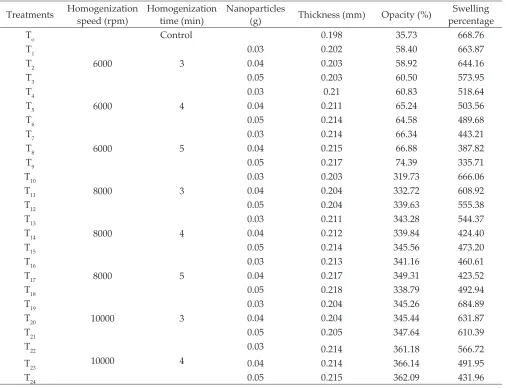
nanoparticles increases the thickness of the cast film. The effects of speed (6000, 8000, and 10000 rpm) and time (3, 4 and 5 min) of homogenization on thickness of SPI based packaging film are presented in Fig. 1. From the figure, it is observed that, the increase in homogenization time increased the thickness of the film significantly. It might be due to proper distribution of particles in the film forming solution. As the speed of homogenization increased from 6000 to 10000 rpm, the thickness of SPI based film was also found to be slightly increased. It might be due to the consistent solution obtained at higher speed. The similar effect on thickness of film was reported by Kadam et al. 2013.
Swelling property
The average swelling property of SPI films with
Table 1. The thickness (mm), opacity (%) and swelling percentage of SPI based nano-functionalized packaging film
Treatments Homogenization speed (rpm) Homogenization time (min) Nanoparticles (g) Thickness (mm) Opacity (%) percentageSwelling
Tο Control 0.198 35.73 668.76
T1
6000 3
0.03 0.202 58.40 663.87
T2 0.04 0.203 58.92 644.16
T3 0.05 0.203 60.50 573.95
T4
6000 4
0.03 0.21 60.83 518.64
T5 0.04 0.211 65.24 503.56
T6 0.05 0.214 64.58 489.68
T7
6000 5
0.03 0.214 66.34 443.21
T8 0.04 0.215 66.88 387.82
T9 0.05 0.217 74.39 335.71
T10
8000 3
0.03 0.203 319.73 666.06
T11 0.04 0.204 332.72 608.92
T12 0.05 0.204 339.63 555.38
T13
8000 4
0.03 0.211 343.28 544.37
T14 0.04 0.212 339.84 424.40
T15 0.05 0.214 345.56 473.20
T16
8000 5
0.03 0.213 341.16 460.61
T17 0.04 0.217 349.31 423.52
T18 0.05 0.218 338.79 492.94
T19
10000 3
0.03 0.204 345.26 684.89
T20 0.04 0.204 345.44 631.87
T21 0.05 0.205 347.64 610.39
T22
10000 4
0.03 0.214 361.18 566.72
T23 0.04 0.214 366.14 491.95
T 0.05 0.215 362.09 431.96
Figure 1. Effect of homogenization speed, time and quantity of nanoparticles on thickness (mm) of SPI based packaging film
Opacity
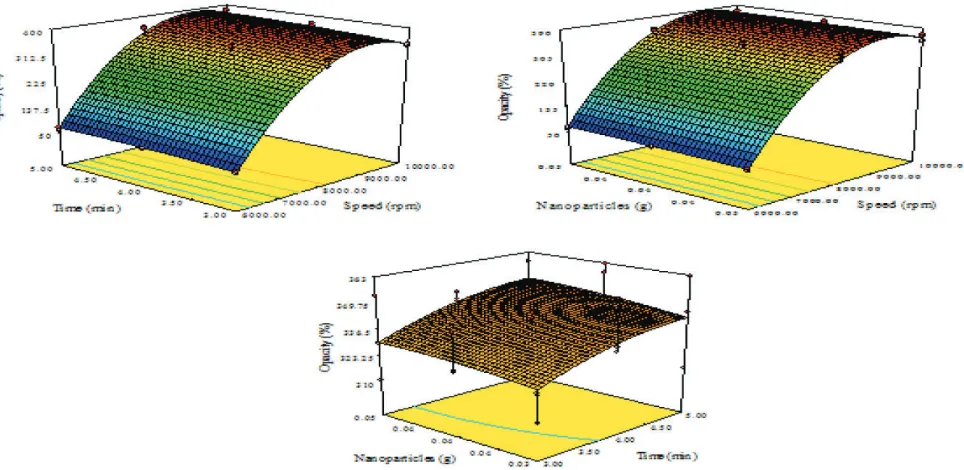
The average opacity of SPI films with and without nanoparticles is presented in table 1.The effects of speed (6000, 8000, and 10000 rpm) and time (3, 4 and 5 min) of homogenization on opacity of SPI
based packaging film are presented in Fig. 3. From the figure, it is observed that as time and speed of homogenization increase, the opacity of film also increased. It might be due to increase in the thickness of film by uniform distribution of particles at higher levels of time and homogenization speed.
Figure 3. Effect of homogenization speed, time and quantity of nanoparticles on tensile strength (MPa) of SPI based
packaging film Tensile strength
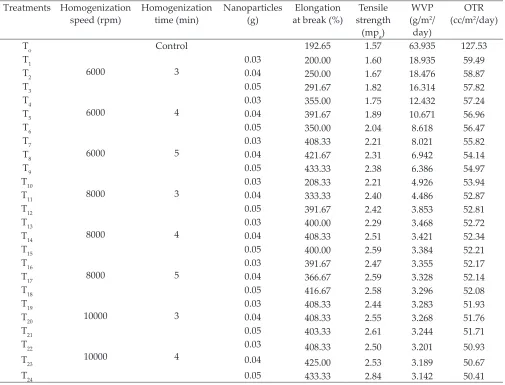
The average tensile strength of SPI films with and without nanoparticles is presented in table 4. The effects of speed (6000, 8000 and 10000 rpm) and time (3, 4 and 5 min) of homogenization on tensile strength of SPI based packaging film are presented in Fig. 4. From the figure, it is observed that as homogenization speed and time increased the tensile strength of cast film increased. It might be due to more possible interaction that involves electrostatic attraction between negatively charged carboxylic or sulphydryl groups from certain amino acids of SPI and positively charged Ti4+ -water
complex during the preparation of SPI-TiO2 film solution. Hydrogen bonding or O-Ti-O bonding might also be contributed to the increase in tensile properties of blend films at higher level of speed.
Elongation at break
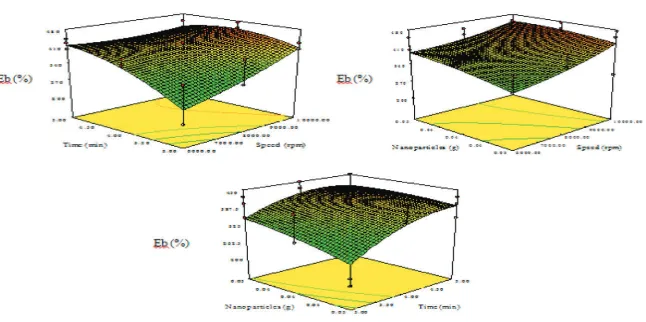
The average elongation at break of SPI films with and
without nanoparticles are presented in table 2.The effects of speed (6000, 8000, and 10000 rpm) and time (3, 4, and 5 min) of homogenization on elongation at break of SPI based packaging are presented in Fig. 5. From the figure, it is observed that as the speed and time of homogenization increased, the elongation also increased. It might be due to the glycerol used in the film. Glycerol acted as a plasticizer without forming any covelent linkage with SPI. Glycerol can interact by hydrogen bonds with protein at amine, amide, carboxyl and hydroxyl sites, increasing the free volume of system. Soy protein with polar and non-polar side chain, which promotes strong inter and intramolecular interactions, such as hydrogen bonding. The strong charge and polar interaction between side chains of soy protein molecules restricts segment rotation and molecular mobility, which lead to an increase of elongation.
Figure 4. Effect of homogenization speed, time and quantity of nanoparticles on elongation at break (Eb) of SPI based
Water vapour permeability (WVP)
The average water vapour permeability of SPI films with and without nanoparticles are presented in table 2. The effects of speed (6000, 8000, and 10000 rpm) and time of homogenization (3, 4, and 5 min) on WVP of SPI based packaging film are presented in Fig. 6. From the figure, it is observed that as homogenization speed and time increased the WVP of the film was found to be decreased. It might be due to addition of formaldehyde as a cross linking agent. Kadam et al. (2013) reported that higher WVP is one of the major limitations when using protein based film as food packaging material. Glycerol has many –OH groups, which has strong absorption ability. The sorbitol acted as plasticizer and formaldehyde as a cross linking agent. Thus, the decrease in absorption ability of WVP of the film was observed. The SPI film had significantly lower WVP by increased in time, speed of homogenization
and also had uniform distribution of nanoparticles in the film forming solution.
Oxygen transmission rate (OTR)
The average OTR of SPI films with and without nanoparticles is presented in table 2. The effects of speed (6000, 8000, and 10000 rpm) and time of homogenization (3, 4, and 5 min) on OTR of SPI based packaging film are presented in Fig. 7. From the figure, it is observed that as speed and time of homogenization increased the OTR of the film decreased. It might be due to soy protein with polar and non-polar side chain, which might have promoted strong inter and intra molecular interactions, such as hydrogen bonding. The strong charge and polar interaction between side chains of soy protein molecules might have restricted the segment rotation and molecular mobility, which led to decrease in OTR.
Table 2: The elongation at break, tensile strength, WVP, OTR of SPI based nanofunctionalized packaging film
Treatments Homogenization
speed (rpm) Homogenization time (min) Nanoparticles (g) at break (%)Elongation strengthTensile (mpa)
WVP (g/m2/
day)
OTR (cc/m2/day)
Tο Control 192.65 1.57 63.935 127.53
T1
6000 3 0.03 200.00 1.60 18.935 59.49
T2 0.04 250.00 1.67 18.476 58.87
T3 0.05 291.67 1.82 16.314 57.82
T4
6000 4 0.03 355.00 1.75 12.432 57.24
T5 0.04 391.67 1.89 10.671 56.96
T6 0.05 350.00 2.04 8.618 56.47
T7
6000 5 0.03 408.33 2.21 8.021 55.82
T8 0.04 421.67 2.31 6.942 54.14
T9 0.05 433.33 2.38 6.386 54.97
T10
8000 3 0.03 208.33 2.21 4.926 53.94
T11 0.04 333.33 2.40 4.486 52.87
T12 0.05 391.67 2.42 3.853 52.81
T13
8000 4 0.03 400.00 2.29 3.468 52.72
T14 0.04 408.33 2.51 3.421 52.34
T15 0.05 400.00 2.59 3.384 52.21
T16
8000 5 0.03 391.67 2.47 3.355 52.17
T17 0.04 366.67 2.59 3.328 52.14
T18 0.05 416.67 2.58 3.296 52.08
T19
10000 3 0.03 408.33 2.44 3.283 51.93
T20 0.04 408.33 2.55 3.268 51.76
T21 0.05 403.33 2.61 3.244 51.71
T22
10000 4 0.03 408.33 2.50 3.201 50.93
T23 0.04 425.00 2.53 3.189 50.67
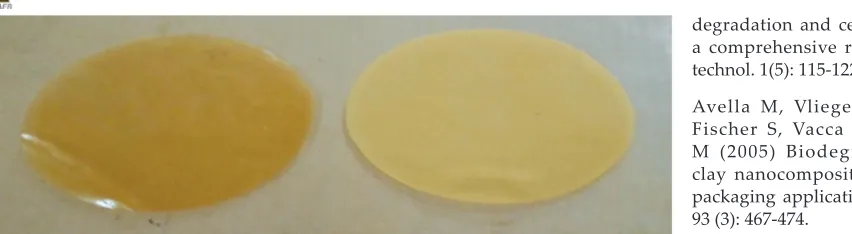
Figure 5. SPI and TiO2 added packaging films
Acknowledgement
The authors sincerely acknowledge UAS Raichur for providing financial support to the present investigation.
Conclusion
It was observed that soy protein isolate film could sustain their structural integrity with the application of homogenization and incorporation of TiO2 nanoparticles. Embedded nanoparticles contributed effectively to increase the thickness and opacity of films. The presence of nanoparticles in the film improved tensile strength from 1.60 MPa to 320 MPa and elongation at break (%) increased from 200.00% to 434.00%. It also improves the WVP and OTR of SPI based film. The optimum process parameter of SPI based packaging film were homogenization speed of 10000 rpm, homogenization time of 5 min and amount of nanoparticles of 0.05g. The SPI film reinforced with nanoparticles have great potential for application in food packaging for extending the shelf life maintain quality of food packaged with them.
References
Agnieszka G, Natalia G and Helena J 2011 Biodegradable polymers for food packaging factors influencing their
degradation and certification types: a comprehensive review. Chemical technol. 1(5): 115-122.
Avella M, Vlieger J, Errico EM, Fischer S, Vacca P and Volpe G M (2005) Biodegradable starch/ clay nanocomposite films for food packaging applications. Food Chem. 93 (3): 467-474.
Averous L and Pollet E 2012 Biodegradable polymer. Springer-Verlag press: London.
Cho YS, Lee YS and Rhee C 2010 Edible oxygen barrier bilayerfilm pouches from corn zein and soy protein isolate for olive oil packaging, LWT – Food. Sci. Technol.,43 (4): 1234-1239.
Heap B 2009. Preface philosophical transactions of the royal society. Biological Sci. 364: 1971-1971.
Kadam MD, Thunga M, Wang S, Kessler RM, Grewell D, Lamsal B and Yu C 2013 Preparation and characterization of whey protein isolate films reinforced with porous silica coated titaniam nanoparticles., J. Food Engg. 117(1): 133-140.
Kuorwel KK, Cran JM, Sonneveld K, Miltz J and Bigger WS 2011 Antimicrobial activity of biodegrdable polysaccharide and protein- based films containing active agents. J. Food Sci. 76: 90-106.
Peelman N, Ragaert P, Meulenaer DB, Adons D, Peeters R, Cardon L, Impe VF and Devlieghere F 2013 Application of bioplastic for food packaging. Trends in Food Sci. Technol. 2:1-14.
Ramesh B, Anitha and Hema R 2010 Recent Trends in Biodegradable Biopolymers. Advanced Biotech. 9(11):30-34.
Sabina G, Andrzej L and Andree V 2013 Effect of oxidized potato starch on the physicochemical properties of soy protein isolate-based edible films. Food Technol. Biotechnol. 51(3): 403–409.