R E S E A R C H A R T I C L E
Open Access
Electrochemical DNA biosensor based on the
BDD nanograss array electrode
Huali Jin
1, Min Wei
1*and Jinshui Wang
2Abstract
Background:The development of DNA biosensor has attracted considerable attention due to their potential applications, including gene analysis, clinical diagnostics, forensic study and more medical applications. Using electroactive daunomycin as an indicator, the hybridization detection was measured by differential pulse voltammetry in this study.
Results:Electrochemical DNA biosensor was developed based on the BDD film electrode (fBDD) and BDD nanograss array electrode (nBDD). In comparison with fBDD and AuNPs/CA/fBDD electrode, the lower semicircle diameter of electrochemical impedance spectroscopy obtained on nBDD and AuNPs/CA/nBDD electrode indicated that the presence of nanograss array improved the reactive site, reduced the interfacial resistance, and made the electron transfer easier. Using electroactive daunomycin as an indicator, the hybridization detection was measured by differential pulse voltammetry.
Conclusions:The experimental results demonstrated that the prepared AuNPs/CA/nBDD electrode was suitable for DNA hybridization with favorable performance of faster response, higher sensitivity, lower detection limit and satisfactory selectivity, reproducibility and stability.
Keywords:DNA biosensor, AuNPs/CA/nBDD, AuNPs/CA/fBDD
Background
The development of DNA biosensor has attracted con-siderable attention due to their potential applications, including gene analysis, clinical diagnostics, forensic study and more medical applications [1,2]. Among the various methods for DNA detection, electrochemical techniques offer great advantages with simplicity, rapid-ness, relatively low cost, and high sensitivity, and are suitable for the development of inexpensive and port-able devices [3-5].
The immobilization of DNA onto the electrodes plays an important role in the fabrication of DNA electrochemical biosensors. With the properties of high surface-to-volume ratio, unique catalytic activity, high electron transfer rate, and strong adsorption ability, gold (Au) nanomaterials with different morphology have been introduced onto the
electrode surface through the Au-thiol binding [6-10] or direct immobilization [11-15] for the loading of DNA.
On the other hand, with the advantages of wide poten-tial window, low background current, high stability and excellent resistance to electrode fouling, boron-doped dia-mond (BDD) film (fBDD) electrode has been used widely for electrochemical detection. In order to add advanced functions, BDD nanograss array electrode (nBDD) was prepared in our previous work [16].
In the present work, electrochemical DNA biosensor was developed based on the fBDD and the nBDD elec-trode. The obtained biosensors were characterized by electrochemical impedance spectroscopy (EIS). Probe DNA with thiol group at 5’ end was covalently linked onto the electrode surface through the Au-thiol binding. Hybridization experiment was conducted by immersing the electrode with probe DNA into the hybridization buffer solution containing its complementary sequence. Using electroactive daunomycin (DNR) as an indicator, the hybridization detection was measured by differential pulse voltammetry (DPV).
* Correspondence:[email protected] 1
College of Food Science and Technology, Henan University of Technology, Zhengzhou 450001, P. R. China
Full list of author information is available at the end of the article
Experimental
Chemicals and apparatus
The oligonucleotides were chosen according to the lit-erature [15] and purchased from TaKaRa Biotechnology Co., Ltd. (Dalian, China).; their base sequences are as follows:
24-base probe sequence (probe DNA): 50-SH-GAG
CGG CGC AAC ATT TCA GGT CGA-30
its fully complementary sequence: 50-TCG ACC TGA
AAT GTT GCG CCG CTC-30
a non-complementary sequence: 50-GAG CGG CGC
AAC ATT TCA GGT CGA-30
Others sequences as following:
50-TCG ACC TGA AACGTT GCG CCG CTC-30
(one-base mismatch);
50-TCG ACC TCA AAT GTT GAG CCG CTC-30
(two-base mismatch);
50-TCGTCC TGA AACGTT GCG CCTCTC-30
(three-base mismatch).
Daunomycin hydrochloride was obtained from Shanghai Institute for Drug Control and used without further purification. 10 × TE buffer (0.1 M Tris–HCl, 0.01 M EDTA, pH 8.0) and wash buffer (PBS, 0.01 M phosphate sodium buffer solution, pH 7.4, 0.1 M NaCl) from Shanghai Your Sun Biological Technology Co., Ltd. were all used as-received. Hybridization buffer (0.75 M NaCl, 0.15 M so-dium citrate, pH 7.4) was self-prepared. All other reagents were of analytical grade and Millipore Milli-Q ultrapure water was used throughout.
Electrochemical measurements were performed on a CHI660c electrochemical workstation with a three-electrode electrochemical cell. A Ag/AgCl (saturated KCl) reference electrode and a Pt wire counter electrode were used.
Preparation of the AuNPs/CA/fBDD and AuNPs/CA/nBDD electrode
The procedure for preparation of the AuNPs/CA/ fBDD and AuNPs/CA/nBDD electrode was described in Scheme 1. Firstly, Au nanoparticles (AuNPs) were prepared according to the literature [17]. Cyclic vol-tammetry (CV) was used to immobilize cysteamine (CA) onto surface of the pretreated fBDD and nBDD elec-trode at the range from−1.5 V to + 2.4 V in PBS (0.1 M, pH 7.0) containing1.0 × 10−3 M CA [18]. Then the CA modified electrodes were rinsed thoroughly with ultrapure water and immersed in AuNPs solution for 1 h. With the strong interaction between Au and the thiol, the AuNPs could be linked to the CA modified fBDD and nBDD.
Hybridization and electrochemical detection
Scheme 1 outlined the procedure of DNA hybridization and electrochemical detection on the prepared electrodes. The concrete experimental processes were as follows:
Probe DNA with thiol group at 5’ end was covalently linked onto the electrode surface through the Au-thiol binding, and the processes were as follows: The prepared electrode was immersed into a 1.58 × 10⁻⁵M probe DNA soultion for 12 h with stirring at room temperature. Then the electrode was washed using wash buffer to remove the unimmobilized probe DNA.
The probe DNA-modified electrode was immersed into hybridization buffer solution containing different concentration of target DNA for 30 min at 37°C. After that, the electrode was soaked in wash buffer for remov-ing the non-hybridized target DNA. Then, the hybrid-ized electrode was immersed into the stirred DNR solution (1.0 × 10⁻⁵ M) containing PBS (0.1 M, pH 7.4) for 15 min at room temperature. After accumulation of DNR, the electrode was rinsed in PBS (0.1 M, pH 7.4) for 30 s to remove the physically adsorbed molecules [19]. Using the hybridized electrode with accumulated
DNR as working electrode, the hybridization detection was measured by DPV in PBS soultion (0.1 M, pH 7.4).
Results and discussion
Characterization of the AuNPs/CA/fBDD and AuNPs/CA/ nBDD electrode
Figure 1 showed the SEM images of AuNPs/CA/fBDD (Figure 1A) and AuNPs/CA/nBDD (Figure 1B) electrode. As shown in Figure 1, AuNPs were successfully immo-bilized onto SH-terminated fBDD and nBDD surfaces randomly. The surface coverage of AuNPs on electrode surface was estimated by manually counting the AuNPs amount in different analysis areas (1μm × 1μm) in SEM images and the average density of nanoparticles was adopted as coverage [20]. The obtained coverage of AuNPs is about 1.31 × 10⁸ particles/cm2 on fBDD surface and 5.75 × 10⁸particles/cm2on nBDD surface, indicating that the presence of nanograss array on the electrode surface could accelerate the immobilization of AuNPs.
Figure 2 showed the results of EIS for 10 mM [Fe(CN)6]3-/4-in 0.1 M KCl on the different electrode
sur-face. The obvious EIS change from both Figure 2a to 2b and 2c to 2d demonstrated that CA and AuNPs successfully bound to surface of fBDD and nBDD. The lower semicircle diameters were obtained on the nBDD electrode (Figure 2c) and the AuNPs/CA/nBDD electrode (Figure 2d), compared to that obtained on the fBDD electrode (Figure 2a) and the AuNPs/CA/fBDD electrode (Figure 2b), indicating that the presence of nanograss array on the electrode surface im-proved the reactive site, reduced the interfacial resistance, and made the electron transfer easier.
Detection of DNA hybridization on the AuNPs/CA/fBDD and AuNPs/CA/nBDD electrode
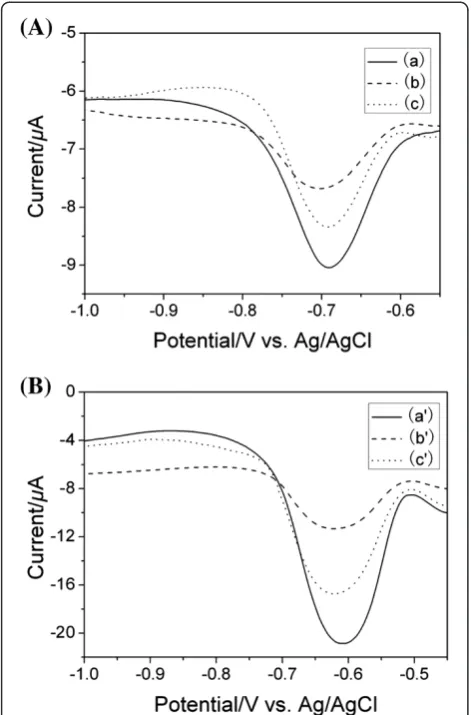
Figure 3 illustrated the different DPV responses of DNR solution (1.0 × 10⁻⁵ M) containing PBS (0.1 M, pH 7.4) without ssDNA probe (a and a’), in the presence of ssDNA probe (b and b’), and those of the hybridized electrodes with accumulated DNR in PBS (0.1 M, pH 7.4) (c and c’) on the AuNPs/CA/fBDD electrode (Figure 3(A)) and that on the AuNPs/CA/nBDD electrode (Figure 3(B)). As shown in Figure 3a and 3a’, the two electrodes not con-taining ssDNA showed the good electrochemical re-sponses in DNR solutions. The reduction peak potential of DNR positively shifted from about−0.69 V on the AuNPs/ CA/fBDD electrode to about−0.60 V on the AuNPs/CA/ nBDD electrode, and the reduction peak current increased from 2.3 μA to 12.33 μA, i.e., on the AuNPs/CA/nBDD electrode, the reduction peak potential shifted positively by ~0.09 V and the peak current increased by almost 5 times, compared to those on the AuNPs/CA/fBDD elec-trode. The results demonstrated that the reduction process
Figure 1SEM images of AuNPs/CA/fBDD (A) and AuNPs/CA/nBDD (B).
of DNR was improved greatly on the AuNPs/CA/nBDD electrode, which was ascribed that nanograss array could accelerate the speed of electron transfer and increase the efficient area of electrode.
The immobilization of ssDNA probe onto the elec-trodes resulted in obvious decreases in DPV responses of DNR (b and b’), which was attributed to the less DNR molecules accessibility to ssDNA probe on the electrode surface [21]. The results also showed that the ssDNA probe had been successfully immobilized on the two electrodes.
After hybridization and DNR intercalation, DPV re-sponses of the hybridized electrodes with accumulated DNR in PBS (0.1 M, pH 7.4) (c and c’) were depicted. As
shown in Figure 3c and 3c’, the pronounced increase in the peak current of the DNR located respectively at
about −0.69 V and about −0.60 V was observed when
hybridized with its complementary sequence. This was ascribed that more DNR could intercalate in the DNA double helix after hybridization, which gave an increased electrochemical response.
In comparison with the AuNPs/CA/fBDD electrode, on the AuNPs/CA/nBDD electrode, the positive shift of peak potential and the obvious increase of all DPV
Figure 4The DPV response of DNR (1.0 × 10⁻⁵M) as indicator in PBS (0.1 M, pH 7.4) recorded for the AuNPs/CA/nBDD electrode with probe DNA without hybridization (f), hybridized with non-complementary sequence (e), three-base mismatch sequence (d), two-base mismatch sequence (c), one-base mismatch sequence (b), and complementary sequence (a). Different target DNA concentration: 1.58 × 10⁻⁷M; DPV parameters: Amplitude: 0.05 V; pulse period: 0.2 s; pulse width: 0.05 s.
Figure 5The DPV responses of DNR as indicator in PBS (0.1 M, pH 7.4) for different target concentrations: (a) 1.58 × 10⁻⁷M, (b) 1.58 × 10⁻⁸M, (c) 1.58 × 10⁻⁹M, (d) 1.58 × 10⁻¹⁰M, (e) 1.58 × 10⁻¹¹M.
responses demonstrated that the AuNPs/CA/nBDD elec-trode had advantages with faster response and higher sensitivity and was superior to the AuNPs/CA/fBDD electrode for DNA hybridization.
Selectivity and calibration curve of DNA hybridization on the AuNPs/CA/nBDD electrode
The selectivity of the DNA hybridization on the AuNPs/ CA/nBDD electrode with probe DNA was investigated by hybridizing with its complete complementary sequence, different-base mismatch sequence, and non-complementary sequence. As shown in Figure 4, as compared with the DPV response of DNR with probe DNA (Figure 4f), a pro-nounced increase in the peak current value of the DNR was observed when hybridized with its complementary se-quence (Figure 4a). The DPV signal was gradual decreasing with the increase of the mismatch numbers of target DNA (Figure 4b to 4d), and the negligible electrochem-ical response was obtained when incubating with non-complementary sequence (Figure 4e). The results showed that the AuNPs/CA/nBDD electrode had satisfactory selec-tivity for DNA hybridization.
Figure 5 displayed the DPV hybridization responses for increasing target concentrations of complementary sequence from 1.58 × 10⁻¹¹ M to 1.58 × 10⁻⁷ M. The peak currents of intercalated DNR increased with the in-crease of the complementary target DNA concentrations and were linear with the logarithmic value of the comple-mentary target DNA concentrations, as shown in the inset of Figure 5. The linear regression equation wasy= 1.972 log x +21.5996 with a correlation coefficient value of 0.996 (xis the concentration of complementary sequence, M;ythe peak current of DNR,μA). The detection limit of 9.8 × 10⁻¹²M was obtained using 3s(sis the standard de-viation of blank solution, n =10), which was lower than the value of previous report for the same target sequence detection [22].
Reproducibility and stability of the DNA biosensor
A series of 8 independent measurements of 1.58 × 10⁻⁷M target DNA were used for estimating the precision, and the relative standard deviation (RSD) was 5.63%. It showed that the proposed DNA biosensor had acceptable reprodu-cibility. The probe DNA modified electrode was first stored in the refrigerator at 4°C over three weeks and then exam-ined via DPV after its hybridization with complementary target DNA. Experiments demonstrated that the DNA bio-sensor retained about 91% of its initial response.
Conclusions
An electrochemical DNA biosensor was developed based on the AuNPs/CA/nBDD electrode. Both the lower semicircle diameter of EIS and the favorable results of hybridization detection obtained on the AuNPs/CA/
nBDD electrode indicated that the presence of nanograss array could improve the reactive site, increase the efficient area of electrode, reduce the interfacial resistance, and make the electron transfer easier. The prepared AuNPs/CA/ nBDD electrode was suitable for DNA hybridization with favorable performance of faster response and higher sensi-tivity, lower detection limit and satisfactory selecsensi-tivity, re-producibility and stability.
Competing interests
The authors declare that there are no any competing interests.
Authors’contributions
MW planed and supervised the whole work, and drafted the manuscript. HLJ carried out the experiments and drafted the manuscript. JSW participated in experiments. All authors read and approved the final manuscript.
Acknowledgements
The authors thank the financial support of the National Natural Science Foundation of China (Grant No. 21105022), and the Doctor Foundation of Henan University of Technology (2010BS019).
Author details 1
College of Food Science and Technology, Henan University of Technology, Zhengzhou 450001, P. R. China.2College of Biological Engineering, Henan University of Technology, Zhengzhou 450001, P. R. China.
Received: 14 February 2013 Accepted: 3 April 2013 Published: 10 April 2013
References
1. Ting BP, Zhang J, Gao Z, Ying JY:A DNA biosensor based on the detection of doxorubicin-conjugated Ag nanoparticle labels using solid-state voltammetry.Biosens Bioelectron2009,25:282–287. 2. Steichen M, Buess-Herman C:Electrochemical detection of the
immobilization and hybridization of unlabeled linear and hairpin DNA on gold.Electrochem Commun2005,7:416–420.
3. Kim E, Kim K, Yang H, Kim YT, Kwak J:Enzyme-amplified electrochemical detection of DNA using electrocatalysis of ferrocenyl-tethered dendrimer.Analytiacal Chemistry2003,75:5665–5672. 4. Wang J, Li J, Baca AJ, Hu J, Zhou F, Yan W, Pang DW:Amplified
voltammetric detection of DNA hybridization via oxidation of ferrocene caps on gold nanoparticle/streptavidin conjugates.Analytiacal Chemistry 2003,75:3941–3945.
5. Li C, Liu S, Guo LH, Chen D:A new chemically amplified electrochemical system for DNA detection in solution.Electrochem Commun2005,7:23–28. 6. Ding Y, Chen M, Erlebacher J:Mesoporous nanocomposites for
electrocatalysis.J Am Chem Soc2004,126:6876–6877.
7. Li F, Feng Y, Dong P, Yang L, Tang B:Gold nanoparticles modified electrode via simple electrografting of in situgenerated mercaptophenyl diazonium cations for development of DNA electrochemical biosensor.
Biosens Bioelectron2011,26:1947–1952.
8. Pingarrón JM, Yáñez-Sedeño P, González-Cortés A:Gold nanoparticle-based electrochemical biosensors.Electrochim Acta2008,53:5848–5866. 9. Lu W, Lin L, Jiang L:Nanogold hollow balls with dendritic surface for
hybridization of DNA.Biosens Bioelectron2007,22:1101–1105. 10. Liu S, Liu J, Han X, Cui Y, Wang W:Electrochemical DNA biosensor
fabrication with hollow gold nanospheres modified electrode and its enhancement in DNA immobilization and hybridization.
Biosens Bioelectron2010,25:1640–1645.
11. Sapsford KE, Park D, Goldman ER, Foos EE, Trammell SA, Lowy DA, Ancona MG:Selective DNA-mediated assembly of gold nanoparticles on electroded substrates.Langmuir2008,24:10245–10252.
12. Wang X, Yang T, Li X, Jiao K:Three-step electrodeposition synthesis of self-doped polyaniline nanofiber-supported flower-like Au microspheres for high-performance biosensing of DNA hybridization recognition.
13. Li F, Han X, Liu S:Development of an electrochemical DNA biosensor with a high sensitivity of fM by dendritic gold nanostructure modified electrode.Biosens Bioelectron2011,26:2619–2625.
14. Hu K, Lan D, Li X, Zhang S:Electrochemical DNA biosensor based on nanoporous gold electrode and multifunctional encoded DNA-Au Bio bar codes.Anal Chem2008,80:9124–9130.
15. Hong C, Zhu N, Jiang Y, He P, Fang Y:Cu@Au alloy nanoparticle as oligonucleotides labels for electrochemical stripping detection of DNA hybridization.Biosens Bioelectron2003,18:1311–1319.
16. Wei M, Terashima C, Lv M, Fujishima A, Gu Z-Z:Boron-doped diamond nanograss array for electrochemical sensors.Chem Commun 2009,24:3624–3626.
17. Frens G:Controlled nucleation for the regulation of the particle size in monodisperse gold solutions.Nature (Phys Sci)1973,241:20–25. 18. Hu GZ, Zhang DP, Wu WL, Yang ZS:Selective determination of dopamine
in the presence of high concentration of ascorbic acid using nano-Au self-assembly glassy carbon electrode.Colloids Surf B Biointerfaces 2008,62:199–205.
19. Yang Y, Wang Z, Yang M, Li J, Zheng F, Shen G, Yu R:Electrical detection of deoxyribonucleic acid hybridization based on carbon-nanotubes/nano zirconium dioxide/chitosan-modified electrodes.Anal Chim Acta 2007,584:268–274.
20. Tian R-H, Zhi J-F:Fabrication and electrochemical properties of boron-doped diamond film-gold nanoparticle array hybrid electrode.
Electrochem Commun2007,9:1120–1126.
21. Zhu N, Gu Y, Chang Z, He P, Fang Y:PAMAM dendrimers-based DNA biosensors for electrochemical detection of DNA hybridization.
Electroanalysis2006,18:2107–2114.
22. Cai H, Cao X, Jiang Y, He P, Fang Y:Carbon nanotube-enhanced electrochemical DNA biosensor for DNA hybridization detection.
Anal Bioanal Chem2003,375:287–293.
doi:10.1186/1752-153X-7-65
Cite this article as:Jinet al.:Electrochemical DNA biosensor based on the BDD nanograss array electrode.Chemistry Central Journal20137:65.
Open access provides opportunities to our colleagues in other parts of the globe, by allowing
anyone to view the content free of charge.
Publish with
Chemistry
Central and every
scientist can read your work free of charge
W. Jeffery Hurst, The Hershey Company.
available free of charge to the entire scientific community peer reviewed and published immediately upon acceptance cited in PubMed and archived on PubMed Central yours you keep the copyright
Submit your manuscript here: