Original Research Article
Fate of e-waste in households in Enugu West Senatorial district of
Enugu State, Southeast Nigeria
Emmanuel I. Umegbolu*
INTRODUCTION
Technological advancement has led to rapid development of the electrical and electronic industry. Indeed, the electronics industry is one of the most important industries in the world today, generating a great number of jobs, promoting technological development, and at the same time fuelling a high demand for raw materials that are considered scarce or rare, but leaving in its wake the generation of a new kind of waste-e-waste.
Although e-waste traditionally stands for electronic waste, operationally, e-waste is a term used to cover all electrical and electronic items and their parts that have been discarded by their owner as waste without the intent
of re-use.1,2 E-waste, has also been defined as waste generated from used electronic devices and household appliances that are not fit for their original intended use and are destined for recovery, recycling, or disposal.3 Electrical and electronic equipment (EEE) include items that have either battery or a power cord as their source of power.
E-waste which is also commonly referred to as waste electrical and electronic equipment (WEEE), can be broadly categorized into three: large household
appliances (refrigerators and washing machines),
information technology (IT) and telecommunication (personal computers, monitors, and laptops), and consumer equipment (television sets, DVD players, ABSTRACT
Background: E-waste, is the waste generated from used electrical and electronic devices that are no longer fit for their original intended use. Currently e-waste comprises more than 5% of total municipal waste flow, equivalent to 20-50 million tonnes annually worldwide. In 2014, Nigeria generated about 219 kilo tonnes of e-waste. The study aimedto increase public awareness on the need for proper management of e-waste because of its hazardous nature.
Methods: This was a cross-sectional study in Enugu West Senatorial District of Enugu State comprising Oji-River, Ezeagu, Udi, Awgu and Aninri Local Government Areas with a population of 980,988. An adaptation of the UNEP, EMPA and Basel convention questionnaire, administered to 400 households was used for data collection.
Results: The potential e-waste generation in the study area was 0.05 kg per inhabitant. 76% of the households were aware of the hazards of waste. 64% were willing to give out their waste to waste collectors. Only 26% of the e-waste were collected with the general e-waste. The correlation between awareness of the hazards of e-e-waste and willingness of the households to give out their e-waste was positive, moderate, and insignificant (r= 0.43, p=0.47).
Conclusions: Although 76 per cent of the households were aware of the hazards of e-waste, with 64% willing to give out their e-waste, only 26% of the e-waste were eventually collected together with the general waste. There is a need to create a separate e-waste collection system.
Keywords: Fate, E-waste, Household, Senatorial, District
Department ofGeneral Outpatient, District Hospital, Awgu, Enugu State, Nigeria
Received: 15 July 2018
Accepted: 20 August 2018
*Correspondence:
Dr. Emmanuel I. Umegbolu, E-mail: [email protected]
Copyright: © the author(s), publisher and licensee Medip Academy. This is an open-access article distributed under the terms of the Creative Commons Attribution Non-Commercial License, which permits unrestricted non-commercial use, distribution, and reproduction in any medium, provided the original work is properly cited.
mobile phones, MP3 players, and leisure sporting equipment.
Although electrical and electronic equipment contain a variety of metals, many of which are harmful to human health and the environment, they also contain valuable materials that can be extracted and recycled.4,5 The presence of elements like lead, mercury, arsenic, cadmium, selenium, and hexavalent chromium and flame-retardants beyond threshold quantities in e-waste makes it hazardous. Reported adverse effects of e-waste on public health include fetal loss, prematurity, low birth weight and congenital malformations, abnormal thyroid function and thyroid development, neuro-behavioural disturbances and genotoxicity.6,7
The environmental effects of e- industry are two pronged: first through the large and growing amount of waste equipment that is discarded annually, and second through the extraction of natural raw materials to supply the demand of the new equipment industry.8
The main cause of adverse health and environmental effects of e-waste is the lack of formal technological recycling or handling systems or effective regulations introduced for the management of these toxic substances.5 The compounds and materials from e-waste that are of most concern are printed circuit boards (PCBs), batteries, cathode ray tubes (CRTs), liquid crystal displays (LCDs), plastics, PCB-containing capacitors, equipment containing freons, toner cartridges, and various mercury containing components.1
As the fastest growing sector of the municipal solid waste stream today, e-waste currently comprises more than 5% of its total flow, which is equivalent to 20-50 million tonnes a year worldwide.9,1 It has been estimated that the e-waste stream increases by 3-5% every year, that is nearly three times faster than the municipal waste streams general growth.10 This unprecedented rapid increase in e-waste generation is the price we are paying for our constant desire for newer and more efficient technology, as well as the intense marketing by the producers, which make us replace our electronic devices more and more frequently. In this regard, youths between the ages of 15 and 35 appear to be largely responsible, as reported by a study from Nigeria.11
Available statistics indicate that the global e-waste generation had actually increased from 9.3 million tonnes in 2005, to 50 million tonnes in 2012.12,13 The 2012 UN report projected that by 2017, global e-waste will have increased by a further 33%, from 49.7 million to 65.4 million metric tonnes annually.2
In spite of the enormous amount of e-waste generated around the world annually, only about 10% of it is collected and taken care of in adequate recycling facilities.14,15 End-of-life treatments of e-waste include reuse, recycling, landfilling and incineration. However,
there is no completely safe end-of –life process available to deal with the e-waste of today.1
Generation of e-waste varies greatly among the countries of the world, depending on their stages of development. For obvious reasons, the more developed a country is, the more e-waste it generates. Expectedly, the main generators of e-waste are developed countries, like the USA, European Union countries, Australia and Japan,
which exploiting loopholes in current e-waste
regulations, deliberately export a large fraction of these
obsolete electrical and electronic equipment to
developing countries under the guise of “donation” and “recycling”, regardless of the fact that this waste is recycled under very primitive conditions in the receiving countries. Countries of destination of these electrical and electronic waste include China, India, Nigeria and Ghana.16,9,17
In recent years, Nigeria has had its own fair share of e-waste. In 2014 alone, Nigeria generated about 219 kilo tonnes of e-waste, which is largely recycled by the informal sector.18,19 It has been estimated that as many as 400,000 units of used electronic equipment arrive through the Lagos port into Nigeria every month.20 Furthermore, a 2010 estimate showed that the ratio of used electrical and electronic equipment which were imported into the country were at par with new ones.18
At present, studies on WEEE in Nigeria appear to be scanty, hence the need for this study. In addition, the study aims to increase public awareness on the need for proper management of WEEE, as this category of waste is considered hazardous because of its contents of heavy metals, among other things.
METHODS
This was a cross-sectional study in Enugu West Senatorial District of Enugu State, which is made up of five Local Government Areas, namely Oji-River, Ezeagu, Udi, Awgu and Aninri. The combined population of the five Local Government Areas of the Senatorial District, according to the last census, is 980,988.21
An adaptation of the UNEP, EMPA and Basel Convention questionnaire was used for data collection.22 400 copies of the questionnaire were administered to households in the area of the study. Those who are literate completed the questionnaire themselves, while those not literate had the questionnaire administered to them by the researcher and his assistants. Administration of the questionnaire was house to house. In order to avoid duplication, no two members of the same household were allowed to fill the questionnaire.
every 5th household was selected until 40 households were obtained. Using these sampling procedures the 400 households required for the study were selected from the ten communities of the five Local Government Areas of the Senatorial District. A pilot study was done in 40 households in Ihu Ezi, Ezeagu LGA, to test the validity and reliability of the instrument (questionnaire). Data were collected over a period of three months, from March to June 2018.
The collected data were analysed as descriptive statistics of means and correlation using MaxStat statistical software version 3.60. The p-level of significance was set at ≤0.05.
RESULTS
A total of 400 copies of the questionnaire were distributed in the five LGAs of the study area. Table 1 shows the distribution of the respondents in the five LGAs. From the table, it is seen that there was an even distribution of respondents (80 per LGA) among the five LGAs.
Table 1: Distribution of respondents by communities.
LGA Number of households
A 80
B 80
C 80
D 80
E 80
Total 400
LGA= Local government area.
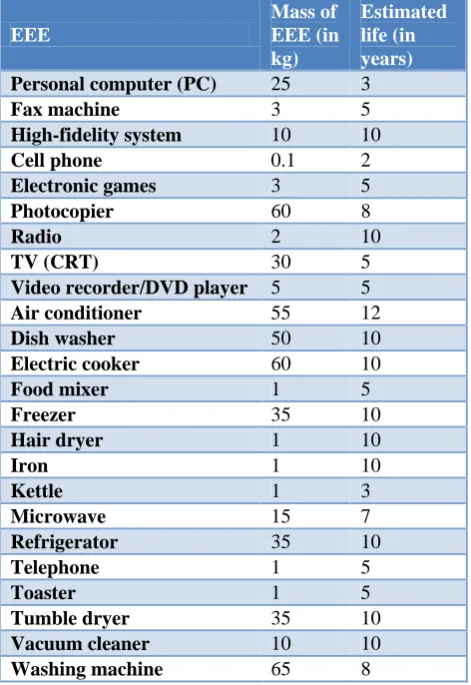
Table 2 shows the masses and estimated life spans of some electrical and electronic equipment (EEE) as adapted from.4
Table 3 shows the categories of household equipment and their respective masses. As shown in the table, the total quantity of household equipment in the five LGAs was 4046. Their total mass was 53310.4 kg. The bulk of the equipment was constituted by category A (Large household appliances) equipment with a total mass of 38194 kg (71.6%), followed by category D (Consumer) equipment with a total mass of 10369 kg (19.5%) and then category C (IT and telecommunications) equipment with a total mass of 3115.4 kg (5.8%). Category B (Small household appliances) had the least mass with a total of 1632 kg (3.1%) The mean mass of equipment per inhabitant of the study area was 0.05 kg.
Table 4 shows the components of category A equipment (Large household appliances) in the five LGAs. From the table, it is seen that freezers made up the bulk of the equipment with a total mass of 11050 kg (28.9%), followed by fridges with a total mass of 9240 kg (24.1%) and electric hot plates with a total mass of 5160 kg
(13.5%). Electric heaters with a total mass of 610 kg (1.6%) constituted the least mass. The mean mass of category A equipment was 44.5 kg.
Table 2: Masses and estimated lives of electrical and electronic equipment (EEE).
EEE
Mass of EEE (in kg)
Estimated life (in years)
Personal computer (PC) 25 3
Fax machine 3 5
High-fidelity system 10 10
Cell phone 0.1 2
Electronic games 3 5
Photocopier 60 8
Radio 2 10
TV (CRT) 30 5
Video recorder/DVD player 5 5
Air conditioner 55 12
Dish washer 50 10
Electric cooker 60 10
Food mixer 1 5
Freezer 35 10
Hair dryer 1 10
Iron 1 10
Kettle 1 3
Microwave 15 7
Refrigerator 35 10
Telephone 1 5
Toaster 1 5
Tumble dryer 35 10
Vacuum cleaner 10 10
Washing machine 65 8
EEE= Electrical and electronic equipment.
Table 3: Categories of household equipment and their respective masses.
Category Quantity Total mass (in kg) (%)
Mean (in kg)
A 858 38194 (71.6) 44.5
B 792 1632 (3.1) 2.1
C 1504 3115.4 (5.8) 2.1
D 892 10369 (19.5) 11.6
Total 4046 53310.4 (100) 13.2
Mass of equipment per inhabitant of the
study area 0.05kg
Category A: Large household appliances; Category B: Small household appliances; Category C: IT and telecommunications equipment; Category D: Consumer equipment; Population of the area of the study=980988.
followed by irons with a total mass of 335 kg (20.5%), and kettles with a total mass of 226 kg (13.8%). Hair dryers constituted the least mass with a total of 37 kg
(2.3%). Mean mass of equipment in this category was 2.1 kg.
Table 4: Category A (large household appliances) equipment.
Equipment Quantity Mass (in kg) per equipment Total mass (in kg) (%)
Fridges 264 35 9240 (24.1)
Air conditioners 74 55 4070 (10.7)
Freezers 170 65 11050 (28.9)
Washing machines 67 65 4355 (11.4)
Electric heaters 122 5 610 (1.6)
Electric hot plate 86 60 5160 (13.5)
Dish washers 34 50 1700 (4.5)
Clothes dryer 41 49 2009 (5.3)
Total 858 38194
Mean 44.5
Table 5: Category B (small household appliances) equipment.
Equipment Quantity Mass (in kg) per equipment Total mass (in kg) (%)
Irons 335 1 335 (20.5)
Kettles 226 1 226 (13.8)
Blenders 134 1 134 (8.2)
Microwaves 60 15 900 (55.2)
Hair dryers 37 1 37 (2.3)
Total 792 1632
Mean 2.1
Table 6: Category C (IT and telecommunications equipment).
Equipment Quantity mass (in kg) Per equipment Total mass (in kg) (%)
PCs (central unit) 28 9.9 277.2 (8.9)
CRT monitors 21 14.1 296.1 (9.5)
LCD monitors 28 4.7 131.6 (4.2)
Laptops 206 3.5 721 (23.1)
Mobile phones 1160 0.1 116 (3.7)
Printers 39 6.5 253.5 (8.1)
Copy machines 22 60 1320 (42.4)
Total 1504 3115.4
Mean 2.1
Table 7: Category D (consumer equipment).
Equipment Quantity mass (in kg) Per equipment Total mass (in kg) (%)
TVs (CRT) 163 31.6 5150.8 (49.7)
TVs (flat panel) 150 23 3450 (33.3)
Radios 234 2 468 (4.5)
DVD players 236 5 1180 (11.4)
MP 3-players 94 0.8 75.2 (0.7)
Game consoles 15 3 45 (0.4)
Total 892 10369
Mean 11.6
Table 6 shows category C equipment (IT and telecommunications equipment) in the five LGAs. From the table, it is seen that the bulk of the total mass of
monitors with a total mass of 296.1 (9.5%). The least mass was constituted by mobile phones with a total mass of 116 kg (3.7%). Mean mass of equipment in this category was 2.1 kg.
Table 7 shows category D equipment (Consumer equipment) in the five LGAs. As shown in the table, TVs (CRT) constituted almost half of the total equipment mass (5150.8 kg), contributing 49.7% of the total. TV (flat panel) contributed 3450 kg (33.3%) of the total mass, while the contribution of DVD players was 1180 kg (11.4%) of the total mass. Game consoles had the least contribution (45 kg, or 0.4%). Category D equipment had a mean mass of 11.6 kg.
Table 8: Awareness of the hazard of e-waste.
LGA awareness Yes
N (%)
No
N (%) Total
A 69 (86) 11 (14) 80
B 65 (81) 15 (19) 80
C 67 (84) 13 (16) 80
D 46 (58) 34 (42) 80
E 56 (70) 24 (30) 80
Total 303 (76) 97 (24) 400
Table 8 shows the level of awareness of the hazard of e-waste in the five LGAs. As shown in the table, awareness was generally high in the five LGAs (more than 50%). The awareness was highest in A (86%), followed by C (84%), B (81%), and E (70%). Comparatively, awareness was lowest in D (58%). Mean awareness of the hazard of e-waste across the five LGAs was 76%.
Table 9: Methods of e-waste collection.
LGA Method of e-waste collection
Together with general waste N (%)
No collection
N (%) Total
A 8 (10) 72 (90) 80
B 25 (31) 55 (69) 80
C 28 (35) 52 (65) 80
D 14 (17) 66 (83) 80
E 28 (35) 52(65) 80
Total 103 (26) 297 (74) 400
Table 9 shows methods of e-waste collection in the study area. From the table, it is seen that collection of e-waste was generally poor. In A, 90% of the e-waste were not collected. In D (83%), B (69%), C (65%) and E (65%) of the e-waste were also not collected. Across the five LGAs, 74% of the total e-waste generated were not collected.
Table 10 shows the willingness of respondents to give out their e-waste to waste collectors. As shown in table, 74%
of the respondents in both C and E were willing to give out their e-waste to waste collectors. In A (64%), B (58%) and D (52%) were equally willing to give out their own e-waste to waste collectors. In all the five LGAs, 64% of respondents were ready to give out their e-waste to waste collectors.
Table 10: Willingness to give out e-waste to waste collectors.
LGA Willingness (in number of households) to give out e-waste
Yes N (%)
No
N (%) Total
A 51 (64) 29 (36) 80
B 46 (58) 34 (42) 80
C 59 (74) 21 (26) 80
D 42 (52) 38 (48) 80
E 59 (74) 21 (26) 80
Total 257 (64) 143 (36) 400
Table 11: Relationship between awareness of e-waste hazard and willingness to give out e-waste to waste
collectors.
LGA Awareness
N (%)
Willingness to give out e-waste N (%)
A 69 (86) 51 (64)
B 65 (81) 46 (58)
C 67 (84) 59 (74)
D 46 (58) 42 (53)
E 56 (70) 59 (74)
r 0.427
p 0.473
Table 11 shows the relationship between awareness of e-waste hazard and willingness of respondents to give out their e-waste to waste collectors. As shown in the table, whereas awareness in A was 86%, willingness to give out their e-waste was 64%. In C and E while awareness were 84% and 70%, willingness to give out e-waste was 74% in both. In B, awareness was 81% and willingness to give out waste was 58%; whereas in D with 58% awareness, willingness was 53%. The correlation between awareness of the hazard of e-waste and willingness to give out waste to waste collectors was positive, moderate, but not significant (r= 0.42, p=0.47).
DISCUSSION
inventory data, waste management policies and advanced
technology for environmentally sound management.5
Data from the United Nations for 2005 which quantified the per capita generation of e-waste in developing countries indicate that Brazil and Mexico were the developing countries that generated the most e-waste from computers, about 0.5 kg and 0.4 kg per person per year respectively; South Africa 0.4kg per person per year and China 0.2 kg per person per year.23
The present study found the mass of potential e-waste in the study area to be 0.05 kg per inhabitant. This is much lower than what had been reported for other countries by UNEP.23 However, in reality, the mass of e-waste per inhabitant as found by the study is likely still going to be lower than 0.05 kg per inhabitant as not all the electrical and electronic equipment are going to get to their end of life at the same time and therefore participate in the total e-waste production. At the end of life, equipment becomes dysfunctional and is subsequently classified as waste for the particular need the user has. Each electronic item’s participation in the annual e-waste production, E (kg/year), depends on each electronic item’s mass, M (kg), its quantity (number) in the market and consumption, N, and its average life cycle, L (year).4 This is expressed by the equation, E=MN/L.
The hazards associated with e-waste increases
substantially when e-waste is treated as general municipal solid waste because during incineration, a wide variety of hazardous compounds may be emitted to the atmosphere via the smoke and exhaust gases, both in gaseous form and bound to particles.1
This study found that 76% of the households in the study area were aware of the hazards associated with e-waste. This finding is significantly higher than what had been reported by some researchers who found that only 43% of e-waste workers had awareness of the health hazards associated with e-waste from three locations in Nigeria.24 However, this finding compares with the awareness level of 70% among butchers also found by the same researchers in the same locations.24 The reason for this paradoxically lower awareness among the e-waste workers is not known. It could be that their desire to earn a living from e-waste business had led to their feigning ignorance of the health hazards associated with e-waste handling.
Only about 10%-15% of all e-waste is collected and taken care of in adequate recycling facilities.14,15,25,17 The final destination of nearly 70% of e-waste is either unreported, or unknown.26
Although 64% of the households were willing to give out their e-waste to waste collectors for further waste management, only 26% of the e-waste were actually collected together with the general waste, while 74% were not collected at all. This finding is in tandem with
what had been previously reported by.26 Between
awareness of the hazards posed by e-waste and the willingness of the households to give out their e-waste to waste collectors there was a moderate positive but insignificant correlation (r= 0.43, p=0.47). In many low- and middle-income countries, handling and disposal of discarded electrical and electronic equipment are frequently unregulated.27 In Nigeria, overall control of e-waste is inadequate as there has been insufficient enforcement of environmental laws and difficulties in implementing extended producer responsibility and producer take-back, together with a general lack of awareness and funds.28 With no material recovery facility for e-waste and/or appropriate solid waste management infrastructure in place, waste materials often end up in open dumps and unlined landfills.28
CONCLUSION
The potential e-waste generation in the study area was 0.05 kg per inhabitant, which is much lower than what had been reported for the African Region (1.7 kg/inhabitant).19 Awareness of the hazard of e-waste in the study area was quite high (76%). A good number of the households (64%) were willing to give out their e-waste to e-waste collectors, but only 26% of the e-e-waste were eventually collected with the general waste. The correlation between awareness of the hazards posed by e-waste and willingness of the households to give out their e-waste was positive, moderate, but not significant (r=0.43, p=0.47).
Putting in place adequate e-waste collection process to discourage mixing of e-waste with the general waste, increasing the awareness on the hazards of e-waste and enforcement of existing environmental laws concerning e-waste would help in tackling some of the problems of poor e-waste management in the study area.
Funding: No funding sources Conflict of interest: None declared Ethical approval: Not required
REFERENCES
1. Swedish Environmental Protection Agency.
Recycling and disposal of electronic waste: health hazards and environmental impacts. Bromma: CM Gruppen AB; 2011.
2. Step Initiative. Solving the e-waste problem (STEP).
White paper, One global definition of e-waste. Bonn; 2014.
3. Ministry of Environment and Forests Central
Pollution Control Board. Guidelines for e-waste, 2008. Available at: http://www.cpcb.nic.in/latest/ 27.06.08%20guidelines%20for%20E-waste.pdf. Accessed on 9 April 2018.
4. Gaidajis G, Angelakoglou K, Aktsoglou D. E-waste:
5. Hossain S, Al-Hamadani SMZF, Rahman T. E-waste: a challenge for sustainable development. J Health Pol. 2015;9:3-11.
6. Robinson B. E-waste: an assessment of global
production and environmental impacts. Sci Total Environ. 2009;408:183-91.
7. Lundgren K. The global impact of e-waste:
addressing the challenge. Geneva: International Labour Office; 2012.
8. Veit HM, Bernardes AM, eds. Electronic waste:
generation and management. Switzerland: Springer International Publishing; 2015.
9. United Nations Environmental Programme, E-waste
the burden side of IT equipment’s manufacturing and use. Environ Alert Bulletin. 2005;5.
10. Arensman R. Ready for recycling? Electronic
business. The Manag Mag Elect Ind. 2000; 11.
11. Omole DO, Tenebe IT, Emenike CP, Umoh AS,
Badejo AA. Causes, impact and management of electronic wastes: case study of some Nigerian communities. As Res Publish Network (ARPN) J Eng Appl Sci. 2015;10(18):7876-84.
12. United Nations Environment Programme. Nairobi
Conference on Basel Convention to address the growing challenge of electronic waste, 2006.
Available at http://www.unep.org/documents.
multilingual/default.asp? Accessed 9 April 2018.
13. Schwarzer S, Bono AD, Guilaini G, Lkuser S,
Peduzzi P. E-waste, the hidden side of IT equipment’s manufacturing and use, 2005. Available at http://www.archiveouverte.unige.ch/ unige:23132. Accessed 9 April 2018.
14. Ladou J, Lovegrove S. Export of electronics
equipment waste. Int J Occup. Environ Health. 2008;14:1-10.
15. Cobbing M. Toxic tech: not in our backyard,
uncovering the hidden flows of e-waste. Full Report. Amsterdam: Greenpeace International; 2008.
16. BAN and SVT. Exporting harm: the high-tech
trashing of Asia. Basel action Network and Silicon Valley Toxics Coalition. 2002: 2.
17. Saranga A. E-waste free Sri Lanka, 2014. Available
at: http://www.highbeam.com/doc/1P3-3310881731. html. Accessed 10 May 2018.
18. Ogungbuyi O, Nnorom IC, Osibanjo O, Schluep M.
E-waste country assessment Nigeria. A report, e-waste Africa project of the Secretariat of the Basel
Convention. Geneva: Secretariat of Basel
Convention; 2012.
19. Balde CP, Wang F, Kuehr R, Huisman J. The global
e-waste monitor: 2014. Bonn: United Nations University; 2015.
20. Okunola A, Alabi ABC, Adekunle A, Bakare C,
Xijin XA, Bin LA, et al. Comparative evaluation of environmental contamination and DNA damage induced by electronic waste in Nigeria and China. Sci Total Environ. 2012;223:62-72.
21. National Population Commission. Report of
Nigeria’s National Population Commission on the
2006 Census, 2006. Available at http://
www.jstor.org/stable/25434601. Accessed 10
October 2014.
22. UNEP, EMPA, Basel Convention. E-waste
assessment methodology training and reference manual, 2012. Available at http://www.basel.int/ Portals/downlod/. Accessed 10 May 2018.
23. United Nations Environment Programme (UNEP).
WEEE/E-waste “take back system”, 2012.
Available at http://www.unep.org. Accessed 10 May 2018.
24. Ohajinwa CM, Van Bodegom PM, Vijver MG,
Peijnenburg WJGM. Health risks awareness of electronic waste workers in the informal sector in Nigeria. Int J Environ Res Pub Health. 2017;14:1-16.
25. Modak P. Waste: investing in energy and resource efficiency In: Towards a green economy: pathways to sustainable development and poverty eradication, 2011. Available at: http://www.unep.org/green economy/Portals/88/documents/ger/o.o
CoverFrontmatter.pdf. Accessed 10 May 2018. 26. Ongando FO, Williams ID, Cherrett TJ. How are
WEEE doing? A global review of the management of electrical and electronic wastes. Waste Manag. 2011;31:714-30.
27. Wajinku R. Africa needs to develop e-waste
regulations in computer world Kenya, 23
September, 2008. Available at http://www.computer world.co.ke/articles/2008/09/23/africa-needs-develop-e-waste-regulations. Accessed 12 May 2018.
28. Heacock M, Kelly CB, Asante KA, Bimbaum LS,
Bergman AL, Brune M-N, et al. E-waste and harm to vulnerable populations: a growing global problem. Environ Health Persp. 2016;124(5):550-5.