C A S E R E P O R T
Open Access
The critical interaction between valproate
sodium and warfarin: case report and
review
Chenguang Zhou
1, Yi Sui
2*, Weijin Zhao
2, Chunyao Dong
2, Li Ren
2, Pingmei Song
3, Bing Xu
2and Xiaohong Sun
4Abstract
Background:Valproic acid (VPA) and warfarin are commonly prescribed for patients with epilepsy and concomitant atrial fibrillation (AF). When VPA and warfarin are prescribed together, clinically important interactions may occur. VPA may replace warfarin from the protein binding sites and result in an abnormally increased anticoagulation effect. This is commonly underrecognized.
Case presentation:In our case, we report a 78-year-old woman with a glioma who presented with status epilepticus. The patient was on warfarin to prevent cardiogenic embolism secondary to AF. Intravenous loading dose of VPA was administered, but international normalized ratio (INR) increased significantly to 8.26. Intravenous vitamin K1 was then given and the patient developed no overt bleeding during the hospitalization.
Conclusion:By reviewing the literature and discussing the critical interaction between valproate sodium and warfarin, we conclude that intravenous VPA and the co-administrated warfarin may develop critical but underrecognized complications due to effects on the function of hepatic enzymes and displacement of protein binding sites.
Keywords:Valproic acid, Warfarin, Interaction, International normalized ratio, Epilepsy
Background
Comorbidity associated with polypharmacy is increas-ingly common among older patients with epilepsy [1]. Antiepileptic drugs (AEDs) and co-administration of other medications may have clinically important implica-tions due to their effects on the function of hepatic enzymes and displacement of protein binding sites [2]. The potential for an interaction between valproic acid (VPA) and warfarin has rarely been reported or dis-cussed and in this study, we present an interaction between intravenous VPA and oral warfarin that resulted in a substantial increase in the international normalized ratio (INR).
Case presentation
A 78-year-old woman was admitted to the Department of Neurology on the third occurrence of generalized
tonic clonic seizures (GTCS). A glioma had been diag-nosed, and resection was performed 5 years previously. Following surgery, levetiracetam (LEV), 500 mg once daily was prescribed but discontinued by the patient 1 month later. The past medical history was otherwise unremarkable, except for 14 years of warfarin use at 1.875 mg per day prescribed for the secondary preven-tion of embolic events from paroxysmal atrial fibrillapreven-tion (AF). The patient’s INR had not been monitored for 6 months, but there was no overt bleeding.
On the day of admission, 10 mg of diazepam was given intravenously to terminate a five-minute of GTCS while en routeto a brain computerized tomography (CT) scan. The working diagnosis was status epilepticus (SE), and a loading dose of intravenous valproate sodium (1200 mg) was administrated to relieve the recurrent GTCS and frequent focal aware seizures. The patient remained physically well during interictal phase. Oral LEV of 500 mg twice daily was prescribed when the patient had regained consciousness. Oral warfarin was not discontin-ued based on the initial INR of 2.02. The patient was also on 40 mg oral isosorbide mononitrate sustained * Correspondence:[email protected]
2Department of Neurology, Shenyang First People’s Hospital, Shenyang Brain Institute, Shenyang Medical College Affiliated Shenyang Brain Hospital, Shenyang, China
Full list of author information is available at the end of the article
release tablets once daily and 12.5 mg succinate meto-prolol tablets twice daily as needed. The brain CT scan showed left frontal and parietal craniectomy and ence-phalomalacia at the left frontal lobe.
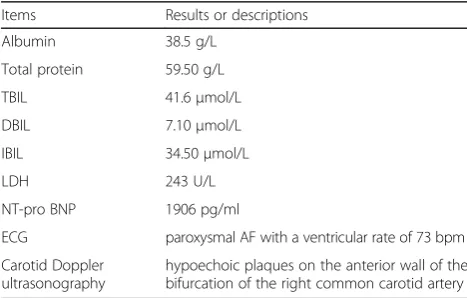
On the second day of admission, routine laboratory studies revealed otherwise unremarkable results, includ-ing PT 22.70 s, PT% 36, albumin 38.5 g/L, total protein 59.50 g/L, TBIL 41.6 μmol/L, DBIL 7.10 μmol/L, IBIL 34.50μmol/L, LDH 243 U/L, and NT-pro BNP 1906 pg/ ml. ECG showed paroxysmal AF with a ventricular rate of 73 bpm. Carotid Doppler ultrasonography showed hypoechoic plaques on the anterior wall of the bifur-cation of the right common carotid artery (Table1).
The intravenous valproate sodium was discontinued at 44 h after admission, and a total dosage of which was approximately 2200 mg. Although seizure ceased from the start of VPA infusion, 18 h of video-monitoring elec-troencephalogram (EEG) commenced 5 h later. This demonstrated global interictal θ waves (4-7 Hz), but without epileptiform discharges.
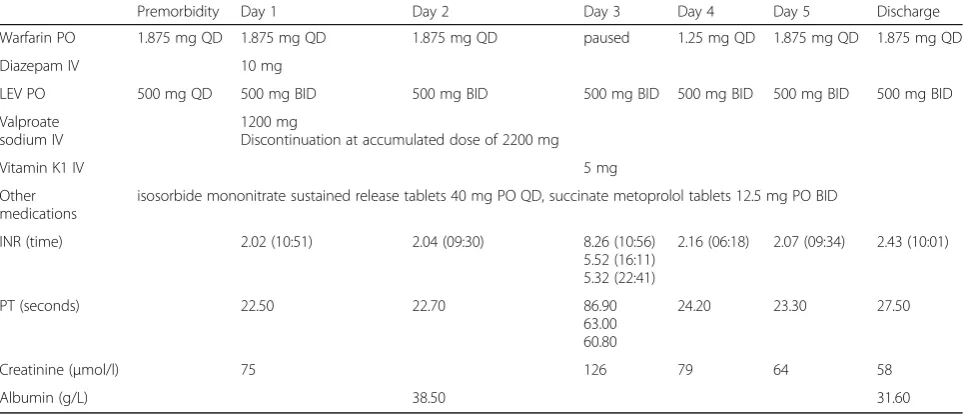
On the 3rd hospital day, the patient developed a renal dysfunction based on the results of BUN 13.74 mmol/l and serum creatinine 126 μmol/l, which was attributed to insufficient fluid intake. Coinciden-tally, the INR was found to be 8.26, and INR 9 h later was 5.52. Oral warfarin was paused but was mistakenly given again 6 h later by a caregiver. A third INR re-vealed an almost identical value of 5.32. Following consultation with a hematologist, 5 mg of vitamin K1 was given intravenously and the INR 8 h later was 2.16. The patient remained asymptomatic and without evident bleeding. A repeat brain CT scan revealed no intracranial hemorrhage. The renal dysfunction was corrected on the 4th day. The repeat BUN and serum creatinine were 9.33 mmol/l and 79 μmol/l, respect-ively. Based on the observation of an INR of 2.16, warfarin was carefully restarted with a dose of 1.25 mg and titrated back to 1.875 mg with steady
monitoring of the INR to ensure a value between 2 and 3 (Table 2).
Discussion and conclusion
Prior to this case, we had noted that warfarin could interact with many AEDs, such as carbamazepine, phenytoin, and others. The theoretical drug-drug inter-action between warfarin and VPA has been hypothesized and previously proposed [3, 4], but the real-world inter-action between these two drugs has been scarcely dis-cussed. Previously, Yoon et al. reported a similar case of an unexpected and substantial increase of INR due to the co-administration of valproate and warfarin [5]. Interestingly, both Yoon et al. and our study share the similarity that both of the patients were coincidently given LEV, either orally or intravenously. The mechan-ism of action of LEV appears to involve neuronal bind-ing to synaptic vesicle protein 2A, inhibitbind-ing calcium release from intraneuronal vesicles and N-type calcium channels [6]. The metabolism of LEV is mostly inde-pendent of the CYP enzyme system, and LEV is neither an inducer nor inhibitor of these enzymes [6, 7]. In addition, LEV at a dose of 2000 mg/d does not affect the pharmacokinetics of warfarin [8]. In short, an interaction between LEV and warfarin seems unlikely, although we cannot entirely exclude any synergistic effects of LEV and VPA on warfarin or the potentiation of LEV regard-ing the interaction between VPA and warfarin. Except for VPA and warfarin, the only medications administered to the patient during this admission were intravenous di-azepam, oral levetiracetam, isosorbide mononitrate sus-tained release tablets and succinate metoprolol tablets. No clinical-relevant interactions between warfarin and these medications have been documented or identified in the literature or drug interaction database. Import-antly, no other medications, in particular vasoactive drugs, proton pump inhibitors or antibiotics were ad-ministered immediately before or during hospitalization.
Warfarin is composed of two racemic active forms, R-enantiomers and S-enantiomers, serum depletion and metabolism of which largely depends on hepatic en-zymes [9, 10]. R-isomers are 2–5 times less potent than their S-isomer counterparts [11]. More specifically, in-activation and metabolism of R-enantiomers occur via CYP1A2 and CYP3A4, while that of S-enantiomers occur via CYP2C9 [12]. Inducers or inhibitors of these enzymes may influence the metabolism of warfarin and, thereafter, its blood concentration. For instance, amioda-rone is a CYP2C9 inhibitor that can enhance warfarin’s anticoagulation effect [13], and carbamazepine is an CYP2C9 inducer that reduces its anticoagulant effect [14]. Likewise, VPA is an inhibitor of CYP2C9, uridine diphosphate glucuronosyltransferase, and epoxide hydro-lase [15]. Presumably, activity of the CYP2C9 enzyme is Table 1Abnormal laboratory results on Day 2
Items Results or descriptions
Albumin 38.5 g/L
Total protein 59.50 g/L
TBIL 41.6μmol/L
DBIL 7.10μmol/L
IBIL 34.50μmol/L
LDH 243 U/L
NT-pro BNP 1906 pg/ml
ECG paroxysmal AF with a ventricular rate of 73 bpm
Carotid Doppler ultrasonography
inhibited by VPA, and as a result, S-warfarin inactiva-tion is lessened and its serum concentrainactiva-tion is ac-cordingly increased. However, why intravenous rather than oral administration of valproate has this effect remains elusive.
This influence of CYP inhibitors on the metabolism of warfarin usually initiates within 24 h after addition of the inhibitor, but the time to maximal affect de-pends on the time at which both interacting drugs reach their steady state [15]. Although warfarin has an average half-life of 40 h [9], based on our observa-tion in this case, the interacobserva-tion between valproate and warfarin may be transient, since the INR value decreased dramatically from 8.26 to 5.52 within 8 h without any intervention.
Given that intravenous VPA is more than 85% protein bound and oral warfarin is 95% protein bound at thera-peutic concentrations [16, 17], displacement of warfarin from its protein binding sites and subsequent redistribu-tion may also account for their interacredistribu-tion [15, 18, 19]. In this regard, Rolan PE et al. proposed that intravenous agents with high protein-binding rates, high hepatic extraction ratios, and narrow therapeutic windows may exhibit clinically significant interactions by way of com-petitive displacement [19].
Impaired renal function, in particular chronic kidney disease, is associated with increased bleeding risk in older adults using warfarin [20–22]. Although specific mechanisms are not well understood, animal studies suggest that downregulation of cytochrome enzymes may alter the pharmacokinetics of warfarin in the presence of renal dysfunction [23, 24]. Specifically for this patient, hypoalbuminemia may also increase levels of unbound warfarin, INR and bleeding risk [25, 26]. According to a
cross-sectional analysis, Limdi NA and colleagues suggested a 9.5% and 19% lower dose of warfarin, respectively for patients with the estimated glomerular filtration rate (eGFR) of 30–59 mL/min/1.73 m2and eGFR < 30 mL/ min/1.73 m2[27].
Therapeutic drug monitoring can be particularly help-ful in AED-treated elderly patients with conditions such as renal/liver disease or low albumin concentrations, trading off between seizure control and adverse effects [28–32]. Specifically for this patient, detection of high serum concentrations of VPA may account for, at least partly, the abovementioned competitive displacement of protein-binding sites or inhibition of CYP2C9 enzyme with warfarin. However, because VPA is a highly and sat-urable protein binding drug with 30% of free fraction at a concentration of 150 mg/L [30, 33], measurement of protein unbound VPA instead may reflect the true levels of its free components. In fact, measurement of un-bound concentrations for highly protein un-bound AEDs such as VPA and phenytoin (i.e., > 90%) has been in-creasingly recommended [30–32, 34]. Unfortunately, neither total nor unbound concentration of VPA was ex-amined in this patient due to guardian’s disconsent.
VPA is effective for treating focal and generalized epi-lepsies with well-established tolerability. An injectable formulation has been available since 1993, and the most commonly effective doses for treating SE vary be-tween 15 and 45 mg/kg in bolus (6 or 10 mg/kg/min) followed by 1–3 mg/kg/h infiltration [35–39]. The most reported adverse effects of intravenous VPA is dizziness, thrombocytopenia, and hypotension [38].
Comorbidity has been increasingly noted among older individuals newly diagnosed with epilepsy. Of 259 pa-tients on oral VPA in a registry, 29% had AF, 36% were Table 2Medications and changes of key laboratory abnormalities
Premorbidity Day 1 Day 2 Day 3 Day 4 Day 5 Discharge
Warfarin PO 1.875 mg QD 1.875 mg QD 1.875 mg QD paused 1.25 mg QD 1.875 mg QD 1.875 mg QD
Diazepam IV 10 mg
LEV PO 500 mg QD 500 mg BID 500 mg BID 500 mg BID 500 mg BID 500 mg BID 500 mg BID
Valproate sodium IV
1200 mg
Discontinuation at accumulated dose of 2200 mg
Vitamin K1 IV 5 mg
Other medications
isosorbide mononitrate sustained release tablets 40 mg PO QD, succinate metoprolol tablets 12.5 mg PO BID
INR (time) 2.02 (10:51) 2.04 (09:30) 8.26 (10:56)
5.52 (16:11) 5.32 (22:41)
2.16 (06:18) 2.07 (09:34) 2.43 (10:01)
PT (seconds) 22.50 22.70 86.90
63.00 60.80
24.20 23.30 27.50
Creatinine (μmol/l) 75 126 79 64 58
Albumin (g/L) 38.50 31.60
receiving warfarin for various reasons [1] and import-antly, 19% of enzyme-inducing AED users reported concomitant usage of warfarin. Besides the INR en-hancement we described in this case, VPA may also cause thrombocytopenia and further impair platelet aggregation [40]. Therefore, when physicians decide to start VPA, particularly intravenously, in patients who are simultaneously on warfarin, caution should be taken and the INR should be closely monitored. Opti-mally, from our point of view, concurrent use of warfarin and intravenous VPA should be avoided, either by replacing warfarin with new oral anticoagu-lants (NOACs) or substituting intravenous VPA with benzodiazepines, such as lorazepam or diazepam. The efficacy of intravenous diazepam for controlling gener-alized convulsive status epilepticus is not different than that of VPA, despite its potentiation in regard to respiratory depression or hypotension [35,41].
In conclusion, we reported an AF patient on oral war-farin presenting with SE and the intravenous VPA was used to control the epileptic seizures. We observed a sig-nificant INR level elevation in this patient. We conclude that intravenous VPA and the co-administrated warfarin may have clinically important implications due to effects on the function of hepatic enzymes and displacement of protein binding sites.
Abbreviations
AEDs:Antiepileptic drugs; AF: Atrial fibrillation; BID: Twice daily; BNP: Brain natriuretic peptide; CT: Computerized tomography; CYP: Cytochrome P450; DBIL: Direct bilirubin; EEG: Electroencephalogram; eGFR: Estimated
glomerular filtration rate; GTCS: Generalized tonic clonic seizures; IBIL: Indirect bilirubin; INR: International normalized ratio; LDH: Lactate dehydrogenase; LEV: Levetiracetam; NOACs: New oral anticoagulants; PO: By mouth; PT: Prothrombin time; QD: Once daily; SE: Status epilepticus; TBIL: Total bilirubin; VPA: Valproic acid
Acknowledgements
We thank Dr. Morgan Tucker and Professor Malcolm Horne for English editing and constructive suggestions.
Funding
This work was supported by Liaoning Provincial Natural Science Foundation (ID 2015020547), China Postdoctoral Science Foundation (ID 2015 M581375) and National Natural Science Foundation of China (ID81371395) to Dr. Yi Sui. There was no role of the funding bodies in the design of the study and collection, analysis and interpretation of data as well as in writing the manuscript.
Availability of data and materials
The datasets supporting the conclusions of this article are included within the article and its additional files.
Authors’contributions
Study conception and design: YS, CZ, WZ, BX and CD. Acquisition, analysis, or interpretation of data: YS, WZ, CD, LR, PS and BX. Manuscript preparation: YS, CZ, WZ, and CD. Critical revision of the manuscript for important intellectual content: YS, BX and XS. Study supervision: YS. All authors have read and approved the final version of the manuscript.
Ethics approval and consent to participate
This study was approved by the ethical review committee of Shenyang First
People’s Hospital, Shenyang Brain Institute, Shenyang Medical College
Affiliated Shenyang Brain Hospital.
Consent for publication
Written consent to publish all the personal and medical details included in the case report, as well as the accompanying laboratory data was obtained by the patient.
Competing interests
The authors declare that they have no competing interests.
Publisher’s Note
Springer Nature remains neutral with regard to jurisdictional claims in published maps and institutional affiliations.
Author details
1Department of Neurology, The Fifth Affiliated Hospital of Zhengzhou University, Zhengzhou, China.2Department of Neurology, Shenyang First People’s Hospital, Shenyang Brain Institute, Shenyang Medical College Affiliated Shenyang Brain Hospital, Shenyang, China.3Department of Diagnostic Sonography, Shenyang First People’s Hospital, Shenyang Brain Institute, Shenyang Medical College Affiliated Shenyang Brain Hospital, Shenyang, China.4Department of Neurology, the Fourth Affiliated Hospital, China Medical University, Shenyang, China.
Received: 4 July 2018 Accepted: 26 September 2018
References
1. Bruun E, Virta LJ, Kalviainen R, Keranen T. Co-morbidity and clinically significant
interactions between antiepileptic drugs and other drugs in elderly patients
with newly diagnosed epilepsy. Epilepsy Behav. 2017;73:71–6.
2. Patsalos PN, Perucca E. Clinically important drug interactions in epilepsy:
general features and interactions between antiepileptic drugs. Lancet
Neurol. 2003;2(6):347–56.
3. Guthrie SK, Stoysich AM, Bader G, Hilleman DE. Hypothesized interaction
between valproic acid and warfarin. J Clin Psychopharmacol. 1995;15(2):138–9.
4. Stephen LJ. Drug treatment of epilepsy in elderly people: focus on valproic
acid. Drugs Aging. 2003;20(2):141–52.
5. Yoon HW, Giraldo EA, Wijdicks EF. Valproic acid and warfarin: an
underrecognized drug interaction. Neurocrit Care. 2011;15(1):182–5.
6. Lyseng-Williamson KA. Levetiracetam: a review of its use in epilepsy. Drugs.
2011;71(4):489–514.
7. Patsalos PN. Clinical pharmacokinetics of levetiracetam. Clin Pharmacokinet.
2004;43(11):707–24.
8. Ragueneau-Majlessi I, Levy RH, Meyerhoff C. Lack of effect of repeated
administration of levetiracetam on the pharmacodynamic and
pharmacokinetic profiles of warfarin. Epilepsy Res. 2001;47(1–2):55–63.
9. Mega JL, Simon T. Pharmacology of antithrombotic drugs: an assessment of
oral antiplatelet and anticoagulant treatments. Lancet. 2015;386(9990):281–91.
10. Bachawati M. Anticoagulation and psychotropic medications. Curr
Psychiatry Rep. 2010;12(3):265–71.
11. Hirsh J, Fuster V, Ansell J, Halperin JL, American Heart A, American College of
Cardiology F. American Heart Association/American College of Cardiology
Foundation guide to warfarin therapy. Circulation. 2003;107(12):1692–711.
12. Kaminsky LS, Zhang ZY. Human P450 metabolism of warfarin. Pharmacol
Ther. 1997;73(1):67–74.
13. Heimark LD, Wienkers L, Kunze K, Gibaldi M, Eddy AC, Trager WF, et al. The
mechanism of the interaction between amiodarone and warfarin in
humans. Clin Pharmacol Ther. 1992;51(4):398–407.
14. Freedman MD, Olatidoye AG. Clinically significant drug interactions with the
oral anticoagulants. Drug Saf. 1994;10(5):381–94.
15. Anderson GD. A mechanistic approach to antiepileptic drug interactions.
Ann Pharmacother. 1998;32(5):554–63.
16. Cloyd JC, Dutta S, Cao G, Walch JK, Collins SD, Granneman GR. Valproate
unbound fraction and distribution volume following rapid infusions in
17. Nadkarni A, Oldham MA, Howard M, Berenbaum I. Drug-drug interactions between warfarin and psychotropics: updated review of the literature.
Pharmacotherapy. 2012;32(10):932–42.
18. Sellers EM, Koch-Weser J. Kinetics and clinical importance of displacement of
warfarin from albumin by acidic drugs. Ann N Y Acad Sci. 1971;179:213–25.
19. Rolan PE. Plasma protein binding displacement interactions—why are they
still regarded as clinically important? Br J Clin Pharmacol. 1994;37(2):125–8.
20. Jun M, James MT, Manns BJ, Quinn RR, Ravani P, Tonelli M, et al. The
association between kidney function and major bleeding in older adults with atrial fibrillation starting warfarin treatment: population based observational study. BMJ. 2015;350:h246.
21. Dahal K, Kunwar S, Rijal J, Schulman P, Lee J. Stroke, major bleeding, and
mortality outcomes in warfarin users with atrial fibrillation and chronic kidney disease: a meta-analysis of observational studies. Chest. 2016;
149(4):951–9.
22. Olesen JB, Lip GY, Kamper AL, Hommel K, Kober L, Lane DA, et al. Stroke
and bleeding in atrial fibrillation with chronic kidney disease. N Engl J Med.
2012;367(7):625–35.
23. Nolin TD. Altered nonrenal drug clearance in ESRD. Curr Opin Nephrol
Hypertens. 2008;17(6):555–9.
24. Dreisbach AW, Lertora JJ. The effect of chronic renal failure on drug
metabolism and transport. Expert Opin Drug Metab Toxicol. 2008;4(8):
1065–74.
25. Ganeval D, Fischer AM, Barre J, Pertuiset N, Dautzenberg MD, Jungers P,
et al. Pharmacokinetics of warfarin in the nephrotic syndrome and effect on vitamin K-dependent clotting factors. Clin Nephrol. 1986;25(2):
75–80.
26. Abdelhafiz AH, Myint MP, Tayek JA, Wheeldon NM. Anemia,
hypoalbuminemia, and renal impairment as predictors of bleeding complications in patients receiving anticoagulation therapy for nonvalvular
atrial fibrillation: a secondary analysis. Clin Ther. 2009;31(7):1534–9.
27. Limdi NA, Limdi MA, Cavallari L, Anderson AM, Crowley MR, Baird MF, et al.
Warfarin dosing in patients with impaired kidney function. Am J Kidney Dis.
2010;56(5):823–31.
28. Wallenburg E, Klok B, de Jong K, de Maat M, van Erp N,
Stalpers-Konijnenburg S, et al. Monitoring protein-unbound Valproic acid serum
concentrations in clinical practice. Ther Drug Monit. 2017;39(3):269–72.
29. Patsalos PN, Spencer EP, Berry DJ. Therapeutic drug monitoring of
antiepileptic drugs in epilepsy: a 2018 update. Ther Drug Monit. 2018;40:
526–48.
30. Patsalos PN, Zugman M, Lake C, James A, Ratnaraj N, Sander JW. Serum
protein binding of 25 antiepileptic drugs in a routine clinical setting: a comparison of free non-protein-bound concentrations. Epilepsia. 2017;58(7):
1234–43.
31. Farrokh S, Tahsili-Fahadan P, Ritzl EK, Lewin JJ 3rd, Mirski MA. Antiepileptic
drugs in critically ill patients. Crit Care. 2018;22(1):153.
32. Landmark CJ, Johannessen SI, Tomson T. Dosing strategies for antiepileptic
drugs: from a standard dose for all to individualised treatment by implementation of therapeutic drug monitoring. Epileptic Dis. 2016;18(4):
367–83.
33. Patsalos PN, Berry DJ, Bourgeois BF, Cloyd JC, Glauser TA, Johannessen SI,
et al. Antiepileptic drugs—best practice guidelines for therapeutic drug
monitoring: a position paper by the subcommission on therapeutic drug monitoring, ILAE commission on therapeutic strategies. Epilepsia. 2008;49(7):
1239–76.
34. Stepanova D, Beran RG. The benefits of antiepileptic drug (AED) blood level
monitoring to complement clinical management of people with epilepsy.
Epilepsy Behav. 2015;42:7–9.
35. Prasad M, Krishnan PR, Sequeira R, Al-Roomi K. Anticonvulsant therapy for
status epilepticus. Cochrane Database Syst Rev. 2014;(9):Cd003723.
36. Mundlamuri RC, Sinha S, Subbakrishna DK, Prathyusha PV, Nagappa M,
Bindu PS, et al. Management of generalised convulsive status epilepticus (SE): a prospective randomised controlled study of combined treatment with intravenous lorazepam with either phenytoin, sodium valproate or
levetiracetam—pilot study. Epilepsy Res. 2015;114:52–8.
37. Dutta S, Faught E, Limdi NA. Valproate protein binding following rapid
intravenous administration of high doses of valproic acid in patients with
epilepsy. J Clin Pharm Ther. 2007;32(4):365–71.
38. Trinka E, Hofler J, Zerbs A, Brigo F. Efficacy and safety of intravenous
valproate for status epilepticus: a systematic review. CNS Drugs. 2014;
28(7):623–39.
39. Visudtibhan A, Bhudhisawadi K, Vaewpanich J, Chulavatnatol S, Kaojareon S.
Pharmacokinetics and clinical application of intravenous valproate in Thai
epileptic children. Brain Dev. 2011;33(3):189–94.
40. Nasreddine W, Beydoun A. Valproate-induced thrombocytopenia: a
prospective monotherapy study. Epilepsia. 2008;49(3):438–45.
41. Chen WB, Gao R, Su YY, Zhao JW, Zhang YZ, Wang L, et al. Valproate versus
diazepam for generalized convulsive status epilepticus: a pilot study. Eur J