Original Article
Reliability and validity of the Iranian version of the human immunodeficiency virus specific World Health Organization quality of life BREF questionnaire
Zahra Nikooseresht1, Shahnaz Rimaz1*, Mohsen Asadi-Lari2, Saharnaz Nedjat3, Effat Merghati-Khoee4, Nargess Saiepour5
1 Department of Epidemiology & Biostatistics, School of Public Health, Tehran University of Medical Sciences, Tehran, Iran 2 Department of Epidemiology & Biostatistics, School of Public Health, Oncopathology Research Centre, Tehran University of Medical Sciences, Tehran, Iran
3 Department of Epidemiology & Biostatistics, School of Public Health, Knowledge Utilization Research Center, Tehran University of Medical Sciences, Tehran, Iran
4 Iranian National Center of Addiction Studies (INCAS), Institution of Risk Reduction, Tehran, Iran AND Department of Psychiatry and Behavioral Sciences, Medical University of South Carolina (MUSC), USA
5 Department of Epidemiology & Biostatistics, School of Public Health, Tehran University of Medical Sciences, Tehran, Iran AND School of Public Health, University of Queensland, Queensland, Australia
ARTICLE INFO ABSTRACT
Received 07.04.2014 Revised 21.07.2014 Accepted 07.09.2014 Published 20.2.2015
Available online at: http://jbe.tums.ac.ir
Background & Aim: Quality-of-life (QOL) among human immunodeficiency virus (HIV)-infected
people has been the center of focus worldwide. The World Health Organization QOL Group (WHOQOL Group) has developed a 31-item QOL questionnaire, which has been translated and used in many countries. This paper aimed at examining the reliability and validity of Persian version of HIV specific WHOQOL scaleBREF questionnaire (WHOQOL-HIV BREF) in Iranian patients suffering from HIV/acquired immunodeficiency syndrome (AIDS) .
Methods & Materials: For the purpose of this cross-sectional study, a standard “
forward-backward” translation and cognitive debriefing were initially applied. Subsequently, 150 people living with HIV/AIDS visitingTertiary Referral Consultation Center for clients with risky behaviors in Tehran completed the Persian version of the questionnaire. Validity was assessed using Known Group Comparison through ANOVA test. Internal reliability was measured by Cronbach 's alpha and Split-Half coefficients.
Results: WHOQOL-HIV BREF was capable to discriminate between two groups who were
different in their QOL (P< 0.05). Internal consistency analysis was satisfactory for domains (Cronbach’s alpha =0.64- 0.85), and whole the instrument (Cronbach's alpha=0.93) .
Conclusion: The Persian version of WHOQOL-HIV BREF is a reliable and valid instrument to
assess the QOL among Iranian HIV-infected population. Key words:
quality-of-life, human
immunodeficiency virus, acquired
immunodeficiency syndrome, reliability, validity, Iran,
HIV specific World Health Organization quality-of-life scale BREF questionnaire
Introduction1
Advances in diagnosis and remedies for those
* Corresponding Author: Shahnaz Rimaz, Postal Address:
Department of Epidemiology & Biostatistics, School of Public Health, Tehran University of Medical Sciences, Tehran, Iran. Email: [email protected]
discrimination, and marginalization, which will lead to serious physical, mental, and social problems (1-3).The World Health Organization (WHO) defines QOL as: individuals’ perceptions of their position in life in the context of the culture and value system in which they live and in relation to their goals, expectations, standards, and concerns (4). Symptoms may be related to the infection, comorbidity, complications, or medications side-effects. Moreover, the disease may not limit to physical ill-health, rather it causes further socio-economic problems for individuals, families, communities, and governments in many countries (5).
Patients suffering from HIV/AIDS struggle with numerous social, emotional and cultural problems such as stigma, sexual health, poverty, depression, social dysfunction, substance abuse, and cultural beliefs.Thismay affect different aspects of their QOL including their activities, physical roles, emotional roles,and interests. Therefore, a comprehensive tool to measure various aspects of health-related QOLis required. Although a number of tools (general and specific) have been introduced, measurement of QOL amongst these people is challenging due to the complexity of experiences, which affect their daily lives. WHOQOLBREF -similar to other generic health-related QOL tools- generally assesses and compares the QOL among both sick and healthy people (6-8). The HIV specific WHOQOL scale BREF questionnaire (WHOQOL-HIV BREF) was developed by the WHOQOL Group as a specific tool to measureQOL in HIV-infected people. This questionnaire has been translated into differentlanguages and validated cross-culturally among HIV/AIDS patients (7, 9-15). The original comprehensive version of WHOQOL-HIV includes 120 detailed questions, which has been recently administered in a different setting in Iran (16), while it may be criticized for the length and therefore, high burden on respondents.
The estimated number of people living with HIV/AIDS in Iran was over 80,000 in 2010 (17), while this figure has an upward trend in the past decade (18) with a major shift from substance
abuse-induced to sexually transmitted in recent years. Despite the magnitude of the HIV-induced health, little has been done concerning their health-related QOL to add life to years. Main reasons for this gap include the nature of highly stigmatized and isolated, priority given to treatment and preventive related issues, and lack of an appropriate and easy-to-useinstrument to measure their QOL for Iranian patients. This study aims at reporting the psychometric properties of Farsi version of WHOQOL-HIV BREF in Iranian HIV/AIDS population.
Methods
Participants
To conduct this cross-sectional study,we collected the sample of people living with HIV (n = 150)and visiting the Imam Khomeini Hospital consultation center for patients with behavioral disorders in Tehran during September to November 2011. Patients who met the below criteria were includedforthe study: (1) HIV positive, (2) registered at the consulting clinic, (3) aged more than 18 years, and (4) lack of cognitive, communicative disabilities or psychotic disorders. There was no limitation for the stage or length of the disease; i.e., patientswere recruited regardless the stage and duration of HIV/AIDS infection.
Ethical approval for the study was obtained from Tehran University of Medical Sciences.A written informed consent was duly obtained from recruited patients to ensure the confidentiality of all data. Both questions and answers were read out to patients, and the questionnaire was administered by a trained administrator.
Questionnaire
questioned (20). There are fourquestions designed for each domain except in psychological and environment which had 5 and 8 questions respectively. There are two items that examine general QOL was also included. Question 1 asks about an individuals' overall perception of QOL and question 2 deals with an individuals' overall perception of his or her health (15).
Each item is rated on a 5-point Likert-type scale where 1 indicates low as negative perception and 5 indicates high as positive perception. As such, domain scores are scaled in a positive direction where higher scores denote higher QOL. Questions 3- 5, 8- 10, and 31 are in the contrary direction, whichare not scaled in a positive direction meaning that for these domains high scores do not denote higher QOL.These need to be recorded so that high scores reflect better QOL. The mean score of items within each domainis used to calculate the domain score. Then, mean scores are multiplied by 4, so that domain scores range between 4 and 20 (20).
Translating and assessing the linguistic validity
Forward- backward translation and cognitive debriefing was employed to translate and assess the linguistic validity. The questionnaire was first translated from English to Farsi by two translators, who are masters both in English and Farsi languages, separately and at the same time. Each translator individually translated the questionnaire into Persian and the first Persian version was prepared through different discussions, modifying the discrepancies and receiving the experts' final approval. Then, the Persian version of the questionnaire was translated from Persian to English by a fluent bilingual master wherethe new English version was compared with the original one (reverse translating method), to ensure the accuracy of the translated phrases.
Following that, the Persian version was administeredin a pilot study with 20 HIV adults who had been referred toImam Khomeini Hospital consultation center for patients with behavioral disorders. The Persian questionnaire was administered by a trained interviewer who confirmed with the patients to declare items
which may be unclear or ambiguity. The main goal of this section was to clarifyfirst the understandability of the questions as intendedand secondto identify the possible discrepancies between participants regarding the same questions. Following this step and after necessary modifications, the final Persian version of the questionnaire was acquired.
Experts interviews were performed to verify face validity in addition to known group comparison to assess construct validity. According to this method, the participants were first divided into two groups based on dichotomous responses (very good and very bad) to the first question of the questionnaire as: The overall perception of QOL, and very dissatisfied or very satisfied responses they gave to the second question as: The overall perception of their health. Following that, both groups' scores of the whole questionnaire and sixdomainswere compared (21, 22).
A complementary questionnaire was also designed to record demographic data such as age, gender, occupational status, level of education, marital status, economic status, years since diagnosis, clinical category, and the mode of transmission. To analyze the data, descriptive tests, contingency tables, and analysis of variance were done with SPSS-18 software.
Results
Out of the150 patients living with HIV/AIDS who participated in the study, 78 (52%) were male, mean age was 34.2 ± 7.3 years, 59% were
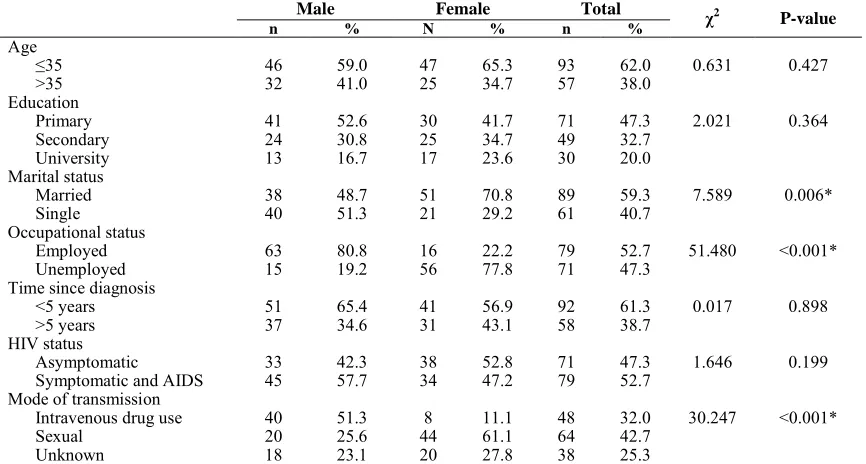
married, less than half had only completed primary school, and almost half were employed. Majority of the patients were aware of their disease during the past 5 years and almost half of them were symptomatic or had diagnosed as AIDS. Unprotected sexual intercourse was found as the most common mode of transmission (42.7%), followed by intravenous drug use (32%). Intravenous drug useprevailed more in men (51.3%), while sexual transmission was found more in women (61.1%). Table 1 shows demographic and disease-related characteristics of the respondents.
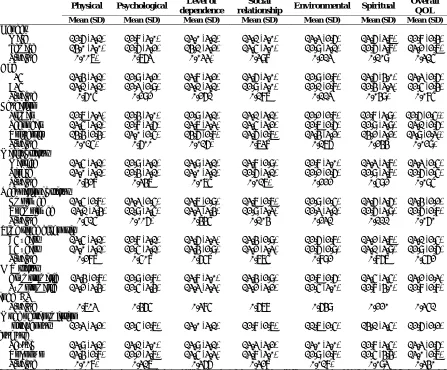
physical (P < 0.01) and level of independence (P < 0.05) domains. Patients older than 35 years had lower scores in spiritual domain (P < 0.05). Patients who had not graduated from high school had significantly lower scores in overall QOL (P < 0.05), physical (P = 0.01) and level of independence (P = 0.016) compared with university educated participants. Married patients showed better QOL in respect to social relationship (P = 0.01) compared withsingle patients. Unemployed patients had lower scores in psychological (P < 0.01) domain compared to their employed counterparts. Duration of the disease/exposure did not show any significant relation with different domains of QOL. QOL did not differ between HIV-positive and AIDS patients. Participants who were infected through drug injection had lower scores in physical (P < 0.01) and environmental (P = 0.01) domains when compared withthose who had unprotected sexual contact. Table2 shows QOL scores by demographic and disease-related characteristics.
Validity
Face and content validity were assessed and confirmed through expert interviewsas they had sufficient experience in QOL research. To
measure construct validity, known group analysis was conducted, where various options in the first two questions were augmented into two, then total QOL score was compared according to the new two-scale questions. ANOVA showed significant differences in all domains regarding the responses given to the first question, whether verygood or verybadand responses given to the second question whether very satisfied or very dissatisfied. Table3 shows more details of ANOVA, which reflects known group analysis.
Reliability
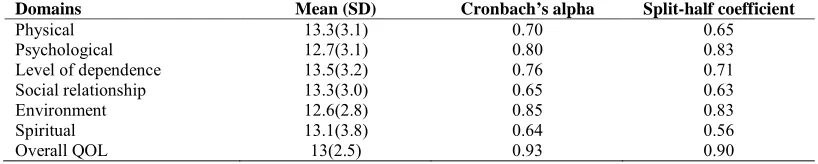
Cronbach’s alpha coefficient was 0.6- 0.85 for different domains of WHOQOL-HIV BREF (Farsi version) and 0.93 for the whole questionnaire. Reliability coefficients for social relationships and spiritual domains were < 0.70. Omission ofa question regarding satisfying with sex life left a slight impact on alpha coefficient and increased it from 0.65 to 0.67.To investigate reliability by split-half method, we calculated the coefficients < 0.70 for three physical, social relationships, and spiritual domains, and > 0.70 for other domains and for the whole questionnaire. Table4 shows the results concerning the reliability.
Table 1.Demographic and disease-related characteristics of total sample (n=150)
Male Female Total
χ2 P-value
n % N % n %
Age
≤35 46 59.0 47 65.3 93 62.0 0.631 0.427
>35 32 41.0 25 34.7 57 38.0
Education
Primary 41 52.6 30 41.7 71 47.3 2.021 0.364
Secondary 24 30.8 25 34.7 49 32.7
University 13 16.7 17 23.6 30 20.0
Marital status
Married 38 48.7 51 70.8 89 59.3 7.589 0.006*
Single 40 51.3 21 29.2 61 40.7
Occupational status
Employed 63 80.8 16 22.2 79 52.7 51.480 <0.001*
Unemployed 15 19.2 56 77.8 71 47.3
Time since diagnosis
<5 years 51 65.4 41 56.9 92 61.3 0.017 0.898
>5 years 37 34.6 31 43.1 58 38.7
HIV status
Asymptomatic 33 42.3 38 52.8 71 47.3 1.646 0.199
Symptomatic and AIDS 45 57.7 34 47.2 79 52.7 Mode of transmission
Intravenous drug use 40 51.3 8 11.1 48 32.0 30.247 <0.001*
Sexual 20 25.6 44 61.1 64 42.7
Unknown 18 23.1 20 27.8 38 25.3
Table 2. Comparison of mean scores of QOL according to demographic and disease-related characteristics (n=150)
Physical Psychological Level of dependence
Social
relationship Environmental Spiritual
Overall QOL Mean (SD) Mean (SD) Mean (SD) Mean (SD) Mean (SD) Mean (SD) Mean (SD)
Gender
Male 12.6 (3.1) 12.8 (3.0) 13.0 (3.1) 13.1 (3.0) 13.3 (2.6) 13.6 (3.7) 12.8 (2.4) Female 14.0 (3.0) 12.6 (3.2) 14.1 (3.2) 13.5 (3.0) 12.9 (3.1) 12.6 (3.8) 13.2 (2.7)
P-value 0.007* 0.763 0.033* 0.398 0.213 0.109 0.315
Age
≤35 13.4 (3.1) 12.9 (3.2) 13.8 (3.2) 13.6 (3.0) 12.9 (2.8) 13.6 (4.0) 13.3 (2.6)
>35 13.1 (3.1) 12.3 (2.9) 13.1 (3.1) 12.9 (3.0) 12.1 (2.8) 12.4 (3.3) 12.5 (2.4)
P-value 0.605 0.292 0.261 0.187 0.113 0.049* 0.085
Education
Primary 12.7 (3.3) 12.4 (3.0) 12.9 (3.1) 13.1 (3.1) 12.2 (2.8) 12.8 (3.9) 12.6 (2.5)* Secondary 13.5 (3.1) 12.8 (3.6) 13.7 (3.3) 13.5 (3.2) 12.7 (2.6) 12.9 (3.9) 13.1 (2.6) University 14.4 (2.4) 13.0 (2.5) 14.6 (2.8) 13.6 (2.7) 13.4 (3.2) 14.2 (3.2) 13.9 (2.3)*
P-value 0.015* 0.600 0.016* 0.738 0.176 0.244 0.029*
Marital status
Married 13.5 (3.1) 12.9 (3.1) 13.9 (3.1) 13.8 (2.9) 12.8 (3.0) 13.3 (3.8) 13.3 (2.5) Single 13.0 (3.1) 12.4 (3.1) 13.0 (3.1) 12.6 (3.1) 12.2 (2.6) 12.9 (3.8) 12.6 (2.5)
P-value 0.428 0.347 0.075 0.017* 0.222 0.592 0.095
Occupational status
Employed 13.5 (2.8) 13.3 (2.5) 13.7 (2.9) 13.7 (2.7) 12.9 (2.5) 13.6 (3.6) 13.4 (2.2) Unemployed 13.1 (3.4) 11.9 (3.5) 13.3 (3.4) 12.9 (3.3) 12.3 (3.1) 12.6 (3.9) 12.6 (2.8)
P-value 0.515 0.006* 0.445 0.104 0.231 0.111 0.060
Time since diagnosis
<5 years 13.5 (3.1) 12.8 (3.1) 13.6 (3.3) 13.4 (2.9) 12.6 (2.8) 13.2 (3.7) 13.1 (2.5) >5 years 13.0 (3.1) 12.5 (3.1) 13.4 (2.9) 13.2 (3.3) 12.6 (2.9) 13.1 (3.9) 12.9 (2.6)
P-value 0.287 0.508 0.658 0.775 0.892 0.867 0.562
HIV status
Asymptomatic 13.4 (2.8) 12.9 (2.8) 13.8 (3.0) 13.4 (2.9) 12.7 (2.6) 13.5 (3.5) 13.2 (2.3) Symptomatic
andAIDS 13.2 (3.4) 12.5 (3.4) 13.3 (3.3) 13.2 (3.2) 12.5 (3.0) 12.8 (4.0) 12.8 (2.8)
P-value 0.703 0.465 0.385 0.678 0.649 0.220 0.351
Mode of transmission Intravenous
drug use 12.3 (3.2) 12.5 (2.7) 13.0 (3.1) 12.8 (2.7) 11.7 (2.5) 14.1 (3.5) 12.6 (2.2) Sexual 13.9 (3.1) 13.1 (3.0) 13.9 (3.1) 13.3 (3.2) 13.0 (3.0) 12.8 (3.5) 13.3 (2.6) Unknown 13.4 (2.8) 12.2 (3.7) 13.5 (3.3) 13.8 (3.0) 12.9 (2.8) 12.5 (4.4) 13.0 (2.7)
P-value 0.008* 0.317 0.366 0.328 0.018* 0.093 0.340
*Means differ significantly, P < 0.05.HIV: Human immunodeficiency virus, QOL: Quality of life, AIDS: Acquired immunodeficiency syndrome SD: Standard deviation
Table 3. Comparison of mean scores of QOL according to the responses to questions 1 and 2 (n = 150) Question 1: How would
you rate your QOL?
Very poor Poor Neither poor
nor good
Good Very good P-value
Physical 8.6 ± 1.8 11.8 ± 3.4 13.0 ± 2.6 13.8 ± 2.6 15.9 ± 2.9 <0.001
Psychological 7.2 ± 1.6 8.8 ± 2.3 11.9 ± 2.3 13.7 ± 2.1 15.8 ± 2.1 <0.001
Level of dependence 8.8 ± 2.6 11.1 ± 2.8 12.9 ± 2.7 14.3 ± 2.4 16.3 ± 2.7 <0.001
Social relationship 8.1 ± 2.3 10.6 ± 3.2 12.7 ± 2.2 14.2 ± 2.5 15.7 ± 2.2 <0.001
Environment 7.2 ± 1.7 10.5 ± 2.4 12.0 ± 2.0 13.3 ± 1.8 15.7 ± 2.6 <0.001
Spiritual 9.3 ± 3.5 11.8 ± 2.9 12.6 ± 3.5 14.4 ± 3.5 15.0 ± 3.4 <0.001
Overall QOL 8.0 ± 1.1 10.4 ±1.8 12.5 ± 1.6 13.9 ± 1.6 15.9 ± 2.1 <0.001 Question 2: How satisfied
are you with your health?
Very dissatisfied
Dissatisfied Neither satisfied nor dissatisfied
Satisfied Very satisfied P-value
Physical 9.9± 3.6 10.6 ±3.0 12.9±2.4 14.0 ± 2.6 16.5±3.0 <0.001
Psychological 8.0±2.1 9.1 ± 2.6 12.0 ± 2.2 13.5 ± 2.3 15.7 ± 3.3 <0.001
Level of dependence 11.9± 4.3 10.9± 2.8 12.6 ±2.6 14.2 ±2.7 16.4± 2.8 <0.001
Social relationship 9.3 ± 2.7 12.0 ± 3.1 12.8 ± 2.4 13.6 ± 2.9 15.6 ± 2.9 <0.001
Environment 9.4 ± 3.3 10.6± 2.3 11.8± 2.7 13.2 ± 2.3 15.2 ± 3.4 <0.001
Spiritual 10.8± 2.5 10.0 ± 3.2 12.9 ± 3.6 14.2 ± 3.4 15.5 ± 3.1 <0.001
Table 4.Mean scores of domains, Cronbach’s alpha and split-half coefficient
Domains Mean (SD) Cronbach’s alpha Split-half coefficient
Physical 13.3(3.1) 0.70 0.65
Psychological 12.7(3.1) 0.80 0.83
Level of dependence 13.5(3.2) 0.76 0.71
Social relationship 13.3(3.0) 0.65 0.63
Environment 12.6(2.8) 0.85 0.83
Spiritual 13.1(3.8) 0.64 0.56
Overall QOL 13(2.5) 0.93 0.90
SD: Standard deviation
Discussion
This is the first psychometric report of the Farsi version of a brief tool (WHOQOL-HIV BREF) to measure health-related QOL among HIV/AIDS patients.The Farsi version of WHOQOL-HIV BREF effectively evaluated the QOL among Iranian HIV infected population. The results of validity assessment revealed that the questionnaire has the capability of differentiating groups with different health conditions.
Internal consistency analysis was satisfactory for six domains and the whole questionnaire, which are more than the mother tool (WHOQOL-HIV-120), which had been validated earlier for Farsi language speakers (16). Cronbach’s alpha was estimated 0.67-0.80 in Taiwan (14), 0.60- 0.72 in Sought Africa (12) and 0.51 - 0.80 in Croatia (9) for the whole questionnaire, while it ranged between 0.64 and 0.93 in our experience. The least estimated alpha was for spirituality domain, while in a similar study in Croatia it was reported as 0.68 (9). This domain contains four questions and its low Cronbach's Alpha can be ascribed to the limited number of questions, which containsconceptual questions such as being frightened of future or worried about death.
Reliability coefficient was 0.65 for social relationships domain, which increased to 0.67 after omitting a question concerning satisfying with sexual life. In a similar study performed in South Africa, this coefficient was least for social relationships domain (0.46), while it was 0.60-0.72 for other domains and 0.88 for the whole questionnaire (12). Low reliability of this domain was also reported in other similar studies. In a study performed to assess the validity and reliability of the Persian version of the WHOQOLBREF, reliability coefficient was
reported as 0.55 for social relationships domain among healthy people and 0.52 for those had a chronic disease (19). A cross-cultural study performed by WHO in 23 countries, revealed Cronbach's alpha coefficient < 0.70 for social relationships domain in 16 countries (23). It should be noted that these two instruments comprisethreecommon questions considering social relationships domain and the only point of difference lies in this question as: “ To what extent do you feel accepted by the people you know? which is available in the WHOQOL-HIV BREF instrument, but not in the original tool. The low reliability coefficient for this domain can be attributed to the limited number of questions (fourquestions), and also inclusion of a question in this domain as: How satisfied are you with your sex life? for whichthe respondents felt inconvenient. In another study in Croatia, the reliability coefficient for social relationships domain was 0.80 (9), which was more than the original cross-cultural study (23); this discrepancy may be attributable to cultural differences, where respondents are unwilling to disclose information about their sexual life, therefore necessary changes are warranted concerning data collection about sensitive issues. Differences in reliability coefficient for physical domain are also noticeable; our result (0.7) was more than other reports (9, 14), which could be attributed to respondents' demographic features.
Compared to the Farsi version of its mother tool (WHOQOL-HIV) (16), the abridged questionnaire showed fairly similar construct validity, which weakly helps distinguishing different clinical phases of the disease.
Limitations
Patients referred to this tertiary consulting center were less interested to participate, which in turn led to longertimeframe of this study than expected and despite our plans it was impossible to perform the re-test. Regardless anonymous administration most of the respondents refused to represent the true mode of transmission, which was higher than expected.
Conclusion
This study revealed the Persian version of WHOQOL-HIV BREF is a valid and reliable instrument to assess QOL among Iranian patients infected with HIV and other Persian speaking people. Since the number of questions is limited, it can be easily performed through different studies either clinical or epidemiologic, which makes cross-cultural comparisons possible, and more importantly may be used in routine assessments of patients to improve their general QOL.
Acknowledgments
This study was financially supported by Tehran University of Medical Sciences and also administratively supported by Department of Behavioral Disorders at Imam Khomeini Hospital in Tehran; authors' gratitudeextends to them for their great cooperation through all parts of this study. This study was conductedas MPH thesis of the first author.
References
1. Douaihy A, Singh N. Factors affecting quality of life in patients with HIV infection. AIDS Read 2001; 11(9): 450-1, 475.
2. Goldenberg D, Boyle B. Psychiatry and HIV: Part 2. AIDS Read 2000; 10(4): 201-4. 3. Howland LC, Storm DS, Crawford SL, Ma
Y, Gortmaker SL, Oleske JM. Negative life
events: risk to health-related quality of life in children and youth with HIV infection. J Assoc Nurses AIDS Care 2007; 18(1): 3-11. 4. The World Health Organization Quality of
Life Assessment (WHOQOL): development and general psychometric properties. Soc Sci Med 1998; 46(12): 1569-85.
5. Walker N, Grassly NC, Garnett GP, Stanecki KA, Ghys PD. Estimating the global burden of HIV/AIDS: what do we really know about the HIV pandemic? Lancet 2004; 363(9427): 2180-5.
6. Asadi-Lari M, Tamburini M, Gray D. Patients' needs, satisfaction, and health related quality of life: towards a comprehensive model. Health Qual Life Outcomes 2004; 2: 32.
7. Fan AP, Kuo HC, Kao DY, Morisky DE, Chen YM. Quality of life and needs assessment on people living with HIV and AIDS in Malawi. AIDS Care 2011; 23(3): 287-302.
8. Initial steps to developing the World Health Organization's Quality of Life Instrument (WHOQOL) module for international assessment in HIV/AIDS. AIDS Care 2003; 15(3): 347-57.
9. Belak KS, Vurusic T, Duvancic K, Macek M. Quality of life of HIV-infected persons in Croatia. Coll Antropol 2006; 30(Suppl 2): 79-84.
10. Castro M, Passos S, Mannarino C. WHOQOL-HIV BREF reliability and scores in depressed and non-depressed HIV-positive patients in a specialized outpatient facility in Rio de Janeiro. European Psychiatry 2008; 23(S2): 271.
11. Saddki N, Noor MM, Norbanee TH, Rusli MA, Norzila Z, Zaharah S, et al. Validity and reliability of the Malay version of WHOQOL-HIV BREF in patients with HIV infection. AIDS Care 2009; 21(10): 1271-8. 12. Peltzer K, Friend-du PN, Ramlagan S,
Anderson J. Antiretroviral treatment adherence among HIV patients in KwaZulu-Natal, South Africa. BMC Public Health 2010; 10: 111.
life in women with HIV/AIDS in a municipality in the state of Sao Paulo. Rev Esc Enferm USP 2011; 45(1): 230-6. [In Portuguese].
14. Hsiung PC, Fang CT, Wu CH, Sheng WH, Chen SC, Wang JD, et al. Validation of the WHOQOL-HIV BREF among HIV-infected patients in Taiwan. AIDS Care 2011; 23(8): 1035-42.
15. O'Connell KA, Skevington SM. An international quality of life instrument to assess wellbeing in adults who are HIV-positive: a short form of the WHOQOL-HIV (31 items). AIDS Behav 2012; 16(2): 452-60. 16. Razavi P, Hajifathalian K, Saeidi B, Esmaeeli DG, Rasoulinejad M, Hajiabdolbaghi M, et al. Quality of life among persons with HIV/AIDS in Iran: Internal reliability and validity of an international instrument and associated factors. AIDS Res Treat 2012; 2012: 849406.
17. UNAIDS, HO, NICEF. Epidemiological fact sheets on HIV [Online]. [cited 2010]; Available from: URL:
http://www.unaids.org/en/dataanalysis/knowy ourepidemic/epidemiologicalfactsheets/ 18. Fallahzadeh H, Morowatisharifabad M,
Ehrampoosh MH. HIV/AIDS epidemic features and trends in Iran, 1986-2006. AIDS Behav 2009; 13(2): 297-302.
19. Nedjat S, Montazeri A, Holakouie K, Mohammad K, Majdzadeh R. Psychometric properties of the Iranian interview-administered version of the World Health Organization's Quality of Life Questionnaire (WHOQOL-BREF): a population-based study. BMC Health Serv Res 2008; 8: 61. 20. Pedroso B, Pilatti LA, de Francisco AC, dos
Santos CB. Quality of life assessment in people with HIV: analysis of the WHOQOL-HIV syntax. AIDS Care 2010; 22(3): 361-72. 21. Montazeri A, Vahdaninia M, Mousavi SJ,
Omidvari S. The Iranian version of 12-item Short Form Health Survey (SF-12): factor structure, internal consistency and construct validity. BMC Public Health 2009; 9: 341. 22. Montazeri A, Vahdaninia M, Mousavi SJ,
Asadi-Lari M, Omidvari S, Tavousi M. The 12-item medical outcomes study short form health survey version 2.0 (SF-12v2): a population-based validation study from Tehran, Iran. Health Qual Life Outcomes 2011; 9: 12.