Available Online At www.ijpret.com
INTERNATIONAL JOURNAL OF PURE AND
APPLIED RESEARCH IN ENGINEERING AND
TECHNOLOGY
A PATH FOR HORIZING YOUR INNOVATIVE WORK
OBJECT DETECTION AND RECOGNIZATION BY IMAGE PARSING USING
MATLAB WAVELET TECHNIQUE
SHRIKANT N. SARDA1, PROF. V. K. PATIL2, PROF M.R DHANDE3, PROF. P. P. DESHMUKH4
1. Information Technology P.R.M.I.T. & R. Badnera, India.
2. Dept. Information Technology V.Y.W.S. Polytechnic. Badnera, India.
3. Dept. Computer Technology Dept V.Y.W.S. Polytechnic, India.
4. MCA Dept. P.R.M.I.T. & R. Badnera, India.
Accepted Date:
27/02/2013
Publish Date:
01/04/2013
Keywords
Image parsing,
Image segmentation,
Object detection,
Object recognition,
Canny Edge Detection.
Corresponding Author Mr. Shrikant N. Sarda
Abstract
We propose a general framework for parsing images into regions and
objects. In this framework, the detection and recognition of objects
proceed simultaneously with image segmentation in a competitive and
cooperative manner. We illustrate our approach on natural images of
complex city scenes where the objects of primary interest are faces and
text. This method makes use of bottom-up proposals combined with
top-down generative models algorithm which is guaranteed to converge to the
optimal estimate asymptotically. More precisely, we define generative
models for faces, text, and generic regions– e.g. shading, texture, and
clutter. These models are activated by bottom-up proposals. Our
experiments illustrate the advantages and importance of combining
bottom-up and Top-down models and of performing segmentation and
Available Online At www.ijpret.com
INTRODUTION
Natural images consist of an overwhelming
number of visual patterns generated by
very diverse stochastic processes in nature.
The objective of image understanding is to
parse an input image into its constituent
patterns. Depending on the type of patterns
that a task is interested in, the parsing
problem is called respectively
1. Image segmentation--- for homogeneous
grey/color/texture region processes
2. Perceptual grouping --- for point, curve,
and general graph processes
3. Object recognition --- for text and
objects.
This project presents a framework for
parsing images into regions and objects. We
demonstrate a septic application on
outdoor/indoor scenes where image
segmentation, the detection of faces, and
the detection and reading of text are
combined in an integrated framework. The
tasks of obtaining these three constituents
have traditionally been studied separately
sometimes with detection and recognition
being performed after segmentation, and
sometimes with detection being a separate
process, see for example. But there is no
commonly accepted method of combining
segmentation with recognition. In this
project we show that our image parsing
approach gives a principled way for
addressing all three tasks simultaneously in
a common framework which enables them
to be solved in a cooperative and
competitive manner. There are clear
advantages to solving these tasks at the
same time. For example, examination of the
Berkeley dataset [8] suggests that human
observers sometimes use object specific
knowledge to perform segmentation but
this knowledge is not used by current
computer vision segmentation algorithms.
In addition, as we will show, segmentation
algorithms can help object detection by
“explaining away” shadows and occludes.
The application in this project is motivated
by the goal of designing a computer vision
system for the blind that can segment
images and detect and recognize important
objects such as faces and text. Object
recognition is one of the most fascinating
Available Online At www.ijpret.com childhood. With a simple glance of an
object, humans are able to tell its identity
or category despite of the appearance
variation due to change in pose,
illumination, texture, deformation, and
under occlusion. Furthermore, humans can
easily generalize from observing a set of
objects to recognizing objects that have
never been seen before. For example, kids
are able to generalize the concept of \chair"
or \cup" after seeing just a few examples.
The process for object recognition involves
multi-resolutiontemplate matching, region
clustering and color segmentation, works
with high accuracy, and gives good
statistical results with training images.
Given the generality of the images and the
templates used, the assumption would be
that the implementation works well on
other images, regardless of the scene
lighting, size of faces or type of faces in the
pictures. Object Recognition is inherently a
hard problem in computer vision. Current
standard object recognition techniques
require small training data sets of images
and apply sophisticated algorithms. These
methods tend to perform poorly because
the small data set does not reflect the true
distribution (selection bias).Recently,
Torralba et al [1] have proposed to develop
a large data set of images (80 million
images) and apply simple algorithms for
object recognition. Their method performs
relatively well for some certain classes of
objects. Nevertheless, their data sets
require very large storage and are noisy.
We propose a general framework for
parsing images into regions and objects. In
this framework, the detection and
recognition of objects proceed
simultaneously with image segmentation in
a competitive and cooperative manner. We
illustrate our approach on natural images of
complex city scenes where the objects of
primary interest are faces and text. This
method makes use wavelet algorithm which
is guaranteed to converge to the optimal
estimate asymptotically. More precisely, we
will define generative models for faces,
text, and generic regions for e.g. shading,
texture, and clutter.
1.1OBJECTIVES OF IMAGE PARSING
We define image parsing to be the task of
decomposing an image I into its constituent
visual patterns. The output is represented
Available Online At www.ijpret.com “parsing graph”. The goal is to optimize the
Bayesian posterior probability p(WjI). Figure 1 illustrates a typical example where a
football scene is first divided into three
parts at a coarse level: a person in the
foreground, a sports field, and the
spectators. These three parts are further
decomposed into nine visual patterns in the
second level: a face, three texture regions,
some text, and a point process (the band on
the field), a curve process (the markings on
the field), a color region, and a region for
nearby people. In principle, we can
continue decomposing these parts until we
reach a resolution criterion. The parsing
graph is similar in spirit to the parsing trees
used in speech and natural language
processing [32] except that itcan include
horizontal connections (see the dashed
curves in Figure 1) for specifying spatial
relationships and boundary sharing
between different visual patterns.
Fig
1: Image parsing example
As in natural language processing, the
parsing graph is not fixed and depends on
the input image(s). An image parsing
algorithm must construct the parsing graph
on the fly1.Our approach is built on
previous work on Data-Driven Markov
Chain Monte Carlo (DDMCMC) for
recognition [57], segmentation [46],
grouping [47] and graph partitioning [1,
2].Image parsing seeks a full generative
explanation of the input image in terms of
generative models, p (IjW) and p (W), for
the diverse visual patterns which occur in
natural images, see Figure 1. This differs
from other computer vision tasks, such as
segmentation, grouping, and recognition.
These are usually performed by isolated
vision modules which only seek to explain
parts of the image. The image parsing
approach enables these different modules
to cooperate and compete to give a
consistent interpretation of the entire
image. The integration of visual modules is
of increasing importance as progress on the
individual modules starts approaching
Available Online At www.ijpret.com
2. LITERATURE REVIEW
Graph theory studies the properties
andrelationships of the vertices and edges
in a graph. It has been widely applied to
solve practical problems in network
topology, traffic routing, and software
structure analysis. It has also been applied
in design pattern detection to calculate the
similarity between the classes (vertices) in
different systems (graphs) using the
similarity score and iterative algorithm
proposed in Kleinberg proposed link
analysis method to find the main hub and
source nodes for web pages. Blondel [2]
generalized this idea to an iterative
algorithm for computing the similarity score
of two vertices. This similarity score
algorithm for design pattern detection has
been applied in [9] by first encoding the
source code and design patterns into
different feature matrixes. For example, the
value of Xijin the generalization matrix represents the inheritance relationship
between classes i and j (1 means true and 0
means false). The generalization matrixes
can be created to represent the
generalization relationships between any
pair of classes in both the source code and
the design patterns to be matched. Besides
generalization, other features are encoded
in matrixes similarly. Second, a similarity
matrix S is defined that the value of
Sijrepresents the similarity score between classi in a design pattern and class j in the source code. S can converge via Blondel’s
algorithm. The limitation of this approach is
that the algorithm can only calculate the
similarity between two vertices, instead of
two graphs. High similarity score of two
vertices does not guarantee a match
between two sets of vertices. Let us use an
example to illustrate this limitation, where
the Permission to make digital or hard
copies of all or part of this work for
personal or classroom use is granted
without fee provided that copies are not
made or distributed for profit or
commercial advantage and that copies bear
this notice and the full citation on the first
page. To copy otherwise, or republish, to
post on servers or to redistribute to lists,
requires prior specific permission and/or a
fee, higher the cell value is, the more similar
the corresponding pair of vertices are. For
Available Online At www.ijpret.com Graph B. Similarly, vertex Y of Graph A is the
most similar to vertex 2 and 3 in Graph B. However, high similarity score of each pair
of vertices does not guarantee a high
degree of similarity of two graphs with
multiple vertices and edges. The main
reason for this problem is that the similarity
score only represents the degree of
similarity between a vertex in thesource
graph and a vertex in the target graph.
3. PROPOSED ALGORITHM
1. Select an Images set as a training set.
2. Apply Wavelet noise removing method
to remove noise in images.
3. Segment a training Images using canny
edge detection method to divide an
images based on its internal content
shape.
4. Save Training set Images.
5. Select an Input Image(Test Image)
6. Apply step 3 on test image.
7. Match Segments based on their Shape
using Eigen values.
8. Display matched Image name from
training directory as a parse image.
9. Save Result.
Fig3.1 Training Images segmentation
Fig3.2 Data Flow diagram of Testing
Available Online At www.ijpret.com
Fig 3.3 Training & Test Image Segments
Matching
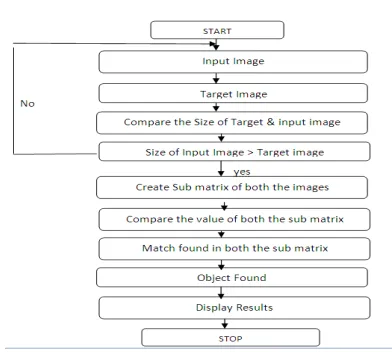
In this project we create a system that is
useful to find the object that is present
inside the image. In this we first take a
image as an input for which we have to find
the object. After selecting the input image
we have to focus on the target image. After
getting both input image and target image
we compare the size of both the image. If
the size of input image is greater than
target image then we proceed with our
system otherwise we are going to focus on
the input image. If the above criteria get
satisfied then we create the sub matrixes of
both the images for example we create 3 X
3 matrixes. After creating the sub matrixes
we compare both the sub matrixes of both
the image. This Matrix can be created with
the help of pixels present in both the
images. If matching found then we
concludes that the given object is found in
the other image. The object is shown as an
output by creating red boxes on that object.
The output object image is displayed and
the co ordinates of that object that is the
height and width from top and bottom in
the form of coordinates.
3.1 WAVELET DENOISING METHOD
In image processing, wavelets are used for
instance for edges detection, watermarking,
texture detection, compression, denoising,
and coding of interesting features for
subsequent classification [2]. Image
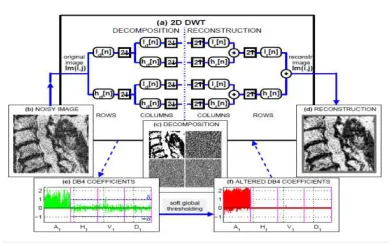
denoisingby thresholding of the DWT
coefficients is discussed in the following
subsections. The principles of image
denoising using the DWT are analogous to
that for signals described above. For
images, we need to extend our work to two
dimensions. To compute the
two-dimensional DWT of an image;we
decompose the approximations at level j to
obtain four matrixes of coefficients at level j
Available Online At www.ijpret.com decomposition using db4 displayed in Fig.
3c are, clockwise, the approximations and
the horizontal, vertical and diagonal details
of level1.
Fig 3.4 wavelet Base Image denoising
As shown in the scheme in Fig. 3.5, first, we
convolve the rows of the image, or
generally the matrix of the approximations
at level j, with a low-pass and a high-pass decomposition filter ld[n] and hd[n], respectively. Then we down sample both
resulting matrixes by 2 keeping every even
column. Second, we filter each of the
matrixes by their columns using the
previously mentioned filters. Then we down
sample all four resulting matrixes by 2
keeping every even row to obtain four
matrixes of one-level decomposition
coefficients, or generally four matrixes of
(j+1)-level coefficients [2]. We can also reconstruct the image by using these
coefficients matrixes, up sampling by 2 and
the reconstruction filters lr[n] and hr[n].
3.2 CANNY EDGE DETECTION
Our edge-based deformable model is an
extension of the one proposed in [13]. The
basic probabilistic model is a
tree-structured conditional random field (CRF).
Let the location of each part li be
parameterized by image position and
orientation [xi, yi, _i]. We will assume parts
are oriented patches of fixed size, where (xi,
yi) is the location of the top of the patch.
We denote the configuration of a K part
model as L = (l1 . . . lK).We can write the
deformable model as a log-linear model.
---Ex. 3.2.1
(li − lj) corresponds to a spatial prior on the
relative arrangement of part i and j.
Fig.3.5 input Fig.3.6 Canny Fig.3.7 input
Available Online At www.ijpret.com
Fig.3.8Segmentation Fig.3.9 Manual Fig.3.10 Synthesize
Segmentation image
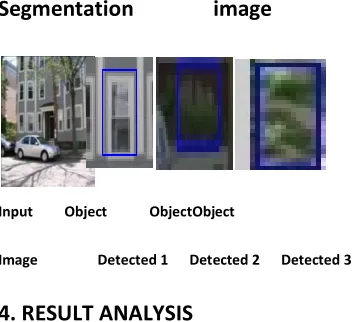
Input Object ObjectObject
Image Detected 1 Detected 2 Detected 3
4. RESULT ANALYSIS
We have tested our parsing algorithm on
two datasets. Most people datasets are
quite small, limited to tens of images. We
have amassed a dataset of 305 images of
people in interesting poses (which will be
available on the author’s webpage). It has
been collected from previous datasets of
sports figures and personal pictures. To our
knowledge, it is the largest labeled dataset
available for human pose recognition. We
also have tested our algorithm on the
Weizmann dataset of horses [1].
Proposed Method Result Previous work
comparison
Sr
No
Scene Objects in
scene
Detected
Objects
% of
Detection
1 Garden 10 8 80%
2 Sea 15 14 93.33 %
3 Nature 17 15 88.23
4 Human
Crowd
5 4 80%
Table 4.1 Proposed work results
Fig 4.1 Graphical representation of
proposed method
5. CONCLUSION
We implement our system using generative
models for text and faces combined with
generic models for shaded and textured
regions. Our approach enables these
different models to compete and cooperate
to describe the input images. We were able
to segment the images, detect faces, and
detect and read text in city scenes. Our
experiments showed several cases where
the shaded models helped face and text 0
20 40 60 80 100
Object in scene
Detected Objects
Available Online At www.ijpret.com detection by explaining away shadows and
occludes (sun-glasses). In turn, the text and
face models improved the quality of the
segmentations. The current limitations of
our approach lie in the limited class of
objects we currently model. This limitation
was motivated by our application goal of
detecting text and faces for the visually
disabled. But, in principle, our approach can
include broad types of objects.
REFERENCES
1. "Bartleby.com homepage". Retrieved 28
November 2010.
2. "Parse". Dictionary.reference.com.
Retrieved 27 November 2010.
3. Aho, A.V., Sethi, R. and Ullman ,J.D.
(1986) " Compilers: principles, techniques,
and tools." Addison-Wesley
Longman Publishing Co., Inc. Boston, MA,
USA.
4. Frost, R., Hafiz, R. and Callaghan, P.
(2007) “Modular and Efficient Top-Down
Parsing for Ambiguous Left-Recursive
Grammars." 10thInternational Workshop on
Parsing Technologies (IWPT), ACL-SIGPARSE,
Pages: 109 - 120, June 2007, Prague.
5. S.Belongie, J. Malik, and J. Puzicha,
“Matching shapes”,Proc. of ICCV, 2001
6. H. Drucker, R. Schapire, and P. Simard,
“Boosting performance in neural networks,”
Intl J. Pattern Rec. and Artificial Intelligence,
vol. 7, no. 4, 1993.
7. F. Fleuret, and D. Geman,
“Coarse-to-Fine face detection”, IJCV, June, 2000.
8. J. Friedman, T. Hastie and R. Tibshirani.
“Additive logistic regression: a statistical
view of boosting”, Dept. of
Statistics,Stanford Univ. Technical Report.
1998.
9. U. Grenander, Y. Chow, and D.Keenan.
HANDS: A Pattern Theoretic Study of
Biological Shapes. Springer-Verlag, 1990.
10.P.Hallinan, G.Gordon, A.Yuille, P.Giblin,
and D. Mumford, “Two and Three
Dimensional Patterns of the Face”,