CATS: A Tool for Customized Alignment of Text Simplification Corpora
Sanja ˇStajner
1, Marc Franco-Salvador
2, Paolo Rosso
3, Simone Paolo Ponzetto
1 1DWS Research Group, University of Mannheim, Germany2Symanto Research, Nuremberg, Germany
3PRHLT Research Center, Universitat Polit`ecnica de Val`encia, Spain
{sanja, simone}@informatik.uni-mannheim.de, [email protected], [email protected]
Abstract
In text simplification (TS), parallel corpora consisting of original sentences and their manually simplified counterparts are very scarce and small in size, which impedes building supervised automated TS systems with sufficient coverage. Furthermore, the existing corpora usually do not distinguish sentence pairs which present full matches (both sentences contain the same information), and those that present only partial matches (the two sentences share the meaning only partially), thus not allowing for building customized automated TS systems which would separately model different simplification transformations. In this paper, we present our freely available, language-independent tool for sentence alignment from parallel/comparable TS resources (document-aligned resources), which additionally offers the possibility for filtering sentences depending on the level of their semantic overlap. We perform in-depth human evaluation of the tool’s performance on English and Spanish corpora, and explore its capacities for classification of sentence pairs according to the simplification operation they model.
Keywords:text simplification, tools and resources, sentence similarity
1.
Introduction
Automated text simplification (ATS) has the goal of au-tomatically transforming sentence structure and lexical choices in a way that it provides better understanding and wider accessibility to large audiences. The main obsta-cle for successful supervised ATS is the scarcity and lim-ited size of parallel TS corpora which would contain orig-inal sentences and their manual simplifications. The par-allel TS corpus for Brazilian Portuguese, compiled for the purposes of the PorSimples project (Alu´ısio et al., 2008) contains around 4,500 aligned sentences, and the paral-lel TS corpus for Spanish, compiled for the purposes of the Simplext project (Saggion et al., 2015) contains only around 1,000 aligned sentences. The largest existing TS comparable corpora is the English Wikipedia – Simple En-glish Wikipedia (EW–SEW), consisting of 170,000 sen-tence pairs (Kauchak, 2013), or 150,000 full matches and 130,000 partial matches in the newer version (Hwang et al., 2015). In both cases, the sentences were automatically aligned from comparable English Wikipedia and Simple English Wikipedia articles. However, the use of EW–SEW dataset for modeling TS has been disputed (Amancio and Specia, 2014; ˇStajner et al., 2015; Xu et al., 2015) for sev-eral reasons: (1) the simplified articles are not necessarily direct simplifications of the original articles; (2) the quality of simplifications is not checked; (3) the dataset does not cover sentence splitting which is one of the most common operations in text simplification.
The Newsela corpora1 of document-aligned news texts,
manually simplified at four different simplification levels have been freely available for a few years for research pur-poses. These corpora have several advantages over the EW– SEW dataset (Xu et al., 2015; ˇStajner et al., 2017): (1) simplified texts present direct simplifications of the orig-inal articles; (2) simplification was performed by trained
1
https://newsela.com/
human editors, following strict guidelines; (3) by sentence-aligning those corpora one can get training material for sim-plifications at various levels, i.e. train different simplifica-tion models depending on the intended reader group; and (4) they provide comparable training material in two lan-guages, English and Spanish. At the beginning of 2016, the Newsela corpora contained around 2,000 original news articles in English and around 250 original news articles in Spanish (both with their corresponding manually simplified versions at four different simplification levels).
The current state-of-the-art systems for automatic sentence-alignment of original and manually simplified text are the Greedy Structural WikNet (GSWN) method (Hwang et al., 2015) used for sentence-alignment of original and simple English Wikipedia, and the HMM-based (using Hidden Markov Model and Viterbi algorithm) method (Bott and Saggion, 2011) used for sentence-alignment of the Span-ish Simplext corpus (Saggion et al., 2015). The HMM-based method can be applied to any language as it does not require any language-specific resources. It is based on two hypothesis: (H1) that the original order of informa-tion is preserved, and (H2) that every ‘simple’ sentence has a corresponding ‘original’ sentence. The GSWN method does not assume H1 or H2, but it only allows for ‘1-1’ sen-tence alignments (which is very restricting for TS) and it is language-dependent as it requires the English Wiktionary2. In this paper, we present a freely available tool for sentence-and paragraph-alignment from document-aligned TS cor-pora, the CATS (Customized Alignment for Text Simplifi-cation) tool.3The tool offers two main functionalities:
1. CATS-Align: sentence- or paragraph- alignment of parallel texts; and
2https://www.wiktionary.org/
3The CATS tool and documentation can be downloaded from:
2. CATS-Measure: three different sentence (or para-graph) similarity measures which can be further used to filter retrieved sentence/paragraph pairs for cus-tomised modeling of text simplification operations.
The CATS-Align has two main advantages over the state-of-the-art GSWN method:
• CATS is language-independent and resource light. Two out of three similarity metrics that CATS require only pre-trained word embeddings in the language for which is to be used, while the third similarity metric does not even require word embeddings (it is based on charactern-gram matching).
• The GSWN method only allows for ‘1-1’ sentence alignments, while CATS-aligns additionally offers a possibility for building a dataset which covers sen-tence splitting (‘1-n’ alignments).
Similarly to the HMM-based method, our alignment meth-ods assume the hypothesis H2. We provide them in both variants, using the hypothesis H1 and without it (Sec-tion 2.2). The detailed human evalua(Sec-tion of our methods and the HMM-based method (Section 3) for both English and Spanish showed that our methods are significantly bet-ter, especially when aligning sentences from distant com-plexity levels.
The CATS tool was released together with our previous pa-per ( ˇStajner et al., 2017). In that work, we were purely interested in augmenting the parallel datasets for training ATS systems and we performed an intrinsic evaluation of the tool only on the English part of Newsela corpora, and an extrinsic evaluation by using newly aligned dataset in a PBSMT approach to English ATS.
Here we build on our previous work by describing the full potential of the CATS tool: (1) for automatic sentence-alignment of both English and Spanish corpora; and (2) for automatic filtering of aligned sentence pairs according to the simplification operation: content deletion, informa-tion addiinforma-tion, and paraphrasing without significant seman-tic change.
In Section 2 we present different modes of the CATS tool. In Section 3, we present a detailed human evaluation and er-ror analysis of the CATS-Align on both English and Span-ish Newsela corpora. We evaluate CATS-Measure auto-matically on the ‘gold standard’ English Wikipedia dataset for classification of sentence pairs in three classes (full matches,partial matches, andno match) in Section 4. Fi-nally, in Section 5, using the labels assigned by human an-notators on the Newsela dataset during the human evalua-tion of CATS-Align, we test whether the CATS-Measure can be used to automatically classify the automatically-aligned sentence pairs (automatically-aligned by CATS-Align) into four classes depending on the type of simplification operation they model.
2.
The CATS
Our CATS software can work in two different regimes:
• CATS-Measurefor providing three different similar-ity measures that can be applied either on paragraph or sentence level;
• CATS-Alignfor choosing best paragraph or sentence alignments in a given document-aligned corpus.
2.1.
CATS-Measure
CATS-Measure provides similarity measures for three dif-ferent sentence/paragraph similarity methods:
1. C3G:The CharacterN-Gram (CNG) (Mcnamee and Mayfield, 2004) similarity model (withnset to 3) with log TF-IDF weighting (Salton and McGill, 1986).
2. WAVG: The continuous skip-gram model (Mikolov et al., 2013b) of the TensorFlow toolkit4 on the En-glish Wikipedia. For each text snippet (i.e. sentence or paragraph, depending on the task) we average its word vectors to obtain a single representation of its content. This setting has shown good results in other NLP tasks (e.g. for selecting out-of-the-list words (Mikolov et al., 2013a), or for language variety identification (Franco-Salvador et al., 2015)).
3. CWASA: The Continuous Word Alignment-based Similarity Analysis (CWASA) model (Franco-Salvador et al., 2016) was initially proposed for plagiarism detection with excellent results. Unlike the WAVG method, CWASA does not average word vectors and was thus proposed as more adequate for long texts.
In all three methods, similarity between the vectors is cal-culated using the cosine similarity. In WAVG and CWASA methods we use 300-dimensional vectors calculated with the continuous skip-gram model. We use the September 2016 Wikipedia dumps as input to train the English vectors. The model uses negative sampling, context windows of size 10, and 20 negative words for each sample. For Spanish, we use the freely available pretrained 300-dimensional vectors obtained using the skip-gram model with negative sampling on a large collection of various Spanish corpora with a total of approximately 1.5 billion words (Cardellino, 2016).
2.2.
CATS-Align
For aligning sentences or paragraphs from a document-aligned TS corpora, CATS-Align offers two different align-ment strategies (MST and MST-LIS) depending on whether we assume the hypothesis H1 (see Section 1) that the sim-plified text presents the information in the same order as the original text:
• Most Similar Text (MST):Having a set of ‘simple’ text snippetsS, a set of ‘complex’ text snippetsC, and one of the similarity methods (Section 2.1), MST com-pares similarity scores of all possible pairs (si, cj),
and aligns eachsi∈Swith the closest one inC.
• MST with Longest Increasing Sequence (MST-LIS):MST-LIS uses the hypothesis H1. It first uses the MST strategy, and then postprocess the output by extracting – from all obtained alignments – only those alignmentsli ∈L, which contain the longest
increas-ing sequence of offsetsjkinC.
Ex. Original Simplified 1a Hand parts take up to 10 hours to print and another couple of hours to
assemble with elastic cords to keep the hands open.
Hand pieces take up to 10 hours to print.
1b Hand parts take up to 10 hours to print and another couple of hours to assemble with elastic cords to keep the hands open.
Putting them together takes another couple of hours.
2a With one his wife bought him for Father’s Day, sheets of colored plastic, and free designs and advice found online, he made a hand for about $20
Chi made his first 3-D hand with a printer his wife bought him for Father ´s Day. 2b With one his wife bought him for Father’s Day, sheets of colored plastic,
and free designs and advice found online, he made a hand for about $20
He found free designs online.
2c With one his wife bought him for Father’s Day, sheets of colored plastic, and free designs and advice found online, he made a hand for about $20
With them, he printed a hand for about $20.
Table 1: Examples of ‘1-n’ alignments obtained by CATS-Align on the Newsela corpora (Newsela, 2016), which can be used either for modeling sentence compression (each example separately) or sentence splitting (by merging examples 1a–1b, and merging examples 2a–2c).
In order to allow for ‘1–n’ alignments (i.e. sentence split-ting), we allow for repeated offsets ofCinL.
The ‘simple’ text snippets not contained inLare included in the setU of unaligned snippets.
Finally, we align eachum ∈ U by restricting the search
space inC to those offsets of ‘complex’ text snippets that correspond to the previous and the next aligned ‘simple’ snippets. For instance, if L = {(s1, c4),(s3, c7)} and
U ={s2}, then the search space for the alignments ofs2is
reduced to{c4...c7}.
We denote the MST-LIS alignment strategy by adding ‘*’ to the name of the similarity method (e.g. C3G*).
2.2.1. Modeling Sentence Splitting and Compression
In both alignment strategies (MST and MST-LIS), we al-low the same original sentence to be aligned with multi-ple simmulti-ple sentences, in order to allow for modeling both sentence splitting and sentence compression later on. This is one of the important differences between our alignment models and the state-of-the-art GSWN method, which only allows ‘1-1’ alignment and thus does not offer a possibility for building a dataset which covers sentence splitting
(‘1-n’ alignments). An example of our customisable alignment tool is presented in Table 1. While each of the separate examples (1a–2c) can be later used for modeling sentence compression, by merging the examples 1a–1b and 2a–2c, we also build good training materials for modeling sentence splitting operations.
2.2.2. Two-Step Alignment
Additionally, the CATS-Align offers two-step alignment option, by first performing paragraph-alignment, and then sentence-alignment within each pair of aligned paragraphs. In this option, paragraphs and sentences can be aligned by any of the six previously mentioned strategies (three simi-larity methods times two alignment strategies), and not nec-essarily the same one. Two-step C3G alignment (C3G-2s) has shown best results in the extrinsic evaluation when used for building ATS systems ( ˇStajner et al., 2017).
3.
Human Evaluation on Newsela Datasets
We randomly selected 10 original English articles and 10 original Spanish articles, together the four corresponding
simpler versions (at different levels of simplification) for each of them, and sentence-aligned them with seven differ-ent alignmdiffer-ent strategies offered by the CATS tool: C3G, C3G*, CWASA, CWASA*, WAVG, WAVG*, C3G-2step, and the HMM-based alignment tool (Bott et al., 2012). Then we asked two native speakers of English (first trained on additional 3 original articles and their corresponding simplified versions) and two native speakers of Spanish (first trained in the same manner) to classify the obtained sentence pairs (a total of approx. 3,500 sentence-pairs for each language) in one of the four classes:
• 3: full match (full semantic overlap),
• 2: partial match (partial semantic overlap where the original sentence contains less information than the simplified sentence)
• 1: partial match (partial semantic overlap where the original sentence contains more information than the simplified sentence),
• 0: no match (no semantic overlap).
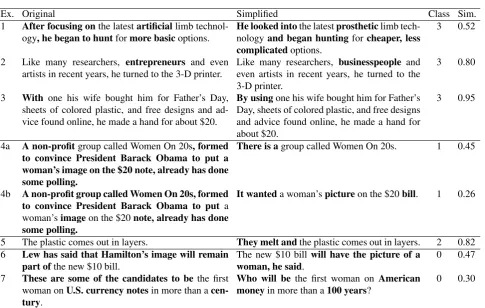
While sentence pairs with full matches can be used to model paraphrasing, sentence pairs with partial matches can be used to model deletions (class ‘1’ where the orig-inal sentence contains more information than the simpli-fied sentence) or additions (class ‘2’ where the original sentence contains less information than the simplified sen-tence). Several examples from different classes are pre-sented in Table 2. As can be seen, the CATS tool can suc-cessfully align sentences with full semantic overlap which differ only by one lexical/phrasal substitution (the second and the third example in Table 2), as well as those which are much stronger paraphrases of each other (the first ex-ample in Table 2). It can also align the sentences which have only partial semantic overlap (examples 4a, 4b, and 5 in Table 2).
3.1.
Results of Human Evaluation
Ex. Original Simplified Class Sim. 1 After focusing onthe latestartificiallimb
technol-ogy, he began to huntformore basicoptions.
He looked intothe latestprostheticlimb tech-nologyand began huntingfor cheaper, less complicatedoptions.
3 0.52
2 Like many researchers, entrepreneurs and even artists in recent years, he turned to the 3-D printer.
Like many researchers, businesspeople and even artists in recent years, he turned to the 3-D printer.
3 0.80
3 With one his wife bought him for Father’s Day, sheets of colored plastic, and free designs and ad-vice found online, he made a hand for about $20.
By usingone his wife bought him for Father’s Day, sheets of colored plastic, and free designs and advice found online, he made a hand for about $20.
3 0.95
4a A non-profitgroup called Women On 20s, formed to convince President Barack Obama to put a woman’s image on the $20 note, already has done some polling.
There is agroup called Women On 20s. 1 0.45
4b A non-profit group called Women On 20s, formed to convince President Barack Obama to put a woman’simageon the $20note, already has done some polling.
It wanteda woman’spictureon the $20bill. 1 0.26
5 The plastic comes out in layers. They melt andthe plastic comes out in layers. 2 0.82 6 Lew has said that Hamilton’s image will remain
part ofthe new $10 bill.
The new $10 bill will have the picture of a woman, he said.
0 0.47
7 These are some of the candidates to bethe first woman onU.S. currency notesin more than a cen-tury.
Who will be the first woman on American moneyin more than a100 years?
0 0.30
Table 2: Examples of different classes of alignments obtained by CATS-Align on the Newsela corpora (Newsela, 2016), together with their similarity scores obtained by C3G-2s alignment strategy. Differences between original and simplified sentences are presented in bold.
the original articles (Level 0) and the first simpler level (Level 1), aligning the sentences for the original articles (Level 0) and the simplest articles (Level 4), and aligning the sentences from the two simplest levels (Level 3 and Level 4). Due to the nature of simplification operations needed to be applied between levels 0 and 1, and those needed between levels 0 and 4, we expect a greater lexi-cal andn-gram overlap between the sentences needed to align between levels 0 and 1, than those sentences needed to align between levels 0 and 4. Furthermore, we are inter-ested in exploring whether the success rate of the alignment tool stays stable whenever we align two neighbouring lev-els, thus taking into account both 0–1 and 3–4 alignments. Finally, we investigate whether the success rate stays stable across the two languages.
3.1.1. Comparison with the State of the Art
In both languages and on all level pairs, the CATS align-ments were able to find higher number of full and partial matches than the state-of-the-art HMM alignment method (Tables 3 and 4). The differences in the percentage of full matches found by the CATS alignments and the HMM method are particularly pronounced when we align 0-1 levels (up to 9.4% difference on the English dataset, and up to 10.8% difference on the Spanish dataset). The dif-ferences in the percentages of partial matches modeling deletion (Part-Del) between the CATS alignments and the HMM method while aligning 0-1 levels are noticeable on the Spanish dataset (up to 13.4% difference), while there is
no much difference on the English dataset (only up to 3.3% difference). In aligning other level pairs (3-4 and 0-4) the differences in the percentages of partial matches modeling deletion were significant regardless the language.
3.1.2. The Influence of Hypothesis H1
We noticed that the use of hypothesis H1 reduces the per-centage of full matches regardless of language, level pairs, and similarity measure. However, it sometimes increases the number of partial matches which model deletion (see Tables 3 and 4).
3.1.3. CATS Alignments across Languages
arti-Align Method Class 3-4 CWASA 45.5% 1.4% 31.3% 21.8%
3-4 CWASA* 42.7% 0.9% 31.3% 25.1% 3-4 WAVG 44.1% 1.4% 32.2% 22.3%
Table 3: Distribution of different sentence-alignments ac-cording to the human evaluation on the English Newsela corpora. For each pair of levels, the highest percentage of
fullandpart-delmatches, and the lowest percentage ofno
matches are shown in bold.
Align Method Class
3 (Full) 2 (Add) 1 (Del) 0 (No) 0-1 C3G 61.4% 3.4% 31.8% 3.4%
0-1 C3G* 55.7% 3.4% 30.7% 10.2% 0-1 CWASA 61.4% 3.4% 29.5% 5.7% 0-1 CWASA* 55.7% 3.4% 30.7% 10.2% 0-1 WAVG 62.5% 2.3% 28.4% 6.8% 0-1 WAVG* 55.7% 2.3% 31.8% 10.2% 0-1 HMM 50.6% 1.1% 18.4% 29.9% 3-4 C3G 44.8% 1.0% 26.7% 27.6%
3-4 C3G* 41.9% 1.0% 25.7% 31.4% 3-4 CWASA 43.8% 1.9% 21.0% 33.3% 3-4 CWASA* 41.9% 1.9% 24.8% 31.4% 3-4 WAVG 41.9% 1.9% 21.9% 34.3%
Table 4: Distribution of different sentence-alignments ac-cording to the human evaluation on the Spanish Newsela corpora.
cles in those two languages, i.e. it is possible that the simpli-fication in Spanish leads to more sentence splittings thus re-flected in higher number of partial matches, while the sim-plification in English leads to more paraphrasing without sentence splitting and thus more full matches. The perfor-mances of the CATS-Align are rather reflected in number of
no matches, which according to the results in Tables 3 and 4 indicate similar performances of CATS-Align for both lan-guages in the case of aligning 0-1 levels, and a slightly better performances of the tool on the English than on the Spanish dataset in the case of 3-4 and 0-4 alignments.
3.2.
Error Analysis
We found that over 50% of original sentences from Level 0 get split into two or more (up to even five sentences) simple sentences when simplifying into Level 4. This sometimes results in low scores (no match) by human evaluation of isolated sentence pairs, although all simple sentences that correspond to the same original sentence, when seen to-gether, perfectly match the original sentence (Table 5). In other words, when treated separately, some of the sentences aligned between levels 0 and 4 present false negatives, as they will later be merged together for training ATS systems, where they will then represent good training material for sentence splitting. These type of errors could be avoided by performing human evaluation on already merged sen-tences (those that together model sentence splitting), but in that case we would not have the count of correct deletions and additions, which might be useful for tasks other than simplification, or for modeling these specific text simplifi-cation operations.
4.
Automatic Evaluation on Wikipedia
The ‘gold standard’ Wikipedia dataset for sentence-alignment (Hwang et al., 2015) contains pairs of sentences and their ‘gold label’ (full match, partial match, or no match) with the same meaning as in our manual evalua-tion task. As the C3G, CWASA and WAVG methods out-put similarity score for each sentence pair, we use them to predict the labels for the sentence pairs in the Wikipedia dataset. Table 6 shows the F1-measures obtained by our
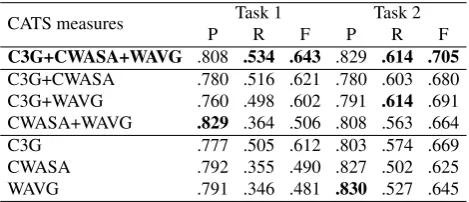
systems (using different combinations of sentence similar-ity measures and classification algorithms) and the state-of-the-art GSWN system, as well as several baselines used by Hwanget al. (2015) on two classification tasks: classify-ing betweenGood&GoodPartialmatches vs.Others(Task 1), and betweenGood matches vs. Others(Task 2). The HMM-method requires full texts to use the H1 hypothesis and thus cannot be successfully applied to these tasks. Detailed results of our various classification methods on Tasks 1 and 2, presenting precision (P), recall (R) and F1
-measure (F) on the Good & GoodPartialclass (Task1) or theGoodclass (Task 2), are presented in Table 7. We ob-serve similar behaviour of our similarity metrics in both tasks; the C3G method obtains significantly better recall than the word-embedding-based methods (CWASA and WAVG), while CWASA and WAVG obtain better precision than the C3G. All three methods combined together signif-icantly boost both recall and F1-measure, significantly
Ex. Simplified (Level 4) Original (Level 0) 1 Todos los estudiantes tienen que hacer el
examen SAT para ser admitidos en la uni-versidad.
En otras palabras, si los estudiantes afroamericanos con las puntua-ciones del SAT m´as bajas que las de sus compa˜neros blancos tambi´en reciben peores calificaciones en la universidad, o se cambian con m´as frecuencia a carreras “m´as f´aciles”, entonces, para empezar, segura-mente estaban menos preparados para la universidad.
2 Algunas personas opinan que los estudi-antes de color est´an menos preparados para entrar a la universidad.
En otras palabras, si los estudiantes afroamericanos con las puntua-ciones del SAT m´as bajas que las de sus compa˜neros blancos tambi´en reciben peores calificaciones en la universidad, o se cambian con m´as frecuencia a carreras “m´as f´aciles”, entonces, para empezar, segura-mente estaban menos preparados para la universidad.
3 Dicen esto cuando los estudiantes afroamericanos tienen calificaciones m´as bajas que las de sus compa˜neros blancos en ese examen.
En otras palabras, si los estudiantes afroamericanos con las puntua-ciones del SAT m´as bajas que las de sus compa˜neros blancos tambi´en reciben peores calificaciones en la universidad, o se cambian con m´as frecuencia a carreras “m´as f´aciles”, entonces, para empezar, segura-mente estaban menos preparados para la universidad.
4 Tambi´en, cuando reciben calificaciones m´as bajas en la universidad o se cambian a carreras “menos dif´ıciles”.
En otras palabras, si los estudiantes afroamericanos con las puntua-ciones del SAT m´as bajas que las de sus compa˜neros blancos tambi´en reciben peores calificaciones en la universidad, o se cambian con m´as frecuencia a carreras “m´as f´aciles”, entonces, para empezar, segura-mente estaban menos preparados para la universidad.
Table 5: An example of sentence pairs which obtained score 0 (no match) each, but in fact present a good example of an ‘1–n’ alignment obtained by CATS-Align C3G method on the Newsela corpora (Newsela, 2016).
Approach Task1 Task2
C3G+CWASA+WAVG .643 .705
C3G+CWASA .621 .680
C3G+WAVG .602 .691
CWASA+WAVG .506 .664
C3G .612 .695
CWASA .490 .671
WAVG .481 .650
GSWN (Hwang et al., 2015) .607 .712
Unconst.WordNet (Hwang et al., 2015) .515 .636 Ordered Vec.Space (Hwang et al., 2015) .415 .564 Unconstr. Vec.Space (Hwang et al., 2015) .431 .550
Table 6: F1-measures on Task1 (Good & Good Partial vs. Others) and Task2 (Good vs. Others). The best results for each task are shown in bold.
obtaining comparable results to the state of the art on Task 2 (see Table 6). Here is important to mention that, unlike the current state-of-the-art method on Task 2 (Hwang et al., 2015), our methods arelanguage-independent, resource-light, and allow for retrieving material for sentence splitting (allow for ‘1–n’ matches).
5.
Automatic Classification of Alignments
Finally, we explore if the similarity measures provided by CATS-Measure can be used to classify the aligned sentence pairs according to the type of simplification operation they model.
5.1.
Distribution of Similarity Scores
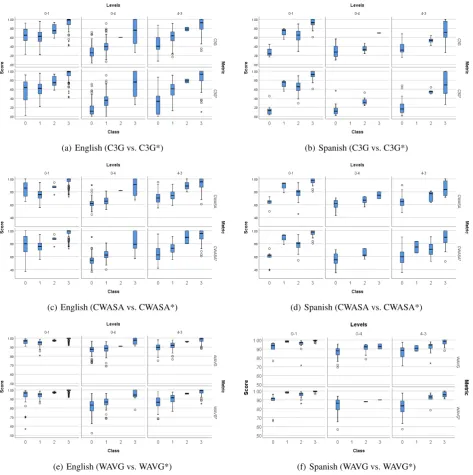
We first explore the distribution of similarity scores across different transformation types and different text levels on
CATS measures Task 1 Task 2
P R F P R F
C3G+CWASA+WAVG .808 .534 .643 .829 .614 .705
C3G+CWASA .780 .516 .621 .780 .603 .680 C3G+WAVG .760 .498 .602 .791 .614 .691 CWASA+WAVG .829 .364 .506 .808 .563 .664 C3G .777 .505 .612 .803 .574 .669 CWASA .792 .355 .490 .827 .502 .625 WAVG .791 .346 .481 .830 .527 .645
Table 7: Detailed results on Task 1 (Good & Good Partial vs. Others) and Task2 (Good vs. Others). The best results for each measure are shown in bold.
(a) English (C3G vs. C3G*) (b) Spanish (C3G vs. C3G*)
(c) English (CWASA vs. CWASA*) (d) Spanish (CWASA vs. CWASA*)
(e) English (WAVG vs. WAVG*) (f) Spanish (WAVG vs. WAVG*)
Figure 1: Distribution of the six similarity scores across different classes, text levels, and languages.
5.2.
Classification Experiments
For classification experiments, we use the labels assigned by human evaluators as the ‘gold standard’ labels. As fea-tures, we use the similarity metrics obtained by CATS-Measure (one metric at the time) and the differences in word count between the original and simplified sentence (in order to distinguish between additionsand deletions) which achieve similar scores for semantic similarity by all our similarity metrics (see Figure 1). Given that we ob-served certain differences in distribution of similarity met-rics across different text levels, we also experiment with adding the level pair as an additional (third) feature for the classification.
We used five different classifiers: Logistic (le Cessie and van Houwelingen, 1992), SMOs – Weka implementation of SVM (Platt, 1998) with feature standardisation, JRip
rule learner (Cohen, 1995), J48 – Weka implementation of C4.5 decision tree (Quinlan, 1993), and Random Forest (Breiman, 2001), in a 10-fold cross-validation setup with 10 repetitions in Weka Experimenter (Hall et al., 2009).
percent-Features English Spanish
Table 8: Results of automatic classification of sentence pairs into four categories (no match, deletions,additions, and full matches) presented as the weighted average F1
measure (w-F) and the percentage of false positives for the
no matchclass (fPos), i.e. cases in whichno matchwas clas-sified as any other category. The best scores achieved for each classification evaluation metric (w-F and fPos), and for each language, are presented in bold.
age of false positives for theno matchclass is only 13.6). If we are interested in classifying sentence pairs by differ-ent transformation operations, this can again be success-fully achieved with classifiers trained on the small number of instances, with better results for Spanish than for English (weighted F-measure of 84.8 for Spanish, and 75.3 for En-glish).
The results in Table 8 also indicate that specifying the level pair from which sentences were aligned improves the F-measure on the Spanish classification task (though not nec-essarily decreases the number of false positives for theno matchclass), but has no effect on the English classification task.
6.
Conclusions
One of the main problems of the state-of-the-art automatic text simplification systems is the absence and the small size of parallel datasets (pairs of original sentences and their manually simplified versions) which leads to insufficient coverage of supervised systems. The CATS tool presented in this paper offers several different ways of sentence- and paragraph-aligning of document-aligned texts on different text complexity levels. It additionally offers three sentence similarity metrics which can be applied on sentence pairs and used for automatically classifying simplification oper-ations asfull matches,additions,deletions, andno matches. Our detailed human evaluation of the alignment module (CATS-Align) showed that it can successfully align sen-tence pairs from document-aligned corpora in English and Spanish. The results of classification experiments con-firmed that the sentence similarity measures offered by our CATS-Measure can be used as features for classifica-tion of sentence pairs asfull matches,additions,deletions, andno matcheson both English and Spanish Newsela cor-pora. More importantly, they showed that wrongly aligned
sentence pairs can be automatically filtered out by classi-fiers built on small size human annotated datasets (approx-imately 1,000 instances).
Finally, the resource-light and language-independent sen-tence similarity metrics offered by CATS-Measure per-formed similar to the state-of-the-art systems for classify-ing sentence pairs from English Wikipedia and Simple En-glish Wikipedia as full matches, partial matches, and no matches, proving thus that they are not effective only on the news domain but also on the encyclopedic domain. The CATS tool with both CATS-Align and CATS-Measure options is freely available on:https://github.com/ neosyon/SimpTextAlign.
7.
Acknowledgements
We would like to thank Newsela for making their data available, and to Luke Orland for his valuable comments and suggestions. Part of the work presented in this arti-cle was performed during second author’s research visit to the University of Mannheim, supported by Contact Fellow-ship awarded by the DAAD scholarFellow-ship program “STIBET Doktoranden”. The work of Paolo Rosso has been par-tially funded by the SomEMBED TIN2015-71147-C2-1-P MINECO research project.
8.
Bibliographical References
Alu´ısio, S. M., Specia, L., Pardo, T. A., Maziero, E. G., and Fortes, R. P. (2008). Towards brazilian portuguese auto-matic text simplification systems. InProceedings of the eighth ACM symposium on Document engineering, Do-cEng ’08, pages 240–248, New York, NY, USA. ACM. Amancio, M. A. and Specia, L. (2014). An Analysis
of Crowdsourced Text Simplifications . InProceedings of the 3rd Workshop on Predicting and Improving Text Readability for Target Reader Populations (PITR), pages 123–130.
Bott, S. and Saggion, H. (2011). An Unsupervised Align-ment Algorithm for Text Simplification Corpus Con-struction. InProceedings of the Workshop on Monolin-gual Text-To-Text Generation, pages 20–26. ACL. Bott, S., Saggion, H., and Figueroa, D. (2012). A Hybrid
System for Spanish Text Simplification. InProceedings of the Workshop on Speech and Language Processing for Assistive Technologies (SLPAT), held in conjunction with NAACL-HLT 2012, pages 75–84.
Breiman, L. (2001). Random Forests. Machine Learning, 45(1):5–32.
Cardellino, C. (2016). Spanish Billion Words Corpus and Embeddings. http://crscardellino.me/SBWCE/.
Cohen, W. W. (1995). Fast Effective Rule Induction. In
Proceedings of the Twelfth International Conference on Machine Learning, pages 115–123.
Franco-Salvador, M., Gupta, P., Rosso, P., and Banchs, R. E. (2016). Cross-language plagiarism detection over continuous-space- and knowledge graph-based represen-tations of language. Knowledge-Based Systems, 111:87 – 99.
Hall, M., Frank, E., Holmes, G., Pfahringer, B., Reute-mann, P., and Witten, I. H. (2009). The weka data mining software: an update. SIGKDD Explor. Newsl., 11:10–18.
Hwang, W., Hajishirzi, H., Ostendorf, M., and Wu, W. (2015). Aligning Sentences from Standard Wikipedia to Simple Wikipedia. InProceedings of NAACL&HLT, pages 211–217.
Kauchak, D. (2013). Improving text simplification lan-guage modeling using unsimplified text data. In Pro-ceedings of the 51st Annual Meeting of the Association for Computational Linguistics (Volume 1: Long Papers), pages 1537–1546. ACL.
le Cessie, S. and van Houwelingen, J. C. (1992). Ridge Estimators in Logistic Regression. Applied Statistics, 41(1):191–201.
Mcnamee, P. and Mayfield, J. (2004). Character n-gram tokenization for European language text retrieval. Infor-mation Retrieval, 7(1):73–97.
Mikolov, T., Chen, K., Corrado, G., and Dean, J. (2013a). Efficient estimation of word representations in vector space. InProceedings of Workshop at International Con-ference on Learning Representations.
Mikolov, T., Sutskever, I., Chen, K., Corrado, G. S., and Dean, J. (2013b). Distributed representations of words and phrases and their compositionality. InAdvances in Neural Information Processing Systems 26, pages 3111– 3119.
Newsela. (2016). Newsela article corpus. https:// newsela.com/data. Version: 2016-01-29.
Platt, J. C. (1998). Fast Training of Support Vector Machines using Sequential Minimal Optimization. In B. Schoelkopf, et al., editors,Advances in Kernel Meth-ods 6 Support Vector Learning, chapter 12, pages 41–65. MIT Press Cambridge.
Quinlan, R. (1993). C4.5: Programs for Machine Learn-ing. Morgan Kaufmann Publishers, San Mateo, CA. Saggion, H., ˇStajner, S., Bott, S., Mille, S., Rello, L., and
Drndarevic, B. (2015). Making It Simplext: Implemen-tation and Evaluation of a Text Simplification System for Spanish. ACM Transactions on Accessible Computing, 6(4):14:1–14:36.
Salton, G. and McGill, M. J. (1986). Introduction to Mod-ern Information Retrieval. McGraw-Hill, Inc.
ˇStajner, S., Bechara, H., and Saggion, H. (2015). A Deeper Exploration of the Standard PB-SMT Approach to Text Simplification and its Evaluation. In Proceedings of ACL&IJCNLP (Volume 2: Short Papers), pages 823– 828.
ˇStajner, S., Franco-Salvador, M., Ponzetto, S. P., Rosso, P., and Stuckenschmidt, H. (2017). Sentence alignment methods for improving text simplification systems. In
Proceedings of the 55th Annual Meeting of the Associa-tion for ComputaAssocia-tional Linguistics (ACL), pages 97–102.