Available Online at www.ijpret.com 560
INTERNATIONAL JOURNAL OF PURE AND
APPLIED RESEARCH IN ENGINEERING AND
TECHNOLOGY
A PATH FOR HORIZING YOUR INNOVATIVE WORK
OBJECT TRACKING USING MODIFIED MEAN-SHIFT ALGORITHM
PROF. SHWETA K. TALMALE,PROF. NITIN J. JANWE
Department of Computer Science and Engineering, Gondwana University, Gadchiroli, Chandrapur, 442401, India.
Accepted Date: 15/03/2016; Published Date: 01/05/2016
\
Abstract: In the field of computer vision object tracking has always been a research area, which has many of applications in real world. The main steps in video analysis are: detection of moving objects and tracking of such objects from frame to frame. There is various tracking algorithms which uses pre-defined methods to process. In this paper, we propose the Modified Mean shift tracking algorithm, which uses joint color-texture histogram to extract the color information as well as spatial information of object. Object tracking is one of the key technologies in intelligent video surveillance and how to describe the moving target is a key issue. Traditional color histogram Mean-shift algorithm only considered object’s color statistical information, and didn’t contain object’s space information, so when the object color was close to the background color, the traditional MS algorithm easily caused object tracking inaccurately or lost. To solve this problem, a novel object tracking algorithm which based on modified MS is proposed in this paper. The experimental results show that the algorithm tracking the object accurately and effectively even though the object color was close to the background color or the target moves fast.
Keywords: Object tracking; Mean-Shift; Local Binary Pattern; color histogram, Feature extraction, color-texture histogram
. Corresponding Author: PROF. SHWETA K. TALMALE
Access Online On:
www.ijpret.com
How to Cite This Article:
Shweta K. Talmale, IJPRET, 2016; Volume 4 (9): 560-570
Available Online at www.ijpret.com 561 INTRODUCTION
Object tracking in a video sequence on the target of interest is widely used and the effective tracking has always been a typical problem in the field of computer vision. These issues are reflected in the performance of the tracking algorithm, which is real-time and robustness. With the continuous development of computer vision the area of pattern recognition technology and digital video technology uses object tracking approach with a lot of new ideas and methods. Of which, how to take into account real-time and soundness of the system is always the forefront of research. Many tracking algorithms have been proposed to get the better of the difficulties arising from noise, occlusion, clutter and changes in the foreground object or in the background environment. Among the various tracking algorithms, Mean-Shift tracking algorithm recently becomes popular due to their simplicity and efficiency. Mean Shift is an iterative kernel-based deterministic procedure which converges to a local maximum of the measurement function with certain assumptions on the kernel behaviors. Furthermore, mean shift is a low complexity algorithm, which provides a general and reliable solution to object tracking and is independent of the target representation.
Recently, a lot of tracking algorithm emerged, such as Mean-shift algorithm, Kalman filter algorithm, particle filter algorithm, etc. the MS algorithm has gained significant attention as an efficient and robust method for visual tracking. As the traditional color histogram MS algorithm caused object tracking inaccurately or lost easily when the object color was close to the background color or the target moves fast. To solve these problems, many researchers proposed various improved methods in recent years, For example, to modeling characteristics of the object better, Yuan et al [14] use the color and texture as the target feature, and then use the detected object contour to track the target; Li et al [5] proposed an object tracking algorithm based on color texture histogram with the right to block average drift.
Available Online at www.ijpret.com 562 than standard mean shift tracking. It can robustly track the target under complex scenes, such as similar target and background appearance, on which the traditional color based schemes may fail to track.
Object tracking is one of the key technologies in intelligent video surveillance and how to describe the moving target is a key issue. Traditional color histogram Mean-shift (MS) algorithm only considered object’s color statistical information, and didn’t contain object’s space information, so when the object color was close to the background color, the traditional MS algorithm easily caused object tracking inaccurately or lost. To solve this problem, a novel object tracking algorithm which is based on MS using color-texture histogram proposed in this paper. The experimental results show that this algorithm tracking the object accurately and effectively even though the object color was close to the background color.
I. Traditional Mean-Shift (MS)
Object tracking algorithm based on traditional Mean-Shift which uses color histogram for extracting object color information has obtained a wide range of applications, because of the method is simple and good real-time, it can deal with target deformation and some shelter. In these algorithms, a lot of things used statistical model for target tracking with neighbor pixel domain expression, often use a reference model through the nonlinear estimation for the parameters of the moving target model.
Available Online at www.ijpret.com 563 II. Joint Color-Texture Histogram
Color histograms consists very useful information about color images. The color dissimilarity measure called histogram intersection, and its successors, have been widely used for object recognition and image retrieval. The texture patterns which reflect the spatial structure of the objects are effective features to represent and recognize targets. Since the texture features introduce new information that the color histogram does not convey, using the joint color-texture histogram for target representation is more reliable than using only color histogram in tracking complex scenes.
Using joint color-texture histogram for target representation is more reliable than using only color histogram in tracking complex video scenes. Idea of combining edge and color for target object representation has been exploited by researchers. The local binary pattern (LBP) technique is very effective to describe image texture features. LBP has advantages such as rotation invariance fast computation and, which facilitates wide usage in the fields of image retrieval, texture analysis, and face recognition. LBP was successfully applied to the detection of moving objects. In LBP, each pixel is assigned a texture value. It can be naturally combined with the color value of the pixel to represent targets. LBP feature is used to construct a two dimensional histogram representation of the target for tracking monochromatic and thermo graphic video. This target representation scheme eliminates noise and smooth background in the tracking process. Compared with the traditional RGB color space based target representation, it exploits the target structural information. This method improves greatly tracking accuracy with fewer mean shift iterations than standard mean shift object tracking. It can robustly track target object under complex scenes, such as similar background appearance and target.
III. Mean-shift Tracking
Recently, a lot of tracking algorithm introduced, the Mean-Sift algorithm has gained significant attention as an efficient and robust method for visual tracking. As the traditional color histogram MS algorithm caused object tracking inaccurately or lost easily when the object color was close to the background color or the target moves fast. To solve these problems, many researchers proposed various improved methods in recent years
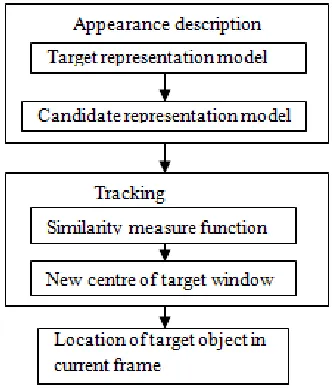
Available Online at www.ijpret.com 564 representation. Mean shift object tracking is consist of two parts, first is appearance description and second one is tracking. Figure 1 shows two parts of mean shift algorithm.
Figure 1: Two parts of Mean- Shift Algorithm
o Target Representation Model
A target is usually defined by a rectangle or an ellipsoidal region in the image. Most of the existing target tracking schemes uses the color histogram to represent the rectangle or ellipsoidal target. In this paper, we will present a new target representation approach by using the joint color-texture histogram. First let us review the target representation in the mean shift tracking algorithm. Denote by {x∗i}i=1···n the normalized pixel positions in the target region, which is supposed to be centered at the origin point. The target model ˆq corresponding to the target region is computed as
(1)
Available Online at www.ijpret.com 565 x∗i to the histogram bin, k(x) is an isotropic kernel profile and constant C is a normalization function defined by
(2)
Similarly, the target candidate model ˆp(y) corresponding to the candidate region is given by
(3)(4)
Where ˆpu(y) represents the probability of feature u in the candidate model ˆp(y), {xi}i=1···nh denote the pixel positions in the target candidate region centered at y, h is the bandwidth and constant Ch is a normalization function.
In order to calculate the likelihood of the target model and the candidate model, a metric based on the Bhattacharyya coefficient is defined between the two normalized histograms ˆp(y) and ˆq as follows:
(5)
The distance between ˆp(y) and ˆq is then defined as
(6)
o Tracking
Available Online at www.ijpret.com 566 Using Taylor expansion around ˆpu(y0), the linear approximation of the Bhattacharyya coefficient (5) is obtained as
(7)
Where
(8)
Since the first term in (7) is independent of y, to minimize the distance in (6) is to maximize the second term in (7). In the iterative process, the estimated target moves from y to a new position y1, which is defined as
(9)
When we choose kernel g with the Epanechnikov profile,7 (9) is reduced to
(10)
By using (10), the mean shift tracking algorithm finds the new frame the most similar region to the object.
IV. Mean-Shift Tracking Using Joint Color-Texture Histogram
A. LBP
Available Online at www.ijpret.com 567 (11)
Where c g corresponds to the gray value of the center pixel
(x c, y c) of a local neighborhood and g p to the gray values of P equally spaced pixels on a circle with radius R. The function s(x) is defined as follows:
(12)
Figure 2: LBP8,1 texture models example
Figure 2 is an example of LBP8,1 (P = 8, R = 1). By varying P and R, we have the LBP operators
under different quantization of the angular space and spatial resolution, and multiresolution analysis can be accomplished by using multiple LBPP,R operators.
The texture model derived by (11) has only gray-scale invariance. The gray-scale and rotation invariant LBP texture model is obtained by
(13)
Where
(14)
Available Online at www.ijpret.com 568 value. It can be naturally combined with the color value of the pixel to represent targets. LBP feature is used to construct a two dimensional histogram representation of the target for tracking monochromatic and thermo graphic video. This target representation scheme eliminates noise and smooth background in the tracking process. Compared with the traditional RGB color space based target representation, it exploits the target structural information. This method improves greatly tracking accuracy with fewer mean shift iterations than standard mean shift object tracking. It can robustly track target object under complex scenes, such as similar background appearance and target.
V. MODULE DESCRIPTION
1. In first module we implement and calculate the target model using joint color-texture histogram Image which considers 1st frame of video as the center of target window and calculate bandwidth of target window and provide quantification scheme of RGB space which in make target model for tracking. In this module the local binary pattern (LBP) technique is used. This technique is very effective to describe the image texture features. LBP has advantages such as fast computation and rotation invariance, which facilitates the wide usage in the fields of texture analysis, image retrieval, face recognition, image segmentation, etc. In LBP, each pixel is assigned a texture value, which can be naturally combined with the color value of the pixel to represent targets.
2. In working of second module is to design the tracking window which is in the range of image, which window of tracking result and define height, width: the size of image. The tracking window represents the tracked object frame to frame.
3. In third module we design basic means shift tracking algorithm and compare it with modified mean shift tracking which improve in tracking window capture.
4. In fourth module we do comparison of both algorithm with different video and calculate correlation between them. It shows the strength of algorithm.
5. In fifth module we do comparison of this algorithm with different algorithms and check the efficiency of algorithm.
VI. CONCLUSION
Available Online at www.ijpret.com 569 effectively extracts the edges and corners, which are important and robust features, of the object while suppressing the smooth background features. Experimental results designate that the proposed joint color-texture based method performs much better than the original color based method with fewer iteration numbers, especially when the tracking objects that have similar color appearance to the background.
REFERENCES
1. X. Mei, H. Ling (2009), “Robust visual tracking using L1 minimization”, Presented at the IEEE 12th International Conference on Computer Vision,pp.1436 - 1443
2. H. Zhou, Y. Yuan, C. Shi (2009), “Object tracking using SIFT features and mean shift”, Computer Vision and Image Understanding,vol. 113(3), pp. 345-352.
3. M. Krainin, P. Henry, X. Ren (2011) , “Manipulator and object tracking for in-hand 3d object modelling”, The International Journal of Robotics Research, vol. 30(11), pp. 1311-1327.
4. H. Grabner, J. Matas, L. Van Gool (2010), “ Tracking the invisible: Learning where the object might be”, Computer Vision and Pattern Recognition (CVPR), IEEE Conference on. IEEE, pp. 1285-1292.
5. J. Ning, L. Zhang, D. Zhang(2009), “Robust object tracking using joint color-texture histogram”, International Journal of Pattern Recognition and Artificial Intelligence, vol. 23(07),pp. 1245-1263.
6. B. Babenko, M. H. Yang, S. Belongie (2011), “Robust object tracking with online multiple instance learning”, Pattern Analysis and Machine Intelligence, IEEE Transactions, vol. 33(8),pp. 1619-1632.
7. Yimaz, O. Javed, M. Shah (2006), “Object tracking: A survey,” Vol. 4, pp. 13-20.
8. Saravanakumar, S. Vadivel, A. Saneem Ahmed (2010), “Multiple human object tracking using background subtraction and shadow removal techniques”, The International Conference on Signal and Image Processing, pp. 15-17
Available Online at www.ijpret.com 570 10. S. Gammeter, A. Gassmann, L. Bossard (2009), “Server-side object recognition and client-side object tracking for mobile augmented reality”, Computer Vision and Pattern Recognition Workshops (CVPRW), IEEE Computer Society Conference on. IEEE, pp: 1-8
11. Jiafu Jiang, Hui Xiong (2012), “Object Tracking Based on Multi-feature Mean-shift Algorithm”, National Conference on Information Technology and Computer Science (CITCS 2012), pp: 1-4
12. Pallavi C. Hingane, S. A. Shirsat (2013), “ Object Tracking Using Joint Color-Texture Histogram”, International Journal of Science and Research (IJSR) ISSN (Online): 2319-7064
13. Matti Pietik.inen, Topi M.enp.. and Jaakko Viertola (), “Color Texture ClassiÞcation with Color Histograms and Local Binary Patterns”, Machine Vision Group, Infotech Oulu
14. T. Ahonen, A. Hadid and M. Pietik¨ainen, Face description with local binary patterns: application to face recognition, IEEE Trans. Patt. Anal. Mach. Intell. 28(12) (2006) 2037–2041.
15. G. Bradski, Computer vision face tracking for use in a perceptual user interface, Intel
Technol. J. 2(2) (1998) 12–21.
16. Guo wu. Yuan, Dan. Xu. A combination of texture and color of the moving object tracking algorithm[J]. Computer application and software, 2011.28(11)
17. Guan Bin. Li, He Feng. Wu. an object tracking algorithm based on color texture histogram with the right to block average drift[J]. Journal of Computer-Aided Design & Computer
Graphics, 2011.23(12)