Available Online at www.ijpret.com
43
INTERNATIONAL JOURNAL OF PURE AND
APPLIED RESEARCH IN ENGINEERING AND
TECHNOLOGY
A PATH FOR HORIZING YOUR INNOVATIVE WORK
AN EVALUATION OF TOTAL SELF ENERGY FOR A MOVING CHARGE AS A
FUNCTION OF DISTANCE FOR THE METAL INSULATOR INTERFACE
AJAY KUMAR SINGH
Department of Physics, A. M. College, Gaya, Bihar.
Accepted Date: 29/03/2014 ; Published Date: 01/06/2014
\
Abstract:In this paper, we have evaluated the real part of the self energy of a moving charge near a metal insulator interface like Al – LiF, Al-KCl and Al-NaCl. We have taken the polarization interaction due to Plasmon's, optical phonon and excitons. Our result indicates that the real part of self energy as a function of Z-decreases for Z< 0 and increases for Z > 0.
Keywords: Optical ultraviolet region, surface Plasmon's, polarization mode, structure less
dielectric constant, eigenfrequencies, exciton field, polarization interaction.
Corresponding Author: MR. AJAY KUMAR SINGH
Access Online On:
www.ijpret.com
How to Cite This Article:
Available Online at www.ijpret.com
44
INTRODUCTION
In this paper we have presented the method of evaluation of real part of self energy due to metal-insulator surface for moving charge. This has been possible by obtaining an interaction Hamiltonian of charge ‘e’ with the electrostatic field created by the interface modes. Here, one analyse the properties of the polarization modes which are localized at the interface. The fact that the exciton and Plasmon energies are usually comparable because both lie in the optical ultraviolet region. These facts have forced to consider the electromagnetic coupling between these two different free surface modes. The response of the insulator in front of the metal plasmons can be described by a structureless dielectric constant. Within a local response model, one obtains a simple expressions for the eigenfrequencies of the strongly mixed interface modes as well as for their coupling Hamiltonian to an external charge1-10. The slow surface optical phonons have been found to be strongly screened by the fast surface plasmons and thus to contribute negligibly to the charge self energy. When fictitiously assuming that the exciton field is much faster than the Plasmon field, one has obtained expansions for the frequencies and coupling parameters which plays the role of dielectric constant. It has been noticed that a very good result can be obtained from the assumption of very fast exciton field11. Since the polarization contribution is only part of the total potential experienced by an electron, one adds a step function in the calculation of that part of the total self energy of the charge Re
t
(z)
. This makes the resulting profile look closer to the actual total potential and the resultscan be modified by the inclusion of more reliable response modes12.
MATERIALS AND METHODS:
One studies the polarization modes of a metal-insulator interface and their contribution to the self energy of a charge. One assumes a sharp boundary between the two media. Let the interface be at z = 0 the metal in z<0 and the insulator in z>0. The metal and insulator is described by the following dielectric functions.
2 2
1
( ) 1
p/
(1)
2 2
e 1
2 2 2 2 2
e t
( ) 1
Available Online at www.ijpret.com
45
Where
p is the bulk Plasmon frequency of the metal
e24
0 2e where
is the atomicdensity and
0 is the static atomic polarizability and2 2 2
t 1 t
where
e is thelongitudinal optical phonon frequency and
t is the transverse optical phonon frequency
e isthe electronic excitation frequency. Use of equation (1) for the metal is equivalent to use of Hamiltonian (4) and (5) for the interaction with a changed particle. The validity of equation (2) to describe the response of a dielectric.
At the interface between the media described by dielectric function
1( )
and
2( )
, theeigenmodes must satisfy the equation13.
1
( )
2( )
0
(3)Introducing (1) and (2) in (3) one finds and algebric equation with three solutions for
2.Taking advantage of the fact that
t p and
t e, one finds the following threesolutions.
1 , 2
and
3
(4)
1 2 2
2 2 2 2 2 2 2 2 2
p e e p e p e p
1
1
2
2
8
4
4
(5)Corrections to the expression given in (4) and (5) go like
2 4
t p
(
/
) ~ 10
. Thus the
approximation
t/
p0
can be considered exact for many practical purposes. Now oneconsider the limit.
2 2 2
p
/ 2
e e/ 2
(6)
In such cases, expression for the frequencies of the mixed modes reduce to very simple forces. The approximation (6) will not be acceptable in most real materials but is useful for qualitative in sight. When taken the limit in (6).
2 2
e e
1
/
Available Online at www.ijpret.com
46
Then this will play the role of the dielectric constant which is of the used to describe the response of the insulator in the optical region of the spectrum14-17. The approximation (6) with transform equations (4) and (5) into
2 2
1 p
2 2
2 e
2 2
3 t
/(
1)
1
(
1)
2
(7)
Clearly
1 corresponds to a surface Plasmon whose natural frequency
p/ 2
has beenshifted by the presence of the semi-infinite dielectric medium.
2 correspond to the freesurface excitons which has not been altered by the slow surface plasmons. Both in (5) and (7),
3
is the vibrational frequency of the strongly screened surface phonons and is essentiallydifferent from
s0 wheres0
2 0 2
t
1
1
These conclusions have been confirmed by the calculations of the coupling of these modes to an external charge, because of this similarity one change the notation from equations (5) to (7) to
ip 1
,
ie 2,
i0 3
(8)
where the subscript i stand for interface. The subscripts p, e and 0 for Plasmon, exciton and optical phonon respectively. Interface models are supposed to be in general of a mixed nature LiF two semi-infinite media i = 1, 2 be described by bulk dielectric functions.
2 ij
i 1 2
j ij
( ) 1
.i 1,2
(9)
Available Online at www.ijpret.com
47
The correlation self-energy for a charge moving in a medium whose only excitation is a
dispersionless Plasmon of frequency
p is given by2 3 2
p
b p 2 2 p
e
d q
q
( )
S(Q ,0)
q.
i
2
q
2m
(10)
It must be remembered that
s(0)
S(Q ,0)
s and thus the discussion applies entirely to thesurface self-energy right at the interface.
The integral (10) can be calculated in several ways. One can use cylindrical coordinates. It is more straightforward to calculate first the angular variable in spherical polar coordinates. For the real part, we have.
2
p p
b 0
p
e
dq
1 q / 2m
/ q
Re
( )
In
2
q
1 q / 2m
/ q
(11)
Eq. (11) can be written :
2 2
p 1 p 2
b 0 0
1 2
e
dq
q
q
e
dq
q
q
Re
( )
In
In
2
q
q
q
2
q
q
q
(12) Where2 2 1/ 2 2 2 1/ 2
1 p 2 p
q
m
(m
2m
/ h)
, q
m
(m
2m
/ h)
(13)
Both integrals in eq. (13) give the same result :
1 p 2
q
/ , q
2m
(14)
2
0
dx
1 x
In
x
1 x
2
(15) Thus 2 p be
Re
( )
4
Available Online at www.ijpret.com
48
No matter what the value m is, as long as we are above the threshold. However, if we had
assumed that the particle was classical
(m
)
, the term2
q / 2m
q
for all q is a slowlyconvergent integral like (13). This makes the limit
m
not well defined.The discrepancy would be removed if: (i) a cutoff were introduced in the q integral, (ii) an exponentially decaying factor were introduced, as in the surface self-energy, or (iii) Plasmon dispersion were taken into account. The result would be uniquely given by eq. (14) in the limit of high velocities, as can be argued from general considerations.
Let two semi-infinite media i = 1, 2 be described by bulk dielectric function:
2 ij
i 2 2
j 0
( ) 1
,i 1, 2
(15)
Index j is summned over all effective oscillators contributing to the response. Let
be thefrequencies satisfying the matching condition
1
(
)
2(
)
0
(16)One assumes that the dielectric response has its origin in the polarizability of a set of microscopic oscillators such that the polarization vector is given by
i y y y
j
P
n e k
(17)
Given by the definition of the dielectric constant where
n
y is the density of oscillations of type jin medium
i,e
y is their effective charge andhy
in the dipole moment of the oscillator.
The equation of motion for a single oscillator will be
2
y y y y 2
m (k
k )
lyE
(18)
Where
E
i is the electric field in medium i. If the medium vibrates with frequency
thenAvailable Online at www.ijpret.com
49
2
0
ij ij ij
m (
)
l E
(19)
1
1 i
( ) 1
P
E
4
(20)(18) and (20) lead to the dielectric function (18), provided that
2 2
ij
4 n e / m
ij ij ij
(21)
General solutions for the electrostatic potential at an interface will be
Q.
(r, t)
Q (t)exp(iQ, )exp( Q | z |)
(22)
Where
is summed over all possible interface modes. SinceE
eqs. (21) and (22) lead to the general expression for the ocillators displacement.
ij ij
ij 2 2 Q
Q. ij
e / m
u
iQ, Qsgn(z)
(t)exp(iQ. )exp( Q | z |)
(23)
The mechanical energy stored in the vibrating oscillators will be
2 2 2
M i ij ij ij ij ij
ij
1
W
dV n m (u
u )
2
(24)
Where
dV
i is the volume element in medium i.The energy in the fields will be
2 F
1
W
dVE
8
(25)If the magnetic field energy is neglected.
From eqn. (23) and (25) the total energy for the particles plus the field,
W
W
M
W
F isAvailable Online at www.ijpret.com
50
2 2 2 2 2
Q Q Q
Q
W
C
(|
|
|
| )
(26)
Q 1 2
AQ
d
C
(
),
16
(27)Where A is the total interface area. To obtain eqs. (26, 27) one has exploited the fact that the
satisfy condition (26).One now introduces the new variables
a
Q; such that* Q
(D
Q/ 2
)(a
Qa
Q)
(28)
*
Q Q Q Q
1
iD
(a
a
)
2
(29)
Where
D
Q is a suitable constant,The total energy W can now be written
2 * *
Q Q Q Q Q Q
Q.
1
C D
(a a
a a
)
2
(30)
If the a’s are now interpreted as boson operators, i.e.,
*
Q Q
a
a
(an operator), and assuming
2
Q a Q
D
/ C
(31)
One has finally
*
Q Q
Q
1
W
a a
2
(32)Available Online at www.ijpret.com
51
Q Q Q
Q.
V
e (r)
exp(iQ. ) exp( Q | z |)(a
a
)
(33)
2 2
Q
e h
AQ
(34)
1
1 2
d
4
(
d
(35)RESULTS AND DISCUSSION:
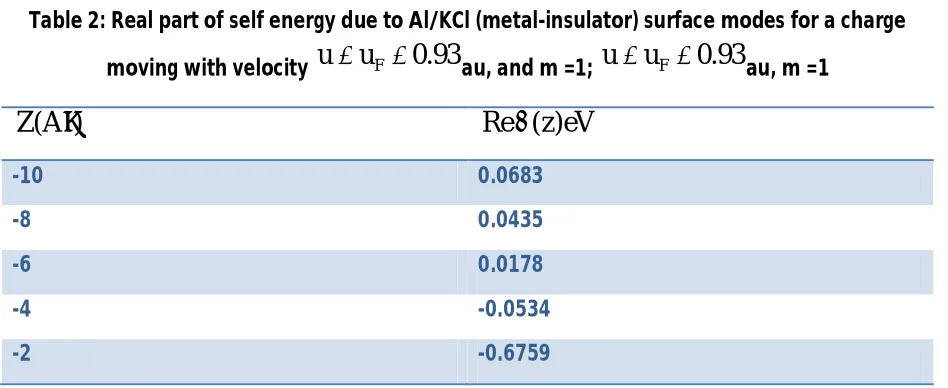
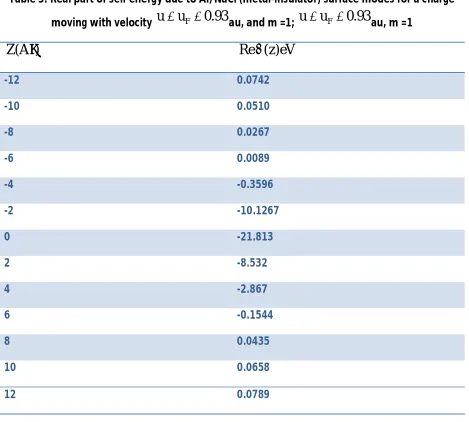
In this paper, we have evaluated the real part of the self energy of a moving charge near a metal, insulator interface system. The metal insulator interface of the system chosen are Al-LiF, Al-KCl and Al-NaCl. These calculations have been performed by aking the velocity
F
u
u
0.93
au and m = 1. The Re
(z)
have been calculated as a function of z and theresults for the above three systems have been given in table
T , T
1 2 andT
3 respectively. Thecalculations have been performed by equations (1) and (2) in the light of equation (6). Our results indicate that the real part of the self energy due to moving charge near a metal insulator interface as a function of z decreases for z<0 and have a maximum negative values for z = 0 after that they increases for z>0. The negative values at z = 0 increases as one goes from Al/LiF to Al/NaCl interface. In the self energy calculations, we have taken the polarization interaction due to plasmons, optical phonons and excitons. Besides these, there are other physical effects which contribute to the total effective potential. To describe the motion of an electron between the conduction bands of a metal and an insulator, one suggests the simple rule that a step function be added such that the difference between the bulk saturation terms equals the difference between the bottom of the conduction bands as obtained from experimental data. The calculations of the total charge self energy near metal and insulator surface shown the role played by the different dynamical parameters like particle velocity etc. The particle velocity determines the overall value of the self-energy while momentum controls the small oscillations on the incident side and the range of convergence to semi classical limit. Due to the small value of the optical phonon frequency, the recoil of the particle has furned out to play a very important role near an insulator surface14-17. Recoil effects cannot be neglected upto distances
of the order of 20
A
Available Online at www.ijpret.com
52
of the electronic contribution to the charge self energy. This implies that the study of surface polaron must properly be included for the coupling of the electron to the localized electronic excitations in the insulator18-20. There is some recent calculation21-28 on the metal insulator interface which also reveal the similar facts.
Table 1 : Evaluation of real part of the self-energy due to charge moving with velocity u for
Al/LiF (metal insulator) surface modes
u
u
F
0.93
au, m =1Z(A )
Re (z)eV
-8 0.0534
-6 0.0405
-4 0.0058
-2 -0.2756
0 -16.273
2 -5.339
4 -2.674
6 0.0392
8 0.0586
Table 2: Real part of self energy due to Al/KCl (metal-insulator) surface modes for a charge
moving with velocity
u
u
F
0.93
au, and m =1;u
u
F
0.93
au, m =1Z(A )
Re (z)eV
-10 0.0683
-8 0.0435
-6 0.0178
-4 -0.0534
Available Online at www.ijpret.com
53
0 -18.536
2 -8.027
4 -1.786
6 0.0138
8 0.0569
10 0.0758
Table 3: Real part of self energy due to Al/NaCl (metal-insulator) surface modes for a charge
moving with velocity
u
u
F
0.93
au, and m =1;u
u
F
0.93
au, m =1Z(A )
Re (z)eV
-12 0.0742
-10 0.0510
-8 0.0267
-6 0.0089
-4 -0.3596
-2 -10.1267
0 -21.813
2 -8.532
4 -2.867
6 -0.1544
8 0.0435
10 0.0658
Available Online at www.ijpret.com
54
CONCLUSIONS:
In this paper, we have presented a method of evaluation of real part of self energy due to metal-insulator interface due to moving charge. On insulator surface a strong space dependence of the electronic contribution to self energy of charge has been noticed. This work will help to study the coupling of the electron to the localized electronic excitations in the insulator.
ACKNOWLEDGEMENT:
I acknowledge Prof. L.K. Mishra (HOD physics M.U. Bodh-Gaya) for valuable suggestion and discussion in this paper.
REFERENCES:
1. R.H. Ritchie. Phys. Rev., 106, 874 (1957).
2. N. Takimoto. Phys. Rev., 146, 366 (1966).
3. A.A. Lkucas. Phys. Rev., 131, 3304 (1970).
4. R.H. Ritchie. Phys. Letters., 138, 189 (1972).
5. G.D. Mahan. Phys. Rev., B5, 739 (1972).
6. P.J. Feibelkman. Surf. Sci., 27, 438 (1971).
7. R. Ray and G.D. Mahan. Phys. Letters, A 42, 301 (1972).
8. M. Sunijie, G. Toulouse and A. Lucas. A Solid State Commun., 11, 1629 (1972).
9. R.H. Ritchie. Surface Sci., 34 (1973).
10.D. Chan and P. Richmond. Surface Sci., 39, 437 (1973).
11.P. de Andres, P.M. Echenque and F. Soles, Phys. Rev., B35, 4529 (1987).
12. F. Cuinea, J. Sanchez-Dehesa and F. Flores. J. Phys., C16, 6499 (1983).
13. R.H. Ritchie. Phys. Rev., 114, 644 (1959).
Available Online at www.ijpret.com
55
15. D. Pines. In polarons and excitons Eds. C.G. Kuper and G.D. Whitfield, Plenum, New York (1963).
16.G.D. Mahan. Phys. Rev. B5, 739 (1972).
17.C., Tejedor, F. Flores and E. Lovis. J. Phys., C20, 2163 (1997).
18. R. Ruppin. Surface, Sci. 129, 286 (1998).
19. R.A. Young. Solid State Commun., 65, 263 (1991).
20. J. Sak. Phys. Rev., B52, 1234 (1996).
21.S. Takanashi, K. Kawasaki and P. Toknre. Applied Physics Lett (APL) 79, 1324 (2001).
22.I. Zutc and J. Fabion and S.D. Surve. Rev. Mod. Phys. 76, 323 (2004).
23. K. Uchida, S. Takanashi, K. Haril, J. Zeda and E. Saitoh, Nature, 455, 778 (2008).
24. A. Krejel, F. Sauli, L. Bartojel and P. Kopietz, Eur. Phys J B71, 59 (2009).
25. J.C. Slonczlwski, Phys. Rev. B82, 054403 (2010).
26.B. Lezk, H. Ulrich, F. Garbs and M. Munzlnbery, Phys. Report 507, 107 (2011).
27.C.E.W. Banch, E. Saitosh and B.J. Van weel, Nature Mater, 11, 391 (2012).