www.sciencepolicyjournal.org JSPG., Vol. 12, Issue 1, February 2018
A Balancing Act: Safety, Innovation, and
Resources in the Implementation of Medical
Device Legislation
Walter G. Johnson
Sandra Day O’Connor College of Law at Arizona State University
111 E. Taylor St., Phoenix, AZ 85004
Corresponding author: Walter G. Johnson, [email protected]
Keywords: science and technology, FDA regulation, regulatory policy, medical devices, implementation, public value mapping
Executive Summary: The implementation of medical device legislation in the United States has been a complex undertaking, colored by overlapping values. Policymakers have oscillated between favoring patient safety versus fostering innovation, while the limited resources available to the Food and Drug Administration (FDA) to implement policies often decide their true impact. The 510(k) process of premarket notification exemplifies this complexity. Originally a footnote in the legislation, the 510(k) process has risen to become the prominent form of premarket device regulation. With Congress using legislation first to reign in, then to loosen premarket notification, the 510(k) process has become the fulcrum on which patient safety and innovation are balanced. This article applies the Public Value Mapping framework to the implementation of medical device legislation in the United States to identify historical and ongoing tensions between values in the device policy space. Recent concerns over morcellation devices, which have been proven harmful to patients, threatens this status quo, and the struggle to balance safety, innovation, and the FDA’s resources makes any significant changes to 510(k) likely to be slow.
I. Introduction
Enacting the Medical Device Amendments of 1976 (MDA)1 in the United States alleviated the concerns of many U.S. stakeholders. After years of petitioning, the Food and Drug Administration (FDA) finally won the authority to formally regulate medical devices, and could now establish clear expectations for industry groups confused by several court rulings allowing “devices” to be regulated as “drugs.” 2 In the wake of a scandal involving deaths and serious infections attributable to the Dalkon Shield intrauterine device, consumers, women’s
health advocates, and healthcare provider groups succeeded in pushing for greater oversight of medical device approval. 3 Lawmakers including Edward Kennedy, who insisted “no one any longer denies the need for medical device legislation,” kept their promise to the public by providing device legislation to ensure patient safety.4
2
examination gloves, would need to meet broad but essential requirements called General Controls, such as good manufacturing practices and record keeping. Mid-‐risk devices (Class II) would be placed under performance standards, allowing the FDA to create more specific requirements for well-‐characterized devices, in addition to General Controls. High-‐risk devices (Class III), including implantable devices such as pacemakers, would be subject to the rigorous premarket approval (PMA) process, whereby the FDA would strictly review scientific and clinical data on the device before granting market access. In addition to these premarket regulations, Congress included several postmarket controls to enable the FDA to monitor devices on the market and enforce rules.
While the MDA offered a comprehensive device regulation system, the difficulties of its implementation complicated the execution of this scheme. The FDA’s
limited resources delayed the
establishment of the device classification system, while other parts of the legislation—including reclassification procedures and mandatory recall
powers—remained unused or
unenforced.6 Even the PMA, heralded as the key to patient safety, was less utilized than originally expected.7
Throughout this process, clashing values exacerbated the FDA’s limited resources. Calls to ensure patient safety and
promote innovation while maintaining a strict budget drove one section of the MDA to take a greater role in device regulation than Congress intended: Section 510(k).8 Initially written as a side
note in the MDA, over time the 510(k) process of “premarket notification” soon became a formalized premarket review process.9 Though the original law never discussed innovation, the 510(k) process would act as a conduit for promoting innovation in medical devices during the implementation of the MDA and its later amendments.
II. Public values analysis
A public value mapping framework10 can illuminate the conflicting values involved in the implementation of the MDA. This framework first seeks to identify and characterize the public values that operate in a policy area, which Bozeman defines as the rights which citizens should enjoy, the responsibilities actors should assume, and the ideologies that should guide governance and decision-‐making with respect to the policy matter.11 The framework then allows for analysis of whether decision-‐making has successfully delivered on public values that permeate the policy area. Lawmakers and stakeholders often use these public values to justify policy decisions, making this an appropriate framework to analyze policies intended to deliver public value and not purely economic value.12
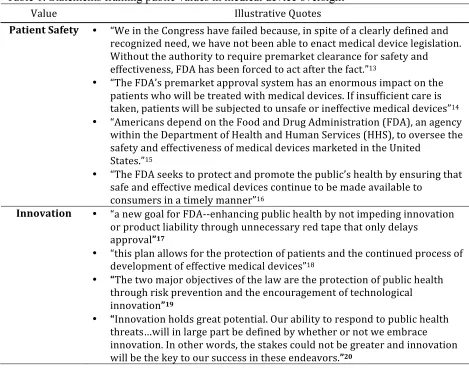
Medical device policy represents one such policy area, as decision-‐makers have defended medical device legislation over the past several decades on the grounds of ensuring both patient safety and medical innovation. Table 1 presents quotes from the history of device oversight which illustrate the nature of both of these values.
3
Table 1. Statements framing public values in medical device oversight
Value Illustrative Quotes
Patient Safety • “We in the Congress have failed because, in spite of a clearly defined and recognized need, we have not been able to enact medical device legislation. Without the authority to require premarket clearance for safety and
effectiveness, FDA has been forced to act after the fact.”13
• “The FDA’s premarket approval system has an enormous impact on the patients who will be treated with medical devices. If insufficient care is
taken, patients will be subjected to unsafe or ineffective medical devices”14
• “Americans depend on the Food and Drug Administration (FDA), an agency
within the Department of Health and Human Services (HHS), to oversee the safety and effectiveness of medical devices marketed in the United
States.”15
• “The FDA seeks to protect and promote the public’s health by ensuring that
safe and effective medical devices continue to be made available to
consumers in a timely manner”16
Innovation • “a new goal for FDA-‐-‐enhancing public health by not impeding innovation or product liability through unnecessary red tape that only delays
approval”17
• “this plan allows for the protection of patients and the continued process of development of effective medical devices”18
• “The two major objectives of the law are the protection of public health
through risk prevention and the encouragement of technological
innovation”19
• “Innovation holds great potential. Our ability to respond to public health
threats…will in large part be defined by whether or not we embrace innovation. In other words, the stakes could not be greater and innovation
will be the key to our success in these endeavors.”20
i. The public value of patient safety
The underlying promise Congress upheld in the MDA was one of advancing the public value of patient safety and preventing device related harm. This value emerged early in the debate over how to create appropriate device regulation, particularly after a 1970 Department of Health, Education, and Welfare report highlighted a myriad of cases of patient injury and death resulting from poor device design and use.21 The influential ‘Cooper Committee Report,’ which recommended the regulatory framework lawmakers would ultimately
use as a scaffold for the final MDA,22 justified the need for this new framework by appealing to patient safety. This fixed the value of safety at the heart of the legislative process behind the MDA.
www.sciencepolicyjournal.org JSPG., Vol. 12, Issue 1, February 2018
apprehension over Dalkon related injuries, found both in prominent newspapers25 and congressional hearing records.26 The text of the MDA was written during the scandal and reflects the importance placed on patient safety, seen in the long title of the Act, “To amend the Federal Food, Drug, and Cosmetic Act to provide for the safety and effectiveness of medical devices intended for human use, and for other purposes” [emphasis added].27
ii. The public value of innovation
The Cooper Committee Report also addressed the importance of regulation promoting innovation.28 To this effect, policymakers designed the MDA using input from industry. 29 However, lawmakers expressed only mild interest in promoting innovation and discussed patient safety more frequently,30 resulting in patient safety ultimately becoming the primary narrative behind enacting the MDA. Only in retrospect would lawmakers point to the importance of device regulation promoting innovation in medical devices, and ultimately set new objectives for the FDA31 while accusing the agency of discouraging device innovation.32 The addition of innovation as a second public value to guide the implementation of device regulation per the MDA introduced complications. The competing values demanded different courses of action, as ensuring patient safety through premarket controls would be seen as limiting industry innovation.33
III. Early implementation of the MDA The FDA struggled to implement the MDA in the decade following enactment of the legislation, enabling the “510(k) clearance” regulatory pathway to arise unexpectedly. At the outset, the sizeable task before the
FDA involved classifying and reviewing all new medical devices through the PMA, as well as promulgating new rules and performance standards.34 But the MDA also tasked the agency with reviewing all high-‐risk devices already on the market. Approximately 1,000 “preamendment” devices could be categorized as Class III, and therefore necessitated FDA review through their new PMA process; a massive undertaking with each PMA requiring approximately 6 months. 35 Ultimately, finalizing the rules on PMA and classification required two years,36 although the FDA began classifying devices in 1974, shortly before being officially granted this authority.37
While debate over the PMA continued, the FDA began to utilize 510(k) premarket notification as another pathway to the market, separate from the PMA, which industry could use to clear their devices with regulators. 38 510(k) clearance operated on a comparative basis, where the FDA would subject a new device to the same level of regulation as a similar preamendment device. 39 Premarket
notification revolved around
demonstrating that the new device was
“substantially equivalent” to
preamendment devices. While this process required data on the device to demonstrate equivalence, significantly less information was required compared to a PMA.40 The shorter time and data requirements in the 510(k) clearance made premarket notification the preferred pathway for industry.41
www.sciencepolicyjournal.org JSPG., Vol. 12, Issue 1, February 2018
required manufacturers to inform the FDA 90 days before marketing a new medical device to ensure the FDA would be aware of all new devices on the market.42 While the MDA originally gave the FDA no authority to deny market access to device manufacturers who submitted premarket notifications via Section 510(k),43 in their 1977 rule the FDA interpreted the purpose of a 510(k) submission as “not only to notify FDA that a device is about to be marketed, but primarily to enable the FDA to determine whether the device is substantially equivalent to one already in commercial distribution.”44 The expansion on the original intent for the provision is particularly clear considering that, while the MDA described ‘substantial equivalence’ at several points, Section 510(k) made no reference to “substantial equivalence.”45
Even though the FDA did not formally define substantial equivalence until 1986,46 the FDA’s interpretation of the 510(k) process placed a notable emphasis on it. Moreover, in spite of the outcomes from the FDA’s interpretation of the 510(K) process, the FDA clearly indicated in their 1977 rule that substantial equivalence “does not in any way denote official approval of the device.”47 These factors resulted in significant confusion in the industry and in lawmakers, who grew concerned by the state of device regulation. Congress acted on these concerns in the 1980s by ordering a series of reports to investigate their patient safety concerns and evaluate the FDA’s progress in implementing the MDA and overseeing medical devices. Investigators identified several issues with the implementation of the 510(k) process involving (1) the use of
substantial equivalence to compare new devices to un-‐reviewed preamendment devices, (2) the industry overuse of premarket notification, and (3) the lack of performance standards promulgated by the FDA.
First, the Government Accountability Office (GAO) found that the FDA never began reviewing preamendment devices which required a retrospective PMA.48 This created apprehension over the extensive use of the 510(k) process, which involved manufacturers claiming a new device was substantially equivalent to un-‐reviewed preamendment devices in their 510(k) submissions.49 As the 510(k) process could not require evidence of safety, only evidence of equivalence, GAO identified a public value failure in ensuring patient safety.
www.sciencepolicyjournal.org JSPG., Vol. 12, Issue 1, February 2018
180 days, and could be halted if the FDA decided it required more information.53 The FDA similarly preferred the 510(k) process, as premarket notification required fewer of their limited resources than PMA applications.54 In response to criticism over using the 510(k) process, the agency argued their postmarket controls would be adequate to remove unsafe devices from the market and prevent a new device from claiming equivalence to an unsafe one.55
Third, the FDA had insufficient resources to establish performance standards for Class II devices,56 yet creating these standards was required by the then 7-‐ year-‐old MDA. 57 With no FDA performance standards in place, deficient regulation existed to confirm the safety of devices used for substantial equivalence claims.58 Congress criticized the failure on performance standards because it allowed new devices to escape safety checks by using the 510(k) pathway,
particularly as industry used 510(k) to avoid the PMA and the otherwise appropriate safety checks involved.59
In the reports evaluating the MDA’s implementation, reviewers prioritized patient safety as a primary goal for the legislation.60 However, the FDA and other reports also claimed the MDA was intended not to interfere with innovation. 61 The FDA’s response to criticisms illustrated this awareness of innovation, in which the agency tempered its pledged to shift resources to reviewing preamendment devices by reiterating its commitment to promoting innovation.62 The agency did note the patient safety benefits of completing the review of preamendment devices and indicated that completion would enhance safety by enabling more resources to go to reviewing new and complex devices. However, the FDA never completed their review of preamendment devices.63
IV. Legislative fixes to the MDA
By the late 1980s, Congress’s critiques of the FDA’s slow implementation of the MDA and statutorily dubious expansion of Section 510(k) was growing. 64 Lawmakers expressed concern over the incomplete classification of existing devices,65 creating questions about the impacts on patient safety outcomes. The FDA’s slow progress had created uncertainty for industry as well, who struggled to determine the FDA’s expectations and requirements for premarket notification. The uncertainty was exacerbated by the FDA waiting 10 years to define substantial equivalence in 510(k) submissions.66 Some stakeholders were unsatisfied with the implementation of Section 510(k) and questioned FDA’s
delivery of only the public value of patient
safety. 67 FDA defended their
implementation of the MDA and 510(k) by citing the need to balance the values of patient safety with innovation.68
www.sciencepolicyjournal.org JSPG., Vol. 12, Issue 1, February 2018
congressional hearings and both eventually died in the Senate,71 but policy points from both bills resurfaced shortly thereafter.
By 1990, Congress’s increasing concerns with the patient safety implications of the FDA’s implementation of device legislation resulted in the political will necessary to pass new legislation. The heavy use of substantial equivalence in by the FDA again arose as a major issue identified by the House.72 The FDA’s leadership was summoned to testify in hearings concerning the FDA’s weak implementation of device regulations, leading Congress to conclude that “some of the industry have taken advantage of
regulatory weaknesses, despite
implications for the public health.”73 The FDA responded to these concerns by declaring their intent to enforce device regulations related to patient safety more strictly, with the aid of potential new legislation crafted with input from the new FDA commissioner.74 At this time, Congress reaffirmed that the primary intended purpose of the MDA was to push for safety and effectiveness in devices.75 Congressional concern for patient safety again forged the overarching narrative in enacting the first major amendment to the MDA, the Safe Medical Devices Act (SMDA) of 1990.76
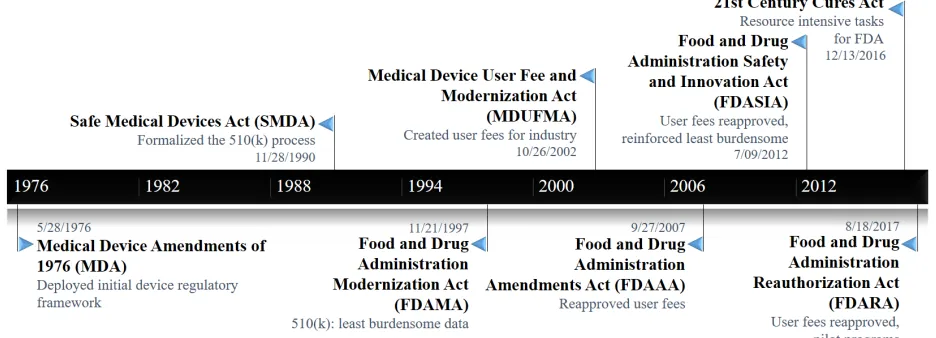
Figure 1. Timeline of U.S. Medical Device Legislation with Respect to 510(k)
i. The Safe Medical Devices Act of 1990
The SMDA modified the MDA with several mechanisms to address concerns for safety in devices, focusing on the formalization of the 510(k) process, substantial equivalence, and the requirements needed for a premarket notification submission.77 In making the 510(k) process an official legal mechanism, Congress could legislate the intended function of premarket notification and thereby realign the process with their intentions. To accomplish this, Congress redefined substantial equivalence as showing a “device is as safe and effective as a
legally marketed device,” now termed “predicate devices.”78 In utilizing this definition, Congress allowed the 510(k) process to continue largely as the FDA had already applied it, demonstrating a congressional understanding of the challenges faced by the FDA in implementing device legislation while still intending to promote patient safety.79
www.sciencepolicyjournal.org JSPG., Vol. 12, Issue 1, February 2018
device manufacturers to submit a PMA, if required by the MDA.81 Since the FDA still had not promulgated performance standards for Class II devices, the SMDA replaced this requirement with “special controls.”82 These special controls were less intensive and required fewer resources to create, so Congress felt they would be a more attainable regulatory goal than performance standards.83 This would attempt to cover gaps in new devices claiming substantial equivalence to functionally unregulated Class II devices.
Congress acknowledged the FDA’s limited resources,84 and included stronger postmarket controls in the SMDA to supplement the 510(k)’s more limited premarket review. This enabled the FDA to expend fewer resources on reviewing devices before they entered the market, and streamlined device review for industry, in exchange for greater control over devices after gaining the FDA clearance. Shortly after, the Medical Device Amendments of 1992 further strengthened these postmarket tools.85 By endorsing postmarket regulation, Congress shifted away from the premarket tools they originally designed as the mechanism to secure patient safety.
ii. The rise of innovation
Shortly after the SMDA and the MDA were enacted in 1992, the Supreme Court interpreted the 510(k) process in a manner which reflected congressional anxieties about the program. Medtronic v. Lohr centered on products liability claims over a pacemaker, which the FDA cleared through premarket notification.86 In Medtronic, a patient filed a lawsuit against a device manufacturer after her implanted pacemaker failed, resulting in emergency surgery. In their opinion, the Court wrote that substantial equivalence could “provide little protection to the public,” as premarket notification “is focused on equivalence, not safety.” 87 The Court’s comment suggested that premarket notification could not deliver patient safety,
advancing the debate over public values on the 510(k) process.
While the Court’s opinion expressed concerns over the 510(k) process, the Court did not make any explicit rulings about the FDA or premarket notification, instead partially ruling against the manufacturer and functionally leaving 510(k) in place.88 The Court established the ongoing importance of device policy protecting patient safety by favoring the plaintiff, but also supported the FDA’s use of 510(k). This endorsement occurred by placing more responsibility for device safety on manufacturers, without addressing the underlying regulatory process. The Court validated the FDA in favoring 510(k) due to their restricted resources and shifted the burden of ensuring patient safety away from regulators and towards device manufacturers.89 This shift in the responsibility for device safety created further space for the FDA to focus policy measures on innovation. In turn, this latitude for regulators would set the stage for the public value of innovation to take lead role in narrative around medical device oversight.
In the absence of a Supreme Court ruling on the 510(k) process in Medtronic, legislation in the following year would change the tone of the public values surrounding medical device oversight. Decision-‐makers advanced new food and drug legislation to ‘modernize’ the FDA shortly after this judicial shift of responsibility for device safety away from the FDA.90 This created space for innovation to enter the discourse on enacting the new legislation. The original draft of the bill even proposed altering the mission statement of the FDA in instructing them to “not unduly impede innovation,” illustrating device innovation increasing in priority to policymakers.
www.sciencepolicyjournal.org JSPG., Vol. 12, Issue 1, February 2018
through unnecessary red tape that only delays approval.” 91 This concept, that impeding innovation was a threat to public health, represented a novel ideal in policy discussions, and placed greater emphasis on innovation targeting populations rather than individuals. However, some in the legislature took this sentiment farther in accusing “the FDA's adherence to bureaucratic and inefficient practices” as it “threatens to undermine the potential benefit of these hard-‐earned innovations.”92 The criticism of FDA’s oversight of medical technologies indicated lawmaker sentiment that the FDA not only needed to focus on promoting innovation, but that the agency had failed at achieving this in the past.
Discussion of patient safety was more limited, except during conversations about a controversial draft provision that aimed to limit FDA to evaluating safety and effectiveness data only on the device’s intended use.93 While the measure would reduce the regulatory burden on industry, the restriction would have opened a regulatory loophole for manufacturers advertising their devices’ off-‐label uses.94 The provision exemplifies the heightened focus on innovation at this time, and the first major example of a decreasing emphasis on patient safety as a public value in device regulation.95 After the Department of Health and Human Services, multiple patient groups, and other policymakers resisted the provision on the grounds of patient safety, the final bill softened this measure for PMAs but not 510(k)s, given the lower risk nature of devices cleared through 510(k).
iii. The Food and Drug Administration Modernization Act of 1997
The debate over the role of innovation in device legislation culminated in the Food and Drug Administration Modernization Act (FDAMA) of 1997.96 Lawmakers prioritized innovation by directing the FDA to expedite reviews of 510(k) applications by relying on postmarket controls.
The statute then restricted the FDA by permitting review of only the “least burdensome” data required to establish substantial equivalence. As a result, postmarket controls replaced some premarket checks in a 510(k) submission and further restricted reviewing safety and effectiveness independent of a comparison device.97 Additionally, the FDAMA promoted innovation in low-‐risk devices by exempting most Class I devices and some Class II devices from 510(k) clearance. Directing the FDA to prioritize PMAs for
“breakthrough technologies” advanced
innovation in higher-‐risk devices.98 Decision-‐ makers raised few objections to this policy shift, other than noting it encouraged manufacturers to continue using 510(k) over PMA.99 Though these modifications aimed to encourage device innovation,100 they softened the premarket controls designed to promote patient safety.
The FDAMA marked the first time that the word “innovation” appeared in device legislation. The statute called for a report on how clinical trial
data requirements caused “adverse
impact[s]…on device innovation and research” [emphasis added].101 While not directly related to regulation, and lacking a definition for innovation, the use of this language demonstrates Congress’s interest in boosting medical devices innovation and a prioritization of innovation as a public value.
www.sciencepolicyjournal.org JSPG., Vol. 12, Issue 1, February 2018
safety, 106 particularly with the American public’s “high premium on innovation.”107
iv. New concerns for resources and safety
Following the FDAMA, lawmakers introduced and renewed legislation over the next 15 years to address FDA’s limited resources in device regulation.108 The Medical Device User Fee and Modernization Act of 2002109 allowed FDA to collect fees for reviewing PMA and 510(k)
submissions for devices. Charging
manufacturers to review submissions could occur on the condition that FDA meet ‘performance goals’ of reviewing submissions in a timely fashion.
Congress advocated for user fees as a mechanism to bring novel devices to market faster. By simultaneously encouraging FDA to review applications faster and providing them with needed resources to review more premarket submissions, policymakers strived to “ensure that patients have timely access to the
newest, most innovative medical
technologies.” 110 Lawmakers noted that increasing the FDA’s resources could promote patient safety, but focused more on the potential of user fees to facilitate innovation.111 By design, the user fee program remained for 5 years and Congress renewed it in the Food and Drug Administration Amendments Act (FDAAA) of 2007.112 FDA has reported user fees shorten the time required to complete regulatory submissions for devices113 and stakeholders have generally supported the fees.114
The FDAAA additionally called for a GAO report to consider whether the 510(k) process could demonstrate a new device was as safe as the predicate device to which it claimed equivalence.115 Congress’s return to concerns for patient safety came in light of recent criticisms of the 510(k) process for failing to ensure patient safety by interpreting ‘substantial equivalence’ too loosely, arguably allowing substantial equivalence comparisons
between functionally dissimilar devices.116 The final report critiqued FDA for allowing the clearance of Class III devices through the 510(k) process and for still not fulfilling its statutory requirement to review preamendment Class III devices through the PMA process, per the MDA and SMDA.1 The GAO recommended completing this review of existing devices or down-‐ classifying existing devices where appropriate.
The Institute of Medicine (IOM) released a report soon after which similarly criticized the FDA’s device regulation,117 calling for the 510(k) process of substantial equivalence to be completely replaced due to its inability to provide for patient safety; a notably harsh assessment.118 Other calls to augment the 510(k) process included the Safety of Untested and New Devices (SOUND) Act, 119 which proposed to address issues for patient safety caused by 510(k) “piggybacking.”120 However, decision-‐makers largely overlooked the IOM report given its controversial recommendations, and the SOUND Devices Act never passed the House.
By the time Congress again renewed the medical device user fees in 2012 with the Food and Drug Administration Safety and Innovation Act (FDASIA), 121 decision-‐makers’ interests had returned to innovation. Congress used the FDASIA to reinforce the “least burdensome” requirements for showing substantial equivalence in a 510(k) submission, striving to “streamline the regulatory process and reduce the burden to improve patient access to breakthrough technologies.” 122 The FDASIA refocused device regulation on Congress’s intentions from the FDAMA to strongly promote innovation.
1 Government Accountability Office. “Medical Devices:
FDA Should Take Steps to Ensure That High-‐ Risk Device Types Are Approved through the Most Stringent Premarket Review Process.” Washington, DC: GAO,
January 15, 2009: 6–7.
www.sciencepolicyjournal.org JSPG., Vol. 12, Issue 1, February 2018
V. The recent past and present
Though no major legislation has substantively modified premarket notification since the FDASIA (arguably since the FDAMA), a citizen movement evolved in the years following the FDAISA which has called for a greater focus on patient safety. The movement has faulted the 510(k) process and the FDA with failing to provide adequate safety for patients, citing concerns focused on patient harm in the use of morcellation surgical devices. 123 Such a movement could push for policy changes in device regulation and may have inspired some more recent legislative proposals.
In the early-‐to-‐mid 2010s, the citizen movement focusing on device safety gained momentum after a physician, Dr. Amy Reed, began speaking out against laparoscopic power morcellators and sharply criticizing the FDA for failing to controlling morcellator risks of patient harm.124 These surgical devices allow a minimally invasive approach to removing tissue, such as uterine fibroids, but carry the risk of rapidly spreading cancerous cells throughout the uterus if mistakenly used on cancerous tissue. This can cause tumor progression to accelerate and increase the severity of undiagnosed uterine cancers. 125 The FDA cleared morcellation devices through the 510(k) process, but the predicate devices used for substantial equivalence claims were designed for orthopedic joint surgery, not gynecological procedures, and the FDA required no clinical trials for 510(k) clearance. 126 Postmarket surveillance tools failed to alert the FDA of the scope of the device’s oncological implications until 2013, 127 resulting in the FDA recommending against morcellator use for uterine fibroids and waning use by physicians during this period.128 This scandal triggered a wave of reports by the Wall Street Journal,129 and culminated in 12 House of Representative members calling for a GAO investigation of the FDA’s handling of morcellators.130
The report highlighted that healthcare providers failed to notify the FDA of the complications experienced by women, 131 demonstrating a failure of postmarket surveillance regulation. While no formal response to the report occurred, lawmakers calling for an investigation suggested an increase in decision-‐maker concern for how device oversight provides patient safety. As Congress increased the FDA’s reliance on postmarket controls to justify easing premarket controls and promoting innovation through legislation,132 a failure of the postmarket system could necessitate a legislative response. As this case demonstrates a clear, active public values failure over patient safety, congressional reactions could occur and Congress may strive to revise legislation with the intent of better securing patient safety.
Concurrent with the morcellation scandal, Congress began discussing major legislation to promote medical innovation and patient access.133 A proposed bill would have mandated physicians report patient harm caused by medical devices,134 addressing some of the issues raised by morcellation, but this provision did not appear in the final legislation. Though some lawmakers expressed interest in strengthening patient safety in medical devices,135 the narrative of the 21st Century Cures Act 136 centered on bolstering innovation.137 The enacted law changed device regulation modestly, but clearly aimed to facilitate innovation by easing oversight on breakthrough devices while again reinforcing that the FDA should use the ‘least burdensome requirements’ in any review of medical devices.
The recent FDA Reauthorization Act
www.sciencepolicyjournal.org JSPG., Vol. 12, Issue 1, February 2018
supporting innovation with the policy,139 though a renewed acknowledgement of the FDA’s resources resurfaced.140 This may reflect the resource toll required by the FDA to implement the 21st Century Cures Act, and decision-‐
makers even began advancing the policy goal of directing the FDA to use its limited resources to promote patient safety.141
A new provision appeared in the FDARA which authorized pilot programs designed to enable the FDA to investigate the safety of devices already on the market.142 Described in Section 708 of the FDARA, the project aims to ensure that the FDA obtains adequate postmarket safety data on devices in a timely manner,143 a direct response to concerns over morcellation. The statute gives the FDA until August 2018 to create or continue at least one such pilot program, for at least one device, to ensure that the FDA obtains appropriate postmarket data to evaluate patient safety. However, the FDARA pilot projects only utilize voluntary
participation from device manufacturers and Section 708 could be fulfilled by mere
continuation of an existing program.144 The FDA will write annual report to Congress on the effectiveness of the projects that could influence
future decision-‐making on postmarket
surveillance of patient safety in medical devices. This redoubled interest in patient safety,
particularly in postmarket devices, could signal a response to the morcellation scandal and the beginning of the policy pendulum swinging back towards a focus on patient safety. For now, though, innovation remains the dominant value in the discourse around medical device
legislation.
VI. Conclusion and future implications
The implementation and legislative
augmentation of the Medical Device Amendments of 1976 reveals a long history of tension between securing patient safety and advancing device innovation in the context of the FDA’s limited resources. Given the public values failure presented by the Dalkon Shield scandal, and the clear policy option, the original MDA was enacted on the grounds of primarily patient safety. In the absence of a patient safety scandal and the presence of limited resources, FDA implementation softened many measures in the statute and drifted from Congressional intent. Lawmakers solidified the resulting 510(k) process into law in an attempt to control it and the consequences on patient safety, 145 but later legislation loosened premarket
notification to accommodate the increasing priority placed on innovation.146 The oscillating Congressional support for patient safety and innovation has created device regulation which strives to achieve both values.
While another patient safety scandal has recently occurred in the form of morcellators,147 a clear policy option which respects FDA’s resources and the complexity of implementation has not emerged. As policy options to address this patient safety public values failure could infringe on the FDA’s ability to facilitate innovation, as well as strain the FDA’s resources, recommendations to modify or replace the 510(k) process have largely remained unnoticed.148 With the recent enactment of the
21st Century Cures Act149 and the present deregulatory administration,150 the FDA will have few resources to spare. The collection of these factors makes augmenting 510(k) unlikely in the near future.
www.sciencepolicyjournal.org JSPG., Vol. 12, Issue 1, February 2018
Though the contemporary political and regulatory environment is not conducive to altering the 510(k) process, medical device regulation remains susceptible to allowing further patient harm. This situation will not resolve without decision-‐maker intervention, including calling for serious Congressional
hearings and commissioning reports for realistic and balanced policy recommendations. If reasonable policy options for devices cannot be generated to rebalance patient safety, innovation, and the FDA’s resources, more patients may continue to face the risk of significant harm.
References
1 The Medical Device Amendments of 1976, Pub. L. 94–
295, 90 Stat. 539 (1976).
2 AMP Inc. v. Gardner, 389 F.2d 825, 825 (2nd Cir., 1968);
United States v. Article of Drug Bacto-‐Unidisk, 394 U.S. 784, 784 (1969)
3 Schwartz, Marshall E. “The Dalkon Shiled: Tale of a Tail.”
Family Planning Perspectives 6, no. 4 (1974): 198.
https://doi.org/10.2307/2133704.
4 Food and Drug Administration Practice and Procedure:
Joint Hearings before the Subcommittee on Health of the Committee on Labor and Public Welfare and the Subcommittee on Administrative Practice and Procedure of the Senate Committee on the Judiciary, Senate, 94th Cong. 1975: 1. (Statement of Edward Kennedy).
5 The Medical Device Amendments of 1976, Pub. L. 94–
295, 90 Stat. 539 (1976).
6 Bauman, Jordan. “The Deja vu Effect: Evaluation of
United States Medical Device Legislation, Regulation, and the Food and Drug Administration’s Contentious 510(k) Program.” Food and Drug Law Journal 67 (2012): 343; Shaprio, Jeffery K. “Substantial Equivalence Premarket Review: The Right Approach for Most Medical Devices.”
Food and Drug Law Journal 69, no. 3 (2014): 367–68.
7 Subcommittee on Oversight and Investigations of the
House Committee on Energy and Commerce, 98th Cong., First Session. (1983). Report on medical device regulation: The FDA’s neglected child (committee print): 33–34.
8 Kahan, Jonathan S. “Premarket Approval versus
Premarket Notification: Different Routes to the Same Market.” Food, Drug, Cosmetic Law Journal 39 (1984): 510.
9 Institute of Medicine. Public Health Effectiveness of the FDA 510(k) Clearance Process: Balancing Patient Safety
and Innovation: Workshop Report. Washington, DC:
National Academies Press, 2010: 9–10. https://www.nap.edu/catalog/12960/public-‐health-‐
effectiveness-‐of-‐the-‐fda-‐510k-‐clearance-‐process-‐ balancing.
10 Bozeman, Barry, and Daniel Sarewitz. “Public Value
Mapping and Science Policy Evaluation.” Minerva 49, no. 1 (2011): 1–23.
11 Bozeman, Barry. Public Values and Public Interest:
Counterbalancing Economic Individualism. Public
Management and Change Series. Washington, D.C: Georgetown University Press, 2007.
12 Bozeman, Barry, and Daniel Sarewitz. “Public Value
Mapping and Science Policy Evaluation.” Minerva 49, no. 1 (2011): 1–23.
13 Food and Drug Administration Practice and Procedure:
Joint Hearings before the Subcommittee on Health of the Committee on Labor and Public Welfare and the Subcommittee on Administrative Practice and Procedure of the Senate Committee on the Judiciary, Senate, 94th Cong. 1975: 1. (Statement of Edward Kennedy).
14 Goldberger, Benjamin A. “The Evolution of Substantial
Equivalence in FDA’s Premarket Review of Medical Devices.” Food and Drug Law Journal 56 (2001): 330.
15 Government Accountability Office. “Medical Devices:
Cancer Risk Led FDA to Warn against Certain Uses of Power Morcellators and Recommend New Labeling.” Washington, DC: GAO, February 8, 2017: 1. http://www.gao.gov/products/GAO-‐17-‐231.
16 Institute of Medicine. Read “Medical Devices and the Public’s Health: The FDA 510(k) Clearance Process at 35
Years” at NAP.edu. Washington, DC: National Academies
Press, 2011: 17.
https://www.nap.edu/read/13150/chapter/1.
17 Food and Drug Administration Modernization and
Accountability Act of 1997: Records from the U.S. Senate (Statement of Barbara Mikulski). Cong Rec, 143 (1997): S9812.
www.sciencepolicyjournal.org JSPG., Vol. 12, Issue 1, February 2018
19 Leflar, Robert B. “Public Accountability and Medical
Device Regulation.” Harvard Journal of Law & Technology 2 (1989): 82.
20 Tsunami Warning, Education, and Research Act of
2015: Records from the U.S. Senate (Statement of Richard Burr). Cong Rec, 162. 2016: S6791.
21 Cooper, Theodore et al. Medical Devices: A Legislative Plan. Washington, DC: Department of Health, Education, and Welfare, 1970.
22 Rogers, P.G. “Remarks by the honorable Paul Rogers at
the twentieth anniversary celebration of the 1976 Medical Device Amendments.” Food and Drug Law Journal, 51(4) (1996): 505–07.
23 Centers for Disease Control and Prevention. “IUD
safety: report of a nationwide physician survey.”
Morbidity and Mortality Weekly Report, 23 (1974): 226–31.
24 Vairo, Georgene M. “The Dalkon Sheild Claimants Trust:
Paradigm Lost (or Found) Essay.” Fordham Law Review 61 (1992–1993): 624–26.
25 Brody, J.E. “Birth-‐curb group acts in IUD risk.” New York
Times (1923-‐Current File). (1974). Retrieved August 29,
2017 from
http://login.ezproxy1.lib.asu.edu/login?url=http://search .proquest.com/docview/120158506?accountid=4485; Mintz, M. Dalkon shield reports more user deaths. The
Washington Post (1974-‐Current File). (1974, Jun 12).
Retrieved August 29, 2017 from http://login.ezproxy1.lib.asu.edu/login?url=http://search .proquest.com/docview/146192718?accountid=4485 26 Food and Drug Administration Practice and Procedure:
Joint Hearings before the Subcommittee on Health of the Committee on Labor and Public Welfare and the Subcommittee on Administrative Practice and Procedure of the Senate Committee on the Judiciary, Senate, 94th Cong. 1975: 1. (Statement of Edward Kennedy).
27 The Medical Device Amendments of 1976, Pub. L. 94–
295, 90 Stat. 539 (1976).
28 Cooper, Theodore et al. Medical Devices: A Legislative Plan. Washington, DC: Department of Health, Education, and Welfare, 1970.
29 Novitch, Mark. “Health Care Technology: The Impact of
Regulation.” Food, Drug, Cosmetic Law Journal 36 (1981): 443.
30 Committee on Interstate Commerce. (1976). Medical
Device Amendments of 1976 (Report No. 94–853).
Washington, DC: U.S. House of Representatives.
31 Food and Drug Administration Modernization and
Accountability Act of 1997: Records from the U.S. Senate (Statement of Barbara Mikulski). Cong Rec, 143 (1997): S9812.
32 Food and Drug Administration Modernization and
Accountability Act of 1997: Records from the U.S. Senate (Statement of Mitch McConnel). Cong Rec, 143 (1997): S9841.
33 Goldberger, Benjamin A. “The Evolution of Substantial
Equivalence in FDA’s Premarket Review of Medical Devices.” Food and Drug Law Journal 56 (2001): 330; Leflar, Robert B. “Public Accountability and Medical Device Regulation.” Harvard Journal of Law & Technology 2 (1989): 82–83.
34 The Medical Device Amendments of 1976, Pub. L. 94–
295, 90 Stat. 539 (1976).
35 Medical Devices and Drug Issues: Hearing before the
Subcommittee on Health and the Environment of the
Committee on Energy and Commerce, House of
Representatives, 100th Cong. 1987: 384 (Testimony of James Benson); Sheridan, Robert L. “Premarket Approval Procedures for Medical Devices.” Food, Drug, Cosmetic
Law Journal 35 (1980): 551–52.
36 Classification procedures. (1978). 43 Fed. Reg., 32988–
99.
37 Institute of Medicine. Public Health Effectiveness of the FDA 510(k) Clearance Process: Balancing Patient Safety
and Innovation: Workshop Report. Washington, DC:
National Academies Press, 2010: 5–6. https://www.nap.edu/catalog/12960/public-‐health-‐ effectiveness-‐of-‐the-‐fda-‐510k-‐clearance-‐process-‐
balancing; Statement of organization, functions, and delegations of authority. (1974). 39 Fed. Reg., 5812–13.
38 Shaprio, Jeffery K. “Substantial Equivalence Premarket
Review: The Right Approach for Most Medical Devices.”
Food and Drug Law Journal 69, no. 3 (2014): 368–69.
39 Food and Drug Administration. A plan for action: Phase II. Rockville, MD: FDA, 1987. Retrieved August 29, 2017 from
http://hdl.handle.net/2027/umn.31951d02275901s; The Medical Device Amendments of 1976, Pub. L. 94–295, 90 Stat. 539 (1976).
40 Establishment registration and premarket notification
procedures. (1977). 42 Fed. Reg., 42520–30.
41 Sheridan, Robert L. “Premarket Approval Procedures
for Medical Devices.” Food, Drug, Cosmetic Law Journal 35 (1980): 551–52.
42 Institute of Medicine. Public Health Effectiveness of the FDA 510(k) Clearance Process: Balancing Patient Safety
and Innovation: Workshop Report. Washington, DC:
National Academies Press, 2010: 6. https://www.nap.edu/catalog/12960/public-‐health-‐ effectiveness-‐of-‐the-‐fda-‐510k-‐clearance-‐process-‐