812
Available online at www.JGTPS.com
Review Article
ISSN
:2230-7346
Journal of Global Trends in Pharmaceutical Sciences
Vol.3, Issue 3, pp -812-827, July–September 2012
A VERSATILE, USER FRIENDLY CHROMATOGRAPHY
P. Sunitha*,C.V.S. Raghu Kiran , G. Kalyani
Teegala Krishna Reddy College of Pharmacy, Medbowli, Meerpet, Hyderabad
*Corresponding Author E-mail:[email protected]
ABSTRACT
This article describes the problems associated with usage of large quantities of solvents in preparative chromatography and highlights the importance of usage of green solvents. It emphasizes the usage of supercritical fluid as green solvent in supercritical fluid chromatography (SFC) which is more versatile, more cost-efficient, user friendly, with higher throughput, better resolution and faster analysis than the other general liquid chromatographic methods. The instrumentation that is required for supercritical fluid chromatography (SFC) is versatile because of its multi-detector compatibility. Due to this, supercritical fluid chromatography (SFC) has formed a niche in the pharmaceutical industry. The present article also reviews the fundamentals, instrumentation and varied applications of supercritical fluid chromatography (SFC) in the analytical area.
Key words: Preparative chromatography, Green chemistry, Green solvents, Supercritical fluid chromatography (SFC)
INTRODUCTION:
Chromatography 1, a method of separating and identifying the components of a complex mixture by differential movement through a two-phase system, in which the movement is effected by a flow of a liquid or a gas (mobile phase) which percolates through an adsorbent (stationary phase) or a second liquid phase. Preparative chromatography is a powerful technique for the isolation and purification of a variety of chemicals including pharmaceutical compounds, natural products and biological molecules. Since preparative HPLC is a
rather expensive technique, solvent consuming and causing environmental hazards its application is limited.
Commonly used solvents:2-4
Acetonitrile, n-Hexane, Methanol,
2-Propanol, Benzene, 1-Butanol, 2-Butoxyethanol, Carbon tetrachloride, 1-Chlorobutane, Chloroform,2-Chloropropane.
813 Sunitha. Pet al/JGTPS/Volume 3, Issue3, July-September 2012
sustainable chemistry, is a philosophy of chemical research and engineering that encourages the design of products and processes that minimize the use and generation of hazardous substances. In the 1960s, klesper proposed the use of supercritical fluid carbon dioxide, which is a green solvent for eluting a chromatographic column and developed the first superficial critical fluid chromatographic equipment. This developed a new window for preparative chromatography. Supercritical fluid is any substance at a temperature and pressure above its critical point, where distinct liquid and gas phases do not exist. It can effuse through solids like a gas, and dissolve materials like a liquid. In addition, close to the critical point, small changes in pressure or temperature result in large changes in density, allowing many properties of a supercritical fluid to be "fine-tuned". Supercritical fluids are suitable as a substitute for organic solvents in a range of industrial and laboratory processes. Carbon dioxide and water are the most commonly used supercritical fluids, being used for decaffeination and power generation, respectively. The solvent power of supercritical Carbon dioxide is relatively weak and is strongly linked to its density, but it can be increased by addition of polar solvent such as methanol or acetonitrile. Because of the lower viscosity and higher diffusivity of supercritical fluids compared to common solvents, a higher mobile phase velocity can be used in the column leading to high though put than that of liquid chromatography. Carbon dioxide can be easily removed from the product by decreasing the pressure of the collected fractions. This eliminates the problem of removal of organic solvent removal encountered with the organic eluents. Carbon dioxide being a natural ingredient of
the ecosystem is a green physiologically compatible solvent.
Comparison of SFC with Other Types of Chromatography:5
814 Due to the thermally unstable or non- –
volatile nature of many nitrogen and / or sulfur containing compounds, they cannot be analyzed by GC. Even if HPLC is applicable to analyze these compounds, it generates a large number of organic solvents, which need to be ultimately disposed. The disposal cost of organic solvents typically ranges from $5 to $10 per gallon and is constantly rising due to the strict environmental regulations. With the desire for environmentally conscious technology, the use of organic chemicals as used in HPLC could be reduced with the use of SFC. Because SFC generally uses carbon dioxide, collected as a byproduct of other chemical reactions or is collected directly from the atmosphere, it contributes no new chemicals to the environment.
Like GC, SFC is inherently faster than HPLC, because of its lower viscosity and higher diffusion rates. It is well documented that SFC provides a combination of 3-5 times increase in the speed of analysis and a decrease in the analysis cost through saving in organic solvent. Unlike GC or HPLC where the mobile phase dominates the type of detector to be used, SFC utilizes mobile phase, which can be either liquid like or gas like. Therefore both GC and HPLC detectors are applicable to SFC. This multidetector compatibility makes SFC a technique of unparallel success in the analysis of thermally liable species and/or relatively high molecular weight compounds.
Supercritical fluid chromatography has several main advantages over conventional chromatographic techniques (GC and HPLC). The biggest advantage that SFC has over HPLC lies within the differences in the mobile phases. Supercritical fluids are less viscous, possess a higher diffusivity than liquids under HPLC conditions and allow
lower pressure drops along an analytical column. This provides not only the ability to increase column lengths, but also allows for faster flow rates. These factors in turn affect capacity ratios, selectivity and theoretical plate heights. It has been reported that 200,000 theoretical plates have been achieved by using eleven analytical (4.6mm i.d.) columns in series
Super Critical Fluids: Fundamentals and properties6-10
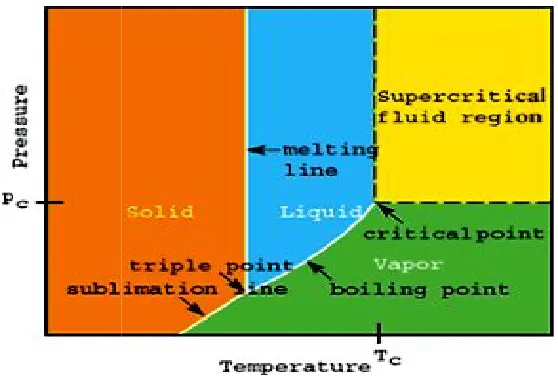
Supercritical fluid may be defined from a phase diagram for a pure substance (Fig.1), in which the regions corresponding to solid, liquid and gaseous state are clear. A substance such as CO 2 can exist in solid,
Sunitha. Pet al/JGTPS/Volume 3, Issue3,
Fig. 1
Important Properties of Super Critical Fluids:
SCFs have high densities (0.2-0.5gm/cm due to which they have a remarkable ability to dissolve large, non-volatile molecules, for example, SC - CO 2 readily dissolves n
alkanes containing 5 to 30 carbon atoms, di n-alkyl phthalates with dialkyl group containing 4-16 carbon atoms and several polycyclic and aromatic compounds with many rings. Solvation strength of SCF is directly related to the fluid density. Thus solubility of solid can be manipulated by making slight changes in temperatures and pressures. Certain important processes are based upon the high solubility of organic species in SC -CO 2 , for example; it has
been employed for extracting caffeine from coffee beans to get decaffeinated coffee and for extracting nicotine from cigarette
et al/JGTPS/Volume 3, Issue3, July-September 2012
Fig. 1: Phase Diagram for Pure Substance
Super Critical
0.5gm/cm 3 ) due to which they have a remarkable ability volatile molecules, for readily dissolves n-alkanes containing 5 to 30 carbon atoms, di-alkyl phthalates with didi-alkyl group
16 carbon atoms and several olycyclic and aromatic compounds with many rings. Solvation strength of SCF is directly related to the fluid density. Thus solubility of solid can be manipulated by making slight changes in temperatures and pressures. Certain important processes are upon the high solubility of organic , for example; it has been employed for extracting caffeine from coffee beans to get decaffeinated coffee and for extracting nicotine from cigarette
tobacco. A second important property of SCFs is that dissolved analytes can be easily recovered by simply allowing the solutions to equilibrate with the atmosphere at low temperatures, for example an analyte dissolved in the SC- CO 2 can be recovered
by simply reducing the pressure and allowing evaporating under ambient laboratory conditions. This property is particularly useful with thermally unstable analytes. Another advantage of many SCFs is that they are inexpensive, innocuous, ecofriendly and non-toxic. With SCFs at hand, there is no need of any organ solvents. SCFs are finding applications in fractionation of low vapour pressure oils, in several reactions in different areas of biochemistry, polymer chemistry, environmental sciences as well as food, polymer and material industries
815 2012
816
Table I: SCFs have densities, viscosities and other properties that are intermediate between those of a substance in gaseous and liquid state
Property Gas (STP) SCF Liquid
Density (g/cm 3 ) (0.6-2) x 10 -3 0.2-0.5 0.6-2
Diffusion coefficient (1-4) x 10 -1 10 -3 x 10 - 4 (0.2-2) x 10 -5 Viscosity (G Cm -1 s -1 ) 1-4) x 10 - 4 (1-3) x 10 - 4 (0.2-3) x 10 -2
Table II: Critical properties of some commonly used SCFs
FLUID CRITICAL
TEMPERATURE (K) PRESSURE (BAR)CRITICAL
Carbon dioxide 304.1 73.8
Water 647.3 221.2
Cyclohexane 553.5 40.7
The two supercritical fluids of particular interest are carbon dioxide and water.
Carbon dioxide: It is a non-flammable, nontoxic and ecofriendly solvent with low critical temperature of 304K and moderate critical pressure of 73bar.It is miscible with variety of organic solvents and is readily recovered after processing. As it’s a small and linear molecule, it diffuses faster than conventional liquid solvents. It is often used to replace freons and certain organic solvents.
Water:It has a critical temperature of 647K and critical pressure of 220bar due to its high polarity. The character of water at supercritical conditions changes from one that supports only ionic species at ambient conditions to one that dissolves paraffins, aromatics, gases and salts. Due to this unique property, research has been carried out on supercritical water for reaction and separation processes to treat toxic wastewater. Control of reactions that depend on the dielectric constant of a medium is
also possible in supercritical water as its dielectric constant changes from about 78 at room temperature and atmospheric pressure to roughly 6 at critical conditions.
Supercritical Fluid Chromatography
817 Sunitha. Pet al/JGTPS/Volume 3, Issue3, July-September 2012
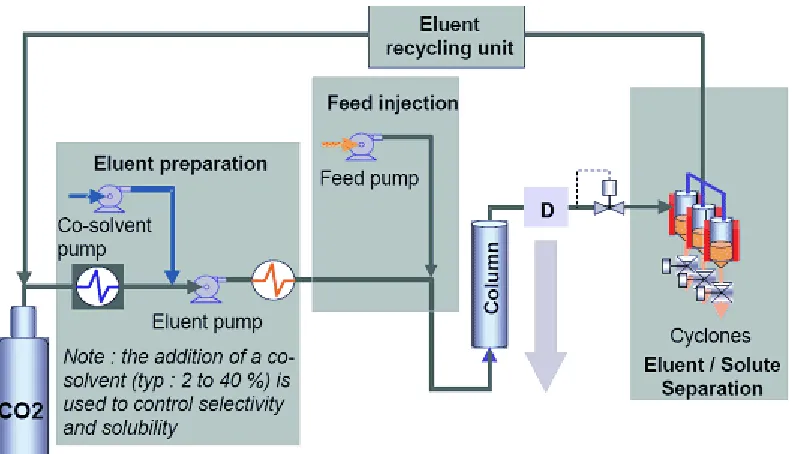
compressed into the desired pressure and adjusted to the required solvent power and separation selectivity. The mixture to be separated is injected into the compressed eluent just before the column inlet. Then the compressed and heated eluent elutes the mixture through a chromatographic column maintained at the same temperature as eluent. this temperature should be near the critical temperature, for which supercritical fluid exhibits its high tuneable properties. The eluent leaving the column is then
decompressed below its critical pressure and the supercritical solvent is transformed in to a gas phase. The gaseous carbon dioxide can then be cleaned, condensed and recycled..Achieving suitable selectivity with pure co2 requires too high pressures, so CO2
is mixed with co solvent modifier.Correct co solvent selection will enhance solvent power and selectivity of separations.
Fig 2: Principle involved in S.F.C
Resolutions using SFC are 3 to 5 times faster than with HPLC. In addition, as the CO2 evaporates, the isolation of the
compound of interest is also very quick. In the lab, this technique uses 3 to 20 times less organic solvent than for HPLC. Moreover, in well engineered preparative SFC systems, the CO2 is recycled, further improving the
process economics and reducing its environmental impact, making it a green separation process in the lab and in the pilot
plant. SFC is a very quick chromatography technique and, thus, ideal in early development to produce grams to multi-kg amounts of desired products.
SFC instrumentation
818 several gases or liquids lie well within the
operating limits of HPLC equipment However, there are two main differences between the two. First, a thermostated oven similar to that of GC, is required to provide precise temperature control of the mobile
phase and second, a restrictor or a back pressure device to maintain the pressure in the column at a desired level and to convert the eluent from SCF to a gas for transfer to detector 7 .
Fig.3: Flow Diagram of Construction of SFC Instrument
In SFC, the mobile phase is initially pumped as a liquid and is brought into the supercritical region by heating it above its supercritical temperature before it enters the analytical column. It passes through an injection valve where the sample is introduced into the supercritical stream and then into the analytical column. It is maintained supercritical as it passes through the column into the detector by a pressure restrictor placed either after the detector or at the end of the column.
Pumps:
819 Sunitha. Pet al/JGTPS/Volume 3, Issue3, July-September 2012
Injector:
Injection in SFC is usually achieved by switching of the content of a sample loop into the carrier fluid at the column entrance by means of a suitable valve. For packed column SFC, a conventional HPLC injection system is adequate, but for the capillary column SFC, the sample volume depends on column diameters and small sample volumes must be quickly injected into the column, therefore pneumatically driven valves are used.
Oven:
A thermostated column oven is required for precise temperature control of the mobile phase. Conventional GC or LC ovens are generally used.
Columns:
The strong solvating abilities of mobile phase in SFC makes the careful selection of stationary phases imperative. Basically two types of analytical columns are used in SFC, packed and capillary. Earlier work employed absorbents such as alumna, silica or polystyrene or stationary phases insoluble in SC -CO 2 . More recent
packed column work has involved bonded non-extractable stationary phases such as octadecylsilyl (C 18 ) or aminopropyl bonded
silica.
Restrictor or Back-Pressure Device
This is a device, which is used to maintain desired pressure in the column by a pressure-adjustable diaphragm or controlled nozzle so that the same column-outlet pressure is maintained irrespective of the mobile phase pump flow rate. It keeps the mobile phase supercritical throughout the
separation and often must be heated to prevent clogging. The pressure restrictor is placed either after the detector or at the end of the column. A typical restrictor for a 50 or 100 µm open tubular column consists of a 2-10 cm length of 5-19 capillary tubing attached to the column. Alternately the restriction may be integral part of the column formed by drawing down the end of the column in the flame.
Microprocessor:
The commercial instruments for SFC are ordinarily equipped with one or more microprocessors to control such variables as pumping pressures, oven temperature and detector performance.
Detector:
SFC utilizes mobile phases, which can either be liquid like or gas like. Therefore it is compatible with both HPLC and GC detectors. Conventional gas-phase detectors such as flame ionization detectors and flame photometric detectors, liquid-phase detectors like refractive index detectors, ultraviolet-visible spectrophotometric detectors and light scattering detectors have been employed for SFC. Mass spectrometry and Fourier transform infrared spectrometry can also be used effectively with SFC.The choice of detectors will depend upon the mobile phase composition, column type, flow rate and ability to withstand the high pressures of SFC.
Effect of Pressure:
820 increases and correspondingly its solvating
power increases. This in turn shortens the elution time for the eluent as pressure changes in SFC have a pronounced effect on the retention of analytes. This effect is general and similar to programmed temperature in GC or gradient elution in HPLC.
Mobile Phase:
There are a number of possible fluids, which may be used in SFC as a mobile phase. However, based on its low cost, low interference with chromatographic detectors and good physical properties (nontoxic, nonflammable, low critical values) CO 2 is
the most used mobile phase for SFC. It is an excellent solvent for a variety of nonpolar organic molecules. In addition, it transmits in the UV. It permits a wide selection of temperatures and pressures without exceeding the operating limits of modern HPLC equipments.
Modifiers11-14
CO 2 is not a very good solvent for high
molecular weight, ionic and polar analytes. This can be overcome by adding a small portion of a second fluid called modifier fluid. This is generally an organic solvent, which is completely miscible with carbon dioxide (alcohols, cyclic ethers) but can almost be any liquid including water. Therefore in some applications methanol is introduced in small concentrations (1-20 %) to modify solvation power of CO 2.
Including chemical additives like acids and bases in the modifier can further enhance the solubility. Modifiers can also enhance selectivity of separation and improve separation efficiency by blocking some of the highly active sites on the stationary phase. Small amount (3.5%) of methanol to CO 2 increases solubility of cholesterol. If an
analyte is only soluble in an aqueous solution, it is probably a poor candidate for SFC. Apart from methanol other solvents are also used as modifiers like acetonitrile, ethanol and1-propanol. For highly retained nonpolar solutes, modifiers increase the column efficiency. For polar solutes, they improve retention and efficiency.
821 Sunitha. Pet al/JGTPS/Volume 3, Issue3, July-September 2012
Exclusive CO2recycling devices:
CO2 recycling after solute separation is standard design for preparative SFC systems. If not, CO2 consumption would
easily exceed 10 or even 20 kg of liquefied gas per hour for a preparative SFC system equipped with a 50 mm I.D. column. Systems are equipped with a robust and efficient CO2 recycling device that reduces
the required quantities of fresh CO2by 10 to
20 times. Except for analytical and small
preparative instruments, CO2 should be
recycled; otherwise carbon dioxide consumption would easily exceed 10 or even 20 kg of liquefied gas per hour for a preparative SFC system equipped with a 50 mm I.D. column. Furthermore, selectivity is governed also by CO2 polar modifier and
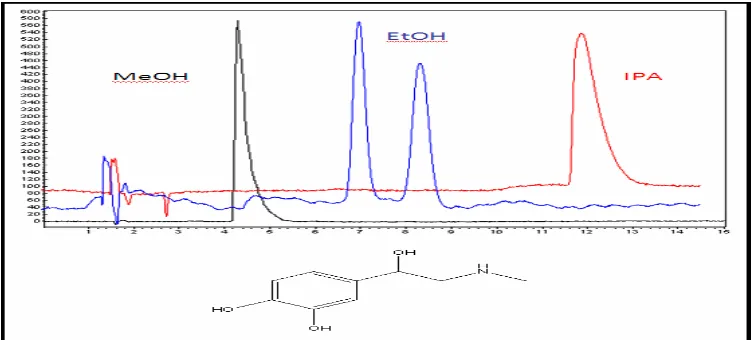
predictions of the most effective modifier must be determined by mostly trial and error as illustrated in Figure 5 where one of three low molecular weight alcohols has a unique dramatic effect on resolution of an enantiomeric pair.
APPLICATIONS:
Separation of polymers 11
It is difficult to separate large molecular weight compounds, large biomolecules and polymers by HPLC but as SFC has combined features of GC and LC techniques, it is capable of their separation at low temperature. SFC is used for the analysis of fluorinated polymers like Polymethyl-333-trifluoropropylsiloxane which is difficult due to their insolubility with common solvent for HPLC analysis
F
Separation of thermally labile pesticides
The most important application of SFC is the separation of thermally labile pesticides without resorting to sample derivatization. As GC has limitation that it can only be used for the separation of volatile and thermostable compounds, analysis and purification of low to moderate molecular weight, thermally labile It is difficult to separate large molecular weight compounds, large biomolecules and polymers by HPLC but as SFC has combined features of GC and LC techniques, it is capable of their separation . SFC is used for the analysis of fluorinated polymers like
trifluoropropylsiloxane which is difficult due to their insolubility with common solvent for HPLC analysis
and their nonvolaitility for GC analysis. Polynuclear aromatic hydrocarbo
automobile exhaust, polyole antioxidants /light stabilizers and polyethox ylated alkylphenols are analysed successfully by using SFC. Various dimethyl polysiloxane oligomers and polycyclics aromatic hydrocarbon extracted from carbon black using
detection can be separated. Silanised polyglycerols can also be analysed.
Fig: 6-SFC Separation of Sample
Separation of thermally labile pesticides:
The most important application of SFC is the separation of thermally labile pesticides without resorting to sample derivatization. As GC has limitation that it can only be used for the separation of volatile and thermostable compounds, ation of low to moderate molecular weight, thermally labile
molecules and non-volatile compounds is done by SFC. Various pesticides belonging to different classes, triazines (ametryne, atrazine), carbamates (carbofuran) and sulfonylureas (chlorsulfuron, me
methyl and benzsulfuron methyl) are detected and quantified in soil by packed column supercritical fluid chromatography interfaced with atmospheric pressure chemical ionisation mass spectrometry .
822 and their nonvolaitility for GC analysis. Polynuclear aromatic hydrocarbons in automobile exhaust, polyole-finic antioxidants /light stabilizers and polyethox-ylated alkylphenols are analysed successfully by using SFC. Various dimethyl polysiloxane oligomers and polycyclics aromatic hydrocarbon extracted from carbon black using fluorescence detection can be separated. Silanised polyglycerols can also be analysed.
Sunitha. Pet al/JGTPS/Volume 3, Issue3, Fig 7:SFC Separation
Separation of fatty acids, triglycerides and lipids 16-18
Geometric isomers of fatty acids can be separated by open tubular columns in SFC along with quantification of triglycerides. Analysis of mono-, di- and triglyceride mixtures in several pharmaceutical excipients can be performed using capillary SFC with carbon dioxide as mobile phase and flame ionization detection. The fatty acids like fatty acid methyl esters, (FAMEs) or free fatty acids, (FFAs) can be separated by supercritical fluid chromatography (SFC) using pure CO2. Capillary-SFC is used to analyze various natural and processed fish oil triglyceride mixtures. As a result, free fatty acids, squalene, esters, cholesteryl esters, di-and triglycerides get separated. This analysis is not possible by gas chromatography or high-performance liquid chromatography methods without prior treatment of the fish oil, thus making SFC superior for this application Carbon dioxide is effectively used for the separation of lipids of high molecular weight like triacylglycerols without thermal cracking like GC or relatively long elution time like
et al/JGTPS/Volume 3, Issue3, July-September 2012 Separation of thermally labile Pesticides
Separation of fatty acids, triglycerides
Geometric isomers of fatty acids can be separated by open tubular columns in SFC with quantification of triglycerides. and triglyceride mixtures in several pharmaceutical excipients can be performed using capillary SFC with carbon dioxide as mobile phase and flame ionization detection. The fatty acid methyl esters, (FAMEs) or free fatty acids, (FFAs) can be separated by supercritical fluid chromatography (SFC) SFC is used to various natural and processed fish oil triglyceride mixtures. As a result, free ds, squalene, esters, cholesteryl and triglycerides get separated. This analysis is not possible by gas performance liquid chromatography methods without prior treatment of the fish oil, thus making SFC pplication Carbon dioxide is effectively used for the separation of lipids of high molecular weight like triacylglycerols without thermal cracking like GC or relatively long elution time like
HPLC. Paraffin wax, free fatty acids, mono di-and triacylglycerols and detergents like Triton X-100 can be separated without thermal cracking using pressure programming and a high degree of quantification is also observed. Separation, identification and quantification of triacylglycerols can be easily performed using SFC-MS. various
glycosphingolipids, archae can also be analyzed.
Chiral and achiral separations
The first demonstration of a chiral separation by SFC took place in 1985. SFC is widely used in chiral separations becau of easier and faster method development, high efficiency, superior and rapid separations of a wide variety of analytes, extended-temperature capability, analytical and preparative-scale equipment improvements and a selection of detection options. A number of chiral molecules can be analysed using SFC due to its high column efficiency at normal flow rates. SFC is used for rapid enantiomer resolution of large numbers of compounds in a very less time by using methanol and isopro
823 2012
HPLC. Paraffin wax, free fatty acids, mono-, rols and detergents like 100 can be separated without thermal cracking using pressure programming and a high degree of quantification is also observed. Separation, identification and quantification of triacylglycerols can be easily performed phospholipids, glycosphingolipids, archae-bacterial lipids
Chiral and achiral separations 19-21
824 used as modifiers. The compounds which
are not completely separated by reverse-phase or normal reverse-phase chromatography are successfully separated by SFC due to its unique properties. As it offers a higher success rate, performance and throughput for chiral separations of new compounds, it contributes in drug development and drug discovery. Negligible interferences from achiral impurities, enantiomeric excess determined with much lower detection limits than UV and much shorter analysis times compared to other separation techniques makes SFC– MS superior. A new concept of rapid chiral method development using sample pooling and supercritical fluid chromatography– mass spectrometry (SFC– MS) on four chiral stationary phases, namely Chiralpak AD and AS, and Chiralcel OJ and OD, and eight different modifier concentrations (5 to 40% methanol– 0.2% isopropylamine) has also been reported. Moreover, the higher diffusivity and lower viscosity of supercritical and near-critical fluids leads to faster analysis with improved resolution for chiral separations. A packed column supercritical fluid chromatography (SFC) method for the separation of ibuprofen enantiomers on a chiral stationary phase and CO2 with modifier as mobile phase has been developed. The use of SFC in achiral separations is a novel approach. Here, several achiral methods have been optimised and batches of compounds purified using a retention time mapping strategy. It allows fast analytical purity analysis without compromising the ability to scale up to the preparative system, leading to drug discovery. SFC 22-30 is used for high throughput screening and purifications of pharmaceuticals. It has become a technique for solving problems that are difficult to be monitored by other GC and LC techniques. With pure supercritical CO2, it is difficult to analyze polar samples so polar modifiers are
added to supercritical CO2 for their separation like the separation of vitamins is possible by supercritical fluid chromatography using water-modified carbon dioxide as the mobile phase. Various aliphatic and aromatic mono-hydroxamic acids can be separated by SFC using methanol modified CO2 on a diol column. Using supercritical fluids CO2 and water, fine particles like micro and nanoparticles can be formed because chemical and physical properties of solvent can be varied with temperature or pressure that ultimately affect the degree of super-saturation and nucleation. Various stereoisomers (enantiomers and geometrical isomers) of furan derivatives which are important intermediates for the synthesis of physiologically active natural products can be separated. Thermally unstable furan derivatives can also be separated. Dexamethasone and betaniethasone, prednisolone, and cortisone and hydrocortisone can be resolved by using a methylpolysiloxane open tubular capillary column and SF CO2 as the mobile phase. Phencyclidine-dine, methaqualone, methadone, propoxyphene, erythromycin, atenolol, and oxytetracyclin and many other drugs are analyzed by SFC. Biodegradable particle formation for drug and gene delivery using supercritical fluid and dense gas is a remarkable application of SFC that makes it important in pharmaceuticals.
Isotope separation by supercritical fluid chromatography:
Sunitha. Pet al/JGTPS/Volume 3, Issue3, Lithium isotope separation by displacement
chromatography was performed with a resin packed column of 0.8 cm inner diameter and 100 cm length at 293 K under the pressure of 10, 12, 15 and 18 kPa. Lithium
lithium-6 were enriched in the soluti
Fig. 8:Correlation
CONCLUSION:
Thus SFC has found a niche in the field of pharmaceutical chemistry and has gained much support in the field of bioanalytical applications. In the overall ranking of chromatographic techniques, it has been judged that SFC falls somewhere between HPLC and GC as the chromatographic method of choice. There are too many examples in the literature testifying to the practicality of using SFC to separate specific compounds. The list of compounds separated by SFC is increasing day by day. SFC enjoys many advantages ove existing chromatographic techniques. But the most important contribution that SFC has made is towards separation of chiral compounds. SFC is enjoying great success in meeting the challenges of stereoisomer separation and may have already surpassed HPLC in the ability to provide appreciable
et al/JGTPS/Volume 3, Issue3, July-September 2012 Lithium isotope separation by displacement
chromatography was performed with a resin packed column of 0.8 cm inner diameter and 100 cm length at 293 K under the pressure of 10, 12, 15 and 18 kPa. Lithium-7 and 6 were enriched in the solution
phase and in the resin phase, respectively. Enrichment factor became minimum at 15 MPa, though the difference between the values under each pressure was not large. Enrichment factor was obtained as 0.002 0.012.
Correlation between pressure and enrichment factor.
SFC has found a niche in the field of pharmaceutical chemistry and has gained much support in the field of bioanalytical applications. In the overall ranking of chromatographic techniques, it has been judged that SFC falls somewhere between the chromatographic method of choice. There are too many examples in the literature testifying to the practicality of using SFC to separate specific compounds. The list of compounds separated by SFC is increasing day by day. SFC enjoys many advantages over the existing chromatographic techniques. But the most important contribution that SFC has made is towards separation of chiral compounds. SFC is enjoying great success in meeting the challenges of stereoisomer separation and may have already surpassed LC in the ability to provide appreciable
selectivity of molecular stereoisomers. The biggest advantage that SFC holds over GC is the ability to separate thermally labile compounds, which is a very significant application in the pharmaceutical field as 20% of all drug candidates fall in this category. With the advent of SFC
picogram per milliliter concentrations can be detected easily which is not possible with other techniques. The enforcement of strict quality standards has produced a need for fast, complete and sensitive analysis of drug candidate. SFC can provide the fast and complete analysis and MS can provide universal, sensitive detection. SFC shows great potential in the field of bioanalytical chemistry, but especially in chiral separation and detection. As the science advances, it would be reasonable to foresee the practicality of this analytical technique reach into mainstream of analytical chemistry.
825 2012
phase and in the resin phase, respectively. Enrichment factor became minimum at 15 MPa, though the difference between the values under each pressure was not large. Enrichment factor was obtained as
826
REFERENCES:
1. Willard, Merritt, Dean, settle, Instrumental methods of analysis, 7th edition:513-516
2. "Green Chemistry". United States Environmental Protection Agency. 2006-06-28. Retrieved 2011-03-23. 3. The 12 Principles of Green
Chemistry". United States Environmental Protection Agency. Retrieved 2006-07-31.
4. Smith R. M.; Nomenclature for supercritical chromatography and
extraction, IUPAC
Recommendations, Pure Appl. Chem. 1993, 65(11), 2397-2403. 5. R.S Khandpur hand book of
analytical instruments 2ndedition 435 6. Skoog, holler, niemanPrinciples of
instrumental analysis, fifth edition 768-774
7. Robert d Braun, Introduction to instrumental analysis 926-927
8. Chromatographic analysis of pharmaceuticals 2nd edition revised and expanded. Edited by john A Admovics volume 74.
9. Sandie Lindsay High performance liquid chromatography 2nd edition 319-323
10. Peter J dunn,Andrew s wells Michael T Williams Green Chemistry in the pharmaceutical industry 243-254 11. Dixon D. J. and Jhonston K. P.;
Encyclopedia of Separation Technology, Ruthven D. M.Ed., John Wiley, 1997, 1544-1569.
12. Raymond Scott PW. Liquid Chromatography for the Analyst. Marcel Dekker. 1994; 7.
13. Zou W., Dorsey J.G. et al., Modifier effects efficiency in packed-column supercritical fluid chromatography.
Anal. Chem . 2000, Aug 1, 72 (15): 3620-3626.
14. Chromatography: Concepts and Contrasts, Miller J.M.Ed., 2 nd edition, Wiley Publishers, 2004, 52-54.
15. Jiang C., Ren Q. et al., Study on retention factor and resolution of tocopherols by supercritical fluid chromatography, J. Chromatogr. A.
2003, Jul 11, 1005 (1-2): 155-164. 16. Giron D., Link R. et al., Analysis of
mono-, di- and triglycerides in pharmaceutical excipients by capillary supercritical fluid chromatography, J. Pharm. Biomed. Anal . 1992, Oct-Dec, 10 (10-12): 821-830.
17. Blomberg L.G., Demirbuker M. et al., Characterization of lipids by supercritical fluid chromatography and supercritical fluid extraction, In, Lipid analysis in oils and fats, Hamilton R.J. ed., Blackie, London, 1998, 34-58.
18. Matsumoto K. and Taguchi M., Supercritical fluid chromatographic analysis of lipids, In Lipid chromatographic analysis, Shibamoto T. Ed. Dekker NY, 1993, 365-396
19. Li H. and Hu X., Chiral drug separation by supercritical fluid chromatography, Se. Pu. 1999, Mar, 17(2): 166-170.
20. Johannsen M., Separation of enantiomers of ibuprofen on chiral stationary phases by packed column supercritical fluid chromatography, J. Chromatogr. A. 2001, Dec7, 937(1-2): 135-138.
827 Sunitha. Pet al/JGTPS/Volume 3, Issue3, July-September 2012
performance liquid chromatography, a comparitive study, J. Biochem. Biophys. Methods. 2002, Dec 31, 54 (1-3): 251-260.
22. Separation of vitamins by supercritical fluid chromatography with water modified CO 2 as mobile
phase, J. Biochem. Biophys. Methods. 2000, Jul 5, 43 (1-3): 113-123.
23. Guo Y.D., Determination of caffeine in teas by supercritical liquid chromatography, Se. Pu . 2002, Jan 20(1): 75-77.
24. Scalia S. and Games D.E., Analysis of conjugated bile acids by packed column supercritical liquid chromatography, J. Chromatogr.
1992, Feb 14, 574 (2): 197-203. 25. Sandra P., David F. et al.,
Supercritical fluid chromatography. Smith R. M., Ed., Royal society of chemistry, London. 1980, 137-158. 26. Morrisey M.A. and Hill H.H.Jr.,
Selective determination of underivatized 2,4-dichlorophenoxy acetic acids in soil by supercritical fluid chromatography with ion
mobility determination , J. Chromatogr Science. 1989, Sep 27(9): 529-533.
27. Simon P. and Nicot T., Capillary electrophoresis and supercritical chromatography, complementry and alternative technique for the determination of urinary metabolites of styrene, J.Chromatography. B. Biomed. Appl. 1996, Apr 26, 679 (1-2): 103-112.
28. Toribio L., Bernal J. L. et al., Application of Chiralpak AD and Chiralcel OD chiral columns in enantiomeric separation of several dioxolane compounds by supercritical fluid chromatography, J. Chromatography. A. 2001, Jul 6, 921 (2): 305-313.