Available Online At www.ijpret.com
INTERNATIONAL JOURNAL OF PURE AND
APPLIED RESEARCH IN ENGINEERING AND
TECHNOLOGY
A PATH FOR HORIZING YOUR INNOVATIVE WORK
STATUS OF MUNICIPAL SOLID WASTE MANAGEMENT IN INDIA: CURRENT
OPTIONS AND FUTURE PERSPECTIVE
AMIT G. PANDEY
Bipin Tripathi Kumaon Institute of Technology (An Autonomous College of Govt. of Uttarakhand) Dwarahat, Almora, Uttarakhand, India.
Accepted Date:
27/02/2013 Publish Date:
01/04/2013
Keywords
Solid waste, Incineration, Energy, Biogas, Pyrolysis,
Anaerobic Digestion
Corresponding Author Mr. Amit G. Pandey
Abstract
In last few decades as a result of increased population and industrialization the generation of MSW and its treatment and disposal has become a serious problem for the government. At present, India
produces 42.0 million tons of municipal solid waste annually and
per capita waste generation has increased by 1.3% per annum with urban population increased between 3 – 3.5% per annum and yearly increase in waste generation is around 5% annually. The main reasons for improper management of MSW in India include lack of planning, technically trained manpower, community involvement and awareness creation mechanism etc. In recent years government has taken strict decision to handle this problem in a safe and environment friendly manner. Organic fraction of the waste (biodegradable as well as non-biodegradable) can also be converted into energy using thermo-chemical conversion and bio-thermo-chemical conversion. Various environment friendly and economic technologies are being adopted in India to handle
this problem like incineration, pyrolysis, Biocomposting,
Available Online At www.ijpret.com INTRODUCTION
The generation of municipal solid waste in
India is a serious environmental problem for
its disposal. As we know that the need of
energy is also increasing day by day and to
full fill this growing energy need research
interest has been shifted towards green
energy. Conversion of Municipal solid waste
into energy using microorganisms can be
considered as an environment friendly and
cheap technology. At present, the main
feedstock for the generation of electricity
and heat from biomass are forestry,
agricultural and municipal residues, and
wastes. For the production of liquid befouls
sugar, grain, and vegetable oil crops can be
used as feed stocks in small quantities.
Approximately 55 million tons of MSW are
generated in urban areas of India annually
(1.5 lake tones per day) ((1) Kumar et al, 2010). Today, biomass supplies some 50 EJ1 globally, which represents 10% of global
annual primary energy consumption. This is
mostly traditional biomass used for cooking
and heating. India is an agriculturally based
country with a present population of
approximately 1020 million ((2) Union
Health Ministry, 2004). There are 28 states and seven union territories in the country.
Due to rapid industrial growth, the urban
population is increasing rapidly. As a result,
the 677 Class I cities and Class II towns
existing in 1991 have increased to more
than 700 by 2001 ((3) Central Pollution Control Board (CPCB), Annual Report 2002-2003). The quantity of MSW has also increased tremendously with improved life
style and social status of the populations in
urban centers ((4) Sharholy et al., 2007).
The annual waste generation has been
observed to increase in proportion to the
rise in population and urbanization, and
issues related to disposal have become
challenging as more land is needed for the
ultimate disposal of these solid wastes (5) Idris et al., 2004). Solid waste can be defined as no liquid material that no longer
has any value to the person who is
responsible for it. The words rubbish,
garbage, trash, or refuse are often used as
synonyms when talking about solid waste.
In urban areas, solid waste is generated by
domestic households, commercial and
industrial enterprises, and health care and
Available Online At www.ijpret.com
streets. Street refuse contains a mixture of
refuse from many sources, because streets
are used as dumping grounds by all
generators of waste. Where sanitation
facilities are lacking and a large animal
population roams the streets, street refuse
contains a lot of human fecal matter and
manure. Streets are also often used for
extensive dumping of construction and
demolition debris—attracting further
dumping of solid waste.
Adverse impact on all components of the
environment and human health occurs due
to unscientific disposal of MSW [6-9]. The MSW amount is expected to increase
significantly in the near future as India
strives to attain an industrialized nation
status by the year 2020 [10-12].
There is a potential for generation of over
2600 MW of power from urban wastes in
the country. The potential of energy from
MSW is estimated to be 3650 and 5200
MW, by the end of 11th and 12th five year
Plans, respectively. Estimated energy
recovery potential from solid and liquid
waste from industrial sector is about 1300
MW. The energy recovery potential of
industrial waste is expected to increase to
about 1600 MW by 2012 and 2000 MW by
the year 2017 (MNRE, 209-10). It is clear
that technology options for
waste-to-energy are increasing and there will be
teething problems. Appropriate incentives
and regulatory frameworks can provide
scope for experimentation and application
of technology to find environment-friendly
ways of converting waste to energy. By
encouraging municipal waste-to-energy
projects, we can clean our cities by
scientifically disposing of solid waste and
generating electricity and at the same time;
help reduce the large electricity deficit in
Available Online At www.ijpret.com Table 1: Total Municipal Solid Waste
Generation in Major Cities of India
Sr. No. Name of City MSW generation
Tones Per Day
(TPD)
1 Delhi 7400
2 Chennai 3036
3 Kolkata 2653
4 Mumbai 5320
5 Bangalore 1669
6 Hyderabad 2187
7 Ahmedabad 2187
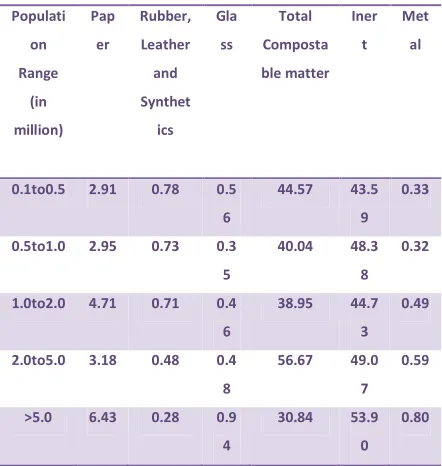
Table 2.Physical Characteristics of
Municipal Solid Wastes in Different Cities of India Populati on Range (in million) Pap er Rubber, Leather and Synthet ics Gla ss Total Composta ble matter Iner t Met al
0.1to0.5 2.91 0.78 0.5
6
44.57 43.5
9 0.33
0.5to1.0 2.95 0.73 0.3
5
40.04 48.3
8 0.32
1.0to2.0 4.71 0.71 0.4
6
38.95 44.7
3 0.49
2.0to5.0 3.18 0.48 0.4
8
56.67 49.0
7 0.59
>5.0 6.43 0.28 0.9
4
30.84 53.9
0 0.80
Source: Background material for Manual on SWM, NEERI, 1996
TREATMENT TECHNOLOGIES FOR MSW IN INDIA
The various treatment and disposal
technologies which are currently in used for
MSW are as follows:
(1) Anaerobic Digestion (AD)
In this process, also referred to as
bio-methanation, the organic fraction of
wastes is segregated and fed to a closed
container (biogas digester) where, under
anaerobic conditions, the organic wastes
undergo bio-degradation producing
methane-rich biogas and effluent/ sludge.
The biogas production ranges from
50-150m3/ tonne of wastes, depending upon
the composition of waste. The biogas can
be utilised either for cooking/ heating
applications, or through dual fuel or gas
engines or gas / steam turbines for
generating motive power or electricity. The
sludge from anaerobic digestion, after
stabilisation, can be used as a soil
conditioner, or even sold as manure
Available Online At www.ijpret.com
determined mainly by the composition of
the input waste.
(2) Incineration
In India the incineration is a poor
option as the waste consists mainly high
organic material (40–60%) and high inert
content (30–50%) also low calorific value
content (800–1100 kcal/kg), high moisture
content (40–60%) in MSW and the high
costs of setting up and running the plants
[18]. The first large-scale MSW incineration
plant was constructed at Timarpur, New
Delhi in 1987 with a capacity of 300 t/day
and a cost of Rs. 250 million (US$5.7
million) by Miljotecknik volunteer,
Denmark. The plant was out of operation
after 6 month and the Municipal
Corporation of Delhi was forced to shut
down the plant due to its poor
performance. Small incinerators, in many
cities in India, are being used for burning
hospital waste however [9, 13, and 14].
The RDF and the fuel pelletisation were the
first generation waste-to-energy products,
which were not environment friendly and
therefore not welcome. Burning these
products in an uncontrolled manner
(without requisite pollution control
equipments for energy) released harmful
gases in the environment. The second
round of waste-to-energy plants faced the
challenge from the mixed nature of Indian
waste, which had very low calorific value.
The Timarpur plant in the 1980s failed
mainly because the technology was
designed for segregated waste but it had to
handle mixed waste. The Lucknow
biomethanation plant in the 1990s failed
because, again, it could handle only wet
segregated waste but had to cope with
mixed waste. Fortunately, in more recent
years, the technology options in converting
Indian solid waste into energy have
expanded.
(3) Paralysis
Paralysis converts portions of municipal
solid wastes, hazardous wastes and special
wastes such as tires, medical wastes and
even old landfills into solid carbon and a
liquid or gaseous hydrocarbon stream. The
typical paralysis process heats a
carbonaceous waste stream to 290 - 900°C
in the absence of oxygen and reduces waste
Available Online At www.ijpret.com
The solid carbon char has existing markets
as an ingredient in many manufactured
goods and as an adsorbent or filter to
sequester certain hazardous waste
components. Paralytic gases may be burned
as fuel by utilities or liquefied for use as
chemical feedstock or constituents of
low-pollution motor vehicle fuels.
(4) Sanitary Landfills
11 secure landfills exist in India and
additional 74 sites are identified. Municipal
Solid Waste is simply dumped without any
treatment into land (depressions, ditches,
soaked ponds) or on the outskirts of the city
in an unscientific manner with no
compliance to regulations .A preliminary
assessment of the potential for an LFG
utilization project was performed for the
Hyderabad Landfill (Landfill) in Hyderabad,
India, based on information provided by the
Landfill engineer and observations made
during a site visit on February 19, 2007. A
preliminary assessment of the potential for
an LFG utilization or flaring only project was
also performed for the Okla. Landfill in Delhi
based on information provided by the City
and observations made during a site visit on
February 21, 2007. So far at present only
one largest Sanitary Landfill site is planned
in India at Gaspar Ahmedabad.
(4.1) Land filling as per MSW Rules, 2000
Disposal Of Residual Solid Wastes On Land
In A Facility Designed With Protective
Measures Against Pollution Of Ground
Water, Surface Surface Water And Air
Fugitive Dust, Wind-blown Litter, Bad Odor,
Fire Hazard, Bird Menace, Pests Or Rodents,
Greenhouse Gas Emissions, Slope Instability
And Erosion
MSW Rules 2000, Government of India
MSW rules 2000 made by the Government
of India to regulate the management and
handling of municipal solid wastes (MSW)
provide a framework for treatment and
disposal of MSW. These rules were the
result of a ‘Public Interest Litigation (PIL)’ in
the Supreme Court of India (SC). The MSW
rules 2002 and other documents published
by the Government of India (GOI)
recommend adoption of different
technologies, which include
biomethanation, gasification, paralysis,
Available Online At www.ijpret.com
(RDF), waste-to-energy combustion (WTE),
sanitary landfills (SLF). However, the
suitability of technologies to Indian
conditions has not been sufficiently studied,
especially with regard to the sustainable
management of the entire MSW stream and
reducing its environmental and health
impacts.
CONCLUSION
India produces annually around 960 MT of
solids wastes from different activities like
industrial mining, agricultural and domestic,
the requirement of large land area for its
disposal is not only matter of great concern
but it poses serious environmental
problems also. This huge quantity of wastes
can be used in secondary industries to
produce construction materials using this
waste as minerals or resources, this will not
only solve the problem of its disposal but
also help to minimize the generation of
solid waste from secondary industries. The
Municipal Solid Waste (Management and
Handling) Rules of the Government of India
had laid down the norms for collection,
segregation, processing and disposal of
waste in 2000. Thirteen years have elapsed,
but the rules are still observed more in the
breach. Door-to-door collection of
municipal waste covers at most only about
a half of the total waste, and segregation at
the household level is a rarity. Collection
from the community bins is not regular, and
scientific processing is limited to a very
small portion of the waste.
Finally, solid waste provides enormous
benefits and can contribute significantly in
the national energy mix at least economic,
environmental and social costs and it is
expected that the share of solid waste in
the total Bioenergy generation capacity will
increase in future.
REFERENCES
1. Kumar Gaurav, Loganathan Karthik and
Kokati Venkat Bhaskara Rao,(2010),
Antimicrobial Activity of Latex of Calotropis
Gigantea Against Pathogenic
Microorganisms - An In Vitro Study,
pp155-163
2. National Health Accounts Cell Ministry
of Health and Family Welfare Government
Available Online At www.ijpret.com
3. Central Pollution Control Board (CPCB),
Annual Report (2002-2003)
4. Sharholy Mufeed, Ahmad Kafeel,
Mahmood Gauhar, Trivedi R.C., (2007) A Municipal solid waste management in
Indian cities – A review, Science Direct
waste management 27,pp 490-496
5. Gupta S., Choudhary N. and Alappat B.J.,
(2007),”Bioreactor Landfill for MSW Disposal in Delhi” Proceedings of the
International Conference on Sustainable
Solid Waste Management, Chennai, India.
pp. 474-481.
6. Jha, M.K., Sondhi, O.A.K., Pansare, M.,
(2003) Solid waste management – a case study. Indian Journal of Environmental
Protection 23 (10), pp 1153–1160.
7. Rathi, S. (2006) Alternative approaches for better municipal solid waste
management in Mumbai, India. Journal of
Waste Management 26 (10), pp1192–1200.
8. Ray, M.R., Roychoudhury, S.,
Mukherjee, G., Roy, S., Lahiri, T., (2005)
Respiratory and general health impairments
of workers employed in a municipal solid
waste disposal at open landfill site in Delhi.
International Journal of Hygiene and
Environmental Health 108 (4), pp 255–262.
9. Sharholy, M., Ahmad, K., Mahmood, G.,
Trivedi, R.C., (2005). Analysis of municipal solid waste management systems in Delhi –
areview. In:Book of Proceedings for the
second International Congress of Chemistry
and Environment, Indore, India, pp. 773–
777.
10.Sharma, S., Shah, K.W., (2005).
Generation and disposal of solid waste in
Hoshangabad. In: Book of Proceedings of
the Second International Congress of
Chemistry and Environment, Indore, India,
pp. 749–751.
11.CPCB, (2004) Management of Municipal Solid Waste. Ministry of Environment and
Forests Shekdar, A.V., (1999) Municipal solid waste management – the Indian
experience.
12.Dayal, G., (1994) Solid wastes: sources, implications and management. Indian
Journal of Environmental Protection 14 (9),
669–667
Available Online At www.ijpret.com
Protection 16 (1), 1–11.2009-10 MNRE
annual report on Solid waste management