Organized by S.V.B.I.T., Gandhinagar. Available Online at www.ijpret.com71
INTERNATIONAL JOURNAL OF PURE AND
APPLIED RESEARCH IN ENGINEERING AND
TECHNOLOGY
A PATH FOR HORIZING YOUR INNOVATIVE WORK
DEVELOPMENT OF OUTPUT AND PERFORMANCE BASED ROAD CONTRACT
(OPRC) MODEL FOR MAINTAINANCE AND MANAGEMENT OF ROADS
JAYKUMAR SONI1, RAJESH GUJAR2, TEJASKUMAR THAKER2, SAGAR DESHMUKH3,
MAHESH H. M.3
1. M. Tech Student (Infrastructure Engineering and Management), Dept. Of Civil Engg, PDPU, Gandhinagar 2. Assistant Professor, Department Of Civil Engineering, Pandit Deendayal Petroleum University, Gandhinagar 3. Associate Director, Lea Associates South Asia Pvt. Ltd, Gandhinagar
Accepted Date: 27/01/2018; Published Date: 01/03/2018
Abstract:Road infrastructure is considered as the lifeline of the economy of a country and Its importance in the development of a country cannot be ignored. Creating assets is one aspect and it is one time; but maintaining them is a real challenge for the government. Improperly maintained roads lead to significant raise in vehicle operating costs, increase accident rates and aggravate isolation, poverty, poor health, and illiteracy in rural communities. Reduction in maintenance cost and provision of timely improvement of road transportation is the need for preservation of road infrastructure. Traditional methods of maintaining roads over the years are not giving the required service levels and; In addition, most of the methods are lacking in providing benefits for stakeholders including employer, concessionaire and road user. There is a need of changing the focus towards maintainance and management of Road Network and Output and Performance Based Road Contracts (OPRC) is one of the new methods for the maintainance and management of existing as well as new roads which provides efficient, cost-effective and innovative maintainance service and help maintain roads as assets.
Keywords: Output Based Contracts, Road Maintainance, Road Management, Service Level, Performance Based Management
Corresponding Author: JAYKUMAR SONI
Access Online On:
www.ijpret.com
How to Cite This Article:
Jaykumar Soni, IJPRET, 2018; Volume 6 (7): 71-76
PAPER-QR CODE
SPECIAL ISSUE FOR
NATIONAL LEVEL CONFERENCE
Organized by S.V.B.I.T., Gandhinagar. Available Online at www.ijpret.com72
INTRODUCTION
Importance of Road Maintenance:
The need of maintenance is widely recognized, it is still not getting adequately done.Many countries spend very less of what they should be spending on maintenance of roads. And this phenomenon is widely depicted in developing countries who are focusing on developing new infrastructure rather than maintaining the existing ones.(Burningham and Stankevich, 2005) Despite the importance of roads, many countries are spending less than 50% of required amounts for the maintenance and management of road network. Here, the poor road condition leads to the higher cost of road user and ultimately the user has to spend high amount as a part of rehabilitation cost of existing roads in form of various taxes and tolls (Rohatgi, Specialist and Bank, 2011)
Types of Road Maintenance:
Maintenance comprises of activities to keep pavement, shoulders, slopes, Drainage facilities and other structures within road margin to renewed condition. These maintenances are of three types:
• Routine
• Periodic
• Emergency or Urgent(Burningham and Stankevich, 2005) Routine Maintenance:
Which comprises small-scale works conducted regularly, aims “to ensure the daily pass ability and safety of existing roads in the short-run and to prevent premature deterioration of the roads” (Radović et al., 2008).
Periodic Maintenance:
Which covers activities on a section of road at regular and relatively long intervals, aims “to preserve the structural integrity of the road” (WB Maintenance website). Activities can be classified as preventive, resurfacing, overlay, and pavement reconstruction. Resealing and overlay works are generally undertaken in response to measured deterioration in road conditions(Burningham and Stankevich, 2005).
Urgent maintenance:
It is undertaken for repairs that cannot be foreseen but require immediate attention, such as collapsed culverts or landslides that block a road. Maintenance does not include rehabilitation, building shoulders, or widening roads. (Stankevich, Qureshi and Queiroz, 2005)
Concept of Output and Performance based Road Contracts:
Organized by S.V.B.I.T., Gandhinagar. Available Online at www.ijpret.com73
through service levels. Another major difference is that the contractor is fully responsible for the design of works which are necessary to reach to the required levels (Radović et al., 2008) OPRC is also suitable for Long Term DBOM (Design-Build- Operate-Maintain) which is having its main focus towards Maintainance and Management(Radovic et al., 2014).This Contract is an agreement between Government Department and Private Contractor whereby the private contractor maintains the road to achieve Specified Condition Standards for a certain period of time in return for a fixed payment scheme (Mulmi, 2016).
One of the main objectives of OPRC is that it helps to ensure that variation orders are minimised and that the contractor is generally paid in equal instalments throughput the contract period (Radović et al., 2008). It is a new way of Road Works Contracting and a contract modality for Road Asset Management and Maintainance. (Rao, 2012)
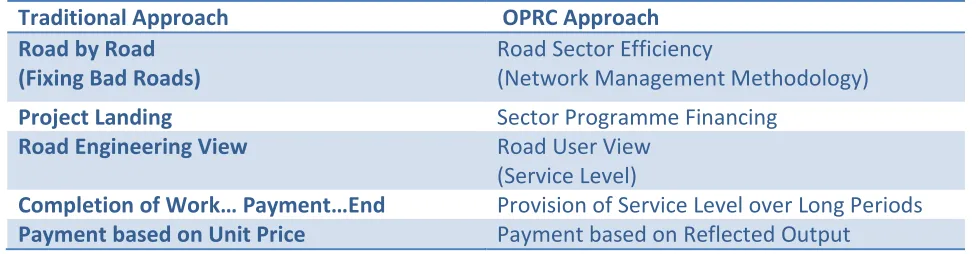
Difference of Approach between Traditional Methods and OPRC:
In traditional method-based contracts, the road agencyas a client normally specifies techniques, technologies,materials and quantities of materials to be used, togetherwith the time period during which the maintenance worksshould be executed. The payment to the contractor isbased on the amount of inputs (e.g., cubic meters ofasphalt concrete, number of working hours)(Stankevich, Qureshi and Queiroz, 2005). Whereas, in performance-based contracting the client does notspecify any method or material requirements. Instead hespecifies performance indicators that the contractor isrequired to meet when delivering maintenance services. According to the World Bank Procurement Guidelines(2004), performance-based procurement, also calledoutput-based procurement, refers to competitive procure(Stankevich, Qureshi and Queiroz, 2005)
For example, the contractor is not paid for the number ofpotholes he has patched, but for the output of his work:no pothole remaining open (or 100% patched). Failure tocomply with the performance indicators or to promptlyrectify revealed deficiencies adversely affects thecontractor's payment through a series of clearly definedpenalties. In case of compliance the payment is regularlymade, usually in equal monthly instalments (Stankevich, Qureshi and Queiroz, 2005).
Table 1.1 Difference between Traditional and OPRC Approach
Traditional Approach OPRC Approach
Road by Road (Fixing Bad Roads)
Road Sector Efficiency
(Network Management Methodology)
Project Landing Sector Programme Financing
Road Engineering View Road User View
(Service Level)
Completion of Work… Payment…End Provision of Service Level over Long Periods
Organized by S.V.B.I.T., Gandhinagar. Available Online at www.ijpret.com74
Source: (Rohatgi, Specialist and Bank, 2011)
Under the OPRC, the contractor has a strong financial incentive to be efficient and effective whenever he undertakes the work (Radović et al., 2008). In order to maximise profits, he must reduce his activities to the smallest possible volumes of intelligently designed interventions which never the less ensure that predefined indicators and service level criteria are achieved and maintained over time and he is free to define what to do, when to do, how to do, where to do.(Radovićet al., 2008)
Importance of Service Level Criteria:
Figure 1.1 Works Related to PBMC Contracts
Here; ‘Service level’ define the desired road performance standards mainly from road users’ perspective. They are the operational conditions of roads. Whereas, ‘Performance Criteria’ should cover all aspects of contract (Rao, 2012). Service level criteria should be defined on the basis of affordability and economically justifications (Rao, 2012). The performance indicators must ideally cover all aspects of contracts, they should be clearly defined and measurable (Radović et al., 2008)
Figure 1.2 Service Level Criteria
The contractor has to ensure that road user get a service level at certain level.
Implementation of OPRC Contracts Worldwide:
Organized by S.V.B.I.T., Gandhinagar. Available Online at www.ijpret.com75
Following are the various countries where Output and Performance Based Contracts have implemented successfully:
Table 1.2 Worldwide Cost Saving in OPRC
Sr. No.
Country Cost Saving (in %)
1 Norway 20-40
2 Sweden +/- 30
3 Finland 30-35
4 Holland 30-40
5 Britain 10 (Min)
6 Australia 10-40
7 New Zealand 20-30
8 USA 10-15
9 Ontario Cda +/- 10
10 Alberta +/- 20
11 Canada +/- 10
Though having same concept; Output and Performance Based Road Contracts (OPRC) has various names where it has been implemented like; “Performance Contracts” in Western Australia, “Asset Management Contracts” in USA, “Performance Specified Maintenance Contracts” in Australia and New Zealand, “Contracts for Rehabilitation” in Argentina and Brazil, “Managing Agents Contracts” in United Kingdom (Final, no date)
Reasons to go for Output and Performance based Road Contracts (OPRC):
Road agencies have moved towards this approachbecause it offers several advantages over moretraditional approaches: (a) cost savings in managing andmaintaining road assets; (b) greater expenditurecertainty for road agencies; (c) ability to manage theroad network with fewer agency staff; (d) bettercustomer satisfaction with road service and conditions;and (e) stable multi-year financing of maintenance. Apart from all these; following are more benefits obtained from implementation of OPRC:
o The performance based contracts can lead to cost savings through:
o Incentives to the private sector for innovation and higher productivity;
o Reduction in administrative expenses and road agency overheads, due to better packaging of contracts, requiring fewer agency personnel to administer and supervise contracts;
Organized by S.V.B.I.T., Gandhinagar. Available Online at www.ijpret.com76
CONCLUSION:
It can be seen that creating assets is one aspect and it is one time; but maintaining them is a real challenge for the government. Traditional methods are having certain lacunas which leads to Improper maintainance and management of roads. Output and Performance Based Road Contracts (OPRC) have certain benefits like Reduction in Maintenance Cost, Providing Transparency to Users, Improving Quality and Control Standards and Improving Overall Road Conditions. Therefore, by implementing Output and Performance Based Road Contracts (OPRC) for the maintainance of roads can provide cost-effective, innovative and efficient maintainance service and the value for money can be achieved significantly.
REFERENCES:
1. Burningham, S. and Stankevich, N. (2005) ‘Why road maintenance is important and how to get it done’, Transport, (June), pp. 1–10. Available at: http://siteresources.worldbank.org/INTTRANSPORT/Resources/3362911227561426235/56110 53-1231943010251/TRN4_Road_Maintenance.pdf.
2. Final, P. (no date) ‘Introducing Performance Based Maintenance Contracts to Indonesia Framework Document Introducing Performance Based Maintenance Contracts to Indonesia Framework Document’.
3. Learned, R. L., Forward, W. and Siddique, S. Bin (2017) ‘Performance-Based Maintenance Contract ( PBMC ) under Second Bangladesh Rural Transport Improvement Project’, (July). 4. Mulmi, A. Das (2016) ‘Assessment of Performance Based Road Maintenance Practices in Nepal’, (March), pp. 225–241.
5. Radović, N. et al. (2008) ‘Output and performance based road maintenance contracting-case study serbia’, 3651, pp. 681–688.
6. Rao, K. S. (2012) ‘Application in LIBERIA Content’.
7. Garza, J. M. De, D, P. and Ozbek, M. E. (2006) ‘A Framework for Monitoring Performance-Based Road Maintenance Contracts’.
8. Rohatgi, R., Specialist, S. T. and Bank, T. W. (2011) ‘Output and Performance Based Road Contracts ( OPRC ) An Alternate PPP Model’.
9. Stankevich, N., Qureshi, N. and Queiroz, C. (2005) ‘Performance-based Contracting for Preservation and Improvement of Road Assets’, The World Bank: Transport Notes No.TN-27, 27(September 2005), pp. 1–11. Sultana, M. (2012) ‘Performance Based Maintenance of Road Infrastructure by Contracting—A Challenge for Developing Countries’, Journal of Service Science
and Management, 5(2), pp. 118–123.