Available Online at www.ijpret.com 162
INTERNATIONAL JOURNAL OF PURE AND
APPLIED RESEARCH IN ENGINEERING AND
TECHNOLOGY
A PATH FOR HORIZING YOUR INNOVATIVE WORK
DEVELOPING A FUZZY SEARCH ENGINE BASED ON FUZZY ONTOLOGY
SUSHMA D. CHAVHAN, PROF. P. B. NIRANJANEDepartment of CSE, BabasahebNaik College of Engineering, Pusad (India)
Accepted Date: 05/03/2015; Published Date: 01/05/2015
\
Abstract: A web application has playing most important role in the online business. In this
circumstances search engine optimization is play most important play between user and web applications. In Million web pages are available the user should need their specific search criteria such as business man have search the own needs, students have search their own needs and etc. Our aim is whatever user search and they can get information their information quickly. In that situation we are using few search engine optimization methods and concepts such as a crawler. In this paper, The Fuzzy-Go search engine can thus automatically search web pages that contain synonyms or terms similar to keywords. Second, users can input multiple keywords with different degrees of importance based on their needs. The totally satisfactory degree of keywords can be aggregated based on their degrees of importance and degrees of satisfaction.
Keywords: Fuzzy search engine, Web Crawler, Fuzzy ontology, fuzzy search mechanism
Corresponding Author: MS. SUSHMA D. CHAVHAN
Access Online On:
www.ijpret.com
How to Cite This Article:
Sushma D. Chavhan, IJPRET, 2015; Volume 3 (9): 162-170
Available Online at www.ijpret.com 163 INTRODUCTION
Most of existing search engines retrieves web pages by means of finding exact keywords. Traditional keyword-based search engines suffer several problems. First, synonyms and terms similar to keywords are not taken into consideration to search web pages. Users may need to input several similar keywords individually to complete a search. Second, traditional search engines treat all keywords as the same importance and cannot differentiate the importance of one keyword from that of another. Third, traditional search engines lack an applicable classification mechanism to reduce the search space and improve the search results. In this paper, we develop a fuzzy search engine, called Fuzzy-Go. First, a fuzzy ontology is constructed by using fuzzy logic to capture the similarities of terms in the ontology, which offering appropriate semantic distances between terms to accomplish the semantic search of keywords. The Fuzzy- Go search engine can thus automatically retrieve web pages that contain synonyms or terms similar to keywords. Second, users can input multiple keywords with different degrees of importance based on their needs. The totally satisfactory degree of keywords can be aggregated based on their degrees of importance and degrees of satisfaction. Third, the domain classification of web pages offers users to select the appropriate domain for searching web pages, which excludes web pages in the inappropriate domains to reduce the search space and to improve the search results. As the massive data on the internet is increasing rapidly, internet search engines have become the essential ways to find information. Most of existing search engines, such as Google, Yahoo, MSN, ASK, Baidu, and Bing, retrieve web pages by means of finding exact keywords. These keyword-based search engines collect and analyze web pages through web crawlers. While users input keywords to search web pages, web pages that contain exact keywords are retrieved and ranked. For example, the Google search engine sorts the search results by their Page-rank scores, Relevance scores and Local scores. However, traditional keyword-based search engines suffer several problems: Synonyms and terms similar to keywords are not taken into consideration to search web pages. Users may need to input several similar keywords individually to complete a search. The restriction of exact keywords makes it inconvenient for users to search web pages. Many valuable web pages would be
several keywords to search web pages, different keywords may have different degrees of importance in their opinions. Traditional search engines treat all keywords as the same importance and cannot differentiate the importance of one keyword from that of
Available Online at www.ijpret.com 164
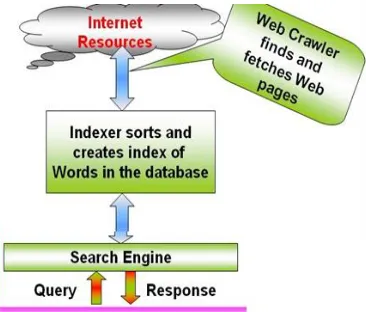
search engine, called Fuzzy-Go. First, a fuzzy ontology is constructed by using fuzzy logic to capture the similarities of terms in the ontology, which offering appropriate semantic distances between terms to accomplish the semantic search of keywords. The Fuzzy- Go search engine can thus automatically retrieve web pages that contain synonyms or terms similar to keywords. Second, users can input multiple keywords with different degrees of importance based on their needs. The totally satisfactory degree of keywords can be aggregated based on their degrees of importance and degrees of satisfaction. Third, the domain classification of web pages offers users to select the appropriate domain for searching web pages, which excludes web pages in the inappropriate domains to reduce the search space and to improve the search results.Fig.1 show the working of search engine.
Fig 1.Working of Search engine
II. FUZZY SEARCH ENGINE
Now a day’s Internet is booming around, everyone uses internet, search for what they want and hope for the result they are expecting. Early days when there is exact search engine if there is a person don’t know what exact he want to search he won’t be able search what he want but in a fuzzy search engine it is not the case. Fuzzy search engine is work on a fuzzy set which has a degree of membership. This framework propose a mainly a general idea about the fuzzy search engine.
Available Online at www.ijpret.com 165
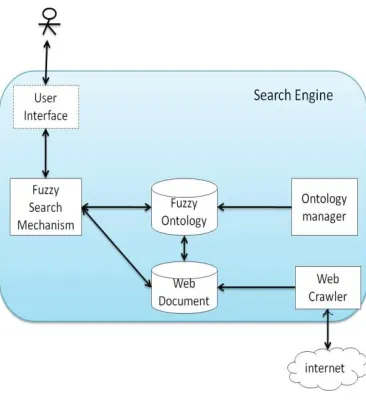
Web Document to calculate the fuzzy similarity between terms in the Fuzzy Ontology. The User Interface provides users to select an appropriate domain and to input multiple keywords with different degrees of importance based on their needs. The Fuzzy Search Mechanism would exclude web pages in the inappropriate domains to reduce the search space and to improve the search results. The keywords are expanded by the Fuzzy Ontology to find out synonyms and terms similar to keywords. The search results are ordering based on several fuzzy factors including the satisfaction degrees of keywords, the importance degrees of keywords, the relevance of domains, the page ranks , the page in-links, titles, and last modified dates. In fuzzy search engine, first it select a file from which we search a word and then add a word in indexer and start searching that word in a selected file if the exact word is found then return with a membership value 1 or if the exact word is not found then set a fuzzy logic calculate a membership value and display a result on screen.
A. Membership Function
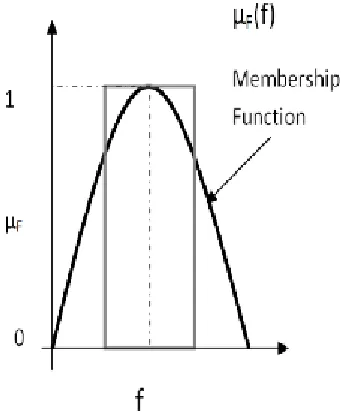
Membership function is used to defined a membership of an element which is available in fuzzy set. suppose F is taken as a fuzzy set and then its membership function is denoted by μF and if we have to find out the membership degree of an element f in set F which is denoted by μF(f) if it 1 means it is fully member of a the fuzzy set, 0 means it is not at all member of the fuzzy set and value in between 1 and 0 means it is partially a member of a fuzzy set. Usually the fuzzy membership value lie in between [0 1] are then called [0 1]-value membership functions. Membership function of fuzzy set is shown in figure 2.
Available Online at www.ijpret.com 166
A fuzzy search approach is proposed to improve the problems encountered by traditional search engines, including searching for the synonyms and similar terms, distinguishing the importance degrees of keywords, and the problem of information overload .The proposed fuzzy search approach includes several mechanisms as follows. Users can select the appropriate domain to search web pages, which excludes web pages in the inappropriate domains to reduce the search space and to improve the search results. Users can input multiple keywords with different degrees of importance based on their needs. We adopt linguistic degrees to represent the degrees of importance. The similarity between terms in the fuzzy ontology can be utilized to find out synonyms and terms similar to keywords Synonyms and terms similar to keywords are not taken into consideration to search web pages. Users may need to input several similar keywords individually to complete a search. The restriction of exact keywords makes it inconvenient for users to search web pages. Many valuable web pages would be omitted if users did not search for several similar keywords individually. While users input several keywords to search web pages, different keywords may have different degrees of importance in their opinions.Traditional search engines treat all keywords as the same importance and cannot differentiate the importance of one keyword from that of another. The problem of information overload makes it difficult for users to find really useful information from a large amount of search results.Traditional search engines lack an applicable classification mechanism to reduce the search space and improve the search results.
Available Online at www.ijpret.com 167 III. FUZZY ONTOLOGY
The goal of Ontology is to represent the collective knowledge intended for the use of a group. Ideally the Ontology captures knowledge independently of its use and in a way that can be shared, but practically different tasks and uses call for different representations of the knowledge in Ontology. Ontology has a richer internal structure as it includes relations and constraints between the concepts. It claims to represent a certain consensus about the knowledge in the Domain ONTOLOGY is a conceptualization of a domain into a human understandable, machine-readable format consisting of entities, attributes, relationships, and axioms. It is used as a standard knowledge representation for the Semantic Web. However, the conceptual formalism supported by typical ontology may not be sufficient to represent uncertainty information commonly found in many application domains due to the lack of clear-cut boundaries between concepts of the domains. For example, a document can be very relevant, relevant, or irrelevant to a research area. In addition, keywords extracted from scientific publications can be used to infer the corresponding research areas. However, it is inappropriate to treat all keywords equally as some keywords may be more significant than others. To tackle this type of problems, one possible solution is to incorporate fuzzy logic into ontology to handle uncertainty data. Traditionally, fuzzy ontology is generated and used in text retrieval and search engines, in which membership values are used to evaluate the similarities between the concepts in a concept hierarchy. However, manual generation of fuzzy ontology from a predefined concept hierarchy is a difficult and tedious task that often requires expert interpretation. So, automatic generation of concept hierarchy and fuzzy ontology from uncertainty data of a domain is highly desirable. Suggested Upper Merged Ontology (SUMO) to classify domains. SUMO is owned by the IEEE and defines a group of domain ontologies which have been mapped to the WordNet domains. In this approach, the domain hierarchy is treated as gen-spec relationships.
IV. THE WEB CRAWLER
Available Online at www.ijpret.com 168
more clusters. The FCM algorithm attempts to partition a finite collection of points into a collection of C fuzzy clusters with respect to some given criteria. Thus, points on the edge of a cluster, may be in the cluster to a lesser degree than points in the center of cluster.
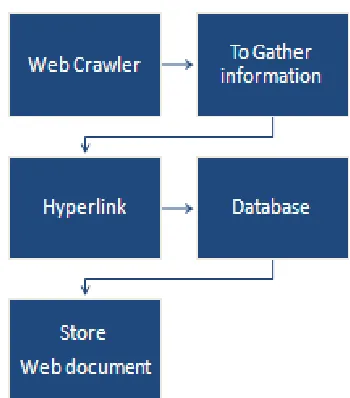
Fig 4. Workflow of web crawler
Available Online at www.ijpret.com 169 V. FUZZY SEARCH MECHANISM
A fuzzy search approach is proposed to improve the problems encountered by traditional search engines, including searching for the synonyms and similar terms, distinguishing the importance degrees of keywords, and the problem of information overload. The proposed fuzzy search approach includes several mechanisms as follows. Users can select the appropriate domain to search web pages, which excludes web pages in the inappropriate domains to reduce the search space and to improve the search results. Users can input multiple keywords with different degrees of importance based on their needs. It adopt linguistic degrees to represent the degrees of importance. The similarity between terms in the fuzzy ontology can be utilized to find out synonyms and terms similar to keywords. The semantic search of keywords makes it convenient to automatically search web pages that contain synonyms or terms similar to keywords.
VI. CONCLUSION
This paper discussed that how a fuzzy search engine reduce the search space and improve search result.
The Fuzzy-Go search engine can thus automatically search web pages that contain synonyms or terms similar to keywords. Second, users can input multiple keywords with different degrees of importance based on their needs. The totally satisfactory degree of keywords can be aggregated based on their degrees of importance and degrees of satisfaction. Third, the domain classification of web pages offer users to select the appropriate domain for searching web pages, which excludes web pages in the inappropriate domains to reduce the search space and to improve the search results.
REFERENCES
1. Lien-Fu, Lai Chao-Chin, Wu Pei-Ying Lin, Liang-Tsung Huang, Developing a Fuzzy Search Engine Based on Fuzzy Ontology and Semantic Search”,2011 IEEE International Conference on Fuzzy Systems
2. Yu-Cheng Lin Lien-Fu Lai Chao-Chin Wu, Liang-Tsung Huang,” A Self-Adaptation Approach to Fuzzy-Go Search Engine” Changhua, R.O.C.2010
Available Online at www.ijpret.com 170
4. Kamal Taha, Member, IEEE,” GO seek: A Gene Ontology Search Engine using Enhanced Keywords”,35th Annual International Conference of the IEEE EMBS Osaka, Japan, 3 - 7 July, 2013
5. Shilpa Sagar Motghare, G. P. Bhole,” Design of Fuzzy Keyword Search Engine”, Department of Computer Engg. & IT, VJTI, Mumbai, India
6. Stefania GALLOVA,” Fuzzy Ontology and Information Access on the Web”, Technical University of Kosice, Letna 9, SK-042 00 Kosice, Slovak,2011
7. Quan Thanh Tho, Siu Cheung Hui, Senior Member, IEEE, A.C.M. Fong, Senior Member, IEEE, and Tru Hoang Cao,” Automatic Fuzzy Ontology Generation for Semantic Web, JUNE 2006