ISSN (e): 2250-3021, ISSN (p): 2278-8719 Vol. 05, Issue 03 (March. 2015), ||V2|| PP 01-07
Analysis and Reduction of Power using Gating Techniques Near
Subthreshold Region
A. Biju Anusha
1, Mrs.C.N.Kalaivani
21
(ECE,DACE/Anna University, India) 2
(ECE,DACE/ Anna University, India)
Abstract: The sub-threshold and gate leakage power consumption in deep submicron CMOS systems are projected to become a significant part of the total power dissipation. This paper presents several dual-threshold voltage techniques for reducing standby power dissipation while still maintaining high performance. A dual-mode logic gate, for selectable operation in either of static and dynamic dual-modes, includes: a static gate which includes at least one logic input and a logic output; a mode selector, configured for outputting a turn-off signal to select static mode operation and for outputting a dynamic clock signal to select dynamic mode operation and a switching element associated with the mode selector static gate, comprising a first input connected to a constant voltage, a second input for inputting the mode selection signal from the mode selector, and an output connected to a logic output of the static gate. The switching elements switches the logic gate operation from static to dynamic mode, by applying the appropriate signal to the switching element. As transistor sizes scale down and levels of integration increase, leakage power has become a critical problem in VLSI designs. In this paper, an industry-standard technique known as power-gating is explored, whereby transistors are used to disconnect the power from idle portions of a chip.This paper discusses the evolution of full adder circuits in terms of lesser power consumption high speed. The power gating techniques are implemented to design a full adder by reducing the number of transistors which also leads to the reduction of chip size.
Keywords: Dual Mode Logic, Sub-threshold, Power Gating
I. INTRODUCTION
The power consumption has become a primary focus in the VLSI design. There are number of portable applications requiring small area low power high throughput circuitry. The sub-threshold logic technique is the main area for low power applications. The supply voltage of the sub-threshold region is less than the threshold voltages of the transistors so the static and dynamic power can be reduced. The dual mode logic (DML), which operates in the sub-threshold region. The DML logic can be operated in two modes: static CMOS like mode and dynamic np - CMOS- like mode. In the static mode the dual mode logic gate features very low power dissipation with moderate performance while in dynamic mode they attain higher performance, though with huge power dissipation. Low power utilization to be the most important for design of microprocessors and system mechanism addition is one of the fundamental arithmetic operations. It is used in many VLSI systems such as application specific DSP architectures and microprocessors.
II. POWER GATING TECHNIQUES
Power gating is a technique used in integrated circuit design to reduce power consumption, by shutting off the current to blocks of the circuit that are not in use. In addition to reducing standby or leakage power, power gating has the benefit of enabling Iddq testing. Shutting down the blocks can be accomplished either by software or hardware. Driver software can schedule the power down operations. Hardware timers can be utilized. A dedicated power management controller is another option. An externally switched power supply is a very basic form of power gating to achieve long term leakage power reduction.
2.1.Sleep Method
Fig(1): Type B dynamic NAND sleep method
2.2.Sleepy Stack Method
The sleepy stack approach merges the sleep and stack approaches. The sleepy stack technique splits the existing transistors into two half Size transistors like the stack approach. The activity of the sleep transistors in the sleepy stack method is same as the activity of the sleep transistors in the sleep method. The sleep transistors are turned on during the active mode and they are turned off during the sleep mode. Fig.2 shows Type A static NOR gate with Sleepy Stack Gating Technique.
Fig(2): Type A static NOR sleepy stack method
2.3.DualSleep Method
The Dual sleep approach has the advantage of using the two extra pull up and two extra pull down transistors in sleep mode either in OFF state or in ON state. In normal mode when S=1 the pull down NMOS transistor is in ON state and in the pull up network the PMOS sleep transistor is in ON state since S‟=0. During sleep mode state S is forced to 0 and hence the pull down NMOS transistor is in OFF state and PMOS transistor is in ON state and in the pull up network, PMOS sleep transistor is OFF while NMOS sleep transistor is ON. So in sleep mode state a PMOS is in series with an NMOS both in pull up network and pull down network which reduces the power dissipation. Fig.3 shows Type B Dynamic PSEUDO NMOS with Dual Sleep Gating Technique.
The NAND Dual mode logic gate is compared in terms of power consumption for different gating techniques like sleep method, sleepy stack method and dual sleep method in Table 1.
Table(1): Comparison between NAND DML gates with different gating techniques
The NOR Dual mode logic gate is compared in terms of power consumption for different gating techniques in Table 2.
Table(2): Comparison between NOR DML gates with different gating techniques
The Pseudo nMOS logic is compared in terms of power consumption for different gating techniques in Table 3.
Table(3): Comparison between PSEUDO NMOS DML gates with different gating techniques Gating
Techniques
Modes
NAND SLEEP NAND
SLEEPY STACK NAND DUAL SLEEP 0-2 v 2-5 v 5-50 v 0-2 v 2-5 v 5-50 v 0-2 v 2-5 v 5-50 v Conventional 26
uW 42 uW 230 mW 200 uW 460 uW 270 mW 330 uW 820 uW 940 mW Type A static 28
uW 44 uW 280 mW 350 uW 740 uW 310 mW 500 uW 1.2 mW 1000 mW Type A dynamic 38
uW 60 uW 280 mW 330 uW 700 uW 310 mW 480 uW 1.1 mW 1000 mW Type B static 320
uW 620 uW 290 mW 380 uW 840 uW 330 mW 350 uW 880 uW 900 mW Type B dynamic 300
uW 640 uW 290 mW 370 uW 800 uW 340 mW 350 uW 840 uW 900 mW Gating Techniques Modes
NOR SLEEP NOR SLEEPY STACK NOR DUAL SLEEP
0-2 v
2-5 v
5-50v 0-2 v
2-5 v
5-50v 0-2 v
2-5 v
5-50v Conventional 180
uW 340 uW 190 mW 170 uW 370 uW 190 mW 320 uW 780 uW 190 mW Type A static 230
uW 460 uW 320 mW 270 uW 580 uW 320 mW 400 uW 920 uW 320 mW Type A dynamic 220 uW 440 uW 320 mW 230 uW 450 uW 320 mW 370 uW 900 uW 320 mW Type B static 180
uW 350 uW 160 mW 160 uW 350 uW 160 mW 330 uW 780 uW 160 mW Type B dynamic 180 uW 350 uW 160 mW 160 uW 370 uW 160 mW 330 uW 780 uW 160 mW Gating Techniques Modes
PSEUDO NMOS SLEEP PSEUDO NMOS SLEEPY STACK PSEUDO NMOS DUAL SLEEP 0-2 v 2-5 v 5-50 v 0-2 v 2-5 v 5-50 v 0-2 v 2-5 v 5-50 v Conventional 130
uW 240 uW 170 mW 15 uW 25 uW 170 mW 270 uW 700 uW 170 mW Type A static 10
uW 15 uW 240 µW 200 uW 450 uW 240 µW 340 uW 860 uW 240 µW Type A dynamic 19
uW 30 uW 500 µW 170 uW 400 uW 500 µW 320 uW 840 uW 500 µW Type B static 8 uW 12 uW 200 µW 82 uW 210 uW 200 µW 280 uW 680 uW 200 µW Type B dynamic 16
III. FULL ADDER CIRCUITS
A one-bit full adder adds three one-bit numbers, and it is written as A, B, and Cin. A and B are the
operands, and Cin is a bit carried in from the previous less significant stage. The full adder is a component in a
cascade of adders, which adds 8, 16, 32, etc. bits binary numbers. The circuit produces a two-bit outputs. The outputs are carry and sum typically represented by the signals Cout and S. The expression for sum and carry can
be represented as,
Sum = 𝐴 ⊕B ⊕C
𝐶𝑎𝑟𝑟𝑦 = 𝐴. 𝐵 + (𝐶(𝐴 ⊕ 𝐵))
The full adder consists of two half adders and one OR gate. The circuit diagram for one bit full adder is shown in fig.4.
Fig(4): 1-bit Full Adder
The conventional full adder is a basic full adder and it consists of 32 transistors. The schematic of conventional full adder is shown in Fig.5.
Fig(5): Schematic of Conventional Full Adder
Fig(6): Schematic of Full Adder Sleep method
The full adder sleepy stack method consists of 36 transistors. The drawback of sleep method is avoided by using sleepy stack method. In active mode the dissipation of power is active power. The active power consists of dynamic power as well as static power. so it is named as an active power. In static mode the both header and footer switches will be off there will be no 𝑉𝑑𝑑 supply and ground connected to the circuit. So the power dissipation will be very less. The schematic of full adder sleepy stack method is shown in fig.7.
Fig(7): Schematic of Full Adder Sleepy Stack method
Fig(8): Schematic of Full Adder Dual Sleep method
The transmission gate full adder consists of 22 transistors. The transmission gate full adder enforced with minimum number of transistors compared to conventional full adder design. The consecutive connected PMOS and NMOS arrangement act as a switch and is thus referred to as transmission gate. A transmission gate or analog switch is an electronic element that will selectively block or pass a signal level from the input to the output. The schematic of transmission gate full adder is shown in fig.9.
Fig(9): Schematic of Transmission Gate Full Adder
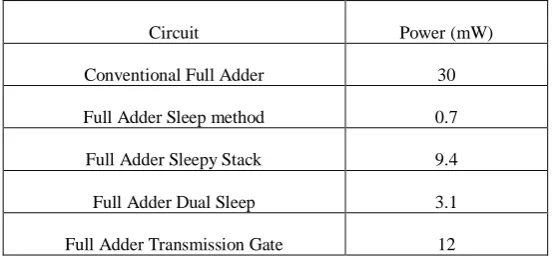
The power analysis of different gating techniques is shown in Table 4.
Circuit Power (mW)
Conventional Full Adder 30
Full Adder Sleep method 0.7
Full Adder Sleepy Stack 9.4
Full Adder Dual Sleep 3.1
Full Adder Transmission Gate 12
IV. CONCLUSION
The result obtained leads to the conclusion that while operating in the dynamic mode, sub threshold DML gates achieve an improvement in speed compared to a standard CMOS, while dissipating more power and in the static mode, a reduction of power dissipation is achieved, at the expense of a decrement in performance. The different methods of power gating applied to the DML logic have reduced the power dissipation.
REFERENCES
[1] B. H. Calhoun, A. Wang, and A. Chandrakasan, “Modeling and sizing for minimum energy operation in subthreshold circuits,” IEEE J. Solid-State Circuits, vol. 40, no. 9, pp. 1778–1786, Sep.2005.
[2] N. Geetha Rani, N. Praveen Kumar, Dr. B. Dr. B. Stephen Charles, Dr. P. Chandrasekhar Reddy S.Md.Imran Ali , “Design of Near-Threshold CMOS Logic Gates”, IJVLSICS Vol.3, No.2, April 2012. [3] Branko L. Dokić, “A Review on Energy Efficient CMOS Digital Logic,” ETASR - Engineering,
Technology & Applied Science Research, Vol. 3, o. 6, 2013, 552-561.
[4] PriyaGupta, AnuGupta, AbhijitAsati, “A Review on Ultra Low Power Design Technique :Subthreshold Logic,” IJCST Vol. 4, Issue Spl - 2, April - June 2013.
[5] JagannathSamanta, MousamHalder, Bishnu Prasad De, “Performance Analysis of High Speed Low Power Carry Look-Ahead Adder Using Different Logic Styles” International Journal of Soft Computing and Engineering (IJSCE) ISSN:2231-2307, Volume-2, Issue-6, Jan-2013.
[6] Ms.S.A.AmeenaNasreen, Dr.T.Kavitha, “Design of Carry Look Ahead Adder using Subthreshold Dual Mode Logic”, IJAICT ISSN:2348-9928, volume 1, Issue 3, July 2014.
[7] Athira.P.K, Ms.M.Mahalakshmi ,“Low power design of dual mode logic using stacking power gating”, International Journal of Review in Electronics & Communication Engineering (IJRECE), Volume 2, Issue 2, April 2014.
[8] AbhijeetDhanotiya, Vishal Sharma,“Power Reduction in Digital VLSI Circuits”,International Journal of Research in IT, Management and Engineering (ISSN 2249- 9482), Volume 4, Issue 6, June 2014. [9] SrinivasaRaoIjjada, S.V. Sunil Kumar, M. Dinesh Reddy, Sk.AbdulRahaman, Dr.V.
MalleswaraRao,“Design of Low Power and High Speed Inverter”, International Journal of Distributed and Parallel Systems (IJDPS), Vol.2, No.5, September 2011.
[10] Salendra.Govindarajulu,Dr.T.JayachandraPrasad,“Low Power, Energy- efficient Domino Logic Circuits”, International Journal of Recent Trends in Engineering, Vol 2, No. 7, November 2009.
[11] SenthilSivakumar M, ArockiaJayadhas S, Arputharaj T and E.Ramkumar,“Design of MT-CMOS Domino Logic for Ultra Low Power High Performance Ripple Carry Adder”, International Journal of Emerging trends in Engineering and Development, ISSN 2249-6149, Issue 3, Vol.1, January 2013.
[12] Kyungseok Kim and Vishwani D. Agrawal, “Ultra Low Energy CMOS Logic Using Below-Threshold Dual Voltage Supply”, Journal of Low Power Electronics, Vol. 7, 1–11, 2011.
[13] Lakshmi sree P V, Raghu M C, “Design of Subthreshold DML Logic Gates with Power Gating Techniques”,International Journal of Research in Engineering and Technology(IJRET), Volume 03, Issue 04, Apr-2014.
[14] Kyungseok Kim and Vishwani D. Agrawal, “Minimum energy CMOS design with dual subthreshold supply and multiple logic level gates”, IEEE , 2011.
[15] Muhammed Umar KarimKhan,Chong Min Kyung, “Energy Reduction of Ultra Low Voltage VLSI Circuits by Digit-serial Architectures”, IEEE, 2013.
[16] Y L V Santosh Kumar, U Pradeep Kumar, K H K Raghu Vamsi , “Low Power Optimization Of Full Adder, 4-Bit Adder And 4-Bit BCD Adder ”, International Journal Of Scientific & Technology Research, Volume 2, Issue 9, September 2013 .
[17] Abhishek Dixit , SaurabhKhandelwal , ShyamAkashe, “ Power Optimization of 8:1 MUX using Transmission Gate Logic (TGL) with Power Gating Technique”, International Journal of Computer Applications, Volume 99– No.5, August 2014 .
[18] P.Balasubramanyam, D. Sreekanth Reddy, “Reduction of Ground Bounce Noise in 14T Full Adder by Using Various Power Gating Techniques”, International Journal of Engineering Trends and Technology (IJETT) ,Volume 17 Number 1 – Nov 2014 .
[19] Bipin Gupta, Sangeeta Nakhate2, “Transistor Gating: A Technique for Leakage Power Reduction in CMOS Circuits”, International Journal of Emerging Technology and Advanced Engineering , Volume 2, Issue 4, April 2012 .