5730 A NEW RP-UPLC METHOD DEVELOPMENT AND VALIDATION FOR THE
SIMULTANEOUS ESTIMATION OF IVACAFTOR AND LUMACAFTOR Baki Sharon*, Meruva Sathish Kumar, S. Marakatham, Kanduri Valli Kumari
Department of Pharmaceutical Analysis and Quality Assurance, Malla Reddy Institute of Pharmaceutical Sciences, JNTUH, Medchal -Malkajgiri, Telangana –
500014, India
*Corresponding author E-mail: [email protected]
ARTICLE INFO ABSTRACT
Key Words
Ivacaftor, Lumacaftor, UPLC, Validation
The different analytical performance parameters such as linearity, precision, accuracy, and specificity were determined according to International Conference on Harmonization ICH Q2B guidelines. The calibration curve was obtained by plotting peak area versus the concentration over the range of 62.5-187.5 µg/ml For ICF and 100-300 µg/ml for LMF. From linearity the correlation coefficient R2 value was found to be 0.999 for ICF and 0.999 for LMF. The proposed HPLC method was also validated for system suitability, system precision and method precision. The %RSD in the peak area of drug was found to be less than 2%. The number of theoretical plates was found to be more than 2000, which indicates efficient performance of the column. The percentage of recovery of ICF and LMF were found to be 99.9 and 99.8respectively shows that the proposed method is highly accurate. The optimum wavelength for the determination of ICF and LMF was selected at 265 nm on the basis of isobestic point. Various trials were performed with different mobile phases in different ratios, but finally Potassium di hydrogen orthophosphate Phosphate Buffer pH 4.5: Methanol (60:40) %v/v) was selected as good peak symmetry and resolution between the peaks was observed. The Retention time of ICF and LMF were found to be 1.180 and 2.547 min respectively. The Retention times for both the drugs were considerably less compared to the Retention time obtained for the drugs in the other mobile phase.
INTRODUCTION
Ivacaftor (also known as Kalydeco or VX-770) is a drug used for the management of Cystic Fibrosis (CF) in patients aged 2 years and older. Cystic Fibrosis is an autosomal recessive disorder caused by one of several different mutations in the gene for the Cystic Fibrosis Trans membrane Conductance Regulator (CFTR) protein, an ion channel involved in the transport of chloride and sodium ions across cell membranes. Chemically, it is N-(2,4-di-tert-butyl-5-hydroxyphenyl)-4-oxo-1,4-dihydroquinoline-3-carboxamide.
Its molecular formula and molecular
weight is C24H28N2O3 and 392.20
respectively.
Fig 1: Chemical structure of Ivacaftor
An Elsevier Indexed Journal ISSN-2230-7346
5731
Lumacaftor is a drug used in combination
with Ivacaftor as the fixed dose
combination product Orkambi for the management of Cystic Fibrosis (CF) in patients aged 6 years and older. Its molecular formula is C24H18F2N2O5 and
molecular weight is 452.118. It is used to treat people with cystic fibrosis who have the F508del mutation in the cystic fibrosis
transmembrane conductance
regulator(CFTR), the defective protein that causes the disease. Chemically, it is3-{6- [1-(2,2-difluoro-2H-1,3-benzodioxol-5- yl)cyclopropaneamido]-3-methylpyridin-2-yl}benzoic acid.
Fig 2: Chemical structure of Lumacaftor.
MATERIALS AND METHODS:
Ivacaftor and Lumacaftor sample were obtained from Madras pharmaceuticals, Chennai, India. All reagents used were HPLC/AR grade, nylon membrane filters of 0.45µ pore size were used to filter the mobile phase and its components.
Instrumentation: Analysis was carried out in waters acquity with binary UPLC pump equipped with PDA detector. Separation has been carried out using Agilent 1290 Infinity C18(50x2.1mm ID), 1.8 µ column.
Method Development: Various analytical development trials has been performed by using different chemicals and reagents, organic solvents at different pH ranges and strengths in different proportions of buffer and Organic solvents to separate the three peaks with acceptable resolution and with good peak shape. Various stationary phases of multiple makes were used to check the chromatography with acceptable
peak shape, tailing factor and plate count
for reproducibility at 250C. Based on the
observations and conclusions obtained from the number of chromatographic trials performed on UPLC, a particular set of
chromatographic conditions were
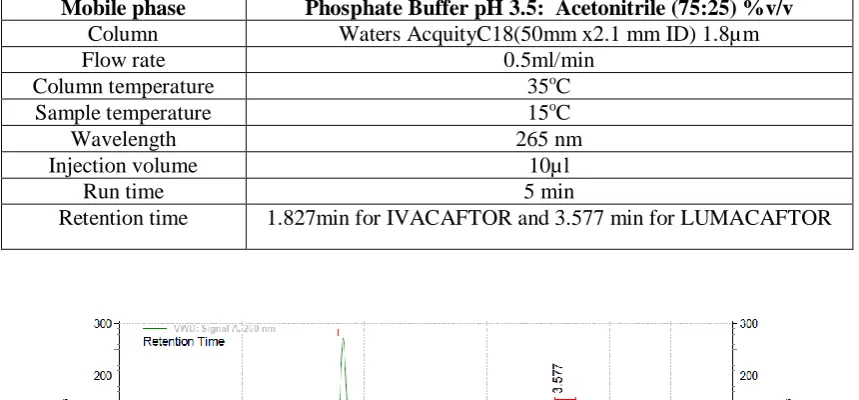
optimized to be suitable for estimation of the Ivacaftor and Lumacaftor in the tablets. The optimized chromatographic conditions which are found to be suitable for the estimation of the Ivacaftor and Lumacaftor are given below. Table No.1.
Preparation of Diluent: Prepared a mixture of water and Acetonitrile in the ration 75:25 (v/v). Mixed well.
Preparation of Phosphate buffer pH 3.5:
2.72 gm of Potassium Di hydrogen
orthophosphate was weighed and
dissolved in 1000ml of water. Adjust the
pH to3.50.02 using diluted
orthophosphoric acid. Buffer was filtered through 0.45µm filters to remove all fine particles and gases.
Preparation of Mobile Phase: Prepared a mixture of buffer and Acetonitrile in the ratio of 75:25 (v/v). Mixed well. Sonicated for 10mins.
Preparations for Methodology:
Preparation of Ivacaftor standard stock solution: About 125mg of Ivacaftor were weighed into a 100ml volumetric flask, to this 70ml of mobile phase was added, sonicated and the volume was made up with the mobile phase. Pipetted 5ml of the clear solution into 50ml volumetric flask and make up volume with mobile phase.
5732
into 50ml volumetric flask and make up volume with mobile phase.
Preparation of Standard solution: About
10mg of Ivacaftor and 10mg of
Lumacaftor were weighed into a 50ml volumetric flask, to this 50ml of mobile phase was added, sonicated and the volume was made up to mark with the mobile phase.
Method Validation:
System suitability: It is assessed by injecting the six replicate into a system. Results are given in Table no.1 & 2.
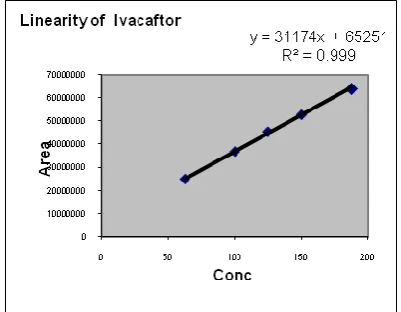
Calibration curve: A linear relationship was evaluated across the range of the analytical procedure and demonstrated directly on the drug substance. The test results were evaluated by calculation of regression line by the method of least
square. The respective component
concentrations were given below.
vacaftor – 62.5, 100, 125, 150, 188.5 and umacaftor – 100, 160, 200, 240, 300
All the above prepared solutions of respective individual component were analysed to calculate the correlation coefficient of the individual components.
Accuracy: Accuracy of the method was determined by Recovery studies. To the formulation (preanalysed sample), the reference standards of the drugs were added at the level of 50%, 100%, 150%. The recovery studies were carried out three times and the percentage recovery and percentage mean recovery were calculated.
Sample stock preparation: Crush more than 20 tablets then weigh a quantity of powder equivalent to 125mg of Ivacaftor and 100mg of Lumacaftor in 100ml volumetric flask and add 70ml of mobile phase then sonicated it for 30min intermittent shacking after 30min make up
volume with mobile phase. Pipetted 5ml of the clear solution in to 50ml volumetric flask and make up volume with mobile phase. Filter the solution through 0.45µm filter paper.
Method Precision: The Precision of the method was determined by sample preparation. Calculated % of assay using formula
Where,
AS: Average peak area due to standard preparation
AT: peak area due to assay preparation,
ws: standard weight of ivacaftor/
lumacaftor in mg
WT: Weight of sample in assay
preparation
DT: Dilution of assay preparation
ds: dilution of standard preparation
p: purity of ivacaftor /lumacaftor
av: average weight of tablets in mg
lc: labelled claim of ivacaftor/lumacaftor
RESULTS AND DISCUSSIONS:
Method Optimization: The developed method was optimized after many trials. The optimized method developed on C18(50mm x 2.1mm ID), 1.8μm as stationary phase. Using phosphate buffer and Acetonitrile in the ratio 75:25 %v/v as mobile phase. The column temperature
was maintained constantly at 35oC. Mobile
5733 Table no. 1: Chromatographic conditions
Mobile phase Phosphate Buffer pH 3.5: Acetonitrile (75:25) %v/v Column Waters AcquityC18(50mm x2.1 mm ID) 1.8µm
Flow rate 0.5ml/min
Column temperature 35oC
Sample temperature 15oC
Wavelength 265 nm
Injection volume 10µl
Run time 5 min
Retention time 1.827min for IVACAFTOR and 3.577 min for LUMACAFTOR
Fig no.3: chromatogram of optimized condition Table no. 2: System Suitability
Table no. 3: Linearity S.NO Name of the
component
Retention time
Area Theoretical plates
Theoretical factor
Resolution
1 IVACAFTOR 1.827 18924601 4707 1.24 -
2 LUMACAFTOR 3.577 14353057 8200 1.14 4.5
S.No Parameter IVACAFTOR LUMACAFTOR
1 Correlation coefficient 0.9995 0.9997
2 Slope 311744 168573
5734 Fig no.4 a :Linearity graph of Ivacaftor
Fig no. 4 b: Linearity graph of Lumacaftor
Table no. 4: Accuracy
Table no.4 (a): Results for Recovery of ivacaftor.
* Mean of three observations
Table no. 4 (b): Results for recovery of Lumacaftor %Recov
ery
Amount present (µg/ml)
Amount found (µg/ml)*
Percent Recovery *
% Mean Recovery
50% 62.50 62.66 100.3
99.9
100% 125.0 123.75 99.4
150% 188.5 188.17 100.4
%Rec overy
Amount present (µg/ml)
Amount found (µg/ml)*
Percent Recovery *
% Mean Recovery
50% 100 100.94 99.1
99.8 100% 200 198.58 100.7
5735 * Mean of three observations
Specificity
Fig no. 5 (a) : Chromatogram of Ivacaftor and Lumacaftor Blank
Fig no.5(b): Chromatogram of Placebo
Table no. 5: Precision
Injection IVACAFTOR LUMACAFTOR
Area %Assay Area %Assay
1 45741313 98.8 33365477 98.9
2 45787695 98.9 33411360 99.1
3 46080749 99.6 33638194 99.7
4 45802928 99.0 33304993 98.7
5 45286836 98.8 32828676 98.3
6 45786681 98.9 33039426 98.0
Average - 98.8 - 98.6
SD - 0.6 - 0.9
%RSD - 0.6 - 0.9
System suitability: All system suitability parameters were passed which include the theoretical plates, tailing factor, resolution for Ivacaftor and Lumacaftor respectively. Table No.02.
Linearity: The best fit line was obtained with regression coefficient between the
peak area vs concentration. Results are given below .Table No.03 and Fig No.4a and 4b.
5736
Chromatogram depicted below Fig No.5a and 5b.
Method Precision: The Precision of the method was determined by injecting Ivacaftor and Lumacaftor with sample solution 6 times respectively. Method precision was expressed in terms of % RSD. Results are given in table no.05.
Accuracy: Prepared accuracy at 3 levels in triplicate at 50% , 100% and 150% with matrix and achieved satisfactory results and at each level of recovery was calculated. Results are given below table No.04.
CONCLUSION:
A new precise, accurate, rapid method has been developed for the simultaneous estimation of Ivacaftor and Lumacaftor in pharmaceutical dosage form by RP-HPLC.
The optimum wavelength for the
determination of ICF and LMF was selected at 260 nm on the basis of isobestic point. Various trials were performed with different mobile phases in different ratios,
but Phosphate Buffer pH 3.5:
Acetonitrile(75:25) %v/v) was selected as good peak symmetry and resolution between the peaks was observed. The Retention time of ICF and LMF were found to be 1.827 and 3.577 min respectively. The retention times for both the drugs were considerably less compared to the retention time obtained for the drugs in the other mobile phase. The different analytical performance parameters such as
linearity, precision, accuracy, and
specificity were determined according to
International Conference on
Harmonization ICH Q2B guidelines. The calibration curve was obtained by plotting peak area versus the concentration over the range of 62.5-187.5 µg/ml For ICF and 100-300 µg/ml for LMF. From linearity
the correlation coefficient R2 value was
found to be 0.999for ICF and 0.999 for LMF. The proposed HPLC method was
also validated for system suitability, system precision and method precision. The %RSD in the peak area of drug was found to be less than 2%. The number of theoretical plates was found to be more than 2000, which indicates efficient
performance of the column. The
percentage of recovery of ICF and LMF
were found to be 99.9 and
99.8respectivelyshows that the proposed method is highly accurate. Hence the proposed method is highly sensitive, precise and accurate and it successfully applied for the quantification of API content in the commercial formulations of Ivacaftor and Lumacaftor in Educational
institutions and Quality control
laboratories.
BIBLIOGRAPHY:
1. Chatwal, R. G.; Anand, K. S. High
performance liquid
chromatography. Instrumental
methods of chemical analysis,
5thed.; Himalaya publishers:
Mumbai, 2010; 2.570-2.629.
2. Sharma, B. K. High performance
liquid chromatography.
Instrumental methods of chemical analysis, 24th ed.; Goel publishers:
Meerut, 2005; 295 - 300.
3. Dong,W. M. HPLC
instrumentation and trends.
Modern HPLC for practicing scientists, USA, 2006; 5-10, 78-110.
4. Typical diagram of HPLC
http://www.comsol.com/stories/wat ers_corp_hplc_systems/full/ Hplc diagram
5. HPLC solvent properties
www.sanderkok.com/techniques/hp lc/eluotropic_series_extended.htm
6. Swartz,M. E.; Ira Krull, S,
5737
7. Satinder, A.; Dong, M. W. Method
development and validation.
Pharmaceutical analysis by HPLC,
15th ed.; New York, 2005; 16-70.
8. Snyder, R. L.; Kirkland, J. J.;
Glajch, L. J. Getting Started.
Practical HPLC Method
Development, 2nd ed.; New York, 1997; 30-100.
9. Selection of buffers
http://www.sigmaaldrich.com/etc/ medialib/docs/Aldrich/General_Inf ormation/labbasics_pg144.Par.000 1.File.tmp/labbasics_pg144.pdf.
10.ICH, Text on Validation of
Analytical Procedures, ICH – Q2A, International Conference on Harmonisation, IFPMA, Geneva, 1995, 2-3, A–1 to A–3.
11.ICH, Validation of Analytical
Procedures: Methodology, ICH – Q2B, International Conference on Harmonisation, 1996, 1-3.
12.ICH Guidelines, Q2 (R1) -
Validation of Analytical
Procedures:Text and
Methodology,2005, 1-6.
13.Ivacaftordrug profile
-https://www.drugbank.ca/drugs/DB 08820
14.Lumacaftordrug profile
-https://www.drugbank.ca/drugs/DB 09280
15.Akram and Umamahesh et. al A
New method was established for
simultaneous estimation of
Lumacaftor and Ivacaftor by RP-HPLC method.
16.Satheesh, Dr. D. Naresh,
P.Sowjanya, Dr. Gampa Vijaya Kumar et. al A new method was
established for simultaneous
estimation of Ivacaftor and
Lumacaftor by RP-HPLC method.
17.B. Sravanthi*, M. Divya et. al A
simple, selective, linear, precise, and accurate RP-HPLC method was developed and validated for the simultaneous estimation of