Available Online At www.ijpret.com
INTERNATIONAL JOURNAL OF PURE AND
APPLIED RESEARCH IN ENGINEERING AND
TECHNOLOGY
A PATH FOR HORIZING YOUR INNOVATIVE WORK
BUFFER-OVERFLOW ATTACK BLOCKER FOR GIF AND JPG FILES
PANKAJ B. PAWAR1, MALTI NAGALE2, PANKAJ K. KAWADKAR2
1. Scholar of M.Tech. , Dept. of CSE, PIES, RGPV, Bhopal, India.
2. Astt. Prof. ,PIES, Bhopal, India.
Accepted Date:
27/02/2013
Publish Date:
01/04/2013
Keywords
Buffer Overflow,
IDS,
Malicious code,
Intrusion,
Thread
Corresponding Author
Mr. Pankaj B. Pawar
Abstract
Available Online At www.ijpret.com
I. Introduction
Computer Security includes the protection
of information and property from theft,
corruption while allowing the information
to remain accessible to its intended user.
Computer Security means valuable
information and services are protected
from publication, tampering or collapse by
unauthorized activities or events. A buffer
overflow occurs when data written to a
fixed sized buffer, due to insufficient bound
checking, corrupts data values in memory
addresses adjacent to the allocated buffer.
A Buffer overflow attack is an attack in
which a malicious user exploits an
unchecked buffer in a program and
overwrites the program code with
their-own data. If the program code is
overwritten with new executable code, the
effect is to change the program's operation
as dictated by the attacker. If overwritten
with other data, the likely effect is to cause
the program to crash. Today‘s software has
been widely targeted by buffer overflows
Such exploits range from arbitrary code
execution on the victim‘s computer to
denial of service (DoS) attacks. Detecting
and eliminating buffer overflows would
thus make software far more secure.
There are many more tools and
technologies for detecting and preventing
buffer overflow and other vulnerabilities
but still there are some pros and cons of
certain technique.
Network threat can attack through three
steps i.e. penetrate, launch and propagate
without human intervention.
Network-based attacks on the host predominantly
exploit vulnerabilities in protocols and
network-aware processes. These
vulnerabilities are typically the result of
programming errors which provide
opportunities for a buffer overflow. There
are several different approaches for finding
and preventing buffer overflows. These
include enforcing secure coding practices,
statically analyzing source code, halting
exploits via operating system support, and
detecting buffer overflows at runtime [5].
The general idea is to overflow a buffer so
that it overwrites the return address. When
the function is done it will jump to
whatever address is on the stack. We put
some code in the buffer and set the return
Available Online At www.ijpret.com Threat can Prevented by using Personal
firewalls, Intrusion detection systems and
Buffer overflow exploit prevention
technique.
II. Existing Study
Xinran Wang, Chi-Chun Pan, Peng Liu, and
Sencun Zhu proposed work on SigFree: A
Signature-Free Buffer Overflow Attack
Blocker [1]. There experimental study
shows that the dependency-degree-based
SigFree could block all types of
code-injection attack packets (above 750) tested
in our experiments with very few false
positives. Moreover, SigFree causes very
small extra latency to normal client
requests when some requests contain
exploit code.
Eric Haugh and Matt Bishop proposed work
on Testing C Programs for Buffer Overflow
Vulnerabilities[2] This evaluation shows
that the tool is useful for finding buffer
overflow flaws, that it has a low false
positive rate, and compares well with other
techniques.
Crispin Cowan, Perry Wagle, Calton Pu,
Steve Beattie, and Jonathan Walpole
proposed work on Buffer Overflows:
Attacks and Defenses for the Vulnerability
of the Decade*[3] . They consider which
combinations of techniques can eliminate
the problem of buffer overflow
vulnerabilities, while preserving the
functionality and performance of existing
systems.
Hassen Sallay, Khalid A. AlShalfan, Ouissem
Ben Fred j proposed work on A scalable
distributed IDS Architecture for High
speedNetworks [4]. They worked on
switch-based splitting approach that supports
intrusion detection on high-speed links by
balancing the traffic load among different
sensors running Snort.
We are proposing technique using IDS
(Intrusion Detection System) for detecting
malicious code penetrated by attacker
while transmission of images. This
technique capable of detecting malicious
code by applying Pattern matching scheme.
We separate out the original image from
malicious image by applying IDS. Each time
during receiving end we check for malimage
and if malimage found then we are applying
Available Online At www.ijpret.com
III. Network-based attacks Detection
Techniques
Network-based attacks can penetrate,
launch and propagate without human
intervention. Network-based attacks on the
host predominantly exploit vulnerabilities in
protocols and network-aware processes.
These vulnerabilities are typically the result
of programming errors which provide
opportunities for a buffer overflow.
Network-based attacks can be protected by
using Firewall, Intrusion Prevention System
and Buffer Overflow Exploit Prevention.
Personal firewalls are deployed form of host
protection, and defend against attacks
using network threat vectors in the
pre-launch phase before they affect the system.
By blocking access to ports, single IP
addresses or ranges of IP addresses,
protocols and services not needed for
legitimate business, personal firewall can
reduce, but not eliminate.
Intrusion detection systems (IDS) provide
deep packet inspection capabilities that
examine the traffic allowed through by
personal firewall rules and alert the user to
an attack on the host system. IPS
technology is with the ability to identify
good traffic from malicious traffic in real
time. It is categorized into either
signature-based methods or protocol analysis-signature-based
methods. Signature-based techniques are
effective at stopping known exploits, but
are often too reactive. As the time
decreases between vulnerability disclosure
and the release of rapidly propagating,
highly infectious worms, signature-based
IPS techniques tend to be of less value. In
contrast, vulnerability based protocol
analysis proves very effective against
modern, fast-moving attacks, and since it’s
based on shielding vulnerabilities, often
provides protection even before attacks are
released.
One of the newest host protection
technologies available is buffer overflow
exploit prevention, also known as memory
protection. As a high-level rule, code should
never be executed from writable areas of
system memory. By watching the use of
Stack and Heap system memory, BOEP
identifies if a buffer overflow has succeeded
and attempts to thwart its executable
Available Online At www.ijpret.com A personal firewall will block known and
unknown attacks against the ports and
services you don’t need. IPS will filter out
known and unknown attacks against known
vulnerabilities. At a cost, buffer overflow
exploit prevention will provide the
necessary insurance for overflows against
unknown vulnerabilities.
IV. Methodology
To overcome the problem of buffer
overflow we proposed the SigFree attack
blocker technique. The background behind
the SigFree is motivated by an important
observation that “the nature of
communication to and from network
services is predominantly or exclusively
data and not executable code” [12].
Since remote exploits are typically binary
executable code, this observation indicates
that if we can correctly distinguish (service
requesting) messages containing byte code
from those containing no byte code, we can
protect most Internet services (which
accept data only) from code injection buffer
overflow attacks by blocking the messages
that contain binary code.
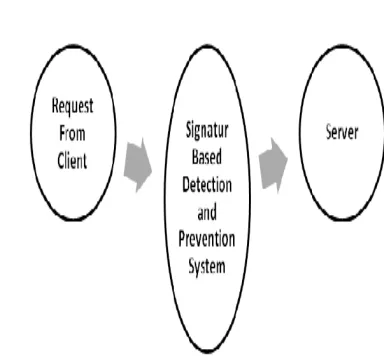
Block diagram
Figure 1: Block Diagram of System.
Algorithm
Input: Data from network
Step 1: Check request from Network
Step 2: Decode the URL
Step 3: Check for signature
Step 4: Signature found goto Step 7
Step 5: Check size of Data
Step 4: If size < N (Buffer overflow not
Available Online At www.ijpret.com Step 5:Goto step 7
Step 5: Apply IDS
Step 6: IDS separates pure code and
malcode
Step 7: Supply pure code to Server.
Step 8: Stop.
Flowchart
We implementing Intrusion Detection
System (IDS) to handle the buffer overflow
attack occurred during transmission of data.
Intrusion detection systems (IDS) provide
deep packet inspection capabilities that
examine the traffic allowed through by
personal firewall rules and alert the user to
an attack on the host system. Intrusion
Prevention System (IPS) technology is with
the ability to identify good traffic from
malicious traffic in real time. It is
categorized into either signature-based
methods or protocol analysis-based
methods.
Signature-based techniques are effective at
stopping known exploits, but are often too
reactive. As the time decreases between
vulnerability disclosure and the release of
rapidly propagating, highly infectious
worms, signature-based IPS techniques
tend to be of less value. In contrast,
vulnerability based protocol analysis proves
very effective against modern, fast-moving
attacks, and since it’s based on shielding
vulnerabilities, often provides protection
even before attacks are released.
One of the newest host protection
technologies available is buffer overflow
exploit prevention, also known as memory
protection. As a high-level rule, code should
never be executed from writable areas of
Available Online At www.ijpret.com Stack and Heap system memory, BOEP
identifies if a buffer overflow has succeeded
and attempts to thwart its executable
payload.
V. PROPOSED METHODOLOGY
Modern techniques to detect and prevent
Unknown threat and vulnerability. There
are two types of modern threat i.e.
Network Attack and Application Attack.
There are three phases host attack. They
are Penetration, Launch and Prorogation.
The compromise of a host which allows
further malicious activity to occur.
Penetration can occur through e-mail, Web
Browsers, remote buffer overflow or
various other methods. Launch the
execution of the attack’s malicious payload.
Launch method can range from user double
click to remote memory buffer overflow.
Prorogation is post compromise activity
intended to replicate, retrieve other
component, transmit data or enable remote
control.
Network-based attacks can penetrate,
launch and propagate without human
intervention. Network-based attacks on the
host predominantly exploit vulnerabilities in
protocols and network-aware processes.
These vulnerabilities are typically the result
of programming errors which provide
opportunities for a buffer overflow.
Network-based attacks can be protected by
using Firewall, Intrusion Prevention System
and Buffer Overflow Exploit Prevention.
Personal firewalls are deployed form of host
protection, and defend against attacks
using network threat vectors in the
pre-launch phase before they affect the system.
By blocking access to ports, single IP
addresses or ranges of IP addresses,
protocols and services not needed for
legitimate business, personal firewall can
reduce, but not eliminate.
Intrusion detection systems (IDS) provide
deep packet inspection capabilities that
examine the traffic allowed through by
personal firewall rules and alert the user to
an attack on the host system. IPS
technology is with the ability to identify
good traffic from malicious traffic in real
time. It is categorized into either
signature-based methods or protocol analysis-signature-based
methods. Signature-based techniques are
Available Online At www.ijpret.com are often too reactive. As the time
decreases between vulnerability disclosure
and the release of rapidly propagating,
highly infectious worms, signature-based
IPS techniques tend to be of less value. In
contrast, vulnerability based protocol
analysis proves very effective against
modern, fast-moving attacks, and since it’s
based on shielding vulnerabilities, often
provides protection even before attacks are
released.
One of the newest host protection
technologies available is buffer overflow
exploit prevention, also known as memory
protection. As a high-level rule, code should
never be executed from writable areas of
system memory. By watching the use of
Stack and Heap system memory, BOEP
identifies if a buffer overflow has succeeded
and attempts to thwart its executable
payload.
A personal firewall will block known and
unknown attacks against the ports and
services you don’t need. IPS will filter out
known and unknown attacks against known
vulnerabilities. At a cost, buffer overflow
exploit prevention will provide the
necessary insurance for overflows against
unknown vulnerabilities.
Figure 2: Malicious code removal system
VI. LIMITATIONS
SigFree does not detect attacks that just
corrupt control flow or data without
injecting code. If the buffer being
overflowed is inside a JPEG or GIF system,
ASN.1 or base 64 encoder, SigFree cannot
be directly applied. Although SigFree can
decode the protected file according to the
protocols or applications it protects, more
details need to be studied in the future.
The mechanism of code abstraction
technique and its robustness to obfuscation
are not related to any hardware platform.
Therefore, we believe that detection
capabilities and resilience to obfuscation
Available Online At www.ijpret.com study this portability issue in our future
work.
VII. RESULT
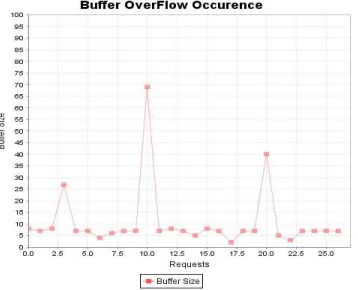
The result is obtained by comparing request
from network against the buffer size as
shown in figure 3 below. The nature of
buffer is changed according to the request
from network. Sometimes take more buffer
size (buffer overflow occurs) and maximum
time average buffer size depending on the
nature of request from the network.
Figure 3: Analysis of different request from
network against buffer size.
VIII. CONCLUSION
We have proposed Signature and
signature-free malicious code blocker
system with gif and jpg format that can
filter code-injection buffer overflow attack,
one of the most serious cyber security
paradigm. SigFree does not require any
signatures, thus it can block new malicious
code and provide security for the systems.
SigFree is less affected from malicious
attack, and economical for deployment with
little maintenance cost and low
performance overhead.
REFERENCES
1. Xinran Wang, Chi-Chun Pan, Peng Liu,
and Sencun Zhu, “SigFree: A Signature-Free
Buffer Overflow Attack Blocker”, Ieee
Transactions On Dependable And Secure
Computing, Vol. 7, No. 1, January-March
2010.
2. Eric Haugh and Matt Bishop, “Testing C
Programs for Buffer Overflow
Vulnerabilities”.
3. Crispin Cowan, Perry Wagle, Calton Pu,
Steve Beattie, and Jonathan Walpole
“Buffer Overflows: Attacks and Defenses for
the Vulnerability of the Decade”
http://www.cse.ogi.edu/DISC/projects/imm
unix.
4. Hassen Sallay, Khalid A. AlShalfan,
Ouissem Ben Fred j,” A scalable distributed
Available Online At www.ijpret.com IJCSNS International Journal of Computer
Science and Network Security, VOL.9 No.8,
August 2009.
5. E. Barrantes, D. Ackley, T. Palmer, D.
Stefanovic, and D. Zovi, “Randomized
Instruction Set Emulation to Disrupt Binary
Code Injection Attacks,” Proc. 10th ACM
Conf. Computer and Comm. Security (CCS
’03), Oct. 2003.
6. Newsome and D. Song, “Dynamic Taint
Analysis for Automatic Detection, Analysis,
and Signature Generation of Exploits on
Commodity Software,” Proc. 12th Ann.
Network and Distributed System Security
Symp. (NDSS), 2005.
7. B.A. Kuperman, C.E. Brodley, H.
Ozdoganoglu, T.N. Vijaykumar, and A.
Jalote, “Detecting and Prevention of Stack
Buffer Overflow Attacks,” Comm. ACM, vol.
48, no. 11, 2005.
8. M. Costa, J. Crowcroft, M. Castro, A.
Rowstron, L. Zhou, L. Zhang, and P. Barham,
“Vigilante: End-to-End Containment of
Internet Worms,” Proc. 20th ACM Symp.
Operating Systems Principles (SOSP), 2005.
9. J. Pincus and B. Baker, “Beyond Stack
Smashing: Recent Advances in Exploiting
Buffer Overruns,” IEEE Security and Privacy,
vol. 2, no. 4, 2004.
10. G. Kc, A. Keromytis, and V. Prevelakis,
“Countering Code-
11. Injection Attacks with Instruction-Set
Randomization,” Proc. 10th ACM Conf.
Computer and Comm. Security (CCS ’03),
Oct. 2003.
12. Pankaj Pawar ,Malti Nagle and Pankaj
Kawadkar “Prevention of Buffer overflow
Attack overflow Attack overflow Attack
Blocker Using IDS” IJCSN Volume 1, Issue 5,