Fully Simulatable Quantum-Secure
Coin-Flipping and Applications
Carolin Lunemann and Jesper Buus Nielsen
Department of Computer Science, Aarhus University, Denmark {carolin|jbn}@cs.au.dk
Abstract We propose a coin-flip protocol which yields a string of strong, random coins and is fully simulatable against poly-sized quantum adver-saries on both sides. It can be implemented with quantum-computational security without any set-up assumptions, since our construction only as-sumes mixed commitment schemes which we show how to construct in the given setting. We then show that the interactive generation of random coins at the beginning or during outer protocols allows for quantum-secure realizations of classical schemes, again without any set-up as-sumptions. As example applications we discuss quantum zero-knowledge proofs of knowledge and quantum-secure two-party function evaluation. Both applications assume only fully simulatable coin-flipping and mixed commitments. Since our framework allows to construct fully simulat-able coin-flipping from mixed commitments, this in particular shows that mixed commitments arecompletefor quantum-secure two-party function evaluation. This seems to be the first completeness result for quantum-secure two-party function evaluation from a generic assumption.
1
Introduction
True randomness is a crucial ingredient in many cryptographic applications. Therefore, secure coin-flipping is an essential primitive, which allows two parties to agree on a uniformly random bit in a fair way, such that neither party can influence the value of the coin to his advantage. We investigate coin-flip proto-cols with classical messages exchange but where the adversary is assumed to be capable of quantum computing. Security of cryptographic protocols in the quan-tum world means, of course, that quanquan-tum computation does not jeopardize the assumption, underlying the protocol construction. However, we encounter addi-tional setbacks in the security proofs, which are mostly due to the fact that some well-known classical proof techniques cannot be applied in a quantum environ-ment.
Our Contribution.We aim at establishing coin-flipping as a stand-alone tool in a model without any setup assumptions. As such, our protocol can be used in several contexts and different generic constructions. One notable application is as subroutine for realizing the theoretical assumption of the common-random-string-model (CRS-model).1 Since the generation of a CRS often significantly
1
simplifies the design of (quantum-secure) protocols, this then implies that var-ious interesting applications can be implemented quantum-securely in a simple manner from scratch.
In more detail, we first investigate different degrees of security that a coin-flip protocol can acquire. Then, we propose and prove constructions that allow us to amplify the respective degrees of security such that weaker coins are con-verted into very strong ones.2 The amplification only requires mixed
commit-ment schemes, which we know how to construct with quantum security under reasonable assumptions—for instance, based on the quantum hardness of the learning with error problem. Combining our amplification protocols allows to take a very weak notion of coin-flipping and amplify it to a coin-flip protocol which isfully simulatable against poly-sized quantum adversaries. By fully simu-latable we mean that both sides can be simulated in quantum polynomial time. Our amplification framework should also be understood as a step towards fully simulatable constant-round coin-flipping. To the best of our knowledge, to date there does not exist any fully simulatable protocol which is constant-round and which allows to generate a long random bit-string. In particular, no fully simulatable constant-round coin-flip protocol is known to securely compose in parallel. Since all our amplification protocols work in constant-round, we show that if there exists a constant-round coin-flip protocol of long strings with weak security, then there also exists a constant-round coin-flip protocol of long strings which is fully simulatable. Even though our work leaves fully simulatable constant-round coin-flipping of long strings as a fascinating open problem, we consider it a contribution in itself to define a reasonably weak but sufficient security notion to realize fully simulatable constant-round coin-flipping of long strings.
Related Work. The standard coin-flip protocol of [2] was proven secure in a quantum environment in previous work [7]. In its basic form this protocol yields
one coin as output. Of greater importance, however, is flipping a string of coins instead of a bit, in particular, when generating a CRS. The basic construction composes in sequence with security classified as medium in our framework here. Parallel composition is possible using an extended construction providing effi-cient simulations on both sides. This extension, however, requires a CRS as initial assumption, i.e. the CRS-model, and hence, violates our strong requirement of applications, implementable quantum-securely without any set-up assumptions. As an example application, we discussed in [7] the generation of a CRS in the context of e.g. a quantum zero-knowledge proof. For an overview and more details, see also [14]. To further show the implications of coin-flipping as an im-plementation of the CRS-model in the quantum setting, we here add the func-tionalities of a quantum zero-knowledge proof of knowledge and quantum-secure function evaluation. We want to mention the following related work. First, an alternative approach in the context of zero-knowledge was independently
tigated by Smith [17]. There, coin-flipping is implemented by a string commit-ment with special openings and validated in subsequent zero-knowledge proofs in sequence, and which therefore has round complexity depending on the secu-rity parameter, i.e. how many proofs must be completed to achieve a negligible soundness error. The coin-string is used as key to encode the witness and more zero-knowledge proofs are given to prove that. As encryption scheme, they sug-gest a scheme with similar properties as in the standard construction for mixed commitments [4, 5, 8]. To the best of our knowledge, the question of its actual secure implementation was left open, and a formal description and analysis was never published. Second, we want to mention the concurrent and independent work of Hallgren, Smith, and Song, as sketched in [12]. They also prove, among other things, classical protocols for zero-knowledge proofs of knowledge and func-tion evaluafunc-tion secure in the quantum setting by proposing a composifunc-tion theo-rem that allows to use the basic coin-flipping protocol in [7] to generate a CRS. In addition, they give a UC-secure protocol for said tasks in the CRS-model.
Furthermore, the techniques used in our reductions are inspired by techniques used by works in the UC framework (cf. [8]), where rewinding is also a problem. But to the best of our knowledge, all our reductions are novel, and might be also of classical interest.
Security in the Quantum World.It is well known that bit commitments imply a single coin-flip—in the classical as in the quantum world [2, 7]—in a straightforward way: Alice chooses a random bitaand commits to it, Bob then sends his bitb in plain, then the commitment is opened, and the resulting coin is a⊕b. However, even when basing the embedded commitment scheme on a computational assumption that withstands quantum attacks (for the hiding property), the security proof of the outer coin-flipping (and its integration into other applications) cannot easily be translated from the classical to the quantum world. Typically, security against a classical adversary is argued in this context by rewinding the adversary in a simulation. In brief, it is shown that a run of a protocol between a dishonest Bob and honest Alice can be efficiently simulated without interacting with Alice but with a simulator instead. A simulator basically prepares a valid conversation and tries it on dishonest Bob. Now, in case Bob does not send the expected reply, we need the possibility to rewind him. Then to conclude the proof, we have to show that the expected running time of the simulation is polynomial.
commitments [7]. However, the generation of a string of coin must be based on string commitments. In this setting, the simulator cannot rewind in poly-time. A possible solutions for simulating against a classical Bob is then to let him commit to his message in a way which allows to extract the message in the simulation. Therewith, the message is known to the simulator in any following iteration of rewinding. This technique seems to be doomed to fail in the quantum realm, since it is neither known how to rewind quantumly for string commitments nor can any intermediate status (such as Bob’s commitment) be preserved. Moreover, commitment constructions providing flavors of extractability without rewinding require some stronger set-up assumptions. Thus, other techniques such as our method based on mixed commitments, are needed for solutions in this context. Applications.Even though we establish coin-flipping as a stand-alone tool, we highlight again that the generation of a CRS leads to a simple and quantum-secure implementation of various interesting applications without any set-up assumptions. We show two different example applications, in addition to the functionalities already discussed in [7]. First, we propose aquantum-secure zero-knowledge proof of zero-knowledge based on a witness encoding scheme, which we define such that it provides a certain degree of extractability and simulatabil-ity in the quantum world. Our zero-knowledge construction only requires mixed commitments, which can be implemented with quantum security. This is of par-ticular interest, as the problems of rewinding in the quantum realm complicate implementing proofs of knowledge from scratch. And second, we show that mixed commitment schemes are sufficient forquantum-secure function evaluationofany
classical poly-time functionf with security against active quantum adversaries. In more detail, we first show that mixed commitments imply an oblivious trans-fer protocol with passive security. From that it is straightforward to construct a protocol for any classical poly-time function with security against passive quan-tum adversaries [13]. As our main result in that context, we then propose a quantum-secure implementation for evaluating any such function with security against active quantum adversaries.
2
Preliminaries
Notation. We use negl(n) to denote the set of negligible functions (in n). For a bit-string x ∈ {0,1}n and a subset S ⊆ {1, . . . , n} of size s, we define
x|S ∈ {0,1}sto be the restriction (xi)i∈S. Theprobabilityof eventE is denoted
by Pr [E]. For a random variable X we use PX to denote the distribution of
X, and for an additional random variable Y we use PX|Y to denote the
con-ditional distribution ofX givenY. Statistical indistinguishability of families of classical random variables is denoted by≈, ands ≈q indicates quantum poly-time indistinguishability of families of random variables, i.e., the families cannot be distinguished by poly-sized families of quantum circuits.
and extended in [4]. The definitions are proposed for quantum protocols that implementclassical non-reactive two-party functionalities, meaning that in- and output must be classical. The framework allows functionalities which behave dif-ferently in case of a dishonest player, and it is further shown that any protocol in the frameworkcomposes sequentially in a classical environment, i.e. within an outer classical protocol. For the sake of simplicity, the framework does not assume additional entities such as e.g. an environment. The original security definitions for unconditional security [9] are phrased in simple information-theoretic con-ditions, depending on the functionality, which implies strong simulation-based security. In [4], it is then shown that computational security (in the CRS-model) can be defined similarly. In the following, we state the formalism essential for this work.3For more details on the framework and notation, we refer to [4, 6, 9], and to [14] for an overview.
Our protocols run between players Alice (A) and Bob (B) and all definitions are given in thetwo-world paradigm of simulation-based proofs. Thereal world
captures the actual protocol Π, consisting of message exchange between the parties and local computations. Real-world players are denoted by honestA,B
and are restricted to poly-time classical strategies. Dishonest playersA0,B0 are allowed anyquantum poly-time strategy. Formally, letPdenote the set of poly-size quantum circuits, so we assume thatA0,B0 ∈P. The ideal functionality F models the intended behavior of the protocol in theideal world, where the players interact using F. Honest and dishonest players in the ideal world (a.k.a. sim-ulators) are denoted by ˆA,Bˆ and ˆA0,Bˆ0, respectively. An honest player simply
forwards messages to and fromF, dishonest players are allowed to change their messages. Again ˆA0,Bˆ0 ∈ P. Now, the input-output behavior of F defines the required input-output behavior ofΠ. Intuitively, if the executions are indistin-guishable, security of the protocol in real life follows. In other words, a dishonest real-world player that attacks protocol Π cannot achieve (significantly) more than an ideal-world adversary that attacks the corresponding functionalityF.
The common input stateρU V =Pu,vPU V(u, v)|uihu| ⊗ |vihv|for some
prob-ability distribution PU V is classical, and we understand U, V as random input
variables (for Alice and Bob, respectively). The same holds for the classical output state ρXY with output X, Y for Alice respectively Bob. The
input-output behavior of the protocol is uniquely determined by PXY|U V, and we
writeΠ(U, V) = (X, Y). Then, a general classical ideal functionalityF is given by a conditional probability distributionPF(U,V)|U V withF(U, V) denoting the
ideal-world execution, where the players forward their inputs U, V to F and output whatever they obtain from F.
Definition 1 (Correctness). A protocol Π(U, V) = (X, Y) correctly imple-ments an ideal classical functionality F, if for every distribution of the input values U and V, the resulting common output (X, Y) satisfies (U, V, X, Y) ≈s (U, V,F(U, V)).
3
We now define computational security against dishonest Alice, the definitions for dishonest Bob are analogue. LetZ andU0 denote dishonest Alice’s classical and quantum information. We consider a poly-size quantum circuit, calledinput sampler, which takes as input the security parameter and produces the input stateρU0ZV. We require from the input sampler that anyρU0ZV is restricted to be of formρU0↔Z↔V =P
z,vPZV(z, v)|zihz| ⊗ |vihv| ⊗ρ z
U0 (see [6] for notational details), where it holds that4 ρz
U0 = ρ
z,v
U0. This expresses conditional
indepen-dence, namely that Bob’s classicalV is independent of Alice’s quantum partU0 when givenZ. In other words, Alice’s quantum partU0 is correlated with Bob’s part only via her classicalZ.
Definition 2 (Computational security against dishonest Alice). A
pro-tocol Π implements an ideal classical functionality F computationally securely against dishonest Alice, if for any real-world adversary A0 ∈P, there exists an
ideal-world adversary Aˆ0 ∈ P such that, for any efficient input sampler with
ρU0ZV =ρU0↔Z↔V, it holds that the outputs are quantum-computationally
in-distinguishable, i.e.,outΠA0,B
q
≈outFˆ A0,Bˆ.
We state these output states explicitly as outΠ
A0,B = ρU X0ZY and outFˆ A0,Bˆ =
ρU X0↔Z↔Y, which shows that Alice’s possibilities in the ideal world are limited: She can produce some classical input U for F from her quantum input state U0, and then she can obtain a quantum state X0 by locally processing U and possibly F’s classical replyX.
3
Security Notions for Coin-Flipping
We denote a generic protocol with a λ-bit coin-string as output by Πλ−COIN A,B , corresponding to an ideal functionalityFλ−COIN. The outcome of such a protocol isc∈ {0,1}λ∪{⊥}, i.e., either anλ-bit-string or an error message. We use several
security parameters, indicating the length of coin-strings for different purposes; the length of a coin-flip yielding a key or a challenge are denoted by κ or σ, respectively. The ideal functionality for coin-flipping is defined symmetric such that always the respective dishonest party has an option to abort. We state the ideal functionalities in the case of both players being honest and in the case of dishonest Alice and honest Bob (Fig. 1). Note that the latter then also applies to honest Alice and dishonest Bob by simply switching sides and names.
Recall that thejoint output representationof a protocol execution is denoted byoutΠA,B (withΠ =ΠAλ,−BCOIN) and given here for the case of honest players. The
same notation with F =Fλ−COIN and ˆA,Bˆ applies in the ideal world asoutFˆA,ˆB,
where the players invoke the ideal functionality Fλ−COIN and output whatever
4
ρxE denotes a state in registerE, depending on valuex∈ X of random variableX
overX with distributionPX. Then, from the view of an observer, who holds register
E but does not know X, the system is in state ρE =Px∈XPX(x)ρxE, where ρE
FunctionalityFλ−COIN with honest players:
Upon receiving requests start from both Alice and Bob, Fλ−COIN outputs
uniformly randomh∈R{0,1}λto Alice and Bob.
FunctionalityFλ−COIN with dishonest Alice:
1. Upon receiving requests start from both Alice and Bob, Fλ−COIN outputs
uniformly randomh∈R{0,1}λto Alice.
2. It then waits to receive her second input>or⊥and outputshor⊥to Bob, respectively.
Figure 1.The Ideal Functionality forλ-bit Coin-Flipping.
they obtain from it. We need an additional notation here, describing theoutcome
of a protocol run between e.g. honestAandB, namelyc←Πλ−COIN A,B .
We will define three flavors of security for coin-flip protocols, namely un-controllable (uncont), random and enforceable (force). The two sides can have different flavors. Then, if a protocolΠAλ,−BCOINis, for instance, enforceable against Alice and random against Bob, we write π(force,random), and similarly for the
eight other combinations of security. Note that for simplicity of notation, we will then omit the indexed name as well as the length of the coin, as they are clear from the context. Again, we define all three flavors for Alice’s side only, as the definitions for Bob are analogue. Recall that U0 and Z resp. V denote dishon-est Alice’s quantum and classical input resp. hondishon-est Bob’s classical input. As before, we assume a poly-size input sampler, which takes as input the security parameter, and produces a valid input state ρU0ZV =ρU0↔Z↔V. Note that an honest player’s input is empty but models the invocationstart. We stress that we require for all three security flavors and for allc∈ {0,1}λ that
Pr [c←Πλ−COIN A,B ] = 2
−λ,
which implies that when both parties are honest, then the coin is unbiased. Below we only define the extra properties required for each of the three flavors. We call a coin-flipuncontrollable against Alice, if she cannot force the coin to hit some negligible subset, except with negligible probability.
Definition 3 (Uncontrollability against dishonest Alice). We say that
protocolΠλ−COIN
A,B implements anuncontrollablecoin-flip against dishonest Alice,
if it holds for any poly-sized adversaryA0 ∈Pwith inputs as specified above and all negligible subsetsQ⊂ {0,1}λ that
Pr [c←ΠAλ0−,BCOIN : c∈Q]∈negl(κ).
Note that we denote byQ⊂ {0,1}λ a family of subsets{Q(κ)⊂ {0,1}λ(κ)} κ∈N
for security parameterκ. Then we callQnegligible, if|Q(κ)|2−λ(κ) is negligible
We call a coin-fliprandomagainst Alice, if she cannot enforce a non-uniformly random output string in {0,1}λ, except by making the protocol fail on some
chosen runs. That means she can at most lower the probability of certain output strings compared to the uniform case.
Definition 4 (Randomness against dishonest Alice).We say that protocol
ΠAλ,−BCOIN implements a randomcoin-flip against dishonest Alice, if it holds for any poly-sized adversary A0 ∈P with inputs as specified above that there exists an event E such that Pr [E]∈negl(κ)and for all x∈ {0,1}λ it holds that
Pr [c←ΠAλ0−,BCOIN : c=x|E]¯ ≤2−λ.
It is obvious that if a coin-flip is random against Alice, then it is also an un-controllable coin-flip against her. We will later discuss a generic transformation going in the other direction from uncontrollable to random coin-flipping.
We call a coin-flipenforceableagainst Alice, if it is possible, given a uniformly randomc, to simulate a run of the protocol hitting exactly the outcomec, though we still allow that the corrupted party forces abort on some outcomes.5
Definition 5 (Enforceability against dishonest Alice). We call protocol
Πλ−COIN
A,B enforceableagainst dishonest Alice, if it implements the ideal
function-ality Fλ−COIN against her.
That means that for any poly-sized adversaryA0∈P, there exists an ideal-world adversary ˆA0 ∈ P that simulates the protocol with A0 as follows. ˆA0 requests outputh∈ {0,1}λfromF
λ−COIN. Then it simulates a run of the coin-flip protocol withA0 and tries to enforce outputh. If ˆA0 succeeds, it inputs>asA0’s second input to Fλ−COIN. In that case, Fλ−COIN outputs h. Otherwise, ˆA0 inputs ⊥ to Fλ−COIN as second input and Fλ−COIN outputs ⊥. In addition, the simulation is such that the ideal output is quantum-computationally indistinguishable from the output of an actual run of the protocol, i.e.,outΠA0,B
q
≈outFˆ
A0,Bˆ, where Π =
ΠAλ0−,BCOIN and F=Fλ−COIN. Enforceability against dishonest Bob is analogously defined. Corollary 1 follows.
Corollary 1. If ΠAλ,−BCOIN ∈π(force,force), i.e., it is enforceable against both
dis-honest Alice and disdis-honest Bob, then Πλ−COIN
A,B is a secure implementation of Fλ−COIN, according to Definition 2.
4
Mixed Commitments
We use mixed commitment schemes throughout our constructions—they will indeed be our only computational assumption. Mixed commitment are uncon-ditionally hiding for some public keys and unconuncon-ditionally binding for others.
5
In the following, we introduce mixed commitments, denoted bycommitpk, more
formally. We also describe a construction of an interactive commitment protocol
COMMITpk with mixed-commitment-scheme-like properties. The reason for
pre-senting the protocol here is to simplify the description of the later protocol in which it is used as a subprotocol.
4.1 Mixed Commitment Schemes
Mixed commitment schemes consists of four poly-time algorithmsGH,GB,commit, andxtr. Theunconditionally hiding key generator GH outputs public keyspk∈ {0,1}κ.6Theunconditionally binding key generatorG
Boutputs key pairs (pk, sk), where pk∈ {0,1}κ and wheresk is the secret key. The commitment algorithm
takes as input a messagem, a randomizerr and a public keypk and outputs a commitmentC=commitpk(m, r) . The extraction algorithmxtrtakes as input
a commitment C and a secret key sk and outputs a message m0, meant to be the message committed byC. We require the following properties:
Unconditionally hiding: For keyspk generated byGHit holds thatcommitpk
is statistically hiding, i.e. (pk,commitpk(m1, r1) ) s
≈(pk,commitpk(m2, r2) ) for
allm1, m2 whenr1 andr2 are uniformly random and independent.
Extractability: It holds for all pairs (pk, sk) generated byGBand for all values m, rthatxtrsk(commitpk(m, r) ) =m.
Key indistinguishability: A random public key pk1 generated byGB and a random public keypk2generated byGHare indistinguishable by poly-sized quan-tum circuits, i.e., pk1
q
≈pk2.
We additionally require that random public keys generated by GH are sta-tistically close to uniform in {0,1}κ, i.e., almost all keys are unconditionally
hiding.7
As a candidate for instantiating our definition we can, for instance, take the lattice-based public-key encryption scheme of Regev [16] in its multi-bit vari-ant as given in the full version of [15]. Regev’s cryptosystem is based on the hardness of the learning with error problem, which can be reduced from worst-case (quantum) hardness of the shortest vector problem (in its decision version). Thus, breaking the scheme implies an efficient algorithm for approximating the lattice problem in the worst-case, which is assumed to be hard even with quan-tum computing power. A regular public key for Regev’s scheme is proven to be quantum-computationally indistinguishable from the case where a public key is chosen from the uniform distribution. In this case, the ciphertext carries essen-tially no information about the message [16, Lemma 5.4]. This proof of semantic
6
For notational simplicity, the length of public keys is assumed to equal security parameterκ.
7
security for Regev’s cryptosystem is in fact the property we require for our com-mitment.
4.2 The protocol COMMITpk
In one of our security amplifications of coin-flip protocols we will need a mixed commitment scheme which also providesequivocability, i.e., a simulator can open unconditionally hiding commitments to different values. We add equivocability using an interactive protocolCOMMITpk. Instead of equipping unconditionally
hid-ing keys with equivocation trapdoors, we will do it by letthid-ing the equivocation trapdoor be the ability of the simulator to force the outcome of a coin-flip proto-col in the simulation. The reason for this change, as compared to [8], is that the notion of a mixed commitment scheme in [8] was developed for the CRS-model, where the simulator is free to pick the CRS and hence could pick it to be a un-conditionally hiding public key with known equivocation trapdoor. Here we are interested in the bare (CRS devoid) model and hence have to add equivocation in a different manner. This is one of the essential steps in bootstrapping fully simulatable strong coin-flipping from weak coin-flipping.
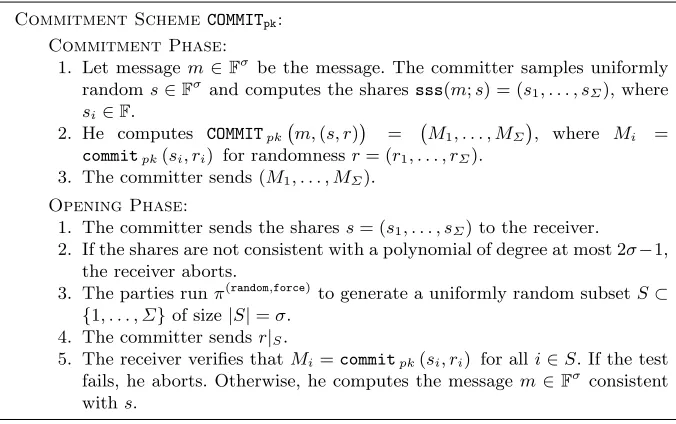
The protocolCOMMITpkuses a secret sharing schemesss, described now. Let
σ be a secondary security parameter. Given message m = (m1, . . . , mσ) ∈ Fσ and randomizers= (s1, . . . , sσ)∈Fσ, letfm,s(X) denote the unique polynomial
of degree 2σ−1, for whichfm,s(−i+ 1) =mi for i= 1, . . . , σand fm,s(i) =si
for i = 1, . . . , σ. Furthermore, we “fill up” positions i = σ+ 1, . . . , Σ, where Σ= 4σ, by lettingsi=fm,s(i). The shares are nows= (s1, . . . , sΣ).
We stress two simple facts about sss. First, for any message m ∈ Fσ and any subsetS ⊂ {1, . . . , Σ} of size|S|=σ, the sharess|S are uniformly random
inFσ, whenS is chosen uniformly at random inFσ and independent ofm. This aspect is trivial for S = {1, . . . , σ}, as we defined it that way, and it extends to the other subsets using Lagrange interpolation. And second, if m1, m2 ∈Fσ are two distinct messages, then sss(m1;s1) and sss(m2;s2) have Hamming distance at leastΣ−2σ. Again, this follows by Lagrange interpolation, since the polynomialfm1,s1(X) has degree at most 2σ−1, and hence, can be computed from any 2σ shares si using Lagrange interpolation. The same holds for fm2,s2(X). Thus, if 2σ shares are the same, then fm1,s1(X) and fm2,s2(X) are the same, which implies that the messages m1 =f
m1,s1(−σ+ 1), . . . , fm1,s1(0) andm2= fm2,s2(−σ+ 1), . . . , fm2,s2(0) are the same.
In addition tosss, the protocolCOMMITpkuses a mixed commitment scheme
commitpk. The key generators for COMMITpk are the same as forcommitpk.
Fi-nally, COMMITpk uses a coin-flip protocol π(random,force) which is random for the
committer and which is enforceable against the receiver of the commitment. The details of COMMITpkare given in Fig. 2.
We first show that when (pk, sk) is generated usingGB, thenCOMMITpk is
ex-tractable. Given any commitmentM = M1, . . . , MΣ
, we extractxtrsk(M) =
xtrsk(M1), . . . ,xtrsk(MΣ)
= (s1, . . . , sΣ) = s . Assume s0 = (s01, . . . , s0Σ) is
Commitment SchemeCOMMITpk:
Commitment Phase:
1. Let messagem∈Fσ be the message. The committer samples uniformly randoms∈Fσ and computes the sharessss(m;s) = (s1, . . . , sΣ), where
si∈F.
2. He computes COMMITpk m,(s, r)
= M1, . . . , MΣ
, where Mi =
commitpk(si, ri) for randomnessr= (r1, . . . , rΣ).
3. The committer sends (M1, . . . , MΣ).
Opening Phase:
1. The committer sends the sharess= (s1, . . . , sΣ) to the receiver.
2. If the shares are not consistent with a polynomial of degree at most 2σ−1, the receiver aborts.
3. The parties runπ(random,force) to generate a uniformly random subsetS⊂ {1, . . . , Σ}of size|S|=σ.
4. The committer sendsr|S.
5. The receiver verifies thatMi=commitpk(si, ri) for all i∈S. If the test
fails, he aborts. Otherwise, he computes the messagem∈Fσ consistent withs.
Figure 2.The Commitment SchemeCOMMITpk.
the same time differs fromsin the fewest positions. Note that we can finds0 in poly-time when using a Reed Solomon code, which has efficient minimal distance decoding. We then interpolate the polynomial fm0,s0(X), let m0 = fm0,s0(−σ+ 1), . . . , fm0,s0(0), and letxtrsk(M) = m0. Any other sharing s00 = (s001, . . . , s00
Σ)
must have Hamming distance at least 2σtos0. Now, sincesis closer tos0 than to any other consistent sharing, it must, in particular, be closer tos0 then tos00. This implies thatsis at distance at leastσtos00.
We will use this observation for proving soundness of the opening phase. To determine the soundness error, assume thatCOMMITpkdoes not open to the shares
s0 consistent withs. As observed, this implies that xtrsk(M1), . . . ,xtrsk(MΣ)
has Hamming distance at leastσtos0. However, whencommitpkis
uncondition-ally binding, allMican only be opened toxtrsk(Mi). From the above two facts,
we have that there are at least σ valuesi ∈ {1, . . . , Σ} such that the receiver cannot open Mi to si fori ∈S. Since Σ= 4σ, these σ bad indices (bad for a
dishonest sender) account for a fraction of 14 of all points in {1, . . . , Σ}. Thus, the probability that none of the σ points in S is a bad index is at most (3
4) σ,
which is negligible. Setting σ= log4
32 gives a negligible error of (
1 2)
κ, whereκ
is the security parameter.
We then analyze the equivocability ofCOMMITpk. We will use the ability of the
SimulatingCOMMITpk with TrapdoorS:
1. ˆS gets as input a uniformly random subsetS ⊂ {1, . . . , Σ}of sizeσ and an initial messagem∈Fσ.
2. ˆS commits honestly tom∈Fσ byM =COMMITsk m,(s, r)
, as specified in the commitment phase.
3. ˆS is given an alternative message ˜m∈Fσ, i.e., the aim is openingM to ˜m. 4. ˆS letss|S be theσmessages committed to byM|S. Then it interpolates the
unique polynomialfm,s˜ of degree at most 2σ−1 for whichfm,s˜ (i) = si for
i∈ S and for whichfm,s˜ (−i+ 1) = ˜mi fori = 1, . . . , σ. Note that this is
possible, as we have exactly 2σ points which restrict our choice of fm,s˜ . ˆS sendss= fm,s˜ (1), . . . , fm,s˜ (Σ)
to the receiver. 5. The parties runπ(random,force)
and ˆS forces the outcomeS.
6. For alli∈S, the sender opensMitofm,s˜ (i). This is possible, sincefm,s˜ (i) =si
is exactly the message committed to byMiwheni∈S.
Figure 3.The Ideal-World Simulation ofCOMMITpk.
5
Amplification Theorems for Strong Coin-Flipping
We now propose and prove theorems, which allow us to amplify the security strength of coins. Ultimately, we aim at constructing a strong coin-flip protocol π(force,force)with outcomes of any polynomial length`inλfrom a weaker
coin-flip protocolπ(force,uncont)ofκ-bit-strings, whereκis the key length of the mixed
commitment scheme. We do this in two steps. We first show how to implement π(force,random)for`-bit-strings (for any polynomial`) givenπ(force,uncont)for
κ-bit-strings, and we then show how to implementπ(force,force)for poly-long bit-strings
givenπ(force,random)for poly-long bit-strings.
The ability to amplifyπ(force,uncont)forκ-bit-strings toπ(force,force)for
poly-bit-string is of course only interesting, if there exists such a candidate. We do not know of any protocol with flavor (force,uncont) but not (force,random). However, we consider it as a contribution in itself to find the weakest security notion for coin-flipping that allows to amplify to the final strong (force,force) notion using a constant-round reduction.
A candidate forπ(force,random) with one-bit outcomes is the protocol in [7],
which is—in terms of this context—enforceable against one side in poly-time and random on the other side, with empty event E according to Definition 4, and the randomness guarantee even withstanding an unbounded adversary.8The
protocol was shown to be sequentially composable [7,14]. Repeating the protocol κ times in sequence gives a protocol π(force,random) for κ-bit-strings. Note that
this, in particular, gives a protocolπ(force,uncont)forκ-bit-strings.
8
The protocol was described and proven as π(random,force)
5.1 From (force,uncont) to (force,random)
Assume that we are given a protocolπ(force,uncont), that only guarantees that Bob
cannot force the coin to hit a negligible subset (except with negligible probabil-ity). We now amplify the security on Bob’s side from uncontrollableto random
and therewith obtain a protocol π(force,random), in which Bob cannot enforce a
non-uniformly random output string, except by letting the protocol fail on some occasions. The stronger protocolπ(force,random)is given in Fig. 4, where
commitpk
is the basic mixed commitment scheme as described in Section 4.1. Correctness ofπ(force,random)is obvious by inspection of the protocol.
Protocolπ(force,random):
1. AandBrunπ(force,uncont)
to produce a public keypk∈ {0,1}κ
.
2. Asamplesa∈R{0,1}`, commits to it withA=commitpk(a, r) and
random-izerr∈R{0,1}`, and sendsAtoB.
3. Bsamplesb∈R{0,1}`and sendsbtoA.
4. AopensAtowardsB. 5. The outcome isc=a⊕b.
Figure 4.Amplification from (force,uncont) to (force,random).
Theorem 1. If π(force,uncont) is enforceable against Alice and uncontrollable
against Bob, then protocolπ(force,random)is enforceable against Alice and random
for Bob.
We sketch the basic ideas behind the proof, which can be found in greater detail in Appendix A. Enforceability againstAfollows by forcingpk to be apk gener-ated as (pk, sk)← GB. The simulator then usesskto extractafromAand then sends thebwhich makesa⊕bhit the desired outcome. Randomness againstB fol-lows from the fact that only a negligible fraction of the keyspk∈ {0,1}κare not
unconditionally hiding keys and the outcome of π(force,uncont) is uncontrollable
forB.
5.2 From (force,random) to (force,force)
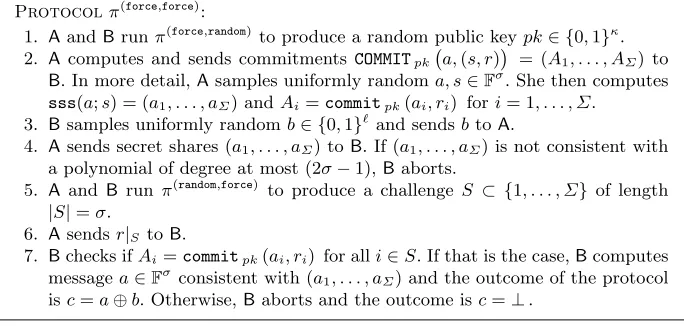
We now show how to obtain a coin-flip protocol, which is enforceable against both parties. Then, we can also claim by Corollary 1 that this protocol is a strong coin-flip protocol, poly-time simulatable on both sides for the natural ideal func-tionalityF`−COIN. The protocol π(force,force) is described in Fig. 5 and uses the extended commitment construction COMMITpk from Section 4.2. The protocol
makes two calls to a subprotocol with random flavor on one side and enforce-ability on the other side, but where the sides are interchanged, i.e.π(force,random)
and π(random,force), so we simply switch the players’ roles. Again, correctness of
Protocolπ(force,force):
1. AandBrunπ(force,random)
to produce a random public keypk∈ {0,1}κ
. 2. Acomputes and sends commitments COMMITpk a,(s, r)
= (A1, . . . , AΣ) to B. In more detail,Asamples uniformly randoma, s∈Fσ. She then computes sss(a;s) = (a1, . . . , aΣ) andAi=commitpk(ai, ri) fori= 1, . . . , Σ.
3. Bsamples uniformly randomb∈ {0,1}`
and sendsbtoA.
4. Asends secret shares (a1, . . . , aΣ) toB. If (a1, . . . , aΣ) is not consistent with
a polynomial of degree at most (2σ−1),Baborts.
5. A and B run π(random,force)
to produce a challenge S ⊂ {1, . . . , Σ} of length |S|=σ.
6. Asendsr|S toB.
7. Bchecks ifAi=commitpk(ai, ri) for alli∈S. If that is the case,Bcomputes
messagea∈Fσ consistent with (a1, . . . , aΣ) and the outcome of the protocol
isc=a⊕b. Otherwise,Baborts and the outcome isc=⊥.
Figure 5.Amplification from (force,random) to (force,force).
Theorem 2. If π(force,random) is enforceable against Alice and random against
Bob, then protocol π(force,force) is enforceable against both Alice and Bob.
We sketch the main ideas behind the proof, which can be found in greater de-tail in Appendix B. Enforceability against Afollows by forcing pk to be a key pk generated as (pk, sk) ← GB. The simulator then uses sk to extracta from (A1, . . . , AΣ). Then it sends the b that makes a⊕b hit the desired outcome.
Enforceability against B follows by letting the simulator sample a uniformly random S and running COMMITpk a,(s, r)
= (A1, . . . , AΣ) in the equivocal
model with trapdoor S. Then the simulator waits forband forces the outcome of π(random,force) to be S, which allows it to open (A
1, . . . , AΣ) to the a that
makesa⊕b hit the desired outcome.
6
Application: Zero-Knowledge Proof of Knowledge
The purpose of a zero-knowledge proof of knowledge [1,10] is to verify in classical poly-time in the length of the instance, whether the prover’s private inputwis a valid witness for the common instancexin relationR, i.e. (x, w)∈ R. Here, we propose a quantum-secure construction of a zero-knowledge proof of knowledge based on witness encoding, which we define in the context of a simulation in the quantum world. The protocol is constant-round if the coin-flip protocol is constant-round.
6.1 Simulatable Witness Encodings of N P
We first specify a simulatable encoding scheme for binary relationR ⊂ {0,1}∗×
Let E : R × {0,1}m → {0,1}n denote an encoder, such that for each
(x, w) ∈ R, then-bit output e ←E(x, w, r0) is a random encoding of w, with randomnessr0∈ {0,1}mand polynomialsm(|x|) andn(|x|). The corresponding
decoderD:{0,1}∗×{0,1}n→ {0,1}∗takes as input an instancex∈ {0,1}∗and
an encodinge∈ {0,1}n and outputsw←D(x, e) withw∈ {0,1}∗. Next, letS
denote a selector with inputs ∈ {0,1}σ (with polynomial σ(|x|)) specifying a
challenge, and outputS(s) defining a poly-sized subset of{1, . . . , n} correspond-ing to challenges. We will useS(s) to select which bits of an encodingeto reveal to the verifier. For simplicity, we useesto denote the collection of bitse|S(s). We
denote with J the judgment that checks a potential encoding e by inspecting only bits es. In more detail, J takes as input instance x ∈ {0,1}∗, challenge
s∈ {0,1}σ and the |S(s)| bitse
s, and outputs a judgmentj←J(x, s, es) with
j ∈ {abort,success}. Finally, the simulator is called ˆE. It takes as input in-stancex∈ {0,1}∗ and challenges∈ {0,1}σ and outputs a random collection of
bitst|S(s)←E(x, s). Again for simplicity, we letˆ ts=t|S(s). Then, if this set has
the same distribution as bits of an encodingein positionsS(s), the bits needed for the judgment to check an encodingecan be simulated given just instancex (see Definition 8).
Definition 6 (Completeness). If an encoding e ← E(x, w, r) is generated correctly, then success←J(x, s, es)for alls∈ {0,1}σ.
We will call an encodinge admissible for x, if thereexist two distinct chal-lengess, s0 ∈ {0,1}σfor which
success←J(x, s, es) andsuccess←J(x, s0, es0).
Definition 7 (Extractability). If an encoding e is admissible for x, then
x, D(x, e) ∈ R.
We stress that extractability is similarly defined to the special soundness prop-erty of a classical Σ-protocol, which allows to extract w from two accepting conversations with distinct challenges. Such a requirement would generally be inapplicable in the quantum setting, as the usual rewinding technique is prob-lematic and in particular in the context here, we cannot measure two accepting conversations during rewinding in the quantum world. Therefore, we define the stronger requirement that if there exist two distinct answerable challenges for one encoding e, then w can be extracted given only e. This condition works nicely in the quantum world, since we can obtain e without rewinding, as we demonstrate below.
Definition 8 (Simulatability). For all (x, w)∈ R and alls ∈R {0,1}σ, the
distribution of e ← E(x, w, r0) restricted to positions S(s) is identical to the distribution of ts←E(x, s)ˆ .
bits corresponding to some positionsS0(0) or positionsS0(1). The details can be found in [3]. This gives us a simulatable witness encoding for any N P-relation R with σ = 1, using a Karp reduction from N P to circuit simulatability. By repeating itσtimes in parallel we get a simulatable witness encoding for anyσ. Fori= 1, . . . , σ, compute an encodingeiofwand lete= (e1, . . . , eσ). Then for
s∈ {0,1}σ, letS(s) specify that the bitsS0(s
i) should be shown ineiand check
these bits. Note, in particular, that if two distinctsands0passes this judgment, then there exists isuch that si6=s0i, so ei passes the judgment for bothsi= 0
andsi= 1, which by the properties of the protocol for circuit satisfiability allows
to compute a witnessw forxfromei. One can find wfrom esimply by trying to decode eachej forj= 1, . . . , σand check if (x, wj)∈ R.
6.2 The Protocol
We now construct a quantum-secure zero-knowledge proof of knowledge from proverAto verifierB. We are interested in theN P-language
L(R) = {x ∈ {0,1}∗| ∃w s.t. (x, w) ∈ R}, where A has input x and w, and
both AandBreceive positive or negative judgment of the validity of the proof as output. We assume in the following that on input (x, w) ∈ R, honest/ A
aborts. Unlike zero-knowledge proofs, proofs of knowledge can be modeled by an ideal functionality, given asFZKPK(R)in Fig. 6. FZKPK(R)can be thought of as
a channel which only allows to send messages in the language L(R). It models
zero-knowledge, as it only leaks instancexand judgment j but not witness w. Furthermore, it models aproof of knowledge, since Alice has to know and input a valid witnesswto obtain outputj=success.
Functionality FZKPK(R):
1. On input (x, w) from Alice,FZKPK(R)setsj=successif (x, w)∈ R. Otherwise, it setsj=abort.
2. FZKPK(R) outputs (x, j) to Bob.
Figure 6.The Ideal Functionality for a Zero-Knowledge Proof of Knowledge.
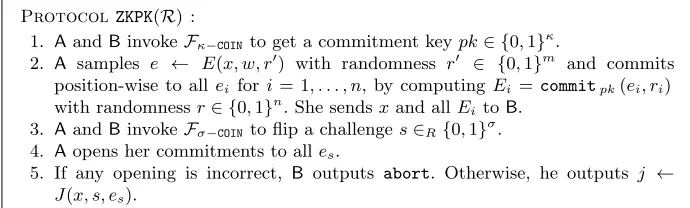
Protocol ZKPK(R) is describe in Fig. 7. It is based on our fully simulatable coin-flip protocol π(force,force), which we analyze here in the hybrid model by
invoking the ideal functionality of sequential coin-flipping twice (but with dif-ferent output lengths).9 One call to the ideal functionalityF
κ−COIN with output length κis required to instantiate a mixed bit commitment scheme COMMITpk.
The second call to the functionality Fσ−COIN produces σ-bit challenges for a simulatable witness encoding scheme with (E, D, S, J,E) as specified in the pre-ˆ
9 Note that in the hybrid model, a simulator can enforce a particular outcome to hit also when invoking the ideal coin-flip functionality. We then use Definition 5 to replace the ideal functionality by the actual protocolπ(force,force)
vious Section 6.1. The formal proof of Theorem 3 can be found in Appendix C. Corollary 2 follows immediately.
Theorem 3. For any simulatable witness encoding scheme(E, D, S, J,E)ˆ , sat-isfying completeness, extractability, and simulatability according to Definitions 6 - 8, and for negligible knowledge error2−σ, protocolZKPK(R)securely implements
FZKPK(R).
Corollary 2. If there exist mixed commitment schemes, then we can construct a classical zero-knowledge proof of knowledge against any quantum adversary
P0∈P without any set-up assumptions.
ProtocolZKPK(R):
1. AandBinvokeFκ−COINto get a commitment keypk∈ {0,1}κ.
2. A samples e ← E(x, w, r0) with randomness r0 ∈ {0,1}m
and commits position-wise to allei fori= 1, . . . , n, by computingEi =commitpk(ei, ri)
with randomnessr∈ {0,1}n
. She sendsxand allEitoB.
3. AandBinvokeFσ−COINto flip a challenges∈R{0,1}σ.
4. Aopens her commitments to alles.
5. If any opening is incorrect, B outputs abort. Otherwise, he outputs j ← J(x, s, es).
Figure 7.Zero-Knowledge Proof of Knowledge.
7
Application: Two-Party Function Evaluation
Here, we first show that mixed commitments imply a passively secure oblivi-ous transfer protocol. From such a protocol it is straightforward to construct a protocol forany classical poly-time function with security against passive quan-tum adversaries [13]. We then propose a quanquan-tum-secure implementation for evaluating any such function with security against active quantum adversaries.
7.1 Oblivious Transfer
In an oblivious transfer protocol (OT), the senderAsends two messagesm0and
m1 to the selectorB. Bcan choose which message to receive, i.e.mc according
to his choice bit c. B does not learn anything about the other messagem1−c,
and A does not learn B’s choice bit c (see Fig. 8). The protocol is correct, as
Bknowsskc and xtrskc(Cc) =xtrskc(commitpkc(mc, rc) ) =mc. Furthermore,
it hides the other message m1−c as commitpk1−c is unconditionally hiding for
randompk1−c, except with negligible probability. Last, the choice bit is hidden
ProtocolOT :
1. Bsamples two keyspk0 andpk1 according to his choice bitc, i.e. he samples pkcas (pkc, skc)← GBandpk1−c asp1−c← GH. He sends (pk0, pk1) toA. 2. Acommits to her messages (m0, m1) by computingC0=commitpk0(m0, r0)
andC1=commitpk1(m1, r1) . She sends (C0, C1) toB. 3. Bcomputesxtrskc(Cc).
Figure 8.Oblivious Transfer based on Mixed Commitments.
7.2 The Protocol
Based on protocolOT, we can construct a passively secure protocol for any classi-cal poly-time functionf. LetΠAf,B(x1, r1, x2, r2) denote such a protocol between
partiesAandBwith inputsx1andx2and random stringsr1andr2, respectively.
We show an implementation of the ideal functionalityFSFEf evaluating—with se-curity against active quantum adversaries—any classical poly-time function f for which there exists a classical passively secure protocol as described above. FunctionalityFSFEf is shown in Fig. 9.10 The implementation ΠASFE,B(f) ofFSFEf is shown in Fig. 10. Corollary 3 is proven in Appendix D.
Corollary 3. If there exist mixed commitment schemes, then there exists a clas-sical implementation of FSFEf for all classical poly-time functions f secure, ac-cording to Definitions 1 and 2.
FunctionalityFSFEf with honest players:
On inputx1 from Alice andx2 from Bob,FSFEf outputsy=f(x1, x2) to Alice and
Bob.
FunctionalityFSFEf with dishonest Alice:
1. On inputx1 from Alice andx2 from Bob,FSFEf outputsy=f(x1, x2) to Alice. 2. It then waits to receive her second input>or⊥and outputsyor⊥to Bob,
respectively.
Figure 9.The Ideal Functionality for Secure Function Evaluation.
10
ProtocolΠASFE,B(f):
1. AandBinvokeFκ−COINto get a commitment keypk∈ {0,1}κ.
2. Asends a random commitmentX1 = commitpk(x1,˜r1) and B sends a ran-dom commitmentX2 =commitpk(x2,r˜2) . Both parties useFZKPK(R) to give a zero-knowledge proof of knowledge that they know the plaintextxi inside
commitmentsXifori= 1,2.
3. Asends random commitmentS1=commitpk(s1,rˆ1) for uniformly randoms1 of length|s1|=|r1|, where r1 is the randomness she intends to use in ΠAf,B. Similarly,Bsends random commitmentS2=commitpk(s2,rˆ2) for uniformly random s2 of length |s2| = |r2|. Again, they use FZKPK(R) to give a zero-knowledge proof of zero-knowledge ofsi inSi fori= 1,2.
4. AandBinvokeFσ−COINtwice to get uniformly randoms
0
1ands
0
2with|s
0
i|=|si|
fori= 1,2.
5. Aletsr1=s1⊕s01 andBletsr2=s2⊕s02.
6. AandBrunΠAf,B(x1, r1, x2, r2), i.e. they run the passively secure protocol on inputs and randomness as defined in the previous steps.
7. Whenever A sends a message m in the execution ofΠAf,B(x1, r1, x2, r2), she gives a zero-knowledge proof of knowledge ofs1 inS1andx1 inX1, such that ifΠAf,B(x1, r1, x2, r2) is run onx1,r1 =s1⊕s01, andB’s messages sent toA so far, thenAwould indeed sendm. This is anN P-statement, so we can use FZKPK(R) for this proof.
8. IfΠAf,B(x1, r1, x2, r2) terminates with outputy, both parties outputy.
Figure 10.Procedure for Secure Function Evaluation
Acknowledgement
Lunemann acknowledges financial support for part of this work by Institut Mittag-Leffler, The Royal Swedish Academy of Sciences. Nielsen acknowledges support from the Danish National Research Foundation and the National Sci-ence Foundation of China (under the grant 61061130540) for the Sino-Danish Center for the Theory of Interactive Computation, within which part of this work was performed.
References
1. Mihir Bellare and Oded Goldreich. On defining proofs of knowledge. InAdvances in Cryptology—CRYPTO ’92, volume 740 ofLecture Notes in Computer Science, pages 390–420. Springer, 1992.
2. Manuel Blum. Coin flipping by telephone. InAdvances in Cryptology: A Report on CRYPTO ’81, pages 11–15. U.C. Santa Barbara, Dept. of Elec. and Computer Eng., ECE Report No 82-04, 1981.
3. Gilles Brassard, David Chaum, and Claude Cr´epeau. Minimum disclosure proofs of knowledge. Journal of Compututer and System Sciences, 37(2):156–189, 1988. 4. Ivan B. Damg˚ard, Serge Fehr, Carolin Lunemann, Louis Salvail, and Christian
Advances in Cryptology—CRYPTO ’09, volume 5677 ofLecture Notes in Computer Science, pages 408–427. Springer, 2009. Full version available at arXiv:0902. 3918v4[quant-ph].
5. Ivan B. Damg˚ard, Serge Fehr, and Louis Salvail. Zero-knowledge proofs and string commitments withstanding quantum attacks. InAdvances in Cryptology— CRYPTO ’04, volume 3152 ofLecture Notes in Computer Science, pages 254–272. Springer, 2004.
6. Ivan B. Damg˚ard, Serge Fehr, Louis Salvail, and Christian Schaffner. Secure identification and QKD in the bounded-quantum-storage model. In Advances in Cryptology—CRYPTO ’07, volume 4622 of Lecture Notes in Computer Science, pages 342–359. Springer, 2007.
7. Ivan B. Damg˚ard and Carolin Lunemann. Quantum-secure coin-flipping and ap-plications. InAdvances in Cryptology—ASIACRYPT ’09, volume 5912 ofLecture Notes in Computer Science, pages 52–69. Springer, 2009.
8. Ivan B. Damg˚ard and Jesper B. Nielsen. Perfect hiding and perfect binding univer-sally composable commitment schemes with constant expansion factor. InAdvances in Cryptology—CRYPTO ’02, volume 2442 ofLecture Notes in Computer Science, pages 581–596. Springer, 2002.
9. Serge Fehr and Christian Schaffner. Composing quantum protocols in a classi-cal environment. InTheory of Cryptography Conference (TCC), volume 5444 of Lecture Notes in Computer Science, pages 350–367. Springer, 2009.
10. Shafi Goldwasser, Silvio Micali, and Charles Rackoff. The knowledge complexity of interactive proof-systems (extended abstract). In17th Annual ACM Symposium on Theory of Computing (STOC), pages 291–304, 1985.
11. Jeroen van de Graaf.Towards a formal definition of security for quantum protocols. PhD thesis, Universit´e de Montr´eal (Canada), 1997.
12. Sean Hallgren, Adam Smith, and Fang Song. Classical cryptographic protocols in a quantum world. Extended abstract available at qip2011.quantumlah.org/ scientificprogramme/abstract/183.pdf, 2011.
13. Joe Kilian. Founding cryptography on oblivious transfer.20th Annual ACM Sym-posium on Theory of Computing (STOC), pages 20–31, 1988.
14. Carolin Lunemann. Cryptographic Protocols under Quantum Attacks. PhD thesis, Aarhus University (Denmark), November 2010. arXiv:1102.0885[quant-ph]. 15. Chris Peikert, Vinod Vaikuntanathan, and Brent Waters. A framework for efficient
and composable oblivious transfer. In Advances in Cryptology—CRYPTO ’08, volume 5157 ofLecture Notes in Computer Science, pages 554–571. Springer, 2008. Full version available ateprint.iacr.org/2007/348.pdf.
16. Oded Regev. On lattices, learning with errors, random linear codes, and cryptog-raphy. In37th Annual ACM Symposium on Theory of Computing (STOC), pages 84–93, 2005.
17. Adam Smith. Personal communication, 2009.
A
Proof of Theorem 1 (Enforceability and Randomness)
Proof (Enforceability against Alice). In case of corruptedA0, ˆA0 samples (pk, sk)← GBas input. It then requests a uniformly random valuehfromF`−COIN. It runs π(force,uncont) with A0, in which ˆA0 enforces the outcome pk in the first
step. WhenA0sends commitmentA, ˆA0usesskto decryptAto learn the unique stringathatAcan be opened to. ˆA0computesb=h⊕aand sendsbtoA0. IfA0
opens commitmentAcorrectly, then the result isc=a⊕b=a⊕(h⊕a) =has desired. In case she does not open correctly, ˆA0 aborts with result⊥. Otherwise, ˆ
A0 outputs whateverA0 outputs.
Since h is uniformly random and independent of A and a, it follows that b=h⊕ais uniformly random and independent ofA, exactly as in the protocol. Therefore, the transcript of the simulation has the same distribution as the real protocol, except that pk is uniform in X and not in {0,1}κ. This is, however,
quantum-computationally indistinguishable, as otherwise, A0 could distinguish random access to samples fromX from random access to samples from{0,1}κ.
The formal proof proceeds through a series of hybrids as described in full detail in the proof for Theorem 2 in Appendix B.
The above two facts, that first we hit h when we do not abort, and sec-ond that the transcript of the simulation is quantum-computationally indistin-guishable from the real protocol, show that the resulting protocol is enforceable against Alice and simulatable on Alice’s side for functionalityF`−COIN, according
to Definition 5 combined with Theorem 5.
Proof (Randomness against Bob). For anyB0,pkis uncontrollable, i.e.pk∈ {0,1}κ\ X, except with negligible probability, asX is negligible in{0,1}κ. This,
in particular, means that the commitment A is perfectly hiding the value a. Therefore, a is uniformly random and independent of b, and thus, h = a⊕b is uniformly random. This proves that the resulting coin-flip is random against
Bob, according to Definition 4.
B
Proof of Theorem 2 (Enforceability)
Proof (Enforceability against Alice). IfA0is corrupted, ˆA0samples (pk, sk)← GBas input and enforcesπ(force,random)in the first step to hit the outcomepk. It then requests valuehfrom F`−COIN. WhenA0 sends commitments (A1, . . . , AΣ),
ˆ
A0 uses sk to extract a0 with a01, . . . , a0Σ
= xtrsk(A1), . . . ,xtrsk(AΣ)
. ˆA0
First, we show indistinguishability. The proof proceeds via a hybrid argu-ment.11 LetD0 denote the distribution of the output of the simulation as
de-scribed. We now change the simulation such that, instead of sendingb=h⊕a0, we simply choose a uniformly random b ∈ {0,1}` and then output the
cor-responding h = a0 ⊕b. Let D1 denote the distribution of the output of the
simulation after this change. Sincehis uniformly random and independent ofa0 in the first case, it follows that thenb=h⊕a0 is uniformly random. Therefore, the change to choose a uniformly randombin the second case actually does not change the distribution at all, and it follows thatD0=D1.
By sending a uniformly randomb, we are in a situation where we do not need the decryption keyskto produceD1, as we no longer need to knowa0. So we can
now make the further change that, instead of forcingπ(force,random)to produce a
random public keypk∈ X, we force it to hit a random public keypk∈ {0,1}κ.
This produces a distribution D2of the output of the simulation. Since D1 and
D2 only differ in the key we enforce π(force,random) to hit and the simulation is
quantum poly-time, there exists a poly-sized circuit Q, such that Q(U(X)) = D1 and Q(U({0,1}κ)) = D2, where U(X) and U({0,1}κ) denote the uniform
distribution onX and the uniform distribution on{0,1}κ, respectively. AsU(X)
and U({0,1}κ) are quantum-computationally indistinguishable, andQ is
poly-sized, it follows thatQ(U(X)) andQ(U({0,1}κ)) are quantum-computationally
indistinguishable, and therewith, D1≈ Dq 2.
A last change to the simulation is applied by running π(force,random)
hon-estly instead of enforcing a uniformly random pk ∈ {0,1}κ. Let D3 denote
the distribution obtained after this change. As given in Definition 5, real runs of π(force,random) and runs enforcing a uniformly random value are
quantum-computationally indistinguishable. Using a similar argument as above, where Q is the part of the protocol following the run of π(force,random), we get that
D2≈ Dq 3. Finally by transitivity, it follows thatD0≈ Dq 3. The observation that
D0 is the distribution of the simulation andD3 is the actual distribution of the
real protocol concludes the first part of the proof.
We now argue the second part, i.e., ifc6=⊥, thenc =h, except with neg-ligible probability. This follows from extractability of the commitment scheme
COMMITpk. Recall that, ifpk∈ X, then the probability thatA0 can open anyAto
a plaintext different from xtrsk(A) is at most (34)σ whenS is picked uniformly
at random and independent ofA. The requirement onS is however guaranteed (except with negligible probability) by therandomflavor of the underlying proto-colπ(random,force)producingS. This concludes the proof of enforceability against
Alice, as given in Definition 5.
11
Proof (Enforceability against Bob). To prove enforceability against cor-ruptedB0, we construct a simulator ˆB0as shown in Fig. 11. It is straightforward to verify that the simulation always ensures thatc=h, ifB0does not abort. How-ever, we must explicitly argue that the simulation is quantum-computationally indistinguishable from the real protocol.
SimulationBˆ0forπ(force,force) :
1. ˆB0requestshfromF`−COINand runsπ(
force,random)honestly withB0
to produce a uniformly random public keypk∈ {0,1}κ
. 2. ˆB0computesCOMMITpk a0,(s, r)
= (A1, . . . ,AΣ) for uniformly randoma0, s∈
Fσ and sends (A1, . . . , AΣ) toB0.
3. ˆB0receivesbfromB0.
4. ˆB0computesa=b⊕h. It then picks a uniformly random subsetS⊂ {1, . . . , Σ} with|S|= σ, and lets a0|S be theσ messages committed to by A|S. Then,
it interpolates the unique polynomialf of degree at most (2σ−1) for which f(i) =a0ifori∈Sand for whichf(−i+ 1) =aifori∈ {1, . . . , Σ} \S. Finally,
it sends (f(1), . . . , f(Σ)) toB0. 5. During the run ofπ(random,force)
, ˆB0 enforces the challengeS. 6. ˆB0sendsr|S toB0.
7. ˆB0outputs whateverB0outputs.
Figure 11.Simulation for Bob’sforceinπ(force,force) .
Indistinguishability follows by first arguing that the probability for pk /∈ {0,1}κ\ X is negligible. This follows fromX being negligible in{0,1}κ andpk
produced with flavorrandomagainstB0byπ(force,random)being uniformly random
in {0,1}κ, except with negligible probability.
Second, we have to show that if pk ∈ {0,1}κ \ X, then the simulation is
quantum-computationally close to the real protocol. This can be shown via the following hybrid argument. LetD0be the distribution of the output of the
sim-ulation and let D1 be the distribution of the output of the simulation where
we send all a0i for all i = {1, . . . , Σ} at the end of Step (4.). Since commit-ments by commitpk are unconditionally hiding in case of pk ∈ {0,1}κ \ X,
commitments by COMMITpk are unconditionally hiding as well. Furthermore,
both a0 andaare uniformly random, so we obtain statistical closeness between (a0,COMMITpk a0,(s, r)
) and (a,COMMITpk a0,(s, r)
). Note further that distri-butions D0 and D1 can be produced by a poly-sized circuit applied to either
(a0,COMMITpk a0,(s, r)) or (a,COMMITpk a0,(s, r), it holds thatD0 q
≈ D1.
Now, letD2 be the distribution obtained by not simulating the opening via
the trapdoor, but instead doing it honestly to the value committed to, i.e. (a0, r). We still use the challenge S from the forced run ofπ(random,force) though.
How-ever, for uniformly random challenges, real runs are quantum-computationally indistinguishable from simulated runs, and we getD1≈ Dq 2.
Next, letD3be the distribution of the output of the simulation where we run
producedS0 in the proof in Step (6.) instead of the enforcedS. We can do this, as we modified the process leading to D2 towards an honest opening without
any trapdoor, so we no longer need to enforce a particular challenge. Under the assumption thatπ(random,force) is enforceable againstB0, and observing that
real runs are quantum-computationally indistinguishable from runs enforcing uniformly random outcomes, we obtainD2≈ Dq 3.
It follows by transitivityD0≈ Dq 3, and we conclude the proof by observing
that after our changes, the process producing D3 is the real protocol. This
concludes the proof of enforceability against Bob, according to Definition 5 with
switched sides.
C
Proof of Theorem 3 (Zero-Knowledge Proof of
Knowledge)
Completeness is obvious. A honest partyA, following the protocol with (x, w)∈ Rand any valid encodinge, will be able to open all commitments in the positions specified by any challenges. Honest Bob then outputsJ(x, s, es) =success.
Proof (Security against dishonest Alice). To prove security in case of cor-ruptedA0, we construct a simulator ˆA0that simulates a run of the actual protocol withA0andFZKPK(R). The proof is then twofold. First, we show
indistinguishabil-ity between the distributions of simulation and protocol. And second, we verify that the extractability property of the underlying witness encoding scheme (see Definition 7) implies a negligible knowledge error. Note that if A0 sends abort
at any point during the protocol, ˆA0 sends some input (x0, w0)∈ R/ to F
ZKPK(R)
to obtain output (x, j) withj=abort, and the simulation halts. Otherwise, the simulation proceeds as shown in Fig. 12.
SimulationAˆ0 forZKPK(R) :
1. ˆA0samples a random keypkalong with the extraction keysk. Then it enforces pkas output fromFκ−COIN
2. When Aˆ0 receives x and (E1, . . . , En) from A0, it extracts e =
(xtrsk(E1), . . . ,xtrsk(En)).
3. ˆA0completes the simulation by following the protocol honestly. If any opening ofA0 is incorrect, ˆA0aborts. Otherwise, ˆA0inputs x, D(x, e)
toFZKPK(R) and receives (x, j) back. ˆA0outputs the final state ofA0as output in the simulation.
Figure 12.Simulation against dishonest Alice.
Note that the only difference between the real protocol and the simulation is that ˆA0 uses a random public key pk sampled along with an extraction keysk, instead of a uniformly randompk ∈ {0,1}κ. It then enforces F
However, by assumption on the commitment keys and by the properties of the ideal coin-flip functionality, the transcripts of simulation and protocol remain quantum-computationally indistinguishable under these changes.
Next, we analyze the output in more detail. It is clear that whenever honest
Bwould outputabortin the actual protocol, also ˆA0 aborts, namely, ifA0 does deviate in the last steps of protocol and simulation, respectively. Furthermore, ˆ
A0 accepts if and only if (x, D(x, e))∈ Ror in other words, the judgment of the functionality is positive, denoted byjF=success.
It is therefore only left to prove that the case ofjF=abortbutjJ=success
is negligible, where the later denotes the judgment of algorithmJ(x, s, es) as in
the protocol. In that case, we have (x, D(x, e))∈ R. This means that/ wis not ex-tractable fromD(x, e), which in turn implies that (xtrsk(E1), . . . ,xtrsk(En)) =
eis not admissible. Thus, there are no two distinct challengessands0, in which
A0 could correctly open her commitment to e. It follows by contradiction that
there exists at most one challengeswhichA0can answer. We produces∈ {0,1}σ
uniformly at random, from which we obtain an acceptance probability of at most 2−σ. Thus, we conclude the proof with negligible knowledge error, as desired.
Proof (Security against dishonest Bob). To prove security in case of
corruptedB0, we construct simulator ˆB0as shown in Fig. 13. Our aim is to verify
that this simulation is quantum-computationally indistinguishable from the real protocol. The key aspect will be the simulatability guarantee of the underlying witness encoding scheme, according to Definition 8.
SimulationBˆ0 forZKPK(R) :
1. ˆB0invokes Fκ−COINto receive a uniformly randompk.
2. ˆB0 samples a uniformly random challenge s ∈ {0,1}σ and computes t
s ←
ˆ
E(x, s). ˆB0 then computes commitments Ei as follows: For all i ∈ S(s), it
commits to the previously sampledtsviaEi=COMMITpk ti, ri
. For all other positionsi∈S¯(where ¯S={1, . . . , n} \S(s)), it commits to randomly chosen valuest0i∈R{0,1}, i.e.Ei=COMMITpk t0i, ri
. It sendsxand allEitoB0.
3. ˆB0forcesFσ−COINto hits.
4. ˆB0opensEi totifor alli∈S(s), i.e. to allts.
5. ˆB0outputs whateverB0outputs.
Figure 13.Simulation against dishonest Bob.
The proof proceeds via a hybrid argument. LetD0be the distribution of the
simulation as described in Fig. 13. Let D1 be the distribution obtained from
the simulation but with the following change: We inspectFZKPK(R)to get a valid
witnesswfor instancex, and lete←E(x, w, r0) be the corresponding encoding. Note that this is possible as a thought experiment for any adjacent distribution in a hybrid argument. Fromewe then use bitsesfor the sameS(s) as previously,
instead of bits ts sampled by ˆE(x, s). All other steps are simulated as before.