ZONE-BASED ENERGY EFFICIENT ROUTING PROTOCOLS FOR WIRELESS SENSOR NETWORKS
RAJAN SHARMA∗, BALWINDER SOHI†, AND NITTIN MITTAL‡
Abstract. This paper proposes a novel zone or grid-based network deployment framework for energy efficient selection and reselection process of Zone-Head (ZH) in the WSNs. The proposed zone head reselection process ensures energy efficiency, load balancing, and stability which further prolongs the network lifetime. Instead of carrying out periodic reselection of Zone-Head (ZH) that leads to extra energy consumption and network overhead, the protocol dynamically initiates the process of reselection based on residual energy level of ZH. In the proposed approach the process is segregated into four phases; deployment phase, the zone formation phase, zone head selection phase, data transmission phase and reselection phase. We implemented the proposed algorithm in MATLAB and its result outcomes reveal that the proposed method outperforms the competitive algorithms for parameters such as load balancing, total energy consumption and network lifetime.
Key words: DRESEP, SEECP, WSN, Residual energy, Network lifetime
AMS subject classifications. 68M10, 68M12
1. Introduction. In Wireless Sensor Networks (WSNs), routing protocol plays key role in increasing network energy efficiency and is a source of inspiration for those researchers who attempts to save the energy of wireless sensor node and to enhance the lifetime of the network in parallel [1]. The operation which consumes most of the energy in WSNs is the activity of data packet routing. The characteristics of the WSNs are unique in contrast to traditional networks. These unique characteristics are often taken into account for addressing the issues and challenges related to network coverage, node distribution, node administration, network deployment, energy efficiency, security [2-4] and so forth. In recent years, WSNs have been widely investigated [3- 5]. WSN typically consists of large number of low cost unattended multifunctioning sensing nodes that are typically deployed in large quantities and in a high density manner with limited energy resource [1]. These sensing nodes are linked by wireless medium using radio, infrared, or optical frequency band. These networks have various applications like flood and fire detection in remote areas, traffic surveillance, air traffic control, and so forth. Sensors jointly gather ambient condition information such as temperature, pressure, and humidity from their surrounding environment and forward it towards static data sink. In many scenarios, as nodes are deployed in remote and dangerous area, replacement of their batteries becomes impossible. So they must work without replacing their batteries for many years [6]. Thus power management has become one of the fundamental issues of WSNs. The factors which causes energy consumption in WSNs and deteriorates the network lifetime are collision, overhead, overhearing, idle listening, complexity and traffic fluctuations. These factors deplete the energy resources of WSNs. In WSNs, single-hop routing consumes more energy and leads to unbalancing the energy distribution to the nodes which are far from base station (BS). On the other hand, limited radio range of the node and other environmental factors (obstacles, noise, interference, etc.) make single-hop communication infeasible [7]. In WSNs nodes are often randomly distributed across a given geographical area. In such situation some regions in the network get densely populated whereas others receive less number of nodes. Cluster and grid-based algorithms [8-9] are employed to cope up with this problem. Cluster based schemes minimize energy consumption and simplify network management by treating related nodes in groups. Cluster-based approaches increase scalability, robustness, provide load balancing and data aggregation [1, 6, 9]. These algorithms are utilized for clustering in efficient manner where the entire terrain is segregated into virtual grids, and are widely used because of its simplicity, scalability, and uniformity in energy consumption across the network [10]. In literature, different energy efficient cluster-based and grid-based algorithms have been proposed such as LEACH [11], TEEN [12], CBDAS and GBDD [13] but still load balancing and energy efficiency are open issues because of the randomized nature of WSN. The iterative process of cluster formation and CH reselection requires transmitting continuous control messages which results in extensive energy consumption of the nodes
∗Research Scholar, IKG Punjab Technical University, Kapurthala, Jalandhar.([email protected]). †CGC Group of Colleges.([email protected])
‡Chandigarh University.([email protected])
and leads to poor performance of the network. This paper focuses on a grid or zone-based technique that can ensure load balancing and intelligent selection and reselection of zone head (ZH) to maximize network lifetime. Our main contribution is to develop a robust network model, which has been developed to deal with variability in deployment area and node density. The network is divided into equal squared size grids and the number of nodes in each zone is determined by their coordinates. Dual-hop communication strategy between ZH and BS is used to attain load balancing. After the topology construction, ZH selected is the one having the maximum energy level and distance value. The role of ZH is rotated based on some threshold to increase network stability and overall operational lifetime. This paper is segregated as follows. Section 2 describes about related work. The Section 3 and 4 are focused on the network model and proposed ZEERP protocol respectively. Simulation results of ZEERP are discussed in Section 5. Stability-aware model of ZEERP is given in Section 6 and its performance is presented in Section 7. In section 8, the proposed work is concluded with future scope.
set as the crossing point for the grid and its coordinates become the reference point for the grid creation. In this approach, it is often difficult to achieve preferred number of grids required by the network scenario. In a similar approach, the whole network is partitioned into grids based on the node location where midpoints are computed using the membership degree [24-25]. In another approach, the network is divided into two levels of square shaped grids; low level and high level [26]. Low level is for in-cluster data gathering whereas high level is used for inter-cluster data transmission. In unequal clustering mechanism, whole network is segregated into variable size clusters in which CH reserves more energy for inter-cluster communication in order to avoid hotspot problem [27]. Authors have used multi-hop energy aware routing scheme to balance and minimize the energy load of the CH for inter-cluster communication. Variable size clustering algorithms can result in balanced energy consumption maximizing network lifetime. However, extra advertisements for cluster head selection may lead to extra computation and energy overhead. There are various protocols, techniques and algorithms designs which saves the energy of WSNs. Distance-based Residual Energy-efficient Stable Election Protocol (DRESEP) [18] and its stability-aware version named Stable Energy Efficient Clustering Protocol (SEECP) [19] are energy efficient solutions in WSNs. In [28], proposed a Hierarchical Energy Efficient MAC protocol (HEEMAC) which combines the supremacy of LEACH and CSMA approach. This protocol utilizes the concept of CSMA based data transmission along with neighbor acknowledgement (N-Ack). Results proves that proposed protocol delivers high throughput, energy saving and prolonging lifetime of network. In [29], authors proposed an ANN based framework for evaluating optimal cost routing using BB-BC optimization approach in the WSNs. The integrated link cost is a function of average delay from end to end, residual energy of node and throughput of the sensor network. Authors focused on the literature review of variety of MAC protocols for WSNs based upon different parameters such as energy efficiency, throughput delay, and packet loss [30]. In the literature, we observed that the main aim is to keep the wireless sensor nodes in energy saving mode to the extreme extent and to minimize the parameters which are source of energy wastage such as re-transmission, congestion, overhear, idle channel sensing and overhead due to control packets so that lifespan of network can be prolonged. R. Sharma et al. investigates the impact of DVFS and DMS schemes on energy consumption and lifetime of sensor node [31]. In [32-37], aithors focused on performance, energy efficiency and secured solutions in WSNs. Looking at the above discussion, we can summarize that the services provided by different clustering techniques still have several shortcomings that need to be addressed, for instance, network management overhead, hotspot problem, and broadcasting issues. The above discussion also shows that grid-based system is a better option but the dynamic nature of sensor networks makes it difficult to predict the size of grids and number of nodes. In the proposed technique, the problems of hotspot, non-uniform distribution of nodes (load balancing), and computation overhead have been addressed. Furthermore, the proposed technique is not only energy efficient but also performs better on load balancing when compared with state-of-the-art techniques.
3. Energy dissipation radio model. Power consumption is one of the key factors in designing WSN protocols as sensor nodes are highly energy limited. Sensors consume energy for data processing, wireless communication and sensing data. The network energy is consumed on both sides of the communication (trans-mission and reception) according to a wireless energy consumption model as shown in Figure 3.1 [11, 18, 22]. The model consists of two parts reflecting transmission and reception as shown in equation 1 and 2 respectively. SN needs to consume energy E TX to run the transmitter circuit and E amp to activate the transmitter ampli-fier, whereas a receiver consumes E RX power for running the receiver circuit. Energy consumption in wireless communication also depends on message length (l) [18, 23]. The transmission cost for a l-bit message having communication distance d, is calculated as
ET X =
{
lEelec+lεf riss ampd2
, if d < d0
lEelec+lεtwo ray ampd4
, if d≥d0 (3.1)
whered0 is crossover distance and is given by:
d0=
√
εf riss amp/εtwo ray amp
Fig. 3.1.Energy radio model diagram.
The term Eelec signifies the per-bit energy expended for transmission. The parameters εf riss amp and
εtwo ray amprepresent energy expended to run radio amplifier in free space and two ray ground propagation models, respectively. The reception cost for the l-bit data message is given by:
ERX =lEelec
(3.3)
whereEelecis the per-bit energy consumption for reception.
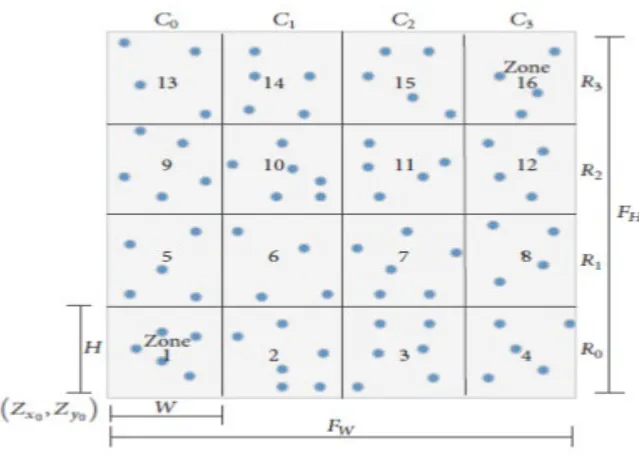
4. ZEERP. To address the problem of load balancing and energy consumption mentioned in the previous section, we proposegrid or zone-based network framework named Zone-based energy efficient routing protocol (ZEERP). It is a reactive, load balancing and energy efficient protocol for WSNs. The proposed approach evenlydistributes the load across the network, improves networkmanagement, and extends network lifetime. Figure 4.1 presents the proposed framework.The process is segregated into the following main phases.
(i) Deployment Phase: The total number of nodes (where = 1, 2, 3, . . . , ) are randomly deployed in a square targeted area (A = FH ×FW ), where and are the field height and width, respectively. We assume some default node parameters, for instance, coordinates, node ID, and energy level. Once the topology is built and nodes are deployed, they share this configuration information with the BS. This information is later used by BS for carrying out the grid formation procedure more efficiently.
(ii) Zone Formation Phase: In this phase, the data collected from different sensors is used to form zones and construct topology as presented in Algorithm 1. The grid denotes a single zone recognized by unique zone ID. Once the zone formation phase is completed, BS governs the number of nodes per zone by computing the initial and finish point of each zone as mentioned in Algorithm 1. Figure??shows zone formation where nodes are randomly deployed across grids. In this figure, C0 to Cm-1 are the columns and R0 to Rm-1 represent rows. (Zxs, Zys) and (Zxe, Zye) represent the start and end of each zone. Zone height (ZH) and zone width (ZW) of each grid are calculated as
ZH =FW/M
(4.1)
ZW =FW/M
(4.2)
where FH andFW represent the height and width of field.
(iii) Zone Head Selection Phase: Zone Head (ZH) selection is very crucial for any energy efficient protocol. ZH is responsible for processing or making any decision upon the received data. ZH selection is an important process; therefore, it is required to define criteria before selection of the ZH. The performance of a zone depends on the ZH; therefore, it is significant to elect the best node as the ZH among available nodes. In the proposed technique two parameters: residual energy levelRE and average distance valueADare aggregated to come up with ZH election value (ZHEV) of a single node i as follows:
ZHEV (i) = 0.5∗RE(i) + 0.5∗(1/AD(i)) (4.3)
Fig. 4.1.Framework of the proposed technique.
Algorithm 1Zone formation
begin
Input: Number of Zones ; Height and Width of Deployment Area ; Zone HeightZH and width ZW ;
forZn = 1: N do
R =Zn/M /* Number of rows */
R = [(Zn−1)modM] + 1 /* Number of columns */
Zxs=C×ZH−ZW /* Starting x -coordinates of zone*/
Zys=R×ZW −ZH /* Starting y -coordinates of zone*/
Zxe=Zxs+ZW /* Ending x -coordinates of zone*/
Zye=Zys+ZH /* Ending y -coordinates of zone*/
fori = 1: Ndo
if(nx >=Zxx&nx < Zxe&ny >=Zys&ny < Zye)then
increment ZD(Zn) NodeInZone(n) = Zn End if
end for end for End
value of each individual node in that specific zone as given in (7). ADis the distance of a node from all other nodes within the zone and from center of the zone as shown in (8) and (9), respectively. Minimum value ofAD, calculated by BS, will increase nodes chance to be a ZH. BS will get theAD of all nodes within the network, which will be calculated once
AD(i) =cent(i, c) + 1
n−1
n ∑
j=1
d(i, j), j̸=i
(4.4)
where d(i, j) is distance of a node from other nodes in its zone. In order to know how far a node is from other nodes which are in direct transmission with it, consider
d(i, j) =
√
(ix−jx)2+ (iy−jy)2 (4.5)
wherecent(i, c) is the center of zone. In order to know the position of the node in its zone, consider
cent(i, c) =
√
(ix−cx)2+ (iy−cy)2 (4.6)
Once the ZH criteria are set and zones are formed, ZH is selected for each individual zone according to (6). Base station will have the collection list that will haveZHEV of all nodes against each zone in the network. Node with maximumZHEV will be selected as ZH for that specific zone. The nominated ZHs announce their status to the network using advertisement message that contains its ID. Each node replies the join request to ZH. Each ZH builds a TDMA plan for its zone members to permit their communication. It specifies time slots during which zone members need to be in active state only when they are authorized to transmit the data.
The main advantage of having a collection list is to avoid any broadcast and communication of any maintenance messages during reselection process of ZH. The reselection process is decentralized where the base station is not involved. This approach significantly reduces the number of messages exchanged in the reselection process of ZH in a zone eventually reducing energy consumption and thus maximiz-ing network lifetime. The lifetime of a ZH for one complete iteration is determined by a threshold valuediscussed in reselection phase.
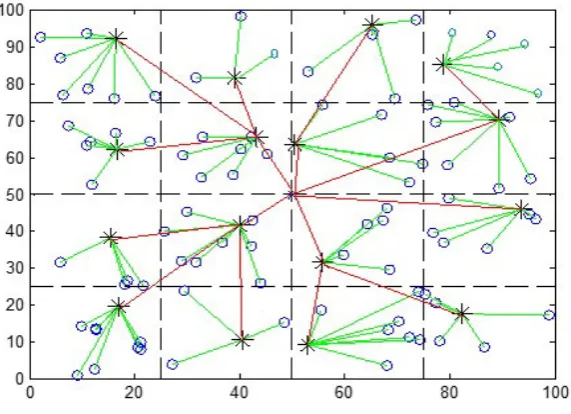
Fig. 5.1.Zone formation and data transmission for ZEERP simulation network.
an event is activated (i.e. current sensed value surpasses hard threshold value H(T)), Once H(T) value is attained, the subsequent transmission is feasible if variation in sensed value surpasses the soft threshold value S(T) (Mittal & Singh, 2015)-(Mittal, Singh, & Sohi, 2017). The nodes send their sensed data to the ZH as per their assigned TDMA schedule of transmission. This enables nodes to keep their radio off until its transmission time occurs. The sleep periods save node energy. In wakeup periods, ZHs will aggregate and compress the received data. ZHs transmit their aggregated information to BS using direct or dual-hop basis as a function of distance between them (Mittal & Singh, 2015), (Mittal, Singh, & Sohi, 2017).
(v) Reselection Phase: In this phase, the attention is to minimize the energy consumption in reselection process of ZH. Instead of carrying out periodic reselection of ZH that leads to extra energy depletion and network overhead, the protocol dynamically initiates the process of reselection based on the election valueZHEV
of the ZH. In a given iteration, if theZHEV value is less than or equal to average energy of the respective zone, the corresponding ZH will change. The number of iterations is independent of the zone and the reselection is carried out per zone when required. The number of iterations can be different for each zone to minimize the traffic generated in the network and also not to disturb the overall network. In order to select the new ZH in next round, the value of average zone energy is therefore periodically monitored by ZH. For this purpose every ZH maintains the collection list that contains ZHEV and residual energy of nodes.
5. Performance analysis of ZEERP. The performance of proposed algorithm is evaluated by carrying out extensive simulations. All simulations were carried out using MATLAB R2015a. The performance of ZEERP is compared with several state-of-the-art energy efficient cluster-based protocols including LEACH,TEEN and DRESEP.
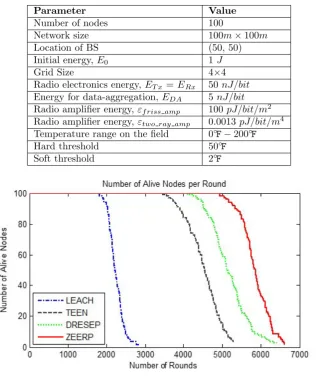
This research work is carried out to investigate the effects of proposed algorithm in homogeneous setup. 100 nodes are randomly deployed in a 100m×100m area with an initial energy of E0=1J as presented in Figure 5.1 Non-ZH nodes are represented by ‘o’ and ZHs are represented by ‘*’. The parameters setting for proposed protocol is given in Table 5.1.
Table 5.1
Simulation parameters used for ZEERP.
Parameter Value
Number of nodes 100
Network size 100m×100m
Location of BS (50, 50)
Initial energy,E0 1J
Grid Size 4×4
Radio electronics energy,ET x =ERx 50nJ/bit
Energy for data-aggregation,EDA 5nJ/bit
Radio amplifier energy,εf riss amp 100pJ/bit/m2 Radio amplifier energy,εtwo ray amp 0.0013pJ/bit/m4 Temperature range on the field 0◦F−200◦F
Hard threshold 50◦F
Soft threshold 2◦F
6.
Fig. 5.2.Network lifetime comparison for LEACH, TEEN, DRESEP and ZEERP.
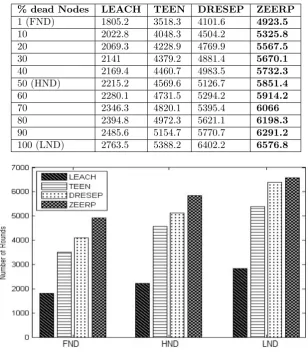
clear that ZEERP surpasses the competitive algorithms in terms of energy efficiency and prolong lifetime. This is because the control messages in ZEERP are reduced in ZH selection and reselection process. This increases the number of rounds and maximizes network lifetime. Table 5.2 shows the round history of dead nodes and average network lifetime in terms of number of rounds it takes until first node dies (FND), half of nodes die (HND) and last node dies (LND) for homogeneous setup. The lifetime comparison of ZEERP protocol with respect to FND, HND and LND is shown in Figure 5.3.
Figure 5.4 shows total energy consumed against the number of rounds. The graph shows that energy consumed by the proposed protocol is less than others with increase in number of rounds. This is due to the even distribution of nodes across the network resulting in steady energy consumption. In comparison with LEACH, TEEN and DRESEP, the proposed protocol maximizes the lifetime approximately by 225.14%, 12.12% and 2.12% respectively.
% dead Nodes LEACH TEEN DRESEP ZEERP
1 (FND) 1805.2 3518.3 4101.6 4923.5
10 2022.8 4048.3 4504.2 5325.8
20 2069.3 4228.9 4769.9 5567.5
30 2141 4379.2 4881.4 5670.1
40 2169.4 4460.7 4983.5 5732.3
50 (HND) 2215.2 4569.6 5126.7 5851.4
60 2280.1 4731.5 5294.2 5914.2
70 2346.3 4820.1 5395.4 6066
80 2394.8 4972.3 5621.1 6198.3
90 2485.6 5154.7 5770.7 6291.2
100 (LND) 2763.5 5388.2 6402.2 6576.8
Fig. 5.3. Lifetime comparison of simulated protocols for homogeneous set-up.
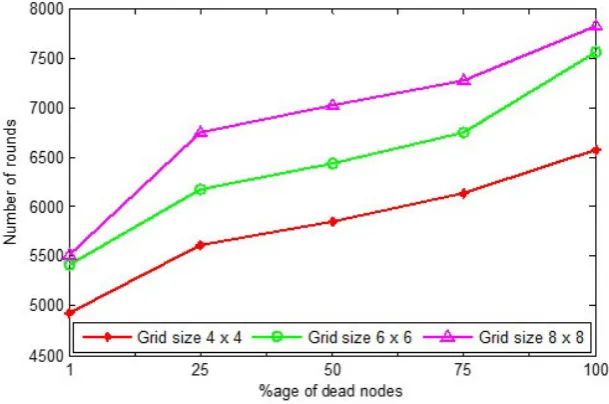
Fig. 5.5.Effect of grid size on the performance of ZEERP
Fig. 5.6. Effect of node density on the performance of ZEERP
approximately 1.1 and 1.2 times better for grid sizes 4 ×4 and 6×6 respectively.
To evaluate the effect of node density in each protocol, the number of nodes is varied from 100 to 500 with initial energy 1 J as shown in Figure 5.6. The number of rounds increases by increasing the node density. ZEERP has more number of rounds than other approaches for varying node density. By increasing the node density, the resulting network has better lifetime as the responsibilities of each ZH is distributed.
Fig. 5.7.Number of rounds when 1with initial energy E 0= 0.25 J.
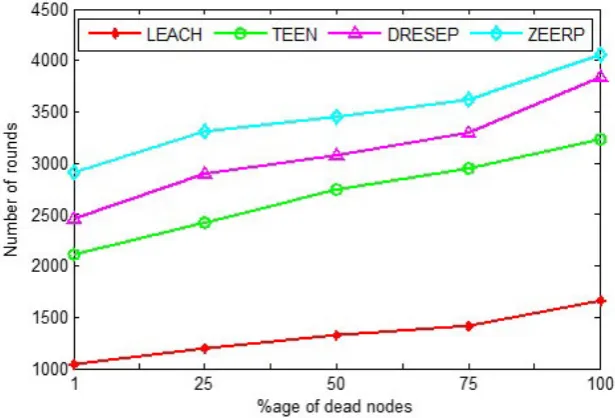
Fig. 5.8.Number of rounds when 1%, 25%, 50%, 75%, and 100% nodes die in the network with initial energy E 0= 0.5 J.
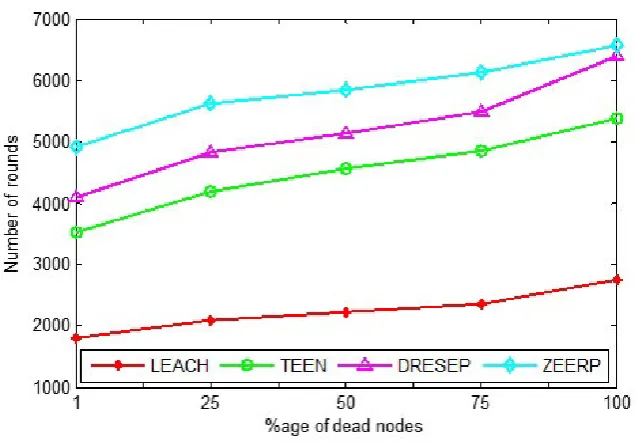
Fig. 5.9.Number of rounds when 1%, 25%, 50%, 75%, and 100% nodes die in the network with initial energy E 0= 1 J.
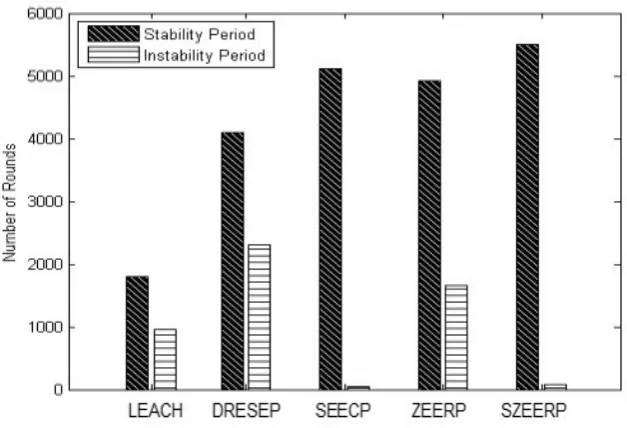
Table 7.1
Network lifetime of simulated protocols together with stability and instability periods
Protocol FND HND LND Stability
Period
Instability Period
LEACH 1805.2 2215.2 2763.5 1805.2 958.3
DRESEP 4101.6 5126.7 6402.2 4101.6 2300.6
SEECP 5109.5 5143.6 5154.3 5109.5 44.8
ZEERP 4923.5 5851.4 6576.8 4923.5 1653.3
SZEERP 5493.3 5546.8 5573.2 5493.3 79.9
while minimizing the instability period. Usually, there is a tradeoff between stability and lifetime of the sys-tem. An optimal balance between these two contradictory goals is a challenge, and is essential to improve the overall network performance. To extend stability period and to balance the load effectively, another protocol named stable version of ZEERP (SZEERP) is proposed. The operation of the protocol is studied in terms of rounds, similar to ZEERP. The essential functioning of SZEERP is same as that of ZEERP. However, SZEERP uses residual energy as a parameter for ZH election (similar to SEECP) in selection and reselection phase for approaching robust performance. The deployment phase and zone formation phase follow the same procedure given in ZEERP. In SZEERP, ZH is selected on the basis of residual energy (RE) but not on average distance value (AD) as given in (6) for ZEERP. Similarly, in reselection phase for a given iteration, ifRE of ZH is less than or equal to average energy of the respective zone, the corresponding ZH will be replaced by highest energy node of that zone.
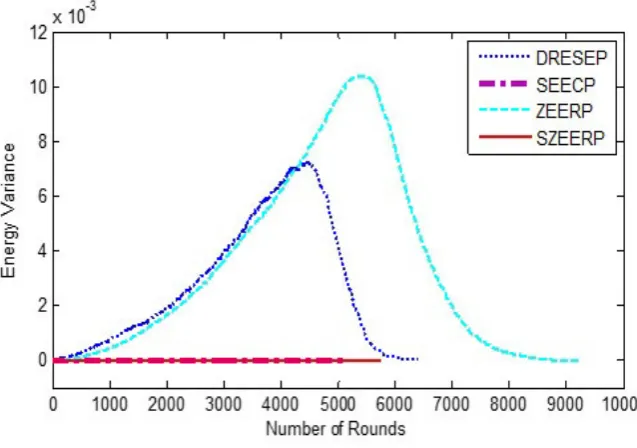
7. Performance analysis of SZEERP. Figure 7.1 shows SZEERP outperforms ZEERP by increasing the stability period for a considerably higher number of rounds. By restricting ZH election criteria to choose the highest energy node, the energy level of all nodes are uniformly preserved throughout the simulation. SZEERP minimizes the energy variance of the network and provides an indistinguishable flat variance plot as shown in Figure 7.2.
Fig. 7.1. Number of alive nodes per round for simulated protocols.
Fig. 7.2. Energy variance per round for simulated protocols.
and 11.57% in stability period for SZEERP as against LEACH, DRESEP, SEECP and ZEERP respectively. In addition, the instability period reduces to 96%, 98.33% and 98.77% in comparison with LEACH, DRESEP and ZEERP respectively. The results show that SZEERP is crucial for applications like military applications and health care applications in which each node is equally important and that require complete coverage of the network.
Fig. 7.3.Performance results of simulated protocols for network lifetime.
distributes the load across the network, improves network management, and extends network lifetime. The sim-ulation results reveal that in ZEERP, total energy consumption during zone formation, ZH selection, reselection of ZH, and transmission has been reduced. In comparison with other existing protocols such as LEACH, TEEN and DRESEP, the proposed ZEERP protocol maximizes the lifetime approximately by 225.14%, 12.12% and 2.12% respectively. To extend stability period and to balance the load effectively, another protocolnamed stable version of ZEERP (SZEERP) is proposed. There is an improvement of 204.32%, 33.94%, 9.87% and 11.57%in the stability period for SZEERP in opposition to LEACH, DRESEP, SEECP and ZEERP respectively. In addi-tion, the instability period for SZEERPs reduces to 96%, 98.33% and 98.77% in contrast to LEACH, DRESEP and ZEERP respectively. The proposed algorithms also outperform other approaches for parameters such as network lifetime, and total energy consumption.
The proposed algorithm opens a lot of gates for the future researchers. This work can be extended as an underlying topology for other energy efficient routing and load balancing protocols. In addition, further research is required to make the network framework adaptive by automatically optimizing number of grids, lower and upper bound for a specified number of senor nodes and terrain area. The future researchers may try their hands in improvising the selection and reselection process of Zone Head (ZH) in order to increase efficiency and to prolong lifetime of sensor network. It would be also interesting to see the impact of evolutionary algorithms in the proposed technique.
REFERENCES
[1] Kim, H. Y.,An energy-efficient load balancing scheme to extend lifetime in wireless sensor networks. Cluster Computing, 19(1), 279283, 2016.
[2] Singh, A. M., Bhatia, T., Sharma, G., Shrivastava, G.”Artificial Intelligence Based Intrusion Detection System to Detect Flooding Attack in VANETs.” In Handbook of Research on Network Forensics and Analysis Techniques, pp. 87-100. IGI Global, 2018.
[3] Shrivastava, G. Kumar, P., Gupta, B. B., Bala, S., Dey, N.Handbook of Research on Network Forensics and Analysis Techniques, 2018.
[4] Gupta, B. B., Joshi, R. C., Misra, M., Meena, D. L., Shrivastava, G., Sharma, K.Detecting a wide range of flooding DDoS attacks using linear prediction model, In IEEE 2nd International Conference on Information and Multimedia Technology (ICIMT 2010), vol. 2, pp. 535-539.2010.
2015 https://doi.org/10.1007/s11276-014- 0785-z
[7] Younis, M., Senturk, I. F., Akkaya, K., Lee, S., & Senel, F. Topology management techniques for toler-ating node failures in wireless sensor networks: A survey. Computer Networks (Vol. 58). Elsevier B.V.. 2014 https://doi.org/10.1016/j.comnet.2013.08.021
[8] Liu, X., A survey on clustering routing protocols in wireless sensor networks. Sensors (Switzerland) (Vol. 12), 2012 https://doi.org/10.3390/s120811113
[9] Zaman, N., Low, T. J., & Alghamdi, T, Enhancing routing energy efficiency of Wireless Sensor Net-works, 17th International Conference on Advanced Communication Technology (ICACT), 4(2), 587595, 2015 https://doi.org/10.1109/ICACT.2015.7224928
[10] Chang, J.-Y., & Ju, P.-H., An energy-saving routing architecture with a uniform clustering algorithm for wireless body sensor networks, Future Generation Computer Systems, 35, 128140, 2014 https://doi.org/10.1016/j.future.2013.09.012 [11] Heinzelman, W. R., Chandrakasan, A., & Balakrishnan, H., Energy-efficient communication protocol for wireless
mi-crosensor networks. Proceedings of the 33rd Annual Hawaii International Conference on System Sciences, vol.1(c), 10, 2000, https://doi.org/10.1109/HICSS.2000.926982
[12] Manjeshwar, A., & Agrawal, D. P. TEEN: A Routing Protocol for Enhanced Efficiency in Wireless Sen-sor Networks, Proceedings 15th International Parallel and Distributed Processing Symposium, 0(C), 2001 https://doi.org/10.1109/IPDPS.2001.925197
[13] Sharma, T. P., Joshi, R. C., & Misra, M., GBDD: Grid Based Data Dissemination in Wireless Sen-sor Networks, 16th International Conference on Advanced Computing and Communications, 234240, 2008, https://doi.org/10.1109/ADCOM.2008.4760454
[14] Heinzelman, W. B., Chandrakasan, A. P., & Balakrishnan, H. An application-specific protocol architec-ture for wireless microsensor networks. IEEE Transactions on Wireless Communications, 1(4), 660670, 2009, https://doi.org/10.1109/TWC.2002.804190
[15] Smaragdakis, G., Matta, I., & Bestavros, A.,SEP: A stable election protocol for clustered heterogeneous wireless sensor networks. Second International Workshop on Sensor and Actor Network Protocols and Applications (SANPA 2004), 111, 2004, https://doi.org/10.3923/jmcomm.2010.38.42
[16] Kumar, D., Aseri, T. C., & Patel, R. B., EEHC: Energy efficient heterogeneous clustered scheme for wireless sensor networks, Computer Communications, 32(4), 662667, 2009 https://doi.org/10.1016/ j.comcom.2008.11.025
[17] Kumar, D., Aseri, T. C., & Patel, R. B.,Multi-hop communication routing (MCR) protocol for heterogeneous wireless sensor networks. International Journal of Information Technology, Communications and Convergence, 1(2), 130145, 2011, https://doi.org/10.1504/IJITCC.2011.039281
[18] Mittal, N., & Singh, U.,Distance-Based Residual Energy-Efficient Stable Election Protocol for WSNs. Arabian Journal for Science and Engineering, 40(6), 16371646, 2015, https://doi.org/10.1007/s13369-015-1641-x
[19] Mittal, N., Singh, U., & Sohi, B. S., A stable energy efficient clustering protocol for wireless sensor networks, Wireless Networks, 18091821, 2017, https://doi.org/10.1007/s11276- 016-1255-6
[20] Attea, B. A., & Khalil, E. A., A new evolutionary based routing protocol for clustered heterogeneous wireless sensor networks. Applied Soft Computing, 12(7), 19501957, 2012 https://doi.org/10.1016/ j.asoc.2011.04.007
[21] Mittal, N., Singh, U., Salgotra, R., & Sohi, B. S.,A boolean spider monkey optimization based energy efficient clustering approach for WSNs. Wireless Networks, 117, 2017, https://doi.org/10.1007/s11276-017-1459-4
[22] Mittal, N., Singh, U., & Sohi, B. S.,A Novel Energy Efficient Stable Clustering Approach for Wireless Sensor Networks, Wireless Personal Communications, 95(3), 29472971, 2017, https://doi.org/10.1007/ s11277-017-3973-1
[23] Mittal, N., Singh, U., Sohi, B. S.,An Energy Aware Cluster-based Stable Protocol For Wireless Sensor Networks” Neural Computing and Applications (NCAA), pp 1-18, 2018.
[24] Zeng, J., A Clustering method of combining grid and genetic algorithm in wirless sensor netwroks, 216, 773779, 2013, https://doi.org/10.1007/978-1-4471-4856-2
[25] Pantazis, N. A., Nikolidakis, S. A., Vergados, D. D., & Member, S.,Energy-Ef fi cient Routing Protocols in Wireless Sensor Networks: A Survey, 15(2), 551591, 2013.
[26] Chen, C., He, Z., Sun, H., Kuang, J., Bai, D., & Yang, C., A grid-based energy efficient routing protocol in Wireless Sensor Networks. International Symposium on Wireless and Pervasive Computing (ISWPC), 16, 2013, https://doi.org/10.1109/ISWPC.2013.6707444
[27] Ismail, W. Z. W., & Manaf, S. A.,Study on Coverage in Wireless Sensor Network using Grid Based Strategy and Particle Swarm Optimization, (December), 69, 2010.
[28] Sharma, R., Sohi, B. S., & Mittal, N.,Hierarchical Energy Efficient MAC protocol for Wireless Sensor Networks, Interna-tional Journal of Applied Engineering Research, 12(24), pp 14727-14738, 2017.
[29] Sharma, R., Sohi, B. S., Kumar, Shakti.,Ann based framework for energy efficient routing in multi-hop wsns, International Journal of Advanced Research in Computer Science, 8(5), 1298-1308, 2017.
[30] Sharma, R., & Sohi, B. S.,A Compartitve Study on MAC Protocols for Wireless Sensor Networks on Energy Reduction. Internatioanl Journal of Computer Science and Information Security, 15(11), 3540, 2017
[31] Rajan Sharma, B. S. S.,The Impact of Dynamic Scaling on Energy Consumption at Node Level in Wireless Sensor Networks, 13(1), 175188, 2018.
https://doi.org/10.12694/scpe.v18i3.1303
[33] Amar Singh, Shakti Kumar, Sukhbir Singh Walia, FW-AODV : An Optimized AODV Routing Protocol for Wireless Mesh Networks, International Journal of Advanced Research in Computer Science, Volume, Volume 8, No. 3, March April 2017, pp. 1131-1135,2017.
[34] Shakti Kumar, S.S. Walia, Amar Singh, Parallel Big Bang-Big Crunch Algorithm, International Journal of Advanced Computing, ISSN:2051-0845, Vol.46, Issue. 3, September 2013, pp. 1330-1335, 2013
[35] Shakti Kumar, Amar Singh, Sukhbir Singh Walia , Parallel Big Bang - Big Crunch Global Optimization Algorithm: Performance and its Applications to routing in WMNs , Wireless Personal Communications, Springer, SCI Indexed Journa,l, pp. 1601- 1618, 2018.
[36] Sharma, K., Bala, S., Bansal, H., & Shrivastava, G.,Introduction to the special issue on secure solutions for network in scalable computing. Scalable Computing, 18(3), 2017, https://doi.org/10.12694/scpe.v18i3.1299
[37] Amar Singh,Shakti Kumar, Sukhbir Singh Walia, P3PGA: Multi-Population 3 Parent Genetic Algorithm and its Applica-tion to Routing in WMNs, InternaApplica-tional Journal of Advanced Research in Computer Science, Volume, 8(5), pp. 968-975, 2017.
[38] Mittal, N., Singh, U., & Sohi, B. S, Harmony Search Algorithm Based Threshold-sensitive Energy-efficient Clustering Protocols For WSNs, Ad Hoc & Sensor Wireless Networks, 36 (1-4), pp 149-174, 2017
Edited by: Khaleel Ahmad
Received: Aug 2, 2018