Available Online at www.ijpret.com
111
INTERNATIONAL JOURNAL OF PURE AND
APPLIED RESEARCH IN ENGINEERING AND
TECHNOLOGY
A PATH FOR HORIZING YOUR INNOVATIVE WORK
PRODUCTION OF ETHANOL THROUGH SEPARATE SACCHARIFICATION AND
FERMENTATION VIA OPTIMIZATION OF PRETREATMENT CONDITIONS
BHETALU A. D.1, PATIL S. S.2, INZALKAR G. S.3
1. Assistant Professor, Department of Engineering Chemistry, IBSS College of Engineering, Amravati, Maharashtra, India.
2. Director, Student Welfare, Sant Gadge Baba Amravati University, Amravati, Maharashtra, India.
3. Assistant Professor, Department of Engineering Chemistry, IBSS College of Engineering, Amravati, Maharashtra, India.
Accepted Date: 27/02/2014 ; Published Date: 01/05/2014
\
Abstract: Eichhornia crassipes (Water hyacinth) is known as one of the “world’s worst aquatic weeds”. It has enormous growth rate and is ranked as one of the world’s worst invasive water weeds causing wide spread problems to millions of users of water bodies and water resources across the globe. Its capacity to produce a huge biomass within a very short period can be utilized for the production of fuel ethanol owing to its lignin content. This paper summarizes fermentation mechanism in water hyacinth by applying the optimized pretreatment methods
Keywords: Eichhornia crassipes , Ethanol; Fermentation; Lignocellulosic biomass
Corresponding Author: MR. BHETALU A. D.
Access Online On:
www.ijpret.com
How to Cite This Article:
Available Online at www.ijpret.com
112
INTRODUCTION
Water hyacinths are found in most of the tropical and subtropical countries of the world. According to Mitchell (1976), the water hyacinth is indigenous to south America, particularly to the Amazonian basin. It started its worldwide journey as an ornamental plant when first introduced into the USA in 1884 (Pen found and East, 1948, Edwards, 1980). It reached Australia in 1895, India in 1902, Malaysia in 1910, Zimbabwe in 1937 and the Republic of the Congo in 1952.
Water hyacinth grows in all types of freshwater. Westlake (1963) predicted that water hyacinths might be exceptionally productive plants since they are warm water species with submerged roots and aerial leaves like emergent macrophytes.
The productivity varies widely and is dependent on the environment under which it grows. Wolverton and McDonald (1976) reported a yield of water hyacinth of up to 657 tonnes/ha/year DM in ponds fertilized with sewage nutrients, while Coche (1983) reported an even higher yield of 750 tonnes/ha/year in irrigation canals in China.
Water hyacinth produces a huge biomass within a very short time such that it suffocates most aquatic life. The weed has a high survival tolerance as:
a) It can survive at a wide range of temperatures;
b) Survives on nutrients at different levels;
c) Survives under wide range of pH; and
d) Seed survives for up to 15 years i.e. high dormancy.
Weeds have been described as non-useful because they destroy land-use systems; yet they are important components of the ecosystems. The possibility of converting water hyacinth to biogas or fuel ethanol is currently established in a number of developing countries, mainly in India (Abraham and Kurup, 1996; Sharma et al., 1999; Nigam, 2002; Singhal and Rai, 2003).
Gunnarsson 2007 reported the average biomass composition of Water hyacinth as:
Components % Composition
Lignin 10
Cellulose 25
Available Online at www.ijpret.com
113 The low lignin content makes it an excellent choice for production of ethanol. The bioconversion of water hyacinth to ethanol can be achieved via various pretreatment methods (Wyman1996). Acid hydrolysis methods are the commonly used pretreatment methods.
Acid pretreatments can be broadly classified as Dilute acid pretreatment and Concentrated acid pretreatment methods. (McMillan 1994) Concentrated acids such as H2SO4 and HCl have been
used to treat lignocellulosic materials. Although they are powerful agents for cellulose hydrolysis, concentrated acids are toxic, corrosive and hazardous and require reactors that are resistant to corrosion. In addition, the concentrated acid must be recovered after hydrolysis to make the process economically feasible (Sivers 1995).
Dilute acid hydrolysis has been successfully developed for pretreatment of lignocellulosic materials. The dilute sulfuric acid pretreatment can achieve high reaction rates and significantly improve cellulose hydrolysis (Esteghlalian 1997).This paper discusses the Dilute acid hydrolysis pretreatment methods during the utilization of water hyacinth for ethanol production.
1. MATERIALS AND METHODS:
Whole water hyacinth plants were collected from the banks of river Morna in Akola city, Maharashtra, India. It was allowed to dry up under the sun for a period of one month to reduce the moisture content of the waste.
All the chemicals viz. Sulphuric acid, absolute ethanol, Sodium Hydroxide, Potassium Dichromate were research grade by Merck and were procured from a scientific chemical scientific shop at Amravati town.
2.1 Pretreatment of Biomass:
The sun dried water hyacinth was chopped into small pieces (approx.1-2 cm), blended to small particles (approx.3-5 mm) using a blender.
Available Online at www.ijpret.com
114
2.2 Detoxification of hemicellulose hydrolysate:
The hemicellulose acid hydrolysate was heated to 60 °C and then basidified with solid NaOH until the pH reached 9.0-9.5. Solid Ca(OH)2 was added to the solution in order to detoxify harmful materials presented in the hydrolysate. Insoluble residues were removed by filtration, and the supernatant was collected for further used as fermentable sugars.
2.3 Preparation of fermentation medium:
The media were sterilized by autoclaving at 120°C for 15 min. D-Xylose and D-glucose were autoclaved separately at 110°C for 10 min. After sterilization and cooling, the solutions were mixed to form a complete medium prior to inoculation. To prepare the inoculum, a 250 ml Erlenmeyer flask containing 50 ml medium was inoculated from a fresh agar slant, and incubated at 30 +/-0.2°C in a rotary shaker at 250 rpm. The cells were grown for 20 hrs..
Constituent Gm/L
D-Xylose 50
Yeast extract 3
Malt extract 3
Peptone 5
D-Glucose 5
pH 5.0 +/-0.2
2.4 Fermentation of water hyacinth hydrolysate to alcohol:
Two full plates of S. cerevisiae were inoculated into the fermentation medium and further incubated at 30 °C for 3 wks. Samples were aliquoted at different time intervals and assayed for ethanol content. ( Idrees 2013 )
2.5 Determination of xylose content by Phloroglucinol assay:
Xylose content was determined using the Phloroglucinol assay (Eberts et al., 1979; Johnson et al., 1984) with minor modifications. Briefly, the color reagent consisting of 0.5 g of phloroglucinol, 100 ml of glacial acetic acid, and 10 ml of conc. HCl was freshly prepared and used within 4 days.
Available Online at www.ijpret.com
115
2.6 Determination of ethanol content by Dichromate assay :
Acid dichromate solution (0.1 M Cr2O72- in 5 M H2SO4) was prepared by dissolving 7.5 g of potassium dichromate in dilute sulfuric acid and the final volume was adjusted to 250 ml with deionized water. To prepare the calibration curve, 300 μl of ethanol solutions were filled into
small plastic caps and placed into beakers containing 3 ml of acid dichromate. The maximum absorbance at 575 nm was recorded. Each set was performed in triplicate.
3.RESULT AND DISCUSSION:
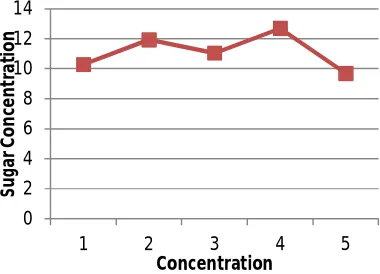
C A Sa Sb Sc
0.5 0.64 514 51.4 10.28
1 0.688 596 59.6 11.92
1.5 0.712 552 55.2 11.04
2 0.752 634 63.4 12.68
2.5 0.648 484 48.4 9.68
Where, C-Conc. of H2SO4,
A-Absorbance at 575 nm,
Sa-Sugar Conc. (µg/ml),
Sb-Sugar Conc.mg per 100 ml filtrate,
Sc-Sugar Conc. Mg Per gram sample
Available Online at www.ijpret.com
116 Fig. Effect of varying concentration of H2SO4 on Sugar yield
CONCLUSIONS
Lignocellulose-to-ethanol bioconversion holds great potential as the substrate is abundant and relatively of low cost. However, the integration of low cost pretreatments with advanced ethanol-producing microorganisms may play a crucial role in lowering the cost of biomass bioconversion processes. Sulphuric acid gave best results for the yield of sugars as compared to other acids and alkalis which was 12.68 mg of sugar per gram of water hyacinth sample when treated with 2% (v/v) of H2SO4.
REFERENCE:
1. Abraham M, Kurup GM (1996). Bioconversion of tapioca (Manihot esculenta) waste and water hyacinth (Eichhornia crassipes) influence of various Physico-chemical factors. J. Ferment. Bioeng. 82: 259-263.
2. Brennan, A.H., Hoagland, W., Schell, D.J., 1986. High temperature acid hydrolysis of biomass using an engineering-scale plug flow reactor: result of low solids testing. Biotechnol. Bioeng. Symp. 17, 53–70.
3. Converse, A.O., Kwarteng, I.K., Grethlein, H.E., Ooshima, H., 1989. Kinetics of thermochemical pretreatment of lignocellulosic materials. Appl. Biochem. Biotechnol. 20/21, 63–78.
4. Esteghlalian, A., Hashimoto, A.G., Fenske, J.J., Penner, M.H., 1997. Modeling and optimization of the dilute-sulfuric-acid pretreatment of corn stover, poplar and switch grass. Bioresour. Technol. 59,129–136
0 2 4 6 8 10 12 14
1 2 3 4 5
Su
ga
r
C
on
ce
n
tr
a
ti
on
Available Online at www.ijpret.com
117 5. Gunnarsson, C.C., Petersen, C.M., 2007, “Water hyacinths as a resource in agriculture and energy production: a literature review”, Waste Management, 27: 117–129.
6. Hinman, N.D., Schell, D.J., Riley, C.J., Bergeron, P.W., Walter, P.J., 1992. Preliminary estimate of the cost of ethanol production for SSF technology. Appl. Biochem. Biotechnol. 34/35, 639– 649.
7. McMillan, J.D., 1994. Pretreatment of lignocellulosic biomass. In: Himmel, M.E., Baker, J.O., Overend, R.P. (Eds.), Enzymatic Conversion of Biomass for Fuels Production. American Chemical Society, Washington, DC, pp. 292–324.
8. Muhammad Idrees, Ahmad Adnan, Shahzad Sheikh, Fahim Ashraf Qureshi, Optimization of dilute acid pretreatment of water Hyacinth biomass for enzymatic hydrolysis and Ethanol production , EXCLI Journal 2013;12:30-40 – ISSN 1611-2156
9. Nigam JN (2002). Bioconversion of water-hyacinth (Eichhornia crassipes) hemicellulose acid hydrolysate to motor fuel ethanol by xylose–fermenting yeast. J. Biotechnol. 97: 107-116
10.Sharma, A, Unni, BG, Singh, HD. A novel fed-batch digestion system for biomethanation of plant biomasses. J Biosci Bioeng. 1999;87:678-82
11.Singhal, V, Rai, JP. Biogas production from water hyacinth and channel grass used for phytoremediation of industrial effluents. Bioresour Technol. 2003;86:221-5
12.Sivers, M.V., Zacchi, G., 1995. A techno-economical comparison of three processes for the production of ethanol from pine. Bioresour. Technol. 51, 43–52.