Synthesis And Study Of Substituted 1,3-Thiazoles And Their Nanoparticles On
Phytotic Growth Of Some Vegetable Crops
CHHAYA D. BADNAKHE* AND P. R. RAJPUT†
1
Department of Chemistry, Dr.Manorama and Prof.H.S.Pundkar, Arts, Commerce and Science College, Balapur, Dist. Akola.
2
Department of Chemistry,Vidyabharti Mahavidyalaya, Amravati-444604. India
Abstract
The synthesis, spectral analysis and biological activities of 5-phenyl-2-hydroxy-chlorosubstituted-2-amino-1,3 thiazoles have been carried out. In this case 4-(heptan-1-one)-2- amino-1,3-thiazole(J), (heptan-1-one)-2-phenyl amino-1,3-thiazole (K), and 5-(2’-hydroxy-3’,5’-dichlorophenyl)-4-(heptan-1-one)-2-diphenyl amino-1,3-thiazole (L) have been screened. The compounds J, K and L
were synthesized from1-(2’-hydroxy-3’,5’-dichlorophenyl)-2-bromo-1,3-nonanedione(a4) by the
action of thiourea, phenylthiourea, diphenylthiourea. The nanoparticles of the compounds J,K and L have been prepared by using ultrasonic technique. The titled compounds and their nanoparticles were screened for growth promoting activity on some vegetable crop plants viz.. Momordica charantia-L-Bitter guard (Karela), Lagneria siceraria-snake guard (Lavki), Luffa cylindrica L-sponge guard (Gilke) and Benincasa hispida-Pumpkin (Kohle).
Keywords : Chalcone, thiazole, thiourea, phenyl thiourea, diphenyl thiourea, growth promoting activities.
I. INTRODUCTION
Heterocyclic nucleus plays an important role in medicinal chemistry and it is a key template for the growth of various therapeutic agents. Thiazole is a heterocyclic compound featuring both a nitrogen atom and sulfur atom as part of the aromatic five-membered ring. Thiazoles and related compounds are called 1,3-azoles (nitrogen and one other hetero atom in a five-membered ring.) They are isomeric with the 1,2-azoles, the nitrogen and sulphur containing compound being called isothiazoles. Thiazoles are found naturally in the essential vitamins. Molecules that possess sulfur atoms are important in living organisms. The researchers(1-6) have reported the synthesis of several thiazoles and also their potent biological activities such as antimicrobial7, antibacterial8-11, antifungal12-13, fungicidal14 and insecticidal agent15. Chalcones and their analogues having α, β-unsaturated carbonyl system are very versatile substrates for the evolution of various reactions and physiologically active compounds.
In the present study, various 5-phenyl-2-hydroxy-chlorosubstituted-2-amino-1,3-thiazoles have been synthesized from 1,3-propanediones by using thiourea, phenyl thiourea and diphenyl thiourea. The synthesized compounds along with their nanoparticles were evaluated for their growth promoting activity on some vegetable crop plants viz. Momordica charantia-L-Bitter guard (Karela), Lagneria siceraria-snake guard (Lavki), Luffa cylindrica L-sponge guard (Gilke) and Benincasa hispida-Pumpkin (Kohle).
II. EXPERIMENTAL
Volume 02, Issue 10, [October- 2016] e-ISSN: 2394-5532, p-ISSN: 2394-823X
pelletes, H1 NMR spectra on spectrophotometer in CDCl3 with TMS as internal standard. UV spectra
were recorded in nujol medium. The analytical data of the titled compounds was highly satisfactory. All the chemicals used were of analytical grade. All the solvents used were purified by standard methods. Physical characterisation data of all the compounds is given in Table 1.
2’-Hydroxy 3’,5’-dichloroacetophenone :
2-Hydroxy-5-chloroacetophenone was dissolved in acetic acid (5 ml), Sodium acetate (3g) was added to the reaction mixture and then chlorine in acetic acid reagent (40 ml; 7.5 w/v) was added dropwise with stirring. The temperature of the reaction mixture was maintained below 200C. The mixture was allowed to stand for 30 minutes. It was poured into cold water with stirring. A pale yellow solid then obtained was filtered, dried and crystallized from ethanol to get the compound 2’ -hydroxy 3’,5’-dichloroacetophenone.
Preparation of 2’-hydroxy-3’,5’-dichlorophenyl-4-hexylchalcone (a) :
2-Hydroxy-3,5-dichloroacetophenone (0.01 mol) dissolved in ethanol (50 ml) treated with heptanaldehyde (0.1 M) at its boiling temperature. Aqueous sodium hydroxide solution [40%, 40 ml] was added dropwise and the the mixture was stirred mechanically at room temperature for about 1 hour. It is then kept for 6 to 8 hours followed by decomposition with ice cold HCl [1:1]. The yellow granules thus obtained were filtered, washed with 10% NaHCO3 solution and finally
crystallized from ethanol-acetic acid solvent mixture to get the compound (a).
Preparation of 1-(2’-hydroxy-3’-5’-dichlorophenyl)-2,3-dibromononan-1-one (a1)
2’-Hydroxy-3’,5’-dichlorophenyl-4-hexylchalcone (a) (0.01 M) was suspended in bromine– glacial acid reagent [25% w/v] [6.4 ml]. The reagent was added dropwise with constant stirring. After complete addition of reagent the reaction mixture was kept at room temperature for about 30 minutes. The solid product, thus separated, was filtered and washed with a little petroleum ether to get the compound (a1).
Preparation of 2-(4”-hexyl)- 6,8-dichloroflavone (a2) :
1-(2’-Hydroxy-3’,5’-dichlorophenyl)-2,3-dibromo-nonan-1-one (a1) (0.01 mol) was dissolved
in ethanol (25 ml). To this, aqueous solution of KOH (25 ml) was added. The reaction mixture was refluxed for 1 hour, cooled and diluted with water. The product, thus separated, was filtered and crystallized from ethanol to get the compound (a2).
Preparation of 1-(2’-hydroxy-3’,5’-dichlorophenyl)-1,3-nonanedione (a3) :
2-(4”-Hexyl)-6,8-dichloroflavone (a2) (0.01 mol) was dissolved in ethanol (25 ml). To this,
aqueous solution of HCl (25 ml) was added. The reaction mixture was then refluxed for one hour, cooled and diluted with water. The solid product, thus obtained, filtered and crystallized from ethanol to get the compound (a3).
Preparation of 1-(2’-hydroxy-3’,5’-dichlorophenyl)-2-bromo-1,3-nonanedione (a4) :
1-(2’-Hydroxy-3’,5’-dichlorophenyl)-1,3-nonanedione (a3) (0.01 mol) was dissolved in a
mixture of ethanol (10 ml) and dioxane (10 ml). To this, calculated amount of liquid bromine (0.5 ml) was added. The product was not separated even after standing for one hour. It was then diluted with water and washed with water several times and extracted with ether. The solvent was removed under reduced pressure to get the white solid of the compound (a4).
Preparation of 5-(2’-hydroxy-3’,5’-dichlorophenyl)-4-(heptan-1-one)-2- amino-1,3-thiazole (J) :
1-(2’-Hydroxy-3’,5’-dichlorophenyl)-2-bromo-1,3-nonanedione (a4) (0.01 mol) and thiourea
Volume 02, Issue 10, [October- 2016] e-ISSN: 2394-5532, p-ISSN: 2394-823X
conc HCl. The product, thus separated, was filtered and crystallized from ethanol to get the compound (J).
Preparatrion of 5-(2’-hydroxy-3’,5’-dichlorophenyl)-4-(heptan-1-one)-2-phenyl amino-1,3-thiazole (K) :
1-(2’-Hydroxy-3’,5’-dichlorophenyl)-2-bromo-1,3-nonanedione (a4) (0.01 mol) and
phenylthiourea (0.01 mol) were dissolved in ethanol (25 ml). To this, aq. KOH solution (0.02 mol) was added. The reaction mixture was refluxed for three hours, cooled, diluted with water and acidified with conc. HCl. The product, thus separated, was filtered and crystallized from ethanol to get the compound (K).
Preparation of 5-(2’-hydroxy-3’,5’-dichlorophenyl)-4-(heptan-1-one)-2-diphenyl amino-1,3-thiazole (L) :
1-(2’-Hydroxy-3’,5’-dichlorophenyl)-2-bromo-1,3-nonanedione (a4) (0.01 mol) and
diphenylthiourea (0.01 mol) were dissolved in ethanol (25 ml). To this, aq solution of KOH (0.02 mol) was added. The reaction mixture was refluxed for three hours, cooled, diluted with water and acidified with conc. HCl. The product, thus separated, was filtered, crystallized from ethanol to get the compound (L).
The newly synthesized compounds were characterised on the basis of elemental analysis, molecular determination, UV, IR, NMR. spectral data.
The UV, IR, and NMR spectral data :- Compound (J) :
UV : Spectrum No. 1
The UV-Vis spectrum of the compound (J) reported in dioxane showed max value 410 nm
corresponding to n transition.
IR (KBr) :- Spectrum No. 2
3036.60 cm-1(-OH phenolic), 2955.55 cm-1 (aliphatic -C-H stretching), 3208.58 cm-1 (aromatic -C-H stretching), 3797.72 cm-1 (-N-H stretching), 1228.56 cm-1 (-C=N- stretching), 756.57 cm-1 (-C-Cl stretching in aliphatic), 1073.66 cm-1 (C-Cl stretching in aromatic).
PMR :- Spectrum No. 3
∂ 5.2 (hump, 2H, (-N-H) ; ∂ 6.7 (d, 1H, -CH=C-H-) ; ∂ 6.8 (d, 1H, -CH=C-H-) ; ∂ 7.0 to 7.8 (m, 2H, Ar-H) ; ∂ offset, (region not observed, observed, O-H)
Compound (K) : UV : Spectrum No. 4
The UV-Vis spectrum of the compound (K) reported in dioxane showed max value 392 nm
corresponding to n transition. IR KBr : Spectrum No. 5
3078.56 cm-1 (O-H phenolic) , 2956.24 cm-1 (aliphatic -C-H stretching) , 3305.55 cm-1 (aromatic C-H stretching) , 3786.79 cm-1 (-NH stretching), 1552.51 cm-1 (-C=N-stretching) , 754.50 cm-1 [C-Cl stretching in aliphatic) , 1174.48 cm-1 [C-Cl stretching in aromatic].
PMR :- Spectrum No. 6
∂ 1.06 (t, 3H, -CH2-CH3) ; ∂ 1.25 [Envelope of –CH2 , 8H, -(CH2)4-CH3],∂ 3.32 (hump, 2H, -NH) ;
∂ 4.15 (d 1H, -CH=C-H-) ; ∂ 4.16 (d, 1H, -CH=C-H-); ∂ 7.01 to 7.72 (m, 7H, Ar-H).
Compound (L) :
Volume 02, Issue 10, [October- 2016] e-ISSN: 2394-5532, p-ISSN: 2394-823X
The UV-Vis spectrum of the compound (L) reported in dioxane showed max value 386 nm
corresponding to n transition. IR KBr :- Spectrum No. 8
3431.6 cm-1 (-OH phenolic) , 3057.11cm-1 (aromatic C-H stretching), 1543.2 cm-1 (-C=N stretching), 772.13 cm-1 (C-Cl stretching in aliphatic), 1051.11 cm-1 (C-Cl stretching in aromatic).
PMR :- Spectrum No. 9
∂ 6.72 (d 1H, -CH=C-H-) ; ∂ 6.70 (d,1H, -CH=C-H-) ; ∂ 11.85 (m, 12H, Ar-H) ; ∂ 10.3 (s,
1H, O-H).
Scheme:
OH
Cl Cl
OCOCH3 (CH3CO)2O
CH3COONa
AlCl3
OH
COCH3 Cl
Cl2 - AcOH
OH
COCH3 Cl
Cl
OH
(CH2)5-CH3 Cl Cl OH H Br H Br
(CH2)5-CH3 Cl Cl O Cl Cl O O EtOH/KOH EtOH/HCl OH H H O Cl Cl O EtOH / liq Br2
OH H O Br Cl Cl O Cl Cl S N OH O NR1R2
R1NHCSNHR2 (a)
a1
a2 a3
a4
CH3-(CH2)5-CHO
O
(CH2)5-CH3 (CH2)5-CH3
(CH2)5-CH3
(CH2)5-CH3 120oC
Br2 / AcOH , 25%(w/v)
Where :
1) R1 = -H, -C6H5
2) R2 = -H, -C6H5
Preparation of nanoparticles of the titled compounds:
Ultrasonic Processor Sonapros PR-250MP was used to produce nanoparticles of the test compounds. The test compounds were dissolved in dioxane to prepare 0.1 M solutions. These solutions were taken in beakers and the probe of the sonapras 250 MP was dipped in solution. These solutions were exposed to sonopros MP 250 for 10 minutes separately. The test compounds were converted to nanoparticles. The solvent dioxane was evaporated by conventional heating method. The size of nanoparticles of the test compounds was confirmed by X-ray diffraction studies using Benchtop x-ray diffraction (XRD) instrument (Miniflex).
Volume 02, Issue 10, [October- 2016] e-ISSN: 2394-5532, p-ISSN: 2394-823X
Characterisation of size of nanoparticles of the test compounds :-
The crystal size of nanoparticles of the test compounds calculated by using Debye-Scherrer equation.
0.94 λ D = --- . Cos Where,
D = The average crystalline size.
0.94 = The particle shape factor which depends on the shape and size of the particle. λ = is the wavelength.
= is the full width at half maximum [FWHM] of the selected diffraction peaks (β = 0.545) = is the Bragg's angle obtained from 2θ values which was corresponding to the maximum intensity peak in XRD pattern ( = 0.7501 rad).
Growth Promoting Effect on some Vegetable crop Plants :-
The experimental set up of the study was devided into two parts: (i) Seed treatment (ii) Field experiment.
(i) Seed treatment :-
With a view to safeguard dormant seed's potential from harmful external agencies, the seeds of the test plants were treated by solution of test compounds (0.01dilution) prepared in dioxane before sowing.
(ii) Field experiment :-
Pregerminated quality seeds of Momordica charantia L-Bitter guard (Karela), Lagneria siceraria snake guard (Lavki), Luffa cylindrica LSponge guard(Gilke) and Benincasa hispida
-Pumpkin (Kohle) were procured from Department of Horticulture, Dr. PDKV, Akola.
The beds of cotton soil, 2.5 x 2.5 m size were prepared in an open field. The sowing of seeds of all four test vegetable crop plants were done in separate beds and irrigated periodically.
The plants from each bed were devided into two groups i.e. A and B and designated as "Control" and "Treated" group plants respectively.
The plants from group B were sprayed with the solution of test compounds at weekly intervals. The field experiments were conducted to compare the treated plants of group B with untreated plants of controlled group A. In this context, the observations were recorded on 7, 14, 21, 28, 35, 42, 45, 56, 63, 70, 77, 84, 91 days after sowing corresponding to early vegetative, late vegetative, flowering, fruitification and fruit maturation, with special reference to number of leaves and height of shoots.
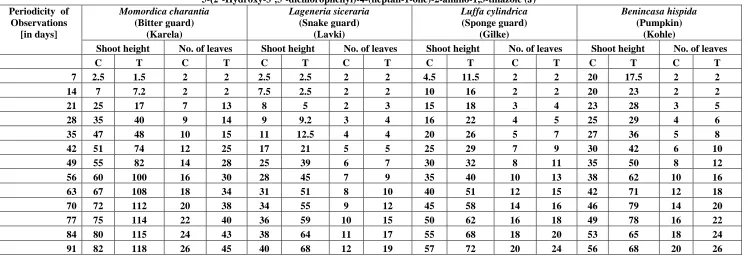
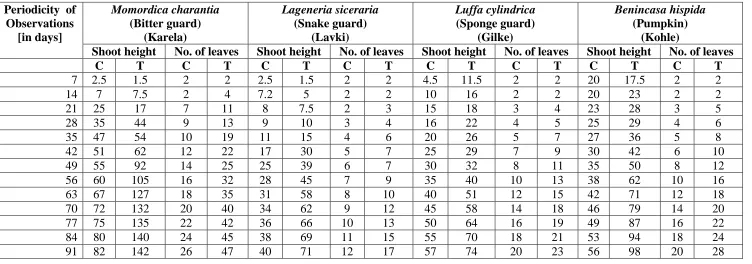
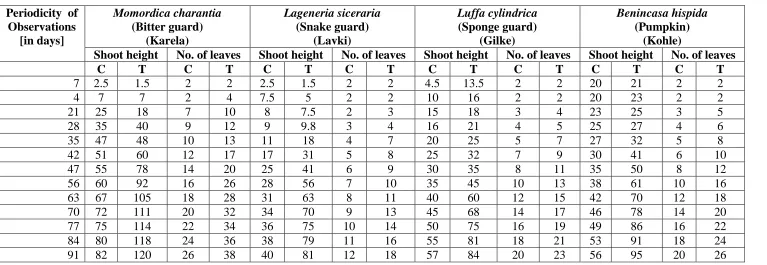
The results of field's experiments are tabulated in the tables 2, 3 and 4.
III. RESULT AND DISCUSSION
The titled compounds and their nanoparticles were screened for their growth promoting activity on test vegetable crop plants viz, Momordica charantia-L-Bitter guard (Karela), Lagneria siceraria-snake guard (Lavki), Luffa cylindrica L-sponge guard (Gilke) and Benincasa
hispida-Pumpkin (Kohle).
Volume 02, Issue 10, [October- 2016] e-ISSN: 2394-5532, p-ISSN: 2394-823X
ACKNOWLEDGEMENTS
The authors are thankful to Dr.B.B.Wankhade, Principal, Malkapur Vidnyan Mahavidyalaya, Malkapur for providing necessary facilities to carry out the research work.
BIBLIOGRAPHY
[1] Baviskar B, Patel S., Baviskr B., Khadabadi S.S., Shiradkar M, Design and synthesis of some novel chalcones as Potent Antimicrobial Agent AsianJ. Research Chem. 1, 2008.
[2] Saravanan G., Alagarsamy V., Pavitra T.G.V., Kumar C.G., Savithri Y., Naresh L., Avinash P. Synthesis, characterisation and antimicrobial activities of novel thiazole derivatives. International Journal of Pharma and Bio
– Sciences 2010 : 1 : 3 : 1-8.
[3] Vicini P. Geronikaki A, Anastasia K, Incer ti M, Zani F. Synthesis and Antimicrobial activity of novel-2-thiazolyl-imino-5-arylidene-4- thiazolidonones Bio. org. Med. Chem. 2006, 14 ; 3859-3864.
[4] Pathan S., Alagwadi K., Bhat A., Reddy V., Patthan J., Khade A., Bhat K., Ind. drugs2007 ; 45 (7) : 532-535. [5] Patthan S., Reddy V., Manvi F., Desai B,, Bhat A., Ind. J. Chem. 2006 ; 45 B, 1778-1781.
[6] Andreni A., Granajola M., Leoni A., Locatelli A., Morigi R., Rambaldi M., Eur. J. Med. Chem. 2001 : 36 : 743-746. [7] Ulusoy N, Kiroz M, Kucukbasmaci O. New 6-(4-Bromophenyl)-imidazo [2,1-b] thiazole Derivatives : synthesis and
antimicrobial Activity. Monatshefte Fur Chemic2002 : 133 : 1305-15.
[8] Narayana B., Vijayaraj K.K., Ashalatha B.V., Kumari N.S. Antibacterial and Antifungal studies on some newactylcinnolines and cinnolinyl thiazole derivatives, Indian J. of chemistry2006 : 45 B : 1704-09.
[9] Narayan B., Raj, K.K. Vijaya Ashalata, B.V. and Kumari, N. Suchetha. Synthesis of some new 4 (2-Chloropyriudin-4-yl) N-Aryl-1, 3-thiazol-2 -Amine Derivatives as possible Antifungal and Antibacterial Agents, phosphorus, Sulphur and Silicon and the related Elements 2007 : 182 : 1 : 7-14.
[10] Bharti S.K., Nath G., Tilak R., Singh S.K., Synthesis, antibacterial and antifungal activities of some novel Schiff's bases containing 2,4- disubstituted-thiazole ring Euro J. Chem. 2010 : 45 : 651-60.
[11] Patel K.H., Mehta A.G. Synthesis and Antifungal activity of Azetidinone and thiazolidinones Derivatives of 2-Amino-6-(2-napthalenyl) thiazolo [3, 2-d] thiadiazole, E-Journal of Chemistry2006 : 3 : 1 3267-278.
[12] Omar K., Geronikaki A., Zoumpoulakis P., Camoutsis C., Sokovic M., Ciric A., Glamoclija J., Novel 4-thiazolidinone derivatives as potential antifungal and antibacterial drugs. Bioorg Med. Chem. 2010 : 18 : 426 -32. [13] Capan G. Ulusoy N., Erganc N., and Kiraz M. New 6 phenyl imidazo [2,1-b] thiazole Derivatives : synthesis and
antifungal Activity. Monatshette FurChemic 1999 : 130 : 1399-1407. [14] Pattanaik J. Pattanaik M., Bhatta D. Ind J. Chem.1998 ; 37 B ; 1304- 1306. [15] Chang Ling-Liu, Zheng Ming Li, Bin Zhong, J. Ful chem.2004 ; 125 : 128
Volume 02, Issue 10, [October- 2016] e-ISSN: 2394-5532, p-ISSN: 2394-823X
Table 1 : Characterisation data of newly synthesized compounds :
Compounds Molecular formula M.P.
in 0C
% of yield
% of element
C H N S Cl Br
C8H6O2Cl2 54 80 47.90/48 2.95/3 34.15/34.58
a C15H18O2Cl2 103 70 52.20/53.35 53.10/53.21 23.25/23.27
a1 C15H18O2Cl2Br2 67 50 39.01/39.04 3.85/3.90 15.20/15.40 34.18/34.70
a2 C15H16O2Cl2 73 50 60.10/60.20 5.25/5.35 23.70/23.74
a3 C15H18O3Cl2 118 60 56.60/56.78 5.60/5.67 22.33/22.39
a4 C15H17O3Cl2Br 84 50 45.40/45.45 4.20/4.29 17.90/17.92 20.15/20.20
J C16H20O2N2Cl2S 96 60 51.10/51.20 5.30/5.33 7.40/7.46 8.50/8.53 18.90/18.93
K C22H23O2N2Cl2S 135 60 58.46/58.66 5.07/5.11 6.18/6.22 7.00/7.11 15.60/15.77
L C28H26O2Cl2N2S 122 50 63.92/64.0 4.90/4.95 5.30/5.33 6.0/6.09 13.50/13.52
Activity of the test compounds J, K and L :
Table No. (02)
5-(2’-Hydroxy-3’,5’-dichlorophenyl)-4-(heptan-1-one)-2-amino-1,3-thiazole (J) Periodicity of
Observations [in days]
Momordica charantia
(Bitter guard) (Karela)
Lageneria siceraria
(Snake guard) (Lavki)
Luffa cylindrica
(Sponge guard) (Gilke)
Benincasa hispida
(Pumpkin) (Kohle)
Shoot height No. of leaves Shoot height No. of leaves Shoot height No. of leaves Shoot height No. of leaves
C T C T C T C T C T C T C T C T
7 2.5 1.5 2 2 2.5 2.5 2 2 4.5 11.5 2 2 20 17.5 2 2
14 7 7.2 2 2 7.5 2.5 2 2 10 16 2 2 20 23 2 2
21 25 17 7 13 8 5 2 3 15 18 3 4 23 28 3 5
28 35 40 9 14 9 9.2 3 4 16 22 4 5 25 29 4 6
35 47 48 10 15 11 12.5 4 4 20 26 5 7 27 36 5 8
42 51 74 12 25 17 21 5 5 25 29 7 9 30 42 6 10
49 55 82 14 28 25 39 6 7 30 32 8 11 35 50 8 12
56 60 100 16 30 28 45 7 9 35 40 10 13 38 62 10 16
63 67 108 18 34 31 51 8 10 40 51 12 15 42 71 12 18
70 72 112 20 38 34 55 9 12 45 58 14 16 46 79 14 20
77 75 114 22 40 36 59 10 15 50 62 16 18 49 78 16 22
84 80 115 24 43 38 64 11 17 55 68 18 20 53 65 18 24
Volume 02, Issue 10, [October- 2016] e-ISSN: 2394-5532, p-ISSN: 2394-823X
Table No. (03)
5-(2’-Hydroxy-3’,5’-dichlorophenyl)-4-(heptan-1-one)-2-phenylamino-1,3-thiazole (K)
Periodicity of Observations
[in days]
Momordica charantia
(Bitter guard) (Karela)
Lageneria siceraria
(Snake guard) (Lavki)
Luffa cylindrica
(Sponge guard) (Gilke)
Benincasa hispida
(Pumpkin) (Kohle)
Shoot height No. of leaves Shoot height No. of leaves Shoot height No. of leaves Shoot height No. of leaves
C T C T C T C T C T C T C T C T
7 2.5 1.5 2 2 2.5 1.5 2 2 4.5 11.5 2 2 20 17.5 2 2
14 7 7.5 2 4 7.2 5 2 2 10 16 2 2 20 23 2 2
21 25 17 7 11 8 7.5 2 3 15 18 3 4 23 28 3 5
28 35 44 9 13 9 10 3 4 16 22 4 5 25 29 4 6
35 47 54 10 19 11 15 4 6 20 26 5 7 27 36 5 8
42 51 62 12 22 17 30 5 7 25 29 7 9 30 42 6 10
49 55 92 14 25 25 39 6 7 30 32 8 11 35 50 8 12
56 60 105 16 32 28 45 7 9 35 40 10 13 38 62 10 16
63 67 127 18 35 31 58 8 10 40 51 12 15 42 71 12 18
70 72 132 20 40 34 62 9 12 45 58 14 18 46 79 14 20
77 75 135 22 42 36 66 10 13 50 64 16 19 49 87 16 22
84 80 140 24 45 38 69 11 15 55 70 18 21 53 94 18 24
91 82 142 26 47 40 71 12 17 57 74 20 23 56 98 20 28
Volume 02, Issue 10, [October- 2016] e-ISSN: 2394-5532, p-ISSN: 2394-823X
Table No. (04)
5-(2’-Hydroxy-3’,5’-dichlorophenyl)-4-(heptan-1-one)-2-diphenylamino-1,3-thiazole (L) Periodicity of
Observations [in days]
Momordica charantia
(Bitter guard) (Karela)
Lageneria siceraria
(Snake guard) (Lavki)
Luffa cylindrica
(Sponge guard) (Gilke)
Benincasa hispida
(Pumpkin) (Kohle)
Shoot height No. of leaves Shoot height No. of leaves Shoot height No. of leaves Shoot height No. of leaves
C T C T C T C T C T C T C T C T
7 2.5 1.5 2 2 2.5 1.5 2 2 4.5 13.5 2 2 20 21 2 2
4 7 7 2 4 7.5 5 2 2 10 16 2 2 20 23 2 2
21 25 18 7 10 8 7.5 2 3 15 18 3 4 23 25 3 5
28 35 40 9 12 9 9.8 3 4 16 21 4 5 25 27 4 6
35 47 48 10 13 11 18 4 7 20 25 5 7 27 32 5 8
42 51 60 12 17 17 31 5 8 25 32 7 9 30 41 6 10
47 55 78 14 20 25 41 6 9 30 35 8 11 35 50 8 12
56 60 92 16 26 28 56 7 10 35 45 10 13 38 61 10 16
63 67 105 18 28 31 63 8 11 40 60 12 15 42 70 12 18
70 72 111 20 32 34 70 9 13 45 68 14 17 46 78 14 20
77 75 114 22 34 36 75 10 14 50 75 16 19 49 86 16 22
84 80 118 24 36 38 79 11 16 55 81 18 21 53 91 18 24
Volume 02, Issue 10, [October- 2016] e-ISSN: 2394-5532, p-ISSN: 2394-823X
Spectrum No. 1
Spectrum No. 2
RC SAIF PU, Chandigarh
Chhaya D-12.sp - 8/25/2014 - L
4000.0 3600 3200 2800 2400 2000 1800 1600 1400 1200 1000 800 600 400.0
45.0 46 48 50 52 54 56 58 60 62 64 66 68 70 72 73.8
c m-1 %T
3797,72
3208,58 3036,60
2955,55 2928,54
2858,60
1955,72
1702,65
1595,54
1538,48 1496,50
1447,54 1347,56
1316,53 1256,56
1228,56 1196,60
1073,66 1027,67
1003,69933,70 901,71
756,57
696,53 631,68
614,70 513,70
Volume 02, Issue 10, [October- 2016] e-ISSN: 2394-5532, p-ISSN: 2394-823X
Spectrum No. 3
Spectrum No. 4
14 13 12 11 10 9 8 7 6 5 4 3 2 1 0 ppm
0.1671 0.1953 0.2355 0.6647 0.6692 0.8496 0.8670 0.8846 1.0414 1.0646 1.3623 1.5294 1.5667 1.7199 1.8600 1.8973 1.9702 1.9891 2.0468 2.0812 2.0976 2.1129 2.1478 2.1683 2.1865 2.2023 2.2301 2.3116 2.3158 2.3200 2.3551 2.4219 2.4398 2.4698 2.4852 2.5099 2.5689 2.6017 2.6395 2.6806 2.7612 2.7908 2.8078 2.9032 3.1776 3.2603 3.9860 5.2323 6.7692 6.8160 6.8914 6.9442 6.9695 6.9896 7.0710 7.1137 7.1223 7.1594 7.2271 7.2850 7.3670 7.3767 7.3829 7.4514 7.4577 7.7079 3.08 6.00 0.10 0.44 0.33
Current Data Parameters NAME Aug20-2014 EXPNO 180 PROCNO 1 F2 - Acquisition Parameters Date_ 20140820 Time 14.16 INSTRUM spect PROBHD 5 mm PABBO BB-PULPROG zg30 TD 65536 SOLVENT DMSO NS 8 DS 2 SWH 12019.230 Hz FIDRES 0.183399 Hz AQ 2.7263477 sec RG 512 DW 41.600 usec DE 6.00 usec TE 295.7 K D1 1.00000000 sec TD0 1 ======== CHANNEL f1 ======== NUC1 1H P1 10.90 usec PL1 -3.00 dB SFO1 400.1324710 MHz F2 - Processing parameters SI 32768 SF 400.1300768 MHz WDW EM SSB 0 LB 0.30 Hz GB 0 PC 1.00
J
BRUKER
AVANCE II 400 NMR Spectrometer SAIF
Panjab University Chandigarh
Volume 02, Issue 10, [October- 2016] e-ISSN: 2394-5532, p-ISSN: 2394-823X
Spectrum No. 5
Spectrum No. 6
RC SAIF PU, Chandigarh
Chhaya D-11.sp - 8/25/2014 - K
4000.0 3600 3200 2800 2400 2000 1800 1600 1400 1200 1000 800 600 400.0 18.0 25 30 35 40 45 50 55 60 65 70 75 80.8 cm-1 %T 3786,79 3305,55 3078,56 2956,24 2929,21 2870,39 2858,37 1706,44 1634,50 1596,47 1552,51 1498,53 1461,34 1378,52 1314,51 1226,40 1174,48 860,68 799,71 754,50 694,65 564,76 505,78
14 13 12 11 10 9 8 7 6 5 4 3 2 1 0 ppm
0.8507 1.0451 1.0624 1.0798 1.2195 1.2517 1.4103 1.4277 1.4452 1.5638 1.5803 1.6877 1.7144 1.7247 2.0511 2.1646 2.2213 2.2373 2.2574 2.2680 2.2811 2.3346 2.3527 2.5080 2.6907 3.3294 3.3460 3.3617 3.3730 3.3859 3.4247 3.4420 3.4594 3.4769 3.5089 3.5225 3.5576 3.5971 3.6136 3.6314 3.6485 3.6545 3.7928 3.8817 4.0214 4.0385 4.1569 4.1698 6.8609 7.0734 7.0899 7.1629 7.1817 7.2009 7.2795 7.2980 7.3167 7.3288 7.3737 7.3937 7.4277 7.4486 7.4700 7.5506 7.7175 7.7214 4.29 3.07 8.19 2.00 3.35 0.22 0.22 1.44 0.31
Current Data Parameters NAME Aug20-2014 EXPNO 190 PROCNO 1 F2 - Acquisition Parameters Date_ 20140820 Time 14.21 INSTRUM spect PROBHD 5 mm PABBO BB-PULPROG zg30 TD 65536 SOLVENT DMSO NS 8 DS 2 SWH 12019.230 Hz FIDRES 0.183399 Hz AQ 2.7263477 sec RG 90.5 DW 41.600 usec DE 6.00 usec TE 295.7 K D1 1.00000000 sec TD0 1 ======== CHANNEL f1 ======== NUC1 1H P1 10.90 usec PL1 -3.00 dB SFO1 400.1324710 MHz F2 - Processing parameters SI 32768 SF 400.1300000 MHz WDW EM SSB 0 LB 0.30 Hz GB 0 PC 1.00
K
BRUKER
AVANCE II 400 NMR Spectrometer SAIF
Panjab University Chandigarh
Volume 02, Issue 10, [October- 2016] e-ISSN: 2394-5532, p-ISSN: 2394-823X
Spectrum No. 7
Spectrum No. 8
RC SAIF PU, Chandigarh
Mallikarjun-10.sp - 8/11/2014 - ZnL4
4000.0 3600 3200 2800 2400 2000 1800 1600 1400 1200 1000 800 600 400.0
0.0 2 4 6 8 10 12 14 16 18 20 22 24 26 28.3
c m-1 %T
3904,27
3431,6 3057,11
1951,25 1810,27
1649,5
1598,2 1580,4
1543,2 1504,2
1447,8 1415,10
1375,8 1349,8
1306,12 1289,11
1258,10
1214,7 1179,10
1147,161108,17
1051,11 1021,13 1012,13 957,14
915,23
873,21
829,15
772,13
749,6 693,7
676,12 613,18
583,19 513,19
Volume 02, Issue 10, [October- 2016] e-ISSN: 2394-5532, p-ISSN: 2394-823X
Spectrum No. 9
14 13 12 11 10 9 8 7 6 5 4 3 2 1 0 ppm
0.6099
0.7371
0.8066
0.8233
0.8405
1.0140
2.2676
3.2028
3.2197
3.3385
6.7040
6.7207
6.7372
6.8651
6.8816
6.8980
6.9353
6.9509
7.0175
7.0352
7.0538
7.0723
7.0896
7.1067
7.2155
7.2343
7.2664
7.2850
8.5678
9.6841
10.3675
1.75
3.05
0.60
1.17
3.48
3.15
0.45
1.00
Current Data Parameters NAME Aug20-2014 EXPNO 200 PROCNO 1
F2 - Acquisition Parameters Date_ 20140820 Time 14.26 INSTRUM spect PROBHD 5 mm PABBO BB-PULPROG zg30 TD 65536 SOLVENT DMSO NS 8 DS 2 SWH 12019.230 Hz FIDRES 0.183399 Hz AQ 2.7263477 sec RG 322 DW 41.600 usec DE 6.00 usec TE 295.8 K D1 1.00000000 sec TD0 1
======== CHANNEL f1 ======== NUC1 1H P1 10.90 usec PL1 -3.00 dB SFO1 400.1324710 MHz
F2 - Processing parameters SI 32768 SF 400.1300949 MHz WDW EM SSB 0 LB 0.30 Hz GB 0 PC 1.00
L
BRUKER
AVANCE II 400 NMR Spectrometer SAIF
Panjab University Chandigarh
Volume 02, Issue 10, [October- 2016] e-ISSN: 2394-5532, p-ISSN: 2394-823X
Impact of compound 5-(2’-hydroxy-3’,5’-dichlorophenyl)-4-(heptan-1-one)-2- amino-1,3-thiazole (J) on phytotic growth of
Momordica charntia
Impact of compound 5-(2’-hydroxy-3’,5’-dichlorophenyl)-4-(heptan-1-one)-2- amino-1,3-thiazole (J) on phytotic growth of
Lageneria siceraria
Impact of compound 5-(2’-hydroxy-3’,5’-dichlorophenyl)-4-(heptan-1-one)-2- amino-1,3-thiazole (J) on phytotic growth of Luffa cylindirca
Impact of compound 5-(2’-hydroxy-3’,5’-dichlorophenyl)-4-(heptan-1-one)-2- amino-1,3-thiazole (J) on phytotic growth of