PAPER
Cite this:Green Chem., 2015,17,
4980
Received 15th June 2015, Accepted 31st July 2015 DOI: 10.1039/c5gc01334h www.rsc.org/greenchem
The synthesis and analysis of advanced lignin
model polymers
†
C. S. Lance
fi
eld* and N. J. Westwood*
If the lignin-first biorefinery concept becomes a reality, high quality lignins close in structure to native lignins will become available in large quantities. One potential way to utilise this renewable material is through depolymerisation to aromatic chemicals. This will require the development of new chemical methods. Here, we report the synthesis and characterisation of advanced lignin model polymers to be used as tools to develop these methods. The controlled incorporation of the major linkages in lignin is demonstrated to give complex hardwood and softwood lignin model polymers. These polymers have been characterised by 2D HSQC NMR and GPC analysis and have been compared to isolated lignins.
1.
Introduction
Lignin is an aromatic rich bio-polymer which is second only to cellulose as the most abundant renewable carbon source on the planet.1As such it holds great potential to supply a future chemical industry with renewable aromatic chemicals as the world economy transitions away from the use of fossil fuels. However, the challenge of selective lignin depolymerisation and valorisation has yet to be fully met and continues to be the focus of a great deal of scientific research.2–5
For over a century lignin has been a major by-product of the pulp and paper industry and it is estimated that currently around 63 million tonnes is extracted annually.6A small pro-portion of this production consists of lignosulfonates from sulfite pulping for which there exists an established market in which Borregard are world leaders.7However, the vast majority is produced through the kraft process.8 In both case the extracted lignins are typically severely chemically altered com-pared to native lignins, making the production of aromatic chemicals, particularly in good yields, much more challen-ging.9 This has led to the development of the “lignin-first” biorefinery concept where the production of high quality lignins, close in structure to native lignin, has been proposed to facilitate the production of aromatic chemicals in good yields.10
Whilst significant advances have been made in recent years,11–20 the selective depolymerisation of lignin to small
molecules is still a challenge. In order to develop new methods, model compounds are often used as a starting point. This greatly simplifies the analysis of new products and the optimisation of reaction conditions. However, these models frequently fail to replicate the surrounding linkages (2D environment) let alone the complex 3-dimensional struc-ture of lignin. These limitations can ultimately lead to appar-ently promising reactions on models failing on lignin. In order to overcome this, interest has started to grow in the synthesis of more complex oligomeric and polymeric models.21–23 Indeed, recently the synthesis of an advanced hexameric lignin model was reported which incorporates a number of different linkages into one molecule.21
Previous research on the chemical synthesis of model poly-mers has focussed only on the β-O-4 linkage, however these lack several of the major linkages present in lignin and there-fore a great deal of the complexity. The synthesis of more complex polymers can be achieved through the dehydrogena-tive polymerisation (DHP) of the monolignols coniferyl, sinapyl and coumaryl alcohol. However this remains challen-ging and control over the relative distribution of linkages is lacking due to the reliance on a radical polymerisation process. These factors perhaps explain why the use of DHP polymers has largely been limited to a number of excellent investigations into the biosynthesis24–29 and biodegrada-tion30–35of lignin rather than chemical depolymerisation.
In order to widen the use of complex polymers for investi-gations into the chemical depolymerisation of lignin we were interested in combining the simplicity of previously described β-O-4 polymer syntheses11,22with the structural complexity of DHP polymers. For example, whilst our previously reported model polymer11contained exclusivelyβ-O-4 linkages (with an S : G ratio of 1 : 1), here we prepare considerably more complex structures that include other common linkages in addition to
†Electronic supplementary information (ESI) available: Detailed synthetic pro-cedures for the synthesis of monomers and polymers, characterization of novel compounds and NMR spectra. See DOI: 10.1039/c5gc01334h
School of Chemistry and Biomedical Sciences Research Complex, University of St Andrews and EaStCHEM, North Haugh, St Andrews, Fife, UK.
E-mail: [email protected], [email protected]
Open Access Article. Published on 03 August 2015. Downloaded on 17/11/2015 12:36:34.
This article is licensed under a
Creative Commons Attribution 3.0 Unported Licence.
View Article Online
theβ-O-4 linkage. Such substrates should prove useful in deve-loping and testing novel chemical methods for lignin valorisa-tion, in particular as stepping stone models between the commonly used dimeric model compounds and more challen-ging biomass derived substrates. We have recently shown the utility of polymeric models in developing a novel method for the selective depolymerisation of birch lignin to aromatic chemicals11and others have used simpler model polymers to study lignin depolymerisation.36,37As an example Samecet al.
reported the development of an efficient method for selective depolymerisation of dimeric lignin model compounds and simple model polymers using a heterogenous Pd/C catalyst. Unfortunately, this methodology failed to produce significant amounts of monomers from lignin37highlighting the need for more advanced and structurally faithful polymeric models. Ultimately, such models could accelerate the introduction of lignin derived green alternatives to fossil fuel products.
2.
Results and discussion
As the composition of natural lignins can vary significantly both in the relative abundances of inter-unit linkages and G : S ratios we wanted to develop a synthesis of model polymers that would allow control over both of these variables. Based on the work of Nakatsuboet al.22we recently reported the facile
syn-thesis of a S–G β-O-4 polymer as a model for a hardwood lignin.11As this methodology makes use of monomers which
can be easily accessed from vanillin and syringaldehyde in one step without chromatography and in excellent yield,11,22 it
formed the basis of the work we report here.
Hardwood lignin models
The first extension we considered was the introduction of the β–β(resinol) unit into the polymer as a model for hardwood
lignins. These lignins are typically rich in β-O-4 and β–β lin-kages, but have low abundances of β-5 ( phenylcoumaran) units.38–40 We proposed this could be achievable using monomer1, the synthesis of which was accomplished in five steps from syringaldehyde (2) (Scheme 1) following established literature procedures. Knoevenagel condensation of 2 with malonic acid gave sinapic acid (3), which was esterified to methyl sinapate (4) and then reduced to give sinapyl alcohol (5). A biomimetic oxidative dimerization gave syringaresinol (6) which was alkylated with ethyl bromoacetate to give the required monomer 1. This synthesis could be achieved on a multigram scale without any chromatographic purifications. As the majority of resinol units in hardwood lignins appear to be derived from syringaresinol38 the introduction of units arising from the homo- or hetero-dimerisation of the other monolignols (coniferyl or p-coumaryl alcohol) was not attempted.
With monomer 1 in hand, its incorporation into an S–G polymer was attempted. This proceeded smoothly using a 0.2 : 1 : 1 mixture of1:7:8(Scheme 2) with LDA in THF to give a polymeric material, the ester groups in which were reduced using NaBH4/MeOH in EtOH at 50 °C without purification
after the first step. Precipitation in acidified water and purifi-cation of the crude polymer by re-precipitation in Et2O gave
polymer9 containing both β-O-4 andβ–βunits in 48% yield over 2 steps on a 2 g scale (Scheme 2).
The synthesis of all S polymer 10 was also undertaken (0.1 : 0.9 ratio of1:8) using the same experimental procedure as for9in 28% yield. This is an interesting model as the pro-duction of extremely S rich lignins has been reported in trans-genic hybrid poplar trees44which show significantly improved pulping characteristics over the wild type trees. These trees are therefore potentially economically interesting for future pulping and biorefinery industries45 which could potentially produce extremely S rich lignins as co-products. Interestingly,
Scheme 1 The synthesis ofβ–βmonomers1and11. Reagents and conditions: (a) malonic acid, cat. aniline, pyridine, 60 °C, 16 h, 86%.41(b) AcCl,
MeOH, reflux, 1 h. 95% for4, 100% for13(c) LiAlH4,n-BuBr, THF,−78 °C to r.t.425used as crude; 61% for14. (d) CuSO4·5H2O, H2O, light, air, r.t.,
38% over 2 steps for6.43FeCl
3, H2O/Acetone, 1 h, r.t. 20% for15. (e) Ethyl bromoacetate, K2CO3, acetone, reflux, 24 h. 86% for1; 95% for11.
Open Access Article. Published on 03 August 2015. Downloaded on 17/11/2015 12:36:34.
This article is licensed under a
the synthesis of syringyl rich polymers from sinapyl alcohol using DHP methods gives low molecular weight products in poor yields highlighting one advantage of the synthesis reported here.46
Softwood lignin models
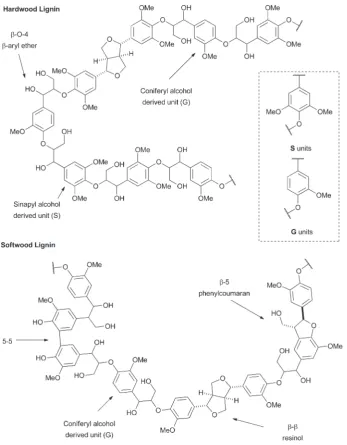
With hardwood lignin model polymers in hand, our attention turned to the synthesis of more complex softwood lignin models. Although, softwood lignins are composed almost exclusively of G units, the inter-unit connectivity is much more complex than in hardwood lignins (see Fig. 1). In particular, such lignins contain significant proportions of β-5 units as well asβ-O-4 and minor amounts ofβ–βunits.47,48As a result the polymer synthesis required the preparation of novel β-5 andβ–β G unit monomers. Following a similar route to that used previously, the requiredβ–βmonomer11was prepared in 4 steps from ferulic acid12(see Scheme 1). Esterification of12 to methyl ferulate (13) followed by reduction gave coniferyl alcohol (14), which underwent dimerization in the presence of FeCl3 to give pinoresinol (15) from which monomer 11 was
prepared.
For the β-5 monomer, the synthesis of a bi-functional monomer16 which would support polymerisation was deve-loped fromβ-5 coupled diferulate17(Scheme 3). Diferulate17 was readily prepared by the horseradish peroxidase mediated oxidative dimerization of13as reported by Brunowet al.and Ralphet al.(Scheme 3).49,50We found that this underutilised and green preparation was preferable to the more commonly reported silver(I) mediated dimerisations.21,51,52 Crude 17
could be separated from the reaction by simple filtration and was purified directly by crystallisation from methanol in a 43% yield. Alkylation of the phenolic group in17 with ethyl
iodo-acetate in the presence of K2CO3 gave 18. Oxidative cleavage
of the olefinic bond in 18 with catalytic amounts of RuCl3
(ca. 0.2 mol%) in the presence of NaIO4 gave the required
bifunctional monomer 16 in good yield (Scheme 3). Both16 and18 could be crystallised directly from the crude reaction mixtures in 70% and 72% yields respectively.
The subsequent polymerisation of a mixture of7,11and16 (1 : 0.3 : 0.1) by LDA in THF followed by reduction of the ester groups with NaBH4/MeOH yielded the synthetic lignin
polymer19in a 40% yield containingβ-O-4,β–βandβ-5 units (Scheme 4).
Phenolic models
Whilst polymers 9, 10 and 19 should prove useful for most chemical investigations into lignin valorisation the lack of phe-nolic groups sets them apart from natural lignins. Whilst we feel in many cases that this would not have a negative impact in the application of these models, we were still interested in introducing such groups for instances where they may be important. In order to do this a protected 5–5 coupled divanil-lin monomer20 was synthesised which would serve to intro-duce phenolic groups into the final polymer, as well as introducing 5–5 linkages. Such linkages are present in soft-wood lignins53,54and are reported to be mainly found as the free phenols in isolated lignins.55The required monomer was prepared by the dimerisation of vanillin (21) to give divanillin (22) followed by alkylation with in situ generated MOMCl (Scheme 5). We chose a MOM protecting group as we believed it could be deprotected during the acidic work-up of the NaBH4/MeOH reduction of the ester groups and therefore
no additional deprotection step would be required. Incorpo-ration of this monomer into a model polymer was then Scheme 2 The synthesis ofβ-O-4 andβ–βcontaining polymers as models for hardwood lignins. Reagents and conditions: (a) LDA, THF, 0 °C, 30 min, 0.17 mmol mL−1. (b) NaBH
4/MeOH, EtOH, 50 °C, 1 h.9–48%;10–28% over 2 steps. n and m can be but are not necessarily equal.
Open Access Article. Published on 03 August 2015. Downloaded on 17/11/2015 12:36:34.
This article is licensed under a
attempted (Scheme 6). Analysis of the resulting polymer23by
31P NMR confirmed the presence of diagnostic peaks for the
phenolic 5–5 groups (Fig. 2) which was supported by13C NMR analysis which showed the appearance of resonances consist-ent with the C4 and C5 carbons in this structural unit (Fig. S1†).
2D HSQC NMR analysis
Due to the high molecular weight and heterogenous nature of these polymers overlapping and broad signals were observed in the 1D 1H NMR spectra (see ESI†). To overcome this, 2D HSQC NMR, a method now well established in lignin analy-sis,57,58was used to characterise them. For the polymers syn-thesised in this study excellent quality 2D HSQC spectra can
be obtained in 20 minutes using approximately 10–20 mg of polymer in 0.6 mL of solvent on a 500 MHz spectrometer, whilst good quality spectra can be obtained in 10 minutes or on a 400 MHz spectrometer. Similar experiments for lignin typically require 80–100 mg of material and a 2 hour experi-ment time, although this can be shorten to as little as 30 minutes using modified NMR protocols.59
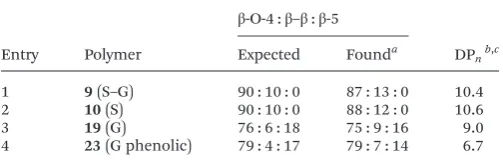
Detailed analysis of 9 indicated that the initial monomer composition was well conserved in the final polymer and, based on end group analysis the degree of polymerisation (DPn) was approximately 10.4 (Table 1, entry 1). It is interesting
to note that benzyl alcohol (BA) end groups are almost comple-tely absent in this polymer, consistent with the incorporation of monomer1into the polymer chain. A similar analysis of10 Fig. 1 Structural representations of sections of hardwood and softwood lignins showing the most abundant units (S/G) and linkages found in each. The known relative stereochemistry of theβ–βandβ-5 linkages is shown. Theβ-O-4 are present as botherythroandthreoisomers in lignin.
Open Access Article. Published on 03 August 2015. Downloaded on 17/11/2015 12:36:34.
This article is licensed under a
[image:4.595.124.472.46.492.2]revealed that the initial monomer composition was again well conserved and that the DPnwas estimated to be 10.6 (Table 1,
entry 2).
2D HSQC NMR analysis of the more complex polymer 19 revealed the successful incorporation of theβ-5 units into the polymer, together with theβ–βandβ-O-4 units. Pleasingly, the Scheme 3 The synthesis of theβ-5 monomer16. Reagents and conditions: (b) HRP, H2O2, H2O/MeOH (87 : 13), pH 3, 37 °C, 10 min, 43%. (c) Ethyl
iodoacetate, K2CO3, acetone, reflux, 16 h, 72%. (d) RuCl3·xH2O (∼0.2 mol%), NaIO4, EtOAc/MeCN/H2O, 0 °C to r.t, 3 h, 70%.
Scheme 4 The synthesis of a softwood lignin model polymer19. Reagents and conditions: (a) LDA, THF,−78 °C to 0 °C, 1 h. (b) NaBH4/MeOH,
EtOH, 50 °C, 1 h, 40% over 2 steps.
Open Access Article. Published on 03 August 2015. Downloaded on 17/11/2015 12:36:34.
This article is licensed under a
ratio of the units was again found to reflect approximately that used in the initial polymerisation, demonstrating excellent control over these ratios in both S–G and all G polymers. In this case end group analysis indicated a DPnof approximately
9.0 (Table 1, entry 3). The phenolic polymer 23 also closely matched the expected composition but displayed the lowest apparent DPnof the prepared polymers (Table 1, entry 4).
The 2D HSQC NMR spectra of these models were compared to those of birch (hardwood) and douglas fir (softwood)
lignins isolated via a mild acid dioxasolv extraction process (Fig. 3).60In general the spectra are remarkably similar, and the chemical shifts of the linkages and aromatic resonances correspond well between model polymers and lignins (Fig. 3). In addition to the expected cross peaks for the linkages, a number of additional peaks are present in the natural lignins, particularly the douglas fir lignin, which are not present in the polymers. These are believed to correspond to other minor linkages present in the native lignin formed during the Scheme 6 The synthesis of a phenolic softwood lignin model polymer23. Reagents and conditions: (a) LDA, THF,−78 °C to 0 °C, 1 h. (b) NaBH4/
MeOH, EtOH, 50 °C, 1 h, 32% over 2 steps.
Scheme 5 The synthesis monomer20. Reagents and conditions: (a) K2S2O8, (NH4)2·Fe(SO4)2·H2O, H2O, 90 °C, 15 min, 82%. (b) Dimethoxymethane,
AcCl, ZnBr2(cat.), toluene, r.t. 3 hours then22, Hunig’s base, DMF, 24 hours, r.t., 64%.
Open Access Article. Published on 03 August 2015. Downloaded on 17/11/2015 12:36:34.
This article is licensed under a
oxidative polymerisation process and to minor acidolysis pro-ducts formed during the extraction process. Similarly there are a number of peaks in the spectra of the model polymers not present in the natural lignins which can be assigned to end groups resulting from the synthetic route used to prepared these polymers (Fig. 3 and Schemes 2 and 4).
Gel permeation chromatography analysis
GPC analysis was carried out to assess polydisperity and to allow comparison of our synthetic polymers with isolated hard and softwood lignins (Fig. 4). This analysis indicated that the hardwood model polymer 9was slightly higher in molecular weight than the isolated birch lignin whilst the polydispersity of the polymer was almost the same (Fig. 4 and Table 2, entries 1 and 5). The softwood model polymer 19 had the highest molecular weight of the polymers synthesised here and was higher than the douglas fir lignin (Fig. 4 and Table 2, entries 3 and 6). Analysis of phenolic polymer23indicated it
had the lowest molecular weight of all the samples which is consistent with the results of the 2D HSQC NMR analysis (Table 1, entry 4 and Table 2, entry 4). Whilst the mild dioxa-solv lignins used in this study maintain many of the character-istics of the native lignin, the lignin is chemically changed during the extraction process. In particular partial cleavage of β-O-4 linkages likely leads to the isolation of lignins which are lower in molecular weight than the protolignin originally present in the biomass.‡
Polymer stereochemistry
Establishing the erythro to threo ratio of the β-O-4 units in these complex polymers is important as this ratio can change significantly between lignins from different plants and can affect the chemical reactivity of the linkage.61,62In particular softwood lignins have been shown to have a lower erythroto
threo ratio than hardwoods.63 Determination of the erythro/
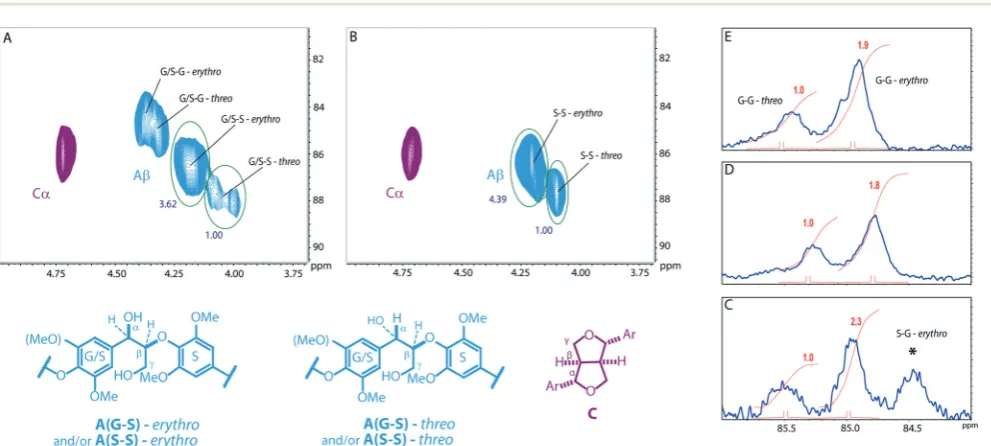
threoratio in lignins, and by extension polymeric models, by NMR methods remains challenging. For units that have the G/ S–S structure (see Fig. 3) the ratio could be assessed from ana-lysis of theβ-protons in the HSQC NMR spectra as theerythro
andthreoforms can be distinguished. This analysis indicated that such units display a clear preference for theerythroform (Fig. 5), consistent with natural lignins.63For the G/S–G struc-tures this ratio could not be assessed from the HSQC spectra due to signal overlap and therefore the13C NMR was used as an indicator. This showed that theerythroform appears to be favoured for these units, although to a lesser extent than for the G/S–S units.
In addition, whilst the relative stereochemistry of the β-5 andβ–β units in lignin is frequently overlooked or taken for granted, it this is in fact well defined.59,64Comparison of the similarity of the 2D HSQC NMR for the polymers and lignins (Fig. 3) spectra clearly shows the relative stereochemistry of these linkages in our polymers closely matches those in lignin based on1H and13C chemical shift analysis.59
Chemical reactivity
In order to assess how the reactivity or our model polymers compared to natural lignins we decided to use the well-estab-lished DFRC method of lignin analysis developed by Ralph
[image:7.595.65.276.48.188.2]et al.65This method has been extensively employed to analyse ligninin situand following isolation. The results of this analy-sis are represented in Fig. 6. For polymer 19 (Fig. 6A) and doulgas fir lignin (Fig. 6B) only coniferyl alcohol diacetate is detected, consistent with NMR analysis indicating that only G units are present in both. An additional peak is present for 19assigned to an end group unit whilst the douglas fir lignin gives remarkably clean products. As expected, for polymer 9 (Fig. 6C) and birch lignin (Fig. 6D) peaks are present for both coniferyl and sinapyl alcohol diacetate. In this case additional Table 1 Results of 2D HSQC NMR analysis of model polymers
Entry Polymer
β-O-4 :β–β:β-5
DPnb,c
Expected Founda
1 9(S–G) 90 : 10 : 0 87 : 13 : 0 10.4
2 10(S) 90 : 10 : 0 88 : 12 : 0 10.6
3 19(G) 76 : 6 : 18 75 : 9 : 16 9.0
4 23(G phenolic) 79 : 4 : 17 79 : 7 : 14 6.7
aWe have previously determined the standard deviation for polymer
analysis by 2D HSQC NMR to be less than 0.05.11.bCalculated based on end-group analysis and given as a function of the number of C9
units. See ESI Fig. S2 for more details.cValues are calculated based on volume integrals and no response factors were used. As end-groups are likely to be more mobile and therefore slower relaxing than the polymer backbone, they may be over represented in these experiments.
Fig. 2 31P NMR analysis of polymer23indicating the presence of 5–5
phenolic groups. Derivatisation of 23 using 2-chloro-4,4,5,5-tetra-methyl-1,3,2-dioxaphospholane was followed by31P NMR analysis. The
observation of the signals in the 140–142 ppm region was consistent with polymer 23 containing a 5–5 phenolic unit (with the phenols having reacted with the phosporylating reagent in order to be visible by this method). This assignments was based on extensive literature pre-cedent (for example Argyropouloset al.56and references therein).
‡Whilst we report molecular weights for these polymers and lignins it should be noted that these are based on polystyrene standards and as such are unlikely to reflect accurately the actual molecular weight of these polymers. As such these values should only be used for comparative purposes.
Open Access Article. Published on 03 August 2015. Downloaded on 17/11/2015 12:36:34.
This article is licensed under a
[image:7.595.42.294.323.404.2]minor peaks are detected from birch lignin whilst9shows two additional peaks assigned to S and G end groups. The G : S ratio calculated for9using this method was 51 : 49 which is in
excellent agreement with the expected 50 : 50 ratio based on the mixture of monomers used to prepared this polymer. This differs from the ratio determined by 2D HSQC NMR (Fig. 3) Fig. 3 2D HSQC NMR spectra of birch lignin (A and E), polymer9(B and F), doulgasfir lignin (C and G) and polymer19(D and H). Cross peaks are coloured according to the structures to which they are assigned. NMR spectra were recorded on a 500 MHz spectrometer ind6-acetone/D2O (9 : 1,
0.65 mL) using 80 mg for lignin and 15–20 mg for polymer models. Further experimental details and HSQC spectra for10and23can be found in the ESI.†
Open Access Article. Published on 03 August 2015. Downloaded on 17/11/2015 12:36:34.
This article is licensed under a
[image:8.595.63.537.45.615.2]because the coniferyl and sinapyl alcohol diacetate monomers detected during this analysis arise from the cleavage of the β-O-4 linkages and not the resinol units.65
Scalability
For these models to be useful substrates for the development of depolymerisation strategies they need to be accessible on gram to multigram scales. With this in mind the number of steps requiring purification by column chromatography has been minimised facilitating scale up. This has allowed the syn-thesis of polymer 9on a 2 g scale, with no need for column chromatography from start to finish. Similar or larger scale synthesis of any of the polymers reported should be achievable if required as all the monomers have been prepared on gram to multi-gram scales. Additionally, given the relatively low abundance of resinol units in softwood lignins it could argu-ably be reasonable in some cases to omit this from the soft-wood lignin polymers, removing the need for any chromatography during the synthesis of non-phenolic β-O-4 and β-5 polymers, further improving scalability. What is, however, still unknown is how minor linkages such as theβ–β unit affect the 3D structure of lignin in solution and hence their potential impact on the chemical reactivity of the lignin polymer.
3.
Conclusions
A new method for the synthesis of complex lignin polymers as an alternative to DHP polymers has been developed for the investigation of lignin depolymerisation and valorisation. The method presented here provides fine control over the G : S ratio and the linkage composition of the polymer. The syn-thesis of polymer9containing both S and G units was demon-strated which was composed of both β-O-4 and β–β units Fig. 4 GPC analysis of isolated birch and douglasfir lignins (black lines)
[image:9.595.56.281.49.187.2]and polymers9and19(red lines). (Acetylated samples in THF at 1 mL min−1, 30 °C, 280 nm).
Table 2 The results of GPC analysis of lignins and polymeric models
Entry Polymer Mna Mwa PDI (Mw/Mn)
1 9(S–G) 2670 3692 1.38
2 10(S) 3110 3978 1.28
3 19(G) 3264 5196 1.59
4 23 1891 2712 1.43
5 Birch 2118 3890 1.36
6 Doulgas fir 2551 4681 1.83
aValues are given relative to polystyrene standards.
Fig. 5 Determination of approximate ratios oferythrotothreoisomers by HSQC and13C NMR analysis. Expansions of the 2D HSQC NMR spectra of
A–9and B–10and13C NMR spectra of C–9, D–19and E–23show the keyβ-proton-carbon resonances of theβ-O-4 units. The13C NMR used
here is not quantitative but we have found that for dimeric models it reasonably reflects thee/tratio and so has been used as an indicator for these polymers. As such the integrals are added only as a guide. *Tentative assignment.
Open Access Article. Published on 03 August 2015. Downloaded on 17/11/2015 12:36:34.
This article is licensed under a
[image:9.595.43.293.266.346.2] [image:9.595.52.548.446.669.2]representing a hardwood lignin model. As an extension to this softwood model polymer19was synthesised containingβ-O-4, β–βandβ-5 units, as was polymer23which also contained 5–5 units and phenolic groups. This is the first time, to the best of our knowledge, that polymers containing all three or four units have been synthesis by non-radical processes and there-fore with excellent compositional control. In addition the scal-ability of such a synthesis has been demonstrated to give model polymers on multigram scales. It is hoped that complex model polymers such as those synthesised here will aid in the development of novel methods for lignin depolymerisation and valorisation ultimately allowing the full potential of this renewable resource to be unlocked.
Acknowledgements
This work was funded by the EP/J018139/1, EP/K00445X/ 1 grants and an EPSRC Doctoral Prize Fellowship. We acknowl-edge the EPSRC UK National Mass Spectrometry Facility at Swansea University for mass spectrometry analysis. We would like to thank Professor Kamer (St Andrews) for use of a GC-FID and Dr Tomas Lebl for NMR support.
Notes and references
1 W. Boerjan, J. Ralph and M. Baucher,Annu. Rev. Plant Biol., 2003,54, 519.
2 J. Zakzeski, P. C. A. Bruijnincx, A. L. Jongerius and B. M. Weckhuysen,Chem. Rev., 2010,110, 3552.
3 H. Lange, S. Decina and C. Crestini, Eur. Polym. J., 2013, 49, 1151.
4 C. Xu, R. A. D. Arancon, J. Labidi and R. Luque,Chem. Soc. Rev., 2014,43, 7485.
5 P. J. Deuss and K. Barta,Coord. Chem. Rev, in press. 6 This figure is an estimate based on data available from the
Food and Agriculture Organization of the United Nations Statistic Division (FAOSTAT) available at http://faostat3.fao. org/download/F/FO/E. In 2013 chemical wood pulp pro-duction was reported as 131 million tonnes. Assuming average pulp yields of 50% this means a total of 262 million tonnes of lignocellulosic biomass was used for pulp production. Taking an average of 30% lignin content with an 80% degree of delignification gives a total extracted lignin of 63 million tonnes.
7 “The World’s Leading Biorefinery.”Borregaard, http://www. borregaard.com/content/view/full/10231, (accessed June 2015).
8 The FAOSTAT estimate that in 2013 global kraft pulp pro-duction was 127 million tonnes (33 million tonnes unbleached and 94 million tonnes bleached) which was 97% of world pulp production. 4.1 million tonnes of sulfite pulp was produced (1.3 million tonnes unbleached and 2.8 million tonnes bleached).
9 F. P. Bouxin, A. McVeigh, F. Tran, N. J. Westwood, M. C. Jarvis and S. D. Jackson,Green Chem., 2015,17, 1235. 10 S. Van den Bosch, W. Schutyser, R. Vanholme, T. Driessen, S. F. Koelewijn, T. Renders, B. De Meester, W. J. J. Huijgen, W. Dehaen, C. M. Courtin, B. Lagrain, W. Boerjan and B. F. Sels,Energy Environ. Sci., 2015,8, 1748.
11 C. S. Lancefield, O. S. Ojo, F. Tran and N. J. Westwood,
Angew. Chem., Int. Ed., 2015,54, 258.
12 A. Rahimi, A. Ulbrich, J. J. Coon and S. S. Stahl, Nature, 2014,515, 249.
13 Q. Song, F. Wang, J. Cai, Y. Wang, J. Zhang, W. Yu and J. Xu,Energy Environ. Sci., 2013,6, 994.
14 M. V. Galkin and J. S. M. Samec, ChemSusChem, 2014,7, 2154.
15 P. J. Deuss, M. Scott, F. Tran, N. J. Westwood, J. G. de Vries and K. Barta,J. Am. Chem. Soc., 2015,137, 7456.
16 K. Barta, G. R. Warner, E. S. Beach and P. T. Anastas,Green Chem., 2014,16, 191.
17 K. Barta, T. D. Matson, M. L. Fettig, S. L. Scott, A. V. Iretskii and P. C. Ford,Green Chem., 2010,12, 1640.
18 P. D. Sainsbury, E. M. Hardiman, M. Ahmad, H. Otani, N. Seghezzi, L. D. Eltis and T. D. H. Bugg,ACS Chem. Biol., 2013,8, 2151.
19 J. Zakzeski and B. M. Weckhuysen,ChemSusChem, 2011,4, 369.
20 S. Dabral, J. Mottweiler, T. Rinesch and C. Bolm, Green Chem., 2015, in press.
21 W. G. Forsythe, M. D. Garrett, C. Hardacre,
M. Nieuwenhuyzen and G. N. Sheldrake, Green Chem., 2013,15, 3031.
22 R. Katahira, H. Kamitakahara, T. Takano and F. Nakatsubo,
J. Wood Sci., 2006,52, 255.
23 T. Kishimoto, Y. Uraki and M. Ubukata,Org. Biomol. Chem., 2006,4, 1343.
Fig. 6 FID GCs of monomeric DFRC products from isolated lignins and polymeric models. A–19, B–douglasfir lignin, C–9, D–birch lignin. Gc/t–coniferyl alcohol diacetate (G unit), Sc/t–sinapyl alcohol diace-tate (S unit),t=trans,c=cis. The G : S ratio for polymer9was calculated using previously reported response factors for Gc/tand Sc/t.65
Open Access Article. Published on 03 August 2015. Downloaded on 17/11/2015 12:36:34.
This article is licensed under a
[image:10.595.49.283.48.225.2]24 Y. Tobimatsu, F. Chen, J. Nakashima, L. L. Escamilla-Treviño, L. Jackson, R. A. Dixon and J. Ralph,Plant Cell, 2013,25, 2587.
25 J. Ralph, R. F. Helm, S. Quideau and R. D. Hatfield,
J. Chem. Soc., Perkin Trans. 1, 1992, 2961.
26 N. D. Bonawitz, J. I. Kim, Y. Tobimatsu, P. N. Ciesielski, N. A. Anderson, E. Ximenes, J. Maeda, J. Ralph, B. S. Donohoe, M. Ladisch and C. Chapple,Nature, 2014, 509, 376.
27 Q. Zhao, Y. Tobimatsu, R. Zhou, S. Pattathil, L. Gallego-Giraldo, C. Fu, L. A. Jackson, M. G. Hahn, H. Kim, F. Chen, J. Ralph and R. A. Dixon,Proc. Natl. Acad. Sci. U. S. A., 2013, 110, 13660.
28 J. H. Grabber, J. Ralph, R. D. Hatfield, S. Quideau, T. Kuster and A. N. Pell,J. Agric. Food Chem., 1996,44, 1453.
29 Y. Tobimatsu, C. L. Davidson, J. H. Grabber and J. Ralph,
Biomacromolecules, 2011,12, 1752.
30 T. Sonoki, Y. Iimura, E. Masai, S. Kajita and Y. Katayama,
J. Wood Sci., 2002,48, 429.
31 R. Kondo, T. Iimori, H. Imamura and T. Nishida,J. Biotech-nol., 1990,13, 181.
32 J. Perez and T. W. Jeffries, Appl. Environ. Microbiol., 1992, 58, 2402.
33 S. Yoshida, A. Chatani, Y. Honda, T. Watanabe and M. Kuwahara,J. Wood Sci., 1998,44, 486.
34 S. Shary, S. A. Ralph and K. E. Hammel, Appl. Environ. Microbiol., 2007,73, 6691.
35 N. G. Lewis, R. A. Razal and E. Yamamoto,Proc. Natl. Acad. Sci. U. S. A., 1987,84, 7925.
36 S. Chu, A. V. Subrahmanyam and G. W. Huber, Green Chem., 2013,15, 125.
37 M. V. Galkin, S. Sawadjoon, V. Rohde, M. Dawange and J. S. M. Samec,ChemCatChem, 2014,6, 179.
38 J. Rencoret, A. Gutiérrez, L. Nieto, J. Jiménez-Barbero, C. B. Faulds, H. Kim, J. Ralph, Á. T. Martínez and J. C. del Río,Plant Physiol., 2011,155, 667.
39 J. C. del Río, J. Rencoret, P. Prinsen, Á. T. Martínez, J. Ralph and A. Gutiérrez,J. Agric. Food Chem., 2012, 60, 5922.
40 A. Rahimi, A. Azarpira, H. Kim, J. Ralph and S. S. Stahl,
J. Am. Chem. Soc., 2013,135, 6415.
41 K. Freudenberg and R. Dillenburg,Chem. Ber., 1951,84, 67. 42 Z. Liu, Y. Gong, H.-S. Byun and R. Bittman,New J. Chem.,
2010,34, 470.
43 K. Freudenberg, J. M. Harkin, M. Reichert and T. Fukuzumi,Chem. Ber., 1958,91, 581.
44 J. J. Stewart, T. Akiyama, C. Chapple, J. Ralph and S. D. Mansfield,Plant Physiol., 2009,150, 621.
45 S. K. Huntley, D. Ellis, M. Gilbert, C. Chapple and S. D. Mansfield,J. Agric. Food Chem., 2003,51, 6178. 46 Y. Tobimatsu, T. Takano, H. Kamitakahara and
F. Nakatsubo, inHolzforschung, 2008, vol. 62, p. 495. 47 A. Wagner, Y. Tobimatsu, L. Phillips, H. Flint, K. Torr,
L. Donaldson, L. Pears and J. Ralph,Plant J., 2011,67, 119. 48 M. Sette, R. Wechselberger and C. Crestini,Chem.–Eur. J.,
2011,17, 9529.
49 J. Ralph, M. T. Garcia Conesa and G. Williamson,J. Agric. Food Chem., 1998,46, 2531.
50 F. Chioccara, S. Poli, B. Rindone, T. Pilati, G. Brunow, P. Pietikainen and H. Setala, Acta Chem. Scand., 1993,47, 610.
51 S. Apers, D. Paper, J. Bürgermeister, S. Baronikova, S. Van Dyck, G. Lemière, A. Vlietinck and L. Pieters,J. Nat. Prod., 2002,65, 718.
52 D. L. A. Rakotondramanana, M. Delomenède, M. Baltas, H. Duran, F. Bedos-Belval, P. Rasoanaivo, A. Negre-Salvayre and H. Gornitzka,Bioorg. Med. Chem., 2007,15, 6018. 53 P. Karhunen, P. Rummakko, J. Sipilä, G. Brunow and
I. Kilpeläinen,Tetrahedron Lett., 1995,36, 169.
54 D. S. Argyropoulos, L. Jurasek, L. Krištofová, Z. Xia, Y. Sun and E. Paluš,J. Agric. Food Chem., 2002,50, 658.
55 C. Crestini, F. Melone, M. Sette and R. Saladino, Biomacro-molecules, 2011,12, 3928.
56 A. Granata and D. S. Argyropoulos, J. Agric. Food Chem., 1995,43, 1538.
57 J.-L. Wen, S.-L. Sun, B.-L. Xue and R.-C. Sun, Materials, 2013,6, 359.
58 C. Heitner, D. Dimmel and J. Schmidt,Lignin and Lignans: Advances in Chemistry, Taylor & Francis, 2010.
59 F. Tran, C. S. Lancefield, P. C. J. Kamer, T. Lebl and N. J. Westwood,Green Chem., 2015,17, 244.
60 D. V. Evtuguin, C. P. Neto, A. M. S. Silva, P. M. Domingues, F. M. L. Amado, D. Robert and O. Faix,J. Agric. Food Chem., 2001,49, 4252.
61 S. Shimizu, T. Yokoyama, T. Akiyama and Y. Matsumoto,
J. Agric. Food Chem., 2012,60, 6471.
62 D. J. Yelle, A. N. Kapich, C. J. Houtman, F. Lu, V. I. Timokhin, R. C. Fort, J. Ralph and K. E. Hammel,
Appl. Environ. Microbiol., 2014,80, 7536.
63 T. Akiyama, H. Goto, S. Nawawi Deded, W. Syafii, Y. Matsumoto and G. Meshitsuka, in Holzforschung, 2005, vol. 59, p. 276.
64 J. Ralph, K. Lundquist, G. Brunow, F. Lu, H. Kim, P. Schatz, J. Marita, R. Hatfield, S. Ralph, J. Christensen and W. Boerjan,Phytochem. Rev., 2004,3, 29.
65 F. Lu and J. Ralph,J. Agric. Food Chem., 1997,45, 2590.
Open Access Article. Published on 03 August 2015. Downloaded on 17/11/2015 12:36:34.
This article is licensed under a