International Journal of Scientific Research and Engineering Development-– Volume 2 Issue 6, Nov- Dec 2019
Available at www.ijsred.com
ISSN : 2581-7175 ©IJSRED: All Rights are Reserved Page 362
Enhanced Routing and Cluster Based Algorithms in WSNs to
Improve Communication and Energy Efficiency
Dr.J.Daniel Mano
Assistant Professor,
Department of Computer Applications, Erode Arts and Science College Erode Tamilnadu India
Email: [email protected]
---
************************
---Abstract:
Wireless Sensor Network [WSN] is a without wired network of many autonomous small size sensor nodes that are self organized and use a sensor to monitor the physical conditions of the real world. The development of wireless sensor network was motivated by military applications for the battlefield and surveillance, but today such networks are used in many industrial and consumer applications [1]. In this paper, proposed algorithms namely RTP-AMODV, MAODV, MM-LEACH and E-LEACH are compared with the existing routing protocols such as AODV, AOMDV, DSDV and TEEN, HEED, E-LEACH of Cluster-Based Routing Protocols using the Network Simulator2. The performance of the protocols are measured based on metrics such as Packet Delivery Ratio, End to End Delay, Throughput and Node Left Energy.
Keywords —NS2, Routing, Frequency, Cluster Based Routing, Wireless Sensor Networks
---
************************
---I. INTRODUCTION
In the modern digital era, Wireless Sensor Networks [WSNs] are most preferred networks in real time applications such as ecological supervision and target tracking. WSNs are constructed with a collection of hundred to thousand sensor nodes. During the data transmission process over WSNs for longer distance, the consumption of energy in the form of battery power, storage, limited processing capacity, etc., is very high. It is the main cause of dead state nodes and loss of information in WSNs environment. In this situation, replacing the dead nodes caused by energy’s depletion with new ones to supply energy is difficult. Routing protocols can also be classified based on whether they are reactive or proactive. A proactive protocol sets up routing
paths and states before there is a demand for routing traffic. Paths are maintained even there is no traffic flow at that time. In reactive routing protocol, routing actions are triggered when there is data to be sent and disseminated to other nodes. Here paths are setup on demand when queries are initiated.
www.ijsred.com
performs aggregation function on data sending and receiving to Base station. This research work focuses on proposing reduction of energy consumption using Modified Multi hop LEACH, Enhanced LEACH and handle the issues of cluster based routing protocol such as adjustment battery level, etc., in WSNs environment.
II. RELATEDWORKS
The literature review is important because, it gives a deep insight on research and also describes how the proposed research is related to prior research in statistics. It shows the originality and relevance of the research problem identified for this work. Specifically, how the present research is different from other research work done by various authors proposed for Energy Efficient Routing Protocols in Wireless Sensor Networks.
Rasih et al., [RASI13] focused a Survey on the Energy Efficiency of Vertical Handover Mechanism which emphasised an improved handoff decision module including additional parameters which consider position of movable node and network conditions during handover decision in order to improve the performance. The authors conclude that there is an improvement in performance through simulation results with respect to less power consumption calculations and speed of Moving Nodes.
Roman et al., [ROMA14] compared the performance of three routing protocols namely AODV, AOMDV and DSDV, It is comparing End to End delay, Throughput, Normalized routing Load and Energy Consumption of the network. Finally the simulation result shows that the AOMDV protocol gives better result in terms of throughput, energy consumption and delay when compared with AODV and DSDV. Boyinbode et al., [BOYI10] presented a survey on clustering algorithms for WSNs. The main challenges for clustering algorithms are
discussed. In this survey paper, nine popular clustering algorithms for WSNs such as LEACH, TL-LEACH, EECS, HEED, EEUC, etc. are analysed. It compares these clustering algorithms based on metrics such as residual energy, uniformity of CH distribution, cluster size, delay, hop distance and cluster formation methodology.
Lotf et al., [LOTF10] discussed several clustering protocols in the survey paper, in addition to that the author analysed the advantages and limitations of each algorithm. The author selected seven popular clustering algorithms for WSNs, such as LEACH, TL-LEACH, EECS, TEEN, APTEEN, and etc. Additionally, the survey compared these clustering protocols in terms of energy consumption and network lifetime.
III. CONTRIBUTIONOFTHERESEARCH
WORKANDMETHODOLOGIES
3.1 RELATION TERMINATION POINT
ALGORITHM SCHEME
Signal strength algorithm consumes the receiving sensor node’s computing power and it does not depend on any add-on device. There are four link prediction algorithms that can be used to calculate the Relation Termination Point (RTP) between two sensor nodes on an active route. Initially, sender power level is assumed as constant. Radio propagation model is an optimistic radio transmission model. TwoRayGround Reflection Approximation is used as radio propagation model to measure the distance.
International Journal of Scientific Research and Engineering Development-– Volume 2 Issue 6, Nov- Dec 2019
Available at www.ijsred.com
ISSN : 2581-7175 ©IJSRED: All Rights are Reserved Page 364 is fixed and the prediction time is constant if
two nodes keep moving in the same direction during the prediction period. In Path Length Calculation of Ad-hoc on Multi path Distance Vector (AOMDV) protocol there may be multiple paths to the destination for the given nodes. For each node there is a different next hop node.
3.2 PROPOSED MODIFIED AODV
PROTOCOL
The purpose of this research work is to find protocols that are energy efficient and support real-time traffic for environments. Wireless Sensor Nodes are operated with the help of battery used for detecting and collecting information from the areas where there is very little scope for manual handling to recharge or change batteries. These sensing nodes collect the information and pass them on to the network towards the sink for further actions. For a better functioning and a longer lifetime for a sensing node within the network, there is need to consider its energy consumption as a major factor of concern.
In Modified AODV Protocol, the control packet RREQ and RREP are routed in the broadcast way. When the source wishes to transmit, it checks its routing table for any valid route to the desired destination. If this is not the case, it starts the detection phase (discovery route process) by broadcasting control packet RREQ. Enhanced [Modified] AODV protocol to minimize the tasks and discovery phase is delegated in all scenarios to the source node for number of attempts RREQ_RETRIES.[16]
3.3 MODIFIED MULTI-HOP LEACH PROCEDURE
Clusters regions are group of circle clusters that forms a zone. Each zone must contain at least one advanced cluster. The advanced cluster nodes participate in the selection of the advanced cluster head by using
the same method as followed by other clusters. The ideas of regions are to manage and balance the network traffic coming from the farther cluster nodes. The cluster heads from other region areas send their traffic to the cluster head of the advanced cluster which forwards it to the base station. The advanced cluster head communicates with only those cluster heads that belong to its region.
The LEACH protocol uses dynamic clustering technique. The proposed Modified Multi-hop LEACH protocol opts for static clustering. It is a round based protocol like LEACH and every round consists of two phases: the setup phase and steady state phase. The proposed Multi-hop LEACH protocol introduces two additional concepts which are logical formations of circle clusters and circle clusters to form region as combined group. In circle clusters formation, the entire network is divided into fixed circle formation clusters. These Clusters are heterogeneous; that is each cluster may have a different number of nodes.
Usually, the base station is placed in the middle of the deployment area. The formations of circle clusters require the dimensions of the deployment area. It is assumed that the dimensions of the deployment area and position of the base station are known. The subdivision of sensor area starts from the middle and the area covered by each cluster is the same.
3.4 ADJUSTING & RESIDUAL BATTERY ENERGY CONSUMPTION
Routing protocols are divided into many categories like structure-based routing protocols and operation-based routing protocols. All these sub layers like flat routing, location-based, multipath-based, query-based and negotiation-based comes under the classes like hierarchical based routing are data-centric routing, location-based routing and network flow–Quality-of Service based routing protocols.
a sensor node. They are classified as three types namely, Type-I, Type-II and Type-III. Sensor node adapt a large transmission range to shorten the routing path, while a sensor node with only a Low Residual Energy can tune the transmission range to be small to conserve its Residual Energy. Enhanced Low-Energy Adaptive Clustering Hierarchy (E LEACH) is one of the new cluster routing approaches for Wireless Sensor Networks. The fundamental idea of LEACH has been an inspiration for many subsequent cluster routing protocols such as E-LEACH. The main objective of E-LEACH is to select sensor nodes as CHs by rotation. Hence, the high energy dissipation in communicating with the BS is spread to all sensor nodes in the network.
IV. EXPERIMENTALRESULTSNETWORK
SIMULATOR2
To simulate the network environment, requires network simulator NS2 in which TCL code runs and also can generate result by analyzing trace files after each scenario run.
• Steps to generate scenario in NS2.34
• Sensor generator specifying position f
discrete time or by Sensor movement.
• View the movement of Sensor using
traffic simulator.
• Configuration files which run in traffic
simulator converted in TCL script language code.
• TCL code can be executed in Network
Simulator2.
The performance of protocols are measured using the following metric
Packet Delivery Ratio (PDR) End to End Delay
Throughput Node Left Energy Total Energy Average Energy
The main objective of our research is to design, develop, implement and test an energy constrained
www.ijsred.com
a sensor node. They are classified as three types III. Sensor node adapt a large transmission range to shorten the routing path, while a sensor node with only a Low Residual Energy can tune the transmission range to be small to conserve its Residual Energy. Enhanced
Hierarchy (E-LEACH) is one of the new cluster routing approaches for Wireless Sensor Networks. The fundamental idea of LEACH has been an inspiration for many subsequent cluster routing LEACH. The main objective of ensor nodes as CHs by rotation. Hence, the high energy dissipation in communicating with the BS is spread to all sensor
NETWORK
To simulate the network environment, requires network simulator NS2 in which TCL code runs and also can generate result by analyzing trace files after each
Steps to generate scenario in NS2.34 Sensor generator specifying position for discrete time or by Sensor movement. View the movement of Sensor using
Configuration files which run in traffic simulator converted in TCL script
TCL code can be executed in Network
ocols are measured
Packet Delivery Ratio (PDR)
The main objective of our research is to design, develop, implement and test an energy constrained
cluster based algorithm that reduces energy consumption. A comparison has been done among these Algorithms and results are listed in Table 4.1 & 4.2..
TABLE4.1
(PDR&DELAY)
TABLE4.2
(THROUGHPUT/TOTAL ENERGY AND
PDR
Figure 4.1 shows that the proposed protocol Enhanced LEACH gives improved result in terms of Packet Delivery Ratio when compared to protocols such as, RTP-AOMDV, Modified MAODV, and MM-LEACH.
Figure 4.1: PDR- Proposed Methodology
92 94 RTP-AOMDV Modified AODV MM-LEACH E-LEACH M e th o d o lo g y (PDR%)
Phase Nodes Proposed Work
1
200
RTP-AOMDV
2 Modified AODV
3 MM-LEACH
4 E-LEACH
Proposed Work Throughput
(Kbps)
RTP-AOMDV 430.61
Modified AODV 486.38
MM-LEACH 637.72
E-LEACH 980.59
www.ijsred.com
cluster based algorithm that reduces energy A comparison has been done among these Algorithms and results are listed in Table 4.1
NERGY AND AVERAGE ENERGY)
Figure 4.1 shows that the proposed protocol Enhanced LEACH gives improved result in terms of Packet Delivery Ratio when compared to AOMDV,
Modified-Proposed Methodology
96 98 100
%
PDR (%) Delay(Ms)
96.4202 0.307538
96.8835 0.21851
94.6662 0.23989
99.0875 0.20837
Throughput Total
Energy (Joules)
Average Energy (%)
1100 (J) 55 %
1260 (J) 63 %
1420 (J) 71 %
International Journal of Scientific Research and Engineering Development-– Volume 2 Issue 6, Nov- Dec 2019
Available at www.ijsred.com
ISSN : 2581-7175 ©IJSRED: All Rights are Reserved Page 366
DELAY
The Figure 4.2 shows that the proposed protocol Enhanced LEACH is reducing the delay when compared to protocols such as, RTP-AOMDV, MAODV and MM-LEACH.
Figure 4.2 Delay – Proposed Methodology
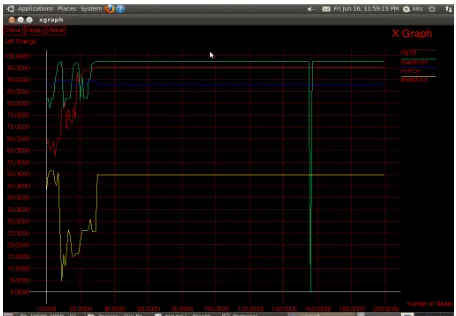
Nodes Left Energy Consumption – RTP-AOMDV, MAODV, MM-LEACH and E-LEACH
Figure 4.3 demonstrates the Node Left Energy comparison of the proposed Methodology RTP-AOMDV, Modified AODV, MM-LEACH and E-LEACH with the existing protocols namely AOMDV, AODV, DSDV, TEEN, HEED and LEACH.
Figure 4.3: Overall Research Work – Node Left Energy Consumption
V. CONCLUSIONS
In this chapter, the current research and the major findings are presented. The communication and cluster based algorithms with the two phase processes is discussed. Although these routing algorithms show the improvements but still there is possibility of improvements in wireless sensor networks. The main objective of our research is to design, develop, implement and test an energy constrained cluster based algorithm that reduces energy consumption. A comparison has been done among these Algorithms and results are listed in Table 4.1/4.2 and Figure 4.3.
The Analysis of simulation result shows that the proposed cluster based routing algorithm Enhanced LEACH-(E-LEACH) achieved a better performance than existing algorithms, in terms of metrics such as Throughput, the Packet Delivery Ratio, Delay, Average Energy, Total Energy and the Node Left energy consumption for data transmission. In addition to that E-LEACH improves the Network Lifetime.
REFERENCES
[1] J.Daniel Mano, Dr.S.Sathappan, “Performance Evaluation of Wireless Routing Protocols Based On RTP”, DOI: 10.1109/ICATCCT.2015.7456986 , IEEE, Pp.766– 770. [2] Seyed Kazem Jahanbakhsh Marzieh Hajhosseini, et al..,
“Improving Performance of Cluster Based Routing Protocol using Cross-Layer Design ”, https://arxiv.org/pdf/0802.0543, 2008
[3] Sunetra Chandel, Kamal Deep Jangra, et al.., “Review on Intelligent Approach for Improving Handoff in Heterogeneous Wireless Sensor Networks”, International Journal of Advanced Research in Computer Science and Management Studies, Volume 3, Issue 6,June2015. [4] Jun Zhu, Hui Gao, et al.., “A Cellular-Assisted Efficient
Handover Algorithm for Wireless Sensor Networks”, Int.J.Communication Network and System Sciences, 5, 708-713, 2012.
[5] Chaudhary D.D, Pranav Pawar and Waghmare. L.M. et al.., “Comparison and Performance Evaluation of Wireless Sensor Network with different Routing Protocols”,
International Conference on Information and Electronics Engineering IPCSIT vol.6 (2011) IACSIT Press, Singapore [6] Madhav Sharma and Rajeshwar Lal Dua v et
al..,“Evaluation of Different Performance Metrics of Wireless Sensor Networks in Different Topologies Using DSR Routing Protocol in NS-2 Simulator , International Journal of Advanced Research in Computer Science and Software Engineering, ISSN: 2277 128X, Volume 3, Issue 4, April 2013.
0 0.1 0.2 0.3 0.4
M
s
www.ijsred.com
[7] Tablibzadeh. M, Sarran.M, Adibnia. F, et al..,“ Hybrid Routing protocol for prolonged network life time in large scale wireless sensor network”,2009, international conference on information and multimedia technology, pp.179-183.
[8] Alia Sabri and Khalil Al- Shqeerat, et al.., Hierarchical cluster based routing protocols for wireless sensor networks- A Survey, International Journal of Computer Science Issue, Vol.11, No.2, January 2014. www.ijcsi.org
[9] Lotf and Hosseinzadeh M, et al.., Hierarchical routing in Wireless Sensor Networks: A survey, ICCET, 16-18 April 2010, pp. 650-654.
[10]Polastre. J, et al.., "Sensor Network Media Access Design", Computer Science Division. EECS Department, University of California,Berkeley. (c) 2003 Regents of the University of California.
[11]Akyildiz. I.F, Su.W, Sankarasubramaniam.Y and Cayirci. E. et al.., "A Survey on Sensor Networks", IEEE Communications Magazine, August 2002.
[12]Daniel Mano. J, Sathappan.S, et al.., “International Journal of ComputerScience & Information Security, IJCSIS Vol. 13 July 2015 Special Issue ISSN 1947-5500.
[13] Bröring, A. New generation sensor web enablement. Sensors, 11, 2011, pp. 26522699. ISSN 1424-8220. Available from: doi:10.3390/s110302652
[14] http://www.iec.ch/whitepaper/pdf/iecWP-internetofthings-LR-en.pdf, International Electro technical Commission, T +41 22 919 02 11,[email protected],www.iec.ch,3 ruede Varembe, PO Box 131,CH-1211 Geneva 20,Switzerland [15]J.Daniel Mano, Dr.S.Sathappan, et al.., “Comparison of
Wireless Routing Protocols in Sensor Network Using NS2 Tool”, IJARBEST, Vol.2, Special Issue 19, ISSN2395-695X, 2016.
[16]Chien-Wen Chiang, Chih-Chung Lin, Ray-I Chang et al.., “A New Scheme of Key Distribution using Implicit Security inWireless Sensor Networks” Feb. 7-10, 2010 ICACT 2010.