Published online December 08, 2014 (http://www.sciencepublishinggroup.com/j/pamj) doi: 10.11648/j.pamj.20140306.14
ISSN: 2326-9790 (Print); ISSN: 2326-9812 (Online)
Visualization of Minkowski patch
Rania Bahgat Mohamed Amer
Department of Physics and Mathematics Engineering, Faculty of Engineering/ P.O. 44519/ Zagazig University, Egypt
Email address:
To cite this article:
Rania Bahgat Mohamed Amer. Visualization of Minkowski Patch. Pure and Applied Mathematics Journal. Vol. 3, No. 6, 2014, pp. 132-136. doi: 10.11648/j.pamj.20140306.14
Abstract:
This study is an introduction to visualize Minkowskian (n, 1) geometry for all n ≥1. The Minkowski geometry naturally encodes the ideas of inertial frames, time and space dilation. Moreover, it also includes studying Minkowski patch which is the natural structure of Minkowski space.Keywords:
Minkowski Space, Einstein Space, Minkowski Patch, Improper Point, Crooked Surface1. Introduction
The Universe contains many kinds of spaces and types of different curvatures. The space scientists have hypothesized many theories to explain the shape and nature of the Universe. Minkowski space is one the newly hypothesized geometrical spaces that explains many unknown phenomena in the Universe. Minkowski Space, which named by Hermann Minkowski, is mathematical setting in which Einstein’s theory of special relativity is most conveniently formulated by 1907 Minkowski realized that the special theory of relativity based on Lorentz and Poincare, could be best understood in a n- dimensional space. Studying Minkowskian mathematical models will enhance our understanding of space-time and the Universe. Moreover, the construction of fundamental properties of Minkowski space develops and enhances techniques in space with applications in general and special relativity. Also, this study will help Egyptian mathematical scientists to understand and integrate effectively in space studies.
2. Minkowski Space
Definition 1. Minkowski Space is simply connected, geodesically complete, flat Lorentzian manifold.
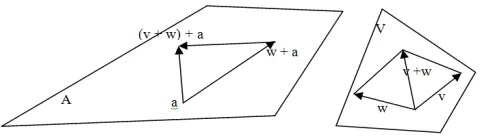
Definition 2. An affine space is defined as a pair (A, V) consisting of a set A together with a vector space V, such that V acts freely and transitively group action on A. There is a map τ called translation by the vector v,
τ: Vx A → A, A: v, a → v + a (1)
with the following properties: Identity
∀ a ∈ A, 0 + a = a or a + 0 = a. (2) Associatively
∀ v, w ∈ V, ∀a ∈ A, v + w + a = v + w + a (3) Uniqueness
∀a ∈ A, V → A: v → v + a. (4) The action is free
∀v ∈ V ∃ a point a ∈ A: a + v = a then v = 0. (5) The action is transitive
∀a, b ∈ A ∃ a vector v ∈ V: b = a + v. (6) The dimension of A is the dimension of the vector space of translations V. Then the vector space of translations is the space of vectors in the plane or in space [1].
Pure and Applied Mathematics Journal 2014;
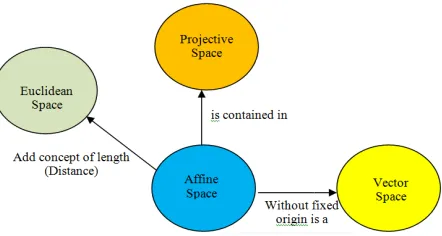
Figure 2. The relation between affine space and
Theorem 1. Minkowski space is an affine space whose underlying vector space of signature (n, 1).
Proof:
Let E denote an affine space which is different from real vector space V = ,!by having no special or fixed origin. Let the translation group V = ,! is given the structure of non degenerate symmetric bilinear form of index 1. The inner product space Rn+1, 2 is introduced by symmetric bilinear form of type (n + 1, 2) as In+1 – I2
〈v, v〉 v!$ v$$ …………+ v%&!$ ' v%&$$
for all v ϵ V.
The bilinear form on inner product space [7]:
B (u, v) = u1v1+ u2v2 + u3v3 +… unv
for all u, vϵ V
The bilinear form is defined a lorentz metric on E as
ds2=dx!$+dx$$ dx)$ ⋯ … dx%$
which is invariant under the translation of E. So Minkowski (n + 1)-space is denoted by E
affine space of dimension n+1 with a non degenerate inner product of index '1'.
The geodesics in Minkowski space En,1
straight line of the form:
Where a point on a line p0 ϵ En,1, a vector u ϵ R
space-like, time-like, or null and a real parame
Then there are three types of curves in Minkowski space [3]:
1-Light-like curves form a cone in Minkowski space and dividing it into two parts so the light like curves that pass through the event will be on the surface of the light cones. 2-Time-like curves fall within a cone defined by light
curves so the time like curves that pass through the event will remain inside that event's past and future light 3-Space-like curves that pass through the event will be
outside the light cones.
Pure and Applied Mathematics Journal 2014; 3(6): 132-136
The relation between affine space and other spaces
Minkowski space is an affine space whose underlying vector space of signature (n, 1).
Let E denote an affine space which is different from real special or fixed origin. Let is given the structure of non degenerate symmetric bilinear form of index 1. The inner is introduced by symmetric bilinear form
$' v%&)$ , (7)
The bilinear form on inner product space ,! is written as
vn – un+1vn+1 (8)
The bilinear form is defined a lorentz metric on E as
' dx%&!$ (9)
under the translation of E.
space is denoted by En,1 is a real 1 with a non degenerate inner
n,1
are Euclidean
(10)
, a vector u ϵ Rn,1 is like, or null and a real parameter t ϵ R. Then there are three types of curves in Minkowski space
like curves form a cone in Minkowski space and dividing it into two parts so the light like curves that pass through the event will be on the surface of the light cones. e curves fall within a cone defined by light-like curves so the time like curves that pass through the event will remain inside that event's past and future light cones. like curves that pass through the event will be
Definition 3. A vector u =
• spacelike if
B(u, u) = u!$ u$$ ⋯
• lightlike (or null) if
B(u, u) = u!$ u$$ ⋯
• timelike if
B(u, u) = u!$ u$$ ⋯
The union of all null lines is called the lightcone. Then the light-cone with vertex p of Minkowski space E
the set of all lightlike vectors of E
L(p) = {(x1, x2, …., xn) ∈ E
n,1;{
= 0} − {(0, 0, 0)}[4].
Figure 3. The curves in Minkowski space
3. Minkowski Patch
Einstein space [5] of dimension n is denoted by Ein homogenous space and it is the image of null cone
μ%,! /u ∈ R%,! |
under projection
R%,!'
This mean that Einstein space is a conformal compact of Minkowski space.
The double covering 2345 is a quotient of null cone by the action of positive scalar
The Minkowski patch Min (p) determined by an element p of Einnis the complement of the
Einn – L (p) and has the natural structure of Minkowski space En,1 [5].
133
∈ R%,! is said to be:
⋯ … u%$' u%&!$ > 0,
⋯ … u%$' u%&!$ 0,
⋯ … u%$' u%&!$ < 0.
nes is called the lightcone. Then the cone with vertex p of Minkowski space En,1 is defined as the set of all lightlike vectors of En,1, that is,
;{ x!$ x$$ ⋯ … x%$' x%&!$ = 0} − {(0, 0, 0)}[4].
The curves in Minkowski space
Einstein space [5] of dimension n is denoted by Einn is a homogenous space and it is the image of null cone
|6 7, 7 8 09 : ' /09; (11)
' /09 → RP%&! (12)
space is a conformal compactness
is a quotient of null cone μ%,! by the action of positive scalar multiplications.
Figure 4. The points in Minkowski space
From figure 4 we see that the origin or the vertex with
homogeneous coordinates=00%
1? is mapped to the improper
point having homogeneous coordinates =01
0
vecor 0n ϵ Rn.
Let p∞ be an improper point, in the double
every Minkowski patch are attached two improper points: 1-The spatial improper point has homogeneous coordinates
='10 0%
? and it is denoted by the unique element
such that the given Minkowski patch is Min
2-The timelike improper point has homogeneous coordi
nates =
0 1 0%
?and it is denoted by the unique element
such that the given Minkowski patch is Min+
Figure 5. The improper points in Minkowski patch of double covering
The point of view of one Minkowski patch is shown in Figure 5 where the timelike improper point is represented by two identified points, the spatial improper point is represented by an entire circle and the sphere at infinity is represented by the two identified circles. A point on one sphere is identified to a point on the other sphere by scalar multiplication by −1.
Theorem 2. The crooked surfaces have four points and Minkowski space En,1 ∈ Min (p1) ∪ Min (p
Min(p∞ .
Proof:
In crooked surfaces ∈ Rn, we get four points in a stem configuration which is defined as the union of null lines passes through the vertex (the origin) inside the light cone:
1-The vertex point p0 = = 0%
0 1?,
The points in Minkowski space
From figure 4 we see that the origin or the vertex with
is mapped to the improper
=01%
0?, where a zero
be an improper point, in the double-covering 2345 , every Minkowski patch are attached two improper points:
The spatial improper point has homogeneous coordinates
and it is denoted by the unique element p∞AB
h that the given Minkowski patch is Min– p∞AB ).
The timelike improper point has homogeneous coordi
and it is denoted by the unique element p∞CD
such that the given Minkowski patch is Min+ p∞CD ).
points in Minkowski patch of double covering 2345
The point of view of one Minkowski patch is shown in Figure 5 where the timelike improper point is represented by two identified points, the spatial improper point is represented le and the sphere at infinity is represented by the two identified circles. A point on one sphere is identified to a point on the other sphere by scalar multiplication by −1.
The crooked surfaces have four points and Min (p2) ∪ Min (p0) ∪
, we get four points in a stem configuration which is defined as the union of null lines passes through the vertex (the origin) inside the light cone:
2-Two ideal points: p1 = = 0 1 0
3-The improper point p∞
We get 8 segments between (p (p∞, p2) and the complement of Ein
consists of four quadrilateral regions. Then E Min (p2) ∪ Min (p0) ∪ Min(p∞
3.1. Visualized Minkowski Patch
Let pE ∈ Einn F Rn+1 \ {0} and the image of null geodesics α in Einn are spiral curves in Rn+1
is the union of geodesics contain cone of an element pE of Ein
revolution in R3 obtained by rotating a spiral contained in a
vertical 2-plane around an axis of the plane. From fig. 6 we can visualize how Minkowski patches embed in R
From fig. 6 we can deduced that Minkowski patch Min in Einn is the intersection between the future oriented time like curve I+ (pE) and the past oriented time like curve I
Figure 6. Minkowski patch in Ein
4. The Closure
Definition 4. Crooked plane is a polyhedral surface in the Einstein space consists of wings which are two null planes inside the light cone, the stem is the union of two quadrants of two null lines (time-like lines) inside the light cone and the spine is a space-like vector [6].
Figure 7. A crooked plane
From fig. 7 we can see the wings are half planes tangent to
0 1 0%
?, p2 = = 0 '1
0% ?,
=01% 0?.
We get 8 segments between (p0, p1), (p0, p2), (p∞, p1) and
) and the complement of Einn –[L( p0) ∪ L(p∞ G
teral regions. Then En,1 ∈ Min (p1) ∪
∞ and the proof is complete.
Visualized Minkowski Patch
{0} and the image of null geodesics
n+1
\ {0}. So that the light cone is the union of geodesics contain pE. Then, if n = 2, the light of Ein2 is a singular surface of obtained by rotating a spiral contained in a plane around an axis of the plane. From fig. 6 we ize how Minkowski patches embed in R3 \ {0}. From fig. 6 we can deduced that Minkowski patch Min+ (pE
is the intersection between the future oriented time like ) and the past oriented time like curve I – (α2(pE .
Minkowski patch in Ein2≈ R3 – {0}
Crooked plane is a polyhedral surface in the Einstein space consists of wings which are two null planes the stem is the union of two quadrants like lines) inside the light cone and the
A crooked plane
Pure and Applied Mathematics Journal 2014;
the light cone and the stem are the two infinite timelike triangles.
Definition 5. A set has the closure property under a particular operation if the result of the operation is always an element in the set
1.The light cone L (p) is the closure of null plane containing p.
2.The closure of a stem H IJJJJJJ is two light
3.The closure of each wings W1, W2 intersect ideal light
cone L (p∞).
4.The closure of time-like geodesic and space geodesic are time-like circle and space containing p∞.
5.Crooke plane C is homomorphic to R
complement E2,1 – C consists of components each homomorphic to R3. This mean crooked half spaces and
their closure closed half spaces.
Definition 6. The crooked half-space with vertex p and direction vector v is defined by:
H v, p /:p v ∈ R)| 〈uK, v〉 8 0 LM
〈uK, v〉〈u&, v〉 8 0 LM 〈v, v〉 〈u&, v〉 8 0 LM 〈v, v〉 6 09
and the corresponding crooked plane is its boundary ∂H(v, p) [7].
Facts about closures: The closures of crooked planes in Minkowski patches are crooked surfaces.
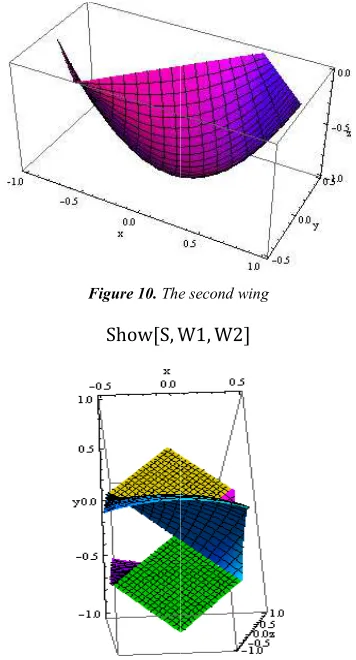
We use Mathematica program to visualize crooked plane as following :
Figure 8. The stem in crooked plane
Figure 9. The first wing
Pure and Applied Mathematics Journal 2014; 3(6): 132-136
are the two infinite timelike
A set has the closure property under a particular operation if the result of the operation is always an
The light cone L (p) is the closure of null plane
is two light-like geodesics. intersect ideal light
like geodesic and space-like like circle and space-like circle
hic to R2 and the C consists of components each . This mean crooked half spaces and
space with vertex p and
LM 〈v, v〉 8 0, 〉 0,
9,
and the corresponding crooked plane is its boundary ∂H(v, p)
: The closures of crooked planes in
We use Mathematica program to visualize crooked plane
lane
Figure 10. The second wing
ShowOS, W
Figure 11. The crooked
5. Conclusions
This research deals with studying the properties of Minkowski patch which is the natural structure of Minkowski space. Also, we have been able to see the points and curves in Minkowski space. Furthermore, Visualized
patches embedded in Rn+1 \ {0}.
Acknowledgements
I wish to express my gratitude towards to Professor Dr. William M. Goldman, University of Maryland and Distinguished Scholar-Teacher Professor, Department of Mathematics, for his valuable, guidance, patience and support. I consider myself very fortunate for being able to work with a very considerate and encouraging professor like him.
Nomenclature
Einstein Universe; Einstein Space
Einn,1
The Double Covering
234Q ,!
The Universal Covering
234R ,!
The Real inner product space of t
&!,$
(n +1) Minkowski Space
2 ,!
Tilde {p} ; Slash [p)
SE
Hat {p}, Bar {p}, Prime {p}
S,T S U, S′
The Direct Sum; Xor; Bigoplus
135
The second wing
W1, W2G
The crooked plane
ch deals with studying the properties of Minkowski patch which is the natural structure of Minkowski space. Also, we have been able to see the points and curves in Minkowski space. Furthermore, Visualized Minkowski
{0}.
I wish to express my gratitude towards to Professor Dr. William M. Goldman, University of Maryland and Teacher Professor, Department of Mathematics, for his valuable, guidance, patience and support. unate for being able to work with a very considerate and encouraging professor like him.
Einstein Universe; Einstein Space The Double Covering
The Universal Covering
The Real inner product space of type (n +1, 2) (n +1) Minkowski Space
Is isomorphic to
F
Light cone L(p)
MSC:
14Rxx, 51B20.References
[1] Izumiya, S. and Saji, K., The mandala of Legendrian dualities for pseudo-spheres in Lorentz-Minkowski space and "flat" spacelike surface, Journal of Singularities,Vol.2, (2010), 92—127.
[2] L´opez, R., Differential Geometry of Curves and Surfaces in Lorentz-Minkowski space, Mini-Course taught at the Instituto de Matem´atica e Estat´ıstica (IME-USP) University of Sao Paulo, Brasil, October 18, 2008.
[3] Izumiya, S. and Yıldırım, H., Slant Geometry of Spacelike Hypersurfaces in the Lightcone, Journal of the Mathematical Society of Japan, Vol. 63, Number 3 (2011), 715—752. lp [4] Goldman, W. M., Crooked Surfaces and Anti-De Sitter
Geometry, arXiv:1302.4911[math.DG] from Cornell University Library, February 20, 2013.
[5] Barbot, T., Charette, V., Drumm, T., Goldman, W. M., and Melnick, K., A primer on the (2 + 1) Einstein universe, Recent Developments in Pseudo-Riemannian Geometry journal, European Mathematical Society, (2008), 179—230.
[6] Drumm, T. and Goldman, W. M., The geometry of crooked planes, Journal of Topology Vol. 38 (1999), No. 2, 323—351. [7] Burelle, J. P., Charette, V., Drumm, T. and Goldman, W. M.,