Published online March 10, 2014 (http://www.sciencepublishinggroup.com/j/ijefm) doi: 10.11648/j.ijefm.20140202.12
A study on analysis of managerial attitudes towards ISO
9001: 2008 quality management system introduction and
implementation process in Sri Lanka
P. M. C. Thilakarathne, S. K. C. Chithrangani
Faculty of Commerce and Management Studies,University of Kelaniya, Sri Lanka
Email address:
[email protected] (P. M. C. Thilakarathne), [email protected] (S. K. C. Chithrangani)
To cite this article:
P. M. C. Thilakarathne, S. K. C. Chithrangani. A Study on Analysis of Managerial Attitudes towards ISO 9001: 2008 Quality Manage-ment System Introduction and ImpleManage-mentation Process in Sri Lanka.International Journal of Economics, Finance and Management Sciences. Vol. 2, No. 2, 2014, pp. 123-131. doi: 10.11648/j.ijefm.20140202.12
Abstract: ISO certification is expected to help organizations to enhance quality and efficiency, improve communications,
achieve competitive advantage and to increase in market share, reduce costs and achieve a high stock price. The successful implementation of the ISO 9001: 2008 quality management system standard depends on how the standard is perceived by the companies, therefore identification of managerial perception for ISO 9001 system is vital. This research paper presents the results of an investigation carried out to identify managerial attitudes towards ISO 9001: 2008 quality management systems. To realize this goal, a sample consisting of 73 managers, representing both top and middle managers were selected from organizations functioning in Sri Lanka, covering all sectors including manufacturing, services, construction and others. Data were gathered using self administered questionnaire, through an email survey. Results indicated that Sri Lankan companies have high level of understanding for the purpose of ISO 9001: 2008 quality management system; by both certified groups for ISO 9001: 2008 and organizations those commenced the quality management system implementation. The main motivating factors behind the implementation of ISO 9001: 2008 quality management system for both certified companies and organi-zations already commence the implementation are to achieve quality improvement. The second most motivator for certified organization is to meet the corporate objectives. The principle perceived benefits of implementing ISO 9001: 2008 by both groups are customer satisfaction, increase quality awareness and reduces the production time. None of the parameters ana-lyzed for understanding the purposes of selecting ISO 9001 quality management system and motivational factors for seeking certifications were statistically significant in both groups. Furthermore this investigation concluded that there is an impact towards ISO 9001: 2008 quality management systems by both certified organizations and organizations those commenced the quality system implementation in Sri Lanka. In addition to that study reveals that majority of organizations are seeking cer-tifications irrespective of their sector and type of the organizations. Therefore, this research is vital for making policy deci-sions of organizations those who anticipate to implement quality management systems for their operations in the future.Keywords:
ISO 9001: 2008, Quality Management Systems Certifications, Managerial Attitudes1. Introduction
It has been revealed that organizations have been con-cerned with quality for many years but only past twenty years have they really began to implement specific measures to achieve high rate of quality (Dreyfus et al., 1999). ISO 9001 establishes a basic set of quality system requirements necessary to ensure that the process is capable of consis-tently producing products that meet the customer's expecta-tions. Products and services are the result of activities or processes that transform inputs into outputs and the quality
sector organizations in Sri Lanka are less compatible with the attitudes and skills of the organizational participants. Therefore, those innovative programs become simply tech-nical, rather than managerially meaningful to the organiza-tions (Samarathunga and Bennington, 2002). In a study carried out by Magd and Curry (2003) confirmed that the implementation of ISO 9001 quality management system standard depends on how the standards is perceived by the companies. Moreover implementation and impact of ISO 9001 standard vary from organization to organization and country to country. Having considered the above research evidences and facts researchers identified there is a neces-sity for carrying out an investigation to identify the percep-tion/ attitudes towards ISO 9001: 2008 quality management system in Sri Lanka, as there were very little known about management attitudes towards ISO 9001 system. Therefore this research was outlined to examine the managerial per-ception towards ISO 9001: 2008 quality management sys-tem among Sri Lankan companies. The main objectives of this study were to evaluate the management attitudes towards ISO 9001: 2008 quality management system in Sri Lanka and to identify the perceived benefits of implement-ing ISO 9001: 2008 quality management system require-ments in Sri Lankan companies. The research problem of this study was to investigate whether there is an impact of managerial attitudes/ perception towards the implementa-tion of ISO 9001: 2008 quality management system in Sri Lanka.
Remainder of this research organizes as follows. Section two reviews the literature and section three discusses the descriptive methodological approach in the study. Section four reports results of analysis and discussion and section five concludes the paper.
2. Literature Review
The ISO 9000 standards are based on the concept that certain minimum characteristics of a quality management system could be usefully standardized, giving mutual bene-fit to suppliers and customers, and focusing on process ra-ther than product/service quality (Dick et al., 2002).
According to Casadesus et al.,(2000), perceptions of the benefits of ISO 9000 have eroded over the last few years in spite of the changes and improvements supposedly pro-vided by the latest version of the standard. However, many studies have suggested that organizations certified for longer periods of time tend to garner greater benefits than more recently certified organizations because they have had more time to integrate improvements derived from ISO 9000 (Escanciano et al. , 2001).
Pheng (2001),has confirmed that many approaches to quality management, including TQM hardly give long-term success to organizations. This is mainly because of the problematic nature of organizational culture (OC) within which managers find it difficult to practice their quality management practices.
Furthermore Samaratunga and Bennington (2002),
con-firmed that the reforms and innovative programmes intro-duced in public sector organizations in Sri Lanka are less compatible with the attitudes and skills of the organization-al participants. Therefore, those innovative programs be-come simply technical, rather than managerially meaning-ful to the organizations. According to the above research findings perception towards ISO 9001: 2008 quality man-agement system is varied amongst different individuals, organizations and in certain occasions based on the organi-zation culture. Therefore taking above findings into con-sideration this study was designed to investigate the mana-gerial attitudes towards ISO 9001: 2008 quality manage-ment system in Sri Lanka.
3. Research Methodology
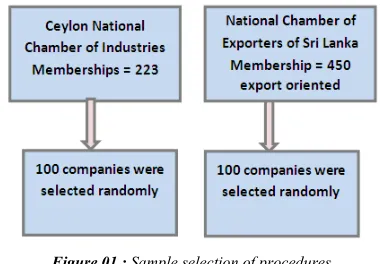
This study is a descriptive study, carried out to investi-gate the managerial perception towards ISO 9001: 2008 quality management system in Sri Lankan companies. Membership data bases of Ceylon National Chamber of Industries and National Chamber of Exporters were ob-tained, 100 companies were randomly selected from each data base.
Sample Selection
The below figure depicts the sample selection procedures from existing data bases of
Figure 01 : Sample selection of procedures
The data for the questionnaire were gathered using a self-administered questionnaire. An email survey was con-ducted to collect the data as per the developed question-naire. The questionnaire was distributed among 200 partic-ipating organizations covering, senior managers / manage-ment representatives for quality managemanage-ment system and junior managers of selected companies of the membership data bases of two (02) chambers through emails, responses were gathered to an online system using Google Drive. The basic design of the self-administered email questionnaire relied on closed questions a five point Likert scale (1= strong disagreement, 5= Strong agreement), and three point Likert scale (1= Low, 2 = Medium, and 3= High).
reasona-ble compared with other studies in the field of quality management (Dissanayaka et al, 2001). Following the data collection stage the responses were coded for the statistical analysis. The data analysis was carried out using Minitab 16, Statistical Package for Social Sciences version 16 (SPSS 16). Moreover descriptive data were analyzed using Microsoft Since this study is a qualitative research, gather-ing data pertaingather-ing to perception under five point likert scale and three point likert scale, as a non-parametric test this Mann Whitney U test was performed to identify whether there is a significant difference between perception towards ISO 9001: 2008 Excel 2010. This principle com-ponent analysis was performed to identify the changes in the perceptions of each parameters analyzed as per the questionnaires.
4. Results and Discussion
4.1. Background information
The results of the sample distribution by the industry sector is depicted in the figure 02. Of the 73 organizations surveyed 41 percent belong to manufacturing sector, 43 percent of organizations belong to service sector, another 5 percent belong to construction industry and remaining 11 percent represented other categories respectively.
Figure 02 : Distribution of respondents by sector type as a percentage
For the purpose of the study organizations with less than 10 employees were categorized as micro organizations, those with 11 to 49 employees were categorized as small organizations, and those with 50 to 249 as medium and those with more than 300 employees as large. With respect to the size of the organizations surveyed 18 percent had staff between 11-49 (Small-sized organizations), 27 percent had staff between 50 to 249 employees (Medium Sized Organizations) whereas 55 percent of had a staff of more than 249 employees (Large Organizations). Moreover, 49 percent of the respondents of surveyed organizations had at least a postgraduate degree. 42 percent of the respondents had a bachelor’s degree whereas 9 percent of respondents of the surveyed organizations had a completed their educa-tion level up to General Certificate of Educaeduca-tion advanced level examination.
In terms of ISO certifications, 44 percent of the re-sponded organizations were certified for ISO 9001: 2008 Quality management systems. This represents a satisfactory rate of certification for quality management. 33 percent of the surveyed organizations had an interest to be certified under ISO 9001: 2008 system certifications. 07 percent of responded organizations which were not certified for ISO 9001: 2008 quality management system had already com-menced the system implementation, including preparation of documents pertaining to ISO 9001: 2008 quality man-agement system implementations. 16 percent of organiza-tions surveyed under this research were not interested in implementing ISO 9001: 2008 quality management system certifications.
4.2. Understanding the purposes of ISO 9001: 2008 Qual-ity Management System
Table 01 : Summary of understanding the purposes of ISO 9001: 2008 Quality Management System between certified organizations
Purposes of selecting ISO 9001:2008
Certified (N=32)
Meana SDb Rank
To establish a consistent documentation method 3.44 1.78 1
A means of guaranteeing high grade products/services] 3.38 2.51 2
A new name for not-so-new management practices 3.31 1.40 3
Making the customer the focus of all business processes 2.78 1.79 4
Continuous improvement through problem solving and teamwork 2.59 1.58 5
To establish a quality/formal system] 2.53 1.34 6
Notes: a - The mean score is based on participants’ level of agreement with each statement on a scale of 1 = strongly disagree to 5 = strongly agree. A mean score above 4 indicates high, between 3 and 4 indicates moderate and a score less than 3 indicates a low level of agreement. b -SD = standard deviation
As can be seen in the above table 01 the main purpose of ISO 9001: 2008 quality management system is to establish a consistent documentation method (3.44). The second reason was to means of guaranteeing high products and services (3.38), by the certified organizations. The below
Table 02: Understanding purposes of ISO 9001: 2008 quality management system by organizations already commenced the implementation of system certifications
Purposes of selecting ISO 9001:2008
Certified (N=32 Organizations commenced the implementation of ISO 9001 system certification
(N = 29))
Meana SDb Rank
A means of guaranteeing high grade products/services] 4.34 2.09 1
A new name for not-so-new management practices 3.32 1.70 2
Making the customer the focus of all business processes 3.24 1.84 3
To establish a consistent documentation method 3.17 1.71 4
To establish a quality/formal system] 2.72 1.22 5
Continuous improvement through problem solving and teamwork 2.34 1.32 6
Notes: a - The mean score is based on participants’ level of agreement with each statement on a scale of 1 = strongly disagree to 5 = strongly agree. A mean
score above 4 indicates high, between 3 and 4 indicates moderate and a score less than 3 indicates a low level of agreement. b -SD = standard deviation
Accordingly the main purpose ISO 9001 : 2008 quality management system by the companies those commenced the system implementation was to provide guaranteeing high grade products / services ( 4.34) , the second main purpose was a new name for not so new management prac-tices (3.32).
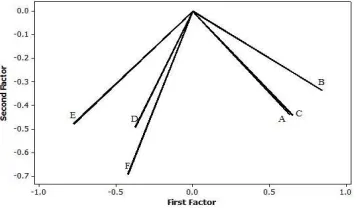
The below figure 03, depicts the contribution made by each parameter for purposes of selecting ISO 9001: 2008 quality management systems by the certified organizations.
Figure 03: Loading plot of factor analysis, method of extraction is prin-ciple component analysis of parameters selecting consider to select ISO9001: 2008 Quality Management system by organizations imple-mented or commenced ISO 9001 quality management system certification. (Where A – to establish a consistent documentation method, B= A new name for not-so- new management practices, C= Continuous improvement through problem solving and teamwork, D= To establish a quality / for-mal system, E = Making the customer the focus of all business processes, F= A means of guaranteeing high grade products/ services)
Contribution for each parameter is denoted by the length of each respective line in the plot for each parameter, angle between two lines explains the degree of correlation of pa-rameters. Accordingly, companies interested or already commenced the implementation of ISO 9001 quality man-agement system considered factor F i.e. a means of gua-ranteeing high grade products/ services as the main factor for purposes of selecting ISO 9001 quality management system. Whereas factor A (to establish a consistent docu-mentation method) and factor C (continuous improvement through problem solving and teamwork) are highly corre-lated in purposes of selecting ISO 9001: 2008 quality management systems by Sri Lankan organizations
interest-ed for ISO 9001 or organizations already commencinterest-ed the quality system implementation.
The below figure 04 shows the contribution for each tested parameter for certified organizations in understand-ing the purposes of ISO 9001: 2008 quality management system in Sri Lankan organizations.
Figure 04: Loading plot of factor analysis, method of extraction is prin-ciple component analysis for understanding the purposes of ISO 9001: 2008 quality management system for certified organizations.(Where A – to establish a consistent documentation method, B= A new name for not-so- new management practices, C= Continuous improvement through prob-lem solving and teamwork, D= To establish a quality / formal system, E = Making the customer the focus of all business processes, F= A means of guaranteeing high grade products/ services)
Table 03: Statistical significance of parameters analyzed for understanding the purposes of selecting ISO 9001: 2008 quality management systems
Parameters P Value ₤ Significance
To establish a consistent documentation method 0.5832 Not significant
A new name for not-so-new management practices 0.9350 Not significant
Continuous improvement through problem solving and teamwork 0.6701 Not significant
To establish a quality/formal system 0.5981 Not significant
Making the customer the focus of all business processes 0.5019 Not significant
A means of guaranteeing high grade products/services 0.1427 Not significant
€- Statistical significance was taken at 0.05 levels (95% confidence interval)
As can be seen from the above table 03 , there is no sta-tistical difference between two (02) groups in understand-ing purposes of selectunderstand-ing ISO 9001: 2008 quality manage-ment systems to their organizations, as the calculated P value for each parameter is higher than 0.05
4.3 Motivations for seeking ISO 9001: 2008 Quality Management System Certifications
The literature suggested many reasons as to why
compa-nies seek ISO 9001 quality management systems certifica-tions (Buttle, 1997; Lee, 1998; Dissanayaka et al., 2001). These reason s were condensed to 12 reason s in the survey. Respondents were asked to rate the importance of these reason s on a five-point Likert - type scale ranging from 5 = strongly agree to 1= strongly disagree.
Table 04 depicts the motivator s as identified by the res-pondents, in terms of mean score and standard deviation. It also presents rank ordered responses.
Table 04: Motivations for seeking ISO 9001: 2008 Quality Management Systems Certifications in certified Sri Lankan companies
Rank Motivations for seeking ISO certifications
Certified organizations (N=32)
Meana SDb
1 To achieve quality improvement 4.34 0.6
2 To meet corporate objectives 4.34 0.65
3 To market products in the international arena 4.31 0.54
4 To comply with customers’ requirements 4.31 0.69
5 To be a step towards TQM 4.28 0.63
6 To improve employees’ relations 4.25 0.62
7 To meet government demands, requirements or pressure 4.22 0.87
8 To use ISO as a marketing/promotional tool 4.19 0.54
9 To improve the efficiency of the quality system 4.19 0.47
10 To achieve cost reduction 4.09 0.59
11 To maintain/increase market share 4.03 0.65
12 Pressures from competitors/foreign partners 3.94 0.76
Notes: a - The mean score is based on participants’ level of agreement with each statement on a scale of 1 = strongly disagree to 5 = strongly agree. A
mean score above 4 indicates high, between 3 and 4 indicates moderate and a score less than 3 indicates a low level of agreement. b - SD = standard
deviation
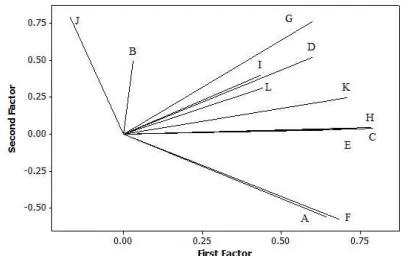
Figure 05 : Loading plot of factor analysis, method of extraction is Prin-ciple Component Analysis of parameters selecting to consider motivations for seeking ISO 9001: 2008 quality management system certifications (where A- To improve the efficiency of quality system, B = Pressures from competitors/ foreign partners, C = To maintain or increase market share,
D = To meet government demands, requirements or pressure, E= To comply with customers’ requirements, F = To achieve quality improve-ment, G = To markets products in the international arena, H = To use ISO as a marketing / promotional tool, I = To be a step towards TQM, J – To achieve cost reduction, K = To meet corporate objectives, L = To improve employees relations
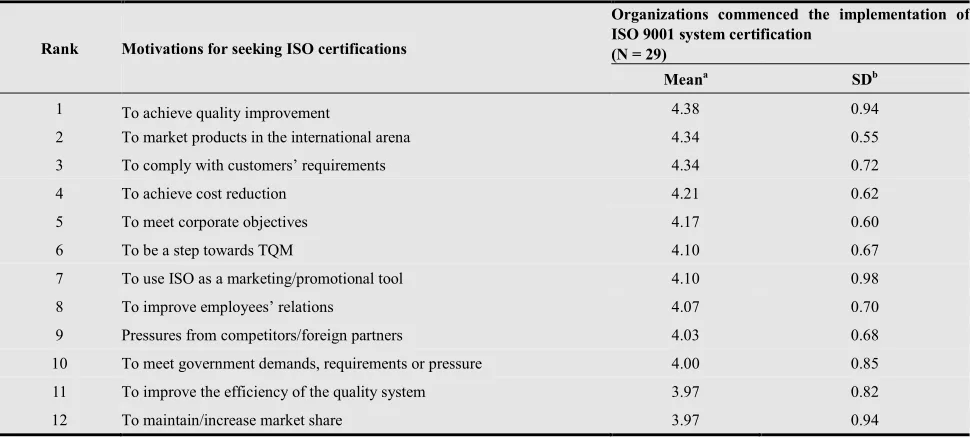
As can be seen from the above table 04 the leading mo-tivator for seeking ISO 9001 certifications by the organiza-tions seeking for ISO 9001 certificaorganiza-tions and companies certified for ISO 9001 certifications was to achieve quality improvement. It is shown that the managers now recognize that the ISO 9001 standard helps for quality improvement of the organization.
Table 05 :Motivations for seeking ISO 9001: 2008 certifications by organizations interested or commenced
Rank Motivations for seeking ISO certifications
Organizations commenced the implementation of ISO 9001 system certification
(N = 29)
Meana SDb
1 To achieve quality improvement 4.38 0.94
2 To market products in the international arena 4.34 0.55
3 To comply with customers’ requirements 4.34 0.72
4 To achieve cost reduction 4.21 0.62
5 To meet corporate objectives 4.17 0.60
6 To be a step towards TQM 4.10 0.67
7 To use ISO as a marketing/promotional tool 4.10 0.98
8 To improve employees’ relations 4.07 0.70
9 Pressures from competitors/foreign partners 4.03 0.68
10 To meet government demands, requirements or pressure 4.00 0.85
11 To improve the efficiency of the quality system 3.97 0.82
12 To maintain/increase market share 3.97 0.94
Notes: a - The mean score is based on participants’ level of agreement with each statement on a scale of 1 = strongly disagree to 5 = strongly agree. A
mean score above 4 indicates high, between 3 and 4 indicates moderate and a score less than 3 indicates a low level of agreement. b - SD = standard
deviation
Figure 06: Loading plot of factor analysis, method of extraction is prin-ciple component analysis of parameters selecting to consider motivations for seeking ISO 9001: 2008 quality management system certifications by Certified organizations (where A- To improve the efficiency of quality system, B = Pressures from competitors/ foreign partners, C = To maintain or increase market share, D = To meet government demands, requirements or pressure, E= To comply with customers’ requirements, F = To achieve quality improvement, G = To markets products in the international arena, H = To use ISO as a marketing / promotional tool, I = To be a step towards TQM, J – To achieve cost reduction, K = To meet corporate objectives, L = To improve employees relations)
Factor analysis also performed to identify contribution and correlation made by each motivational factor for seek-ing ISO 9001: 2008 certifications. Figure 05 depicts the contribution and correlation between parameters analyzed.
The most contributory motivation factor for seeking ISO 9001 certification by the organizations those commenced implementation of quality management system is factor F (To achieve quality improvement). Factor E (To comply with customers’ requirements), H (To use ISO as a mar-keting / promotional tool), C (To maintain or increase market share) are highly correlated. Especially in deciding for certifications, contribution from these three factors col-lectively involve among the management. The figure 06 shows the contribution and correlation made for parameters analyzed by the ISO 9001 certified organizations.
The most contributory motivational factor for seeking ISO 9001 certification for certified organizations is F (To achieve quality improvement). whereas the second most contributory factor for is K ( To meet corporate objectives). Moreover the factor G ( to market products in the interna-tional arena) is also the third most important contributory motivation factor for seeking ISO 9001 certification
Table 06 :Statistical significance for analyzed motivational factors for seeking ISO 9001: 2008 certification between two groups
Statement P value € Statistical significance
To improve the efficiency of the quality system 0.4145 Not significant
Pressures from competitors/foreign partners 0.7073 Not significant
To maintain/increase market share 0.9654 Not significant
To meet government demands, requirements or pressure 0.2787 Not significant
To comply with customers’ requirements 0.8117 Not significant
Statement P value € Statistical significance
To market products in the international arena 0.8341 Not significant
To use ISO as a marketing/promotional tool 0.8533 Not significant
To be a step towards TQM 0.3862 Not significant
To achieve cost reduction 0.5204 Not significant
To meet corporate objectives 0.3261 Not significant
To improve employees’ relations 0.3667 Not significant
€- Statistical significance was taken at 0.05 level (95% confidence interval)
4.4. Perceived benefits from ISO 9001:2008 certifications in Sri Lankan organizations
Assessments were undertaken to identify the perceived benefits from implementing ISO 9001: 2008 quality man-agement system in Sri Lankan organizations. It is often difficult to quantify the benefits due to their nature, whether tangible or intangible. Table 7 and table 8 summarize number of benefits extracted from literature to undertake the research. The participants were asked to rank high, me-dium, or low (where 1- low, 2- medium and 3 – high).
Table 07: Perceived benefits from implementing ISO 9001: 2008 in companies certified for ISO 9001 quality management system in Sri Lanka
Rank Parameter Mean SD Ranking
level
1 Customer satisfaction 2.84 0.59 High
2 Increases quality awareness 2.75 0.54 High
3 Improves employee productivity 2.75 0.57 High
4 Helps develop quality mgt. 2.75 0.55 High
5 Improves the efficiency of the
qual-ity system 2.69 0.44 High
6 Improves product/service quality 2.66 0.61 High
7 Product development tool 2.63 0.57 High
8 Promotional tool 2.59 0.40 Medium
9 Reduces costs 2.56 0.42 Medium
10 Improves employee motivation 2.56 0.41 Medium
11 Helps supplier selection 2.53 0.43 Medium
12 Improves employee relations 2.50 0.50 Medium
13 Improves export potential 2.49 0.50 Medium
14 Improves public relations 2.47 0.50 Medium
15 Improves documentation 2.47 0.49 Low
16 Reduces production time 2.38 0.53 Low
As can be seen from the above table 07, the most impor-tant perceived benefits from implementing ISO 9001 in Sri Lankan certified companies could be summarized as fol-lows,
1.Customer satisfaction (2.84) 2.Increase quality awareness (2.75)
3.Improves employee productivity (2.75) 4.Helps to develop quality management (2.75) 5.Improves the efficiency of the quality system (2.69) 6.Improves the product / service quality (2.66) 7.Product development tool (2.63)
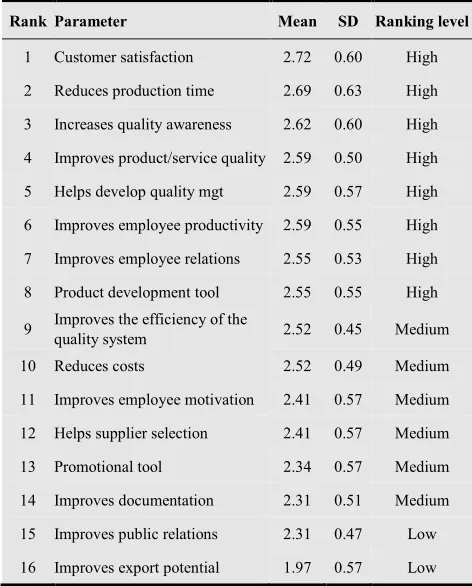
Table 08: Perceived benefits from implementing ISO 9001: 2008 quality management system in organizations those commenced the system imple-mentation
Rank Parameter Mean SD Ranking level
1 Customer satisfaction 2.72 0.60 High
2 Reduces production time 2.69 0.63 High
3 Increases quality awareness 2.62 0.60 High
4 Improves product/service quality 2.59 0.50 High
5 Helps develop quality mgt 2.59 0.57 High
6 Improves employee productivity 2.59 0.55 High
7 Improves employee relations 2.55 0.53 High
8 Product development tool 2.55 0.55 High
9 Improves the efficiency of the
quality system 2.52 0.45 Medium
10 Reduces costs 2.52 0.49 Medium
11 Improves employee motivation 2.41 0.57 Medium
12 Helps supplier selection 2.41 0.57 Medium
13 Promotional tool 2.34 0.57 Medium
14 Improves documentation 2.31 0.51 Medium
15 Improves public relations 2.31 0.47 Low
16 Improves export potential 1.97 0.57 Low
Accordingly, the most important perceived benefits in implementing ISO 9001: 2008 quality management system in the organizations already commenced the system certifi-cations is given below.
5. Conclusion
As far as the Sri Lankan situation is concerned 44 per-cent of the surveyed organizations were certified for ISO 9001: 2008 quality management systems, whereas 40 per-cent of the surveyed organizations were interested for ISO 9001 and already commenced the system certification to implement quality management system within the organi-zations, which is fairly good rate in terms of ensuring qual-ity within the Sri Lankan organizations.
As per the impact surveys carried out by United Nations Industrial Development Organization in year 2009, and as per the ISO survey 678 companies inclusive of all sectors were certified for ISO 9001 quality management system by the end of year December, 2009. This shows the interest and higher managerial perception towards ensuring quality management system within Sri Lankan organizations.
According to the current study, the perception towards the ISO 9001: 2008 perception between certified organiza-tions and companies those commenced the management system implementation are different, although it is statisti-cally insignificant as per the Mann Whitney U test. The loading plot for factor analysis clearly depicts the differ-ences of parameters analyzed between two groups. For in-stance the main purpose of the certified organizations was to establish a consistent documentation system whereas organizations those commenced the system implementa-tion’s purpose is to provide guaranteeing high grade prod-ucts / services. The survey done by Magd and Curry (2003) concluded that the main purpose of understanding ISO 9001 certification was to establish consistent docu-mentation system within Egyptian companies. However it could be confirmed that the certified organizations of Sri Lanka, require establishing a consistent documentation system, in contrast to organizations already commenced system implementation (proceeding organizations for Qual-ity Management System).
As far as the motivational factors seeking for ISO 9001 certifications are concerned, the main contributory factors for both groups for seeking ISO 9001 certification was to achieve quality improvement. However it has been identi-fied that there are some differences between perceptions of seeking ISO 9001 between two groups as per the loading plot of factor analysis based on principle component analy-sis. Moreover the ISO 9001: 2008 certified organizations seeking certifications as one of their corporate objectives, and both groups are seeking ISO 9001 certifications to market products / services in the international arena. Whe-reas the companies certified for ISO 9001 seeking certifica-tions to achieve cost reduccertifica-tions, on the other hand other group (proceeding organizations/ organizations already commenced system implementation) do not consider factor J (to achieve cost reduction). Therefore this factor could be used as a tool to promote continuous quality improve-ment such as six sigma in the long run. On the other hand organizations those commenced the system implementation, were concerned about highly correlated factors (Factor E =
To comply with customers’ requirements, H= To use ISO as a marketing / promotional tool, C= To maintain/ increase market share)
This study being one of the first attempt to investigate the management attitudes towards ISO 9001 international standard in Sri Lankan companies, have concluded that there is a positive attitude towards ISO 9001: 2008 quality management systems, both certified companies and organ-izations those commenced the system implementations to be certified for ISO 9001: 2008, for understanding the pur-poses, seeking for ISO 9001: 2008 quality management system certification and had perceived benefits of imple-menting quality management systems within their organi-zations irrespective of their sector and type of the organiza-tions.
Implementation of ISO 9001: 2008 is a tool for under-standing products and processes, however by itself will not solve existing problems or guarantee quality. Therefore, in order to achieve the true commercial values associated with it, it should be made consistent with organization’s strateg-ic decisions. This refers to using the standard as a founda-tion for a much broader system such as total quality man-agement. Furthermore organizations certified for ISO 9001: 2008 could more focus on the continuous quality improve-ment in order to serve the patrons in different and delightful manner in the long run.
The credibility of the ISO 9001: 2008 certificate is cru-cial in today’s context as many certification bodies are profit oriented and focusing on the business, hence pos-sessing of a ISO 9001: 2008 certificate will not always guarantee effective implementation and continual im-provements in the system. This could be a one of the major limitations of the study. Since there are more certification bodies exist in Sri Lanka including, national, multinational and local certification bodies, it is vital to investigate the credibility of accredited ISO 9001: 2008 certification of-fered by each certification bodies. Therefore future research areas shall focus on credibility, efficiency and effectiveness of issuing ISO 9001: 2008 quality management systems certifications by established certification bodies in Sri Lanka
References
[1] Buttle, F. (1997), “ISO 9000: marketing motivations and-benefits”, International Journal of Quality &Reliability Management, Vol. 14 No. 9, pp. 936-47
[2] Casadesus, M., Heras, I. and Ochao, C. (2000), “The bene-fits of the implementation of the ISO 9000 normative: em-pirical research in the Spanish companies”, paper present at the 1st World Conference on Production and Operations Management (POM), Sevilla
[4] Dissanayaka, S.M., Kumaraswamy, M.M., Karim, K. and Marosszeky, M. (2001), “Evaluatingoutcomes from ISO 9000 certified quality systems of Hong Kong constructors”, TotalQuality Management, Vol. 12 No. 1, pp. 29-40 [5] Dreyfus, P., Gulbro, D.R. and Shonesy, L. (1999), “Quality
in manufacturing: does size really make a difference?” [6] Escanciano, C., Ferna´ ndez, E. and Va´ zquez, C. (2001),
“Influence of ISO 9000 certification on the progress of Spanish industry towards TQM”,International Journal of Quality & ReliabilityManagement, Vol. 18 No. 5, pp. 481-94
[7] Lee, P.K.C., To, W.M. and Yu, B.T.W. (2009), “The im-plementation and performance outcomes of ISO 9000 in service organizations. An empirical taxonomy”, Internation-al JournInternation-al of QuInternation-ality & Reliability Management, Vol. 26 No. 7, pp. 646-62.
[8] Magd, H., and Curry, A., (2003), An empirical analysis of management attitudes towards ISO 9001:2000 in Egypt",
The TQM Magazine, Vol. 15 Iss: 6 pp. 381 – 390
[9] Nanayakkara, G. (1992),Can Sri Lankans Take the Quality Challenge? A Cultural Analysis , Postgraduate Institute of Management, Colombo.
[10] Pheng, S.L. (2001), “Towards TQM – integrating Japanese 5-S principles with ISO 9001:2000 requirements”, The TQM Magazine , Vol. 13 No. 5, pp. 334-40
[11] Samarathunga, R. and Bennington, L. (2002), “New public management: challenge for Sri Lanka”, Asian Journal of Public Administration , Vol. 24 No. 1, pp. 87-109.