COMPUTER SCIENCE & TECHNOLOGY
www.computerscijournal.org
March 2013, Vol. 6, No. (1): Pgs. 17-29 An International Open Free Access, Peer Reviewed Research Journal
Published By: Oriental Scientific Publishing Co., India.
Methods and Techniques for the Intrusion finding in MANET
MUKHTAR AHMAD, FAHEEM KHAN, SOHAIB AHMAD,
SHAZIA NAEEM, M.N.KHALID and SHEHZAD RIZWAN
Islamia College University Peshawar, KPK Pakistan. Gandahara University Peshawar, KPK Pakistan.
Agriculture University Peshawar, KPK Pakistan.
(Received: February 16, 2013; Accepted: February 26, 2013)
ABSTRACT
In this paper, we are showing two Intrusion Detection Techniques for MANET as we know that Data accessibility in a MANETs is influenced by Mobility and Power constrain of the Servers and Clients, and the data in MANETSs be replicated.In this paper we exercise two methods for transferring of Communication among the Nodes. The first method is planned for finding of malevolent Nodes in a Neighborhood of Nodes in which each pair of Nodes in the Neighborhood are contained by the Radio range within Each other.. The next method is to planned for the exposure of malevolent Nodes in a Neighborhood of Nodes, where every pair of Nodes will not be in the Radio range of one another but a Node among them having all the other Nodes in its one count range or one-hop vicinity. In this paper we exercise Intrusion Detection System(IDS) for finding Malevolent Node and the two method known as Clique and Cluster as shown in[8]. To Summarize, it can be seen from ADCLI Algorithm indeed Detects the Malevolent Nodes effectively with a towering proportion of accurateness when at most k malevolent Nodes are present in a set of n (n ³ 4k + 1) Nodes, Even when there is a practical proportion of Packet collision (Message destruction). Moreover, standard false Detection is also minimum in such a situation. on the other hand for the situations where more than k malevolent Nodes are present, the result might be volatile. The proof of accuracy show that the Algorithm functions properly at all times for a consistent channel. In situation of the ADCLU Algorithm, Algorithm functions well Even in an unpredictable channel where the proportion of collision is around 5 %. The two methods known as Clique and Cluster as shown in [8].In these methods a Node call the Monitor Node commences the discovering procedure. Depend on the Communications, which is accepted through the Detection course of action, every Node decides the Nodes it believes to be malevolent and drive a Message to the Monitor Node. The Monitor Node ahead examining the Message to decide the malevolent Nodes among the Suspected Nodes. In this paper, we are showing two Intrusion Detection Techniques for MANET.The first method is planned for finding of malevolent Nodes in a Neighborhood of Nodes zzzzin which each pair of Nodes in the Neighborhood are contained by the Radio range within Each other. This kind of Nodes in the Neighborhood is called a Clique8. The next method is
to planned for the exposure of malevolent Nodes in a Neighborhood of Nodes, where every pair of Nodes will not be in the Radio range of one another but a Node among them having all the other Nodes in its one count range or one-hop vicinity. Such Neighborhood is alike to a Cluster as shown in8. The above two methods exercise Communication transferring among the Nodes. A Node call
the Monitor Node commences the discovering procedure. Depend on the Communications, which is accepted through the Detection course of action, every Node decides the Nodes it believes to be malevolent and drive a Message to the Monitor Node. The Monitor Node ahead examining the Message to decide the malevolent Nodes among the Suspected Nodes.
INTRODUCTION
As Data accessibility in a MANETs is influenced by Mobility and Power constrain of the Servers and Clients, Data in MANETSs be replicated. The IEEE 802 Standards is devoted to the structure of MANs and LANs. Eminent component of this grouping are the IEEE 802.3 and now almost over and done 802.5 however the majority of the rising Standards in this family arrangement with Networking over the Wireless medium1.
The 802.15, of which Blue tooth is part of, are planned to communicate private procedure over a small area Wireless personal area network [WPAN]. For the making of the Wireless corresponding of a LAN (i.e. a Wireless Local Area Network or WLAN), the IEEE planned the 8o2.11 standard; while the 802.16 (WImax) take in hand the difficulty of city area Network or Wireless Metropolitan area Network [WMAN]. Those 3 Standards have in familiar the detail, which they are powerfully support on some type of communcation.In a (WPAN)a master device focuses the entire interchange. For a WLAN, the access point shows a vital task, by relay the entire traffics among contributing Wireless.
Moreover, finally, WImax is as well Communication bound. Its central Nodes is a controlling and practical base station. Although still simple to organize when evaluate to there wired equivalent item, those equipment are not practical in situation where no Communication at all is accessible. E.g. is a tragedy region where a normal disaster or fanatic bother entirely damaged some Communication. Although here is a great deal of more frequent situation wherever Communication-open Network be desirable. The rising and cost-effectively test area wherever no reserves survive to put together or preserve a operational Communication. A no Communication or Ad-hoc Network may be the influential digital addition device desirable to lessen deficiency by way of expanding RIGHT to use to Information and learning stuffing. An Ad-hoc Network is a self-forming, self-configuring Network, which allots some Communication, Even an access point. In such a Network a Nodes is capable to correspond
with several additional Nodes inside collection and as well by Nodes out of instantaneous Radio range. To execute the later, an Ad-hoc Network depends on the Nodes to communicate traffics for benefit of other Nodes. an additional significant class of Multihopes Nodes Network functions is in general call Mesh Network functions. In a Mesh Network functions a few of the Nodes are devoted to the advance of traffics of the other Nodes form a Nodes backhaul, which might be, Measures its communication2, And an explanation of the Routing Protocols and M Characteristically use is able to be establishing in3. The 1st Multihopes Wireless Network functions used layer 3 method to communicate Packet starting the resource to the target and Even though Network layer implementing are still Common in Ad –hoc Network functions, there are current pains to include the lost Multihope abilities in 3 abovementioned IEEE Wireless tools. This lecture show the suggestion of a Mesh Network functions with 8o2.11 devices - a goal being follow through the IEEE 8o2.11 Task Group “s”, namely IEEE 8o2.11s 4-6. It is become aware of which for this IEEE task group the expressions Mesh and ad hoc are exchangeable. The major help of this tutorial are a thorough explanation of a Number of secrete of the upcoming standard and a STEP by-STEP study of genuine Multihope MAC traffics, in addition to the importance of pros and cons of the layer 2 over the layer 3 approaches to the Wireless Multihopes Network functions7.
The paper is prearranged as follows
In Section 2 we talk about The Algorithms on Intrusion of every fixed Infrastructure or a central scheming authority. In this scheme of work, a movable Node performs as a host as well as a router.
In Section 3, we explain our planned Intrusion Detection Algorithms by the side with the suppositions. We also are showing the Algorithms properly in this section. It is pursued by the confirmation of precision for the first Algorithm.
The Algorithms
Here we suggest the two Algorithms for Detection of malevolent Nodes in a MANET. By a malevolent Node, we mean a Node, which does not pursue predictable performance. A malevolent Node may attempt to start a Number of Attacks as declared in the earlier section. a large amount of such Attacks are attained by changing a Message by Forwarding or only not Forwarding an information, which it is believed to be promoted. While increasing equally our Algorithms, we have understood that a malevolent Node will show these two characters throughout its lifetime.
We attempt to sense this unpredicted performance and finally fix the malevolent Nodes demonstrating such characteristics. The ADCLI and ADCLU Algorithms can be exercised in diverse Cliques (Clusters). All Clique (Cluster) will approach with Information as regards the malevolent Nodes, if there are any malevolent Nodes. It can then utilize this Information for separating these malevolent Nodes from itself. More, this Information might be transmitting to other Cliques (Clusters), so that they know how to separate the malevolent Nodes from themselves. In other words, Information concerning the malevolent Nodes might be used in Routing assessments. The Node that begins the ADCLI (ADCLU) Algorithm is mentioned as Monitor Node. There is a Number of Algorithms for grouping the Nodes in a MANET into Clusters (Cliques are known as 1-hop Clusters), which are identified as Clustering Algorithms. These Algorithms particularly allocate a Node in a as the Cluster head. Two Examples of these Clustering Algorithms are [9,10]. Clustering is usually finished for hierarchical Routing. MANET in which Clustering is already being completed for Routing reasons; our Algorithms can be performing on the showed Clusters with the Cluster heads as the Monitor Nodes. Even or else, any showed Clustering Algorithm can at the start be functional to separate the Network into Clusters, and then, our Algorithms can be used on those Clusters with the Cluster head as the Monitor Nodes. If a Monitor Node remains the Monitor Node for a extensive time, its battery power might get used up more quickly than that of the other components of the Cluster as of the
overhead of being the Monitor Node. This can be well in use by utilizing Clustering Algorithms, which selects a new Cluster head with the passage of time depending on power utilization, etc. among the members as a outcome there will be a balance in the energy levels of all the Nodes in the Cluster. Such Algorithm is planned in [9]. Our Algorithms sense malevolent Nodes in a Clique or a Cluster at a exacting instant of time. Though, it will be damaging to punish a Node only depending on its act at one point of point, taking into concern our showed faulty Network functions, which experience from Packet conflicts and as a outcome a high traffic make a congestion, etc. So, our Algorithms might be run at random all through the lifetime of the Network. And the performance of a Node might be seen for a past mentioned period of time, before any penalty be meted out. This will also assist Nodes who had previous malevolent reports to proper themselves and be acknowledged once more into the Network. In addition, in situation there is a congestion, as of which a Node might be dropping Packets, the Algorithm will not operate appropriately and so, it might be terminated assume a method is there to sense congestion in the Network.
The ADCLI Algorithm
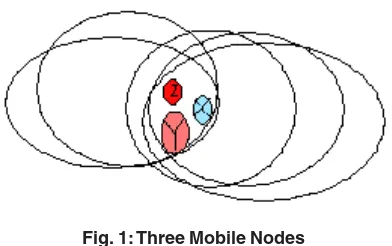
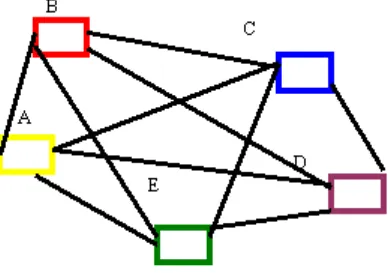
This Algorithm is able to be utilizing to sense malevolent Nodes in a set such that every pair of Nodes in the set is inside the Radio range of Each other (Fig. 1). This set of Nodes is generally known as a Clique. Two Nodes within Radio range of one another might be representing by an edge among the Nodes.
An Example of a set of Nodes in a MANET characterize, therefore is given in Fig. 2.
To show the Algorithm we compose the subsequent statement: one time a Communication is established by a malevolent Node, it Forwards incorrect information’s to at least half of the other Nodes. With no failure of generality we as well suppose that the Initiating Node of this Algorithm i.e., the Node is not malevolent and when the Monitor Node begins the Detection procedure by distribution out a information to the other Nodes, the malevolent Nodes have no way of knowing that a Detection Algorithm is in development. This supposition is necessary as, if a malevolent Node is capable to sense that a Detection Algorithm has been initiated, it might attempt to perform non-malevolently and attempt to circumvent Detection. A malevolent Node in nearly all possibility will not attempt to initiate the Algorithm as it may in any situation exceed incorrect Information to other Nodes Even with no any Intrusion Detection System. We at the moment show the Intrusion Detection Algorithm
That be capable of Detect at the majority k malevolent Nodes in a set of n Nodes, that are inside Radio range of one another where n³ 4k +1.
STEP1
The Monitor Node, M drive the Messages RIGHT to the other n _ 1 Nodes inquire them to Forward the information in turn to the other n _ 2 Nodes.
STEP2
On getting the Messages RIGHT, Node I (for each i such that Node i¹Monitor Node), transmit the information to the other n _ 2 Nodes (Here a malevolent Node might either reject
to Forward the Information or Forward a Information other than the Messages RIGHT, which it acknowledged in STEP 1).
STEP3
The Monitor Node then transmit a MALEVOLENT-VOTE-REQUEST Message to all the other n _ 1 Nodes.
STEP 4
On receipt of
M A L E V O L E N T- V O T E - R E Q U E S T Message from the Monitor Node, Each of the n _ 1 Nodes do the follow: For Each i and j (j ≠ i), let Mj Be the Message Node i acknowledged from Node j in STEP 2 (if Node i does not accept any Message from j or if it accepts a Message different from RIGHT, Mj is allocated default
Message WRONG). If M ≠ RIGHT, mark the Node j as a Suspected Node and transmit Node j to the monitor node (that is., a vote for Node j being a Suspected Node is transmit to the Monitor Node.)
STEP 5
The monitor node will act as follow by accepting of the vote in STEP 4.
i. Accept a maximum of k distinct Votes from Each of the Nodes.
ii. Mark the Nodes, (D1, D2... D) With at least k + 1 Votes as malevolent Nodes.
Let m be the Number of malevolent Nodes. iii. If the amount of identify Nodes is more than k (i.e., m > k), Detection procedure has unsuccessful (When Detection be unsuccessful, it means that there were more than k malevolent Nodes).
STEP 1 is use to transmit the Message employ for Detection by the Monitor Node. In STEP 2, if a Node is not malevolent, it will loyally forward the Message, RIGHT. However if a Node is malevolent, it might perform malevolently and do also of the subsequent
Fig. 2: A set of Nodes in a MANET (a Clique): an edge between two Nodes denotes they
Situation (a)
Not Forward the Message at all to some or all of the n _ 2 Nodes.
Situation (b)
Transform the Message and transmit the modiûed Message to some or all of the n _ 2 Nodes. In STEP 3, after waiting for STEP 2 to be concluded, the Monitor Node transmits a MALEVOLENT-VOTE-REQUEST Message requesting the other n _ 1 Nodes to transmit in Information (Votes) about Nodes, which they suspect as malevolent. The supposition is that awaiting a Node accepts this Vote demand Message from the Monitor Node; it has no thought that a Detection Algorithm is in improvement. With the passage of time a malevolent Node accepts this Message, it has already acted malevolently in STEP 2 demonstrating its malevolent ness, and it cannot run away Detection. This supposition is suitable and can be guaranteed by using a method such as building the Message transmit by the Monitor Node in STEP 1 (i.e., RIGHT) appear similar to a usual Packet, so that no Node will suspect it. on the other hand, this Packet be supposed to not be of an significant Packet type, that may lead to precautions troubles. A Node is therefore deceived and believes that the Monitor Node (the Monitor Node is like any regular Node) has applied for it to forward some Message to the other Nodes. In STEP 4, the n _ 1 Nodes transmit Information about Suspected Nodes to the Monitor Node. Suspected Nodes are those Nodes that performed Malevolently. At this point we describe such Nodes Suspected Nodes and not malevolent (or Detected) Nodes because some Suspected Nodes might not in reality be malevolent. This condition can happen in the situation when a malevolent Node deceit concerning some other Nodes and transmit these Nodes as Suspected Nodes to the Monitor Node. (Keep in mind that a malevolent Node cannot be reliance to perform non-malevolently at any situation.)
In STEP 5, the Monitor Node calculates the Votes to finally the Detected Nodes. The Algorithm can detect at the majority k malevolent Nodes. If there are additional, the Detection process is said to have unsuccessful.
Descriptive Examples:
To realize how this Algorithm mechanism, we believe the situation when there are 5 Nodes out of which one Node is malicious, that is k =1, n =5.
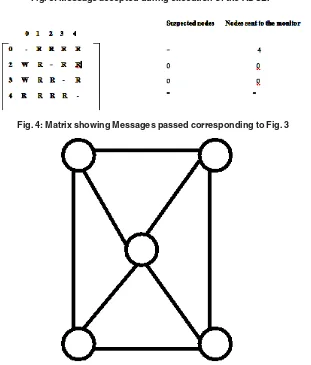
Fig. 3 demonstrates the Message approved among the Nodes through the first two STEPS of the ADCLI Algorithm. Node 0 is the malevolent Node and Node 1 is the Monitor Node. In STEP 1, Node 1 transmits out a Message RIGHT (symbolized by solid lines label R), to the other four Nodes 0, 2, 3 and 4. In STEP 2, all of these four Nodes in turn communicate the Message to the other three Nodes. Nodes 2, 3, and 4 being non-malevolent communicate the Message RIGHT (symbolized by dashed lines reshow R), to other Nodes. Node 0 being malevolent communicates Message WRONG (symbolized by dotted lines reshow W), to Nodes 2 and 3, whereas it transmits Message RIGHT to Node 4.
Fig. 4 demonstrate the Message acknowledged by the n _ 1 Nodes throughout STEP 1 and
Situation (a)
The single malevolent Node0 transmits no Vote to the Monitor Node:
In this situation, the Monitor Node in STEP5 will accept the Votes: (0, 0). Hence it will Detect Node 0 as the malevolent Node as it accepts at least k + 1 Votes.
Situation (b)
The single malevolent Node 0 transmits malevolently at most k Votes of non- malevolent Node(s) to the Monitor Node
more than one malevolent Node collude with Each other is illustrated progress as in the situation of the ADCLI Algorithm. We now show the ADCLU Intrusion Detection Algorithm.
The ADCLU Algorithm
We use the ADCLU for the set of Nodes to Detect the malevolent Nodes, these set of Nodes form a Clusters which are make clear as a Neighborhood of Nodes in which there are a Node which have all his other Nodes as its 1- hop Neighbor, (Fig. 5). Unlike in a Clique, here all pair of Node will not be within the wireless connection among the Nodes are bi-directional. When the Monitor Node starts the Detection method, the malevolent Nodes having no idea of knowing that Detection is in
STEP 1
The Monitor Node, M Broadcasts the Message RIGHT to its Neighbor Nodes inquiring them to promote broadcast the Message in their Neighborhood. M ® Broadcast: (RIGHT)
STEP 2
On accepting the Message RIGHT, Each Neighbor, B of M more Broadcast the Message in its Neighborhood B → Broadcast: (X) (X = RIGHT if B is not malevolent, X ≠ RIGHT if B is malevolent)
STEP 3
The Monitor Node, M then Broadcasts a MALEVOLENT-VOTE-REQUEST Message in its Neighborhood. M → Broadcast: (MALEVOLENT-VOTE-REQUEST)
STEP 4
On accepting of a MALEVOLENT-VOTE-REQUEST Message from M, Each Neighbor of M does the following: Let PA is the Message Node B accepted from Node A
In STEP 2 (if Node B does not B any Message from A or if it accepts a Message dissimilar from RIGHT, PA is allocated default Message WRONG.). If PA ≠ RIGHT, then B transmits a Vote for Node A being a Suspected Node to M. B → M: (VOTE; A)
STEP 5
The monitor node will acts as follow by the receipt of the votes in STEP4.
´ Accept just distinct Votes from Each of the Nodes (By distinct Votes, we mean that the Monitor Node can accept at most one Vote concerning a Suspected Node from any Node).
´ Let NA be the Number of Votes accepted for Node A. If NA³ k, mark Node A as malevolent. (The Monitor Node also gives its Vote. k is the Threshold Value.).The basic dissimilarity among the ADCLI Algorithm and the ADCLU Algorithm is that the ADCLI Algorithm use Unicast for Message transferring, where the ADCLU Algorithm use Broadcast for Message transferring. In this Algorithm the Monitor Node sets an ensnare by Transmitting a junk Message which a malevolent Node (say m) may fall or Forward after changing it to its Neighbors. When it do that, the Neighbors of m, which are also Neighbors of the Monitor Node come to suspect that Node. The Neighbors to the Monitor then report the distinctiveness of this Suspected Node, which in turn later than calculate the number of such information finally senses the malevolent Nodes. In this view a Threshold Value (k) is sustained by the Monitor Node, such that the Monitor marks a Suspected Node in reality malevolent Node if it accepts negative information from at least k of its Neighbors. The Value of k relies on the Number of Neighbors a Node can have in the Network and also we are using a strict or a lenient Detection Measures. An elevated Value of k will indicate that a strict Measures (require more Votes for Detection) has been used and a small Value will mean a lenient Measures (requiring less Votes for Detection) has been used in the Detection process.
Descriptive Examples
In STEP 1, Node 1 Broadcasts a Message
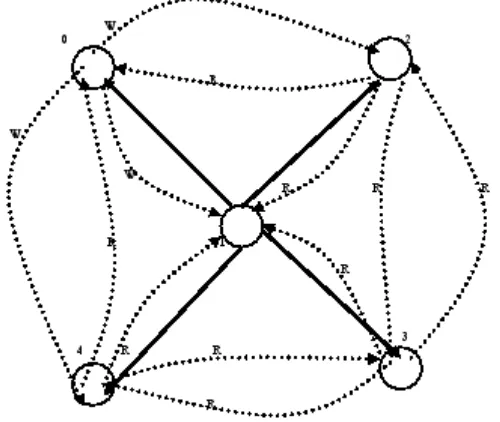
RIGHT (represent by solid lines labeled R), to its four Neighbor Nodes 0, 2, 3 and 4. In STEP 2, each of these four Nodes in reply broadcasts the Message to its Neighbor Nodes. Nodes 2, 3, and 4 being non-malevolent Broadcasts the Message RIGHT (represent by dashed lines labeled R), to its Neighbor Nodes. Node 0 being malevolent broadcasts the Message WRONG (represent by dotted lines labeled W), to its Neighbor Nodes, 1, 2 and 4. Fig. 7 show the Messages accepted by Each Node through STEP 1 and STEP 2 of the Algorithm, and the Votes sent by them in reply to the MALEVOLENT-VOTE-REQUEST Message sent out at STEP 3. As for Example, The first row of the matrix indicates that Node 0 Accepted Messages (R, R, R) from Nodes 1, 2 and 4 correspondingly. Correspondingly, the second row indicates that Node 2 accepted Messages (W, R, R) from Nodes 0, 1 and 3 correspondingly. In STEP 3 of the Algorithm, the Monitor Node 1 Broadcasts a MALEVOLENT -VOTE-REQUEST Message to all its Neighbor Nodes. In reply to that Nodes 2 and Node 4 in STEP 4 transmit one Vote Each of Node 0 to the Monitor Node because it accepted a WRONG Message from Node 0. In STEP 5, the Monitor Node count up the Votes it accepted for Each Neighbor. Here accepted 2 Votes for Node 0 (from Node 2 and Node 4) and adding its own 1 Vote for Node 0, and so the count is 3 votes for Node 0. The Value of k is 2, and since the count is larger than the Value of k, Node 0 is detected as malevolent.
Threshold Value setting
As we know, the efficiency of the ADCLU
Algorithm hinges on the Threshold Value k. therefore the Value of k has to be set wisely. Excessively high Value of k will guide to the Algorithm being very strict and therefore might effect in malevolent Nodes continue unnoticed. Alternatively, very low a Value of k will result in the Algorithm ending up Detection Nodes, which are not malevolent as malevolent The Threshold Value, k can be set repeatedly by the Monitor Node assumes that it distinguishes the topology of its Cluster. This can be achieved by asking for the Neighbor tables from its member Nodes with the passage of time. Assume a reliable Communicationbetween any two Neighbor Nodes;
the Value of k can be set such that the Algorithm Even take care of Colluding Nodes. Colluding Nodes are those Nodes who have approved with Each other not to inform (transmit Vote) about Each other to the Monitor Node. We suppose only malevolent Nodes can be Colluding Nodes. We also suppose that Colluding Nodes may go one STEP more in performing malevolently and consent on to transmit Votes about a non-malevolent Node to the Monitor Node, therefore increasing it. Let the least Number of Neighbors in the Cluster any member Node can have be nominated by d. Let c be the expected number of Colluding Nodes. We believe two situations:
Case (a)
No Colluding Nodes are present. Then, k = d. In this situation, in situation (a) Node is malevolent, all its Neighbor Nodes (whose count will be ³d) will report to (Transmit Vote about it) the Monitor Node. Consequently, it will be detected.
Case (b)
Colluding Nodes are present and it is estimated that there are c of them. Then, k = d _ (c _ 1), when k > c. Say, a Node is malevolent and also it Colludes with other malevolent Nodes. Assume Colluding Nodes are Neighbors of Each other; c _ 1 is the Number of Votes that might not be informed by its Colluding Neighbors. Therefore, the Algorithm has to try to Detect from Votes added by other Non-Colluding Neighbors. This Value of k functions only when k > c. This situation is necessary so as to take care of the situation when the Colluding Nodes try to incriminate a non-malevolent Node. For Example, in a Cluster where d = 3 and c =2, k will be set to 2, i.e., the Monitor Node necessitates a minimum of 2 Votes for a Node to be Detected as malevolent. Assume that the two Colluding Nodes transmit a Vote Each about a non-malevolent Node to the Monitor Node, it will unfortunately be Detected as malevolent as it accumulated Number of Votes equal to k. therefore the above appearances for k also gives an higher bound on the Number of Colluding Nodes that can be effectively taken care of.
Proof of accuracy for the ADCLI Algorithm Theorem
Fig. 3: Message accepted during execution of the ADCLI
Fig. 4: Matrix showing Messages passed corresponding to Fig. 3
the range of each other, where k (k > 0) malevolent Nodes, the Algorithm effectively senses the malevolent Nodes if n ³ 4k + 1.
Proof
Here a situation may arise.
Case (a)
k malevolent Nodes are there.
In STEP 4 of the ADCLI Algorithm, a Node i mark Node j as a Suspected Node if it accepts from Node j a Message M¹ RIGHT. That is Node j pass on a Message that is not initially transmit by the Monitor Node (The initial Message (i.e., RIGHT) was transmit to the Node by the Monitor Node in STEP 1). As we have previously understood that the Monitor Node is not malevolent, the k malevolent Nodes are among the other n _ 1 Nodes. These k malevolent Nodes Forward Messages other than RIGHT to at least half of the other n _ 2 Nodes, i.e., (n _ 2)/2e Nodes. Here we enter at two situations.
Scenario I: The k malevolent Nodes Forward
Messages other than RIGHT only to non-malevolent Nodes (From the receiver viewpoint, a malevolent Node not Forwarding the Message RIGHT is equal to Forwarding the Message WRONG). This situation is shown in Figs. 3 and 4 for k =1and n = 5. As per our supposition, each of the k malevolent Nodes transmits out at least (n _ 2)/2e many Number of WRONG Messages to non-malevolent Nodes. So the non-non-malevolent Nodes will be capable to cooperatively suspect each malevolent Node at least (n _ 2)/2e times. In other words, there will be at least d(n _ 2)/2e numerous Votes for Each of the k malevolent Nodes at the Monitor Node. As for Example in Fig. 4, the non-malevolent Node 2 and Node 3 transmit a Vote Each say that Node 0 is suspected. Therefore, together the Monitor Node Accepts 2 Votes for Node 0 that it is suspected to be malevolent. Alternatively, the malevolent Nodes also might try to transmit some Votes malevolently to the Monitor Node. In Fig. 4 e.g., the malevolent Node 0 transmits Node 4 as a Suspected Node to the Monitor Node. At nearly all k the Monitor Node still if accepted as per our supposition suppose such Votes from malevolent Nodes. Therefore for every malevolent
Node, let x be the Number of Votes (saying that it is a Suspected Node) transmit by the non-malevolent Nodes to the Monitor Node. Therefore, x ≥ (n _ 2)/ 2e. For any non-malevolent Node, let y be the maximum Number of Votes (saying that it is a Suspected Node) that can be transmits by the malevolent Nodes malevolently to the Monitor Node. We see that y = k (when all of k malevolent Nodes make a decision to Vote it as a Suspected Node). As n ≥ 4k + 1, it is simple to wrap up that x > y. In STEP 5, we see that only the Suspected Nodes with at least k + 1 Votes are Detected as malevolent. Therefore, only the real malevolent Nodes, which have x numerous Votes every will be Detected since x > k. For any non-malevolent Node Wrongly Suspected by a malevolent Node, every will have a greatest of k Votes and so, will not be Detected. Furthermore for the situation when less than k malevolent Nodes are present the Algorithm workings properly. Suppose j where (j < k) be the Number of malevolent Nodes present. In this situation also, the Number of Votes transmit to the Monitor Node for Each malevolent Node will be at least (n _ 2)/2e, that is larger than k, where the utmost Number of Votes that can be transmit to the Monitor Node for a non-malevolent Node malevolently Suspected by the malevolent Nodes is only j (all malevolent Nodes make a decision to transmit a Vote for a non-malevolent Node). And j < k. therefore, only the definite malevolent Nodes will be Detected as they only will have Votes ≥k +1.
Techniqal Background
The subsequent are some of the planned Techniques for Intrusion Detection in MANET set up in the literature.
Fig. 6: Messages accepted during execution of the ADCLU Algorithm for a Neighborhood of 5 Nodes; Node 0 is malevolent; Node 1 is the Monitor Node
Fig. 7: Matrix showing messages received corresponding to Fig. 6
to the Path-rater. Examples of malevolent actions can be dropping a Packet or adjust its contents before Forwarding. Path-rater is also a section consecutively on every Node, which sustains performance ratings for every Node in the Network. These ratings are use as Metrics at the same time as selecting a path for data Broadcast.
Watchdog has some observable drawbacks such as Watchdog can be trick by two Neighbors Colluding mutually and the other being a need for Each Node to accumulate the transmitted Packets until they are forwarded by its Neighbor on the path12.
Detection System depends on irregular actions of Neighboring Nodes15. Each Node Monitors fastidious traffic action inside its Radio range. All in the neighborhood Detected Intrusions are preserved in an audit log. Once local audit data is composed, it can be practiced by means of some Algorithm to Detect ongoing Attacks from the composed data.
Zhang and Lee16 observed the exposing of a WANET, the need for Intrusion Detection to supplement safe Routing methods, and the explanation why Detection Techniques accessible for the wired surroundings are not appropriate straightforwardly in a wireless environment. They as well planned an Intrusion Detection System, which is both supportive and dispersed. Zhang et al.17 developed Architecture for Intrusion Detection, which is supportive and dispersed. They also offered how using a classifier, which is qualified using normal data to determine what is generally the next happening given the earlier succession of actions, could complete inconsistency Detection. Divergence from the predicted result will mean that there is an Intrusion.
Anantvalee and Wu19 widely review on various Intrusion Detection methods and also give a evaluation among these Techniques. Albers et al.,19 gave IDS Architecture with the use of movable Agent, which is both supportive and dispersed. A Local Intrusion Detection System (LIDS) sit on Each Node, which Detects Intrusion in the neighborhood. on the other hand, a LIDS can collaborate with other LIDS for worldwide Detection. Intrusion Detection System, which is both supportive and dispersed. Zhang et al.,17 developed Architecture for Intrusion Detection, which is supportive and dispersed. They also offered how using a classifier, which is qualified using normal data to determine what is generally the next happening given the earlier succession of actions, could complete inconsistency Detection. Divergence from the predicted result will mean that there is an Intrusion.
Anantvalee and Wu19 widely review on various Intrusion Detection methods and also give a evaluation among these Techniques. Albers et al.19 gave IDS Architecture with the use of movable
Agent, which is both supportive and dispersed. A Local Intrusion Detection System (LIDS) sit on Each Node, which Detects Intrusion in the neighborhood. on the other hand, a LIDS can collaborate with other LIDS for worldwide Detection.
Kachirski and Guha20 also used Mobile Agent to develop a multisensor Intrusion Detection System. The System consists of three major Agents: Monitoring Agent, action Agent and decision Agent, every taking concern of functionality thus allocates the workload. Monitoring Agent is of two types: the Network Monitoring Agent and the host-depends Monitoring Agent. The action Agent sits on every Node and takes concern of initiating a reply after an inconsistency is detected. The Network is rationally divided into Clusters, Each with a Cluster head. The Network Monitoring Agent and the Detection Agent are run on the Cluster head. The Network Monitoring Agent captures and Monitors Packets passing all the way through the Network inside its Radio range.
When the local Detection cannot compose a choice on its own, it inform to the decision Agent, that uses the Packet-Monitoring results that comes from the Network-Monitoring Agent to make a decision whether it is malevolent or not.
Buchegger and LeBoudec21 planned the CONFIDANT (Cooperation of Nodes, Fairness in Dynamic Ad-hoc Netfunctions) Protocol, which makes misconduct unappealing. This Protocol is similar to Watchdog and Path rater. Though, apart from Monitoring malevolent performance inside its radio range as in Watchdog, a Node also process data from reliance Nodes to detect a bad Node. When a Node wrap up from its explanation that one more Node is malevolent, it informs the route manager, Fig. 6. Messages accepted during execution of the ADCLU Algorithm for a Neighborhood of 5 Nodes; Node 0 is malevolent; Node 1 is the Monitor Node.
Bansal and Baker22 Projected OCEAN (observation depends cooperation enhancement in ad-hoc network), an expansion to the DSR Protocol. It as well use a Monitoring System and a reputation System as in the above methods. The differentiation of OCEAN from the other Protocols that use mutually these Systems is that it depends only on its personal interpretation. This avoids unnecessary conclusion that may result from fake allegations. The Algorithms planned in this paper are depends on variance Detection as in 11,21,23. This is differentiation
from mistreat Detection as projected in13,14. on the other hand, our Algorithms use collaborative efforts of Nodes in the Neighborhood to Detect a malevolent Node. This formulates them more lenient to issues such as Packet collision. The projected Algorithms also acquires care of Colluding Nodes, that find little or not mention in the earlier work. As in14, to move our Algorithms, the Network is separated into Clusters, and the Algorithms can be run in all Clusters, with the Cluster head as the Monitor Node. As much as we identify this is the first work that uses a collaborative Message transmitting methods to Detect malevolent Nodes.
CONCLUSIONS
In this research paper we offered two new Algorithms for Intrusion Detection in MANET. The Algorithms use collaborative efforts from a Collection of Nodes for knowing the malevolent Nodes by voting. Messages are voted for among the Nodes and depending on the Messages accepted, these Nodes make a decision Suspected Nodes (Nodes that are Suspected to be malevolent). These Suspected Nodes (Votes) are ultimately transmitted to the Monitor Node. At the Monitor Node, the Suspected Nodes that accept
at least a Minimum Number of Votes are finally detected as malevolent Nodes. Thus as an alternative of giving the exclusive power to a single Node to make a decision about the malevolent ness of another Node, the Algorithm functions in such a way that a cluster of Nodes jointly make this choice.
The ADCLU Algorithm can be used for cliques As well for Clusters, while ADCLI can be used only for cliques. Equally Algorithms use a Message passing method, however with a little dissimilar approaches. As point out previous, the appropriate setting of the Threshold Value, k is critical for the efficiency of the ADCLU Algorithm. on the other hand, the ADCLI Algorithm is more robust in a logic that its efficiency does not rely on the careful setting of a limitation. The proof of accuracy of the ADCLI Algorithm demonstrate that presumptuous a consistent Communication among Neighbor Nodes, if the Algorithm is run on a clique having n Nodes, such that n ≥ 4k + 1, then at most k malevolent Nodes present in the clique will be effectively Detected.
To Summarize, it can be seen from ADCLI Algorithm indeed Detects the Malevolent Nodes effectively with a towering proportion of accurateness when at most k malevolent Nodes are present in a set of n (n ≥ 4k + 1) Nodes, Even when there is a practical proportion of Packet collision (Message destruction). Moreover, standard false Detection is also minimum in such a situation. on the other hand for the situations where more than k malevolent Nodes are present, the result might be volatile. The proof of accuracy show that the Algorithm functions properly at all times for a consistent channel. In situation of the ADCLU Algorithm, Algorithm functions well Even in an unpredictable channel where the proportion of collision is around 5 %.
REFERENCES
1. H K SONI (2011-03-22). “Ad hoc Network”. DoS attack in MOBILE AD-HOC NETWORK. http://www.yuvakranti.com.
2. TOmas Krag And Sebastian Büettrich (2004-01-24). “Wireless Mesh Networking”.
O’Reilly Wireless Dev Center. http:// www.oreillynet.com/pub/a/Wireless/2004/ 01/22/Wirelessmesh.html. Retrieved 2009-01-20.
hoc_Network
4. M. Frodigh, P. Johansson, and P. Larsson. “Wireless ad hoc networking: the art of networking without network,” Ericsson Review, 4: 248-263 (2000).
5. IETF Working Group: Mobile Adhoc Networks (manet). http://www.ietf.org/ html.charters/manet-charter.html.
6. Ad Hoc Networking Extended Research Project. Online Project. http:// triton.cc.gatech.edu/ubicomp/505.
7. IEEE 802.11 Working Group. http:// www.manta.ieee.org/groups/802/11/ 8. Yi-an Huang, Wenke Lee, A cooperative
intrusion detection system for ad hoc networks, in: Proceedings of the ACM Workshop on Security in Ad Hoc and Sensor Networks (SASN’03), 135–147 (2003). 9. M. Chatterjee, S.K. Das, D. Turgut, WCA: a
weighte clustering algorithm for mobile ad hoc networks, Journal of Cluster Computing (Special Issue on Mobile Ad hoc Networks)
5: 193-204 (2002).
10. P. Krishna, N.H. Vaidya, M. Chatterjee, D.K. Pradhan, A cluster-based approach for routing in dynamic networks,
11. S. Marti, T.J. Giuli, K. Lai, M. Baker, Mitigating routingmisbehavior in a mobile ad-hoc environment, in: Proceedings of the Sixth Annual ACM/IEEE International Conferenceon Mobile Computing and Networking, (2000).
12. S. Gupte, M. Singhal, Secure routing in mobile wireless adhocnetworks, Ad Hoc Networks 1: 151–174 (2003).
13. C. Manikopoulos, Li Ling, Architecture of the mobile adhoc network security (MANS) system, in: Proceedings of the IEEE International Conference on Systems, Man and Cybernetics, 4: 3122–3127 (2003). 14. K. Nadkarni, A. Mishra, Intrusion detection
in MANETs – the second wall of defense, in: Proceedings of the IEEE Industrial Electronics Society Conference’2003, Roanoke, Virginia, USA, 2-6: 1235–1239 (2003).
15. A. Partwardan, J. Parker, A. Joshi, M. Iorga,
T. Karygiannis, Secure routing and intrusion detection in ad-hoc networks, in: Proceedings of Third IEEE International Conference on Pervasive Computing and Communications, Hawaii Island, Hawaii, 8-12 (2005).
16. Y. Zhang, W. Lee, Intrusion Detection in Wireless Ad-hoc Networks, Mobicom 2000, August 6–11, 2000, Boston,Massachusetts, USA.
17. Y. Zhang, W. Lee, Y. Huang, Intrusion Detection Techniques for Mobile Wireless Networks, ACM WINET.
18. Tiranuch Anantvalee, Jie Wu, A survey on intrusion detection in mobile ad hoc networks, in: Y. Xiao, X. Shen, D.-Z. Du (Eds.), Wireless/Mobile Network Security, Springer, 170–196 (2006).
19. P. Albers, O. Camp, J.-M. Percher, B. Jouga, L. Me, R.Puttini, Security in ad hoc networks: a general intrusion detection architecture enhancing trust based approaches, in: Proceedings of First International Workshop on WirelessInformation Systems (WIS-2002).
20. O. Kachirski, R. Guha, Eûective intrusion detection usingmultiple sensors in wireless ad hoc networks, in: Proceedingsof 36th Annual Hawaii International Conference on Systemsciences (HICSS’03), . 57.1 (2003). 21. S. Buchegger, J. Le Boudec, Performance analysis of the CONFIDANT protocol Cooperation of nodes – fairness in dynamic ad-hoc networks, in: Proceedings Third ACM International Symposium on Mobile Ad Hoc Networking and Computing (MobiHoc’02), 226-336 (2002).
22. S. Bansal, M. Baker, Observation-based cooperation enforcement in ad hoc networks, Research Report cs. NI/0307012, Stanford University.