Active Learning via Perfect Selective Classification
Ran El-Yaniv [email protected]
Yair Wiener [email protected]
Computer Science Department
Technion – Israel Institute of Technology Haifa 32000, Israel
Editor: Yoav Freund
Abstract
We discover a strong relation between two known learning models: stream-based active learning and perfect selective classification (an extreme case of ‘classification with a reject option’). For these models, restricted to the realizable case, we show a reduction of active learning to selective classification that preserves fast rates. Applying this reduction to recent results for selective clas-sification, we derive exponential target-independent label complexity speedup for actively learning general (non-homogeneous) linear classifiers when the data distribution is an arbitrary high dimen-sional mixture of Gaussians. Finally, we study the relation between the proposed technique and existing label complexity measures, including teaching dimension and disagreement coefficient. Keywords: classification with a reject option, perfect classification, selective classification, ac-tive learning, selecac-tive sampling, disagreement coefficient, teaching dimension, exploration vs. exploitation
1. Introduction and Related Work
Active learning is an intriguing learning model that provides the learning algorithm with some
con-trol over the learning process, potentially leading to significantly faster learning. In recent years it has been gaining considerable recognition as a vital technique for efficiently implementing inductive learning in many industrial applications where abundance of unlabeled data exists, and/or in cases where labeling costs are high. In this paper we expose a strong relation between active learning and selective classification, another known alternative learning model (Chow, 1970; El-Yaniv and Wiener, 2010).
Focusing on binary classification in realizable settings we consider standard stream-based active
learning, which is also referred to as online selective sampling (Atlas et al., 1990; Cohn et al., 1994).
In this model the learner is given an error objective ε and then sequentially receives unlabeled examples. At each step, after observing an unlabeled example x, the learner decides whether or not to request the label of x. The learner should terminate the learning process and output a binary classifier whose true error is guaranteed to be at mostεwith high probability. The penalty incurred by the learner is the number of label requests made and this number is called the label complexity. A label complexity bound of O(d log(d/ε))for actively learningε-good classifier from a concept class with VC-dimension d, provides an exponential speedup in terms of 1/εrelative to standard (passive) supervised learning where the sample complexity is typically O(d/ε).
advan-tage over passive learning. Perhaps the most favorable result was an exponential label complexity speedup for learning homogeneous linear classifiers where the (linearly separable) data is uniformly distributed over the unit sphere. This result was manifested by various authors using various anal-ysis techniques, for a number of strategies that can all be viewed in hindsight as approximations or variations of the “CAL algorithm” of Cohn et al. (1994). Among these studies, the earlier theoreti-cal results (Seung et al., 1992; Freund et al., 1993, 1997; Fine et al., 2002; Gilad-Bachrach, 2007) considered Bayesian settings and studied the speedup obtained by the Query by Committee (QBC) algorithm. The more recent results provided PAC style analyses (Dasgupta et al., 2009; Hanneke, 2007a, 2009).
Lack of positive results for other non-toy problems, as well as various additional negative re-sults that were discovered, led some researchers to believe that active learning is not necessarily advantageous in general. Among the striking negative results is Dasgupta’s negative example for actively learning general (non-homogeneous) linear classifiers (even in two dimensions) under the uniform distribution over the sphere (Dasgupta, 2005).
A number of recent innovative papers proposed alternative models for active learning. Balcan et al. (2008) introduced a subtle modification of the traditional label complexity definition, which opened up avenues for new positive results. According to their new definition of “non-verifiable” label complexity, the active learner is not required to know when to stop the learning process with a guaranteedε-good classifier. Their main result, under this definition, is that active learning is asymp-totically better than passive learning in the sense that only o(1/ε)labels are required for actively learning anε-good classifier from a concept class that has a finite VC-dimension. Another result they accomplished is an exponential label complexity speedup for (non-verifiable) active learning of non-homogeneous linear classifiers under the uniform distribution over the the unit sphere.
Based on Hanneke’s characterization of active learning in terms of the “disagreement coeffi-cient” (Hanneke, 2007a), Friedman (2009) recently extended the Balcan et al. results and proved that a target-dependent exponential speedup can be asymptotically achieved for a wide range of “smooth” learning problems (in particular, the hypothesis class, the instance space and the dis-tribution should all be expressible by smooth functions). He proved that under such smoothness conditions, for any target hypothesis h∗, Hanneke’s disagreement coefficient is bounded above in terms of a constant c(h∗)that depends on the unknown target hypothesis h∗(and is independent of δandε). The resulting label complexity is O(c(h∗)d polylog(d/ε))(Hanneke, 2011b). This is a very general result but the target-dependent constant involved in this bound is only guaranteed to be finite.
With this impressive progress in the case of target-dependent bounds for active learning, the current state of affairs in the target-independent bounds for active learning arena leaves much to be desired. To date the most advanced result in this model, which was already essentially established by Seung et al. and Freund et al. more than fifteen years ago (Seung et al., 1992; Freund et al., 1993, 1997), is still a target-independent exponential speed up bound for homogeneous linear classifiers under the uniform distribution over the sphere.
a lower error rate using the same labeling “budget.” The main quantities that characterize a selective classifier are its (true) error and coverage rate (or its complement, the rejection rate).
There is already substantial volume of research publications on selective classification, that kept emerging through the years. The main theme in many of these publications is the implementation of certain reject mechanisms for specific learning algorithms like support vector machines and neural networks. Among the few theoretical studies on selective classification, there are various excess risk bounds for ERM learning (Herbei and Wegkamp, 2006; Bartlett and Wegkamp, 2008; Wegkamp, 2007), and certain coverage/risk guarantees for selective ensemble methods (Freund et al., 2004). In a recent work (El-Yaniv and Wiener, 2010) the trade-off between error and coverage was exam-ined and in particular, a new extreme case of selective learning was introduced. In this extreme case, termed here “perfect selective classification,” the classifier is given m labeled examples and is required to instantly output a classifier whose true error is perfectly zero with certainty. This is of course potentially doable only if the classifier rejects a sufficient portion of the instance space. A non-trivial result for perfect selective classification is a high probability lower bound on the clas-sifier coverage (or equivalently, an upper bound on its rejection rate). Such bounds have recently been presented in El-Yaniv and Wiener (2010).
In Section 3 we present a reduction of active learning to perfect selective classification that preserves “fast rates.” This reduction enables the luxury of analyzing dynamic active learning problems as static problems. Relying on a recent result on perfect selective classification from El-Yaniv and Wiener (2010), in Section 4 we then apply our reduction and conclude that general (non-homogeneous) linear classifiers are actively learnable at exponential (in 1/ε) label complexity rate when the data distribution is an arbitrary unknown finite mixture of high dimensional Gaus-sians. While we obtain exponential label complexity speedup in 1/ε, we incur exponential slow-down in d2, where d is the problem dimension. Nevertheless, in Section 5 we prove a lower bound ofΩ((log m)(d−1)/2(1+o(1))on the label complexity, when considering the class of unrestricted
linear classifiers under a Gaussian distribution. Thus, an exponential slowdown in d is unavoidable in such settings.
Finally, in Section 6 we relate the proposed technique to other complexity measures for active learning. Proving and using a relation to the teaching dimension (Goldman and Kearns, 1995) we show, by relying on a known bound for the teaching dimension, that perfect selective classification with meaningful coverage can be achieved for the case of axis-aligned rectangles under a prod-uct distribution. We then focus on Hanneke’s disagreement coefficient and show that the coverage of perfect selective classification can be bounded below using the disagreement coefficient. Con-versely, we show that the disagreement coefficient can be bounded above using any coverage bound for perfect selective classification. Consequently, the results here imply that the disagreement co-efficient can be sufficiently bounded to ensure fast active learning for the case of linear classifiers under a mixture of Gaussians.
2. Active Learning and Perfect Selective Classification
In binary classification the goal is to learn an accurate binary classifier, h :
X
→ {±1}, from a finite labeled training sample. HereX
is some instance space and the standard assumption is that the training sample, Sm={(xi,yi)}mi=1, containing m labeled examples, is drawn i.i.d. from somesome unknown target hypothesis h∗∈
H
. Thus, the underlying distribution reduces to P(X). The performance of a classifier h is quantified by its true zero-one error, R(h),Pr{h(X)6=h∗(X)}. A positive result for a classification problem(H,P)is a learning algorithm that given an error targetε and a confidence parameterδcan output, based on Sm, an hypothesis h whose error R(h)≤ε, with probability of at least 1−δ. A bound B(ε,δ)on the size m of labeled training sample sufficient for achieving this is called the sample complexity of the learning algorithm. A classical result is that any consistent learning algorithm has sample complexity of O(1ε(d log(1ε) +log(1δ))), where d is
the VC-dimension of
H
(see, e.g., Anthony and Bartlett, 1999).2.1 Active Learning
We consider the following standard active learning model. In this model the learner sequentially observes unlabeled instances, x1,x2, . . ., that are sampled i.i.d. from P(X). After receiving each xi, the learning algorithm decides whether or not to request its label h∗(xi), where h∗∈
H
is an unknown target hypothesis. Before the start of the game the algorithm is provided with some desired error rateεand confidence levelδ. We say that the learning algorithm actively learned the problem instance (H,P) if at some point it can terminate this process, after observing m instances and requesting k labels, and output an hypothesis h∈H
whose error R(h) ≤ε, with probability of at least 1−δ. The quality of the algorithm is quantified by the number k of requested labels, which is called the label complexity. A positive result for a learning problem(H,P)is a learning algorithm that can actively learn this problem for any givenεandδ, and for every h∗, with label complexity bounded above by L(ε,δ,h∗). If there is a label complexity bound that is O(polylog(1/ε))we say that the problem is actively learnable at exponential rate.2.2 Selective Classification
Following the formulation in El-Yaniv and Wiener (2010) the goal in selective classification is to learn a pair of functions (h,g) from a labeled training sample Sm (as defined above for passive learning). The pair(h,g), which is called a selective classifier, consists of a binary classifier h∈
H
, and a selection function, g :X
→ {0,1}, which qualifies the classifier h as follows. For any samplex∈
X
, the output of the selective classifier is(h,g)(x),h(x)iff g(x) =1, and(h,g)(x),abstainiff g(x) =0. Thus, the function g is a filter that determines a sub-domain of
X
over which the selective classifier will abstain from classifications. A selective classifier is thus characterized by its coverage,Φ(h,g),EP{g(x)}, which is the P-weighted volume of the sub-domain ofX
that is not filtered out, and its error, R(h,g) =E{I(h(X)6=h∗(X))·g(X)}/Φ(h,g), which is the zero-one loss restricted to the covered sub-domain. Note that this is a “smooth” generalization of passive learning and, in particular, R(h,g)reduces to R(h)(standard classification) if g(x)≡1. We expect to see a trade-off between R(h,g)andΦ(h,g)in the sense that smaller error should be obtained by compromising the coverage. A major issue in selective classification is how to optimally control this trade-off. In this paper we are concerned with an extreme case of this trade-off whereby(h,g)is required to achieve a perfect score of zero error with certainty. This extreme learning objective is termed perfect learning in El-Yaniv and Wiener (2010). Thus, for a perfect selective classifier
(h,g) we always have R(h,g) =0, and its quality is determined by its guaranteed coverage. A positive result for (perfect) selective classification problem(H,P)is a learning algorithm that uses a labeled training sample Sm (as in passive learning) to output a perfect selective classifier (h,g)
BΦ=BΦ(H,δ,m) is called a coverage bound (or coverage rate) and its complement, 1−BΦ, is called a rejection bound (or rate). A coverage rate BΦ=1−O(polylog(m)m )(and the corresponding 1−BΦrejection rate) are qualified as fast.
2.3 The CAL Algorithm and the Consistent Selective Strategy (CSS)
The major players in active learning and in perfect selective classification are the CAL algorithm and the consistent selective strategy (CSS), respectively. To define them we need the following definitions.
Definition 1 (Version space, Mitchell, 1977) Given an hypothesis class
H
and a training sample Sm, the version space V SH,Sm is the set of all hypotheses inH
that classify Smcorrectly.Definition 2 (Disagreement set, Hanneke, 2007a; El-Yaniv and Wiener, 2010) Let
G
⊂H
. Thedisagreement set w.r.t.
G
is defined asDIS(G),{x∈
X
:∃h1,h2∈G
s.t. h1(x)6=h2(x)}. The agreement set w.r.t.G
is AGR(G),X
\DIS(G).The main strategy for active learning in the realizable setting (Cohn et al., 1994) is to request labels only for instances belonging to the disagreement set and output any (consistent) hypothesis belonging to the version space. This strategy is often called the CAL algorithm. A related strategy for perfect selective classification was proposed in El-Yaniv and Wiener (2010) and termed
consis-tent selective strategy (CSS). Given a training set Sm, CSS takes the classifier h to be any hypothesis in V SH,Sm (i.e., a consistent learner), and takes a selection function g that equals one for all points in the agreement set with respect to V SH,Sm, and zero otherwise.
3. From Coverage Bound to Label Complexity Bound
In this section we present a reduction from stream-based active learning to perfect selective clas-sification. Particularly, we show that if there exists for
H
a perfect selective classifier with a fast rejection rate of O(polylog(m)/m), then the CAL algorithm will actively learnH
with exponential label complexity rate of O(polylog(1/ε)).Lemma 3 Let Sm={(x1,y1), . . . ,(xm,ym)}be a sequence of m labeled samples drawn i.i.d. from
an unknown distribution P(X)and let Si ={(x1,y1), . . . ,(xi,yi)} be the i-prefix of Sm. Then, with
probability of at least 1−δover random choices of Sm, the following bound holds simultaneously
for all i=1, . . . ,m−1,
Prxi+1∈DIS(V SH,Si)|Si ≤1−BΦ
H
, δ log2(m),2⌊log2(i)⌋
,
Proof For j=1, . . . ,m, abbreviate DISj,DIS(V SH,Sj)and AGRj,AGR(V SH,Sj). By definition,
DISj =
X
\AGRj. By the definitions of a coverage bound and agreement/disagreement sets, with probability of at least 1−δover random choices of SjBΦ(H,δ,j)≤Pr{x∈AGRj|Sj}=Pr{x6∈DISj|Sj}=1−Pr{x∈DISj|Sj}.
Applying the union bound we conclude that the following inequality holds simultaneously with high probability for t=0, . . . ,⌊log2(m)⌋ −1,
Pr{x2t+1∈DIS2t|S2t} ≤1−BΦ
H
, δ log2(m),2t
. (1)
For all j≤i, Sj⊆Si, so DISi⊆DISj. Therefore, since the samples in Smare all drawn i.i.d., for any
j≤i,
Pr{xi+1∈DISi|Si} ≤Pr
xi+1∈DISj|Sj =Pr
xj+1∈DISj|Sj . The proof is complete by setting j=2⌊log2(i)⌋≤i, and applying inequality (1).
Lemma 4 (Bernstein’s inequality Hoeffding, 1963) Let X1, . . . ,Xnbe independent zero-mean
ran-dom variables. Suppose that|Xi| ≤M almost surely, for all i. Then, for all positive t,
Pr
(
n
∑
i=1 Xi>t
)
≤exp
−
t2/2
∑E n
X2j o
+Mt/3
.
Lemma 5 Let Zi, i=1, . . . ,m, be independent Bernoulli random variables with success
probabili-ties pi. Then, for any 0<δ<1, with probability of at least 1−δ,
m
∑
i=1
(Zi−E{Zi})≤
r
2 ln1
δ
∑
pi+ 2 3ln1
δ.
Proof Define Wi,Zi−E{Zi}=Zi−pi. Clearly,
E{Wi}=0, |Wi| ≤1, E{Wi2}=pi(1−pi). Applying Bernstein’s inequality (Lemma 4) on the Wi,
Pr
(
n
∑
i=1 Wi>t
)
≤ exp
−
t2/2
∑E h
Wj2 i
+t/3
=exp
− t
2/2 ∑pi(1−pi) +t/3
≤ exp
− t
2/2 ∑pi+t/3
.
Equating the right-hand side toδand solving for t, we have
t2/2
∑pi+t/3
=ln1
δ ⇐⇒ t2−t·
2 3ln
1
δ−2 ln
1
and the positive solution of this quadratic equation is
t=1
3ln 1
δ+ r
1 9ln
21 δ+2 ln
1
δ
∑
pi< 2 3ln1
δ+ r
2 ln1
δ
∑
pi.Lemma 6 Let Z1,Z2, . . . ,Zmbe a high order Markov sequence of dependent binary random
vari-ables defined in the same probability space. Let X1,X2, . . . ,Xmbe a sequence of independent random
variables such that,
Pr{Zi=1|Zi−1, . . . ,Z1,Xi−1, . . . ,X1}=Pr{Zi=1|Xi−1, . . . ,X1}. Define P1,Pr{Z1=1}, and for i=2, . . . ,m,
Pi,Pr{Zi=1|Xi−1, . . . ,X1}.
Let b1,b2. . .bmbe given constants independent of X1,X2, . . . ,Xm.1 Assume that Pi≤bi
simultane-ously for all i with probability of at least 1−δ/2, δ∈(0,1). Then, with probability of at least
1−δ,
m
∑
i=1 Zi≤
m
∑
i=1 bi+
r
2 ln2
δ
∑
bi+ 2 3ln2
δ.
We proceed with a direct proof of Lemma 6. An alternative proof of this lemma, using super-martingales, appears in Appendix B.
Proof For i=1, . . . ,m, let Wi be binary random variables satisfying
Pr{Wi=1|Zi=1,Xi−1, . . . ,X1},
bi+I(Pi≤bi)·(Pi−bi)
Pi
,
Pr{Wi=1|Zi=0,Xi−1, . . . ,X1},max
bi−Pi 1−Pi
,0
,
Pr{Wi=1|Wi−1, . . . ,W1,Xi−1, . . . ,X1}=Pr{Wi=1|Xi−1, . . . ,X1}.
We notice that
Pr{Wi=1|Xi−1, . . . ,X1} = Pr{Wi=1,Zi=1|Xi−1, . . . ,X1} + Pr{Wi=1,Zi=0|Xi−1, . . . ,X1}
= Pr{Wi=1|Zi=1,Xi−1, . . . ,X1}Pr{Zi=1|Xi−1, . . . ,X1} + Pr{Wi=1|Zi=0,Xi−1, . . . ,X1}Pr{Zi=0|Xi−1, . . . ,X1} =
(
Pi+b1i−−PPii(1−Pi) =bi, Pi≤bi; bi
Pi ·Pi+0=bi, else.
Hence the distribution of each Wiis independent of Xi−1, . . . ,X1, and the Wiare independent Bernoulli
random variables with success probabilities bi. By construction if Pi≤bi then
Pr{Wi=1|Zi=1}=
Z
XPr{Wi
=1|Zi=1,Xi−1, . . . ,X1}=1.
By assumption Pi≤bifor all i simultaneously with probability of at least 1−δ/2. Therefore, Zi≤Wi simultaneously with probability of at least 1−δ/2. We now apply Lemma 5 on the Wi. The proof is then completed using the union bound.
Theorem 7 Let Smbe a sequence of m unlabeled samples drawn i.i.d. from an unknown distribution
P. Then with probability of at least 1−δover choices of Sm, the number of label requests k by the
CAL algorithm is bounded by
k≤Ψ(H,δ,m) + r
2 ln2
δΨ(H,δ,m) +
2 3ln
2
δ, where
Ψ(H,δ,m),
m
∑
i=1
1−BΦ
H
, δ 2 log2(m),2⌊log2(i)⌋
and BΦ(H,δ,m)is a coverage bound for perfect selective classification with respect to hypothesis class
H
, confidenceδand sample size m .Proof According to CAL, the label of sample xi will be requested iff xi ∈DIS(V SH,Si−1). For i=1, . . . ,m, let Zibe binary random variables such that Zi,1 iff CAL requests a label for sample
xi. Applying Lemma 3 we get that for all i=2, . . . ,m, with probability of at least 1−δ/2
Pr{Zi=1|Si−1} = Pr
xi∈DIS(V SH,Si−1)|Si−1 ≤1−BΦ
H
, δ 2 log2(m),2⌊log2(i−1)⌋
.
For i=1, BΦ(H,δ,1) =0 and the above inequality trivially holds. An application of Lemma 6 on the variables Zicompletes the proof.
Theorem 7 states an upper bound on the label complexity expressed in terms of m, the size of the sample provided to CAL. This upper bound is very convenient for directly analyzing the active learning speedup relative to supervised learning. A standard label complexity upper bound, which depends on 1/ε, can be extracted using the following simple observation.
Lemma 8 (Hanneke, 2009; Anthony and Bartlett, 1999) Let Sm be a sequence of m unlabeled
samples drawn i.i.d. from an unknown distribution P. Let
H
be a hypothesis class whose finite VC dimension is d, and letεandδbe given. Ifm≥4 ε
d ln12
ε +ln
2
δ
,
then, with probability of at least 1−δ, CAL will output a classifier whose true error is at mostε.
Proof Hanneke (2009) observed that since CAL requests a label whenever there is a disagreement
in the version space, it is guaranteed that after processing m examples, CAL will output a clas-sifier that is consistent with all the m examples introduced to it. Therefore, CAL is a consistent learner. A classical result (Anthony and Bartlett, 1999, Theorem 4.8) is that any consistent learner will achieve, with probability of at least 1−δ, a true error not exceedingεafter observing at most
4
ε d ln12ε +ln2δ
Theorem 9 Let
H
be a hypothesis class whose finite VC dimension is d. If the rejection rate of CSS (see definition in Section 2.3) is O
polylog(mδ) m
, then(H,P)is actively learnable with exponential
label complexity speedup.
Proof Plugging this rejection rate intoΨ(defined in Theorem 7) we have,
Ψ(H,δ,m),
m
∑
i=1
1−BΦ(H, δ log2(m),2
⌊log2(i)⌋)
=
m
∑
i=1 O
polylog
i log(m)
δ
i
.
Applying Lemma 41 we get
Ψ(H,δ,m) =O
polylog
m log(m) δ
.
By Theorem 7, k=O polylog mδ, and an application of Lemma 8 concludes the proof.
4. Label Complexity Bounding Technique and Its Applications
In this section we present a novel technique for deriving target-independent label complexity bounds for active learning. The technique combines the reduction of Theorem 7 and a general data-dependent coverage bound for selective classification from El-Yaniv and Wiener (2010). For some learning problems it is a straightforward technical exercise, involving VC-dimension calculations, to arrive with exponential label complexity bounds. We show a few applications of this technique resulting in both reproductions of known label complexity exponential rates as well as a new one. The following definitions (El-Yaniv and Wiener, 2010) are required for introducing the technique.
Definition 10 (Version space compression set) For any hypothesis class
H
, let Sm be a labeledsample of m points inducing a version space V SH,Sm. The version space compression set, S′⊆Sm,
is a smallest subset of Smsatisfying V SH,Sm =V SH,S′. The (unique) number ˆn=n(Hˆ ,Sm) =|S
′|is
called the version space compression set size.
Remark 11 Our ”version space compression set” is precisely Hanneke’s ”minimum specifying set” (Hanneke, 2007b) for f on U with respect to V , where,
f =h∗, U=Sm, V=
H
[Sm] (see Definition 23).Definition 12 (Characterizing hypothesis) For any subset of hypotheses
G
⊆H
, thecharacteriz-ing hypothesis of
G
, denoted fG(x), is a binary hypothesis overX
(not restricted toH
) obtainingpositive values over the agreement set AGR(G)(Definition 2), and zero otherwise.
Definition 13 (Order-n characterizing set) For each n, let Σn be the set of all possible labeled
samples of size n (all n-subsets, each with all 2npossible labelings). The order-n characterizing set of
H
, denotedF
n, is the set of all characterizing hypotheses fG(x), whereG
⊆H
is a version spaceDefinition 14 (Characterizing set complexity) Let
F
nbe the order-n characterizing set ofH
. Theorder-n characterizing set complexity of
H
, denotedγ(H,n), is the VC-dimension ofF
n.The following theorem, credited to (El-Yaniv and Wiener, 2010, Theorem 21), is a powerful data-dependent coverage bound for perfect selective learning, expressed in terms of the version space compression set size and the characterizing set complexity.
Theorem 15 (Data-dependent coverage guarantee) For any m, let a1,a2, . . . ,am∈R be given,
such that ai ≥0 and∑mi=1ai ≤1. Let(h,g) be perfect selective classifier (CSS, see Section 2.3).
Then, R(h,g) =0, and for any 0≤δ≤1, with probability of at least 1−δ,
Φ(h,g)≥1− 2
m
γ(H,n)ˆ ln+
2em
γ(H,n)ˆ
+ln 2
anˆδ
,
where ˆn is the size of the version space compression set andγ(H,n)ˆ is the order- ˆn characterizing set complexity of
H
.Given an hypothesis class
H
, our recipe to deriving active learning label complexity bounds forH
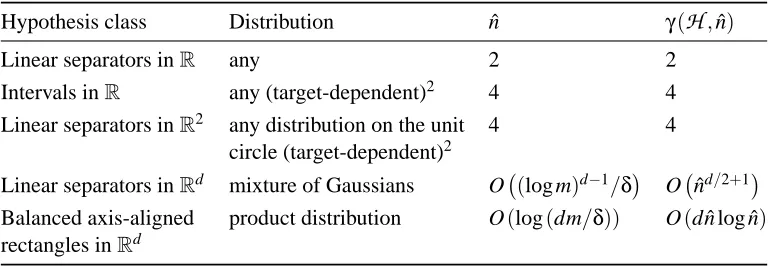
is: (i) calculate both ˆn and γ(H,n)ˆ ; (ii) apply Theorem 15, obtaining a bound BΦ for the coverage; (iii) plug BΦ in Theorem 7 to get a label complexity bound expressed as a summation; (iv) Apply Lemma 41 to obtain a label complexity bound in a closed form.4.1 Examples
In the following example we derive a label complexity bound for the concept class of thresholds (linear separators in R). Although this is a toy example (for which an exponential rate is well known) it does exemplify the technique, and in many other cases the application of the technique is not much harder. Let
H
be the class of thresholds. We first show that the corresponding version space compression set size ˆn≤2. Assume w.l.o.g. that h∗(x),I(x>w)for some w∈(0,1). Letx−,max{xi∈Sm|yi=−1}and x+,min(xi∈Sm|yi = +1). At least one of x− or x+ exist. Let
S′m={(x−,−1),(x+,+1)}. Then V SH,Sm =V SH,S′m, and ˆn=|S
′
m| ≤2. Now,γ(H,2) =2, because the order-2 characterizing set of
H
is the class of intervals inRwhose VC-dimension is 2. Plugging these numbers in Theorem 15, and using the assignment a1=a2=1/2,BΦ(H,δ,m) =1−2
m
2 ln(em) +ln4
δ
=1−O
ln(m/δ) m
.
Next we plug BΦin Theorem 7 obtaining a raw label complexity
Ψ(H,δ,m) =
m
∑
i=1
1−BΦ
H
, δ 2 log2(m),2⌊log2(i)⌋
=
m
∑
i=1 O
ln(log2(m)·i/δ) i
.
Finally, by applying Lemma 41, with a=1 and b=log2m/δ, we conclude that
Ψ(H,δ,m) =Oln2m
δ
.
Hypothesis class Distribution nˆ γ(H,n)ˆ
Linear separators inR any 2 2
Intervals inR any (target-dependent)2 4 4
Linear separators inR2 any distribution on the unit 4 4
circle (target-dependent)2
Linear separators inRd mixture of Gaussians O (log m)d−1/δ
O ˆnd/2+1
Balanced axis-aligned product distribution O(log(dm/δ)) O(d ˆn log ˆn)
rectangles inRd
Table 1: The ˆn andγof various hypothesis spaces achieving exponential rates.
last two cases are fully analyzed in Sections 4.2 and 6.1, respectively. For the other classes, whereγ and ˆn are constants, it is clear (Theorem 15) that exponential rates are obtained. We emphasize that
the bounds for these two classes are target-dependent as they require that Sminclude at least one sample from each class.
4.2 Linear Separators inRdUnder Mixture of Gaussians
In this section we state and prove our main example, an exponential label complexity bound for linear classifiers inRd.
Theorem 16 Let
H
be the class of all linear binary classifiers inRd, and let the underlying distri-bution be any mixture of a fixed number of Gaussians inRd. Then, with probability of at least 1−δ over choices of Sm, the number of label requests k by CAL is bounded byk=O (log m)
d2+1 δ(d+3)/2
!
.
Therefore by Lemma 8 we get k=O(poly(1/δ)·polylog(1/ε)).
Proof The following is a coverage bound for linear classifiers in d dimensions that holds in our
setting with probability of at least 1−δ(El-Yaniv and Wiener, 2010, Corollary 33),3
Φ(h,g)≥1−O (log m)
d2
m ·
1
δ(d+3)/2 !
. (2)
2. Target-dependent with at least one sample in each class.
3. This bound uses the fact that for linear classifiers in d dimensions ˆn=O (log m)d−1/δ
(El-Yaniv and Wiener, 2010, Lemma 32), and thatγ(H,nˆ) =O
ˆ
nd/2+1
Plugging this bound in Theorem 7 we obtain,
Ψ(H,δ,m) =
m
∑
i=1
1−BΦ
H
, δ 2 log2(m),2⌊log2(i)⌋
=
m
∑
i=1
O (log i)
d2
i ·
log2(m) δ
d+23!
= O
log2(m) δ
d+23
· m
∑
i=1
(log(i))d2 i
!
.
Finally, an application of Lemma 41 with a=d2and b=1 completes the proof.
5. Lower Bound on Label Complexity
In the previous section we have derived an upper bound on the label complexity of CAL for various classifiers and distributions. In the case of linear classifiers inRd we have shown an exponential speed up in terms of 1/εbut also an exponential slow down in terms of the dimension d. In passive learning there is a linear dependency in the dimension while in our case (active learning using CAL) there is an exponential one. Is it an artifact of our bounding technique or a fundamental phenomenon?
To answer this question we derive an asymptotic lower bound on the label complexity. We show that the exponential dependency in d is unavoidable (at least asymptotically) for every bounding technique when considering linear classifier even under a single Gaussian (isotropic) distribution. The argument is obtained by the observation that CAL has to request a label to any point on the convex hull of a sample Sm. The bound is obtained using known results from probabilistic geometry, which bound the first two moments of the number of vertices of a random polytope under the Gaussian distribution.
Definition 17 (Gaussian polytope) Let X1, ...,Xmbe i.i.d. random points inRdwith common
stan-dard normal distribution (with zero mean and covariance matrix 12Id). A Gaussian polytope Pmis
the convex hull of these random points.
Denote by fk(Pm)the number of k-faces in the Gaussian polytope Pm. Note that f0(Pm)is the number of vertices in Pm. The following two Theorems asymptotically bound the average and variance of
fk(Pm).
Theorem 18 (Hug et al., 2004, Theorem 1.1) Let X1, ...,Xm be i.i.d. random points in Rd with
common standard normal distribution. Then
E fk(Pm) =c(k,d)(log m) d−1
2 ·(1+o(1))
Theorem 19 (Hug and Reitzner, 2005, Theorem 1.1) Let X1, ...,Xmbe i.i.d. random points inRd
with common standard normal distribution. Then there exists a positive constant cd, depending only
on the dimension, such that
Var(fk(Pm))≤cd(log m) d−1
2
for all k∈ {0, . . . ,d−1}.
We can now use Chebyshev’s inequality to lower bound the number of vertices in Pm( f0(Pm)) with high probability.
Theorem 20 Let X1, ...,Xmbe i.i.d. random points inRdwith common standard normal distribution
andδ>0 be given. Then with probability of at least 1−δ,
f0(Pm)≥
cd(log m) d−1
2 −√c˜d
δ(log m)
d−1 4
·(1+o(1))
as m→∞, where cdand ˜cdare constants depending only on d.
Proof Using Chebyshev’s inequality (in the second inequality), as well as Theorem 19 we get
Pr(f0(Pm)>E f0(Pm)−t) = 1−Pr(f0(Pm)≤E f0(Pm)−t) ≥ 1−Pr(|f0(Pm)−E f0(Pm)| ≥t)
≥ 1−Var(f0(Pm))
t2 ≥1− cd
t2 (log m)
d−1 2 .
Equating the RHS to 1−δand solving for t we get
t= s
cd
(log m)d−21
δ .
Applying Theorem 18 completes the proof.
Theorem 21 (Lower bound) Let
H
be the class of linear binary classifiers in Rd, and let the underlying distribution be standard normal distribution inRd. Then there exists a target hypothesis such that, with probability of at least 1−δ over choices of Sm, the number of label requests k byCAL is bounded by
k≥cd
2 (log m) d−1
2 ·(1+o(1)).
as m→∞, where cdis a constant depending only on d.
Proof Let us look at the Gaussian polytope Pminduced by the random sample Sm. As long as all labels requested by CAL have the same value (the case of minuscule minority class) we note that every vertex of Pmfalls in the region of disagreement with respect to any subset of Sm that do not include that specific vertex. Therefore, CAL will request label at least for each vertex of Pm. For sufficiently large m, in particular,
log m≥
2 ˜cd
cd √
δ d−41
,
6. Relation to Existing Label Complexity Measures
A number of complexity measures to quantify the speedup in active learning have been proposed. In this section we show interesting relations between our techniques and two well known measures, namely the teaching dimension (Goldman and Kearns, 1995) and the disagreement coefficient (Han-neke, 2009).
Considering first the teaching dimension, we prove in Lemma 26 that the version space compres-sion set size is bounded above, with high probability, by the extended teaching dimencompres-sion growth function (introduced by Hanneke, 2007b). Consequently, it follows that perfect selective classifi-cation with meaningful coverage can be achieved for the case of axis-aligned rectangles under a product distribution.
We then focus on Hanneke’s disagreement coefficient and show in Theorem 34 that the coverage of CSS can be bounded below using the disagreement coefficient. Conversely, in Corollary 39 we show that the disagreement coefficient can be bounded above using any coverage bound for CSS. Consequently, the results here imply that the disagreement coefficient,θ(ε)grows slowly with 1/ε for the case of linear classifiers under a mixture of Gaussians.
6.1 Teaching Dimension
The teaching dimension is a label complexity measure proposed by Goldman and Kearns (1995). The dimension of the hypothesis class
H
is the minimum number of examples required to present to any consistent learner in order to uniquely identify any hypothesis in the class.We now define the following variation of the extended teaching dimension (Heged¨us, 1995) due to Hanneke. Throughout we use the notation h1(S) =h2(S) to denote the fact that the two
hypotheses agree on the classification of all instances in S.
Definition 22 (Extended Teaching Dimension, Heged ¨us, 1995; Hanneke, 2007b) Let V⊆
H
, m≥0, U ∈
X
m,∀f ∈
H
, X T D(f,V,U) =inf{t|∃R⊆U :|{h∈V : h(R) = f(R)}| ≤1∧ |R| ≤t}.Definition 23 (Hanneke, 2007b) For V ⊆
H
, V[Sm]denotes any subset of V such that∀h∈V, |
h′∈V[Sm]: h′(Sm) =h(Sm) |=1.
Claim 24 Let Smbe a sample of size m,
H
an hypothesis class, and ˆn=n(H,Sm), the version spacecompression set size. Then,
X T D(h∗,
H
[Sm],Sm) =nˆ.Proof Let Snˆ⊆Smbe a version space compression set. Assume, by contradiction, that there exist two hypotheses h1,h2∈
H
[Sm], each of which agrees on the given classifications of all examples in Snˆ. Therefore, h1,h2∈V SH,Snˆ, and by the definition of version space compression set, we get h1,h2∈V SH,Sm. Hence,|
h∈
H
[Sm]: h(Sm) =h∗(Sm) | ≥2, which contradicts definition 23. Therefore,|
and
X T D(h∗,
H
[Sm],Sm)≤ |Snˆ|=nˆ.Let R⊂Smbe any subset of size|R|<n. Consequently, V Sˆ H,Sm⊂V SH,R, and there exist hypothesis,
h′∈V SH,R, that agrees with all labeled examples in R, but disagrees with at least one example in
Sm. Thus,
h′(Sm)6=h∗(Sm),
and according to definition 23, there exist hypotheses h1,h2∈
H
[Sm]such that h1(Sm) =h′(Sm)6=h∗(Sm) =h2(Sm). But h1(R) =h2(R) =h∗(R), so
|{h∈V[Sm]: h(R) =h∗(R)}| ≥2.
It follows that X T D(h∗,
H
[Sm],Sm)≥n.ˆDefinition 25 (XTD Growth Function, Hanneke, 2007b) For m≥0, V⊆
H
,δ∈[0,1],X T D(V,P,m,δ) =inft|∀h∈
H
,Pr{X T D(h,V[Sm],Sm)>t} ≤δ .Lemma 26 Let
H
be an hypothesis class, P an unknown distribution, and δ>0. Then, withprobability of at least 1−δ,
ˆ
n≤X T D(H,P,m,δ).
Proof According to Definition 25, with probability of at least 1−δ,
X T D(h∗,
H
[Sm],Sm)≤X T D(H,P,m,δ).Applying Claim 24 completes the proof.
Lemma 27 (Balanced Axis-Aligned Rectangles, Hanneke, 2007b, Lemma 4) If P is a product distribution on Rd with continuous CDF, and
H
is the set of axis-aligned rectangles such that∀h∈
H
, PrX∼P{h(X) = +1} ≥λ, then,X T D(H,P,m,δ)≤O
d2 λ log
dm δ
.
Lemma 28 Blumer et al., 1989, Lemma 3.2.3 Let
F
be a binary hypothesis class of finite VC dimension d≥1. For all k≥1, define the k-fold union,F
k∪,n
∪ki=1fi: fi∈
F
,1≤i≤ko
.
Then, for all k≥1,
VC(Fk∪)≤2dk log2(3k).
Lemma 29 (order-n characterizing set complexity) Let
H
be the class of axis-aligned rectangles inRd. Then,Proof Let Sn=S−k ∪S+n−k be a sample of size n composed of k negative examples,{x1,x2, . . .xk}, and n−k positive ones. Let
H
be the class of axis-aligned rectangles. We define,∀1≤i≤k, Ri,Sn+−k∪ {(xi,−1)}.
Notice that V SH,Ri includes all axis aligned rectangles that classify all samples in S+ as positive, and xi as negative. Therefore, the agreement region of V SH,Ri is composed of two components as depicted in Figure 1. The first component is the smallest rectangle that bounds the positive samples, and the second is an unbounded convex polytope defined by up to d hyperplanes intersecting at xi. Let AGRi be the agreement region of V SH,Ri and AGR the agreement region of V SH,Sn. Clearly,
Ri⊆Sn, so V SH,Sn ⊆V SH,Ri, and AGRi⊆AGR, and it follows that
k
[
i=1
AGRi⊆AGR.
Assume, by contradiction, that x∈AGR but x6∈Ski=1AGRi. Therefore, for any 1≤i≤k, there exist
two hypotheses h(i)1 ,h(i)2 ∈V SH,Ri, such that, h(i)1 (x)6=h(i)2 (x). Assume, without loss of generality, that h(i)1 (x) =1. We define
h1,
k
^
i=1
h(i)1 and h2,
k
^
i=1 h(i)2 ,
meaning that h1classifies a sample as positive if and only if all hypotheses h(i)1 classify it as positive.
Noting that the intersection of axis-aligned rectangles is itself an axis-aligned rectangle, we know that h1,h2∈
H
. Moreover, for any xiwe have, h(i)1 (xi) =h(i)2 (xi) =−1, so also h1(xi) =h2(xi) =−1, and h1,h2∈V SH,Sn. But h1(x)6=h2(x). Contradiction. Therefore,AGR=
k
[
i=1 AGRi.
It is well known that the VC dimension of a hyper-rectangle inRd is 2d. The VC dimension of
AGRi is bounded by the VC dimension of the union of two hyper-rectangles in Rd. Furthermore, the VC dimension of AGR is bounded by the VC dimension of the union of all AGRi. Applying Lemma 28 twice we get,
VCdim{AGR} ≤42dk log2(3k)≤42dn log2(3n).
If k=0 then the entire sample is positive and the region of agreement is an hyper-rectangle. There-fore, VCdim{AGR}=2d. If k=n then the entire sample is negative and the region of agreement is
the points of the samples themselves. Hence, VCdim{AGR}=n. Overall we get that in all cases,
Figure 1: Agreement region of V SH,Ri.
Corollary 30 (Balanced Axis-Aligned Rectangles) Under the same conditions of Lemma 27, the class of balanced axis-aligned rectangles inRdcan be perfectly selectively learned with fast cover-age rate.
Proof Applying Lemmas 26 and 27 we get that with probability of at least 1−δ,
ˆ
n≤O
d2 λ log
dm δ
.
Any balanced axis-aligned rectangle belongs to the class of all axis-aligned rectangles. Therefore, the coverage of CSS for the class of balanced axis-aligned rectangles is bounded bellow by the coverage of the class of axis-aligned rectangles. Applying Lemma 29, and assuming m≥d, we
obtain,
γ(H,n)ˆ ≤ O
dd 2 λ log
dm δ log
d2
λ log dm
δ
≤O
d3
λ log2 dm
λδ
.
Applying Theorem 15 completes the proof.
6.2 Disagreement Coefficient
In this section we show interesting relations between the disagreement coefficient and coverage bounds in perfect selective classification. We begin by defining, for an hypothesis h∈
H
, the set of all hypotheses that are r-close to h.Definition 31 (Hanneke, 2011b, p.337) For any hypothesis h∈
H
, distribution P overX
, and r> 0, define the set B(h,r)of all hypotheses that reside in a ball of radius r around h,B(h,r),nh′∈
H
: Pr X∼P
h′(X)6=h(X) ≤r o
.
Theorem 32 (Vapnik and Chervonenkis, 1971; Anthony and Bartlett, 1999, p.53) Let
H
be a hypothesis class with VC-dimension d. For any probability distribution P onX
× {±1}, with prob-ability of at least 1−δover the choice of Sm, any hypothesis h∈H
consistent with SmsatisfiesR(h)≤η(d,m,δ), 2 m
d ln2em d +ln
2
δ
For any G⊆
H
and distribution P we denote by∆G the volume of the disagreement region of G, ∆G,Pr{DIS(G)}.Definition 33 (Disagreement coefficient, Hanneke, 2009) Letε≥0. The disagreement coefficient
of the hypothesis class
H
with respect to the target distribution P isθ(ε),θh∗(ε) =sup r>ε
∆B(h∗,r) r .
The following theorem formulates an intimate relation between active learning (disagreement coef-ficient) and selective classification.
Theorem 34 Let
H
be an hypothesis class with VC-dimension d, P an unknown distribution,ε≥0,and θ(ε), the corresponding disagreement coefficient. Let (h,g) be a perfect selective classifier (CSS, see Section 2.3). Then, R(h,g) =0, and for any 0≤δ≤1, with probability of at least 1−δ,
Φ(h,g)≥1−θ(ε)·max{η(d,m,δ),ε}.
Proof Clearly, R(h,g) =0, and it remains to prove the coverage bound. By Theorem 32, with probability of at least 1−δ,
∀h∈V SH,Sm R(h)≤η(d,m,δ)≤max{η(d,m,δ),ε}.
Therefore,
V SH,Sm ⊆B(h
∗,max{η(d,m,δ),ε}),
∆V SH,Sm ≤∆B(h∗,max{η(d,m,δ),ε}). By Definition 33, for any r′>ε,
∆B(h∗,r′)≤θ(ε)r′. Thus, the proof is complete by recalling that
Φ(h,g) =1−∆V SH,Sm.
Theorem 34 tells us that whenever our learning problem (specified by the pair (H,P)) has a disagreement coefficient that grows slowly with respect to 1/ε , it can be (perfectly) selectively learned with a “fast” coverage bound. Consequently, through Theorem 9 we also know that in each case where there exists a disagreement coefficient that grows slowly with respect to 1/ε, active learning with a fast rate can also be deduced directly through a reduction from perfect selective classification. It follows that as far as fast rates in active learning are concerned, whatever can be accomplished by bounding the disagreement coefficient, can be accomplished also using perfect selective classification. This result is summarized in the following corollary.
Proof The proof is established by straightforward applications of Theorems 34 withε=1/m and 9.
The following result, due to Hanneke (2011a), implies a coverage upper bound for CSS.
Lemma 36 (Hanneke, 2011a, Proof of Lemma 47) Let
H
be an hypothesis class, P an unknown distribution, and r∈(0,1). Then,EP∆Dm≥(1−r)m∆B(h∗,r),
where
Dm,V SH,Sm∩B(h
∗,r). (3)
Theorem 37 (Coverage upper bound) Let
H
be an hypothesis class, P an unknown distribution, andδ∈(0,1). Then, for any r∈(0,1), 1>α>δ,BΦ(H,δ,m)≤1−(1−r) m−α
1−α ∆B(h
∗,r),
where BΦ(H,δ,m)is any coverage bound.
Proof Recalling the definition of Dm(3), clearly Dm⊆V SH,Sm and Dm⊆B(h∗,r). These inclusions imply (respectively), by the definition of disagreement set,
∆Dm≤∆V SH,Sm, and ∆Dm≤∆B(h
∗,r). (4)
Using Markov’s inequality (in inequality (5) of the following derivation) and applying (4) (in equal-ity (6)), we thus have,
Pr
∆V SH,Sm≤ (1−r)
m−α
1−α ∆B(h
∗,r)
≤Pr
∆Dm≤
(1−r)m−α
1−α ∆B(h
∗,r)
= Pr
∆B(h∗,r)−∆Dm≥
1−(1−r)m
1−α ∆B(h
∗,r)
≤ Pr
|∆B(h∗,r)−∆Dm| ≥
1−(1−r)m 1−α ∆B(h
∗,r)
≤ (1−α)· E{|∆B(h∗,r)−∆Dm|}
(1−(1−r)m)∆B(h∗,r) (5)
= (1−α)· ∆B(h∗,r)−E∆Dm
(1−(1−r)m)∆B(h∗,r). (6)
Applying Lemma 36 we therefore obtain,
≤ (1−α)·∆B(h∗,r)−(1−r)
m∆B(h∗,r)
(1−(1−r)m)∆B(h∗,r) =1−α<1−δ.
Observing that for any coverage bound,
Pr∆V SH,Sm ≤1−BΦ(H,δ,m) ≥1−δ,
Corollary 38 Let
H
be an hypothesis class, P an unknown distribution, andδ∈(0,1/8). Then for any m≥2,BΦ(H,δ,m)≤1−1 7∆B
h∗,1
m
,
where BΦ(H,δ,m)is any coverage bound.
Proof The proof is established by a straightforward application of Theorem 37 withα=1/8 and
r=1/m.
With Corollary 38 we can bound the disagreement coefficient for settings whose coverage bound is known.
Corollary 39 Let
H
be an hypothesis class, P an unknown distribution, and BΦ(H,δ,m)a cover-age bound. Then the disagreement coefficient is bounded by,θ(ε)≤max
(
sup r∈(ε,1/2)
7·1−BΦ(H,1/9,⌊1/r⌋)
r ,2
)
.
Proof Applying Corollary 38 we get that for any r∈(0,1/2),
∆B(h∗,r)
r ≤
∆B(h∗,1/⌊1/r⌋) r ≤7·
1−BΦ(H,1/9,⌊1/r⌋)
r .
Therefore,
θ(ε) =sup r>ε
∆B(h∗,r) r ≤max
(
sup r∈(ε,1/2)
7·1−BΦ(H,1/9,⌊1/r⌋)
r ,2
)
.
Corollary 40 Let
H
be the class of all linear binary classifiers inRd, and let the underlying distri-bution be any mixture of a fixed number of Gaussians inRd. Thenθ(ε)≤O
polylog
1
ε
.
Proof Applying Corollary 39 together with inequality 2 we get that
θ(ε) ≤ max
(
sup r∈(ε,1/2)
7·1−BΦ(H,1/9,⌊1/r⌋)
r ,2
)
≤ max
(
sup r∈(ε,1/2)
7
r ·O
(log⌊1/r⌋)d2
⌊1/r⌋ ·9
d+3 2
!
,2
)
≤O
log1
ε d2!
7. Concluding Remarks
For quite a few years, since its inception, the theory of target-independent bounds for noise-free ac-tive learning managed to handle relaac-tively simple settings, mostly revolving around homogeneous linear classifiers under the uniform distribution over the sphere. It is likely that this distributional uniformity assumption was often adapted to simplify analyses. However, it was shown by Dasgupta (2005) that under this distribution, exponential speed up cannot be achieved when considering gen-eral (non homogeneous) linear classifiers.
The reason for this behavior is related to the two tasks that a good active learner should success-fully accomplish: exploration and exploitation. Intuitively (and oversimplifying things) exploration is the task of obtaining at least one sample in each class, and exploitation is the process of refin-ing the decision boundary by requestrefin-ing labels of points around the boundary. Dasgupta showed that exploration cannot be achieved fast enough under the uniform distribution on the sphere. The source of this difficulty is the fact that under this distribution all training points reside on their con-vex hull. In general, the speed of exploration (using linear classifiers) depends on the size (number of vertices) of the convex hull of the training set. When using homogeneous linear classifiers, explo-ration is trivially achieved (under the uniform distribution) and exploitation can achieve exponential speedup.
So why in the non-verifiable model (Balcan et al., 2008) it is possible to achieve exponential speedup even when using non homogeneous linear classifiers under the uniform distribution? The answer is that in the non-verifiable model, label complexity attributed to exploration is encapsulated in a target-dependent “constant.” Specifically, in Balcan et al. (2008) this constant is explicitly de-fined to be the probability mass of the minority class. Indeed, in certain noise free settings using linear classifiers, where the minority class is large enough, exploration is a non issue. In general, however, exploration is a major bottleneck in practical active learning (Baram et al., 2004; Begleiter et al., 2008). The present results show how exponential speedup can be achieved, including explo-ration, when using different (and perhaps more natural) distributions.
With these good news, a somewhat pessimistic picture arises from the lower bound we obtained for the exponential dependency on the dimension d. This negative result is not restricted to stream-based active learning and readily applies also to the pool-stream-based model. While the bound is only asymptotic, we conjecture that it also holds for finite samples. Moreover, we believe that within the stream- or pool-based settings a similar statement should hold true for any active learning method (and not necessarily CAL-based querying strategies). This result indicates that when performing noise free active learning of linear classifiers, aggressive feature selection is beneficial for explo-ration speedup. We note, however, that it remains open whether a slowdown exponent of d (rather than d2) is achievable.
Acknowledgments
We thank the anonymous reviewers for their good comments. This paper particularly benefited from insightful observations made by one of the reviewers, which are summarized in Section 6, including the proof of Theorem 37 and the link between our ˆn and the extended teaching dimension
(Lemmas 26 and 27).
Appendix A.
Lemma 41 For any m≥3, a≥1, b≥1 we get
m
∑
i=1
lna(bi) i
<4
aln
a+1(b(m+1)).
Proof Setting f(x), lna(bx)
x , we have
d f
dx = (a−ln bx)·
lna−1(bx) x2 .
Therefore, f is monotonically increasing when x<ea/b, monotonically decreasing function when x≥ea/b and its attains its maximum at x=ea/b. Consequently, for i<ea/b−1, or i≥ea/b+1,
f(i)≤ Z i+1
x=i−1
f(x)dx.
For ea/b−1≤i<ea/b+1,
f(i)≤ f(ea/b) =b a
e a
≤aa. (7)
Therefore, if m<ea−1 we have,
m
∑
i=1
f(i) =lna(b) +
m
∑
i=2
f(i)<2·
Z m+1
x=1
f(x)dx≤ 2 a+1ln
a+1(b(m+1)).
Otherwise, m≥ea/b, in which case we overcome the change of slope by adding twice the (upper
bound on the) maximal value (7),
m
∑
i=1
f(i) < 2
a+1ln
a+1(b(m+1)) +2aa= 2
a+1ln
a+1(b(m+1)) +2 aa
a+1
≤ a+21lna+1(b(m+1)) +2
aln
a+1bm
Appendix B. Alternative Proof of Lemma 6 Using Super Martingales
Define Wk,∑ki=1(Zi−bi). We assume that with probability of at least 1−δ/2,
Pr{Zi|Z1, . . . ,Zi−1} ≤bi, simultaneously for all i. Since Zi is a binary random variable it is easy to see that (w.h.p.),
EZi{Wi|Z1, . . . ,Zi−1}=Pr{Zi|Z1, . . . ,Zi−1} −bi+Wi−1≤Wi−1,
and the sequence W1m,W1, . . . ,Wm is a super-martingale with high probability. We apply the fol-lowing theorem by McDiarmid that refers to martingales (but can be shown to apply to super-martingales, by following its original proof).
Theorem 42 (McDiarmid, 1998, Theorem 3.12) Let Y1, . . . ,Ynbe a martingale difference sequence
with−ak≤Yk≤1−akfor each k; let A=1n∑ak. Then, for anyε>0,
Pr
∑
Yk≥Anε ≤exp(−[(1+ε)ln(1+ε)−ε]An)≤exp
− Anε
2
2(1+ε/3)
.
In our case, Yk=Wk−Wk−1=Zk−bk≤1−bkand we apply the (revised) theorem with ak,bk and An,∑bk,B. We thus obtain, for any 0<ε<1,
Pr
∑
Zk≥B+Bε ≤exp
− Bε
2
2(1+ε/3)
.
Equating the right-hand side toδ/2, we obtain
ε = 2
3ln 2
δ± r
4 9ln
22
δ+8B ln
2
δ !
/2B
≤ 1
3ln 2
δ+ r
1 9ln
22 δ+
r
2B ln2
δ !
/B
= 2
3ln 2
δ+ r
2B ln2
δ !
/B.
Applying the union bound completes the proof.
References
M. Anthony and P.L. Bartlett. Neural Network Learning; Theoretical Foundations. Cambridge University Press, 1999.
L. Atlas, D. Cohn, R. Ladner, A.M. El-Sharkawi, and R.J. Marks. Training connectionist networks with queries and selective sampling. In Neural Information Processing Systems (NIPS), pages 566–573, 1990.
M.F. Balcan, S. Hanneke, and J. Wortman. The true sample complexity of active learning. In 21st