Phase Formation and Morphological Features of Calcium
Copper Titanate by Modified Solid State Process
ASHNARAYAN SAH,
1SOUMYA MUKHERJEE,
2*
MOHAMMED SHAHNAWAZ
3and SATH BANERJEE
11Department of Metallurgical and Materials Engineering, Jadavpur University, Kolkata - 700032, West Bengal, India.
2Department of Metallurgical and Materials Engineering, Kazi Nazrul University, Asansol - 713340, West Bengal, India.
3Department of Electronics and Telecommunication Engineering, Heritage Institute of Technology, Kolkata - 700107, West Bengal, India.
Abstract
Perovskite calcium copper titanate posses giant dielectric constant making it suitable candidate for possible applications in microelectronic components, advanced transistors, energy storage capacitors. Generally, this grade of material is synthesized by chemical route to improve homogeneity, controlled size growth for enhanced properties. In the present research, simple synthesis process was adopted using precursors of high purity oxides like Calcium carbonate, titania, Copper oxide without any use of complicated synthesis routes and costly chemical precursors. Molar ratio of oxides used was about 1:3:4 with mechano-chemical activation in agate mortar for 20, 25 and 30 hours respectively in dry condition. After milling, powders obtained were made to undergo annealing at fixed temperature of 900 °C for 26 hours soaking period. Phase analysis was carried to determine the phase along with crystallite size calculation. Bonding information of the synthesized sample was analyzed to obtain the M-O coordination and vibration - stretching analysis of the bonds. Morphological features were also noted using FESEM (Field Emission Scanning Electron Microscopy) for understanding grains and granular boundaries. Both FTIR (Fourier Transform Infra Red Spectroscopy) and XRD (X - Ray Diffractogram) analyses confirm the compound formation in terms of molecular structure responsible to obtain the proper phase.
Material Science Research India
www.materialsciencejournal.org
CONTACT Soumya Mukherjee [email protected] Department of Metallurgical and Materials Engineering, Kazi Nazrul University, Asansol - 713340, West Bengal, India.
© 2019 The Author(s). Published by Oriental Scientific Publishing Company
This is an Open Access article licensed under a Creative Commons Attribution-NonCommercial-ShareAlike 4.0 International License Doi:http://dx.doi.org/10.13005/msri/160105
Article History
Received: 07 March 2019 Accepted: 12 April 2019
Keywords:
Calcium Copper FTIR;
Introduction
Perovskite having ABO3 formula is a versatile ceramic structure with applications as semiconductor, catalyst, sensors, memory devices and others. Calcium Copper titanate is a modified perovskite structure material (also referred as aurivillius structure) having applications in the above mentioned domain in addition to application as magnetic materials after doping. The parent structure of perovskite is modified due to superimposition of body centered ordering of Ca, Cu along with prominent tilting of Titanium centred octahedral.1 The ceramic is also known as colossal relative permeability due to high dielectric constant of about 104. High dielectric constant also influences the volume of the electrical devices in applications. The origin for large dielectric constant is still under investigations. It has been reported in research studies that TiO2 and perovskite oxide lose oxygen during high temperature sintering while reoxidation occurs during cooling. During cooling re-oxidation occurs at the surface layers and at the grain boundaries as a cause of rapidly falling temperature and availability of short time. As a consequence, insulating layers are formed at surface and grain boundaries while the bulk grain remains semiconducting in nature.2 The giant dielectric constant of the material is found to be almost independent of temperature in the range 100 - 400K. Chung et al. observed non-linear dielectric coefficient in the ceramic perovskite to be about 900 quite higher than ZnO which is used as classical varistor. Calcium copper titanate also exhibits high dielectric loss limiting its application in the domain of devices. This hindrance of the material is made to overcome by undergoing substitution at proper site. The scientific reason behind such suppression of dielectric loss may be due to retardation of barrier layer formation at grain boundaries. Material is noted to follow non-ohmic characteristics at such conditions.3 The mentioned perovskite is observed to be synthesized by sol - gel process1,4,5,6 mechanochemical process7,8 solid state processing9,10 hydrothermal11 and others. Some other popular methods of synthesis are combustion synthesis method or self propagating high temperature synthesis, sonochemical assisted and co-precipitation technique. Calcium copper titanate is noted to be applied for capacitors, antennas, microwave devices and sensors. Porous polycrystalline nanostructure is found to be quite
beneficial for sensor applications. One of the significant properties of Calcium Copper titanate based sensor is the ability to detect, monitor gases and toxic species without decomposition or changes in their molecular arrangement.12 In the present article, modified solid state process is adopted to synthesize utilizing proper molar ratio. The synthesized material is analyzed for phase determination by XRD, stretching bonding and M - O co-ordinations by FTIR analysis while morphology is studied by FESEM.
Experimental Procedure
In the synthesis of perovskite (Aurivillius) Calcium Copper Titanate, Calcium Carbonate, Cupric Oxide and titania (AR Grade, Merck India) were selected as precursors. All the powders were taken in a proper stoichometric ratio of CaCO3:CuO:TiO2 as 1:3:4 and made to undergo milling activation in arid condition. Milling activation was carried for 20 hours, 25 hours and 30 hours respectively followed by annealing at 900 °C for 26 hours. Phase analysis was carried by XRD (Rigaku, Ultima III, Cu Kα1.54A°, 50KV, 40mA) for synthesized powder samples. Scan range for the sample was 10 to 90° with scan rate of 5°/ min along with determination of crystallite size and planes of orientation. Morphology of the sample was studied using FESEM, Hitachi S-4800 in powder state. The sample was placed on carbon tape with conducting coating over it to prevent static charge accumulation for better resolution and imaging. Bonding and metal co-ordination analysis was carried for powder samples by FTIR analysis (IR Prestige - 21, Shimadzu) after mixing it with KBr for pellet preparation. Pellets were prepared for FTIR analysis by undergoing pressing under pressure of 6t / cm2 in hydraulic press.
Results and Discussions
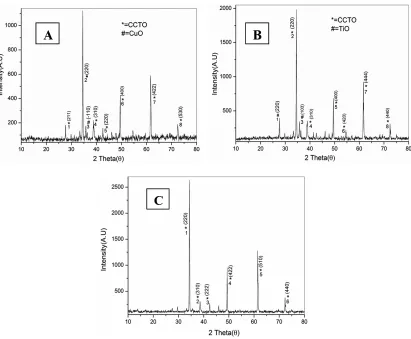
within the 2θ scan range at 34.55°, 38.8°, 49.50° and 61.65° respectively. Small peaks can also be observed about 2θ values of 27.75°, 35.80°, 42.60° and 75.30° respectively. The peaks are indexed as per the (hkl) planes reported in JCPDS file (75 - 1149). Appearance of peaks corresponding to CCTO phase indicates formation of single phase compound. The above XRD peaks are in correspondence with findings by N. Tripathy et al.,13 R. E. - Gonza´lez et al.7 where synthesis is carried by solid state routes followed by sputtering and mechanochemical process. Some minor impurities like copper oxide is noted at about 35.88° after 20 hours milling, 26 hours annealing at 900 °C. Similarly for 25 hours milling minor peaks of impure oxides of Ti is noted respectively. For 30 hours milling, sample is noted to be the most pure without any formation of other metal oxides instead of desired perovskite
compound. Crystallite size obtained by Scherrers formula is noted to be about 84.47 nm, 82.66 nm for 20 hrs, 30 hours sample and around 122 nm for 25 hours mill sample. The sudden change may be due to formation of TiO as noted from XRD analysis. TiO is metastable in nature formed as intermediate during milling which later converts to perovskite after milling reaction followed by annealing. Due to development of minor secondary phase, nucleation, growth of phases undergo metastabilization and hence such possible drastic increase in crystallite size happens. Moreover, 30 hours milling followed by 26 hours heat treatment leads to pure calcium copper titanate without any presence of other oxides as noted from XRD analysis with reference to JCPDS of Titanium oxide (81 - 1286), Copper Oxide (80 - 1917) used as precursors.
Fig. 1: XRD of Calcium Copper Titanate synthesized after 20hrs milling
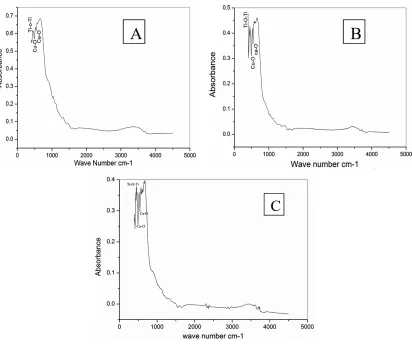
Fig. 2: FTIR of Calcium Copper Titanate synthesized after 20hrs milling
(A), 25hrs milling (B) and 30 hours milling (C) activation after soaking at 900°C for 26 hours
Figure 2 represents FTIR spectra of the synthesized samples. Major peaks of vibration for M-O co-ordinations are noted within 1000 cm-1 indicating the successful synthesis of inorganic structure. Absorption peaks are noted at about 530 cm-1, 450 cm-1, 500 cm-1 mainly. The above absorptions are corresponding to Ca-O, vibration mode of the O-Ti and bending of Cu-O bonds present in the synthesized samples. The experimental characteristics bands are noted within the scan range of 380 cm-1 to 700 cm-1 encompassing the mixture of CuO
4 and TiO6 groups. The above experimental bands and peaks indicate presence of CCTO as sample validating the XRD phase determination. The above experimental findings are in correspondence with the results of P. Thirumanathan et al who have studied optical, electrical properties of sol-gel synthesized calcium copper titanate powders.5 Almeida observed three main absorptions at 561, 516, 437 cm-1 and Ti-O vibrations at about 653-550 cm-1 while for Ti-O-Ti it is about 495 - 436 cm-1.14 Thus above findings are noted to be in correspondence with research article by Almeida et.al which focussed on mechanochemical alloying of Calcium copper titanate.
FESEM morphology of the best synthesized conditioned sample is noted after confirming the s from phase analysis and FTIR analysis on bonding, M-O information. From XRD analysis it is concluded that 30 hours milling followed by 26 hours soaking period at 900 °C yields the most pure perovskite. Morphology of the synthesized sample at the above mentioned conditions exhibit proper granular formation with strong agglomeration tendency. Few minute pores are noted within the agglomerated
form. Strong interconnections among grains are noted. Grains are having polygonal shape with conchoidal fracture face at top while some are having spherical morphology. Individual grains are around 500nm to about 200nm, 100nm in some cases. Grains are found to get interlocked in a particular fashion leading to floral one with conchoidal fracture granules around the central hub of the agglomerates. There is absence of any unwanted distortion observed in the matrix of the synthesized sample.
Conclusions
Modified Solid State Process was utilized to prepare modified perovskite structure material Calcium Copper titanate. Crystallite size was noted to be about 84.47nm, 82.66nm for 20 hrs, 30 hours sample and around 122 nm for 25 hours mill sample. Bonding and stretching vibration analysis of M-O coordnation were noted from FTIR analysis. FESEM analysis reveals the morphology to be granular in nature with strong agglomeration, minute porosity while grains were polygonal shape with conchoidal fracture.
Acknowledgement
Corresponding would like to thank HOD, Department of Metallurgical & Materials Engineering for providing XRD facilities to study phase formation. Author also acknowledges Prof (Dr.) Kalyan Kumar Chappopadhyay, Director, SMSNT, Jadavpur Univerasity for providing FTIR and FESEM facilities.
Funding Sources
There is no funding sources for carrying the experiment in the laboratory.
References
1. Jesurani S., Kanagesan S., Velmurugan R., Kalaivani T. Phase formation and high dielectric constant of calcium copper titanate using sol-gel route. J. Mater. Sc. Electron. 2012;23:668-674.
2. Rai A. K., Singh N. K., Lee S. K., Mandal K. D., Kumar D., Om Parkash. Dielectric properties of iron doped calcium copper titanate, CaCu2.9Fe0.1Ti4O12. J. Alloy. Compd. 2011; 509:8901-8906.
3. Chung S. Y., Kim Il. D., Kang S. J. L. Strong
nonlinear current-voltage behaviour in perovskite derivative calcium copper titanate. Nat. Mater. 2004;3:774-778.
4. Xu D., He K., Chen B., Xu Ch., Mua Sh., Lei. Jiao, Xi. Sun, Yang Y. Microstructure and electric characteristics of AETiO3 (AE=Mg, Ca,Sr) doped CaCu3Ti4O12 thin films prepared by the sol–gel method. PRO. NAT. SCI-MATER. 2015;25L:399-404.
Sol-Gel Synthesized Calcium Copper Titanate Nanopowders. Int. J. Chem. Tech. Res. 2015;8 No. 3:981-987.
6. Jesurani S., Kanagesan S., Velmurugan R., Thirupathi C., Sivakumar M., Kalaivani T. Nanoparticles of the giant dielectric material, Calcium Copper titanate from a Sol-gel technique. Mater. Lett. 2011;65:3305-3308. 7. Gonza´lez R. E., Vega E., Tamayo R., Criado
J. M. Dia´nez M. J. Mechanical Processing of CaCu3Ti4O12 with Giant Dielectric Properties. Mater. Manuf. Processes. 2014;29:1179-1183.
8. Alizadeha M., Ardakani H. A., Amini R., Ghazanfari M. R., Ghaffari M. Structural and phase evolution in mechanically alloyed calcium copper titanate dielectrics. Ceram. Int. 2013;39:3307-3312.
9. A.P. Ramirez, M.A. Subramanian, M. Gardel, G. Blumberg, D. Li, T. Vogt, S.M. Shapiro, Giant dielectric constant response in a copper-titanate. Solid. State. Commun. 2000;115: 217–220.
10. Yu, Tim & Liu, Hanxing & Hao, Hua & Guo, Liling & Jin, Chengjun & Yu, Zhiyong & Cao, Minghe. (2007). Grain Size Dependence of Relaxor Behavior in CaCu3Ti4O12 Ceramics. Applied Physics Letters. 91. 222911-222911.
10.1063/1.2820446.11. Oliveira L. H., de Moura A. P., Mazzo T. M., Ramírez M. A., Cavalcante L. S., Antonio S. G., Avansi W., Mastelaro V. R., Longo E., Varela J. A. Structural refinement and photoluminescence properties of irregular cube-like (Ca1-xCux) TiO3 microcrystals synthesized by the microwave hydrothermal method. Mater. Chem. Phys. 2012;136:130-139.
12. Ahmadipour M., Ain M. F., Ahmad Z. A. A Short Review on Copper Calcium Titanate (CCTO)
Electroceramic: Synthesis, Dielectric Properties, Film Deposition and Sensing Application. Nano-Micro Lett. 2016;8:291-311.
13. Tripathy N., Das K. C., Ghosh S. P., Bose G., Kar J. P. Fabrication of high-k dielectric Calcium Copper Titanate (CCTO) target by solid state route. IOP Conf. Series: Materials Science and Engineering. 115 (2016) 012022 doi:10.1088/1757-899X/115/1/012022 14. Almeida A. F. L., De Oliveira R. S., Go´es J. C.,