ISSN: 2306-9007 Farsi, Emami & Molaie (2014) 557
I
www.irmbrjournal.com June 2014I
nternationalR
eview ofM
anagement andB
usinessR
esearchVol. 3 Issue.2
R
M
B
R
Subjective Probability and Consumer Behavior
JAHANGIR YADOLLAHI FARSI
Associate Professor, Faculty of Entrepreneurship, University of Tehran, Iran
AMIR EMAMI
Faculty of Entrepreneurship, University of Tehran, Tehran, Iran Email: [email protected]
MAHSA MOLAIE
Ershad Damavand University, Tehran, Iran
Abstract
The theory of subjective probability was independently and almost simultaneously discovered in 1926 by Frank Ramsey in Cambridge and Bruno de Finetti in Italy and was later developed in an interdisciplinary form by the researchers in the fields of psychology and economics such as Tversky and Kahneman who were awarded the Noble Prize in Economics in 2002 upon presenting his prospect theory in the field of economics. This theory is today used on an applied basis in all fields from medicine and treatment to politics and economics. In this paper, after describing the literature on subjective probability both from mathematical and cognitive views, the relation between this phenomenon and consumer behavior in the marketing field will be explained by using qualitative research method. Our commentary highlights the need for future research to study the relationship between competitors messages and consumers subjective value.
Key Words: Subjective Probability, Behavioral Economics,Mental Accounting, Consumer Behavior.
Introduction
ISSN: 2306-9007 Farsi, Emami & Molaie (2014) 558
I
www.irmbrjournal.com June 2014I
nternationalR
eview ofM
anagement andB
usinessR
esearchVol. 3 Issue.2
R
M
B
R
Research Literature
Mathematical View on the Theory of Subjective Probability
Ramsey introduces the theory of subjective probability by providing detailed criticisms of Keynes’s classic probability view. It seems at that time that De Finetti was first influenced by Keynes. He himself hesitates about the Keynes’s view and he does not know what it is about. Later, he describes and criticizes Keynes’s views. He states that the relations discussed by Keynes in classic probability do not exist at all. This is because there is little agreement on the fact that which of them is related to the two presumed propositions. Ramsey strengthens his essential argument by this point that in a rational theory we can apparently understand logical relations in completely complicated situations which we are unable to understand them in simple situations. Thus, he considers all about Keynes’s rational probability relations as general certain propositions and summing and multiplication rules. Ramsey (1926) states that “It seems that anyone knows geometrical rules but no one can say that whether the assumed object is round or square. I can hardly imagine how such a large portion of general knowledge can be mixed with a small set of special realities. It is correct that there is agreement on special cases, but these cases are always complicated. We all agree that the possibility of a coin to be heads or tails is 50-50, but none of us can exactly determine the implications that form another term for a possible relation that we are going to judge it.” Ramsey’s hesitations about establishment of probability theory based on rational intuition are strengthened by considering the function of rational intuitions in an inductive inference mode which is less problematic than deductive mode. In a rational inference, probability h is identified with some degree of rationality on the condition of e; i.e., a person who has evidence e at his/her disposal will agree to h to the same degree. Such degree of rational belief is considered the same for all reasonable people. However, in subjective probability inference, rationality presumption that leads to agreement is set aside. For example, although different people (e.g., Ms. A, Mr. b, and person c) are quite reasonable and enjoy the very e evidence, they may have different degrees of belief (it will be discussed in the following that this belief is the same mental value) for h. Therefore, probability is defined as degree of belief of a certain person, in the manner that no probability is set forth anymore and instead, the probabilities of Ms. A, Mr. b, or person c will be discussed. It should be reminded that in the opposite approach (mathematical view of probability), probabilities are considered as figures within an interval of 0 and 1. Therefore, if mental theory is to provide an expressive interpretation of arithmetic, we should find a way to measure the belief degree of a person who believes an event (e.g., E) will occur (for example, belief degree of Mr. b to the effect that it will rain in Tehran tomorrow). These are the issues that stand within the scope of subjective probability theory. Ramsey states that the degree of a belief is something which is understood by its owner. We can imagine that beliefs are different with respect to the emotional intensity attached to them. By degree of belief we mean the intensity of emotion. We cannot attribute the figures to the intensity of emotions because the strongest beliefs we have mostly lack any emotion in practice. No one has any strong emotion about the things he/she considers definite (Ramsey, 1926). To measure the belief of person, Ramsey suggests to propose a betting to him/her and to observe then the least chances he/she accepts. De Finetti (quoted by Moshkani, 2007) confirms this practice as well. Ramsey therefore considers the whole life as a gambling. Whenever we go to a railway station, we bet if a train will move. If we did not believe that, we should not accept the gambling and we should stay at home. In subjective probability theory, Ramsey and de Finetti discuss the theory. But before that, two major principles of this theory, i.e., betting fractions should be explained. First of all, we should provide a presumptive betting situation in which the rate by Mr. b is prepared to bet on E (his betting fraction on E) can be considered as a criterion of his belief in E. Then, we present integrity condition.
Definition of betting fractions (q) in subjective probability theory
ISSN: 2306-9007 Farsi, Emami & Molaie (2014) 559
I
www.irmbrjournal.com June 2014I
nternationalR
eview ofM
anagement andB
usinessR
esearchVol. 3 Issue.2
R
M
B
R
Mr. b should select a number like q (called with his betting fraction on E) and then Mr. a selects the opposite condition S. If E occurs, Mr. b should pay Mr. a the amount qS against S. The amount S may be positive or negative, but |s| (absolute value of S) should be small as compared to Mr. b’s wealth; otherwise, Mr. b will never bet on all his wealth. Under such conditions, q is considered as a criterion of Mr. b’s belief degree in E. The important point is that when b selects q, he does not know if the presumption opposite S will be positive (which corresponds to his betting to the order of event E) or negative (which corresponds to his betting against event E). If b knows that S is positive, it will be advisable for him to select q to the smallest amount as much as possible. And if he knows that S will be negative, it will be advisable for him to pick q to the largest possible amount. The important point is that in both situations, q will not correspond to his actual belief degree. But if he does not know if S is positive or negative, he has to modify q according to his actual belief. This selective strategy against the opponent in terms of an event which is based on the belief of an individual is called betting fraction in subjective probability (Gillies, 2000).
The only difference between the views of Ramsey and De Finetti is related to the betting fractions for a desirability for which gambling is established. Ramsey says that it should be of monetary quantity material, but De Finetti believed that it is difficult to select for betting a number which is neither so large which is larger than or equal to the wealth of either of the parties (otherwise, no wise individual would be ever interested in gambling by all his wealth) nor is so small that remains no motivation for the game. Moreover, the person may not be directly asked of his wealth. Instead, he suggests the game value in terms of qualitative units to be used, e.g., preferring two hours of swimming than one hour of swimming plus one hour of study and generally, game value is substituted by these utilities. Of course, Ramsey has questioned the feasibility of such a utility (Gillies, 2000). It should be noted that it is necessary to determine subjective value (the extent should which be determined to influence the individuals’ minds); otherwise, subjective probability will not be formed.
Integrity
It should be reminded in integrity that the first problem in subjective approach was how to measure belief degree so that subjective probability occurs. Therefore, there is a second problem here:
Second problem: If subjective theory is to offer an interpretation of standard mathematical probability theory, the belief degrees (betting fractions) should then apply to the principles of probability standard. Why?
Suppose that belief degrees of an individual are quite arbitrary and they are not applicable to any of the principles of probability. If Mr. b has to bet on a series of events (E1…….En), his betting fractions are considered integral if and only if Miss a cannot select turns S1……Sn such that she wins anyway. If it is contrary to this, it is said that she has planned a certain loss in the gambling against Mr. b. It is evident that Mr. b wants his bets to be integral, i.e., he wants to avoid his loss under any circumstances. This condition (integrity) is both necessary and sufficient for betting fractions to apply to the principles of probability subject. This issue forms the contents of Ramsey- De Finetti theorem. Therefore, an individual who lacks any mental stability in ordinary situations and do not act according to a rational principle (requesting for maximum options from among other options), has breached from integrity principle (quoted by Moshkani, 2007).
Ramsey-De Finetti Theorem in Subjective Probability Theory
A series of betting fractions is integral if and only if they apply to the principles of probability.
ISSN: 2306-9007 Farsi, Emami & Molaie (2014) 560
I
www.irmbrjournal.com June 2014I
nternationalR
eview ofM
anagement andB
usinessR
esearchVol. 3 Issue.2
R
M
B
R
degree; instead it offers a broad range of options. In this way, some of subjective resources are necessary for probability. For this reason, De Fenitti sometimes refers to compatibility instead of integrity because we must ensure that different belief degrees are matched and in this way we can prevent the paradox of facing with a definite loss in gambling (we can be reasonable).
Ramsey-De Fenitti theorem is a significant achievement and it clearly reveals the superiority of subjective theory over rational theory. While in rational theory one can justify the principles of probability only by an ambiguous and satisfactory recourse to intuition, in subjective theory they can be accurately proved by the very reasonable condition of integrity. At the end, it should be noted that Ramsey attributes subjective probability theory to the domain of theory of games and believes that it should not be reviewed in the issue of probability (quoted by Moshkani, 2007).
iii. Principles of Subjective Probability
If E, F, ….E1, …. are the signs of events in whose occurrence we believe and Ώ is an event of certainty occurrence degree which should occur, then there will be three subjects of probability.
1) For each E, 0≤P(E)≤1 and P(Ώ)=1
2) If E1,….En incompatible events, in which occurrence of two events is not possible and at least one of them should occur, then
=1 ( En ) P (+....+ 1 E ) P
Which is reminded in probability as addition rule.
3) According to the multiplication rule, for each pair of events E&F: ( F ) P ( F │ E ) P = ( F & E ) P
Theory of Behavioral Economics in Subjective Probability Theory
In behavioral approach, the theory of subjective probability is rooted in the literature of judgment and decision making. It took a long time to provide a model to take a reasonable decision under risky and uncertainty conditions until the expected utility theory was developed. But that theory failed in some cases to offer a justification for the irrational behavior of individuals in probabilities and resulted in emergence of newer theories such as prospect theory which will be discussed later. Generally, subjective probability is psychologically viewed in a more applied manner. Subjective probability in that approach has resulted in Judgment and Decision Making Psychology branch. In that approach, subjective probability is viewed as a representation of decision (figure 1) that finally results in decision.
Figure 1) Role of Subjective Presentation in Judgment and Decision Making
Until the late of 1970s, Subjected Utility Theory (SEU) was the dominant theory in the field of decision making especially under risky conditions. This theory is a model of normative (rational) behavior originating from economics and mathematics and assumes that decisions should be adopted that first of all different situations of facing with that is collected and secondly, the utility of each situation should be subjectively measured along with the reasonable probability of its occurrence (Ranyard, Crozier and Svenson, 1997). In other words, utility theory is an effort for subjective inference of value of utility of options. This theory may be used both in making decisions under risky conditions and in uncertainty situations (Bell, Raiff, and Tversky, 1988). Several findings emphasize that we systematically violate SEU theory under risky and uncertainty conditions. In this regard, cognitive biases are considered as the most
The problem occurred in decision Subjective representation of the problem decision
Judgment of the Individual
ISSN: 2306-9007 Farsi, Emami & Molaie (2014) 561
I
www.irmbrjournal.com June 2014I
nternationalR
eview ofM
anagement andB
usinessR
esearchVol. 3 Issue.2
R
M
B
R
important factor. One of the most controversial paradoxes known in decision making is Allais Paradox. Allais (1953) presented a presumptive decision making scenario and showed that when we explain two options with another two options (including some amount of money and the probability of wining it) equal to them in two different forms, namely table and explanation, we will see contrasting choices, in the manner that if option one is selected in the table-based form, most individuals do not select the third option if it is equivalent with the first option in the explanatory form. Therefore, manipulation and framing of the problem has resulted in paradox/different options contradictory to SEU theory. This paradox was the point of addressing the effect of value, subjective probability and descriptive theories such as prospect theory (Baron, 2008).
Prospect Theory (PT)
According to Tversky and Kahneman, another approach was needed to reduce the differences between behavior and SEU theory to produce new theories and to provide justifiable reasons for the findings. Such theory may almost be used for all the available data under risky and uncertainty conditions in decision making. It is very important to know that PT is descriptive and not normative. PT well describes the deviation of our choices from SEU. It is directly related to situations such as Allais Paradox in which we need to select an option from among probable consequences.
Consider the following problem:
Do you accept this bet?
- The chance to win US$ 150.00 is 50%. - The change to lose US$ 100.00 is 50%.
Does your choice change if your total amount of money is less than US$ 100.00?
Few people accept betting on plan 2. Experimental evidences indicate that most people do not accept the betting unless the chance to win is at least two times the chance to lose (Tversky and Kahneman, 1992). Of course, the answer to the second question is negative. Now, consider another problem:
Which one do you choose?
- You will certainly lose US$ 100.00; or - The chance to win US$ 50.00 is 50%. - The chance to lose US$ 200.00 is 50%.
Does your decision change if your total amount of money is more than US$ 100.00?
It seems in plan 3 that betting is more attractive than the certainty of lose. Experimental results indicate that tendency to riskability is observed among most of those who respond to such choice (Tversky and Kahneman, 1979). Here too, the idea that the chance of US$ 100.00 in the entire money influences on tendency cannot be taken seriously. Plans 2 and 3 have strongly different tendencies. This difference is a framing effect. When we speak about the final wealth, the problem has only one difference and it is that all the figures in plan 3 are less than US$ 100.00.
ISSN: 2306-9007 Farsi, Emami & Molaie (2014) 562
I
www.irmbrjournal.com June 2014I
nternationalR
eview ofM
anagement andB
usinessR
esearchVol. 3 Issue.2
R
M
B
R
which are necessary for this hypothesis. Distinguished predictions of perspective theory follow performance function type which is shown in figure 2.
Figure 2) Value Function of Prospect Theory (Kahneman and Tversky, 1979)
Performance function is determined in the profits and losses and has four characteristics:
1) It is concave in the scope of profit and prefers to be far from any risk; 2) It is convex in the scope of losses and prefers to be risk taker;
3) Above all, function in that is strongly related to the point of preference and loss avoidance - it is faster for losses as compared to profits and its coefficient is almost 2-2.5 (from the viewpoint of reference independence); and
4) Several studies indicate that performances can be approximated well within two fields in terms of exponential function which are both lower than unit (Tversky and Kahneman, 1992).
The main idea of prospect theory – value-based performance is related to reference point and loss avoidance – can be useful for economists because Thaler (1980) has used that to explain low-risk options. In general, loss avoidance is a kind of breach from customer theory and Thaler has defined that as Endowment Effect: The highest amount people pay to get a good thing is usually less than the least amount they pay for a part of that when they get it. Sale price is usually two times or higher than purchase price (Tversky and Kahneman, 1991). This is a very simple interpretation: A good thing is more valuable when it may be lost as compared to when it is considered as a probable profit. PT as the modified form of SEU is constituted of two main parts:
- A part that deals with probabilities;
- A part that deals with utility (i.e., psychological value).
PT contains an assumption in which we multiply subjective probability by utility in decision making and we give a higher weight to utility. According to PT, we deviate from probabilities and we think about changes from a basic point.
Probable part in PT
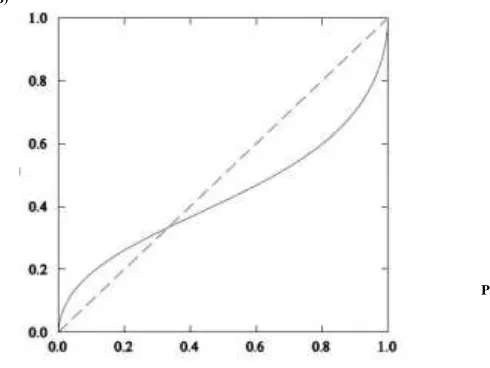
PT essentially begins with this principle that we do not behave probabilities in the way they are presented, instead we distort them. This distortion is made based on an algebraic function which is called pi function or the Greek letter π by Tversky and Kahneman. Instead of multiplication of utility by probability (P) they suggested that it would be better to multiply that by π (subjective value) (P) π . π is the weight applied for utility of each event as a function of P based on prospect theory (figure 2) (Baron, 2008).
ISSN: 2306-9007 Farsi, Emami & Molaie (2014) 563
I
www.irmbrjournal.com June 2014I
nternationalR
eview ofM
anagement andB
usinessR
esearchVol. 3 Issue.2
R
M
B
R
Figure 3) The weight imposed on utility of each consequence as a function of probability of consequence occurrence based on PT (Baron, 2008)
On the other hand, they preferred an amount of US$ 45.00 with a probability of 20% to an amount of US$ 30.00 with a winning probability of 25% because they believed that they could get US$ 15.00 more with a higher risk of 5%. The preference of definite US$ 30.00 to probable US$ 45.00 is called Certainty Effect because people had been attracted by the absolute certainty of US$ 30.00 in their decision, i.e., (1.00) π is much more than other P values. Except for very low values, certainty is automatically attractive.
Certainty effect exists in the field of losses as well. People accept risk to avoid definite losses in order to achieve a definite winning. Another point about π is that people have the highest sensitivity to changes in the probabilities near to zero (impossible) and one (certainty) borders (figure 3). Sensitivity to these changes reduces upon getting far from those borders. Therefore, an increase of 0.1 in the probability of winning a profit has a higher effect on the decisions. Once the probability of wining changes turns to 1 from zero (turning from impossible to possible) as compared to when probable changes turns e.g., from 0.4 to 0.7 (turning of a possibility to a higher possibility). As for buying lottery ticket to Hawaii for example, if there are totally 10 tickets, most of the people pay a higher price for the first ticket if they have already no ticket (to provide for themselves the possibility of winning), or they pay a higher price for the tenth ticket if they have already prepared the ninth ticket (to guaranty winning) as compared to when they pay for the fourth ticket if they have already prepared the third ticket (increase of winning possibility is modified).
Principle of Invariance is another case that utility theory could not define that but PT justified that well. This principle states that the choice of one person should not be dependent on the situation of that person and no on the way through which the issue is described. When we can have two equal descriptions of one condition, we should have similar choices. This principle is sometimes violated. Violation of this principle is called Framing Effects because choice is dependent on the format in which the problem is presented and not on the information alone (Tversky and Kahneman, 1981). The question here is that is Certainty Principle reasonable? And that why should not we give a higher weight to probability in definite consequences? The answer is that certainty effect is not reasonable first because it leads to decisions which are subject to the manner in which a problem is presented (or to the manner in which everybody presents and describes that for himself/herself). Secondly, our feelings about certainty for a phenomenon are often, if not always, a coefficient, or more accurately, an artificial product of the manner of describing the problems. For example, receipt of US$ 30.00 may be a definite consequence until money is our only goal in life although US$ 30.00 may be a tool for achieving another goal.
π(p)
ISSN: 2306-9007 Farsi, Emami & Molaie (2014) 564
I
www.irmbrjournal.com June 2014I
nternationalR
eview ofM
anagement andB
usinessR
esearchVol. 3 Issue.2
R
M
B
R
Overweighting and underweighting the probable amounts
Another characteristic of function π in describing subjective probabilities includes overweighting the lower probabilities. For example, the probability of 0.1 for wining nothing is larger in our mind than what it should be. For example, the difference of winning probability of 0.9 to 0.8 (0.1) has a lower weight than the difference of probability 0.0 to 0.1 (0.1) although they are normatively equal. This phenomenon justifies the reason for paying money for lottery and life insurance in air travels although they are in contradiction (in insurance, we pay an amount to another person to risk while in lottery we pay an amount so that another person lets us risk). We may cause much entertainment for us concerning low chance of winning and crash of aircraft due to overweighting to low probabilities. Many people tend to spend one dollar to win US$ 1,000.00 with a winning probability of 0.001 while they have less tendency in betting with a higher probability of winning. People generally avoid risking; however, they act with risk in lower probabilities. Another example in this regard includes the finding of Schwalm and Slovic (1982). They showed that only 10% of subjects tended to use safety belt when they were told that death probability in each trip was 0.0000025 but when it was announced that death probability during the entire period of driving was 0.01, only 39% tended to fasten seatbelts. Although this probability is almost equal to 0.0000025, people consider such low probability as zero. Therefore, it is not the case for them how many times they travel when the intended probability is low (Baron, 2008).
Utility in PT
Based on PT, people often evaluate consequences based on a basic point which is presumption condition. Basic points are different and they depend on how the problem is presented that it leads to different decisions. Therefore, this utility is actual and not based on experience and it is a decision utility. Bernoli viewed the utility of financial losses or profits for an individual as a function of his total wealth after occurrence of profit or loss, i.e., if a person had US$ 1000.00 before and obtained US$ 30.00, then the added utility obtained from winning US$ 30.00 would be
u($1030)-u($1000)
In contrast, Tversky and Kahneman assume that we consider utility evaluation of US$ 30.00 alone, i.e., u($30) without addressing our total wealth. They believe that our decisions enjoy an independent value function for profits and losses (figure 3).
PT Formula
Where Pi is the probability of occurrence, W is the visual value of the intended phenomenon, V is the value or subjective probability of event and U is subjective utility of the individual.
ISSN: 2306-9007 Farsi, Emami & Molaie (2014) 565
I
www.irmbrjournal.com June 2014I
nternationalR
eview ofM
anagement andB
usinessR
esearchVol. 3 Issue.2
R
M
B
R
this reason, most of us do not accept to participate in any betting in which the chance of win and lose is US$ 10.00. It is the characteristic of loss avoidance that plays the main role in describing most of the phenomena in decision making biases. Therefore, people’s reactions are different depending on the choice which is classified within the framework of profits or losses. Basically, one of the consequences of a rational decision follows SEU normative theory. As mentioned before, based on normative theory, a rational decision making should not violate invariant principle (Tversky and Kahneman). According to invariance principle, presentation method of a decision scenario in different conditions and situations should not cause any change in the individuals’ choice. In formatting however, different choices (even opposite) may be provided by changing the problem in different ways. The reason is that each different format emphasizes on a special type or part of information. Thaler (1980) set forth cash discount in relation to traditional purchase and by credit card. He pointed that different ways of offering prices by credit card and traditional purchase provide different reactions in purchasers in discounting. As for credit card, since a commission equal to purchase price is deducted by bank terminal, people consider such commission as a loss despite the ease it provided to them. In contrast, they consider cash discount in traditional purchase as a net profit. This is because in PT value function, the scope of loss function is deeper than that of profit function. If the customer is given the right to choose, then we can make them interested in using credit cards once we make them understand that there is no discount instead of saying that a commission is deducted. This is because loss is always larger than profit. Therefore, although two formats may be of equal value, they will result in predictable and opposite choices. That is why occurrence probability of events is clear in the type of risky format, but the manipulation caused in the form of problem by formatting changes the risky form of problem in the minds of people to unreliability. Therefore, formatting issues have both characteristics of risk and unreliability. Formatting is one of the most popular and most controversial human issues with several deviations as compared to rational decision making (Thaler, 1999).
Generalization of PT to the consequences in which probabilities are not mentioned
In some of the examples provided in the literature of this research, subjects faced the formats in which numerical probabilities were mentioned. They caused risky situations other than unreliability. These probabilities rarely exit in the real world and we should often make decisions automatically based on the consequences. For example, when we want to make effort in achieving a reward or when we bet on a sport event, we cannot ask anyone to tell us the related probability. PT can be generalized to these cases (Fox and Tversky). People analyze the intended event in decision making in their values and beliefs. They make decisions such as if they allocate probabilities to their beliefs. But the probabilities are sub-additive.
It means that if we have two events, namely A and B, subjective probability allocated to their unified amount (A or B) P is less than P(A)+P(B) (while they should not be reasonably different). Sub-additive situations in implicit probabilities are found once in which subjects in different situations imagine definite equality amounts. For example, Fox and Tversky (1998) asked basketball fans to have a series of choices from among different monetary amounts and betting. If a team (from among 8 participant teams) won, its selected was paid US$ 160.00 in betting. In this way, researcher could infer the value set by the subject for the betting. Based on SEU theory with reduced utility margin, the value of bets for all the eight teams should be totally less than the 160-Dollar prize and people should avoid risk and not interested in betting for events with low probabilities.
ISSN: 2306-9007 Farsi, Emami & Molaie (2014) 566
I
www.irmbrjournal.com June 2014I
nternationalR
eview ofM
anagement andB
usinessR
esearchVol. 3 Issue.2
R
M
B
R
Methodology
The present research method is a qualitative and is taken from the review of texts in the literature of behavior economics, psychology of decision making and its relation with subjective probability in scientific resources. After reviewing subject literature in the above fields we discuss their connections and applications in consumer behavior field.
Subjective Probability and Consumer Behavior
Among interdisciplinary fields, review of subjective probability (subjective value) encompasses a broad range of cognitive biases (Kahneman et al., 1991). In the following, the instances discussed in the field of consumer behavior will be reviewed. When people face decision making, they provide a mental model in their minds called “Frame”. Mental accounts in consumer behavior are created in the minds of people upon facing with a problem. Each mental account will not be closed until it receives the SEU value. For example, a person buys a ticket to watch a football match. The mental pressure for watching that football match always exist in him until he receives the expected value (watching the football match) in the stadium. In fact, avoiding from loss motivates him to watch the match (to receive the product or service). It even encourages him to watch the game live from TV in case of bad weather conditions. This is while that person could for example watch the game from TV. However, the cost that has been already paid by him and the account caused in his mind forces him to watch the game (Arkes and Blumer, 1985). In consumer behavior, this effect which is resulted by payment of cost by the person (this cost is not necessarily of monetary type) before receiving the service is called Sunk-cost Effect. It has been said that loss avoidance effect makes people in negative situations (e.g., poor quality of goods) to select options in which there is threat. Avoiding from negative consequences is so strong that people prefer to accept more risks to increase their receivable value. Therefore, the following scenario is always established:
If existence of 5 is of a positive material < if existence of 5 is of a negative material.
ISSN: 2306-9007 Farsi, Emami & Molaie (2014) 567
I
www.irmbrjournal.com June 2014I
nternationalR
eview ofM
anagement andB
usinessR
esearchVol. 3 Issue.2
R
M
B
R
ISSN: 2306-9007 Farsi, Emami & Molaie (2014) 568
I
www.irmbrjournal.com June 2014I
nternationalR
eview ofM
anagement andB
usinessR
esearchVol. 3 Issue.2
R
M
B
R
function of psychological paradigm in consumer behavior in view of prospect theory (Soman, 2004; Thaler, 1985) which plays an important role in pricing. This phenomenon borrows from PT the people’s level of subjective utility in the fields of profit and loss and proposes four functional principles in pricing and supply method of product to the consumers. As a presumption, it should be noted that receipt of money (price of goods) is considered negative and as a loss and offering discount is considered positive and as a profit. This profit may even include other facilities offered to the consumer by the firm such as payment of money for a product, delivery of two products to the consumer and other promotions.
1) Provide the consumers with losses altogether. This will be more valuable in subjective probability. 2) Provide the consumer with separate profits to provide a higher mental value. For example, due to restricted sources of the firm, it is better to provide the customer with different facilities of purchasing in different times and not to provide them altogether.
3) If we provide the consumer with profits and losses and the losses were much larger than the profits, it is better to separate them such that the small profit removes the negative effect to a high extent. This is called
Silver lining.
4) In contrast, if profits are much larger than loses, it is better to mix them because due to loss aversion effect, even that small amount will have large effects on the mental value of consumer.
We finish this section with Penney A Day (PAD) discussion. Originally, at first the effect of pleasure was set forth claiming that in case of several losses it is better to integrate them in order to reduce loss weight in subjective probability. Gourville (1998) found that when we can divide a loss into very small pieces, it is better to use loss separation. For example, in a charity program, two options for money payment to a charity foundation were offered to people. One option was to pay US$ 00.85 cents per year and the other option was to pay US$ 300.00 for one year altogether. Although the two amounts were almost equal, most people tended to the separated option. Here, two important points are necessary to understand the difference between the principle of a pleasure effect and PAD. The first one includes returning to concepts such as integration and betting fractions that were mentioned at the beginning of this paper and reviewing in order to determine the level of mental value for the person so that it may be attractive for him and he is convinced to the transaction (consumption). The second discussion is that in the first principle, the pleasure of each loss is sufficiently large and the losses should be mixed, but in PAD the losses are so small that an individual considers them nothing in comparison to his income. But as for the second party of the game, when he collects these small amounts from a large population, he will have a considerable sum. It should be noted that in classic probability, all people were equally viewed in calculation, but in subjective probability, the cognitive approach governs as well in which mental value of a person differs from that of another person.
Concluding Remarks and Future Research
Two areas of research are suggested here: the first concern with the application of risky framing of PT. Studies have applied the application of risky choice framing in managerial field (e.g., Barbosa and Fayolle, 2008). No studies have ever measure the risk taking propensity of consumers in consumption of products by risky framing mostly because always the two choices of classic risky framing concerned in the literature while it is possible to make change in manipulation of the choices in order to use it as risk measurement for consumer behavior in uncertain market (Emami and Motevaseli, 2012). By this measurement companies are able to test the true attitudes (subjective value) of their consumers toward their product. For example, to what extent they are willing to be loyal to especial brand in comparison to a substitute products of their competitors? Framing effects has a lot to assist marketing managers in this area of consumer behavior.
ISSN: 2306-9007 Farsi, Emami & Molaie (2014) 569
I
www.irmbrjournal.com June 2014I
nternationalR
eview ofM
anagement andB
usinessR
esearchVol. 3 Issue.2
R
M
B
R
practitioners to raise their awareness regarding the current intangible atmosphere (i.e., competitor messages) of their market as this awareness enables them to make more rational decisions in an uncertain markets.
In this review paper the application of subjective probability in consumer behavior considered from two main scientific streams of mathematic and psychology. Competitive game of market imply that managers need not only take care of their targeted segments strategically but also be aware of the messages their consumers receive from their competitors. These messages have tremendous effect on subjective probability of the customers and shape the intention of their next purchasing decision making.
References
Arkes, H.R. & Blumer, C.,(1985). The Psychology of Sunk Cost, Organizational behavior and human decision processes, 35, 124-140.
Barbosa, S. D., & Fayolle, A. (2008).Where is the risk? Availability, anchoring, and Framing effects on entrepreneurial risk taking, Organization behavior and human decision process, 102, , 302-312. Bell, D. E., Raiff, H. & Tversky, A. (1988). Decision making: Descriptive, normative, and prescriptive,
New York: Cambridge University Press.
Baron, J. (2008). Thinking and Deciding(4th edition), Cambridge, University press, UK.
Bernoulli,D. (1954). Exposition of a new theory on the measurement of risk”, Econometrica, 22, 1, 23-36 Busenitz, L. W., & Barney, J. B. (1997). Differences between entrepreneurs and managers in large
organizations: Biases and heuristics in strategic decision-making. Journal of Business Venturing, 12, , 9-30.
Emami. A. & Motevaseli, M. (2012). Framing Vs Entrepreneurial Alertness, International Journal of Academic Research in Business and Social Sciences, 2, 66-79
Fox, C. R., & Tversky, A. (1998). A belief-based account of decision under uncertainty. Management Science, 44, 879–895.
Gourville, J. T. (1998). Pennies-a-Day: The Effect of Temporal Reframing on Transaction Evaluati Journal of Consumer Research, 24, 395-403.
Hogarth, R. (1987) .Judgement and Choice: The Psychology of Decision (2nd ed.). Chichester, New York, Brisbane, Toronto: John Wiley & Sons,.
Kahneman, D., & Tversky, A. (1979). Prospect Theory: an Analysis of Decision under Risk. Econometrica, 47(2), 263-291.
Kahneman, D., Knetsch, J.L., & Thaler, R.H.(1991). Anomalies: The Endowment Effect, Loss Aversion, and Status Quo Bias, The Journal of Economic Perspectives, 5, 1 ,193-206.
Kahneman, D., Slovic, P., & Tversky, A. (1982). Judgment under uncertainty: heuristics and biases. New York: Cambridge University Press,.
Krueger, N. F. (1993).The impact of prior entrepreneurial exposure on perceptions of new venture feasibility and desirability. Entrepreneurship Theory and Practice, 18, 5-21.
Levin, I. P., Schnittjer, S. ., & Thee, S. L. (1988). Information framing effects in social and personal decisions. Journal of Experimental Social Psychology, 24, 520–529.
Linville, P. W., Fischer, G. W., & Fischhoff, B. (1993). AIDS risk perceptions and decision biases. In J. B. Pryor & G. D. Reeder (Eds.), The social psychology of HIV infection (pp. 5–38). Hillsdale, NJ: Lawrence Erlbaum.
Moshkani; Mohammadreza (2007), Philosophical Theories of Probability, Scientific Publications of Sharif University of Technology, Gillies, D. (2000). Philosophical Theories of Probability, Routledge. Peterman, N. E., & Kennedy, J. (2003). Enterprise Education: Influencing Students' Perceptions of
Entrepreneurship. Entrepreneurship Theory and Practice, 28, 129-144.
ISSN: 2306-9007 Farsi, Emami & Molaie (2014) 570
I
www.irmbrjournal.com June 2014I
nternationalR
eview ofM
anagement andB
usinessR
esearchVol. 3 Issue.2
R
M
B
R
Schwalm, N. D., & Slovic, P. (1982). Development and test of a motivational approach and materials for increasing use of restraints (Final technical report PFTR-1100–82–3). Woodland Hills, CA: Perceptronics, Inc.
Slovic, P., Fischhoff, B., & Lichtenstein, S. (1982).Facts versus fears: Understanding perceived risk. In D. Kahneman, P. Slovic & A. Tversky (Eds.), Judgment under uncertainty: Heuristics and biases (pp. 463-489): Cambridge University Press,.
Soman, D., (2004). Framing, Loss Aversion and Mental Accounting, Blackwell Handbook of Judgment and Decision Making Research, N. Harvey and D. Koehler (eds.), London, England: Blackwell, 379-398. Thaler, R. H., (1999). Mental Accounting Matters. Journal of Behavioral Decision Making, 12, 183- 206. Thaler, R. H. (1980). Toward a positive theory of consumer choice. Journal of Economic Behavior and
Organization, 1, 39–60.
Thaler, R. (1985), Mental Accounting and Consumer Choice, Marketing Science, 4, 199-214.
Tversky, A., & Kahneman, D. (1974). Judgment under uncertainty: Heuristics and biases. Science, 185, , 1124-1131.
Tversky, A., & Kahneman, D. (1986). Judgment under uncertainty: Heuristics and biases. In H. R. Ares & . R. Hammond (Eds.), Judgment and decision making: An interdisciplinary reader (pp. 38–55). New Yor: Cambridge University Press.
Tversky, A., & Kahneman, D. (1981). The framing of decisions and the psychology of choice. Science,211, 453–458.
Tversky, A., & Kahneman, D. (1991). Loss aversion in riskless choice: A reference-dependent model. Quarterly Journal of Economics, 106, 1039–1061.