Chapter 7
“Ionic and Metallic
Bonding”
Pre-AP Chemistry
Section 7.1 - Ions
OBJECTIVES:
–
Determine the number of
Section 7.1 - Ions
OBJECTIVES:
–
Explain how the octet
Section 7.1 - Ions
OBJECTIVES:
–
Describe how
cations
Section 7.1 - Ions
OBJECTIVES:
–
Explain how
anions
Valence Electrons are…?
The electrons responsible for the
chemical properties of atoms, and
are those in the
outer
energy level.
Valence electrons
- The
s
and
p
electrons in the outer energy level
–
the highest occupied energy level
Core electrons
– are those in the
Keeping Track of Electrons
Atoms in the same column...
1) Have the same outer electron configuration.
2) Have the same valence electrons.
The number of valence electrons are
easily determined. It is the group
number for a representative element
Group 2A: Be, Mg, Ca, etc.
Electron Dot diagrams are…
A way of showing & keeping
track of valence electrons.
How to write them?
Write the symbol - it
represents the nucleus and inner (core) electrons
Put one dot for each valence
electron (8 maximum)
They don’t pair up until they
have to (Hund’s rule)
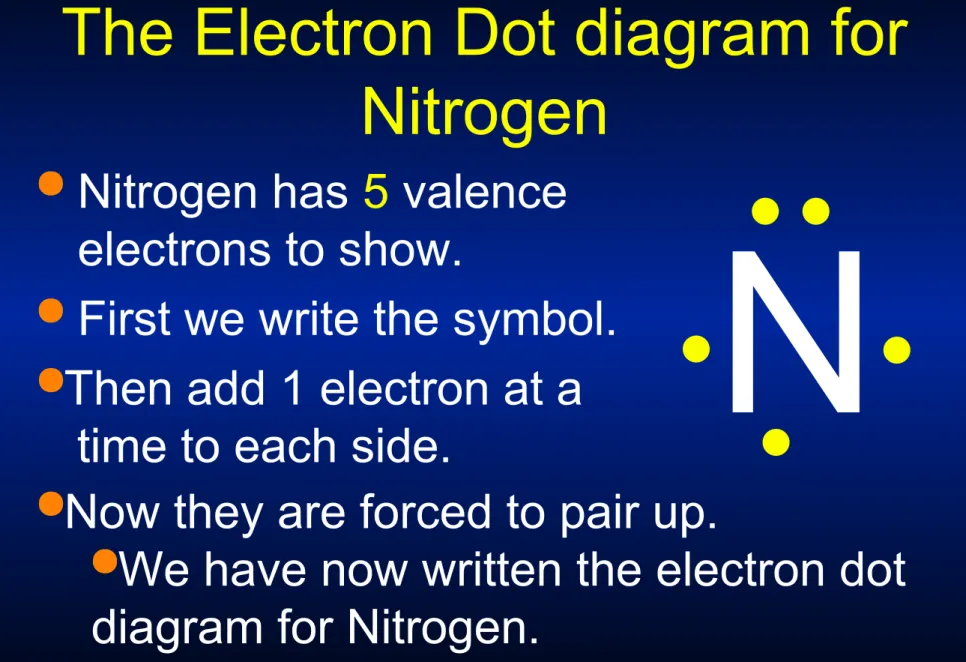
The Electron Dot diagram for
Nitrogen
Nitrogen has 5 valence
electrons to show.
First we write the symbol.
N
Then add 1 electron at a
time to each side.
Now they are forced to pair up.
We have now written the electron dot
The Octet Rule
In Chapter 6, we learned that noble gases
are unreactive in chemical reactions
In 1916, Gilbert Lewis used this fact to
explain why atoms form certain kinds of ions and molecules
The Octet Rule: in forming compounds,
atoms tend to achieve a noble gas
configuration; 8 in the outer level is stable
Each noble gas (except He, which has
Formation of Cations
Metals
lose
electrons to attain a noble
gas configuration.
They make positive ions
(cations)
If we look at the electron configuration,
it makes sense to lose electrons:
Na
1s
22s
22p
63s
11 valence electron
Na
1+1s
22s
22p
6This is a noble gas
Electron Dots For Cations
Metals will have few valence electrons
(usually 3 or less); calcium has only 2 valence electrons
Electron Dots For Cations
Metals will have few valence electrons Metals will lose the valence electrons
Electron Dots For Cations
Metals will have few valence electrons Metals will lose the valence electrons Forming positive ions
Ca
2+
NO DOTS
are now shown for the cation.Electron Dots For Cations
Let’s do Scandium, #21
The electron configuration is:
1s
22s
22p
63s
23p
64s
23d
1
Thus, it can lose 2e
-(making it
2+), or lose 3e
-(making 3+)
Sc
=
Sc
2+Scandium (II) ion
Sc
Scandium (III) ion=
Sc
Electron Dots For Cations
Let’s do Silver, element #47
Predicted
configuration is:
1s
22s
22p
63s
23p
64s
23d
104p
65s
24d
9
Actual
configuration is:
1s
22s
22p
63s
23p
64s
23d
104p
65s
14d
10Ag = Ag
1+(can’t lose any more,
Electron Dots For Cations
Silver did the best job it
could, but it did not achieve a
true
Noble Gas configuration
Instead, it is called a
Electron Configurations: Anions
Nonmetals
gain
electrons to attain
noble gas configuration.
They make negative ions
(anions)
S
=
1s
22s
22p
63s
23p
4= 6 valence
electrons
S
2-=
1s
22s
22p
63s
23p
6= noble gas
configuration.
Halide ions are ions from chlorine or
Electron Dots For Anions
Nonmetals will have many valence
electrons (usually 5 or more)
They will gain electrons to fill outer shell.
Stable Electron Configurations
All atoms react to try and achieve anoble gas configuration.
Noble gases have 2 s and 6 p electrons.
8 valence electrons = already stable!
This is the octet rule (8 in the outer level is particularly stable).
Section 7.2 Ionic Bonds and
Ionic Compounds
OBJECTIVES:
–
Explain the electrical
Section 7.2 Ionic Bonds and
Ionic Compounds
OBJECTIVES:
–
Describe three
Ionic Bonding
Anions and cations are held together
by
opposite charges
(+ and -)
Ionic compounds are called
salts
.
Simplest ratio of elements in an ionic
compound is called the formula unit.
The bond is formed through the
transfer of electrons (lose and gain)
Electrons are transferred
to achieve
Ionic Compounds
1)
Also called
SALTS
2)
Made from: a
CATION
with an
ANION
(or
literally from a
metal
combining with a
Ionic Bonding
Na Cl
The metal (sodium) tends to lose its one electron from the outer level.
Ionic Bonding
Na
+
Cl
Ionic Bond
Between atoms of metals and
nonmetals with very different electronegativity
Bond formed by transfer of electrons Produce charged ions all states.
Conductors and have high melting point.
Examples; NaCl, CaCl
1). Ionic bond
– electron from Na is
transferred to Cl, this causes a charge
imbalance in each atom. The Na
becomes
(Na
+
)
and the Cl becomes
Ionic Bonding
All the electrons must be accounted for,
and each atom will have a noble gas configuration (which is stable).
Ca
P
Ionic Bonding
Ionic Bonding
Ionic Bonding
Ca
2+
P
Ionic Bonding
Ca
2+
Ionic Bonding
Ca
2+
P
Ionic Bonding
Ca
2+
P
Ionic Bonding
Ca
2+
P
3-Ca
2+
P
Ionic Bonding
Ca
2+
P
3-Ca
2+
P
Ionic Bonding
Ca
2+
P
3-Ca
2+
Ionic Bonding
= Ca
3
P
2
Formula Unit
This is a
chemical formula
, whichshows the kinds and numbers of atoms in the smallest representative particle of the substance.
For an ionic compound, the smallest representative particle is called a:
Properties of Ionic Compounds
1.
Crystalline
solids - a regular repeating
arrangement of ions in the solid: Fig.
7.9, page 197
–
Ions are strongly bonded together.
–
Structure is rigid.
2.
High melting points
Coordination number
- number of ions
- Page 198
Coordination Numbers:
Both the sodium and chlorine have 6
Both the cesium and chlorine have 8
Each titanium has 6, and each oxygen has 3
NaCl
CsCl
Do they Conduct?
Conducting electricity means allowing
charges to move.
In a solid, the ions are locked in place. Ionic solids are insulators.
When melted, the ions can move around.
3. Melted ionic compounds conduct.
– NaCl: must get to about 800 ºC.
- Page 198
The ions are free to move when they are
Section 7.3
Bonding in Metals
OBJECTIVES:
–
Model the valence
Section 7.3
Bonding in Metals
OBJECTIVES:
–
Describe the
Section 7.3
Bonding in Metals
OBJECTIVES:
–
Explain the importance
Metallic Bonds are…
How metal atoms are held
together in the solid.
Metals hold on to their valence
electrons
very weakly
.
Think of them as positive ions
Sea of Electrons
+ + + +
+ + + +
+ + + +
Electrons are free to move through
the solid.
Metals are Malleable
Hammered into shape (bend).
Also ductile - drawn into wires.
Both malleability and ductility
explained in terms of the
- Page 201
1) Ductility 2) Malleability
Due to the mobility of the
valence electrons, metals have:
and Notice that the ionic crystal breaks
Malleable
+ + + +
+ + + +
+ + + +
Malleable
+ + + +
+ + + +
+ + + +
Mobile electrons allow atoms to slide
by, sort of like ball bearings in oil.
Ionic solids are brittle
+
-
+
-+
-
-
+
+
-
+
-+
-
-
+
Ionic solids are brittle
+
-
+
-+
-
-
+
+
-
+
-+
-
-
+
Strong Repulsion breaks a crystal apart,
due to similar ions being next to each other.
Crystalline structure of metal
If made of
one kind of atom
,
metals are among the simplest
crystals; very compact & orderly
Note Fig. 7.14, p.202 for types:
1. Body-centered cubic:
–
every atom (except those on
the surface) has 8 neighbors
Crystalline structure of metal
2. Face-centered cubic:
–
every atom has 12 neighbors
–
Cu, Ag, Au, Al, Pb
3. Hexagonal close-packed
Alloys
We use lots of metals every day,
but few are pure metals
Alloys are
mixtures
of 2 or more
elements, at least 1 is a metal
made by melting a mixture of the
ingredients, then cooling
Why use alloys?
Properties are often superior to the pure
element
Sterling silver (92.5% Ag, 7.5% Cu) is
harder and more durable than pure Ag, but still soft enough to make jewelry and tableware
Steels are very important alloys
– corrosion resistant, ductility, hardness,
More about Alloys…
Table 7.3, p.203 – lists a few alloys
Types? a) substitutional alloy- the
atoms in the components are about
the same size
b) interstitial alloy- the atomic sizes
quite different; smaller atoms fit into
the spaces between larger