Gland Location Hormone Target Cells Function Overproduction Underproduction Islets of
Langerhans Pancreas Insulin All cells and the liver
Lowers blood glucose by causing cells to take in more glucose and the liver to turn glucose into glycogen.
Low levels of
glucose Elevated levels of glucose (diabetes)
Glucagon Liver Causes the liver to turn
glycogen into glucose Elevated levels of glucose Low levels of glucose (hypoglycaemia)
Thyroid Neck Thyroxine All cells Increases metabolism
(conversion of organic molecules to ATP)
Hot, weight loss, increased heart rate
Cold, weight gain, decreased heart rate
Calcitonin Bones and
kidneys
Lowers blood calcium levels by increasing uptake in the bones and lowering reabsorption in kidneys
Low levels of blood calcium
High levels of blood calcium (kidney stones and weaker bones)
Parathyroid On top of thyroid gland Parathyroid hormone (PTH) Bones, kidneys, and intestinal tract
Increases blood calcium levels by increasing the reabsorption by kidneys and intestines while
causing bones to release Ca ions
High levels of blood calcium (kidney stones and weaker bones)
Low levels of calcium Adrenal Medulla Center of adrenal gland on top of kidneys Epinephrine and Norepinephrine (Adrenaline and Noradrenaline) All cells especially nervous and muscle
Prepares the body for the fight or flight response.
Lengthened response to short term stress
Lowered response to short term stress
Adrenal Cortex Outer portion of adrenal gland on top of kidneys
Corticoids (cortisol) White blood cells, liver, muscle, kidney, all cells
Long term stress response (think starvation) causes decreased immune response, using organic compounds such as carbs, lipids, and proteins to make glucose, increased uptake of water and salt by kidneys
Wide range of health
Aldosterone Nephron Increases the
reabsorption of sodium ions and water.
High sodium levels in blood and low levels in urine
Low sodium levels in blood and high levels in urine
Estrogens Uterus, all cells of the body
Thickens endometrium of the uterus in
preparation for
implantation of a zygote. Formation of secondary sex characteristics. Testosterone Testes, all
cells Increases the production of sperm and formation of secondary sex
characteristics. Pituitary Under the
hypothalamu s in the center of the brain.
Adrenocorticotropic hormone (ACTH)
Adrenal cortex.
Stimulates the release of corticoids (cortisol) by the adrenal cortex.
Overreaction to long term stress.
Under reaction to long term stress.
Thyroid Stimulating Hormone (TSH)
Thyroid Stimulates the release of thyroxine by the thyroid gland.
Too much thyroxine is released.
Too little thyroxine is released.
Growth Hormone
(GH) Bones, muscles, all cells.
Stimulates cell division
and therefore growth. Gigantism Dwarfism
Antidiuretic
Hormone (ADH) Nephron Increases the reabsorption of water. High blood pressure and volume.
Low blood pressure and volume.
Oxytocin Uterus,
mammary glands
Causes contractions of the uterine muscles during birth and
Prolactin Mammary
glands Promotes the formation of milk by the mammary gland.
Follicle Stimulating Hormone (FSH)*
Luteinizing Hormone (LH)*
Pineal By the
midbrain Melatonin Brain, all cells Promotes sleep Longer sleep period Shorter sleep period
Testes Testosterone*
Ovaries Estrogens*
Progesterone*
Placenta Human Chorionic
Gonadotropin (HCG)* Estrogen*
*Denotes hormones that will be discussed in depth during the reproduction unit.
1. Compare the endocrine and nervous system. Give one example of how they work together.
The endocrine system responds to environmental stimuli less rapidly than the nervous system but both work together to maintain homeostasis. One example of how they work together is when both the hypothalamus increases heart rate (through the medulla) and epinephrine increases heart rate when in a fight or flight situation.
2. Describe how either oxytocin or epinephrine function in both the nervous and endocrine system.
Epinephrine works as a neurotransmitter in the nervous system and as a hormone in the endocrine system when in short term stressful situations.
3. How are epinephrine and cortisol similar? Different?
They are both hormones released by the adrenal glands. They are different because epinephrine is released by the medulla while cortisol is released by the cortex. Cortisol is regulated by ACTH released from the pituitary while epinephrine is regulated directly by the
hypothalamus.
4. How is the regulation of metabolism (thyroxine) and the fight or flight response (epinephrine) different?
Thyroxine is regulated by a hormone pathway from the hypothalamus to the pituitary, pituitary to thyroid gland (TSH), and finally the release of thyroxine. Epinephrine is released when stimulated directly by the nervous system.
5. Describe the similarities in the regulation of the hormones thyroxine and cortisol (must discuss TSH and ACTH). Contrast the regulation of these hormones with the regulation of ADH.
Both thyroxine and cortisol are regulated indirectly by the hypothalamus and indirectly via the pituitary gland using TSH and ACTH. ADH is released by the pituitary and has an immediate effect on the nephron.
6. Create an organizational flow chart or diagram that outlines the processes involved in controlling blood glucose levels (insulin/glucagon).
9. Create an organizational flow chart or diagram that outlines the processes involved in controlling Ca2+ concentration (calcitonin/parathyroid hormone).
Increased blood calcium à Thyroid stimulated to release calcitonin à Stimulates bones to take up Ca2+ and for the kidneys to decrease reabsorption of Ca2+ à calcium levels drop à if they drop too far this stimulates parathyroid gland to secrete parathyroid
hormone à stimulates the bones to release Ca2+, the kidenys and intestines to reabsorb more Ca2+ à calcium levels rise à start over
10. Describe the similarities in the regulation of Ca2+ concentration and blood glucose levels.
Both use the antagonistic action of 2 hormones to regulate homeostasis.
11. Compare and contrast the roles of ADH and aldosterone.
ADH increases water reabsorption while aldosterone increases Na and H20 reabsorption by the kidneys. ADH is released by the pituitary while aldosterone is released by the adrenal cortex.
12. Give one example of negative feedback in the endocrine system. Prolactin is considered to be a hormone that is regulated by positive feedback. How does positive feedback work? Compare and contrast negative and positive feedback.
One example of negative feedback is regulation of the hormone thyroxine. As more thyroxine is produced it increases metabolism and therefore heat which works as negative feedback on the hypothalamus and pituitary thereby reducing the amount of thyroxine released.
13. Describe how each of the following diseases represents an inability to maintain homeostasis. What is the hormone deficiency/excess that leads to the inability to maintain homeostasis?
a) hypothyroidism (cretinism)
Too little thyroxine in young people produces cretinism. This means they have a low metabolism and growth is stunted.
b) hyperthyroidism (Grave’s disease)
Too much thyroxine is produced increasing metabolism above a standard level.
c) diabetes insipidus
d) diabetes mellitus
Type I- body fails to produce insulin Type II- insulin resistance
Both result in high levels of blood glucose
e) hypoglycemia
Low levels of blood glucose resulting from defecient production of glucagon.
f) gigantism
Overproduction of growth hormone by the pituitary.
g) dwarfism
Underproduction of HGH (growth hormone) by the pituitary
h) goiter
Overproduction of TSH because thyroid gland is not capable of producing enough thyroxine. The result is the pituitary keeps telling the thyroid gland to amp up production but it can’t and so negative feedback doesn’t occur.
14. What is the difference between diabetes type I and type II?
Type I is failure to produce insulin, type II is insulin resistance.
17. What are three ways that biotechnology has manipulated our knowledge of the endocrine system to produce technological applications that have benefited society. What is a negative consequences of these technologies?
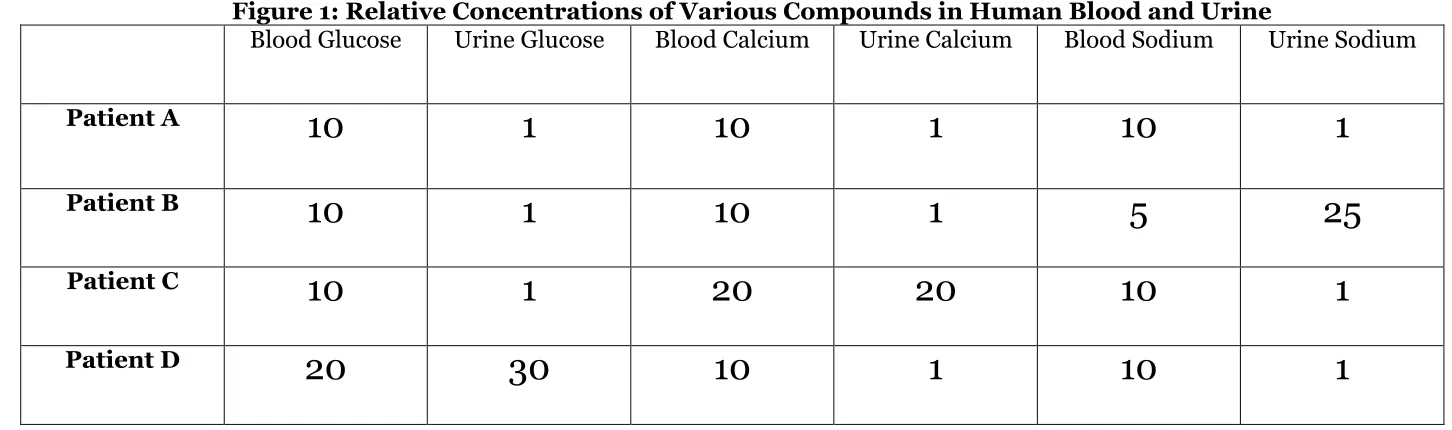
18. Describe the disease exhibited by each patient using the following urine sample to determine a diagnosis.
Figure 1: Relative Concentrations of Various Compounds in Human Blood and Urine
Blood Glucose Urine Glucose Blood Calcium Urine Calcium Blood Sodium Urine Sodium
Patient A
10
1
10
1
10
1
Patient B
10
1
10
1
5
25
Patient C
10
1
20
20
10
1
Patient D
20
30
10
1
10
1
Patient A- Normal because you don’t want glucose, calcium, or sodium in your urine in elevated quantities.\
Patient B- Low production of aldosterone because the kidney appears to be unable to hold onto sodium
Patient C- High production of parathyroid hormone because there are elevated levels of Calcium in the blood and urine (could also expect there to be a lower calcium level in urine)
Humans were injected with different quantities of fluid, represented by the three different lines in the graph. When asked to engage in exercise, all participants showed increased levels of aldosterone in their blood over time.
19. Why do the levels of aldosterone increase with exercise?
Because the body is trying to reabsorb more water and salt that could be lost with sweat as you exercise.
20. Why do diabetics and prediabetics experience a large increase in blood glucose levels after eating a meal?
A student achieving the acceptable standard can: ¡ Describe the general function of an endocrine gland
¡ Identify in diagrams and models the principal endocrine structures of humans, including the hypothalamus, pituitary gland, thyroid gland, adrenal glands, and pancreatic islet cells.
¡ Identify the source and describe the function of thyroid stimulating hormone (TSH), thyroxine, calcitonin, parathyroid hormone (PTH), adrenocorticotropic hormone (ACTH), cortisol, insulin, glucagon, human growth hormone (hGH), antidiuretic hormone (ADH), epinephrine, and aldosterone.
¡ Describe how hormones maintain homeostasis through negative feedback
¡ Explain the roles of thyroxine in metabolism; insulin, glucagon and cortisol in blood glucose metabolism; hGH in growth; ADH in water regulation; aldosterone in sodium regulation; and PTH and calcitonin in calcium regulation.
¡ Using a specific example, explain how the endocrine system allows humans to sense their internal environment and respond appropriately.
¡ Describe the physiological consequences of hormone imbalance in a person with diabetes mellitus.
A student achieving the standard of excellence can also:
¡ Describe the relationship between the hypothalamus and pituitary gland.
¡ Infer, through the analysis and interpretation of data, the role of a hormone in regulating the internal environment. ¡ Illustrate negative feedback control of hormonal secretion
¡ Analyze and interpret data on blood and urine composition to infer the role of insulin in the maintenance of glucose in the blood. ¡ Analyze and interpret data on blood and urine composition to infer the role of ADH and aldosterone in the maintenance of water
and ions in the blood.
¡ Compare the endocrine and nervous control systems and explain how they act together,
¡ Describe the physiological consequences of a hormone imbalance when given information on a particular disorder. ¡ Evaluate the use of hormone therapy as medical treatment.