IJBCP
International Journal of Basic & Clinical Pharmacology
Original Research Article
In-vitro study of quality control parameters of three different brands of
azithromycin tablets
Rashmi Singh
1*, Monika Saxena
1, Deeksha Sahay
2, Sujata Singh
3INTRODUCTION
Azithromycin is a semi-synthetic macrolide antibiotic related to Erythromycin, which inhibits RNA‐dependent protein synthesis by binding to 50s ribosome, resulting in bacteriostatic antimicrobial activity. It is effective against gram-positive and gram-negative pathogens but has greater activity against gram negative organisms,
particularly genitourinary pathogens (e.g. C. trachomatis, U. urealyticum, N. gonorrhoeae, and T. pallidum).1
Azithromycin is supplied as various dosage forms like 125, 250 and 500mg tablets or capsules and powder for oral administration as a suspension. The usual dose for an adult is 500 mg once a day. Its chemical formula is C38H72N2O12 which comprised of 15-membered ring with two deoxysugars. It is derived from erythromycin through
ABSTRACT
Background: Azithromycin, being a very important antibiotic, is manufactured by different pharmaceutical companies and available in numerous brands. Therefore, it requires a quantitative evaluation and assessment of tablets chemical, physical and bioavailability properties.
Methods: The physicochemical quality pararametrs like weight variation, size, hardness, friability, disintegration time and dissolution profile of three brands of azithromycin tablets were assessed by performing various test procedures according to established methods.
Results: The different brands of tablets showed very slight variations in weight and size, not exceeding more than 5% of standard value. Similarly, hardness of all the brands was less than 5kg/f and friability ranged from 0.2 to 0.5%. All the brands tested disintegrated in <6 minutes and all the brands released >75% of the active ingredient within 45 minutes.
Conclusions: All the physiochemical quality parameters of three brands of azithromycin tablets were found to be within the pharmacopeial specifications therefore all the brands were pharmaceutically and chemically equivalent and can be freely interchanged.
Keywords: Azithromyin, Disintigration time, Dissolution test, Friability, Hardness
DOI: http://dx.doi.org/10.18203/2319-2003.ijbcp20172548
1Department of Pharmacology,
Rajshree Medical Research Institute, Bareilly, Uttar Pradesh, India
2Department of Pharmacy,
Mahatama Jyotiba Phule Rohilkhand University, Bareilly, Uttar Pradesh, India
3Department of Pharmacology,
Shri Ram Murti Smarak Institute of Medical Sciences, Bareilly, Uttar Pradesh, India
Received: 23 April 2017
Accepted: 30 May 2017
*Correspondence to:
Dr. Rashmi Singh, Email: rashmidrlko@ yahoo.co.in
a methyl-substituted nitrogen atom in the lactone ring,
having a molecular weight of 748.98.2 A little modification in structure results in better pharmacokinetic profile of the drug such as the improved acid stability associated with more reliable and greater oral bioavailability, more extensive tissue penetration and significantly longer elimination half-life leading to extensive spectrum of activity as compared with erythromycin.3,4 Due to its extensive tissue penetration and distribution, it appears to be suitable antibiotic for the treatment and prophylaxis of various respiratory tract infection, skin and soft tissue infection, and sexually transmitted diseases.
The availability of numerous brands of azithromycin in our drug market today places clinicians and pharmacists in a difficult situation of choice of a suitable brand or the possibility of alternative use. Most of these drugs or products are sold at highly cheaper retail prices than the innovator drug, making their qualities, safety and efficacy oblivious to scrutiny among physicians and pharmacists. Quality of product defines to its confining to the standards pre-set to assure the desired purpose and it is the most important factor for efficacy and safety of product.5 It is necessary to ensure that drugs products are chemically and pharmaceutically equivalent. They must be identical in strength, quality, purity, active ingredient release profile and also in the same dosage form, for the same route of administration.6-9 Though these information are collected during clinical trials and to some extent by scientific literature but the data obtained by postmarketed monitoring helps in product improvement, development of standards and regulations. It is therefore imperative to conduct postmarketing surveillance or monitoring of approved medicines in order to assess their quality, therapeutic effectiveness and safety of medicines for the public.
Therefore the aim of the present study is to assess the in vitro evaluation of the physicochemical quality parameters such as weight variation, size and thickness, hardness, friability and disintegration time of the three different brands of azithromycin tablets available in Bareilly, UP.
METHODS
Study area
The study was conducted in the Department of Pharmacology, at Rajshree Medical Research Institute, Bareilly, in collaboration with the Department of Pharmacy, MJP Rohilkhand University, Bareilly, from January 2017 to March 2017.
Materials
An in vitro study was done by evaluating the various physicochemical quality control parameters of the three brands of tablet Azithromycin, by the three different
manufacturers. These were coded as drug A (Zithrorich, manufactured by Pure and Cure Health Care Pvt Ltd. marketed by Rich Faith Pharmaceuticals), drug B (Azithrolect, manufactured by Scott-Edil Pharmacia Ltd. marketed by Abott Healthcare) and drug C (Okamycin, manufactured by L.V. Life Sciences marketed by Instant Remedies Pvt. Ltd.). All the drugs were obtained from a retail pharmacy of Bareilly, UP, India and were labelled to contain 500 mg azithomycin per tablet. The quality of the tablets was evaluated by performing various test procedures like weight variation, size, thickness, hardness, friability, disintegration time and dissolutuion test. All the tests were performed within product expiration dates.
Instruments and equipment
• Electronic balance • Vernier caliper
• Digital friability tester (Tnnco) • Monsanto hardness tester • Disintegration test apparatus • Dissolution apparatus
• Spectrophotometer: UV-systronic smart, double beam spectrophotometer 2203
Methodology Weight variation test
Twenty tablets from each brands of Azithromycin were randomly selected and weighed individually with the electronic balance and the average weight and standard deviation was determined for each brand.
Thickness and diameter measurement
Ten tablets from each brand were randomly taken and their thickness and diameter were determined individually by Vernier caliper. Mean and standard deviations were calculated.
Hardness test
Hardness can be defined as the crushing strength of the tablet to withstand the pressure applied. The crushing strength was determined with a tablet hardness tester (Monsanto). It is expressed in kg/cm2.
Friability
Friability is the ability of tablets to withstand both shocks and abrasion without crumbling during manufacturing, packing, transportation and consumer handling. Friability can be evaluated by means of friability test apparatus. The friabilator consists of a plastic chamber divided into two parts and it revolves at 25rpm. Twenty tablets were initially weighed (Wt), placed in the tumbling chamber and rotated for four minutes of 100 revolutions. During each revolution the tablets fall from a distance to undergo shock. After 100 revolutions the dedusted tablets were again weighed. The loss in weight indicates the friability. The % friability was then calculated by:
Percentage friability =
(Initial weight- Final weight) x100 Initial weight
Disintegration test
The disintegration time is the time required for a tablet to break up into granules of specified size, under carefully specified test conditions. The disintegration time for six tablets per brand was determined by placing one tablet in each tube, using the distilled water at 37ºC±2ºC as a disintegration media in the disintegration test apparatus. The time taken for the tablets to disintegrate and pass through the mesh was measured in minutes and seconds.
Dissolution test
A dissolution test is a means of identifying and proving the availability of active drug materials in their delivered form.
Preparation of standard calibration curve
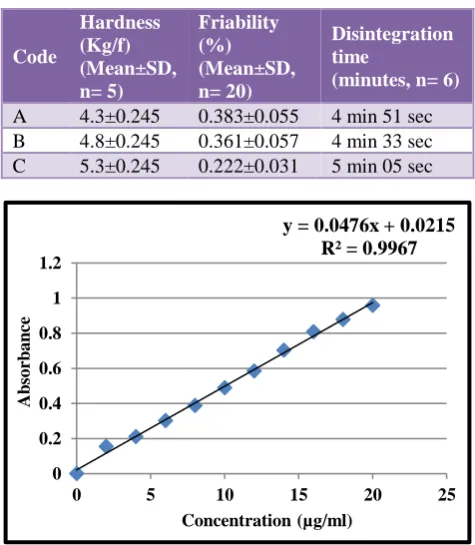
Stock solution was prepared by dissolving 100mg of accurately weighed Azithromycin in little amount of ethanol and making the final volume up to 100ml with 0.1 N HCl. After that 1 ml of stock solution was further diluted with 0.1 N HCl in 100ml to get 10μg/ml (working standard). Then 2, 4, 6, 8, 10ml of working standard was taken in 10 ml standard volumetric flask and made up the volume with 0.1N HCl to prepare 2μg, 4μg, 6μg, 8μg and 10μg drug per ml solution. Then the absorbance was measured by systronic smart double beam UV spectrophotometer 2203 at 210 nm against 0.1 N HCl as blank and standard calibration curve was plotted (Figure 1).
Invitro dissolution study
The test was performed on dissolution testing apparatus I (paddle method) by using 900ml of a buffer solution, pH 6.0, temperature 37±0.5°C and 100 rpm for 60 minutes. The buffer solution was prepared by adding 6 litres of 0.1 M dibasic sodium phosphate, 40 ml of hydrochloric acid,
600 mg of trypsin. A sample (10ml) of the solution was withdrawn from dissolution apparatus at appropriate time intervals of 5, 10, 15, 20, 30, 45 and 60 minutes and filtered through a filter paper. The samples were replaced with fresh dissolution medium of same quantity. Absorbance of these solutions was analyzed at 210nm using a systronic smart, double beam UV spectrophotometer 2203. The amount of dissolved active ingredient of the tablet in the solution as a percentage of the stated amount was calculated.
RESULTS
The three brands of azithromycin tablet showed a very slight variation in weight and size which were not exceeding 5% of standard value (Table 1).
Table 1: Weight variation, thickness, and diameter of azithromycin tablet.
Code
Weight(gm) (Mean±SD, n= 20)
Thickness(mm) (Mean±SD, n= 10)
Diameter(mm) (Mean±SD, n= 10)
A 0.716±0.011 5.306±0.047 7.58±0.044
B 0.699±0.009 5.478±0.043 7.52±0.043
[image:3.595.309.547.417.690.2]C 0.756±0.012 5.699±0.039 7.67±0.048
Table 2: Hardness, friability and disintegration time of azithromycin tablet.
Code
Hardness (Kg/f) (Mean±SD, n= 5)
Friability (%) (Mean±SD, n= 20)
Disintegration time
(minutes, n= 6)
A 4.3±0.245 0.383±0.055 4 min 51 sec
B 4.8±0.245 0.361±0.057 4 min 33 sec
C 5.3±0.245 0.222±0.031 5 min 05 sec
Figure 1: Standard calibration curve for azithromycin.
Similarly, hardness of all the brands was less than 5 kg/f which was again in acceptable range (Table 2) and
y = 0.0476x + 0.0215 R² = 0.9967
0 0.2 0.4 0.6 0.8 1 1.2
0 5 10 15 20 25
Concentration (µg/ml)
Ab
so
rb
a
n
friability of all the brands ranged from 0.2 to 0.5%. All
the brands tested disintegrated in <5 min except brand C which showed the disintegration time of 5 minutes and 05seconds (Table 2).
The calibration curve as shown in Figure 1 has good correlation (R2= 0.996).
The dissolution profiles for brands A, B and C indicate that all the brands released >75% of the active ingredient within 45 minutes (Figure 2).
Figure 2: Dissolution profile of three brands of azithromycin.
DISCUSSION
Weight variation of tablets is an important in-process control evaluation of tablet which is a valid indication of the corresponding variation in the drug content. A small variation does not ensure good content uniformity between dosage units while a large weight variation precludes good content uniformity.10,11 The specification of this weight variation test is given in different pharmacopeias. All the three brands of Azithromycin tablets passed the weight variation uniformity test as specified in the Indian Pharmacopoeia according to which the acceptable limit for the deviation of weight for tablets having average weight of 250 mg or more should not exceed 5%. (Table 1).12 The difference in the mean weights of all brands may be because of different excipients used in the different brands.
The uniformity in thickness and diameter of tablets are necessary for consumer requirement and also for packaging of tablets. The tablet thickness varies with changes in die fill, compressive load and tablet weight. This variation can be controlled by monitoring the physical properties of raw material, continuous standardization of upper and lower punch lengths and granulation properties of drug like density, particle size and particle distribution.13 According to Indian Pharmacopoeia, general tablet thickness is controlled within 5% of a standard value. The thickness and
diameter of all the three brands of tablet Azithromycin were found to be within their permissible limit (±5%) (Table 1).
Hardness denotes the capability of a tablet to withstand mechanical shocks during handling, manufacturing, packaging and shipping. It depends on the weight of the material used, nature and quantity of excipients or binders used during formulation, space between the upper and lower punches at the time of compression and pressure applied during compression. Tablet hardness, in turn, influences the tablet density and porosity. It may also affect tablet friability and disintegration time, drug dissolution and release which may inturn affect bio-availability. Hard tablet interferes with the disintegration while the soft tablet cannot withstand the handing during packing and transporting. The acceptable range of hardness or crushing strength of tablet is 4 to 7kgf (kilogram of force).10,13 Regarding the results, average hardness for each brand was between 4 and 6kg/f (Table 2).
Friability is a tendency of the tablet to crumble which results in weight loss. It is an important factor for the tablet to resist attrition in the package container, owning to partial powdering, chipping, or fragmentation of the tablets during handling and transporting. Cotton or other cellulose materials are commonly placed in containers of tablets to keep them tightly packed to reduce railing and fractional contact on shipping or other handling and agitation.14 Tablet friability may also be profoundly affected by the moisture content of the tablet granulation. According to Indian Pharmacopoeia, a maximum loss of weight not greater than 1.0 per cent is acceptable for most of the tablets. In our study, the friability values for Azithromycin for all the brands were ranged from 0.2 to 0.5% which ensures that all the tablets of each brand were mechanically stable (Table 2).
Disintegration is the break down process of tablet into smaller particles and is the first step towards dissolution. The disintegration test measures the time required for a tablet to disintegrate into particles when in contact with gastrointestinal fluids. The test is useful as a quality assurance tool for conventional dosage forms. The rate of drug absorption as well as the therapeutic efficacy of the drug is dependent upon the disintegration time. The type and amount of excipient used in tablet formulation as well as manufacturing process are all known to affect the disintegration.15 The standard disintegration time for an uncoated tablet usually varies between 5 to 30 minutes. Results indicate that all the brands comply with this limit (Table 2).
Dissolution of drug from oral solid dosage form is a necessary criterion for drug bioavailability. The results indicated that dissolution profile of tablets of all the brands were within the Pharmacopeial specifications which should not be less than 75 per cent of the stated amount of drug after 45 minutes.
0 20 40 60 80 100 120
0 20 40 60 80
% DR---A % DR---B % DR--C
Per
ce
n
ta
g
e
o
f
d
ru
g
r
elea
se
In this study quality parameters of three brands of
azithromycin tablets were evaluated and were found pharmaceutically and chemically equivalent and can be freely interchanged. There is also need to carry out in vivo studies to further validate the in vitro predictions. This study also highlights the need for constant monitoring of the new products introduced into our drug market with the view to ascertain bioequivalence and conformity with pharmacopoeia standards.
ACKNOWLEDGMENTS
The authors are thankful to the Department of Pharmacy, MJP Rohilkhand University, Bareilly, specially to Dr. Kamal Kishore, Mr. Pankaj Patel and Mr. Lakshyveer for guiding and providing laboratory facilities to carry out this research work easily.
Funding: No funding sources Conflict of interest: None declared
Ethical approval: The study was approved by the Institutional Ethics Committee of RMRI, Bareilly
REFERENCES
1. Mac Dougall C, Chambers HF. Protein synthesis inhibitors and miscellaneous antibacterial agents. Brunton LL, Chabner BA, Knollmann BC. Goodman and Gilman's: The Pharmacological Basis of Therapeutics. 12th Ed. New York, Mc Graw-Hill; 2011:1529-1530.
2. Trivedi HK, Patel MC. Development and validation of a precise LC method for the determination of drug release during dissolution profile in pharmaceutical formulation. Int J Chem Tech Res. 2010;2(2):912-9. 3. Hoepelman IM, Schneider MM. Azithromycin: the
first of the tissue-selective azalides. Int J Antimicrob Agents. 1995;5(3):145-67.
4. Zuckerman JM, Qamar F, Bono BR. Review of macrolides (azithromycin, clarithromycin), ketolids (telithromycin) and glycylcyclines (tigecycline). Med Clin North Am. 2011;95:761-91.
5. Sivakumar R, Venkataraman PE, Natarajan R, Ganeasn V, Ashrafali KA. Comparative in vitro evaluation of commercial aceclofenac tablets. Int J Chem Sci. 2009;7(3):1591-4.
6. Awofisayo O, Oladoja A, Awofisayo N. Comparative assessment of the quality control measurements of multisource ofloxacin tablets marketed in Nigeria. Disso Tech. 2010;6:20-5.
7. Nayak AK. Comparative in vitro dissolution assessment of some commercially available paracetamol tablets. International Journal of Pharmaceutical Sciences Review and Research. 2010;2(1):29-30.
8. Adegbolagun O, Ololade OA, Osamah SE. Comparative evaluation of the biopharmaceutical and chemical equivalence of some commercially evaluable brands of ciprofloxacin hydrochloride tablets. Trop J of Pharm Res. 2007;6:737-45. 9. Chow S. Pharmaceutical validation and process
controls in drug development. J Drug Info. 1997;31:1195-201.
10. Jakaria M, Mousa AY, Parvez M, Zaman R, Arifujjaman, Sayeed MA, et al. In vitro comparative study of different brands of dexamethasone tablet available in Bangladesh. Int J of Pharma Qual Assur. 2016;7(2):24-8.
11. Dittert LW. American pharmacy, An introduction to pharmaceutical techniques and dosage forms. 7th Ed. Philadelphia; 1974:308-383.
12. The Indian Pharmacopoeia, Government of India, Ministry of health and family welfare, Controller of publication, New Delhi. 2007;1:63-5.
13. Kumar D, Singh J, Antil M, Kumar V. Quality control of tablets: A review. Int J of Uni Pharm and Bio Sci. 2016;5(4):53-67.
14. Amin R, Biswas S, Rahman R, Rana S. Study and impact evaluation of particle size distribution on physicochemical properties of three different tablet formulations through sieve technology. Int J for Pharm Res Sch. 2014;3(1):448-63.
15. Giri TK, Manjusha. Comparative In Vitro Evaluation of Conventional Ibuprofen Marketed Formulation. Journal of Pharma SciTech. 2013;2(2):75-80.