R E G U L A R A R T I C L E
Evaluation of performance status of daily living activities
and of the future risk of falls in the non-handicapped,
community-dwelling elderly
Taro OkamuraÆNaohito TanabeÆ
Kunihiko ShinodaÆ Nao SekiÆIsamu KonishiÆ Akiko TakeshitaÆHiroshi Suzuki
Received: 24 June 2008 / Accepted: 3 December 2008 / Published online: 20 January 2009
ÓThe Japanese Society for Hygiene 2009
Abstract
Objectives There is a growing need to evaluate the per-formance status of the activities of daily living (ADL) of the elderly in the rapidly aging Japanese society. The purpose of this study was to verify the usefulness of our new scoring sheet for assessing present ADL status and to clarify whether or not the assessed ADL status can predict the future risk of adverse conditions related to falls.
Methods The validation study was performed using 116 non-handicapped community-dwelling Japanese elderly at least 60 years of age. Of those subjects, 44 were also
analyzed for the relationship between baseline ADL status and subsequent risk of adverse conditions related to falls.
Results The daily living performance score sheet had good internal consistency, with a Cronbach’s alpha of 0.82 and a sequential hierarchical structure that reflected the difficulty of the activities. The total score was significantly and positively associated with six of eight subscale scores on the Short-Form 36-Item Health Survey (P\0.01). In the follow-up study, every one-point decrease in total score was significantly associated with a 39% elevated risk of a stumble or fall (P=0.022) and also borderline signifi-cantly associated with higher risks of a fall, anxiety while walking indoors, and anxiety while walking outdoors (P\0.10).
Conclusion Our new scoring sheet can reliably and comprehensively assess present ADL status. The assessed ADL could predict the future risk of adverse conditions related to falls.
Keywords Aging populationAssessment Daily living activitiesFall risk Performance score
Introduction
The Japanese population is rapidly aging. The proportion of the general population in 2005 which was classified as elderly—at least 65 years of age—was 20.2% in 2005 and will be 23.1% in 2010 and 33.7% in 2035 [1]. Given this situation, extending healthy life expectancy and preserving quality of life (QOL) of the elderly are major concerns of Japanese public health strategies [2].
Health status and QOL are highly affected by the per-formance of daily living activities. Physical weakness is the second major cause of nursing care in Japan [3]. Impaired T. Okamura (&)I. KonishiA. Takeshita
School of Health Sciences,
Niigata University of Health and Welfare, 1398 Shimami-machi, Niigata 950-3198, Japan e-mail: [email protected]
N. Tanabe
Division of Health Promotion,
Niigata University Graduate School of Medical and Dental Sciences, 1-757 Asahimachi-dori, Chuo Ward, Niigata 951-8510, Japan
K. Shinoda
Department of Sports and Health Sciences, Faculty of Education, Niigata University,
8050, Ikarashi2-no-cho, Nishi-ku, Niigata 950-2181, Japan
N. Seki
School of Health Sciences,
Faculty of Medicine, Niigata University, 2-756 Asahimachi-dori, Chuo Ward, Niigata 951-8518, Japan
H. Suzuki
Division of Public Health,
Niigata University Graduate School of Medical and Dental Sciences, 1-757 Asahimachi-dori, Chuo Ward,
activities of daily living (ADL) are linked with lower longevity [4] and impaired QOL [5]. Training for daily living performance improves the QOL of disabled elderly people by preventing falls and improving physical and social functions [6–9].
Thus, reliable assessment methods of ADL performance among the elderly are necessary to evaluate their physical condition and to predict future QOL status. Several indexes have been developed for evaluating the physical indepen-dence level of basic daily life activities [10], such as the Barthel Index [11] or physical self-maintenance scale, and for evaluating more advanced daily performance status [12], such as the instrumental ADL scale and the Tokyo Metropolitan Institute of Gerontology Index of Compe-tence [13]. The Short-Form 36-Item Health Survey (SF-36) [14–16] is now frequently used in the evaluation of ADL and QOL, and this questionnaire comprehensively evalu-ates mental function as well as ADL from the perspective of physical and social functions. These indices can help predict adverse events for ADL and QOL, such as falls and injuries [17–21]. All of these questionnaires evaluate ADL from the perspective of activity, meaning whether a person has the ability to perform activities. However, they do not give adequate consideration to the degree of participation or whether a person actually carries out these activities in their daily life.
We have developed a simple questionnaire, denoted the daily living performance score sheet, to assess present ADL status from the viewpoints of activity and participa-tion. The purpose of this study was to verify our new scoring sheet as a useful tool for assessing present ADL status and to determine if ADL status assessed by this questionnaire predicted the future risk of adverse condi-tions related to physical weakness. In this study, falls and related conditions were evaluated as future adverse con-ditions because falls are a major cause of bone fracture in the elderly [22,23], and bone fracture is the fourth major cause of nursing care in Japan [3].
Materials and methods
Daily living performance score sheet
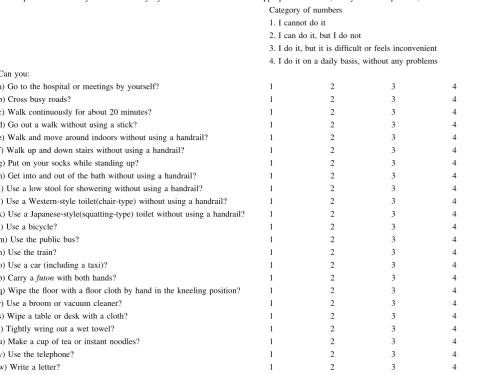
The daily living performance score sheet is a self-reporting questionnaire designed for the Japanese elderly, with 23 questions about the performance status of ADL during daily living in Japan that are presented as scale items. Two occupational therapists carefully selected these activities based on their clinical experiences from among activities commonly performed by the Japanese elderly. These activities were selected on the basis of their degree of difficulty, from easy and simple activities to difficult and
complex ones, and by the parts of the body used to perform the activities (Appendix). Each scale item had four response items, and each answer had a point value of 0, 1, or 2, where 1 = I cannot do it (0 points), 2 = I think I can but do not do it (1 point), 3 = I do it with some difficulty or inconvenience (1 point), and 4 = I do it on a daily basis without any problem (2 points). For the first response item, we gave a maximum point value of ‘‘2’’ because a subject who is actually performing the questioned activity in daily living without any difficulty should have the ability to perform it sufficiently. For the fourth response item, we gave a minimum point value of ‘‘0’’ because a respondent is considered not to be able to perform an activity. For the third response item, we gave a midpoint value of ‘‘1’’ because a respondent should have limited ability to per-form an activity. For the second response item, we also gave a midpoint value of ‘‘1’’ because a respondent would have deteriorated ability to perform an activity that is actually not being performed in daily living. Although the ability of respondents that choose the second response item may be different from those that choose the third one, we gave the same values for these response items for conve-nience as we do not have sufficient data to distinguish them at this time.
A total daily living performance score was then calculated.
A cross-sectional study evaluating the usefulness of the daily living performance score sheet in assessing current ADL status in the elderly
The study subjects were 116 non-handicapped community-dwelling elderly (26 men and 90 women) who were at least 60 years of age (average =70.8±4.4 years). These indi-viduals participated in a fall-prevention program in Sanwa Village, Niigata Prefecture, Japan (Table1). Written informed consents were obtained from all subjects. All of the subjects completed a daily living performance score sheet in November 2003. They also completed the SF-36 and another self-reporting questionnaire evaluating their histories of illness, their experiences of a fall or bone fracture occurring within a 1-year period prior to the assessment using these questionnaires, and their experi-ences of a stumble or fall, anxiety while walking indoors, or anxiety while walking outdoors occurring within 1 month prior to the assessment.
Although a history of stroke, which strongly affects present ADL, was reported for only two subjects, 28 (24.1%) reported having a fall, and 36 (31.0%) reported having a stumble or a fall. Thus, the study subjects inclu-ded elderly with a slightly lowered physical function.
verify the type of physical and mental functions the daily living performance score sheet measured, we examined the correlations between the daily living performance score and each subscale score of the SF-36; the subscale scores used were ‘‘Physical functioning’’, ‘‘Role-physical’’, ‘‘Bodily pain’’, General health perceptions’’, and ‘‘Vitality’’.
A follow-up study for predicting future conditions associated with falls
The 116 participants of the cross-sectional study were divided into two groups. Sixty-five were in the intervention group and participated in a 3-month fall prevention
program, and 51 were in a 3-month wait-list group (the control group). We have already reported the effects of the fall prevention program; in brief, after the program was started, a number of adverse conditions related to falls were significantly decreased and less observed in the interven-tion group than in the control group [24].
After the program for the intervention group was com-pleted, the control group also participated in the same program for a 3-month period. We therefore were able to observe the natural course of adverse conditions related to falls only in the control group. Thus, for the follow-up study, we focused on the control group because their ADL would not be affected by the fall prevention program during the first 3-month period. Three months after the baseline assessment and just before the control group participated in the fall prevention program, 44 of the 51 subjects in the control group responded to the second assessment that examined their adverse conditions related to falls during the follow-up. These respondents were the subjects of the follow-up group (Table 1).
In the second assessment, we assessed falls and injuries during the entire 3-month follow-up period using a self-reporting questionnaire. Conditions occurring within the last month of the follow-up period, such as a stumble or fall, anxiety while walking indoors, and anxiety while walking outdoors, were also assessed in the same questionnaire. The relationships between the baseline daily living performance score and each of these conditions were analyzed.
The daily performance score was also obtained from the 44 subjects followed at the second assessment through a self-reporting questionnaire in order to validate the reproduc-ibility of the score sheet. With regard to the results, the score sheet showed good reproducibility; the mean total score was very similar between the first (43.5±4.3) and the second (43.4±3.87; P=0.845 by Wilcoxon signed-rank test) assessments, and the Spearman’s correlation coefficient between these assessments was high (0.712;P\0.001).
This study was approved by the Niigata University Faculty of Medicine Ethics Committee.
Statistical analysis
The internal consistency of the daily living performance score sheet was assessed by Cronbach’s alpha coefficient. Cluster analysis was used to examine the inter-item rela-tionship. The degree of difficulty of the daily activities selected for the daily performance score sheet was assessed by comparing the average score for each item. The corre-lations between the daily performance score and each of eight subscale scores of the SF-36 were analyzed by Spearman’s rank correlation coefficient (q).
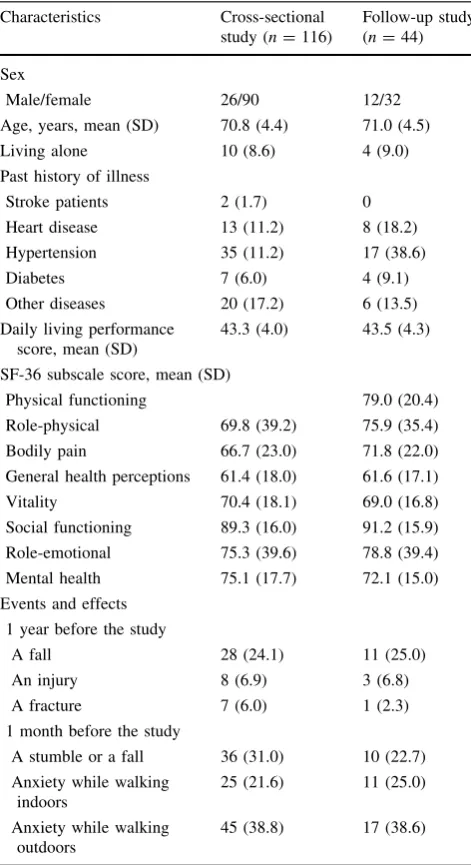
The relationship between the daily living performance baseline score and subsequent adverse conditions was Table 1 Characteristics of the study subjects
Characteristics Cross-sectional study (n=116)
Follow-up study (n=44)
Sex
Male/female 26/90 12/32
Age, years, mean (SD) 70.8 (4.4) 71.0 (4.5)
Living alone 10 (8.6) 4 (9.0)
Past history of illness
Stroke patients 2 (1.7) 0
Heart disease 13 (11.2) 8 (18.2)
Hypertension 35 (11.2) 17 (38.6)
Diabetes 7 (6.0) 4 (9.1)
Other diseases 20 (17.2) 6 (13.5)
Daily living performance score, mean (SD)
43.3 (4.0) 43.5 (4.3)
SF-36 subscale score, mean (SD)
Physical functioning 79.0 (20.4)
Role-physical 69.8 (39.2) 75.9 (35.4)
Bodily pain 66.7 (23.0) 71.8 (22.0)
General health perceptions 61.4 (18.0) 61.6 (17.1)
Vitality 70.4 (18.1) 69.0 (16.8)
Social functioning 89.3 (16.0) 91.2 (15.9)
Role-emotional 75.3 (39.6) 78.8 (39.4)
Mental health 75.1 (17.7) 72.1 (15.0)
Events and effects
1 year before the study
A fall 28 (24.1) 11 (25.0)
An injury 8 (6.9) 3 (6.8)
A fracture 7 (6.0) 1 (2.3)
1 month before the study
A stumble or a fall 36 (31.0) 10 (22.7)
Anxiety while walking indoors
25 (21.6) 11 (25.0)
Anxiety while walking outdoors
45 (38.8) 17 (38.6)
SF-36, Short-Form 36-Item Health Survey
examined by sex- and age-adjusted logistic regression analysis. All statistical analyses were conducted using the SPSS 11.0 J statistical package for Windows (SPSS Japan, Tokyo, Japan), withP\0.05 considered to be statistically significant andP\0.1 to indicate borderline significance.
Results
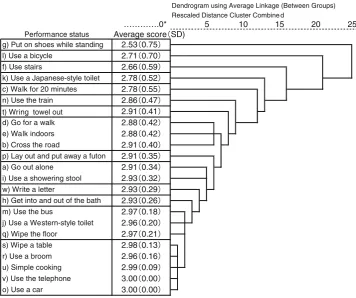
Usefulness of the daily living performance score sheet assessing present ADL status—a cross-sectional study The average and median daily living performance scores and Cronbach’s alpha were 43.3±4.0, 45, and 0.82, respectively (Table2). Cluster analysis revealed that 23 items from the daily living performance score sheet had a sequential hierarchical structure as a dendrogram. The average scores for the activities increased as their hierarchy decreased (Fig.1), indicating that the hierarchy represents the difficulty of the activities.
The daily performance score was significantly and positively correlated (P\0.01) with six of the eight SF-36 subscale scores, such as physical functioning (q=0.57), role-physical (q=0.52), bodily pain (q=0.40), general health perceptions (q=0.25), vitality (q=0.39), and role-emotional (q=0.43) (Table3).
Table 2 Distribution of daily living performance score by the cross-sectional study
Daily living performance score (possible range: 0–46)
Number of individuals
Percentage of total
46 50 43.1
45 11 9.5
44 16 13.8
43 9 7.8
42 7 6.0
41 6 5.2
40 3 2.6
39 3 2.6
38 1 0.9
36 1 0.9
35 2 1.7
34 2 1.7
33 2 1.7
31 1 0.9
29 1 0.9
24 1 0.9
23–0 0 0.0
Total 116 100.0
The average score (standard deviation) and median value of the daily performance score were 43.3 (4.0) and 45, respectively
Cronbach’s alpha coefficient of the score sheet was 0.82
Dendrogram using Average Linkage (Between Groups) Rescaled Distance Cluster Combine d
Performance status Average score SD)
v) Use the telephone 3.00 0.00
o) Use a car 3.00 0.00 r) Use a broom 2.96 0.16
u) Simple cooking 2.99 0.09 q) Wipe the floor 2.97 0.21 s) Wipe a table 2.98 0.13 m) Use the bus 2.97 0.18
j) Use a Western-style toilet 2.96 0.20 w) Write a letter 2.93 0.29 h) Get into and out of the bath 2.93 0.26 a) Go out alone 2.91 0.34
i) Use a showering stool 2.93 0.32 b) Cross the road 2.91 0.40
p) Lay out and put away a futon 2.91 0.35 d) Go for a walk 2.88 0.42 e) Walk indoors 2.88 0.42 n) Use the train 2.86 0.47
t) Wring towel out 2.91 0.41 k) Use a Japanese-style toilet 2.78 0.52 c) Walk for 20 minutes 2.78 0.55 l) Use a bicycle 2.71 0.70
f) Use stairs 2.66 0.59
20 25
g) Put on shoes while standing 2.53 0.75
………….0* 5 10 15 Fig. 1 Hierarchical cluster
Association between the daily living performance score and later adverse conditions
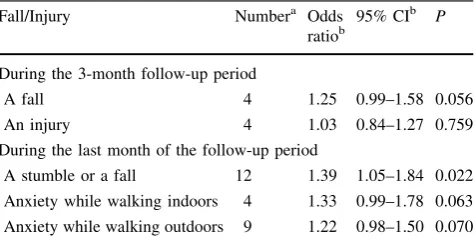
During the 3-month follow-up period, both a fall and an injury occurred in four of 44 subjects (Table4). In the final month of the follow-up period, 12 subjects stumbled or fell, four felt some anxiety while walking indoors, and nine felt anxiety while walking outdoors. Sex- and age-adjusted logistic regression analysis showed that a lower daily performance score at baseline was significantly associated with elevated risk for a stumble or a fall [odds ratio (OR) 1.39; 95% con-fidence interval (CI) 1.05–1.84;P=0.022] and associated with borderline significance for a fall (OR 1.25; 95% CI 0.99– 1.58;P=0.056), anxiety while walking indoors (OR 1.33; 95% CI 0.99–1.78;P=0.063), and anxiety while walking outdoors (OR 1.22; 0.98–1.50;P=0.070).
Discussion
Assessment of ADL performance among the elderly is nec-essary if the physical condition of today’s elderly are to be assessed and their future QOL status be predicted. We
developed the daily living performance score sheet ques-tionnaire reported here, and a cross-sectional study revealed that our scoring sheet had a high internal consistency and was positively correlated with physical function, role-physical, bodily pain, general health perceptions, vitality, and role-emotional subscale scores of the SF-36. In addition, activities listed in this score sheet formed a sequential hierarchical structure that represents the difficulty of the activities. We therefore conclude that our new scoring sheet can reliably and comprehensively assess a very wide range of ADL status in the elderly. The study described here, however, focused on subjects with a relatively well-preserved ADL performance, and further studies are required to warrant the validity of our test for elderly with a lower ADL status.
We prospectively verified the relationship between the daily performance score and the risk of a fall in the non-handicapped community-dwelling elderly, despite the small sample size. Few studies have evaluated these relationships in non-handicapped subjects [17]. Our study indicated that every one-point decrease in the daily living performance score was significantly associated with an 39% increased risk of a stumble or a fall and was also borderline significantly associated with a 25% increased risk of a fall.
Our meta-analysis of prospective cohort studies identi-fied physical function and muscle weakness in the upper and lower limbs as a significant predictor of falls [25]. As the activity items in our daily performance score sheet are affected by muscle strength, a lower score may reflect muscle weakness and thus predict falls and stumbles.
A lower daily living performance score was also associated with a higher future prevalence of anxiety while walking, regardless of whether indoors or outdoors, suggesting that lower ADL status affects the deterioration of emotional conditions related to walking and could accelerate physical weakness by impeding walking. Social activities of the elderly could also be impeded by such a deterioration due to a fear of falling. Thus, assessment of present ADL may help identify subjects with a high risk for developing progressive physical weakness and social isolation. Future large-scale and long-term studies are required to evaluate these associations. As mentioned above, some useful characteristics of the daily performance score sheet have been shown in our study. However, we were unable to confirm its reliability as a tool in the evaluation of ADL status of the elderly. As the number of subjects was limited in our study, we were unable to rule out the possibility that some of the statisti-cally significant results occurred by chance. In addition, the study population consisted of the elderly with relatively preserved ADL. We need to accumulate more data on the elderly with a wider range of ADL status.
Although we carefully selected the activity items on the daily performance score sheet to include common activities of daily life of the elderly in Japan so that the score sheet can be Table 3 Relationship between daily living performance score and
each sub-scale score of SF-36
Sub-scale of SF-36 qa P
Physical functioning 0.57 \0.001
Role-physical 0.52 \0.001
Bodily pain 0.40 \0.001
General health perceptions 0.25 \0.006
Vitality 0.39 \0.001
Social functioning 0.16 0.086
Role-emotional 0.43 \0.001
Mental health 0.17 0.072
a Spearman’s rank correlation coefficient
Table 4 Relationship between daily living performance score and future risk of adverse conditions related to falls
Fall/Injury Numbera Odds ratiob
95% CIb P
During the 3-month follow-up period
A fall 4 1.25 0.99–1.58 0.056
An injury 4 1.03 0.84–1.27 0.759
During the last month of the follow-up period
A stumble or a fall 12 1.39 1.05–1.84 0.022
Anxiety while walking indoors 4 1.33 0.99–1.78 0.063
Anxiety while walking outdoors 9 1.22 0.98–1.50 0.070
A total of 44 individuals participated in the follow-up study a Number of persons with a corresponding event or condition
b Sex- and age-adjusted odds ratios and 95% CI for every one-point
widely used in Japan, some modifications would still be nec-essary. For example, some items would not be suitable for evaluating the condition of participation, and ‘‘crossing the road’’ and ‘‘using trains or buses’’ are not suitable for evaluation in a place without wide roads or train and bus services. ‘‘Using bicycles’’ and ‘‘use of a Japanese-style toilet’’ may also not be suitable for the elderly who do not have them. These problems have been highlighted through application of the score sheet in our study. Some other expressions or activities should be replaced by such scale items. In addition, the scaling system also needs to be dis-cussed. For the this study, we gave the same point values to the second item ‘‘I think I can, but do not do it’’ and the third one ‘‘I do it with some difficulty or inconvenience’’. To elucidate whether these two response items can actually be given equal points in evaluating ADL status of the elderly, we have to accumulate more data from subjects with a wider
range of ADL status. Further studies are required to improve on and generalize our score sheet.
Although these limitations should be addressed in further studies, we conclude that our daily living performance score sheet questionnaire could become a reliable tool for evaluat-ing present ADL status of the Japanese elderly in a community and that ADL measured by this scoring sheet is useful for evaluating future risk of a stumble or fall. Deteriorated emotional conditions related to walking may also be predicted by this ADL assessment. Further studies are required to make the score sheet more universal and to generalize the results on relationships between ADL status and future physical and emotional conditions related to physical weakness.
Acknowledgments We are grateful for the cooperation of Sanwa village in the collection of data. This study was supported in part by a grant from Chiyoda Mutual Life Foundation in fiscal year 2003.
Appendix
Table 5 Structure of daily performance score sheet
These questions concern your current everyday activities. Please circle the appropriate number (1 only for each question)
Category of numbers
1. I cannot do it
2. I can do it, but I do not
3. I do it, but it is difficult or feels inconvenient
4. I do it on a daily basis, without any problems
Can you:
a) Go to the hospital or meetings by yourself? 1 2 3 4
b) Cross busy roads? 1 2 3 4
c) Walk continuously for about 20 minutes? 1 2 3 4
d) Go out a walk without using a stick? 1 2 3 4
e) Walk and move around indoors without using a handrail? 1 2 3 4
f) Walk up and down stairs without using a handrail? 1 2 3 4
g) Put on your socks while standing up? 1 2 3 4
h) Get into and out of the bath without using a handrail? 1 2 3 4
I) Use a low stool for showering without using a handrail? 1 2 3 4
j) Use a Western-style toilet(chair-type) without using a handrail? 1 2 3 4
k) Use a Japanese-style(squatting-type) toilet without using a handrail? 1 2 3 4
l) Use a bicycle? 1 2 3 4
m) Use the public bus? 1 2 3 4
n) Use the train? 1 2 3 4
o) Use a car (including a taxi)? 1 2 3 4
p) Carry afutonwith both hands? 1 2 3 4
q) Wipe the floor with a floor cloth by hand in the kneeling position? 1 2 3 4
r) Use a broom or vacuum cleaner? 1 2 3 4
s) Wipe a table or desk with a cloth? 1 2 3 4
t) Tightly wring out a wet towel? 1 2 3 4
u) Make a cup of tea or instant noodles? 1 2 3 4
v) Use the telephone? 1 2 3 4
w) Write a letter? 1 2 3 4
References
1. Nishioka H, Koike S, Yamauchi M, Suga K, Esaki Y. Population projections by prefecture: 2005–2035 (in Japanese). J Popul Probl. 2007;63–2:14–56.
2. Health Japan 21 Plan Study Panel HJPFSP. Report on the cam-paign to promote better health among the population in the 21st century (Health Japan 21) (in Japanese). Tokyo: Ministry of Health and Welfare; 2000.
3. Statistics and Information Department Minister’s Secretariat Ministry of Health, Labour and Welfare. 2004 Comprehensive Survey of Living Conditions of the People on Health and Welfare (in Japanese). Tokyo: Health and Welfare Statistics Association; 2006.
4. Ishizaki T, Kai I, Kobayashi Y, Imanaka Y. Functional transitions and active life expectancy for older Japanese living in a com-munity. Arch Gerontol Geriatr. 2002;35:107–20.
5. Hinohara S, Doba N. The future profile of health promotion and disease prevention in Japan: based on the study of seniors over age 75. Methods Inf Med. 2005;44:342–7.
6. Walker MF, Gladman JR, Lincoln NB, Siemonsma P, Whiteley T. Occupational therapy for stroke patients not admitted to hos-pital: a randomised controlled trial. Lancet. 1999;354:278–80. 7. Legg L, Langhorne P. Rehabilitation therapy services for stroke
patients living at home: systematic review of randomised trials. Lancet. 2004;363:352–6.
8. Green J, Forster A, Bogle S, Young J. Physiotherapy for patients with mobility problems more than 1 year after stroke: a ran-domised controlled trial. Lancet. 2002;359:199–203.
9. Close J, Ellis M, Hooper R, Glucksman E, Jackson S, Swift C. Prevention of falls in the elderly trial (PROFET): a randomised controlled trial. Lancet. 1999;353:93–7.
10. Ohta T, Haga H, Osada H, Tanaka K, Maeda K, Takezaki T, et al. Development and evaluation of a QOL questionnaire for elderly subject living in a community (in Japanese). Nippon Koshu Eisei Zasshi. 2001;48:258–67.
11. Mahoney FI, Barthel DW. Functional evaluation. The Barthel Index. Md State Med J. 1965;14:61–5.
12. Lawton MP, Brody EM. Assessment of older people: self-main-taining and instrumental activities of daily living. Gerontologist. 1969;9:179–86.
13. Koyano W, Shibata H, Nakazato K, Haga H, Suyama Y. Mea-surement of competence: reliability and validity of the TMIG Index of Competence. Arch Gerontol Geriatr. 1991;13:103–16.
14. Fukuhara S, Bito S, Green J, Hsiao A, Kurokawa K. Translation, adaptation, and validation of the SF-36 Health Survey for use in Japan. J Clin Epidemiol. 1998;51:1037–44.
15. Fukuhara S, Ware JE Jr, Kosinski M, Wada S, Gandek B. Psy-chometric and clinical tests of validity of the Japanese SF-36 Health Survey. J Clin Epidemiol. 1998;51:1045–53.
16. Fukuhara S, Suzukamo Y, Ofuji S, Kurokawa K. Japanese manual for SF-36 v1.2 (in Japanese). Tokyo: Public Health Research Center; 2001.
17. VanSwearingen JM, Paschal KA, Bonino P, Chen TW. Assessing recurrent fall risk of community-dwelling, frail older veterans using specific tests of mobility and the physical performance test of function. J Gerontol A Biol Sci Med Sci. 1998;53:457–64. 18. Tromp AM, Pluijm SM, Smit JH, Deeg DJ, Bouter LM, Lips P.
Fall-risk screening test: a prospective study on predictors for falls in community-dwelling elderly. J Clin Epidemiol. 2001;54: 837–44.
19. Johnson M, Cusick A, Chang S. Home-screen: a short scale to measure fall risk in the home. Public Health Nurs. 2001;18: 169–77.
20. Chaiwanichsiri D, Jiamworakul A, Kitisomprayoonkul W. Falls among stroke patients in Thai Red Cross rehabilitation center. J Med Assoc Thai. 2006;89:47–52.
21. Capon A, Di Lallo D, Mastromattei A, Pavoni N, Simeoni S. Incidence and risk factors for accidental falls among general practice elderly patients in Latina, Central Italy. Epidemiol Prev. 2007;31:204–11.
22. Teno J, Kiel DP, Mor V. Multiple stumbles: a risk factor for falls in community-dwelling elderly. A prospective study. J Am Geriatr Soc. 1990;38:1321–5.
23. Yasumura S, Haga H, Nagai H, Shibata H, Iwasaki K, Ogawa Y, et al. Incidence of and circumstances related to falls among the elderly in a Japanese community (in Japanese). Nippon Koshu Eisei Zasshi. 1991;38:735–42.
24. Shinoda K. Effects of physical and functioning exercise program on fall risk reduction of elderly people living at home: a ran-domized controlled trial (in Japanese). Niigata Med J. 2007;121: 322–30.