SOFTWARE
PGA: a software package for rapid, accurate,
and flexible batch annotation of plastomes
Xiao‑Jian Qu
1,2, Michael J. Moore
3, De‑Zhu Li
1*and Ting‑Shuang Yi
1*Abstract
Background: Plastome (plastid genome) sequences provide valuable information for understanding the phyloge‑ netic relationships and evolutionary history of plants. Although the rapid development of high‑throughput sequenc‑ ing technology has led to an explosion of plastome sequences, annotation remains a significant bottleneck for plastomes. User‑friendly batch annotation of multiple plastomes is an urgent need.
Results: We introduce Plastid Genome Annotator (PGA), a standalone command line tool that can perform rapid, accurate, and flexible batch annotation of newly generated target plastomes based on well‑annotated reference plastomes. In contrast to current existing tools, PGA uses reference plastomes as the query and unannotated target plastomes as the subject to locate genes, which we refer to as the reverse query‑subject BLAST search approach. PGA accurately identifies gene and intron boundaries as well as intron loss. The program outputs GenBank‑formatted files as well as a log file to assist users in verifying annotations. Comparisons against other available plastome annotation tools demonstrated the high annotation accuracy of PGA, with little or no post‑annotation verification necessary. Likewise, we demonstrated the flexibility of reference plastomes within PGA by annotating the plastome of Rosa rox-burghii using that of Amborella trichopoda as a reference. The program, user manual and example data sets are freely available at https ://githu b.com/quxia ojian /PGA.
Conclusions: PGA facilitates rapid, accurate, and flexible batch annotation of plastomes across plants. For projects in which multiple plastomes are generated, the time savings for high‑quality plastome annotation are especially significant.
Keywords: PGA, Plastome, Batch annotation, Accuracy, BLAST, Software, Algorithms
© The Author(s) 2019. This article is distributed under the terms of the Creative Commons Attribution 4.0 International License (http://creat iveco mmons .org/licen ses/by/4.0/), which permits unrestricted use, distribution, and reproduction in any medium, provided you give appropriate credit to the original author(s) and the source, provide a link to the Creative Commons license, and indicate if changes were made. The Creative Commons Public Domain Dedication waiver (http://creat iveco mmons .org/ publi cdoma in/zero/1.0/) applies to the data made available in this article, unless otherwise stated.
Background
The plastid genomes (plastomes) of most photosynthetic seed plants are highly conserved and have a quadripar-tite structure with a large and a small single-copy regions separated by two inverted repeat (IR) regions [1, 2]. The plastomes of photosynthetic seed plants are usually 120– 160 kb [1] in size and contain 101–118 unique genes [2]. Plastome sequences have been widely applied in phylo-genetics [3–5], population genetics and phylogeography [6, 7], and comparative genomics [2, 8]. In addition, the plastome is a key target for genetic engineering efforts to
improve economic traits, resistance to diseases and pests, and stress resistance [9, 10].
The rapid development of high-throughput sequencing platforms has led to an explosion of plastome sequence data, especially via genome skimming approaches [11]. However, annotation of plastomes remains a significant bottleneck, especially if users wish to batch annotate multiple plastomes. Existing tools for plastome annota-tion include four web servers (DOGMA [12], CpGAVAS [13], Verdant [14] and GeSeq [15]) and one command line tool (Plann [16]). However, gene annotations from these programs should be checked manually, and poten-tially inaccurate gene annotations are not always flagged for checking. Hence batch annotation of plastomes using these tools may still be a time-consuming task.
Here we present PGA (Plastid Genome Annotator), a command line tool designed to conduct rapid, accurate,
Open Access
*Correspondence: [email protected]; [email protected]
1 Germplasm Bank of Wild Species, Kunming Institute of Botany, Chinese
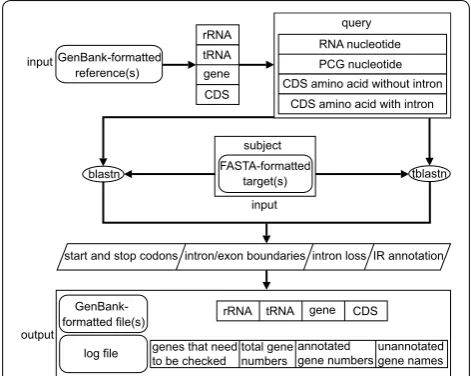
and flexible batch annotation of newly generated plas-tomes. A new approach, which we call reverse query-subject BLAST search, is used to locate genes, followed by algorithms that identify feature boundaries [including for genes, introns, and the Inverted Repeat (IR)] as well as intron loss (Figs. 1, 2 and 3). In reverse query-sub-ject BLAST, the annotated reference plastome(s) is/are used as the query sequence and the unannotated target plastome(s) is/are used as the subject sequence to locate genes in the target plastome(s). Below we demonstrate the speed and utility of PGA through detailed compari-sons with other existing tools (Table 1).
Implementation
PGA is open-source and written in Perl. The core of PGA includes the reverse query-subject BLAST search approach to locate genes and boundary detection algo-rithms to identify feature boundaries as well as intron loss.
Locating genes
BLASTN searches of a reference nucleotide database are used to locate rRNA and tRNA genes in target plasto-mes (Fig. 1). For protein-coding genes (PCGs), BLASTN and TBLASTN searches are conducted (Fig. 1). Any PCGs with a TBLASTN percent identity greater than the changeable threshold value (default = 40%) are annotated in the target plastome. If more than one reference plas-tome is used, each rRNA, tRNA or PCG with the highest BLASTN/TBLASTN percent identity is used to initially identify its position as the high-scoring segment pair (HSP) in the target plastome.
The genes rpl16, petB and petD form a special case. Each of these genes possesses a short first exon (6–9 bp in length) and a much longer second exon. BLASTN and TBLASTN are able to easily locate the second exon, but the first exons are too short to be detected. Because these first exons are highly conserved (for example, each pos-sesses the same sequence across angiosperms with rare exceptions), a search of the region upstream of exon 2 in each gene is performed, using the exon 1 sequence of the reference plastome(s) as a probe.
Boundary detection algorithms
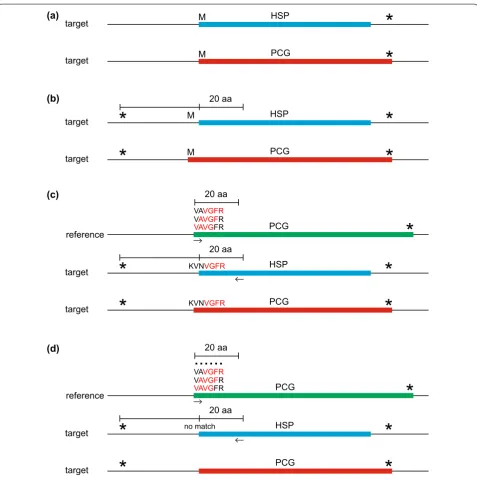
To annotate feature boundaries correctly, three algo-rithms are applied to (1) determine start and stop codons, (2) locate intron–exon boundaries and detect intron loss, and (3) identify the boundaries of the inverted repeat (IR) (Fig. 1). The coordinates of HSPs acquired from TBLASTN search are used as preliminary data. PGA then uses the Gene Boundary Detection Algorithm (GBDA, Fig. 2) to identify start codon and stop codon for PCGs. To detect the stop codon, the GBDA search begins from the 5′ end of the HSP, and the first identified stop codon is returned as the annotated stop codon (Fig. 2). The proper start codon is identified via searching near the 5′ end of the HSP: (a) if the first amino acid of the HSP is methionine, its corresponding “ATG” will be annotated as the start codon (Fig. 2a); (b) if the first amino acid of the HSP is not methionine, PGA will search for methionines in the region between the first detected in-frame stop codon upstream of the HSP and the 20th amino acid of the HSP, and the one that is closest to the stop codon will be annotated as the start codon (Fig. 2b); (c) if no suit-able methionine is detected in (a) or (b), PGA will use the first four amino acids (“VAVG”) of the reference CDS as a probe to search across the same region defined in step (b), with a search from right to left (Fig. 2c). If this fails to find a match, the four amino acid window is moved downstream in the reference CDS by a step of one amino acid (the probe is changed into “AVGF”), and so on to the 20th amino acid of the reference CDS. If this strategy yields an appropriate match (with the probe of “VGFR” after the four amino acid window being moved down-stream by two steps in the reference plastome; Fig. 2c), PGA will treat the position of the first matched amino acid of the probe in the target plastome as the starting point (the “V” of “VGFR” in the target plastome; Fig. 2c). The position of the amino acid that corresponds to the “start codon” (the first “V” of “VNVGFR” in the tar-get plastome) is then identified by moving left from this starting point by the number of steps (two steps) that the four amino acid window was shifted in the reference CDS. PGA then annotates the codon at this position as the “start codon”. If multiple putative start codons are reference(s)
GenBank-formatted input
gene CDS rRNA tRNA
query RNA nucleotide PCG nucleotide CDS amino acid without intron
CDS amino acid with intron
blastn FASTA-formattedtarget(s) tblastn subject
input
log file formatted file(s)GenBank- output
gene CDS rRNA tRNA
unannotated gene names genes that need
to be checked total gene numbers annotated gene numbers
start and stop codons intron/exon boundaries intron loss IR annotation
detected, the one that is closest to the upstream stop codon will be annotated. (d) If strategy (c) fails to identify a start codon, the first amino acid of the HSP will be ten-tatively annotated as the putative “start codon” (Fig. 2d). If the “start codon” is identified via strategies (c) or (d), the annotated PCG for the gene in question will be noted in the log file to allow for manual verification. A similar
algorithm to GBDA is applied to identify the annotation boundaries for rRNA genes and for tRNA genes without introns (Fig. 2c, d); this algorithm uses the first 9 nt from the first 30 nt at both ends of the reference RNA gene as probes. The search region is restricted to the first 30 nt at both ends of the HSP plus the adjacent 30 nt in the upstream and downstream regions.
M HSP
*
PCG
M HSP
*
PCG
*
20 aa
*
HSP
PCG
*
20 aa VAVGFR
20 aa
KVNVGFR target
target
target
target
target
target reference
VAVGFR
VAVGFR
*
KVNVGFR
*
*
M
M
*
*
HSP
PCG
*
20 aa VAVGFR
20 aa
target
target reference
VAVGFR
VAVGFR
*
no match
*
...
(a)(b)
(c)
(d)
*
*
*
PCG
PCG
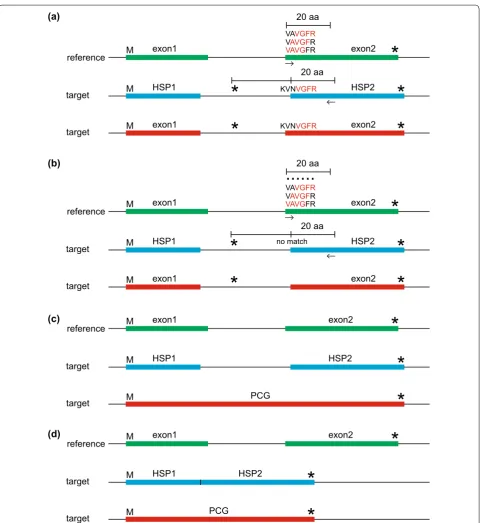
PGA also uses the Intron Boundary Detection Algo-rithm (IBDA) to locate intron–exon boundaries and detect intron loss (Fig. 3). In IBDA, PGA (a) first
identifies the existence of an intron due to the fact that a stop codon(s) is/are found in the region between the 3′ end of HSP1 and the 5′ end of HSP2 in the same reading
*
HSP2
exon2 20 aa
VAVGFR
20 aa
target
target reference
VAVGFR VAVGFR
*
*
(c) (a)
(b)
M HSP1
exon1 M
M exon1 exon2
*
*
*
HSP2 target
target
reference
*
*
M HSP1
PCG M
M exon1 exon2
no match
...
*
HSP2
exon2 20 aa
VAVGFR
20 aa
KVNVGFR
target
target reference
VAVGFR VAVGFR
*
KVNVGFR
*
M HSP1
exon1 M
M exon1 exon2
*
*
(d)
*
HSP2 target
target
reference
*
*
M HSP1
PCG M
M exon1 exon2
frame as HSP1 and HSP2, or because the length of this region is not a multiple of three (Fig. 3a). PGA then uses the first four amino acids (“VAVG”; Fig. 3a) of exon2 of the reference CDS as a probe to search the region between the first detected stop codon upstream of HSP2 and the 20th amino acid of HSP2, with the search from right to left. If this fails to find a match, the four amino acid probe window is moved downstream by one amino acid in exon2 of the reference CDS (the probe is changed into “AVGF”; Fig. 3a), and so on until the 20th amino acid of the exon2 of the reference CDS. If this succeeds in locating a match (with the probe of “VGFR” after the four amino acid window being moved downstream by two steps in the reference plastome; Fig. 3a), PGA will treat the position of the first matched amino acid of the probe in the target plastome as the starting point (the “V” of “VGFR” in the target plastome). The position of the first amino acid of exon2 (the first “V” of “VNVGFR” in the target plastome) is then identified by moving left from this starting point by the number of steps (two steps) that the four amino acid window was shifted in the refer-ence CDS, then the position of the first codon of exon2 is identified. The intron/exon2 boundary is finally identified through moving left from the position of the first codon of exon2 by the number of split-codon nucleotides, which is determined by dividing the length of exon2 in the ref-erence CDS by three. The exon1/intron boundary is identified using the same process. (b) If strategy (a) fails to identify the intron boundaries, the first amino acid of HSP2 is tentatively annotated as the first codon, and the intron/exon2 boundary is identified through moving left from the position of the first codon by the number of
split-codon nucleotides (Fig. 3b). This annotated PCG is then added to the log file for manual verification. Intron loss is detected in one of two ways: (c) if no in-frame stop codon exists between the 3′ end of HSP1 and the 5′ end of HSP2 (Fig. 3c), or (d) if the location of the 3′ end of HSP1 is the same as that of the 5′ end of HSP2, an intron loss event is noted in the log file and the joined exons are annotated as a single CDS (Fig. 3d). A similar algorithm to IBDA is applied to identify intron–exon boundaries for intron-containing tRNAs (Fig. 3a, b); it differs by using the first 9 nt from the first 30 nt at both ends of each reference tRNA exon as probes. The search region is restricted to the first 30 nt at both ends of the HSP1 and HSP2 plus their adjacent 30 nt in the upstream and downstream regions. IR boundary annotation is accom-plished via a self-BLASTN search. One parameter can be adjusted to determine the IR boundaries: minimum allowed IR length (default = 1000).
Detecting pseudogenes
To detect putative pseudogenes, PGA uses a parameter ([-q -qcoverage], optional: [default: 0.5,2]). Briefly, this parameter is determined by dividing the length of the annotated gene by that of the reference gene. The anno-tated genes with a query coverage less or greater than each of the two changeable threshold values will be added to the warning log file. Because pseudogenes can be highly variable among plastomes, users can adjust these two threshold values to satisfy their own needs. It is important to note that a pseudogene may fail to be iden-tified using poorly fitting threshold values.
Table 1 Comparison of existing plastome annotation tools
For PGA, a laptop equipped with 2.5 GHz 4-core Intel core i3 processors and 8 GB memory was used. Runtimes for other tools were derived from the corresponding references. The phrase “target against reference” signifies a BLASTN or TBLASTN search of a target plastome against an annotated reference plastome, whereas “reference against target” signifies a BLASTN or TBLASTN search of an annotated reference plastome against a target plastome
Tools Operating
system User interface Time Approach Post-annotation algorithms for identification of feature boundaries
Output file
format Log file References
DOGMA Windows, Linux,
Mac Web 5–10 min Target against reference No table No Wyman et al. [12] CpGAVAS Windows, Linux,
Mac Web ~ 1 h Target against reference No GFF3 and GenBank No Liu et al. [13] Plan Windows, Linux,
Mac Console ~ 30 s Target against reference No tbl Yes Huang and Cronk [16] Verdant Windows, Linux,
Mac Web 10–30 min Target against reference Yes GFF3 No McKain et al. [14] GeSeq Windows, Linux,
Mac Web 6 s–13 min Target against reference No GenBank No Tillich et al. [15] PGA Windows, Linux,
Results and discussion
Example
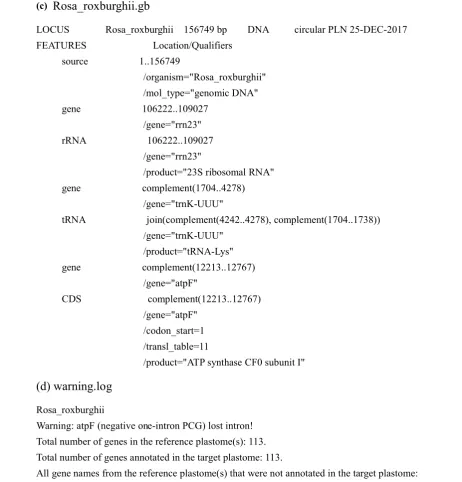
PGA consists of six steps (Fig. 1). The first two steps require user input, whereas the last four are auto-matic. As an example, we used PGA to annotate the target plastome of Rosa roxburghii Tratt. with the plastome of Amborella trichopoda Baill. as a reference (Fig. 4). Geneious R9 [17] was used to check flagged annotations.
Step 1 Preparation of GenBank-formatted reference plastomes
It is possible to use available GenBank-formatted refer-ence plastomes within PGA, but we encourage users to prepare reference plastomes from relatives of the target taxa (Fig. 1). Reference plastomes, whether acquired from GenBank or other sources, must be carefully checked, especially to ensure that the indispensable “/gene” quali-fier is present for each gene (Fig. 4a).
Step 2 Preparation of FASTA-formatted target plastomes
The target plastomes should be prepared in FASTA for-mat, one sequence per file (Figs. 1 and 4b).
Step 3 Reference database generation
PGA uses annotation features (i.e. “gene”, “rRNA”, “tRNA” and “CDS”) from GenBank-formatted reference plastomes to generate a reference database with four components: RNA nucleotides, PCG nucleotides, coding sequence (CDS) amino acids without introns, and CDS amino acids with introns (Fig. 1). PGA parses reference plastomes based on “gene”, “rRNA”, “tRNA” and “CDS” qualifiers and extracts these features and their corre-sponding nucleotide sequences based on their coordi-nates. Then, nucleotide sequences of CDS are translated into amino acid sequences.
Step 4 BLAST search
Reverse query-subject BLAST searches are applied to locate genes in the target plastome (Fig. 1). Search-ing for a fixed number of genes takes full advantage of the conserved gene content of plastomes. BLASTN and TBLASTN [18] are used for searches of nucleotide and amino acid sequences, respectively. During searching, any PCGs with a TBLASTN percent identity less than the changeable threshold value (default = 40%) will be listed in the log file and will not be annotated.
Step 5 Determining feature boundaries
Gene and intron boundaries are initially determined from the BLAST search, and are then refined using the Gene Boundary Detection Algorithm (GBDA), which searches for start and stop codons (including those with non-ATG start codons), and the Intron Boundary Detec-tion Algorithm (IBDA), which locates intron–exon boundaries and detects intron loss (Fig. 1). IR boundary annotation is accomplished via a self-BLASTN search. Details are provided in the section above (“Boundary detection algorithms”) and in Figs. 2 and 3.
Step 6 Generating GenBank and log files
The final step for each run is the generation of Gen-Bank-formatted files and the log file (Figs. 1, 4c, d). To allow for manual verification, the log file will con-tain warnings concerning any unusual feature, includ-ing PCGs with non-ATG start codons and PCGs with a query coverage less or greater than each of the two changeable threshold values (default: 0.5, 2). For each tar-get plastome, the log file also includes a list of the total number of genes in the reference plastome(s), the total number of genes annotated, and all gene names from the reference(s) that were not annotated in the target, to assist users in verifying questionable annotations.
Overall performance
In order to measure the performance of PGA relative to other published tools, we re-annotated 20 gymnosperm plastomes and 20 angiosperm plastomes from GenBank using the properly annotated Zamia furfuracea Aiton plastome and Amborella trichopoda plastome as respec-tive references (Tables 2, 3). We only conducted compari-sons between PGA and GeSeq, because the performance of the most recently published GeSeq is equal or supe-rior to other published tools [15]. In addition, PGA and GeSeq represent useful comparisons due to the full cus-tomizability of reference sequences by the user in both programs. In order to facilitate comparisons, PGA was run with default settings, and GeSeq was run in quick annotation mode. For rRNAs, tRNAs, and PCGs without introns, we compared the number of the missing anno-tated genes (MGs), wrongly annoanno-tated genes (WGs), wrongly annotated gene boundaries (WGBs) and cor-rectly annotated genes (CGs). For tRNAs and PCGs with introns, we compared the number of missing annotated exons (MEs), wrongly annotated exons (WEs), wrongly
(See figure on next page.)
(a)
Amborella_trichopoda.gb
LOCUS Amborella_trichopoda 162686 bp DNA circular UNA 08-JUN-2015 DEFINITION Amborella trichopoda chloroplast genomic DNA, complete sequence.
ACCESSION AJ506156
VERSION AJ506156.2 GI:34481608 KEYWORDS complete genome.
SOURCE chloroplast Amborella trichopoda ORGANISM Amborella trichopoda
Eukaryota; Viridiplantae; Streptophyta; Embryophyta; Tracheophyta; Spermatophyta; Magnoliophyta; basal Magnoliophyta; Amborellales; Amborellaceae; Amborella.
FEATURES Location/Qualifiers source 1..162686
/organism="Amborella trichopoda" /mol_type="genomic DNA" repeat_region 90951..117611
/note="inverted repeat region B; IRB repeat region" /rpt_type="inverted"
rRNA complement(139284..142097) /gene="rrn23"
/product="23S ribosomal RNA" gene complement(139284..142097) /gene="rrn23"
tRNA join(complement(4472..4508), complement(1840..1874)) /gene="trnK-UUU"
/product="tRNA-Lys" gene complement(1840..4508) /gene="trnK-UUU"
CDS join(complement(16186..16330), complement(14506..14915)) /gene="atpF"
/codon_start=1 /transl_table=11
/product="ATPase I subunit"
/translation="MKNVTDSFVSLGHWPSAGSFGFNTDIFATNPINLSVVLGVLIFF
GKGVLSDLLDNRKQRILSTIRNSEELRGGAIEQLEKARARLRKVEIEADEFRVNGYSE
IEREKSNLINAAYENLERLENYKNESIHFEQQRAMNQVRQRVFQQALQGALETLNSYL NSELHLRTISANIGMLGTMKNITD"
gene complement(14506..16330) /gene="atpF"
(b)
Rosa_roxburghii.fasta
>Rosa_roxburghii
annotated exon boundaries (WEBs) and correctly anno-tated exons (CEs).
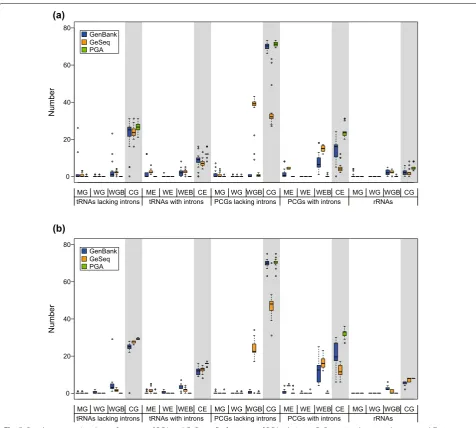
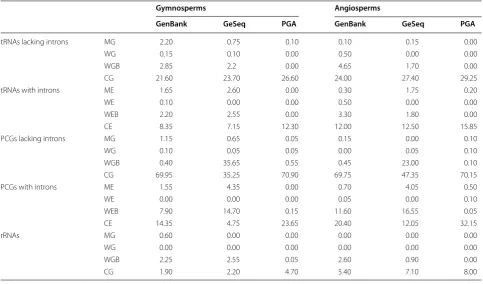
In general, PGA performed better than GeSeq (Fig. 5). For gymnosperms (Fig. 5a; Table 4), PGA and GeSeq produced similar average numbers of WGs/WEs for tRNAs lacking introns, tRNAs with introns, PCGs lacking introns, PCGs with introns and rRNAs, and similar average numbers of MGs for rRNAs. However, PGA annotated significantly lower average numbers
of MGs/MEs than GeSeq for tRNAs lacking introns, tRNAs with introns, PCGs lacking introns and PCGs with introns, and lower average numbers of WGBs/ WEBs than GeSeq for tRNAs lacking introns, tRNAs with introns, PCGs lacking introns, PCGs with introns and rRNAs. Importantly, PGA annotated higher aver-age numbers of CGs/CEs than GeSeq for tRNAs lack-ing introns (26.60 vs. 23.70), tRNAs with introns (12.30 vs. 7.15), PCGs lacking introns (70.90 vs. 35.25), PCGs
(c)
Rosa_roxburghii.gb
LOCUS Rosa_roxburghii 156749 bp DNA circular PLN 25-DEC-2017 FEATURES Location/Qualifiers
source 1..156749
/organism="Rosa_roxburghii" /mol_type="genomic DNA" gene 106222..109027
/gene="rrn23" rRNA 106222..109027
/gene="rrn23"
/product="23S ribosomal RNA" gene complement(1704..4278)
/gene="trnK-UUU"
tRNA join(complement(4242..4278), complement(1704..1738)) /gene="trnK-UUU"
/product="tRNA-Lys" gene complement(12213..12767)
/gene="atpF"
CDS complement(12213..12767) /gene="atpF"
/codon_start=1 /transl_table=11
/product="ATP synthase CF0 subunit I"
(d) warning.log
Rosa_roxburghii
Warning: atpF (negative one-intron PCG) lost intron! Total number of genes in the reference plastome(s): 113. Total number of genes annotated in the target plastome: 113.
with introns (23.65 vs. 4.75) and rRNAs (4.70 vs. 2.20). For angiosperms (Fig. 5b; Table 4), PGA and GeSeq produced similar average numbers of WGs/WEs for tRNAs lacking introns, tRNAs with introns, PCGs lack-ing introns, PCGs with introns and rRNAs, and simi-lar average numbers of MGs for tRNAs lacking introns, PCGs lacking introns and rRNAs. However, PGA anno-tated significantly lower average numbers of MEs than GeSeq for tRNAs with introns and PCGs with introns, and lower average numbers of WGBs/WEBs than GeSeq for tRNAs lacking introns, tRNAs with introns, PCGs lacking introns, PCGs with introns and rRNAs. Importantly, PGA annotated higher average numbers of CGs/CEs than GeSeq for tRNAs lacking introns (29.25 vs. 27.40), tRNAs with introns (15.85 vs. 12.50), PCGs lacking introns (70.15 vs. 47.35), PCGs with introns (32.15 vs. 12.05) and rRNAs (8.00 vs. 7.10). Further-more, PGA had a lower interquartile range than GeSeq, indicating a higher percentage of consistently correct annotations (Fig. 5).
Recommendations for using PGA
(1) Users should carefully check the GenBank-format-ted reference plastome. PGA is packaged with sev-eral properly annotated plastomes, and it is thus possible for users to use PGA to re-annotate a plas-tome that is intended to be used as a reference, in order to correct possible inaccuracies.
(2) It is important that users select a reference plas-tome that contains sufficient numbers of annotated genes for the target taxa. The number of genes in the reference plastome(s) should equal or exceed the number in the target plastome(s). If the num-ber of genes in the target is uncertain, it may be best to use multiple reference plastomes. The Amborella trichopoda (AJ506156) and Zamia furfuracea (JX416857) plastomes included within PGA are examples of plastomes that contain the highest gene numbers among known angiosperms and gymno-sperms, and as such it is recommended that they be included as references during PGA runs.
(3) We do not recommend annotating highly incom-plete plastomes using a comincom-plete reference plas-tome, because BLAST may annotate some genes redundantly (i.e., BLAST may return hits for genes that were not sequenced or are otherwise absent in the incomplete plastome, resulting in spurious annotations). To annotate highly incomplete plas-tomes or plastome segments, we recommend using progressiveMauve as implemented in Mauve 2.4.0 [19] to align the incomplete plastome to the refer-ence plastome, followed by the use of the
corre-Table 2 List of 20 gymnosperm plastomes from GenBank used to test the performance of PGA
Species Family Size (bp) Accession no.
Amentotaxus formosana Taxaceae 136,430 NC_024945 Araucaria heterophylla Araucariaceae 146,723 NC_026450 Callitris rhomboidea Cupressaceae 121,117 NC_034940 Cephalotaxus wilsoniana Cephalotaxaceae 136,196 NC_016063 Cryptomeria japonica Cupressaceae 131,810 NC_010548 Cunninghamia lanceolata Cupressaceae 135,334 NC_021437 Cycas taitungensis Cycadaceae 163,403 NC_009618 Dacrycarpus imbricatus Podocarpaceae 133,811 NC_034942 Dioon spinulosum Zamiaceae 161,815 NC_027512 Ginkgo biloba Ginkgoaceae 156,988 NC_016986 Juniperus communis Cupressaceae 128,334 NC_035068 Metasequoia
glyptos-troboides Cupressaceae 131,887 NC_027423 Podocarpus totara Podocarpaceae 133,259 NC_020361 Retrophyllum piresii Podocarpaceae 133,291 NC_024827 Sciadopitys verticillata Sciadopityaceae 138,284 NC_029734 Sequoia sempervirens Cupressaceae 133,929 NC_030372 Taiwania flousiana Cupressaceae 131,413 NC_021441 Taxodium distichum Cupressaceae 131,954 NC_034941 Torreya grandis Taxaceae 136,949 NC_034806 Wollemia nobilis Araucariaceae 145,630 NC_027235
Table 3 List of 20 angiosperm plastomes from GenBank used to test the performance of PGA
Species Family Size (bp) Accession no.
Acorus gramineus Acoraceae 152,849 NC_026299 Amborella trichopoda Amborellaceae 162,686 NC_005086 Aralia undulata Araliaceae 156,333 NC_022810 Buxus microphylla Buxaceae 159,010 NC_009599 Calycanthus floridus Calycanthaceae 153,337 NC_004993 Carludovica palmata Cyclanthaceae 158,545 NC_026786 Chloranthus japonicus Chloranthaceae 158,640 NC_026565 Ceratophyllum
demer-sum Ceratophyllaceae 156,252 NC_009962 Drimys granadensis Winteraceae 160,604 NC_008456 Eucommia ulmoides Eucommiaceae 163,341 KU204775 Hanguana malayana Hanguanaceae 163,231 NC_029962 Larrea tridentata Zygophyllaceae 136,194 NC_028023 Liquidambar formosana Altingiaceae 160,410 NC_023092 Lupinus albus Fabaceae 154,140 NC_026681 Nelumbo lutea Nelumbonaceae 163,206 NC_015605 Potamogeton
perfo-liatus Potamogetonaceae 156,226 NC_029814 Sapindus mukorossi Sapindaceae 160,481 NC_025554 Trochodendron
sponding homologous block of the reference plas-tome as the reference for annotation in PGA. (4) We suggest that users carefully check highly
diver-gent or otherwise unusual target plastomes for incorrect annotations. This is particularly impor-tant for plastomes with a high degree of gene loss, pseudogenization or sequence divergence.
Conclusions
Comparisons with other plastome annotation tools demonstrate the speed and high annotation accuracy of PGA. Importantly, PGA is also highly flexible, as demon-strated by the annotation of the Rosa roxburghii plastome using the phylogenetically distant Amborella trichopoda plastome as a reference. For projects in which multiple 0
20 40 60 80
Number
GenBank GeSeq PGA
tRNAs lacking introns tRNAs with introns PCGs lacking introns PCGs with introns rRNAs MG WG WGB CG ME WE WEB CE MG WG WGB CG ME WE WEB CE MG WG WGB CG
0 20 40 60 80
Number
GenBank GeSeq PGA
tRNAs lacking introns tRNAs with introns PCGs lacking introns PCGs with introns rRNAs MG WG WGB CG ME WE WEB CE MG WG WGB CG ME WE WEB CE MG WG WGB CG (a)
(b)
plastomes are generated, the time savings for high-qual-ity plastome annotation are especially significant.
Availability and requirements
Project name: PGA-Plastid Genome Annotator
Project home page: https ://githu b.com/quxia ojian /PGA
Operating systems(s): Platform independent Programming language: Perl
Other requirements: Perl 5, BLAST 2.5.0 or higher License: GPL-3 (https ://www.gnu.org/licen ses/gpl-3.0.en. html)
Any restrictions to use by non-academics: none.
Abbreviations
PGA: Plastid Genome Annotator; IR: inverted repeat; PCGs: protein‑coding genes; HSP: high‑scoring segment pair; GBDA: Gene Boundary Detection Algorithm; IDBA: Intron Boundary Detection Algorithm; CDS: coding sequence MGs: missing annotated genes; WGs: wrongly annotated genes; WGBs: wrongly annotated gene boundaries; CGs: correctly annotated genes; MEs: missing annotated exons; WEs: wrongly annotated exons; WEBs: wrongly annotated exon boundaries; CEs: correctly annotated exons.
Acknowledgements
We thank Rong Zhang, Ying‑Ying Yang and Jian‑Jun Jin from Kunming Insti‑ tute of Botany, Chinese Academy of Sciences, and Pin Gong from the Institute of Botany, Chinese Academy of Sciences for suggestions on how to improve the user experience. We thank the Molecular Biology Experimental Center
of the Germplasm Bank of Wild Species at the Kunming Institute of Botany, Chinese Academy of Sciences for providing sequence data.
Authors’ contributions
DZL and TSY designed the research. XJQ developed the program with con‑ tributions from MJM and TSY. XJQ wrote the manuscript. MJM, DZL and TSY revised the manuscript. All authors read and approved the final manuscript.
Funding
This work was supported by grants from the Strategic Priority Research Program of Chinese Academy of Sciences (XDB31010000), CAS “Light of West China” Program (Y8247411W1), the National Natural Science Founda‑ tion of China [key international (regional) cooperative research project No. 31720103903], and the Large‑scale Scientific Facilities of the Chinese Academy of Sciences (No. 2017‑LSF‑GBOWS‑02).
Data availability
The program, user manual and example data sets are freely available on https ://githu b.com/quxia ojian /PGA.
Ethics approval and consent to participate Not applicable.
Consent for publication Not applicable.
Competing interests
The authors declare that they have no competing interests.
Author details
1 Germplasm Bank of Wild Species, Kunming Institute of Botany, Chinese
Academy of Sciences, 132 Lanhei Road, Kunming 650204, Yunnan, China. Table 4 Comparative performance of PGA and GeSeq in annotating plastomes
Numbers represent mean values
MG = missing annotated gene, WG = wrongly annotated gene, WGB = wrongly annotated gene boundary, CG = correctly annotated gene. ME = missing annotated exon, WE = wrongly annotated exon, WEB = wrongly annotated exon boundary, CE = correctly annotated exon
Gymnosperms Angiosperms
GenBank GeSeq PGA GenBank GeSeq PGA
tRNAs lacking introns MG 2.20 0.75 0.10 0.10 0.15 0.00
WG 0.15 0.10 0.00 0.50 0.00 0.00
WGB 2.85 2.2 0.00 4.65 1.70 0.00
CG 21.60 23.70 26.60 24.00 27.40 29.25
tRNAs with introns ME 1.65 2.60 0.00 0.30 1.75 0.20
WE 0.10 0.00 0.00 0.50 0.00 0.00
WEB 2.20 2.55 0.00 3.30 1.80 0.00
CE 8.35 7.15 12.30 12.00 12.50 15.85
PCGs lacking introns MG 1.15 0.65 0.05 0.15 0.00 0.10
WG 0.10 0.05 0.05 0.00 0.05 0.10
WGB 0.40 35.65 0.55 0.45 23.00 0.10
CG 69.95 35.25 70.90 69.75 47.35 70.15
PCGs with introns ME 1.55 4.35 0.00 0.70 4.05 0.50
WE 0.00 0.00 0.00 0.05 0.00 0.10
WEB 7.90 14.70 0.15 11.60 16.55 0.05
CE 14.35 4.75 23.65 20.40 12.05 32.15
rRNAs MG 0.60 0.00 0.00 0.00 0.00 0.00
WG 0.00 0.00 0.00 0.00 0.00 0.00
WGB 2.25 2.55 0.05 2.60 0.90 0.00
•fast, convenient online submission
•
thorough peer review by experienced researchers in your field
• rapid publication on acceptance
• support for research data, including large and complex data types
•
gold Open Access which fosters wider collaboration and increased citations maximum visibility for your research: over 100M website views per year
•
At BMC, research is always in progress.
Learn more biomedcentral.com/submissions
Ready to submit your research? Choose BMC and benefit from: 2 Shandong Provincial Key Laboratory of Animal Resistance Biology, Institute
of Biomedical Sciences, College of Life Sciences, Shandong Normal University, Jinan, Shandong, China. 3 Department of Biology, Oberlin College, Oberlin,
OH, USA.
Received: 26 November 2018 Accepted: 10 May 2019
References
1. Wicke S, Schneeweiss GM, dePamphilis CW, Muller KF, Quandt D. The evolution of the plastid chromosome in land plants: gene content, gene order, gene function. Plant Mol Biol. 2011;76:273–97.
2. Jansen RK, Ruhlman TA. Plastid genomes of seed plants. In: Bock R, Knoop V, editors. Genomics of chloroplasts and mitochondria. Dordrecht: Springer; 2012. p. 103–26.
3. Gitzendanner MA, Soltis PS, Yi T‑S, Li D‑Z, Soltis DE. Plastome phylogenet‑ ics: 30 years of inferences into plant evolution. In: Chaw S‑M, Jansen RK, editors. Advances in botanical research. New York: Academic Press; 2018. p. 293–313.
4. Soltis DE, Gitzendanner MA, Stull G, Chester M, Chanderbali A, Chamala S, Jordon‑Thaden I, Soltis PS, Schnable PS, Barbazuk WB. The potential of genomics in plant systematics. Taxon. 2013;62:886–98.
5. Davis CC, Xi Z, Mathews S. Plastid phylogenomics and green plant phy‑ logeny: almost full circle but not quite there. BMC Biol. 2014;12:11. 6. Soltis DE, Morris AB, McLachlan JS, Manos PS, Soltis PS. Comparative
phylogeography of unglaciated eastern North America. Mol Ecol. 2006;15:4261–93.
7. Rogalski M, do Nascimento Vieira L, Fraga HP, Guerra MP. Plastid genomics in horticultural species: importance and applications for plant population genetics, evolution, and biotechnology. Front Plant Sci. 2015;6:586. 8. Chaw S‑M, Wu C‑S, Sudianto E. Evolution of gymnosperm plastid
genomes. In: Chaw S‑M, Jansen RK, editors. Advances in botanical research. New York: Academic Press; 2018. p. 195–222.
9. Bock R. Engineering plastid genomes: methods, tools, and applications in basic research and biotechnology. Annu Rev Plant Biol. 2015;66:211–41.
10. Daniell H, Lin C‑S, Yu M, Chang W‑J. Chloroplast genomes: diversity, evolution, and applications in genetic engineering. Genome Biol. 2016;17:134.
11. Straub SCK, Parks M, Weitemier K, Fishbein M, Cronn RC, Liston A. Navigat‑ ing the tip of the genomic iceberg: next‑generation sequencing for plant systematics. Am J Bot. 2012;99:349–64.
12. Wyman SK, Jansen RK, Boore JL. Automatic annotation of organellar genomes with DOGMA. Bioinformatics. 2004;20:3252–5.
13. Liu C, Shi LC, Zhu YJ, Chen HM, Zhang JH, Lin XH, Guan XJ. CpGAVAS, an integrated web server for the annotation, visualization, analysis, and GenBank submission of completely sequenced chloroplast genome sequences. BMC Genom. 2012;13:715.
14. McKain MR, Hartsock RH, Wohl MM, Kellogg EA. Verdant: automated annotation, alignment and phylogenetic analysis of whole chloroplast genomes. Bioinformatics. 2017;33:130–2.
15. Tillich M, Lehwark P, Pellizzer T, Ulbricht‑Jones ES, Fischer A, Bock R, Greiner S. GeSeq–versatile and accurate annotation of organelle genomes. Nucleic Acids Res. 2017;45:W6–11.
16. Huang DI, Cronk QCB. Plann: a command‑line application for annotating plastome sequences. Appl Plant Sci. 2015;3:1500026.
17. Kearse M, Moir R, Wilson A, Stones‑Havas S, Cheung M, Sturrock S, Buxton S, Cooper A, Markowitz S, Duran C, Thierer T, Ashton B, Meintjes P, Drum‑ mond A. Geneious basic: an integrated and extendable desktop software platform for the organization and analysis of sequence data. Bioinformat‑ ics. 2012;28:1647–9.
18. Camacho C, Coulouris G, Avagyan V, Ma N, Papadopoulos J, Bealer K, Madden TL. BLAST + : architecture and applications. BMC Bioinform. 2009;10:421.
19. Darling AE, Mau B, Perna NT. progressiveMauve: multiple genome align‑ ment with gene gain, loss and rearrangement. PLoS ONE. 2010;5:e11147.
Publisher’s Note