Open Access
Software
Computer aided data acquisition tool for high-throughput
phenotyping of plant populations
Raju Naik Vankadavath
1, Appibhai Jakir Hussain
1,2, Reddaiah Bodanapu
1,
Eros Kharshiing
1,3, Pinjari Osman Basha
1,4, Soni Gupta
1,
Yellamaraju Sreelakshmi
1and Rameshwar Sharma*
1Address: 1School of Life Sciences, University of Hyderabad, Hyderabad 500 046, India, 2JK AgriGenetics, Begumpet, Hyderabad 500016, India, 3Department of Botany, St Edmund's College, Meghalaya 793003, India and 4Department of Genetics and Genomics, Yogi Vemana University, Kadapa 516003, India
Email: Raju Naik Vankadavath - [email protected]; Appibhai Jakir Hussain - [email protected];
Reddaiah Bodanapu - [email protected]; Eros Kharshiing - [email protected]; Pinjari Osman Basha - [email protected]; Soni Gupta - [email protected]; Yellamaraju Sreelakshmi - [email protected];
Rameshwar Sharma* - [email protected] * Corresponding author
Abstract
Background: The data generated during a course of a biological experiment/study can be sometimes be massive and its management becomes quite critical for the success of the investigation undertaken. The accumulation and analysis of such large datasets often becomes tedious for biologists and lab technicians. Most of the current phenotype data acquisition management systems do not cater to the specialized needs of large-scale data analysis. The successful application of genomic tools/strategies to introduce desired traits in plants requires extensive and precise phenotyping of plant populations or gene bank material, thus necessitating an efficient data acquisition system.
Results: Here we describe newly developed software "PHENOME" for high-throughput phenotyping, which allows researchers to accumulate, categorize, and manage large volume of phenotypic data. In this study, a large number of individual tomato plants were phenotyped with the "PHENOME" application using a Personal Digital Assistant (PDA) with built-in barcode scanner in concert with customized database specific for handling large populations.
Conclusion: The phenotyping of large population of plants both in the laboratory and in the field is very efficiently managed using PDA. The data is transferred to a specialized database(s) where it can be further analyzed and catalogued. The "PHENOME" aids collection and analysis of data obtained in large-scale mutagenesis, assessing quantitative trait loci (QTLs), raising mapping population, sampling of several individuals in one or more ecological niches etc.
Background
The precise documentation of phenotypic characters is of paramount importance for relating them to causative
genes using currently available genomic tools/strategies of forward genetics or reverse genetics. A superior integration of high-throughput phenotyping technology and gene
Published: 10 December 2009
Plant Methods 2009, 5:18 doi:10.1186/1746-4811-5-18
Received: 14 August 2009 Accepted: 10 December 2009
This article is available from: http://www.plantmethods.com/content/5/1/18
© 2009 Vankadavath et al; licensee BioMed Central Ltd.
discovery that aims to unlock gene-phenotype relation-ships is a key step for better understanding of the genetic basis of such characters. Therefore, the development of a computable phenotypic database that allows rapid access to information on genes and associated phenotype(s) would extremely ease the process of data mining and data management. Since the representation of phenotypic information is a complicated process, there are few data standards for managing phenotypes and repositories even within a species [1]. In the process of associating pheno-types with genes, data integration plays a key role in cor-relating heterogeneous phenotypic data with genomic data at different levels. This is especially relevant in reverse genetics, where obvious morphological changes are rarely observed [2], or when mutations bring about only slight alterations in the phenotype. The technique of TILLING (Targeting Induced Local Lesions IN Genomes) [3,4] is a very powerful reverse genetics tool which is employed for high-throughput functional analysis. As with other reverse genetics strategies, this method requires extensive and pre-cise documentation of material collected from which functional genomics data are produced [5]. However, one of the biggest challenges that are faced by such strategies is the availability of tools that would allow researchers to collect, access, organize, integrate and manage phenotypic databases across population(s), and which would enable the subsequent correlation of phenotypic information with genomic data. Thus, there is an urgent need for the development of technologies to encode and organize phe-notypic information for high-throughput analyses [6].
Augmentation in capability of new hardware equipments that support mobile computing has opened a vast range of possible applications that in turn requires development of specific software(s) to run desired application. Palm PCs/ Palm personal Digital Assistants (PDAs) are approxi-mately one-fourth the size of notebook computers. Most of the mobile computer models receive user input from a virtual keyboard on screen, while others depend on an electronic pen and incorporate handwriting recognition. At present the hand-held computers/palm PDAs are embedded with the graffiti powered touch screen feature for user input. By writing with a stylus on the touch screen one is able to enter text/numbers, select options on the screen and give command to submit the data selected on the touch screen to the database present on PDAs. The most valuable feature available on current palm PDAs is the inbuilt barcode scanners, which makes the mobile computers/palm powered PCs/palm PDAs versatile equipment for the end user. Mobile computing has found applications in a vast range of commercial services right from airline baggage handling to tracking of international shipments of postal packets and is even emerging as a future replacement to the conventional data notebooks used in research laboratories. The recent releases of most
software have built-in or add-on support for mobile com-puting, e.g. Wireless Internet Service provides Windows-CE users a stable link and flawless contact between com-patible hand-held PCs/pocket PCs/Smartphone/palm-size PCs and the master PCs http://www.microsoft.com/ windowsembedded/en-us/products/windowsce/
default.mspx.
There are many compatible programming languages used in mobile computing. One of them is CASL (Compact Application Software Language) which is a prominent free programming language used for the development of soft-ware applications and is based on the legendary BASIC computer language for mobile computers/palm powered/ palm PDAs/hand held PCs http://www.caslsoft.com. The vast implementation of the applications developed using CASLide software has made it the programmer's choice for developing new software for mobile computing. The mobile computing technologies in PDAs are used in diverse fields like census operations, courier services, sur-veys in marketing, eProbe studies in educational insti-tutes, managing the stock in manufacturing plant, field studies, etc. One can also use these applications in fields like hospital clinical trials data management/human dis-ease phenotype data management [1]. The necessity to implement unique identification to the individuals is a pivotal part in the management of these kinds of data. Advances in electronics and digital communications have contributed a revolutionary convention of unique identi-fication procedure using "barcode" with various density and dimensions of 1D, 2D and 3D [7,8], giving the indi-viduals a unique identity for the database management. In several spheres, barcoding is used for assigning a unique identity to the individuals for efficient database manage-ment [9] e.g. super market, transport departmanage-ment, hospi-tals, stock/inventory departments, biological and zoological institutes, etc. Here we describe customized phenotyping software developed in CASLide utilizing CASL programming language. This application was then loaded on to a PDA with an integrated barcode scanner for individual identification. With the ease of field data collection by PDA, we successfully phenotyped a large number of individual tomato plants belonging to an EMS-mutagenized population raised for TILLING.
Results and Discussion
population sizes the simultaneous recording of multiple quantitative/qualitative characters most often becomes unmanageable. At the same time such huge quantity of data are crucially required for associating them with other data obtained experimentally in lab. The currently availa-ble technologies of the data management can be adapted for collating such phenotypic data, using the standard software(s) for data management systems [10] as described below for tomato.
Phenotypic Catalogue (tomato mutant's phenotypic catalogue)
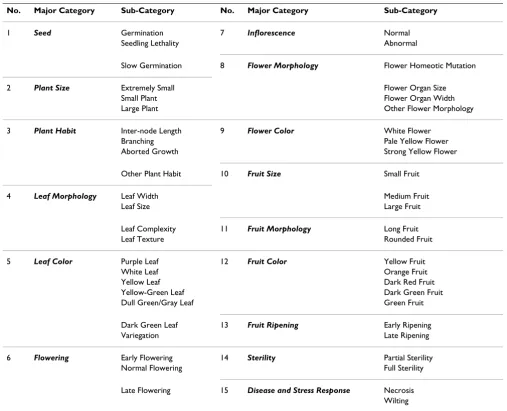
One of the foremost requirements prior to use of the elec-tronic collection of phenotypic data is the selection of phenotypic parameters, which will be used for character-izing a selected population. Thereafter one needs to incor-porate these parameters into a format recognizable by the application in use. In this study, we examined 15 different
categories of plant morphological traits, which could be scored during different developmental stages of tomato beginning from germination to fruit ripening. The 15 cat-egories selected encompassed the visually identifiable traits of the whole plant, leaf, flower, inflorescence, fruit and susceptibility to disease if any (Table 1). These catego-ries were specifically selected to allow characterization of variations in the phenotypes within a large population of plants in a relatively short period with simple visual observations. For each of the 15 primary categories in our catalogue, there were one to seven subcategories describ-ing the plant's phenotype in more specific details (Table 1). These parameters were selectively chosen from a wide range of tomato descriptors described by Menda et al., [11]. Using this system, the mutants were associated with a single subcategory, and thus the maximal number of attributes that each mutant can have equaled to the number of primary categories in the catalogue. This
Table 1: Tomato mutant's phenotypic catalogue
No. Major Category Sub-Category No. Major Category Sub-Category
1 Seed Germination 7 Inflorescence Normal
Seedling Lethality Abnormal
Slow Germination 8 Flower Morphology Flower Homeotic Mutation
2 Plant Size Extremely Small Flower Organ Size
Small Plant Flower Organ Width
Large Plant Other Flower Morphology
3 Plant Habit Inter-node Length 9 Flower Color White Flower
Branching Pale Yellow Flower
Aborted Growth Strong Yellow Flower
Other Plant Habit 10 Fruit Size Small Fruit
4 Leaf Morphology Leaf Width Medium Fruit
Leaf Size Large Fruit
Leaf Complexity 11 Fruit Morphology Long Fruit
Leaf Texture Rounded Fruit
5 Leaf Color Purple Leaf 12 Fruit Color Yellow Fruit
White Leaf Orange Fruit
Yellow Leaf Dark Red Fruit
Yellow-Green Leaf Dark Green Fruit
Dull Green/Gray Leaf Green Fruit
Dark Green Leaf 13 Fruit Ripening Early Ripening
Variegation Late Ripening
6 Flowering Early Flowering 14 Sterility Partial Sterility
Normal Flowering Full Sterility
Late Flowering 15 Disease and Stress Response Necrosis
rationale is important for database queries in a web inter-face, which was designed to enable a straightforward search for simple traits as well as phenotypic traits affect-ing more than one attribute of the plant's morphology. Naturally, some mutant classes were described in the detail as their variations from the wild type were more pronounced under the field conditions.
PHENOME software for high-throughput phenotypic data collection
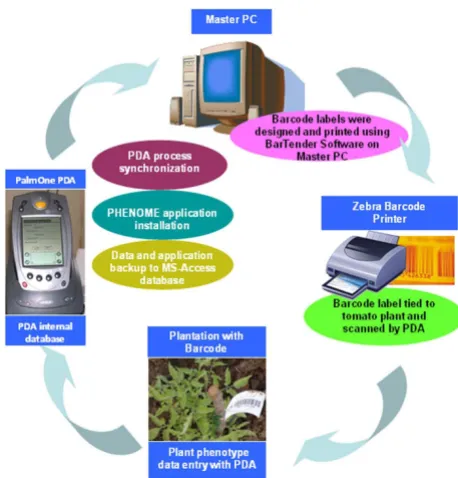
This software was developed to meet the needs of cata-loging divergence in morphological traits for a large muta-genized tomato population that was raised for reverse genetics studies using TILLLING. We first tested the soft-ware by checking the accuracy of PDA barcode scanner to scan the barcode label tagged to the plants in the field. After that, we used PDA to record phenotypic data from a mapping population of tomato (~1,500 plants) and an EMS mutagenized cv. Arka Vikas TILLING population (~10,000 plants) and saved the collected data on to the Master-PC. To ascertain fidelity and ease of the data col-lection, we randomly cross-compared data collected using PDA with data collected manually. We found "PHE-NOME" to be a very convenient tool for data collection with the capability to accumulate phenotypic data rapidly and precisely with modest manual data entry. This accom-plished by using data-handling technologies such as bar codes, personal digital assistants with inbuilt barcode scanner, touch screen, and computer system. The dia-grammatic representation of the plant phenotype data collection using PDA is given in Figure 1. Using PDA, the plants were phenotyped at different stages of vegetative and reproductive growth using pre-defined parameters as enumerated in Table 1. Under field condition the barcode tag of each plant was scanned by a PDA equipped with an integrated laser scanner. Once the PDA recognizes the unique plant-ID barcode label it displays the predefined set of phenotypes for data entry. The visual observations of different parameters of plant phenotype were manually entered with a stylus by using drop down menu on the touch-screen of PDA.
PHENOME works in conjunction with a set of data entry forms for phenotype data collection. First, a "Data Record-ing System" form has to be filled which has an embedded SCAN button facility to record the barcode into the form, followed by "Leaf Data" form, "Flower Data" form, "Fruit Data" form and "other Plant Data" form as given in Figure 2.
At any given time, one can either continue the data record entry, or move to enter data for next plant by tapping the "NEW RECORD" button or tap on the home button on the PDA to exit the application. Thus, the PDA acts as an elec-tronic organizer that enables an easy transfer of
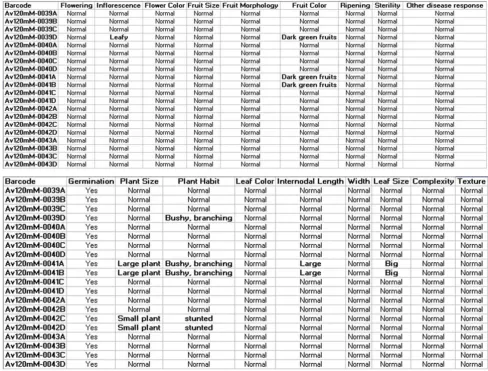
informa-tion from the field to a computer database and funcinforma-tions as an extension of the stored database. The data recorded in the field was transferred to the Master PC (Figure 3) by synchronizing the PDA. Once stored in the Master PC the data can be further classified and analyzed as per the need of the research program.
Conclusion
The utility of the PHENOME application lies in its ability to characterize and evaluate very large sized populations. Accurate and efficient phenotypic characterization is one of the critical parameters for plant breeders for developing hybrids or cultivars that are superior to the existing varie-ties. The key step in phenotyping populations using a mobile technology is the plant descriptors (Phenotype catalogue) which have to be written in program code to be used in the PDA. We used CASL (Compact application solution language) for accomplishing this task. The CASL
The cycle of plant phenotype data collection using PDA with PHENOME software
Figure 1
was selected for the development of data recording appli-cations in PDA because of its free availability, ease of use, less memory consumption and feasibility for fast applica-tion development. Using this applicaapplica-tion, the plants were phenotyped at the different stages described using sets of predetermined characters. We used PHENOME to record and collate phenotypes of individual M2 line of an EMS mutagenized tomato population that was raised for set-ting up TILLING in tomato. In our experience, the use of PDA in the field allows efficient recording of large datasets in a short span of time for large number of plants. Simi-larly, the plant breeders, geneticists, ecologists and molec-ular biologists can utilize the PHENOME software to analyze large populations of plants. Though the PHE-NOME was developed to meet the need of phenotyping
plants, with appropriate customization, the application can be used for collecting data from any other large pop-ulation. Customization can be made for example in the plant descriptors or any other phenotypic descriptors required for any large population based on the require-ment. This customization has to be implemented in the source code of PHENOME software i.e., project file, a file with a .CPJ extension, which is a PHENOME software core file encompassing all the required details for the applica-tion and the same has to be updated in the database file. Then the application could be used for collecting data from any other large population as modified in the source code. The PHENOME software can be edited to suit the end user's experimental requirements and demands. The PHENOME application system will enable collection of
The flow of interactive display of PHENOME application installed on PDA for user input
Figure 2
large datasets from the field thereby permitting efficient analyses and classification of information.
Implementation
Platform Technologies
The eight main components to develop "PHENOME" software were CASLide version 4.3 software http:// www.caslsoft.com, PRCTools version 2.0 http://prc-tools.sourceforge.net/, CYGWIN version B.2.0 http://cyg win.com/, GCCTools http://cygwin.com, PalmOS SDK, ODBC (object database connectivity), PDA http:// www.barcodediscount.com/catalog/symbol/spt1800.htm and PC (personal computer). To generate the barcodes "BarTender" software version 7.5.1 http://www.seagullsci entific.com was installed on the PC and the barcode labels were printed using Zebra barcode printer (Zebra
Technol-ogies). The other remaining components used for the development/executing/synchronization processes of the software and the website addresses for the tools down-loaded were mentioned in the PHENOME software pack-age "PHENOMEReadMe" file. Most of the software components and tools are freely available under GNU Public License. The Microsoft Windows XP Operating Sys-tem compatible software components were used which is user friendly to handle.
The core software language, CASL (Compact Application Solution Language) was used to develop the PHENOME software for PDA in CASLide v4.3 software (Integrated Development Environment). PRCTools component uses GCCTools to compile the project file and uses CYGWIN vB.2.0 Linux emulator software on Windows Operating
The figure illustrates the representative output of phenotypic characters for few M2 plants
Figure 3
System to make and generate the Palm OS (PDA Operat-ing System) compatible p-code (pseudo-code) of the pro-gram for the PDA. The ODBC Connectivity on Microsoft Windows XP Operating System was created to synchro-nize the data between the remote device PDA and the database (Microsoft Access) on Master PC.
Software Development
CASL and IDE Software
CASL is an event driven development tool e.g. objects are positioned on forms and when they are clicked, event occurs which is dependent on the precompiled CASL code that was created to intercept each event. The CASL lan-guage is similar to Visual Basics programming lanlan-guage (most popular GUI programming language of Microsoft)
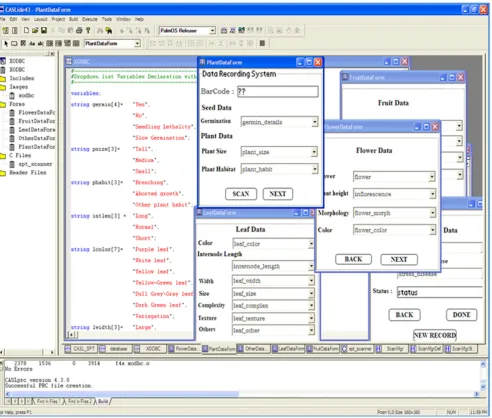
but unlike Visual Basics, it is freely available and it allows one to create programs for PocketPC/PalmPC/PDA taking advantage of the touch screen and inbuilt barcode reader available in PDA's. CASLide was used to design the elec-tronic forms and for editing the programs code of PHE-NOME software. It is a swift application development environment for creating and deploying software to Palm and Pocket PC/Windows mobile devices (Figure 4):
Essentially, the program codes for the customized soft-ware, 'PHENOME', were written in file .CPJ extension using CASL language. These program codes were then compiled using PRC Tools (GCC and C++ compilers). PRC tools package is a collection of tools supporting C and C++ programming for Palm Operating System and
CASL Integrated Development Environment of PHENOME software file
Figure 4
compiles the program in file .MAK extension. Subse-quently, CYGWIN was used to convert the compiled project file .MAK to file .PRC file, which are Palm OS's ver-sion of executable file. The file .PRC extenver-sion was then recognized by HotSync Manager of the PalmOne Desktop software for installing the complete software on PDA. The project files and data types used are described in details in sections below and the schematic representation of the PHENOME software is given in Figure 5.
Barcode label
The prerequisite for data collection in the field is the rec-ognition of Plant ID on barcode labels. The Plant ID's were prepared in the MS-Excel sheet and this file was accessed using BarTender v7.5.1 Enterprise software for printing the unique barcodes on barcode labels for Plant
ID's in the MS-Excel file. Unique plant-ID barcode label designed using BarTender software was printed on syn-thetic polyester, non-erasable, tear proof paper using laser printer. Each plant was tagged with these barcode labels, they were found to be resistant to rain and sunshine and even after six months of exposure to environment in open field, these could be read by the barcode scanning on PDA.
Project Files and Data Types
The PHENOME software was incorporated with include
files, c files, image files, form files, header files and project
files, six sub program files. Here Include files "CASL_SPT"
and "database" possess barcode scanning feature and data-base creation on PDA. CASL_SPT file handles CASL inter-face definition to C functions to perform PDA Bar-Code scanner operations. The database file saves the phenotype data that was entered in electronic form on PDA. This helped to view, retrieve and modify the data records on PDA. The destination for PDA database on Master PC was MS-Access database. The database file name was incorpo-rated in database include file of project as
database_source_name "CASLPlants";. The C file was
"spt_scanner", that holds the definition of barcode scan-ning properties; the form files are used for phenotype data collection in the application. We have created five forms
"PlantDataForm", "LeafDataForm", "FlowerDataForm", "FruitDataForm", and "Other DataForm" to acquire the related data from individual plant. The library files were
"ScanMgr", "ScanMgrStruct" and "ScanMgrDef"; these are barcode scanner supporting files of the application. The project file was file .CPJ extension, which is the core file of the project and gives all the information of the application needs; the String data type was used for storing the pheno-type characteristic values. The image files contain the graphics used by PHENOME software to display user-con-venient image variables for data recording system on PDA display screen, which supports only "Bitmap" image file types. Instead of plant descriptors, bitmap image files can be used to record the phenotypes, for example seed phe-notype can be recorded against seed bitmap image. This PHENOME software package is versatile to include/ remove the phenotype characteristic values e.g. for the phenotype character "Germination", we were able to add new phenotype character value "Fast Germination" to the values existing ("yes", "no", "seedling lethality" and "slow germination") by modifying the program code respec-tively in the file .CPJ extension (In case any phenotype character/values is added/removed in the program code, the same should be created/deleted from the forms). The procedure for adding/removing the new values or charac-teristics is mentioned in "PHENOMEReadMe" file of PHENOME software package. PHENOME software does not support features like image capturing for the plants in the field using inbuilt camera on current releases of PDA's.
Schematic representation of the PHENOME software
Figure 5
However, this is also one of our long-term goals to develop our software for PDA's with built-in cameras, which include capturing the photos of the plants and sub-sequent annotations such as tags, captions, etc.
Data Recording System
Data recording forms were used to feed the plant pheno-type data into PHENOME software on PDA using touch screen. The forms were designed by using a Form Control Toolbar in CASLide project by using objects such as but-tons, labels, text boxes, list, drop down menu, etc. The dis-play screen size of the form while developing the software has to be matched to the size of the PDA screen to prevent objects from being distorted; this was done in the menu project settings of CASLide v4.3 software before installing the PHENOME software on PDA. The default screen reso-lution of the Palm PDA was 160 pixels wide by 160 pixels tall. To facilitate the built-in barcode scanning feature in PHENOME software on PDA, a functionality program code was included in program files.
Creating PDA Executables
CASLide v4.3 software provides six execution modes: two debug and release modes for Windows, Pilot and Pal-mOS. After compiling the file .CPJ extension in Windows Release mode a .CSP file (Windows executable file) con-taining the compiled p-code was created and this file was used by the CASLWin interpreter to test the application in Windows environment before installing on PDA. After compiling the file .CPJ extension in PalmOS Release mode a file .PRC extension (PDA executable file) contain-ing the PalmOS compatible compiled execution code (does not need any interpreter to intercept the code for running the software) was created and it executes directly, to display the PHENOME software on the PDA screen after the software was installed. The installation of file .PRC extension procedure was handled by HotSync man-ager (described in sections below) component. HotSync manager component installed the developed PHENOME software on the PDA and helped in synchronization between the PDA and Master PC.
ODBC Connectivity
Whenever remote devices (PDA) are connected to PC to transfer the remote data (e.g. phenotype data collected onto PDA using PHENOME software) onto the PC there should be PATH SET to synchronize the data between the remote device and PC. The database name mentioned in ODBC was same as in the program in the CASLide project database include file for database connection (data_source_name "CASLPlants";). The user may choose any of the output databases such as MySQL, Oracle, MS-Access, Excel, etc., for setting the path to the output data-base file where it is created on the Master PC.
Alterna-tively, it can be done by connecting to the Data Base Management System (DBMS) directly and writing the database user name and password in program code. We used Microsoft Access database for the plant phenotype data collection.
HotSync Technology
The data collected in field on the mobile PDA was easily transferred to a Master PC by synchronising the PDA to the computer. To synchronize data, one must connect the PDA and Master PC directly with a cable or cradle. Hot-Sync manager created automatic data backup every time it was synchronized [12]. The PDA output data was exported to MySQL Data Base Management System (DBMS). This DBMS was used to develop high-end Tomato Mutants Data Base currently being maintained at the Department of Plant Sciences, University of Hydera-bad, HyderaHydera-bad, India. The conduit components of CASLide software were used for synchronizing PDA with the Master PC (Includes HotSync support for PalmOS and ActiveSync v3.7-4.x support for the Pocket PC/Windows Mobile).
Availability and Requirement
PHENOME software is issued under GNU General Public License. Respective commercial software license is required viz. BarTender software for barcode label design-ing software (Seagull Inc.). PHENOME software is freely available from the authors upon request. It can be used, modified and distributed freely with prior acknowledge-ment from the original authors. The research projects ben-efited from PHENOME application should be cited in arising papers.
Project name: PHENOME
Operating system(s): Windows XP or higher
Programming language: CASL
Other requirements: MS-Access 2003 or higher, MS-Excel 2003 or higher, PalmOne Desktop Software, Cygwin Linux emulator, CASLide 4.3 or higher, PRCTools compil-ers.
Competing interests
The authors declare that they have no competing interests.
Authors' contributions
eval-Publish with BioMed Central and every scientist can read your work free of charge
"BioMed Central will be the most significant development for disseminating the results of biomedical researc h in our lifetime."
Sir Paul Nurse, Cancer Research UK
Your research papers will be:
available free of charge to the entire biomedical community
peer reviewed and published immediately upon acceptance
cited in PubMed and archived on PubMed Central
yours — you keep the copyright
Submit your manuscript here:
http://www.biomedcentral.com/info/publishing_adv.asp
BioMedcentral
uation of software and writing of paper. RS was involved in conceptualization and evaluation of software. All authors read and approved the final manuscript.
Acknowledgements
The development of software was supported by the Dept of Biotechnology, New Delhi, India grant entitled "Genome wide screen for tomato mutants by TILLING"
References
1. Lussier Y, Liu Y: Computational Approaches to Phenotyping High-Throughput Phenomics. ATS Journals Proc Am Thorac Soc
2007, 4:18-25.
2. Bouch N, Bouchez D: Arabidopsis gene knockout: phenotypes wanted. Current Opinion in Plant Biology 2007, 4:222-227.
3. McCallum CM, Comai L, Greene EA, Henikoff S: Targeted screen-ing for induced mutations. Nat Biotechnol 2000, 18:455-7. 4. McCallum CM, Comai L, Greene EA, Henikoff S: Targeting induced
local lesions IN genomes (TILLING) for plant functional genomics. Plant Physiol 2000, 123:439-42.
5. Donofrio N, Rajagopalon R, Brown D, Diener S, Windham D, Nolin S, Floyd A, Mitchell T, Galadima N, Tucker S, Orbach MJ, Patel G, Far-man M, Pampanwar V, Soderlund C, Lee Y-H, Dean RA: 'PACLIMS': A component LIM system for high-throughput functional genomic analysis. BMC Bioinformatics 2005, 6:94.
6. Exner V, Hirsch-Hoffmann M, Guissem W, Hennig L: PlantDB - a versatile database for managing plant research. Plant Methods
2008, 4:1.
7. Monto H, Kumagai , Miller Philip: Development of electronic bar-codes for use in plant pathology. Plant Molecular Biology 2006,
61:515-523.
8. Shellhammer SJ, Katz J, Goldman R: "Method and apparatus to scan randomly oriented two-dimensional bar code symbols," . United States Patent 5523552 1996 [http://www.freepatentson line.com/5523552.html].
9. Henry L, Ramm K, Zhu Q-H, Upadhyaya NM: RGMIMS: a web-based Laboratory Information Management System for plant functional genomics research. Mol Breeding 2008,
22:151-157.
10. Köhl KI, Basler G, Lüdemann A, Selbig J, Walther D: A plant resource and experiment management system based on the Golm Plant Database as a basic tool for omics research. Plant Methods 2008, 4:11.
11. Menda N, Semel Y, Peled D, Eshed Y, Zamir D: In silico screening of a saturated mutation library of tomato. Plant J 2004,
38:861-872.